




Abstract
Background:
In the last decades, long-term outcomes of breast cancer (BC) patients have improved, raising new survivorship issues, including fertility preservation and safety of pregnancy after BC. This study assesses evolution in patterns of fertility discussion/preservation over time and reports pregnancy outcomes in a cohort of young BC patients.
Methods:
A retrospective cohort of 590 BC patients aged ≤40 diagnosed between 2000 and 2016 at a large cancer center was identified. Fertility counseling and preservation patterns for patients receiving chemotherapy were analyzed and compared for two cohorts: 2004–2006 and 2014–2016 (total n = 161). Outcomes were reported for patients with documented pregnancy after BC.
Results:
Significantly, more patients diagnosed in 2014–2016 had evidence of discussion on fertility issues and/or application of fertility preservation techniques versus patients diagnosed in 2004–2006 (82.9% vs. 66.0%, p = 0.017). In particular, there was a significant difference in rate of documented fertility issues discussion (67.6% vs. 34.0%, p < 0.001). Age >35 and parity were associated with lower rates of fertility discussion/preservation. However, rates significantly improved over time (77.6% in 2014–2016 vs. 58.1% in 2004–2006 for patients aged >35, p = 0.046; 80.7% in 2014–2016 vs. 57.6% in 2004–2006 for patients with children at diagnosis, p = 0.018). Twenty-six patients with pregnancy after BC were identified; eight delivered at the age of >40. No complications for women or newborns were reported. Only two patients experienced BC relapse.
Conclusions:
In this small retrospective cohort, no safety concerns were identified for pregnancy after BC. The importance attributed by clinicians to address fertility issues has increased over time.
Introduction
Breast cancer (BC) is the most common malignancy in women, accounting for 1.67 million new cancer cases diagnosed in 2012 worldwide, 1 with more than 10% of new cases diagnosed in women younger than the age of 40 years (more than 190,000 new cases estimated worldwide in 2012). 2 BC is also the most common malignancy in women in Italy, with more than 50,000 estimated new cases in 2017, and accounts for almost half (41%) of the malignancies diagnosed in women younger than the age of 50 years. 3
In the last decades, BC mortality has consistently decreased, 1 thanks to the extensive use of screening and advances in adjuvant systemic treatments. However, both chemotherapy and endocrine treatment may affect the reproductive function of young BC patients. As the number of BC survivors increases, the need to preserve fertility in young BC patients and their potential desire to build or complete their family beyond the diagnosis of BC is becoming a major issue.
Pregnancy after BC has been discouraged for a long time in the belief that increased estrogen levels during gestation may promote the growth of micrometastatic disease, favoring BC relapse. However, recent studies have shown that pregnancy after BC diagnosis is safe, contradicting the initial position. In the large retrospective study by Azim et al., no difference in disease-free survival was described between BC patients who became pregnant (n = 333) and a matched cohort of controls (n = 874); results were similar according to estrogen receptor status of primary BC. 4,5
On these bases, current guidelines do not recommend abortion in case of pregnancy after BC diagnosis. 6 –8
The increased awareness of the safety of pregnancy after BC should influence clinician's sensibility toward fertility issues, calling for a careful management and comprehensive discussion with young BC patients.
This work was conducted retrospectively at a large cancer Institution (Istituto Oncologico Veneto, Padova, Italy), with two main aims: to assess time-dependent variations in fertility preservation for young BC patients to describe characteristics, BC outcome and pregnancy outcome of consecutive patients who became pregnant after BC diagnosis.
Methods
An Institutional Review Board-approved chart review was performed on all patients diagnosed with primary nonmetastatic BC at the age of 40 years or younger who were referred at the Istituto Oncologico Veneto o Padova (Italy) between 2000 and 2016. Due to the limited possibilities of the success of fertility preservation techniques in women older than 40 years of age, 9 we focused our attention only on women aged 40 years or younger.
To assess time-dependent changes in patterns of fertility preservation, young patients who received adjuvant or neoadjuvant chemotherapy were identified and two cohorts were considered: patients diagnosed in the years 2004–2006 and patients diagnosed in the years 2014–2016. Collected data included age at diagnosis, clinicopathological tumor features, type of systemic treatment, parity at diagnosis, documentation in medical records of fertility issues discussion, and fertility preservation method. All data were retrospectively extracted from medical records, including multidisciplinary meeting reports, and were collected in a dedicated database.
Next, we focused on the cohort of patients diagnosed with BC at the age of 40 or younger between 2000 and 2016 who had documentation in clinical records of pregnancy thereafter. For these patients, the following data were collected: age at diagnosis, tumor stage, hormone receptor (HR) and human epidermal growth factor receptor 2 (HER2) status, type of surgery, type and duration of systemic treatment, radiotherapy, fertility preservation, delivery date, age at delivery, pregnancy outcome, breastfeeding, subsequent pregnancies, abortions, and oncologic follow-up.
Statistical analysis
Statistical analysis was performed with SPSS Version 24.
All the analyses, unless otherwise specified, were descriptive in nature. Descriptive statistics included, as appropriate, frequency counts and percentages in contingency tables, medians and ranges, concordance percentages, and graphical displays such as bar charts. The chi-square test was used to evaluate the associations between variables.
Disease-free survival from BC diagnosis was defined as the time interval from BC diagnosis to locoregional/distant relapse, second primary invasive BC, and death from any cause (whichever occurred first).
Disease-free survival from delivery was calculated as the time interval from the date of delivery to locoregional/distant relapse, second primary invasive BC, and death from any cause (whichever occurred first).
Survival curves were estimated according to the Kaplan–Maier method. All hypothesis tests were conducted at a two-sided alpha level of 0.05.
Results
Overall, medical records of more than 9,000 patients with a diagnosis of primary BC between 2000 and 2016 were reviewed, and n = 590 patients (around 6% of the total) aged 40 years or younger at diagnosis were identified (Supplementary Fig. S1).
Patterns of fertility issues discussion and fertility preservation among young BC patients
To assess variations in fertility preservation patterns over time, we considered young patients who received adjuvant or neoadjuvant chemotherapy and who were diagnosed in years 2004–2006 (n = 50, 6% of total patients diagnosed in that period) or in years 2014–2016 (n = 111, 6% of total patients diagnosed in that period) (Supplementary Fig. S1). Patient characteristics are reported in Table 1.
Summary of Patient Demographics and Tumor Characteristics
BC, breast cancer; ER, estrogen receptor; GnRH, gonadotropin-releasing hormone; HER2, human epidermal growth factor receptor 2; HR, hormone receptor; HT, hormonal therapy; PgR, progesterone receptor.
Overall, for 77.6% out of 161 total patients, there was evidence in medical records of discussion on fertility issues related to chemotherapy and/or application of fertility preservation methods, with significant difference when comparing the two time cohorts (82.9% of patients diagnosed in years 2014–2016 vs. 66.0% of patients diagnosed in 2004–2006, p = 0.017), as shown in Figure 1A. When considering fertility preservation rate alone, no significant difference between the two time cohorts was observed, although it was numerically higher in the more recent cohort (73.9% vs. 62.0%, p = 0.13, Fig. 1A). However, there was a significant difference in the frequency of documentation of fertility issues discussion according to time cohort: 75 out of 111 (67.6%) patients diagnosed in years 2014–2016 had documentation in medical records of discussion of fertility issues versus 17 (34.0%) of the 50 patients diagnosed in years 2004–2006 (p < 0.001). Overall, the most frequent fertility method was gonadotropin-releasing hormone (GnRH) analog administration concomitant to chemotherapy (n = 103 of 113 total patients), while oocyte cryopreservation (followed by GnRH analog administration) was used in 10 patients (all of which in the 2014–2016 cohort).
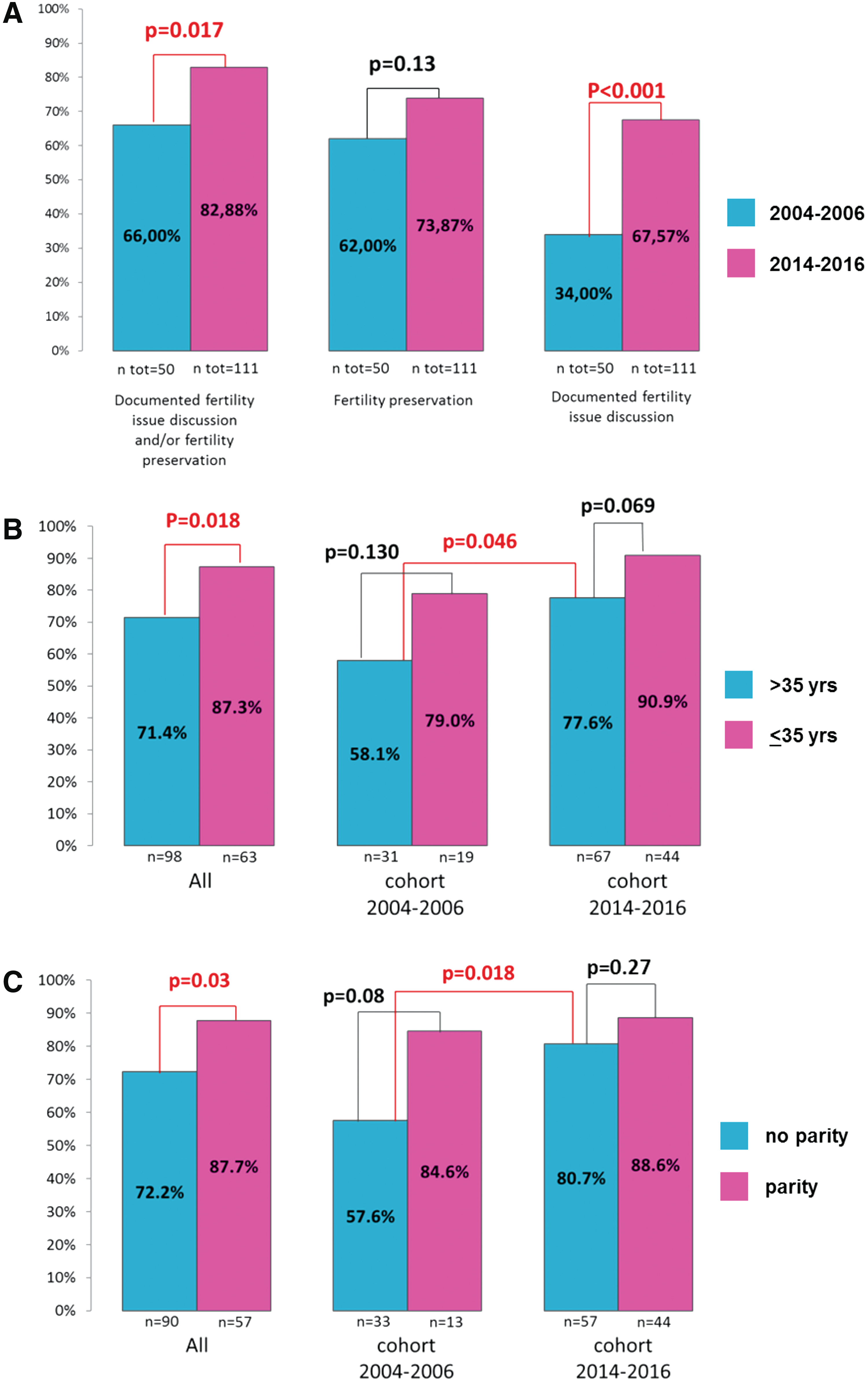
Proportion of patients with documented fertility issue discussion and/or fertility method application according to clinical characteristics and time period. Proportion of patients with documented fertility issue discussion and/or fertility method application in relationship to different time cohorts
We then investigated whether factors such as age at diagnosis and parity may have affected fertility discussion/preservation patterns. Patients aged 35 years or younger were more likely to have fertility discussion or to undergo fertility preservation compared with older patients, overall and in the two time cohorts separately, as shown in Figure 1B. The proportion of patients aged >35 years with documentation of fertility discussion/preservation was significantly higher in the more recent cohort versus the less recent cohort (77.6% vs. 58.1%, p = 0.046). As shown in Figure 1C, parity before BC diagnosis was also associated with a lower rate of fertility discussion documentation/preservation, overall and in the two time cohorts separately; however, in the more recent cohort the proportion of patients with documented fertility discussion/preservation was significantly higher compared to the less recent cohort (80.7% vs. 57.6%, p = 0.018).
Outcome of patients with pregnancy after BC diagnosis
Among 590 patients diagnosed with BC at the age of 40 years or younger between 2000 and 2016, 26 cases presented documentation of pregnancy after BC diagnosis (4.4%, Supplementary Fig. S1). Table 2 summarizes demographics, tumor characteristics, and treatments of these 26 patients. Median age at diagnosis was 32 (range 27–40). The majority of the patients had tumors of ductal histology with positive HR status and moderate/high tumor grade. Eighteen patients received adjuvant and/or neoadjuvant chemotherapy, with concomitant GnRH agonist in 61% (n = 11) of these cases. A majority of patients (n = 15) received endocrine adjuvant treatment; among them, five did not complete the planned 5 years of treatment due to: voluntary treatment interruption or adverse events (n = 3), depression related to the fear of never being able to become pregnant (n = 1), and pregnancy during treatment (n = 1).
Patients with Pregnancy After Breast Cancer Diagnosis: Summary of Patient Demographics, Tumor Characteristics, and Treatment Received
CT, chemotherapy.
Table 3 reports data on pregnancy and delivery outcome. Overall, 38 pregnancies after BC diagnosis were reported: 30 deliveries (4 patients had 2 subsequent successful pregnancies after BC diagnosis) and 8 spontaneous abortions. Four patients had one spontaneous abortion each before the first successful pregnancy after BC diagnosis. The other four abortions occurred after the first successful pregnancy post-BC in two patients (one patient with three abortions). At least one successful pregnancy was reported for each patient included in this cohort. All pregnancies were achieved without the use of medically assisted procreation techniques. Median age at first delivery was 38 years, ranging from 32 to 44 years, with eight patients who delivered at the age of 40 or older.
Patients with Pregnancy After Breast Cancer: Summary of Data Regarding Pregnancy and Delivery Outcome
The median gestational week at delivery and weight of the newborns were within physiologic ranges and all newborns were healthy and did not present any complication. Breastfeeding was documented for five patients.
Median time from BC diagnosis to delivery was 64 months (range 19–108). Median time from last chemotherapy dose and last endocrine treatment dose to delivery was 72 (16–96) and 22 (6–50) months, respectively.
Median follow-up from diagnosis was 9.4 years (95% CI 7.9–10.9 years) and median follow-up from delivery was 3.8 years (95% CI 1.5–6.1 years). Two disease-free survival (DFS) events were observed (BC relapse). DFS rates at 10 years after diagnosis and at 5 years after delivery were 93% and 92%, respectively.
Discussion
Over the past decade, there has been an increasing trend of women delaying childbearing, 10 which, in addition to a continuous decline in recurrence rates and risk of death secondary to BC, 1 has led physicians to give increasingly more attention to fertility issues in BC patients.
In this retrospective analysis, we identified a cohort of 590 young patients diagnosed with invasive BC between 2000 and 2016. In 26 cases (4.4%) medical records reported successful pregnancy after diagnosis, which is consistent with literature data. 11 No case of preterm delivery or fetal malformation was reported. This data confirms that young BC survivors may manage to become pregnant, emphasizing the need to improve patient counseling on this subject. 11,12 This need is additionally stressed by the observation that two patient in this cohort stopped endocrine therapy prematurely due to pregnancy related issues (one for depression related to the fear of never being able to become pregnant and one due to pregnancy during treatment). At this time, there is insufficient data to draw formal recommendations on correct timing of pregnancy after BC and consequent management of adjuvant treatments interruptions/resumptions. An ongoing trial (NCT02308085), which is investigating the safety of temporarily interrupting endocrine therapy, with the goal to permitting pregnancy, will help physicians collect evidence to adequately respond to patients on these issues. Due to the limited sample size of our cohort and to the absence of a control group, data on pregnancy after BC are exploratory and descriptive in nature. Indeed, the risk of selection bias called “health mother effect” could not be controlled in our study. Even so, it is reassuring that our experience appears somehow consistent with more recent evidence from large cohorts reporting that pregnancy does not increase risk of BC relapse, even in HR+ BC patients, 4,5 and that newborns are not exposed to higher risk of prenatal/perinatal complications. 13
Interestingly, observing the characteristics of patients who successfully became pregnant after BC may also help dispel some presumptions regarding which patients should undergo fertility preservation and fertility preservation counseling. In fact, both age and parity are well-known barriers to fertility preservation counseling as clinicians may be induced to assume that patients have completed child-bearing in the first case, or have fully satisfied their desire for family in the second case. 14 –16 In our cohort of patients who successfully mothered children after BC, we observed 7 patients who already had children at time of diagnosis, and patients as old as 40 years at diagnosis, thus pointing out that motherhood after cancer might not be a prerogative of extremely young patients nor a desire reserved to childless women.
This leads to the other aim of the study, which was to evaluate physician awareness regarding fertility issues by assessing time-dependent changes in a 10-year period in fertility preservation counseling and techniques in young BC patients undergoing neo/adjuvant chemotherapy.
In both time cohorts (2004–2006 and 2014–2016), the majority of BC patients aged ≤40 years had evidence in medical records of discussion on fertility issues and/or application of fertility preservation methods. This compares favorably with published data reporting a counseling rate of around 26% in BC patients. 14,16 Nevertheless, the most recent cohort showed a significantly higher rate (82.9% vs. 66.0%, p = 0.017) of fertility counseling documentation and/or application of fertility preservation methods. This difference is mostly due to an increase in the documentation of fertility counseling (67.6% vs. 34.0%, p = 0.06).
Even if counseling does not finally translate in the application of fertility preservation techniques, its documentation in medical records is not irrelevant. Actually, it reflects physicians' awareness and the importance attributed to addressing fertility issues before initiation of treatment, independently from the decision taken by the patient. Clinical data show that female survivors who previously received fertility counseling have less regret and improved quality of life, independently from the final decision on pursuing or not the fertility preservation. 17
In our study, the proportion of patients aged >35 years and/or who already had children receiving counseling was significantly higher in the more recent cohort versus the older cohort, highlighting progressive increase in clinician's perceived importance of extending counseling to all young BC patients. These modifications in clinical practice adequately mirror the evolution of guidelines, as depicted by the 2013 ASCO recommendation that no patient should be excluded from fertility preservation discussion for any reason, including age, prognosis, socioeconomic status, or parity. 18,19
In the most recent cohort (2014–2016), 9.0% of patients finally underwent oocyte cryopreservation procedures, an acceptance rate similar to the one reported by Ruddy et al. in 2014. 20 However, in both the 2004–2006 cohort and the 2014–2016 cohort, more than 60% of patients received an GnRH analog during chemotherapy. This is in keeping with the general attitude of Italian oncologists: in a recent survey, aimed to investigate the approach of Italian oncologists and breast surgeons dealing with BC to fertility issues, 65% of panelists declared to use concomitant administration of GnRH analogs and chemotherapy regularly in their common clinical practice. 21 This attitude might be influenced by the fact that the PROMISE trial, a large randomized trial concerning the use of GnRH analogs in this setting, was conducted in Italy. 22 Moreover, this option is also recommended by national oncological guidelines. 23
Conclusions
Physicians' attention to fertility issues and counseling has increased over time, also regarding women who already have children and older patients.
In this small retrospective cohort, no safety concerns were identified for pregnancy after BC. However, due to the limited sample size of our cohort and to the absence of a control group, data on pregnancy after BC are only descriptive, as risk of selection bias could not be controlled. Even so, this evidence appears consistent with data from large cohorts reporting that pregnancy does not increase risk of BC relapse, even in HR+ BC patients. 4,5 Nevertheless, there are insufficient data to draw formal recommendations on correct timing of pregnancy after BC, and ongoing trials are investigating the best management of adjuvant treatments' interruptions/resumptions.
This analysis contributes in stressing the importance of adequate fertility issue discussion and counseling for young BC patients and the need to keep reducing barriers in the field.
Ethical Approval
All procedures performed in studies involving human participants were in accordance with the ethical standards of the institutional and/or national research committee and with the Declaration of Helsinki 1964 and its later amendments or comparable ethical standards. The study was approved by the local Ethics Committee. For this type of study, formal consent is not required.
Footnotes
Author Disclosure Statement
No competing financial interests exist.
References
Supplementary Material
Please find the following supplemental material available below.
For Open Access articles published under a Creative Commons License, all supplemental material carries the same license as the article it is associated with.
For non-Open Access articles published, all supplemental material carries a non-exclusive license, and permission requests for re-use of supplemental material or any part of supplemental material shall be sent directly to the copyright owner as specified in the copyright notice associated with the article.
