






Abstract
Abstract
Background:
This article details the methods used for a rapid literature review.
Objective:
The eight scientific articles contained in this Palliative Care Matters supplemental issue synthesize and interpret evidence from the rapid review process outlined in this study.
Methods:
The methods of the rapid review were adopted from the Preferred Reporting Items for Systematic Reviews and Meta-Analyses (PRISMA-P) statement of PRISMA.
Results:
The current article contains the literature search strategies for both gray and academic literature, resource eligibility criteria for inclusion and exclusion, and tables and figures to outline the literature search process, and delimit the number of resource items captured at each step in the process.
Introduction
Rationale and objectives
T
The goal of the Palliative Care Matters rapid review process was to capture as much of the literature on each of the eight scientific topics as possible in a short time frame (the review for all eight topics was completed three months). Within the methodological continuum of assessing evidence, the rapid review method poses a trade-off between time cost and literature-searching scope. To evaluate the evidence in a timely manner, it is necessary to limit the amount of literature searching and assessment.
The Palliative Care Matters Research Support Team conducted the review and consisted of two information scientists, one research coordinator, three research analysts, and the lead scientific researcher (see Acknowledgments). Each team member's contribution to the rapid review process is outlined in the Methods section.
Methods
This rapid review was performed according to the Preferred Reporting Items for Systematic Reviews and Meta-Analyses (PRISMA-P) 2015 guidelines of PRISMA. 2
Literature search and screening process, information sources, and search strategies
An overview of the four-step literature search and screening process is illustrated in Figure 1. The Supplementary data contains PRISMA diagrams for each of the eight Palliative Care Matters scientific articles contained in this supplemental issue. The diagrams give the flow and number of resources captured at steps 1–4:
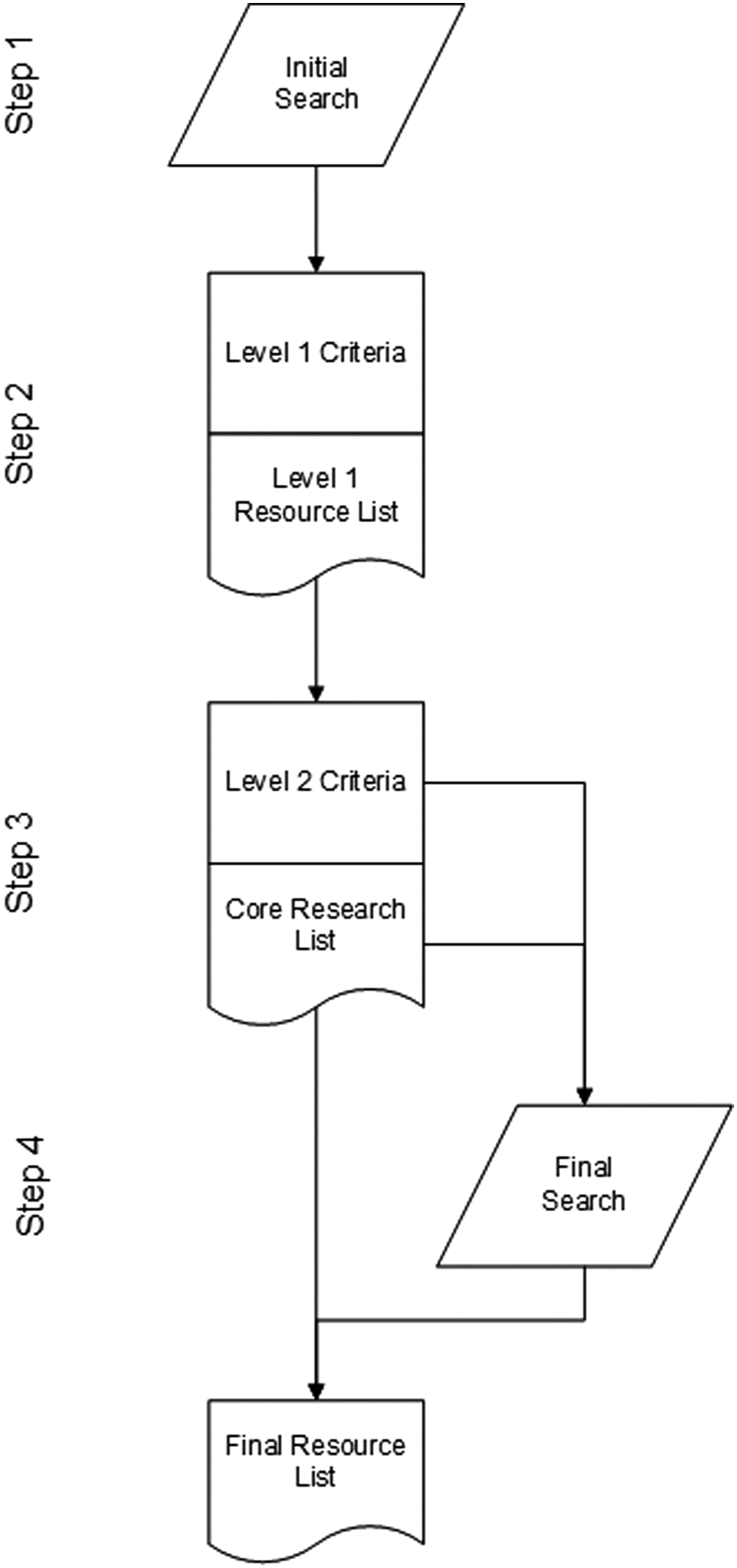
Preferred Reporting Items for Systematic Reviews and Meta-Analyses diagram overview of four-step literature search and screen process.
Step 1: Initial literature searches
A team of information scientists performed an initial literature search. Searches for each scientific article were conducted independently from one another. Separate search sources and search strategies were developed for two domains of literature: published articles, and gray literature (including theses, policy documents, and reports). Initial search strategies were developed jointly by the information scientists and the lead scientific researcher (second author on this article). Search strategies were based on the rationale and objectives for each article outlined in the Introduction section. Search sources for published articles included MEDLINE, CINAHL, and Embase. Search sources for the gray literature include Proquest Dissertations and Theses Global, CareSearch Gray Literature, Cochrane Palliative Care Library, Google Scholar, and Google. Additional sources for the initial literature search were provided by the lead scientific researcher. Citations and abstracts were downloaded into Endnote 3 libraries and exported to text documents for the following step. This initial literature search yielded 6500 resources across all scientific articles.
Step 2: Level 1 criteria and resource lists
A team of research analysts (first author on this article is one analyst) set the first level of inclusion and exclusion criteria to inform their first screen of the initial literature search. The lead scientific researcher abstained from this level of literature screening, except to resolve criteria queries. Any uncertainties the research analysts had about the inclusion or exclusion of a resource were brought to the lead scientific researcher for decision. If warranted, the inclusion/exclusion criteria were adjusted accordingly. This Level 1 literature screen yielded 812 resources across all scientific articles.
Step 3: Level 2 criteria and core resource lists
For each scientific article, the primary criteria and resulting literature screen were then reviewed by the lead scientific researcher and the article's scientific expert, resulting in a secondary, more refined, set of criteria and literature screen. Any inconsistencies and disagreements in criteria and literature selection were resolved by consensus, with the article's scientific expert having the final decision.
Scientific experts were also given the opportunity to provide additional resources to add to the secondary literature screen. These resources included additional published articles, websites, reports, and policy documents. With the expert-added resources, the Level 2 literature screens serve as each article's core resources list. The core lists combined across articles contained 523 resources.
Step 4: Final literature searches
The information scientists and research analysts performed a final literature search for each scientific article based on the core resources lists. The final literature search served to gather more recent and in-progress literature/research to supplement the core list. This was achieved through three additional searches: for each resource on the core list,
1. the first author was contacted if author and contact information for the author was readily available;
2. stakeholders (spanning nonprofit, government, and for-profit sectors) were identified and contacted; and
3. citing literature was identified through a Scopus search.
These additional resources were added to the Endnote 3 libraries to remove duplications with the initial literature search. After removing duplications, the final literature search yielded 5545 additional resources across all scientific articles.
For each scientific article, those additional resources that fit within the Level 2 criteria (as assessed by the research analysts) were combined with the core list to produce a final resource list. The final resources lists combined across articles contained 787 resources.
Full-text articles for each resource in the final bibliography were obtained and forwarded to the scientific experts to aid in their review of the scientific evidence. Each of the scientific evidence articles in this supplement issue contains a discussion of the final bibliographic data items used for the review.
Eligibility criteria
The information scientists limited their search to English publications spanning the academic and gray literature. This yielded resources from Canada, the United States, the United Kingdom, Australia, Japan, Italy, among other countries. With few exceptions for key pieces of seminal research and policies/reports, the literature search was limited to the most recent 10 years (i.e., from 2006 to 2016). Resources were not limited in terms of setting of care, patient population or demographics, clinical interventions, nor disease. A summary of the final (Level 2) inclusion and exclusion criteria for each scientific article is given in Table 1.
LPN, licensed practical nurse; NP, nurse practioner; RN, registered nurse.
Further discussions on the final resource lists' prioritization and outcomes, as well as the meta-analyses, are given in each scientific article within this supplemental issue.
Footnotes
Acknowledgments
The authors acknowledge the contributions of information scientists Sharna Polard and Roger Salus; research coordinator Heather Stiles; research analysts Viki Muller and Lisa Weisgerber; and scientific experts Kevin Brazil, James Downer, Deborah Dudgeon, Sean Marrison, Barbara Pesut, Hsein Seow, Jane Seymour, and Allison Williams.
Author Disclosure Statement
No competing financial interests exist.
References
Supplementary Material
Please find the following supplemental material available below.
For Open Access articles published under a Creative Commons License, all supplemental material carries the same license as the article it is associated with.
For non-Open Access articles published, all supplemental material carries a non-exclusive license, and permission requests for re-use of supplemental material or any part of supplemental material shall be sent directly to the copyright owner as specified in the copyright notice associated with the article.
