




Abstract
The plant Santa herba (Eriodictyon californicum) contains high flavonoids, thus potentially exerting beneficial effects in context of obesity, often accompanied by inflammation and metabolic imbalance. The study assessed the impact of Santa herba on oxidative stress, energy metabolism, weight reduction, and eating behavior, combining in vitro models with clinical data. Santa herba binding of the adenosine receptor A2A (ADORA2A) was assessed using a radioligand binding assay. A Caenorhabditis elegans model was used to determine mobility boosting effects, and Santa herba oxygen radical absorbance capacity (ORAC) values were determined in comparison to antioxidative plants. Clinical data, that is, body weight and appetite-related parameters, were obtained from overweight and obese women receiving either Santa herba or placebo for 12 weeks. Results showed that Santa herba extract binds to ADORA2A, stimulates C. elegans motility (+7.5%) and locomotion, and yields high antioxidative capacities (ORAC: 819 trolox equivalent). Clinical data, obtained from 24 overweight and 25 obese women (mean: 47.5 years), demonstrated a reduced body weight (P = .042) and body fat (P = .044), and by trend reduced leptin levels (P = .065) in women with obesity after Santa herba consumption compared to placebo. In conclusion, Santa herba extract has energizing and antioxidative properties and may aid in weight management of people with obesity.
ClinicalTrials.gov Identifier: NCT03853603.
Introduction
Santa herba (Also known as Yerba Santa or holy weed) is the common name of the chaparral plant Eriodictyon californicum, member of the Borage family (Boraginaceae), which is a widely distributed shrub native to North America. Santa herba is especially rich in polyphenols and flavonoids, such as the flavanones sterubin, eriodictyol, and hesperidin, or the flavones chrysoeriol and luteolin. 1 Animal and in vitro studies showed that Santa herba and its ingredients have antioxidative properties, act anti-inflammatory and bactericidal, and can exert neuroprotective health benefits. 2 –4 Due to these benefits, the herb and its preparations have been long known in American Indian tradition, for instance to treat upper respiratory tract infections and asthma. 5 –7 Today, Santa herba is available as dietary supplement and homeopathic medicine for supportive treatment of asthma and bronchial diseases. Moreover, the pleasant sweet, balsamic and incense-like taste and odor of Santa herba extract is commonly used in food industry to flavor foods, or by drug manufacturers to mask the bitter taste of certain drugs. 1 Obesity has become the most serious public health problem worldwide and its prevalence has dramatically increased during the last few decades, especially in the Western world. The World Health Organisation (WHO) reported in 2016 that more than 39% of adults worldwide are overweight (body mass index [BMI] ≥25 kg/m2), and roughly 13% are categorized as obese (BMI ≥30 kg/m2). Thus, the worldwide prevalence of obesity nearly tripled since 1975. Besides anti-inflammatory actions of Santa herba flavonoids, emerging research additionally point to fat burning and lipid catabolism boosting effects, in particular, of the Santa herba constituent eriodictyol. 8,9
There are different molecular mechanisms underlying the beneficial properties of dietary flavonoids for prevention of obesity and diabetes. Numerous in vitro and in vivo animal studies strongly indicate a benefial role of flavonoids with regard to glucose homeostasis and insulin metabolism, for example, by reducing lipid accumulation and insulin resistance, or by enhancing glucose uptake and insulin sensitivity. 10 –12 Diabetic rat models have shown that eriodictyol, in particular, reduces plasma lipid peroxidation and insulin resistance, while hesperidin lowers blood glucose levels. 13 –15 Importantly, also multivariate models and prospective cohort studies in humans have shown that flavonoid consumption is inversely associated with obesity in both men and women. 16 –18 Obesity is often accompanied or favored by oxidative stress and the presence of reactive oxygen species, which cause permanent low-grade inflammation, eventually leading to cellular and tissue dysfunction. 19 Thus, antioxidative properties of Santa herba flavonoids may help normalizing oxidative stress levels and inflammation in obesity or metabolic diseases. The aim of this study was to investigate the impact of daily Santa herba extract consumption on energy metabolism, oxidative stress, weight management, and eating behavior in overweight and obese women.
Materials and Methods
Adenosine receptor A2A binding assay
Ligand-receptor binding of radioactively labeled [ 3 H]CGS-21680 (adenosine A2A receptor agonist) to purified adenosine A2A receptors in the presence of Santa herba extract was carried out according to the binding assay described by Varani et al.. 20 Details are available as Supplementary Data S1.
Caenorhabditis elegans motility and locomotion assay
Motility and dispersion rates of nematodes were determined using the Caenorhabditis elegans (C. elegans) wild-type strain (N2) and compared between Santa herba extract, caffeine, and control (nematode growth media alone) as described by Zhao et al. 21 Details are available as Supplementary Data S1.
Oxygen radical absorbance capacity assay
Oxygen radical absorbance capacity (ORAC) values of extracts of Santa herba, rosemary, olive leaf, pomegranate, and grape were determined using ORAC assay. Details are available as Supplementary Data S1.
Clinical study design and study subjects
The randomized, placebo-controlled, double-blind study was conducted at BioTeSys GmbH (Esslingen, Germany) in parallel design. After written informed consent and completion of the screening procedures, 50 overweight (BMI 25–29.9 kg/m2) or obese (BMI 30–35 kg/m2) females were invited for study visits between February and August 2019. Ethical approval was obtained from the Institutional Review Board (IRB) of Landesärtzekammer Baden-Württemberg with the approval code F-2018-119. Further details are available as Supplementary Data S1.
Study intervention
The investigational product was SantEnergy™ Nu, a powder extract prepared with homoeriodictyol ≥4.0% produced from the aerial parts of Santa herba (E. californicum) (DER 2.0–4.0:1) (Mibelle AG, Switzerland). Gum arabic (30%; ALLAND & ROBERT, Paris, France) served as carrier. Maltodextrin (Glucidex19, Roquette, France) was used as placebo. Santa herba extract (400 mg) (n = 25) and placebo (400 mg) (n = 25) were orally ingested as capsules for 12 weeks twice daily, together with main meals. Manufacturing of the study products was carried out in compliance with good manufacturing practice conditions and all ingredients and capsules were of food grade quality, meeting European food regulations. For all in vitro studies, a carrier-free, native dry extract has been used, with similar phytochemical composition as SantEnergy™ Nu.
Study assessments
At study start (visit 1 [V1]), after 6 weeks (visit 2 [V2]) and after 12 weeks (visit 3 [V3]), body weight and fat mass were measured. Body fat was evaluated via bioelectrical impendance analysis (BIA) using the 2000-S BIA device and the Software NutriPlus© V.4.5.x (Data Input GmbH, Pöcking, Germany). Blood samples were obtained at V1 and V3 for blood routine and leptin levels. Effects on subjects' eating behaviors were assessed via the Adult Eating Behavior Questionnaire (AEBQ) at V1 and V3. The AEBQ is a reliable questionnaire measuring eight appetitive traits (Hunger, food responsiveness, emotional overeating, enjoyment of food, satiety responsiveness, emotional undereating, food fussiness, and slowness in eating). To control for confounding factors, subjects' physical activity and calorie intake were documented via the International Physical Activity Questionnaire, a food questionnaire and food protocols.
Methods for safety
Any adverse events and used concomitant medications were documented and evaluated throughout study conduct. Blood pressure and vital signs were obtained at all visits and blood routine parameters were assessed at start and end of study. Tolerability of study products was assessed after study cessation.
Study sample collection, processing, and analysis
Venous blood samples (ethylenediaminetetraacetic acid plasma and serum) were taken at screening, V1 and V3 in the morning after at least 10 h of fasting. Samples were centrifuged at 3000 g for 10 min at 4°C. Blood routine parameters (hemogram and clinical laboratory) were analyzed the same day at an accredited laboratory (Synlab Leinfelden-Echterdingen GmbH, Germany). Aliquots of blood plasma were stored at −80°C until further analyses.
Leptin enzyme-linked immunosorbent assay
Leptin was quantitatively determined by enzyme-linked immunosorbent assay (no. RE53151; IBL International GmbH, Hamburg, Germany) in plasma samples. The assay was performed according to manufacturer's instructions.
Data analysis and statistics
All statistical tests were performed two-sided. A P value of .05 was considered statistically significant. For the nematode motility assays (Fig. 2) and the ORAC assay (Fig. 3) statistical significance was tested using analysis of variance (ANOVA) and the Tukey post hoc test. For evaluation of differences between groups, clinical data (Figs. 5 and 6) were evaluated using either parameteric tests (unpaired t-test) or nonparametric tests (Wilxoxon rank-sum test) in case of non-normal distribution (Shapiro-Wilk test P < .05). Data were evaluated in subgroups (overweight and obese). A Fisher's exact test (non-parametric) was applied to evaluate group distribution differences. Statistical evaluation was done using GraphPad Prism V5.04 (GraphPad Software, San Diego, USA) and SAS V9.4 (SAS Institute, Cary, USA).

Caenorhabditis elegans motility rate shown as number of body bends (in 40 sec) and percent in comparison to the control of Santa herba extract-treated compared to caffeine-treated or untreated worms

ORAC values of plant extracts from Santa herba, rosemary, olive leafs, pomegranate, and grapes. Independent assays: n = 4–5. Data are presented as mean ± SD. ORAC, oxygen radical absorbance capacity; TE, trolox equivalent.
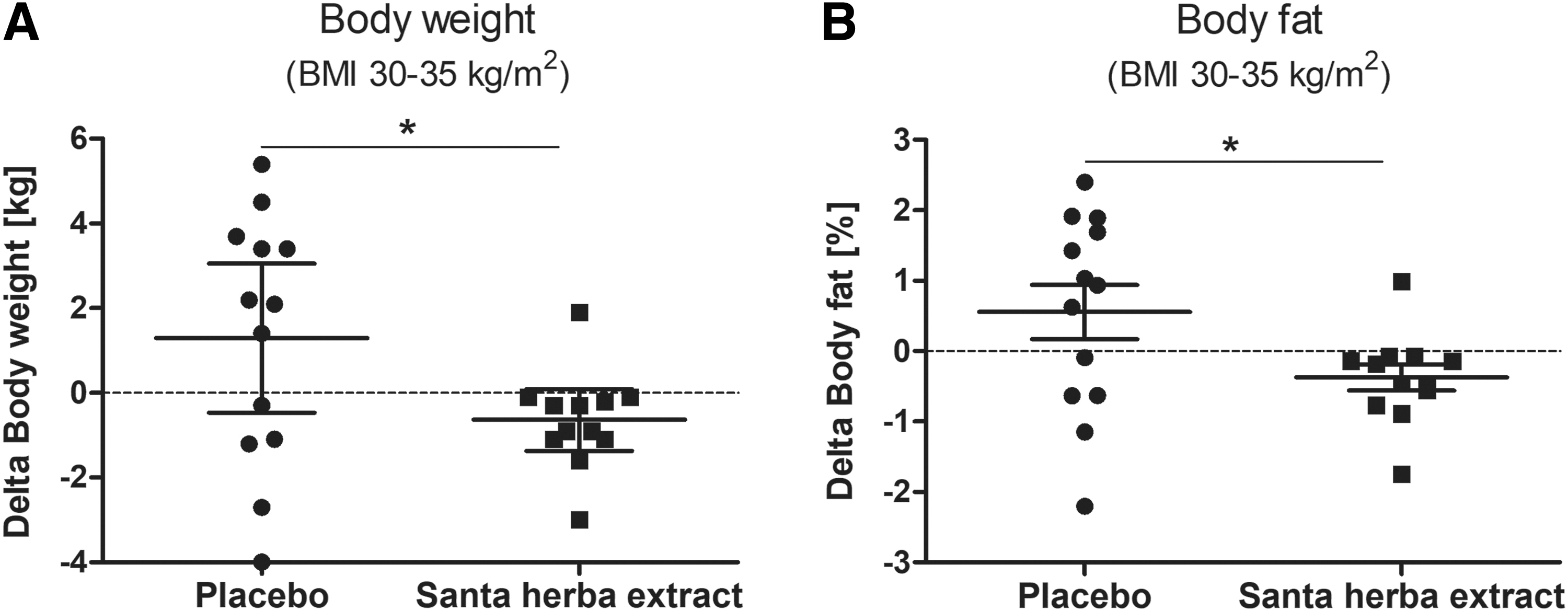
Changes in body weight (kg)
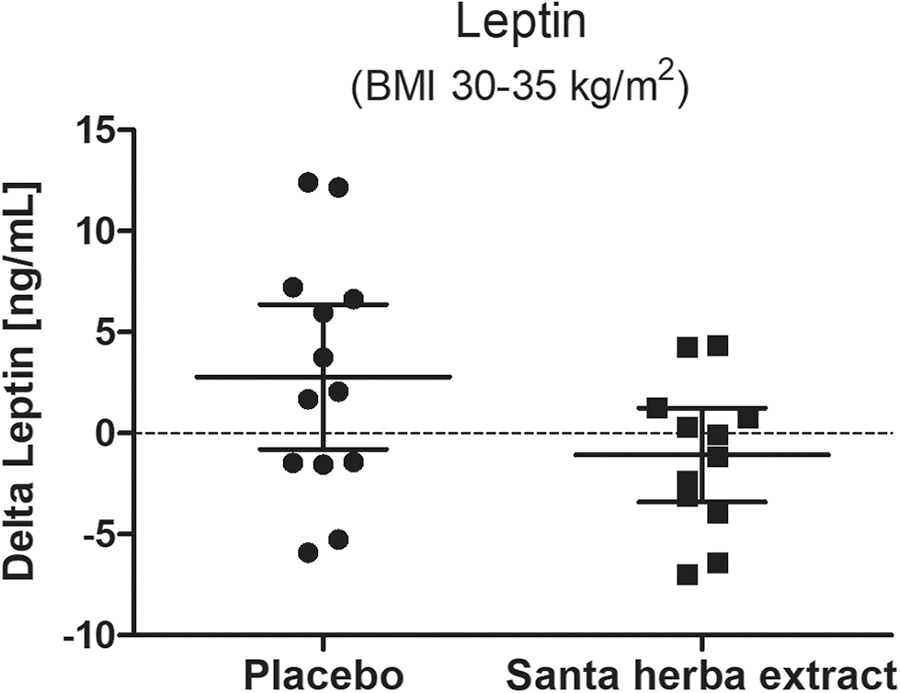
Changes in blood leptin levels (ng/mL) between start (V1) and end (V3) of intervention, after 12 weeks of placebo (n = 13) or Santa herba extract (n = 12) supplementation. Data are presented as mean ± 95% CI.
Results
Santa herba extract yields energizing effects
Adenosine receptor A2A (ADORA2A) is a member of the G-protein coupled receptor family, expressed in adipose tissue regulating lipolysis and inflammation. Inhibition of ADORA2A results in increased metabolism and lipolytic activity and in reduced fatigue and inflammation. Possible ADORA2A-inhibiting activities of Santa herba extract were evaluated in an in vitro radioligand binding assay. We observed a dose-dependent binding to the ADORA2A receptor, resulting in competition with the binding of the specific radioligand, with 9% inhibition applying 3.5 μg/mL Santa herba extract, 27% inhibition applying 10.5 μg/mL Santa herba extract, and 52% inhibition applying 35 μg/mL Santa herba extract (Fig. 1). The dose-dependent binding to the ADORA2A hints toward a potential effect of Santa herba involving this well-characterized receptor.
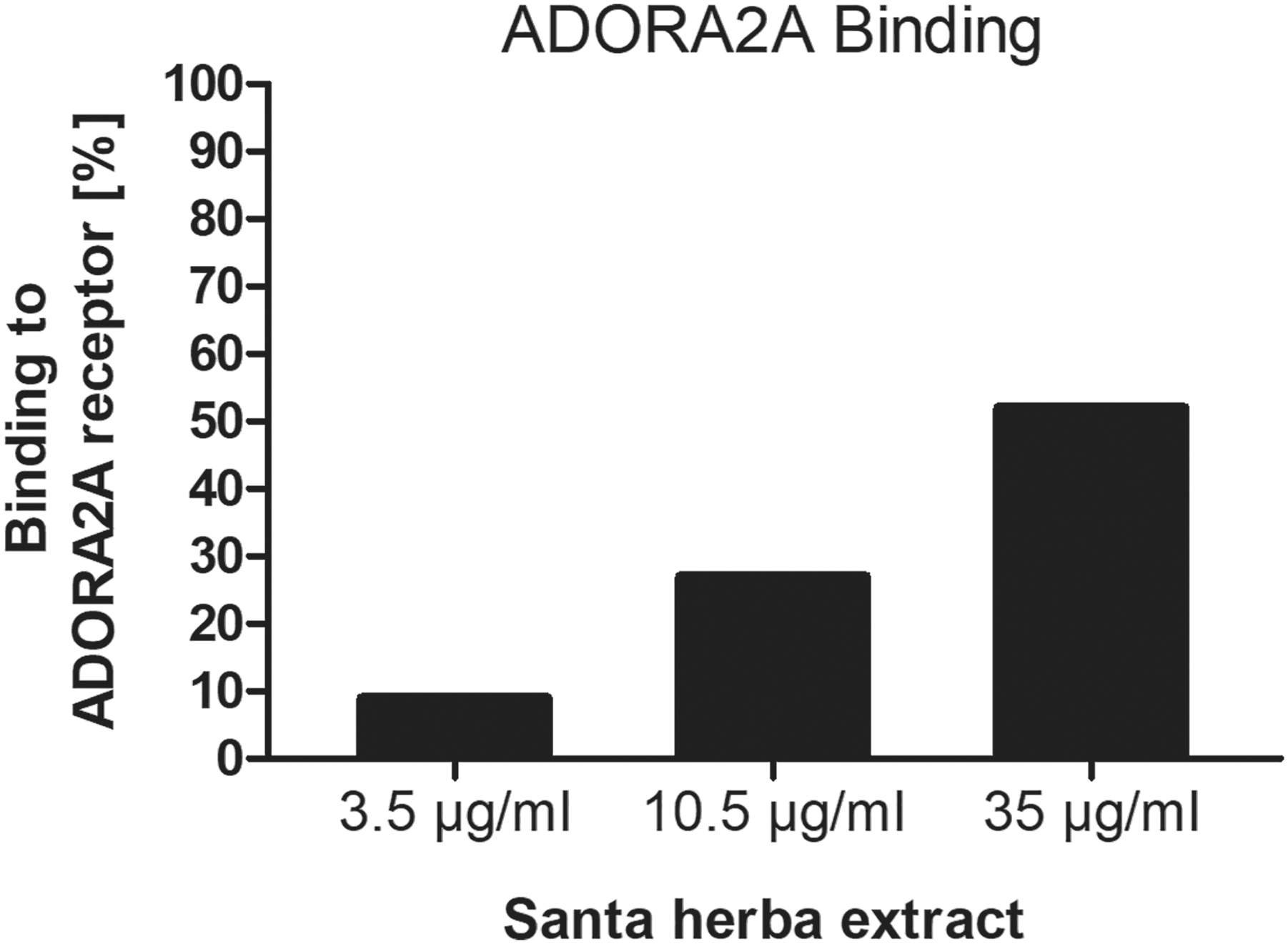
Santa herba extract-induced dose-dependent binding to ADORA2A after application of 3.5, 10.5 or 35 μg/mL Santa herba extract to [ 3 H]CGS-21680-incubated HEK-293 cell membranes. ADORA2A, adenosine receptor A2A.
Caffeine exerts many of its energizing effects via ADORA2A inhibiton. To investigate whether Santa herba extract can exert caffeine-like energizing effects in a model organism, C. elegans motility and locomotion rates were documented after caffeine and Santa herba extract treatment. Indeed, 1000 μg/mL Santa herba significantly stimulated C. elegans motility rate in comparison to control (increase of 7.47%, P < .01), determined as increased number of body bends, to a similar extent as 100 μg/mL caffeine (increase of 7.33% P < .01) (Fig. 2A). Further, Santa herba enhanced C. elegans locomotion, as Santa herba-treated worms increasingly moved to more remote zones, compared to untreated worms (Fig. 2B).
Santa herba extract shows antioxidative capacities
Analysis of Santa herba extract in an ORAC assay showed a high antioxidative capacity of 819.3 (±68.5) trolox equivalent (mM/100 g). Santa herba ORAC levels were significantly higher compared to known antioxidative plant extracts, including rosemary (P < .001), olive leafs (P < .001), pomegranate (P < .001), or grapes (P < .001) (Fig. 3).
Characteristics of study subjects
In total, 69 subjects were screened for study eligibility. Fifty women were enrolled and randomized to either Santa herba extract or placebo, stratified by BMI. Forty-nine subjects completed the study in its entirety and were evaluated in the per protocol population (Fig. 4). On average, subjects were 47.5 years old. Mean BMI was 27.7 kg/m2 in overweight and 32.5 kg/m2 in obese subjects. Subject characteristics, including baseline parameters, are summarized for both BMI subgroups in Table 1. Baseline conditions were comparable between intervention groups. Worth mentioning are the significant differences in leptin, high-density lipoprotein cholesterol, triglycerides, high-sensitivity C-reactive protein (hsCRP), glucose, and insulin between BMI subgroups.
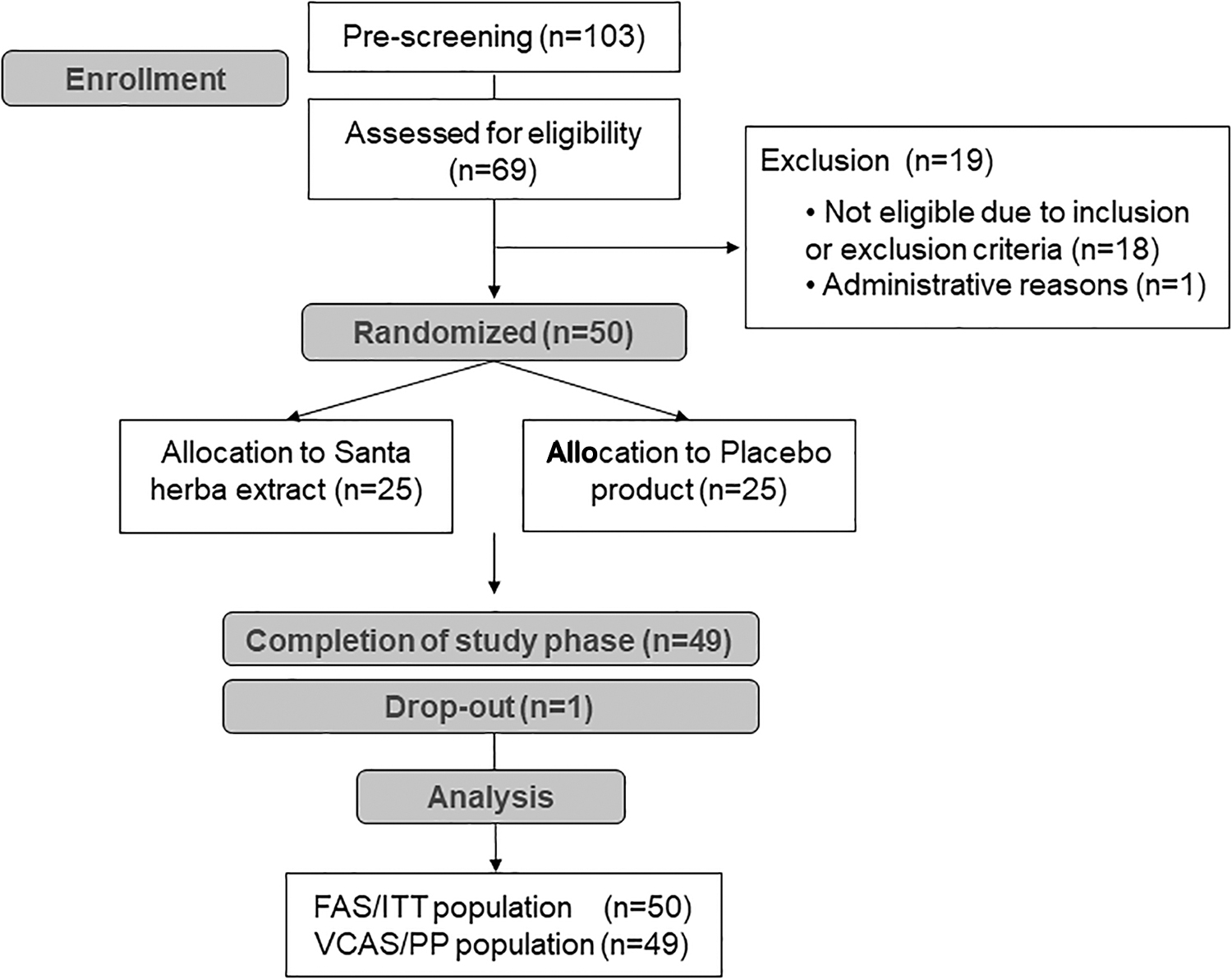
CONSORT-flowchart of subject recruitment, inclusion, and allocation. CONSORT, consolidated standards of reporting trials; ITT, intention-to-treat, PP, per protocol.
Subject Characteristics of Body Mass Index (BMI) Subgroups Overweight (BMI 25–29.9 kg/m2) and Obese (BMI 30–35 kg/m2)
Values are depicted as mean ± standard deviation.
BMI, body mass index; BP, blood pressure, HDL, high-density lipoprotein, LDL, low-density lipoprotein, hsCRP, high-sensitivity C-reactive protein; n.s., not statistically significant between both groups.
Santa herba consumption results in reduced body weight and body fat in women with obesity
Daily Santa herba consumption over the course of 12 weeks resulted in a significant reduction of body weight compared to placebo intake in women with obesity (BMI: 30–35 kg/m2) (P = .042). A difference of 2.1 kg was observed between the body weight changes of both intervention groups at the end of supplementation (Fig. 5A). Regarding the overall study population (overweight and obese women), a nonsignificant trend toward a body weight reduction was observed (P = .086) and an overall difference of 0.9 kg was observed between the body weight change of both intervention groups (data not shown). Supporting the reduction of body weight, a lower total body fat was observed after 12 weeks of Santa herba extract consumption in women with obesity, who lost on average 0.37% body fat (P = .044) (Fig. 5B).
A Fisher's exact test comparing the distribution of study subjects (“increase” or “decrease”) showed a statistically significant difference between the Santa herba extract and the placebo group (P = .0112) for both body fat and body weight. While an increase in both parameters was observed for only one subject in the Santa herba group, eight subjects in the placebo group gained body fat or body weight over the course of intervention. Body weight and body fat values at all measurement time points (baseline, after 6 weeks and after 12 weeks) are shown in the Supplementary Table S1.
Santa herba extract positively influences satiety and hunger
We observed a tendency to reduction of blood leptin levels in subjects with obesity (P = .065) (−1.1 ng/mL ±3.7) after Santa herba consumption compared to placebo (Fig. 6). No such effect was seen regarding the overweight (BMI 25–29.9 kg/m2) subgroup (data not shown). Leptin values at both measurement time points (baseline and after 12 weeks) are shown in the Supplementary Table S1.
In addition to measuring leptin, the effect of Santa herba consumption on the subjects' perceived eating behavior was assessed using the validated AEBQ. After 12 weeks of supplementation with Santa herba extract, we observed a significant reduction in the appetitive traits emotional overeating (P = .049) and food responsiveness (P = .013) in the Santa herba compared to the placebo group, as well as a decrease by trend of the hunger scale (P = .067). AEBQ scores at baseline and after 12 weeks are shown in the Supplementary Table S2.
Safety assessment
During study conduct, 95 AEs were reported (placebo: n = 50 AE by 16 subjects; Santa herba: n = 45 AEs by 15 subjects). No serious adverse events (SAEs) occured, no AE was related to the study products, except of three headache events reported by one subject (placebo), classified as “unlikely related” to the study product. For treatment of AEs, 113 types of concomitant medication were used (placebo: n = 70 by 23 subjects; Santa herba: n = 43 by 21 subjects). No evidence for crossreactions with concomitant medications has been observed. Two subjects rated the placebo product as “slightly uncomfortable,” while all subjects rated Santa herba extract as “well tolerated.” Determined blood routine safety parameters and vital signs were within normal ranges.
Discussion
In the present study, we showed that a nutritional food supplement containing extracts of the Santa herba plant (SantEnergy™ Nu) could aid in reducing body weight and body fat in women with obesity, when being continusouly consumed over the course of 3 months. The selected study cohort revealed that those effects were apparent only in women with high BMI (exceeding 30 kg/m2) and high initial weight and body fat, but not to a significant extent in those who were overweight, exceeding BMI 25 kg/m2. Investigations with regard to weight management or weight loss are commonly conducted over the course of several months or years to detect long-term effects. Large prospective cohort studies described by Bertoia et al., for instance, revealed that weight reduction correlated with flavonoid intake within 4-year periods, as assessed from self-reported food servings and weight changes in both men and women. 18 Other approaches include retrospective association studies in large cohort sets, showing that flavonoid consumption is inversely associated with obesity, that is, with BMI and waist circumference. 16
In contrast, this study was conducted as a prospective, placebo-controlled, double-blind study with measures to control for dietary influences, namely using food protocols, where average calorie intake was shown to be comparable between groups and between start and end of intervention. Nevertheless, given the limited time period of the study, it remains to be shown whether a continuous long-term intake of Santa herba extract can further contribute to weight reduction, also in case of initially lower body weight. To determine whether the observed light slimming effects may, in parts, be promoted by reduced appetite or earlier feeling of satiety, we investigated the underlying hormonal regulation and measured the appetite-regulating marker leptin. Leptin increases appetite and is produced by adipose tissue, thus being present in higher levels in humans with obesity.
Indeed, continuously elevated leptin levels seem to trigger leptin resistance, which is associated with obesity, although cause and effect are not entirely distinguished yet. 22 In this study, baseline leptin was significantly higher in obese compared to the overweight subjects, pointing to an imbalance in hunger-satiety regulation and possible leptin resistance. Importantly, data showed a slight leptin reduction in obese subjects consuming Santa herba extract compared to placebo, which might be a sign toward improved hormonal hunger regulation in these subjects. Unhealthy food habits, including regular cravings for sugar and salt, can negatively influence energy metabolism and trigger chronic fatigue, often resulting in overall low quality of life. To assess these correlations, the validated AEBQ reliably measuring appetitive traits was completed by study subjects. 23 Interestingly, subjects consuming Santa herba extract did perceive a reduction in emotional overeating (“I eat more when I'm worried”) and food responsiveness (“I am always thinking about food”), which might be related to leptin levels.
Overall, Santa herba extract has been well tolerated by all subjects during the clincial trial. No SAE has been reported and no abnormalities in respect to blood pressure, vital signs, or blood routine parameters have been observed, confirming the good safety profile and suitability of Santa herba extract as food supplement.
As shown in an association study, flavonoid consumption did not only negatively correlate with BMI, but also with the inflammatory marker hsCRP, 16 which was found to be associated with diabetes and cardiovascular risk. 24 We determined significantly higher baseline levels in the obese compared to the overweight study collective, but we did not observe noteworthy effects of Santa herba supplementation on hsCRP levels. Adipose tissue is not only known for ongoing inflammatory processes but also for oxidative stress of adipocytes and negative impact of ROS imbalance, favouring metabolic disorders, such as the metabolic syndrome. 25,26 Here, we demonstrated in an in vitro assay, that Santa herba extract yields high antioxidative capacities, possibly beneficially affecting obesity-related oxidative stress.
Additional investigations showed that Santa herba extract can boost activity of nematodes and exert caffeine-like energizing effects. These effects may, in parts, be mechanistically attributed to the ADORA2A receptor binding by Santa herba extract, which we showed in an in vitro ligand binding assay, suggesting an antagonizing effect. Inhibition of adenosine receptors, particulary ADORA2A is, besides inhibition of phosphodiesterases, discussed as the major molecular target of the energizing effects of caffeine, a frequently used slimming ingredient. 27,28 Furthermore, caffeine is able to stimulate locomotor activity in C. elegans and mice. 29,30 In adipocytes, adenosine could inhibit lipolysis as mediated by adenosine receptors. 31 Accordingly, ADORA2A inhibition might trigger lipolysis in adipocytes and lead to a body fat and body weight reduction.
Taken together, this comprehensive study suggests a synergistic triple-mode of action of Santa herba extract, which appears to be highly antioxidative, boosts metabolic energy, and regulates hunger and satiety, thus beneficially affecting obesity-related metabolic imbalances and contributing to weight management. Most probably the major flavonoids of Santa herba, particulary homoeriodictyol and hesperitin, will contribute to the demonstrated energizing and slimming effects. They show chemical similarity to the flavonoids present in citrus extracts, which have been frequently investigated for their slimming effects. 32,33 Future investigations should assess to which extent the described actions of Santa herba extract can be substantiated in further cohorts, such as in (pre)diabetics or subjects suffering from metabolic syndrome, none of which has been included in the current study. As for all dietary weight loss supplements, Santa herba extract should be integrated in a weight loss concept, including adaption of dietary habits and increased physical activity, thereby possibly increasing overall health and quality of life.
In conclusion, the study objective was to evaluate the effect of the flavonoid-containing Santa herba extract on energy metabolism, antioxidative capacities, weight management, and eating behavior. Results show that daily Santa herba consumption may aid in weight management, particularly in subjects with a BMI exceeding 30 kg/m2. Results of this study suggest that Santa herba extract reduces levels of the obesity marker and appetite-related hormone leptin and beneficially affects the subjects' eating behavior. As antioxidative compound and metabolic energizer, Santa herba extract may be applied as natural metabolism booster and slimming ingredient to support healthy aging.
Footnotes
ACKNOWLEDGMENTS
We thank all study participants and coworkers of BioTeSys GmbH. The authors thank Synlab (Leinfelden-Echterdingen, Germany) for blood sample analysis and Eurofins-Panlabs (St. Charles, USA) for conduction of the ADORA2A Assay. The authors thank Florian Hofer of Mibelle Group Biochemsitry for in vitro analyses.
Author Disclosure Statement
No competing financial interests exist.
Funding Information
This research received no external funding.
Supplementary Material
Supplementary Data
Supplementary Table S1
Supplementary Table S2
References
Supplementary Material
Please find the following supplemental material available below.
For Open Access articles published under a Creative Commons License, all supplemental material carries the same license as the article it is associated with.
For non-Open Access articles published, all supplemental material carries a non-exclusive license, and permission requests for re-use of supplemental material or any part of supplemental material shall be sent directly to the copyright owner as specified in the copyright notice associated with the article.
