






Abstract
Background:
There is currently no generally accepted theory able to explain the observed clinical efficacy of homeopathy. The aim of this scoping review is to identify all theoretical approaches that have been used to explain homeopathy, with the objective of establishing a basis for identifying promising hypotheses and theories for future elaboration.
Methods:
Medline, Embase, Scopus, Web of Science, PhilPapers, several online library catalogs, and personal libraries were searched for original studies up to July 12, 2024. Screening and data extraction were performed independently by two reviewers. Publications were included if they developed or advanced theories or models related to homeopathy. The aspect of homeopathy addressed by each study was extracted: the Principle of Similars and/or Potentisation. The theories identified in this review could be grouped into 14 overarching theoretical frameworks.
Results:
In total, 2118 records were screened, 500 full texts were assessed for eligibility, and 216 studies were included in this review. Starting in 1832 until the late 20th century, only sporadic contributions were found. From the 1990s, a marked increase in scholarly output was recorded. Most first authors were established in Germany, the United States, the United Kingdom, or India. The frameworks with the highest number of contributions were humanities, complex systems, water structures, and weak quantum theory. Overall, 22% of included publications described theoretical approaches that tried to cover both main aspects of homeopathy, 46% only Potentisation, 20% only the Principle of Similars (and 11% were unspecific). The theories within the humanities framework focused more on the Principle of Similars, complex systems theories on both principles, and the theories within the water structures, nanostructures, and mathematical models frameworks focused mostly on the Potentisation aspect.
Conclusions:
This scoping review offers an overview of theories and models on the mode of action of homeopathy. These could be classified into 14 largely nonoverlapping frameworks. Unexpectedly, the placebo did not emerge as such a framework. In the next step, these theories would be assessed in terms of their quality, plausibility, compatibility with modern science, and experimental falsifiability.
Keywords
Introduction
According to the most recent systematic review, there is substantial empirical evidence supporting the clinical efficacy of homeopathy. 1 There is however currently no generally accepted theoretical framework or model able to provide a plausible and comprehensive explanation for its reported effects. In 1991, Kleijnen et al. stated in their systematic review on clinical trials of homeopathy, “The amount of positive evidence even among the best studies came as a surprise to us. Based on this evidence we would be ready to accept that homoeopathy can be efficacious, if only the mechanism of action were more plausible.” 2 This situation seems essentially unchanged since then, though the evidence for the efficacy of homeopathy has increased qualitatively as well as quantitatively.
Currently, there are >450 randomized controlled trials and >150 cohort studies on homeopathy. 3 The latest systematic review of meta-analyses of randomized placebo-controlled homeopathy trials for any indication concluded that the available meta-analyses “reveal significant positive effects of homeopathy beyond placebo” with a high quality of evidence for individualized homeopathy. 1 The most recent systematic reviews of basic research into the effects of homeopathic preparations support the notion of specific effects of such preparations beyond placebo.4,5 Furthermore, the latest systematic reviews of physicochemical investigations of homeopathic preparations also yielded evidence for specific physicochemical characteristics of such preparations.6–8 However, to the best of our knowledge, no convincing model or theory has emerged able to explain the reported clinical and preclinical effects of homeopathic preparations beyond placebo.
The placebo argument is often leveled at homeopathy, and it is indeed a valid argument when it comes to daily practice.9–11 However, it is inadequate when dealing with placebo-controlled studies in clinical and basic research, of which there are enough to justify investigating the theories and models that might explain the effects reported.
The most controversial topic in homeopathy is the use of often highly diluted potentized (serially diluted and shaken or “succussed”) preparations, especially when the degree of dilution exceeds the inverse of Avogadro’s number. 12 However, at the very core of homeopathy is the Principle of Similars, which is used to determine the remedy to be applied for a specific patient. This principle states that a homeopathic remedy is to be chosen based on the best possible match of a given patient’s symptoms with those induced in healthy volunteers by a particular homeopathic preparation (similia similibus curentur, also referred to as the Principle of Similars, “let like be cured by like”).
Thus, any comprehensive theory should address these two main aspects of homeopathy: the Potentisation procedure and the Principle of Similars. Since the foundation of homeopathy by Hahnemann 200 years ago, 13 many different theoretical approaches have been developed, which were partly reviewed in earlier publications.14–17 However, to the best of our knowledge, no review sought to systematically explore all these theories.
Therefore, we set out to perform an exhaustive scoping review of all theoretical approaches proposed to explain homeopathy in order to map out the field. In particular, we wanted to address its two core elements (the Potentisation procedure and the Principle of Similars). We furthermore aimed at clustering similar theoretical approaches into “frameworks,” that is, conceptual models or sets of theoretical principles, to gain a structured overview of the field.
Methods
Study design
A scoping review is used to map the key concepts, types of evidence, and research gaps in a given field. 18 This scoping review is reported in accordance with the Preferred Reporting Items for Systematic Reviews and Meta-Analyses extension for Scoping Reviews. 19 No review protocol was drafted ahead.
Search strategy
A comprehensive literature search was conducted to identify relevant publications. The following databases and catalogs were searched on July 12, 2024: Medline (via Ovid), Embase (via embase.com), Scopus, Web of Science Core Collection, PhilPapers, the Gemeinsamer Verbundkatalog (GVK), swisscovery, CAMBase, as well as the webOPACs of University Witten/Herdecke, Institut für Geschichte der Medizin Robert Bosch Stiftung, and Europäische Bibliothek für Homöopathie and Homöopathische Bibliothek Hamburg (WissHom library). The database search strategies (see Supplementary Data S1) were devised by an information specialist within the team (S.D.K.). In addition, the personal libraries of the authors were consulted.
Inclusion and exclusion criteria
The inclusion and exclusion criteria were predefined to ensure the selection of publications that focused on theories and explanatory models related to homeopathic remedies. Publications were included if they directly developed or advanced theories or models. Also included were publications that reported on experimental results and explored relevant explanatory avenues in relation to these results. Subtopics relating to the two aspects of homeopathy were also included. In particular, discussions of the homeopathic anamnesis process (which seeks to match a patient’s symptoms with a remedy picture following the Principle of Similars) and discussions of drug provings (which generate the remedy pictures used in applying the Principle of Similars) were associated with the Principle of Similars. Discussions of the dilution process and the role of succussion were included as parts of the dynamization aspect.
Articles primarily focused on experimental aspects, predominantly phenomenological or descriptive in nature, as well as those with a general focus on integrative and complementary and alternative medicine, were excluded. Editorials, comments, letters to editors, conference abstracts, and reviews were also excluded. Publications in all languages were considered; online translation tools such as Deepl (www.deepl.com) were used for languages other than English, German, and French. When books were translated into various languages or published in several editions, these were considered as duplicates.
Selection of studies
All identified references underwent a screening process to determine their eligibility for inclusion in the review. This process involved multiple stages: (a) Prescreening: Titles and abstracts were initially screened to assess their general relevance to the review objectives. (b) Title and abstract screening: The selected references from the prescreening stage were imported into Covidence (Covidence systematic review software, Veritas Health Innovation, Melbourne, Australia, available at www.covidence.org) and subjected to a more detailed assessment based on their titles and abstracts. References from reviews initially found in this step were extracted and reinserted into the screening process. (c) Full-text screening: The full texts of the articles that passed the title and abstract screening were evaluated to determine their suitability for inclusion. All screening steps were performed by two authors independently, and disagreements were solved by discussion.
Data extraction: Data items and data charting
For the included publications, relevant data were extracted by two authors independently, in a predefined and systematic manner, in Covidence; disagreements were again resolved through discussion. This included information on the publication language, location of the corresponding author, publication year, theoretical framework, and aspect of homeopathy (Potentisation and/or Principle of Similars).
The extracted data were analyzed using a combination of quantitative and qualitative methods. The qualitative evaluation was performed to identify and describe the theoretical frameworks. In the first step, 72 different and often quite specific frameworks were identified in the publications. These were then discussed among the authors in terms of content and meaning. They were then grouped following an iterative process, which resulted in the 14 broader frameworks presented below.
To visualize temporal trends, rolling averages were applied to all plots where time served as the abscissa. A 5-year window was utilized, with each data point representing the average of values over the last five years, including the publication year. This method was employed to smooth short-term fluctuations and emphasize underlying long-term trends.
Definition of a Framework
Framework here refers to a structured conceptual model or set of theoretical principles that underpin a particular scientific discipline, field, or tradition. These frameworks guide the organization of knowledge and influence the assumptions and methods used in the investigations. For the purposes of this review, the term “framework” encompasses both well-established scientific disciplines as well as emerging or interdisciplinary approaches that aim to provide a coherent perspective on the phenomena under study, in the present case homeopathy.
Citation counts were retrieved from Scopus using a Python script and the Scopus API (https://dev.elsevier.com/). The calculation of the average citation count per framework excludes publications where no citation could be retrieved.
Data availability
The extracted data from the included publications is available as Supplementary Data S2 (.pdf) and S3 (.xlsx).
Results
A total of 9393 records were identified from database searches and several catalogs (see Fig. 1). An additional 146 records were retrieved by following up citations and from personal libraries. After the removal of 7421 records (duplicates and ineligible based on title/keyword screening), 2118 records were screened. From these, 519 records were sought for full-text retrieval, with 19 records not retrieved. Following full-text assessment, 216 studies met the inclusion criteria and were included in this scoping review.
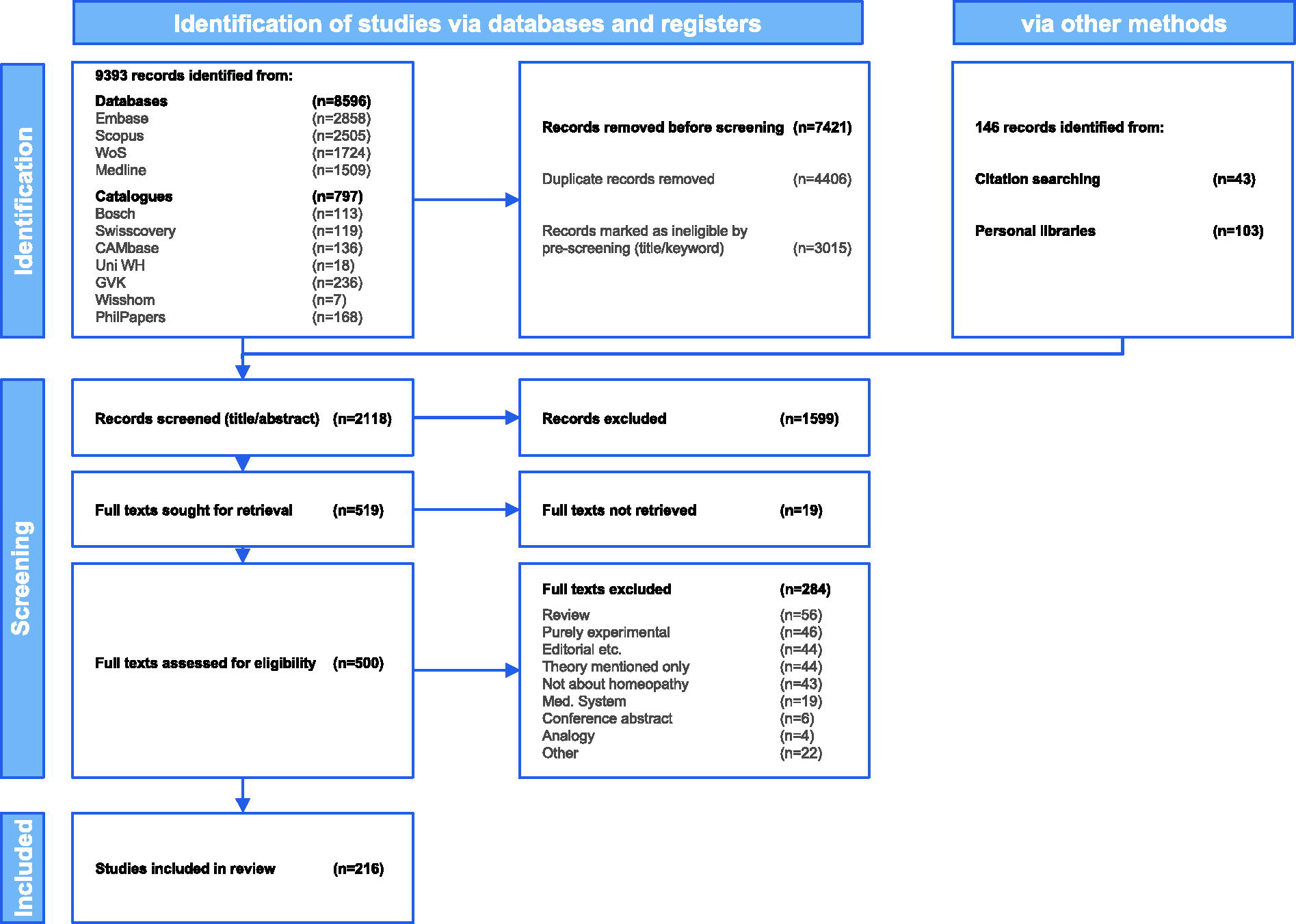
PRISMA flow diagram showing the publication selection process, detailing identified records, duplicate removal, screenings, and exclusions. PRISMA, Preferred Reporting Items for Systematic Reviews and Meta-Analyses.
Publication trends over time and geographic distribution
The earliest included publication dates back to 1832, with only sporadic contributions until the late 20th century. The 1990s, particularly 1994, marked an increase in scholarly output (see Fig. 2). Further peaks of publication frequency were observed in 2002 and 2012, with a general decreasing trend after the turn of the millennium.
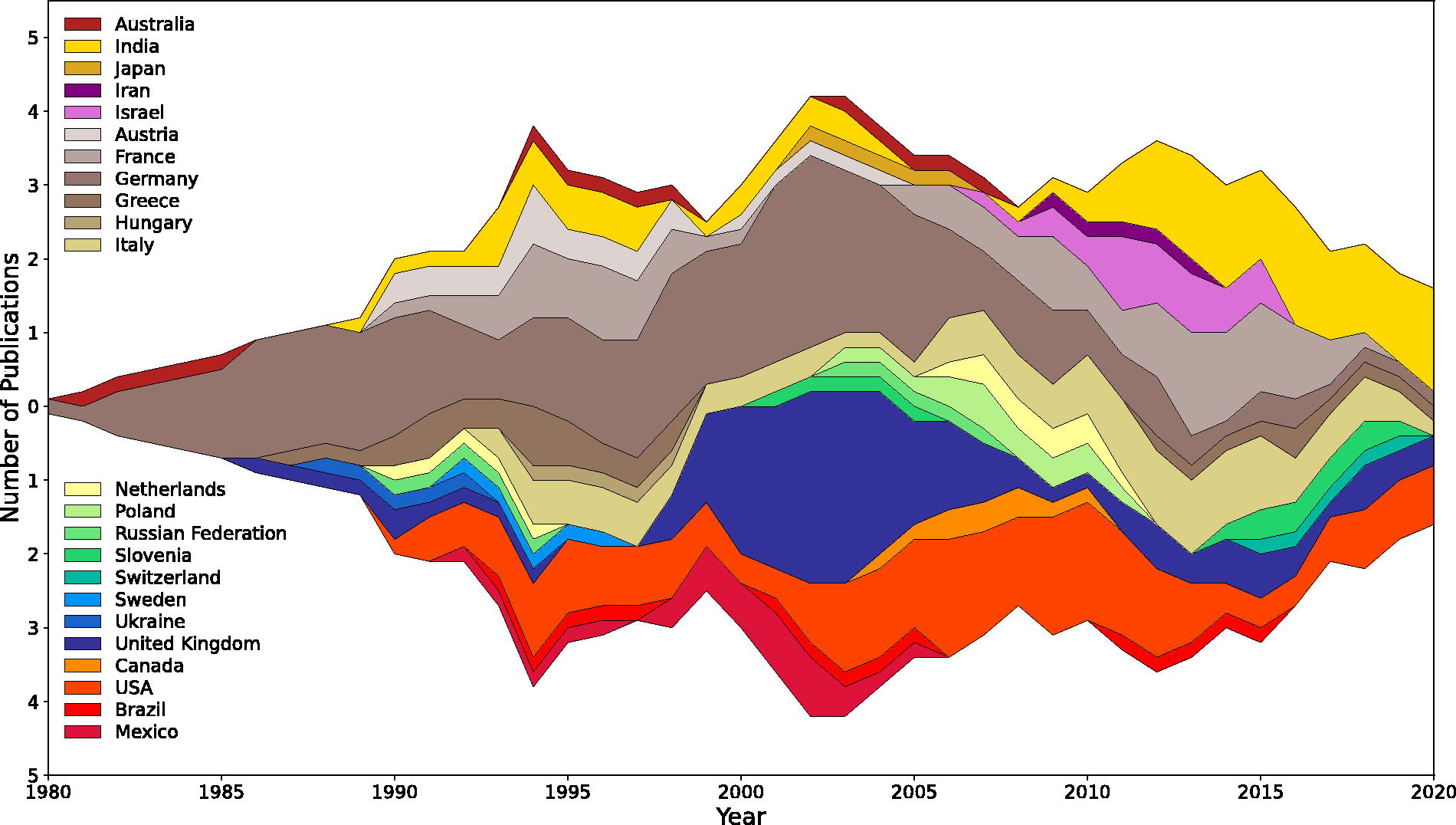
Number of included publications over time, segmented by country. The vertical extent represents the total number of publications per year, smoothed by a 5-year rolling average.
The geographic distribution of the corresponding authors spans multiple countries, with the majority of publications originating from Germany (53), followed by the United States (30) and the United Kingdom (25). Other countries, including India, France, and Italy, also contributed notably to the literature (see Table 1).
Number of Publications per Country of First Author
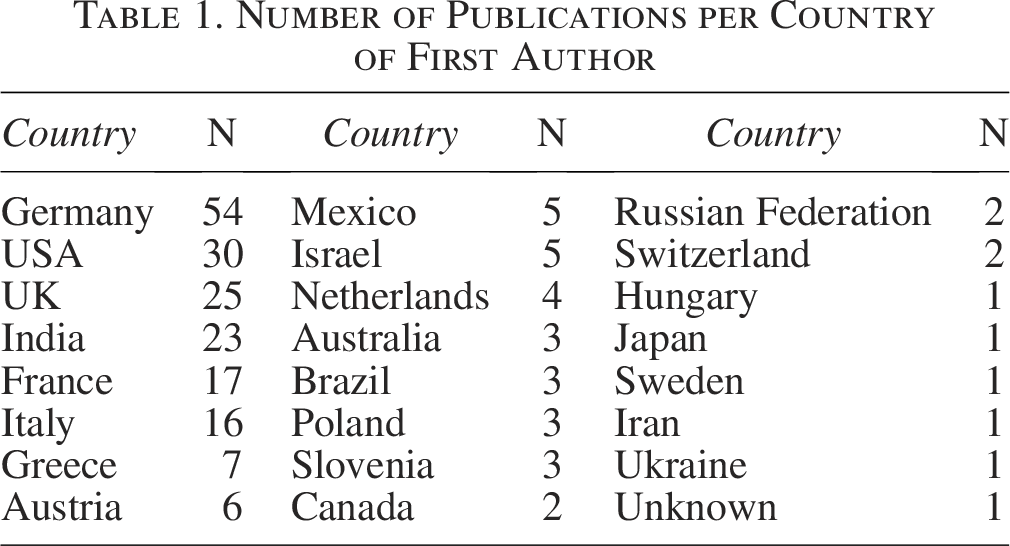
Figure 2 provides a detailed geographic breakdown as a function of time. We see that Germany dominated the field up to about 2000, when the UK took a stronger place, followed by the USA. More recently, Indian publications have gained more importance.
Theoretical frameworks
Through the iterative process described above, the initial 72 theoretical approaches identified in the articles were reduced to the following 14 major theoretical frameworks (all references provided in Supplementary Data S2 and S3). The order of the frameworks is intended to reflect the degree to which they are materially based.
Water structures
Water structures encompass various spatial configurations of water molecules. Such structures include clathrates, where water cages encapsulate guest molecules, hydrogen-bond clusters, exclusion zone water, and other specific molecular arrangements. To explain the effects of homeopathic preparations, the postulated structures are hypothesized to serve as information carriers.
Nanostructures
Nanostructures refer to materials and compounds (other than water), typically ranging from 1 to 100 nanometers in size, which exhibit unique optical, electrical, and mechanical properties due to their high surface-area-to-volume ratio and size-dependent characteristics. This framework encompasses nanoparticles, nanobubbles, and the silica hypothesis. Nanoparticles demonstrate new or enhanced properties compared to their larger counterparts. Nanobubbles are extremely small gas bubbles known for their stability in liquids. The silica hypothesis posits that silicates in homeopathic preparations serve as structured active ingredients. This framework encompasses all approaches that make use of nanoscale properties of different structures to explain the effects of homeopathic preparations.
Chemistry
This framework includes theoretical approaches that invoke chemical reactions (involving molecules), impurities, or chemical laws (e.g., the Le Chatelier principle, according to which a chemical equilibrium will shift when conditions are changed) to explain aspects of homeopathy.
Biochemistry
Biochemistry is the study of chemical processes occurring in living organisms at the cellular and molecular levels. Stress response pathways, gene expression, compensatory reactions, mechanisms of homeostasis, olfactory receptors, and the vomeronasal system have been proposed to play a role in propagating the information contained within homeopathic preparations and thus in eliciting responses in biological systems.
Hormesis
Hormesis is defined as a dose–response relationship characterized by a low-dose stimulation and a high-dose inhibition induced through a biochemical, chemical, or physical intervention in biological systems. The hormetic dose response is typically represented as an inverted U- or J-shaped form. In the context of homeopathy, the concept of hormesis is proposed as a way to explain the beneficial effects of low doses of stressors.
Biophotons
The idea of biophotons posits that living organisms emit a low level of coherent photon emissions (light) that is not only a by-product of chemical reactions within the body but also plays a crucial role in cellular communication and biological functions. According to these theories, biophotons would be a signature of homeopathic preparations and form a basis for their mode of action in clinical application.
Electrodynamics
Electrodynamics, also referred to as classical electromagnetism, is a branch of theoretical and applied physics that describes electric and magnetic fields and their interaction with charges and currents. In the present context, some specific configurations of electromagnetic fields are hypothesized to explain the effects of homeopathic preparations.
General physics
This category encompasses physical concepts that do not align with more specific frameworks such as quantum physics, electrodynamics, or biophotons. It includes theories and ideas that explore broader principles of physics, along with concepts such as syntropy and retrocausality, to explain aspects of homeopathy.
Mathematical models
This category encompasses frameworks that utilize mathematical models or formalisms to describe phenomena related to homeopathy or complementary medicine. It includes approaches that employ mathematical tools such as differential equations, statistical methods, or computational simulations. Additionally, it includes information theory, which is a branch of applied mathematics dealing with quantifying and encoding information. This also includes the concept of entropy, that is, measuring the uncertainty or randomness in a system.
Quantum physics
Quantum physics, also known as quantum mechanics, is the branch of physics that describes the behavior of particles at the smallest scales, such as atoms. It extended our understanding of nature by introducing concepts such as superposition, where particles can exist in multiple states simultaneously, and entanglement, where the properties of particles become correlated in ways that defy classical causal concepts. Quantum physics also introduced the probabilistic nature of physical phenomena, where the outcome of measurements is inherently uncertain. Theories grouped under this framework directly apply concepts of quantum physics to understand homeopathic treatment effects.
Weak quantum theory
Weak quantum theory is a generalized formal theoretical framework that extends the principles of quantum mechanics to systems beyond the microscopic scale, including macroscopic and even psychological systems. It proposes quantum-like features, such as entanglement and superposition, which manifest in a wide range of contexts, not limited to the behavior of subatomic particles. Applied to homeopathy, such a generalized entanglement is proposed between patient and homeopathic preparation, and sometimes practitioner. Such an entanglement would result in a noncausal relationship describing the effects of homeopathic treatment.
Quantum analogies
Quantum mechanical concepts can be generalized and extended to systems beyond the microscopic scale, including macroscopic and even psychological systems. This category is closely related to the weak quantum theory framework; however, it groups together those theories that did not use any formal logical or mathematical structure. Here, all theoretical approaches were of a purely descriptive and qualitative nature.
Complex systems
Complex biological systems are interconnected and interdependent structures that encompass multiple components, such as cells, organisms, or ecosystems, working together through nonlinear interactions to exhibit properties not present in the individual components. These systems are characterized by their adaptability, emergent behavior, and ability to self-organize in response to changes in the environment. This category also includes chaotic systems, which are nonlinearly coupled systems demonstrating high sensitivity to initial conditions, and cybernetical theories that describe the regulation and steering of complex systems, especially circular causal systems such as feedback loops. It also encompasses Prigogine’s concept of dissipative structures, which are systems that maintain stable structures through continuous exchange of matter and energy with their environment. These concepts are applied to either the patient, the homeopathic preparation, or both to explain homeopathic treatment effects.
Humanities
This category includes frameworks that use more philosophical arguments to discuss the reasoning behind homeopathy, including approaches from the philosophy or history of science. This category encompasses a broad range of explanatory approaches, such as those based on semiotic concepts, nonreductionistic philosophical worldviews (e.g., vitalism), and nonlocal acausal processes in psychology (e.g., synchronicity). It also includes publications written in earlier times when academic discourses focused more on philosophical explanations.
Framework occurrences
All 219 publications were classified into 14 different theoretical frameworks (see Table 2 and over time in Fig. 3). The most commonly used frameworks were humanities (n = 34 publications), complex systems (n = 32), and water structures (n = 31). Emerging areas such as biochemistry, nanostructures, and quantum physics have also received notable attention in recent years.
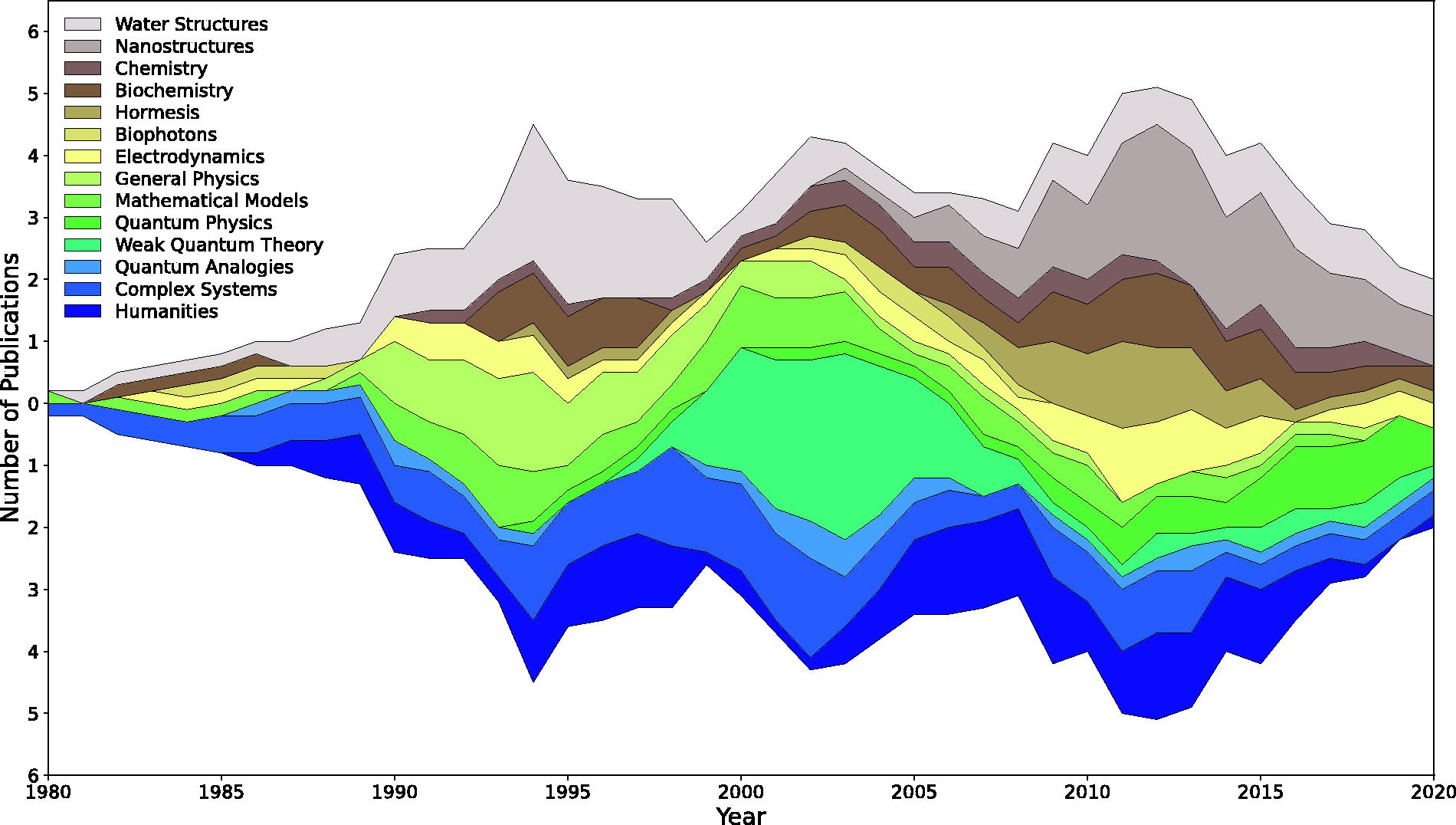
Number of included publications as a function of time, segmented by research framework. The vertical extent represents the total number of publications per year, smoothed by a 5-year rolling average. The different frameworks are stacked to illustrate their relative contributions over the years.
Number of Publications per Framework (Publications Assigned to Multiple Frameworks Account for the Higher Total Occurrence)
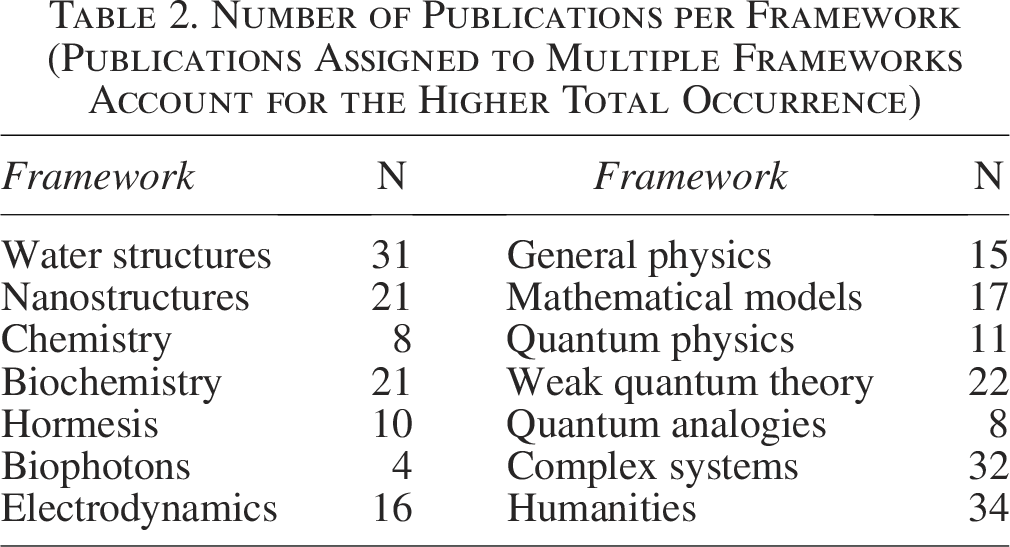
From Figure 3, we see that general physics models were discussed in the 1990s, followed by water structures and complex systems models. After 2000, weak quantum theoretical models were discussed extensively, while nanostructures have been the focus of recent publications. While efforts were made to assign only one framework to each publication, in 25 cases, it was necessary to assign several frameworks (range 2–4) to certain publications where multiple theoretical approaches were equally relevant. This results in the total of framework occurrences exceeding the total number of publications.
Aspects of homeopathy addressed
The publications were further categorized based on the aspects of homeopathy they addressed: Potentisation and/or the Principle of Similars. 22% of all articles described theoretical approaches that tried to cover both main principles, 46% focused on Potentisation, and 20% on the Principle of Similars. Furthermore, 11% of the publications were not detailed or explicit enough to be allocated to either principle and were categorized as unspecific (percentages do not add up to 100% due to how the rounding occurred). The relative contributions were quite stable over the years (see Fig. 4).
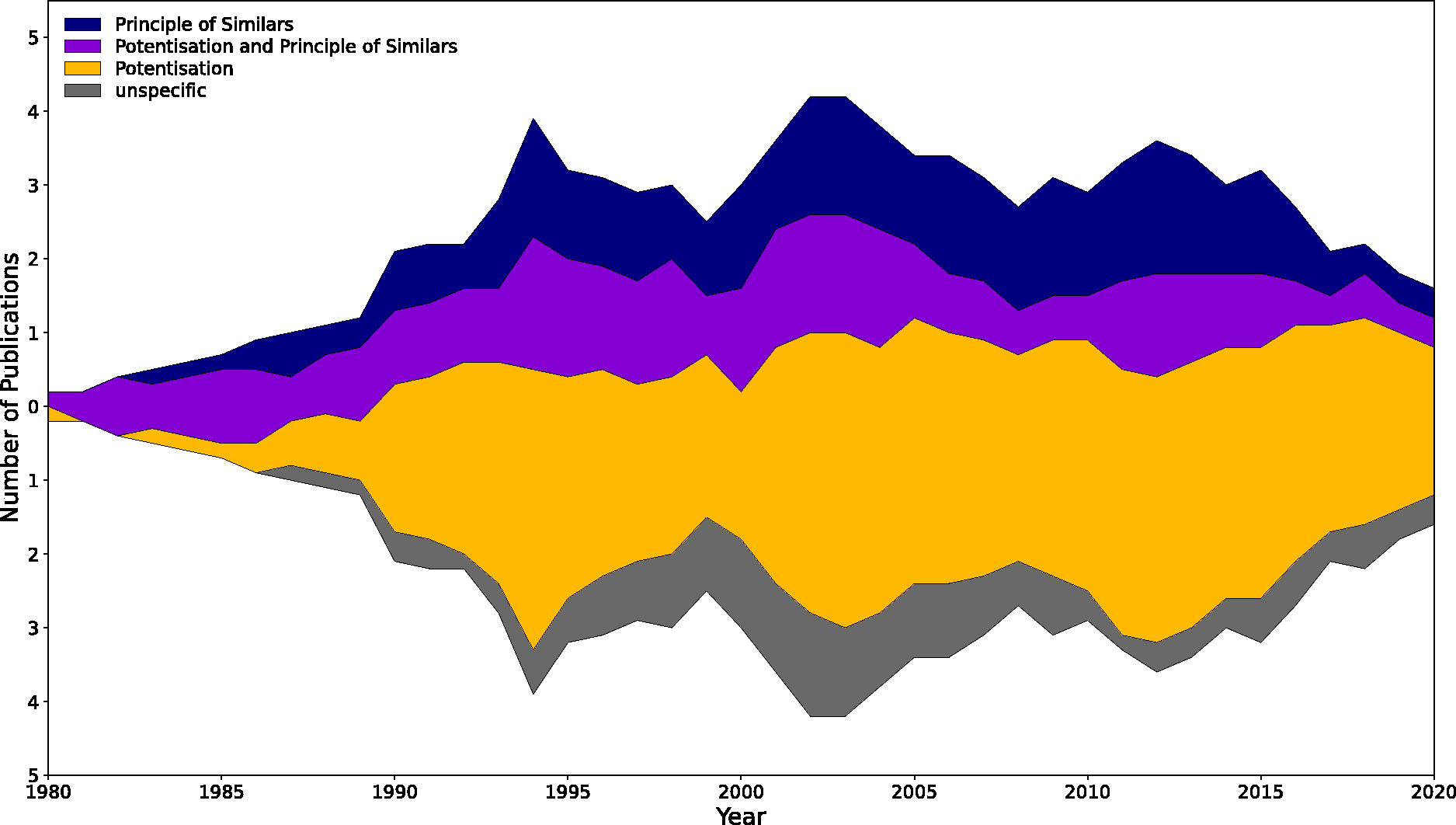
Number of included publications as a function of time, segmented by the aspect (i.e., “Potentisation,” “Principle of Similars”) a published theory aims to explain. The vertical extent represents the total number of publications per year, smoothed by a 5-year rolling average.
Frameworks and aspects of homeopathy
Figure 5 maps out the different frameworks we identified in terms of the number of publications that addressed the two aspects (Potentisation and Principle of Similars), showing the average citation score and overall number of publications for each framework. The most discussed frameworks (in terms of their average citation score) are nanostructures (n = 34 citations/publication), followed by biochemistry (n = 30), hormesis (n = 30), weak quantum theory (n = 27), and complex systems (n = 26). While most frameworks hardly address the Principle of Similars, humanities, complex systems, biochemistry, weak quantum theory, and hormesis deal with both aspects of homeopathy.
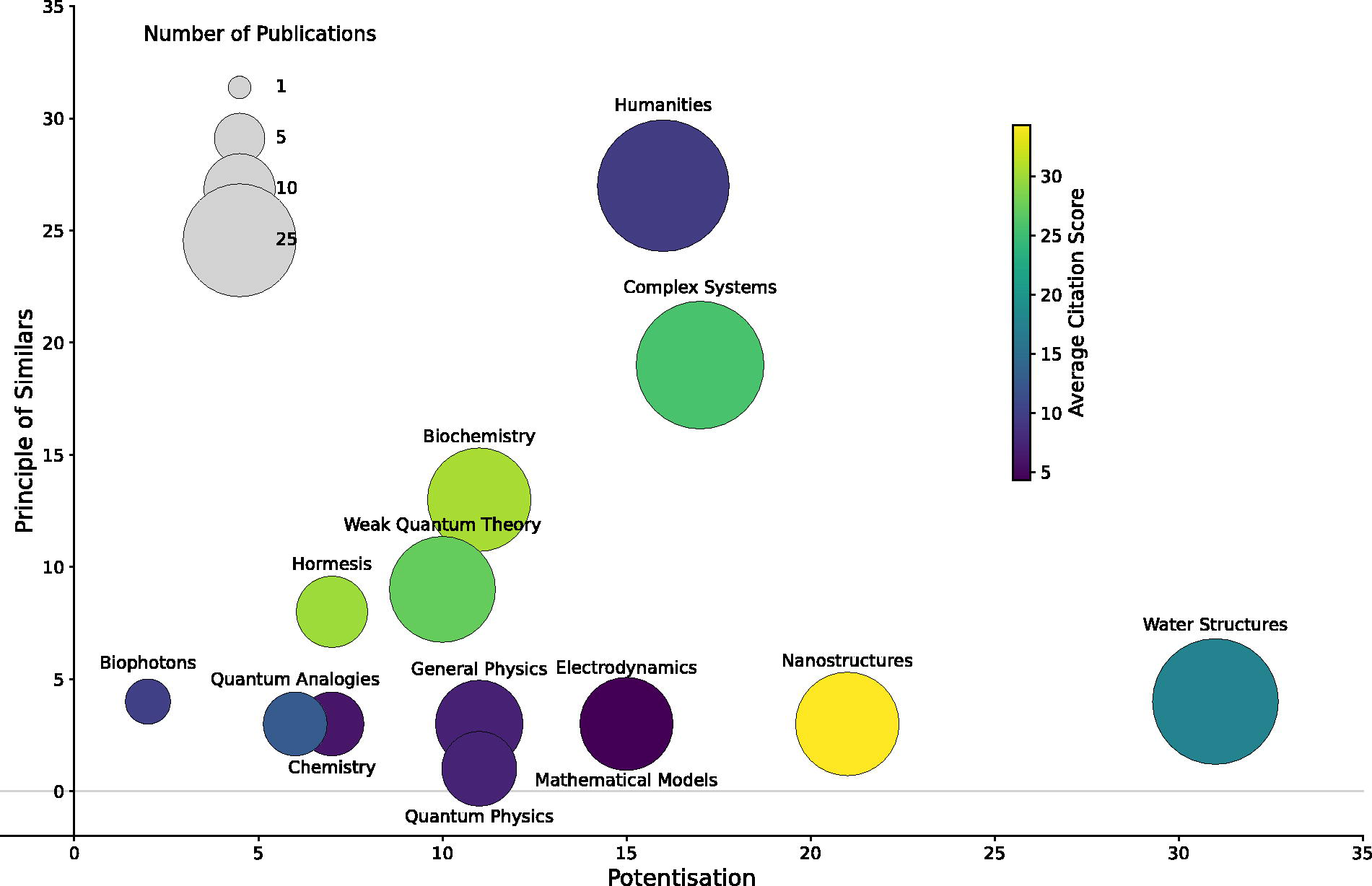
Target of explanatory approach (Principle of Similars and Potentisation) for the 14 theoretical frameworks identified. Frameworks are plotted as a function of the number of publications addressing Principle of Similars (y-axis) and Potentisation (x-axis). Marker size indicates the number of publications in total, and colors indicate the average number of citations per study (using data from studies for which citation data was available in Scopus, which corresponds to about half of all studies). Notice that electrodynamics and mathematical models overlap as they are very similar (16 vs. 17 publications and 7.6 vs. 4.3 average citation score, respectively).
Discussion
The results show the diverse range of theoretical frameworks employed over the last 30 years to explain homeopathy in its two main aspects: the Principle of Similars and the more contentious principle of Potentisation. Only about 22% of the identified theoretical approaches covered both central aspects of homeopathy, while about 20% and 46%, respectively, covered either the Principle of Similars or the principle of Potentisation, while the remaining 11% did not address either principle.
The discussion has noticeably shifted between different theories over time, with discussions of nanoparticles having recently taken over from the discussion of more quantum physics-based theories (2000–2005).
The publication frequency increased until 1995 and was more or less constant over the following 10 years. After 2005, a declining trend can be observed, pointing toward reduced interest in this scientific area and/or a reduction in resources. This is to be contrasted with the marked increase in physicochemical investigations of homeopathic preparations identified after the year 2000 by Klein et al. 6 ; we conclude that a shift in interest has occurred in the field from more theoretical approaches toward more empirical investigations.
Though our search strategy was quite exhaustive, we cannot be sure we have uncovered all publications on theories of homeopathy. Some might have evaded our search strategy. Also, we did not manage to obtain all the full texts of the references we found (3.7% not obtained), though we expended a considerable amount of effort seeking full texts, using university accounts, borrowing and buying books, document delivery, and interlibrary services. Nevertheless, we do not anticipate any major theory to have been overlooked. Therefore, we expect all theories to have been at least reasonably sampled in the present study.
In the present publication, we do not report on any deeper assessment of the theories identified, neither in terms of their quality nor of their plausibility, compatibility with modern science, or experimental falsifiability. We intend to report on these aspects in a follow-up publication.
When we set off upon the task of identifying the different explanative frameworks, the notion of placebo was one of the frameworks we expected to encounter. Contrary to our expectations, this framework remained empty as no publication arising from our search strategy actually articulated this theory in a consistent manner. The placebo idea was mentioned in some publications,20,21 but was not fully developed; therefore, the corresponding publications were excluded according to our predefined criteria.
The process by which we arrived at the 14 frameworks is worth reflecting upon. We started by extracting the types of theories present in the literature without predefined categories, aiming at an unrestricted and unprejudiced bottom-up approach to characterize the theories. This process led to the identification of 72 theories, fields, or subfields used to explain homeopathy. Upon examination of these 72 items, we found trends and similarities that allowed us to group them using the notion of frameworks. The idea of using the term framework came about as we realized that the different theories formed self-consistent and relatively tight clusters with rather few studies bridging several frameworks. This was quite unexpected as we anticipated the discussion of theories to evolve gradually through time, following technological and conceptual advances. However, this is not what we found. These frameworks form self-consistent views and ways of understanding the world, and the authors sought to explain homeopathy within that particular framework. Discussion of other possible explanatory frameworks was rarely provided.
The final grouping into 14 frameworks retains some subjective elements. Therefore, we present the categorization into these 14 frameworks as a first approach to structure the field of theories of homeopathy; it could be revised and further refined in a follow-up project. Also, it is important to note that some frameworks are clearly interlocking. Quantum theory is part of general physics, for example, and similarly, biochemistry can be considered as relying on chemistry and, hence, not independent in some sense. That being said, our concept of framework denotes the fact that authors tend to approach the problem from a relatively narrow perspective, which does not mention any overarching conceptual framework.
Many efforts have been made to explain the effects reported in controlled clinical and basic research studies in the field of homeopathy.1,4–8 Over the last few decades, many fields have contributed to this endeavor, demonstrating an unexpected richness and creativity. A valuable next step would be to explore the frameworks outlined in the present study in more detail, comparing and contrasting them to determine which ones, if any, are worth exploring further.
Conclusions
Overall, this review provides a needed overview of the theoretical landscape underpinning the basic tenets of homeopathy, the Principle of Similars and Potentisation. An unexpected finding was the fact that the different theories could be sorted relatively well into 14 disjoint frameworks. Also of note is that the placebo argument, despite being often used to criticize homeopathy, did not appear in our findings as a well-articulated theory. A next step will be to provide a thorough qualitative analysis of the theories identified, including assessments of their quality, plausibility, compatibility with modern science, and experimental falsifiability.
Authors’ Contributions
S.W. and S.B. developed the initial concept. All authors contributed equally to the methods employed. C.D. conducted the literature searches assisted by S.D.K. C.D. and A.L.T. did the initial title and abstract screening. All authors contributed to the assessments of the references found. C.D. designed the figures and tables. All authors contributed to the article.
Footnotes
Acknowledgments
The authors are grateful to the document delivery team at the Library of the University of Zurich for procuring hard-to-find full texts.
Author Disclosure Statement
No interests to disclose.
Funding Information
The project was mostly self-funded with additional contributions provided by the Steffen Lohrer Stiftung, Heidelberg, Germany; the DHU-Arzneimittel GmbH & Co. KG, Karlsruhe, Germany; and the Förderverein Komplementärmedizinische Forschung, Arlesheim, Switzerland. The above funders had no influence on the design and the conduct of the study, the data evaluation, article writing, and the decision for the submission.