




Abstract

Introduction
Dietary supplements advertised to support or boost the immune system are intended to target healthy consumers wishing to maintain or optimize their health, or resist, recover, or grow from a challenge or life stressor they may be facing. The ultimate goal could be not getting sick with, or recovering more quickly from, such ailments as the common cold, cough, congestion, fever, body aches, and influenza. Dietary supplements are not meant to prevent or treat disease but to supplement the diet. 1 Yet, for reasons beyond the scope of this letter, much of the research on dietary supplements tends to explore treatment outcomes rather than outcomes relevant to maintaining and enhancing health, within a resilience framework. 2
The authors performed a scoping review of the market to identify the frequently listed ingredients contained in immune boosting dietary supplements, 3 analyzed select products, 4 performed a systematic review to evaluate the evidence surrounding such claims made, 3 and convened a research expert panel to develop priorities and evidence-based recommendations for future research. The end product would be information so the public can make evidence-informed decisions when choosing products.
Methods
Eleven diverse panelists with no conflicts or financial interests to disclose participated in a research expert panel jointly sponsored by the Office of Dietary Supplements, National Institutes of Health, and the Consortium for Health and Military Performance, Uniformed Services University. A white paper detailing the systematic review evidence for select dietary supplement ingredients in preserving and protecting the immune system in otherwise healthy individuals who may be exposed to stressors (e.g., winter season, extreme exercise, academic stress, and air travel) was shared with panelists. Panelists independently reviewed the evidence, rated the importance of specific elements for research on dietary supplements in general, answered specific research questions posed through systematic review, and prioritized future research directions for specific dietary supplement ingredients.
The authors collected the initial ratings and produced a deidentified summary report to represent the spread of agreement. Panelists convened virtually to review the distribution of ratings, discuss areas of diverging opinion, and finally rerate anonymously.
Results
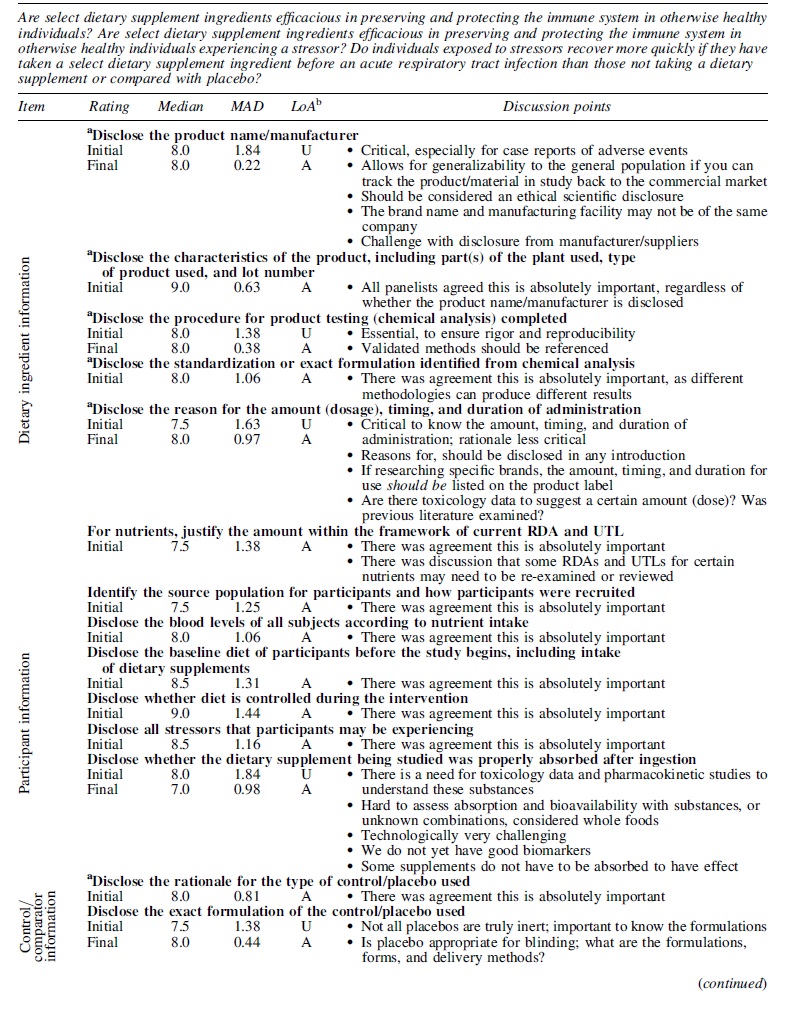
Most panelists agreed on the importance of disclosing specific details when planning, conducting, and reporting on dietary supplement research; they rated details as “absolutely important,” with scores ranging from 7 to 9 on a 9-point scale. Some level of uncertainty was raised surrounding the importance of 6 of the 21 details asked about. Through discussion, panelists agreed to the importance of these items to ensure rigor, reproducibility, and ultimately, generalizability to the end-user (Table 1).
Importance of Specific Items in General When Planning, Conducting, and Reporting on Dietary Supplement Research in the Focus Area of the Research Questions Posed Through Systematic Review Conducted

Panelists' opinions of how they would answer the research questions posed through systematic review varied across ingredients evaluated. Relying on what they believed could be reasonably claimed based on the evidence and what additional evidence or studies would be needed to make additional claims, panelists developed priorities for the ingredients evaluated, discussed barriers, and rated whether it would be appropriate to invest resources in clinical trials at this time (Table 2). Zinc received the highest priority rating for future research.
Priorities for Future Research Within the Context of Systematic Review Research Questions, Evaluation, and Findings
Priorities for research were rated on a 1–9-point scale with 1–3 representing low priority, 4–6 some priority, and 7–9 high priority for research.
After rerating the priority for research, panelists were asked to rate whether they believed it was appropriate to invest resources in clinical trial research specifically given the barriers discussed, at this time; 1–9-point scale with 1–3 representing absolutely inappropriate, 4–6 neutral, and 7–9 absolutely appropriate.
LoA defined as (A) Agreement, meaning ≤2 panelists outside the 3-point region containing the median (1–3, 4–6, 7–9), (D) Disagreement, meaning 3 or more panelists in each extreme (1–3 and 7–9), (U) Uncertainty meaning anything outside the above categories.
DV, daily value(s); RCT, randomized clinical trial.
Discussion
The research expert panel process allowed for the formulation of recommendations to develop an innovative, robust research agenda based on what stakeholders reveal as the most pressing opportunities and/or barriers. The proposed next steps for the field will help facilitate meaningful research priorities and allow for the translation of dietary supplement research findings into useful information for consumers, health professionals, researchers, and policymakers. As we transition toward a society focused on health promotion and learning about resilience rather than focusing solely on disease prevention and treatment, these recommendations will assist with uncovering the requisite evidence needed to either support or not support the immune claims made on dietary supplement labels.
Footnotes
Acknowledgments
The authors would like to thank the research expert panelists involved in the project. No compensation was provided for their contributions. Written permission was obtained to acknowledge these individuals in this article. Roger Clemens, DrPH, USC School of Pharmacy, D.K. Kim International Center for Regulatory Science, M.A.J. Brigette Grimes, US Army Special Operations Command, Human Performance Division, Mary Hardy, MD, Academy of Integrative Health and Medicine, Ikhlas Khan, PhD, National Center for Natural Products Research, School of Pharmacy, University of Mississippi, Helene M. Langevin, MD, Craig Hopp, PhD, Mark Pitcher, PhD, National Center for Complementary and Integrative Health, National Institutes of Health, Lt Col (US AF MC) David Sayers, MD, MTM&H, Air Force Medical Readiness Agency, David Trosin, NSF International, LTC David Whaley, Pharm D, Medical Command Deployment Support, Dayong Wu, PhD, Jean Mayer USDA Human Nutrition Research Center on Aging at Tufts University, and Friedman School of Nutrition Science and Policy, Tufts University.
Authors' Contributions
All authors contributed to the conception/design of the work, and the acquisition, analysis, and interpretation of the work, drafting of the work, and revising it critically. All authors gave final approval of the version to be published and are in agreement to be accountable for all aspects of the work. All information and materials in this article are original.
Disclaimer
The opinions and assertions expressed herein are those of the author(s) and do not reflect the official policy or position of the Uniformed Services University or the Department of Defense. The contents of this publication are the sole responsibility of the author(s) and do not necessarily reflect the views, opinions, or policies of the Henry M. Jackson Foundation for the Advancement of Military Medicine. Mention of trade names, commercial products, or organizations does not imply endorsement by the Office of Dietary Supplements, National Institutes of Health, Department of Defense, nor the U.S. Government.
Author Disclosure Statement
The authors have no financial interests, activities, relationships, and/or affiliations to disclose.
Funding Information
Funding for this work was provided by the Office of Dietary Supplements, National Institutes of Health award number HU0001-21-1-0004 and by the Consortium for Health and Military Performance, Operation Supplement Safety award number HU0001-18-2-0099. No information contained in this article has been presented or reported on previously in print or electronic format and is not under consideration by another publication or electronic medium.