






Abstract
Corncob is an agricultural byproduct, a result of maize grains processing. It is a lignocellulosic biomass, and its hydrolysis releases a great amount of xylose, a five-carbon sugar that is not readily assimilated by industrial yeasts for bioethanol production.
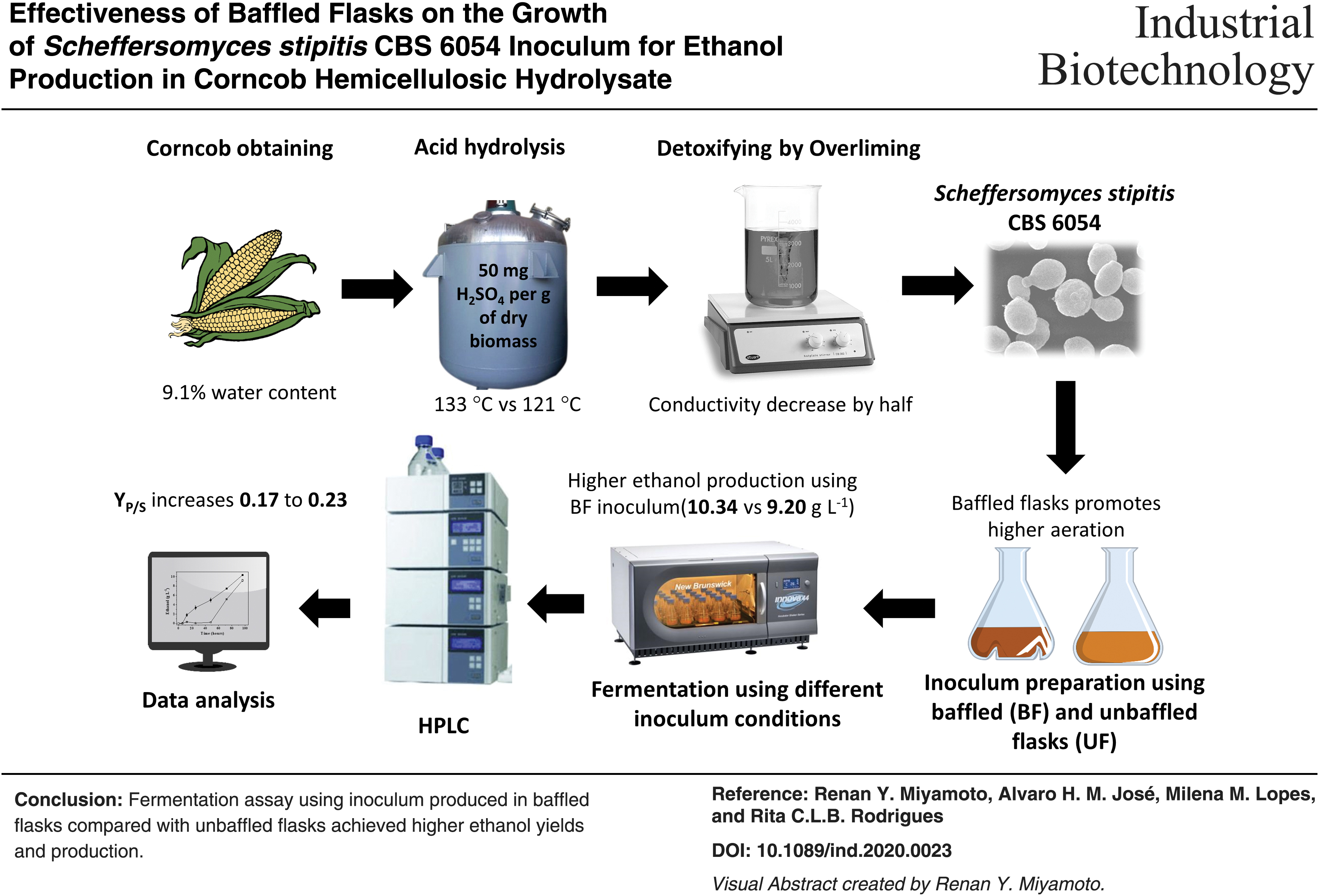
Scheffersomyces stipitis CBS 6054, however, is a yeast that can directly assimilate xylose. It is also known that aeration control has a positive effect on ethanol production during the fermentation process. However, it is rare to find research integrating the inoculum preparation with fermentation processes, and the physiological condition of the inoculum on the very moment of the culture transference can trigger off-target effects on fermentation performance. In this work, we evaluate the inoculum production of S. stipitis CBS 6054 in corncob hemicellulosic hydrolysate (CHH), containing glucose and xylose, and employing Erlenmeyer flasks with and without baffles. Baffles tend to cause an increase in oxygen transfer rate. The inoculum prepared on CHH using baffled flasks (BF) achieved faster exponential phase than unbaffled flasks (UF; 7–14 h versus 12–18 h). Cell density in this phase was also higher (0.2–2.8 versus 0.01–0.70 g L−1) compared with UF. Fermentations conducted with these inoculums presented a significant increase in ethanol production and yield (YP/S of 0.17 to 0.23), proving the important role of oxygen transfer rates on inoculum preparation.
Color images are available online
Get full access to this article
View all access options for this article.