






Abstract
Background:
Fractures of the proximal humerus are the third commonest fracture category in the elderly, comprising 4%–5% of all fractures affecting this population after low-energy trauma. Despite the fact that for stable and minimally displaced fractures recent guidelines recommend conservative treatment with immobilization of the upper limb, for unstable three- or four-part fractures, surgery with open reduction and internal fixation is the treatment of choice.
Case Report:
A case of a comminuted subcapital fracture of the humerus for which the initial conservative treatment with immobilization did not yield any radiological improvement during the first 3 weeks of treatment is presented. The patient is a 53-year-old woman who presented to the clinic after a fall. After 3 weeks of treatment with sling immobilization, there were no signs of callus formation. The subsequent treatment of the fracture with the help of classical homeopathy yielded very fast results, both in relation to the radiological picture of the fracture as well as in relation to the patient’s mobilization and function. The remedy chosen, according to the relevant repertorization, was Symphytum officinale, 1M initial potency, followed by 30 CH daily, for 3 weeks.
Conclusions:
Individualized classical homeopathy offers powerful assistance to the treating physician in the treatment of complex bone fractures of the human body that are difficult to treat with standard conservative methods. A series of experimental and clinical findings require the continuation of scientific research in this particular field.
Background
Fractures of the proximal humerus are the third commonest fracture category in the elderly, comprising 4%–5% of all fractures affecting this population after low-energy trauma. 1 Despite the fact that for stable and minimally displaced fractures recent guidelines recommend conservative treatment with immobilization of the upper limb, for unstable three- or four-part fractures—such as the fracture in the present case—surgery with open reduction and internal fixation is the treatment of choice. 2 Up to date, there are no reports in the medical literature on the treatment of similar fractures using classical homeopathy.
Case Report
A 53-year-old woman, after a fall, presented to the clinic with a comminuted subcapital fracture of her left humerus (Fig. 1). Τhe combination of the patient’s age, which was particularly active, and the severe appearance of the fracture led to the recommendation for surgery; nevertheless, she was reluctant to proceed and decided to choose conservative treatment will full immobilization of the upper limb. The patient was treated with sling immobilization, and no further investigation (CT or MRI scan) was performed. She was prescribed painkillers and supplementation of calcium and vitamin D. The patient did not suffer from any chronic disease and had no significant medical history.

The initial X-ray of the fracture (November 1, 2021).
The next two X-ray follow-ups, 1 and 3 weeks after the injury, did not show any signs of callus formation (Fig. 2), whereas the patient was still in severe pain with the slightest motion. Once more, surgical reconstruction with open reduction and internal fixation was proposed, but the patient was not keen to proceed. On the contrary, since there was a suspicion of a possible delayed union of the fracture, the patient agreed to proceed with treatment with the help of classical homeopathy.

Three weeks after the injury (November 23, 2021)—no signs of callus formation. The patient was offered treatment with classical homeopathy.
The repertorization was carried out according to the Vithoulkas Compass Acute Homeopathy Software (version 7.0) software 3 and in Figure 3, the recommended remedies for the acute case are shown.
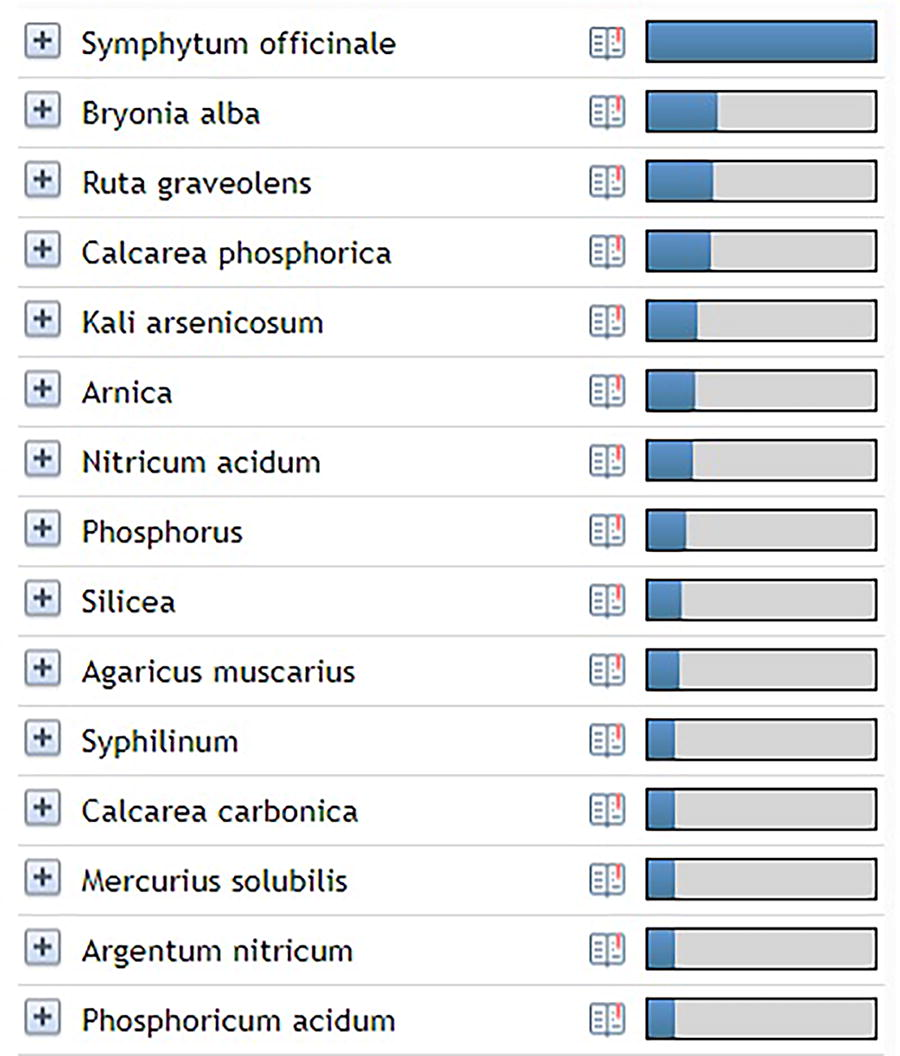
The recommended remedies for the acute case.
Symphytum officinale was the obvious remedy of choice that was given to the patient, 1 M initial potency, followed by 30 CH daily, for 3 weeks.
The next X-ray follow-up, 2 weeks after the homeopathic treatment, showed the first signs of callus formation, while the patient stated that from the very first week, the pain was greatly reduced and she felt her arm much more “stable and secure.” In 3 weeks, the fracture consolidation was obvious, and the patient was advised to start gentle, own mobilization of her arm, which was almost pain-free. The final X-ray follow-up, 6 weeks after the homeopathic treatment and 9 weeks after the injury showed nice fracture healing, both in the anteroposterior and in the lateral view (Fig. 4). The patient had a pain-free and acceptable range of motion of her glenohumeral joint, which improved in the almost normal range after just 10 sessions of physiotherapy. Three months after the injury, she was discharged from our care, particularly pleased with the overall development of her clinical condition.
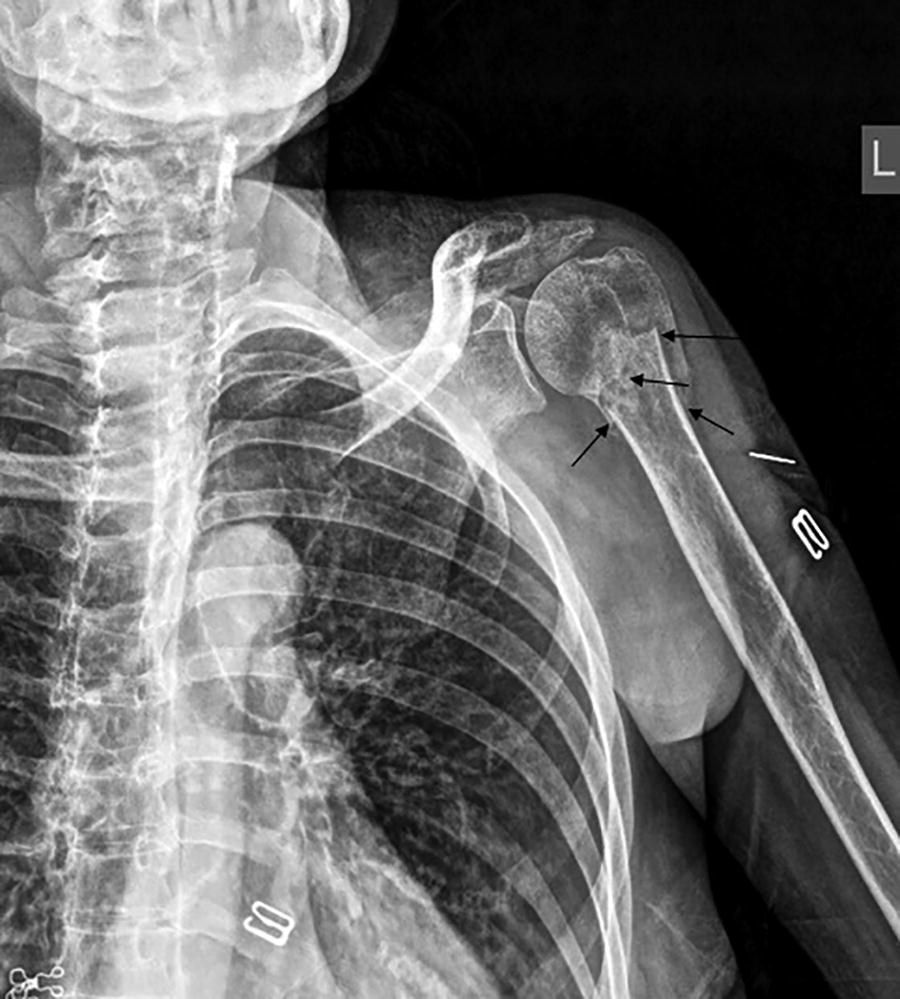
Six weeks after homeopathic treatment (January 4, 2022)—lateral view. Excellent bony union of the fracture (arrows).
Discussion
Comminuted, multifragmental fractures of proximal humerus present a major challenge for the treating physicians.1,2 The surgical option was offered to the patient, both when she presented to the clinic and 3 weeks after the injury, when there was no progress in the fracture healing—but the patient did not accept it.
In the present medical literature, there are just a few published papers regarding the clinical use and results of fracture treatment with the use of classical homeopathy, both at experimental and clinical levels. Oberbaum et al., 4 in an experimental study in which an ulna fracture was induced in 36 guinea pigs, recorded significantly better fracture union rates in the intervention group (homeopathic remedies Arnica montana or Symphytum officinale) in comparison to the control group. In another experimental model, Werkman et al. 5 reported that after the induction of tibia fracture in 84 rats, different bone formation regarding the maturation and the remodeling aspects were observed between the group treated with risedronate and the one treated with the homeopathic remedy Calcarea phosphorica 6C. Finally, in a recently published experimental study, Vaezi et al. 6 concluded that S. officinale 6C could enhance osteogenic differentiation of rat bone marrow-derived mesenchymal stem cells, meaning that this particular homeopathic remedy could be an effective, safe, and low-cost treatment for bone regeneration after fractures and bone losses.
Sharma et al.,
Homeopathic Materia Medica is the study of the action of drugs on healthy human beings as a whole, taking into consideration individual susceptibility and its reaction to various circumstances and time. Boericke in his Materia Medica indicates S. officinale in nonunion of fractures in capital letters, 11 whereas Allen states that it is an excellent remedy for fracture and mechanical injuries, facilitates union of fractured bones, and favors production of callus. 12 According to G. Vithoulkas, Materia Medica notes, “Symphytum officinale promotes the repair of broken bones, especially when they heal slowly. It helps the slow repair of broken bones (stated in capital letters), lessens peculiar bone pain and favors production of callus.” 13
Conclusions
According to our experience, individualized classical homeopathy offers powerful assistance to the treating physician in the treatment of complex bone fractures of the human body that are difficult to treat with standard conservative methods. In cases of the ineffectiveness of conservative treatment or problems with surgical treatment, classical homeopathy is an effective method of treatment. A series of experimental and clinical findings require the continuation of scientific research in this particular field.
Footnotes
Authors’ Contributions
G.V. supervised the article and reviewed it. D.T. was responsible for the treatment of the patient and wrote the original draft.
Consent
The patient has given written consent to authors to publish his X-rays and the details of his case in the present case report.
Author Disclosure Statement
There is no conflict of interest regarding this case report.
Funding Information
No funding was received for this article.