






Abstract
Objective:
To analyze the utilization patterns of traditional Chinese medicine (TCM) formula granules in type 2 diabetes mellitus (T2DM) patients.
Methods:
Data were collected from all district-owned tertiary comprehensive hospitals and community health service centers in Longhua District of Shenzhen from May 15, 2018 to March 31, 2020. We first assessed how TCM formula granules were used as add-on therapies to routine T2DM medications and compared the routine medication categories and combinations with or without add-on therapies. Next, we evaluated the overall use of TCM formula granules in T2DM patients, including patient percentages and prescription characteristics.
Results:
Of the T2DM patients in the analytic sample, 4.19% with routine T2DM medication prescriptions used TCM formula granules as add-on therapies. Of the routine medication prescriptions, 10.94% of sodium-glucose cotransporter-2 inhibitors (SGLT2i) prescriptions had TCM formula granules as add-on therapies, the highest among all categories. In addition, the categories and the use of combination therapies differed significantly between routine T2DM medication prescriptions with and without TCM formula granules as add-on therapies. Dipeptidyl peptidase-4 inhibitors (5.73%/3.88%, p < 0.001) and SGLT2i (0.43%/0.1%, p < 0.001) had higher proportions in routine medication prescriptions with TCM formula granules as add-on therapies than in those without. In addition, routine medication prescriptions with TCM formula granules as add-on therapies had a higher proportion of monotherapies of routine medications than those without (54.44%/49.74%, p < 0.01). Of T2DM patients, 4.09% received TCM formula granule prescriptions within this period. On average, TCM formula granule prescriptions included 10.9 types of TCM granules, with an interval of 43.41 days. The average cost of TCM formula granules per prescription was 107.95 yuan. Poria formula granules were the most commonly used among T2DM patients.
Conclusion:
The uptake rate of TCM formula granules among T2DM patients is relatively low, indicating that they are not commonly prescribed for clinically treating T2DM.
Introduction
Diabetes mellitus (DM) is a metabolic disease characterized by elevated blood sugar levels due to insufficient insulin secretion or defective insulin action. 1 According to evidence in the literature, type 2 diabetes mellitus (T2DM) accounts for approximately 90% of all diabetes cases globally. 2 T2DM can lead to various complications, including cardiovascular diseases, kidney diseases, retinal changes, and cognitive dysfunction, imposing a significant burden on patients and the society. 3
The pharmacotherapy of T2DM has rapidly evolved in the past several decades, with a focus on reducing the risks of clinical outcomes such as preventing complications. The introduction of new antidiabetic drug classes, such as sodium-glucose cotransporter-2 inhibitors (SGLT2i), α-glucosidase inhibitors, and glucagon-like peptide 1 receptor agonists (GLP1-RAs), has changed the landscape of treatment by demonstrating strong effects in reducing cardiovascular and renal risks and lowering hospitalization rates for heart failure. 4 However, in addition to these routine T2DM medications, traditional Chinese medicine (TCM) has been widely used and recognized in the treatment of T2DM. 5 Among them, TCM formula granules, as a modernized dosage form of TCM, have many advantages that are not found in TCM decoction pieces or Chinese patent medicines.
TCM formula granules are granulated products made from TCM decoction pieces through processes such as water extraction and concentration. Compared with TCM decoction pieces, they can be taken with water. Physicians must mix various individual granules according to the patient’s condition and prescribe them to the patient. 6 Compared with TCM decoction pieces, the most prominent advantage of TCM formula granules is that they are convenient to use by avoiding the time-consuming decoction process, have a smaller volume, and are more acceptable to patients. 6 Compared with Chinese patent medicines, one of the main advantages of TCM formula granules is that the combination of TCM can be adjusted according to the patient’s actual situation, thus realizing individualized treatment, whereas Chinese patent medicines, which are processed according to a fixed combination of TCM, cannot be adjusted. 7 Therefore, since being formally included in the management category of TCM decoction pieces in 2001, the role of TCM formula granules in the treatment of T2DM has gradually gained attention in China.
Several studies have suggested that TCM formula granules may have a therapeutic effect on T2DM. Currently,8–11 many hospitals and community health centers (CHCs) in China have included TCM formula granules in their prescription categories. 12 However, there is a lack of real-world evidence on the patterns of TCM formula granules add-on therapy use among T2DM patients in China. Exploring the medication patterns of TCM formula granules in patients with T2DM helps to understand the current status of the application of TCM formula granules in the treatment of T2DM, discover the deficiencies of TCM formula granules in the treatment of T2DM, and provide references for the clinical application of TCM formula granules, which is of great theoretical significance for further promoting the development of TCM and improving the quality of life of patients with T2DM. This study utilizes data from all district-owned tertiary comprehensive hospitals and CHCs in Longhua District of Shenzhen, China, to explore the usage patterns of TCM formula granules in T2DM patients. The results may provide insights on the extent to which TCM formula granules have been integrated into the mainstream clinical practice of diabetes care and may help to identify the gaps between the status quo and optimal use of such add-on therapies.
Materials and Methods
Data source
The data for this study were derived from the outpatient and inpatient medical records of patients with DM who visited all CHCs (a total of 88) and all district-owned tertiary comprehensive hospitals (only one hospital met this criterion) in Longhua District of Shenzhen between May 15, 2018, and March 31, 2020. Longhua District is one of the most densely populated jurisdictions in Shenzhen, located in the southern part of China, with a permanent population close to 2.5 million. 13 This district boasts a relatively comprehensive system for the registration and management of patients with DM. As of December 2021, the CHCs in Longhua District were managing a total of 28,225 patients with DM, with a standardized management rate of 63.46%. 14 This provides certain conditions for the research on the real-world medication patterns of patients with T2DM.
The patient information available for analysis in the outpatient visit records included the following: unique patient identifiers, visit date, visit number (an identifier for each visit), diagnosis information in the outpatient electronic medical record, prescription drug names, and cost of each drug in the prescription. In line with the prevailing practice in China’s electronic outpatient records, the diagnoses in our study’s outpatient data were recorded as physician-authored narratives rather than International Classification of Diseases (ICD)-10 codes. Each outpatient visit generated one prescription, which might include multiple types of drugs. Correspondingly, several drug use information might be linked to the same prescription. The inpatient information available for analysis included: unique patient identifiers, inpatient diagnosis codes (recorded using the ICD-10 classification system), and admission date.
Study design
This study, a cross-sectional survey, is divided into two parts to analyze the usage patterns of TCM formula granules in patients with T2DM.
Part one focuses on the analysis of TCM formula granules as add-on therapy to routine T2DM medications (hereinafter referred to as “routine medications”; Supplementary Table S1 and Supplementary Data S1 lists the types of routine T2DM medications in China). This part delineated the frequency of TCM formula granules used as add-on therapy across various types of routine medications. It also examined the differences in the categories of routine medications and their combinations when TCM formula granules were or were not used as add-on therapy.
Part two analyzes the overall situation of TCM formula granule usage among T2DM patients. This part does not further describe the potential relationship between TCM formula granules and routine medication prescriptions. Instead, it focuses on the usage patterns of TCM formula granules to provide reference for future optimization of TCM formula granule use.
Population inclusion and exclusion criteria
In conducting the first part of the analysis, this study considers that the patient used TCM formula granules as add-on therapy for the routine medication prescription if there is a prescription record containing TCM formula granules within 90 days before and after the prescription of this routine medication for the same patient (Fig. 1). In medical research utilizing electronic medical records, a medication use interval exceeding 90 days is commonly considered as treatment interruption.15–17 Based on this, our study established a 90-day window to assess add-on therapy scenarios: if the prescription dates of TCM formula granules and routine medications are more than 90 days apart, it is concluded that they do not belong to the same treatment regimen, indicating that TCM formula granules are not used as add-on therapy to routine medications. Excluded were the prescription records where it was impossible to determine whether the TCM formula granules prescription was add-on therapy. Specifically, we considered routine diabetic medication prescriptions ineligible for the study if the dates 90 days before and after the routine medication prescription dates were beyond the study time period of May 15, 2018 to March 31, 2020, and no TCM formula granule uses were observed within the limited observed periods. Finally, using the patient identifiers, the routine antidiabetic prescriptions and TCM formula granule prescriptions were linked. The analysis focused on the proportions of patients using and prescriptions containing routine antidiabetic medications with TCM formula granules as add-on therapy, the differences in the proportions of different types of routine antidiabetic medication users and prescriptions associated and not associated with TCM formula granule add-on therapies, and the differences in the categories of medications and routine medication combination therapy. This study defined each prescription with two or more records of routine antidiabetic medications as a prescription of routine medication combination therapy.
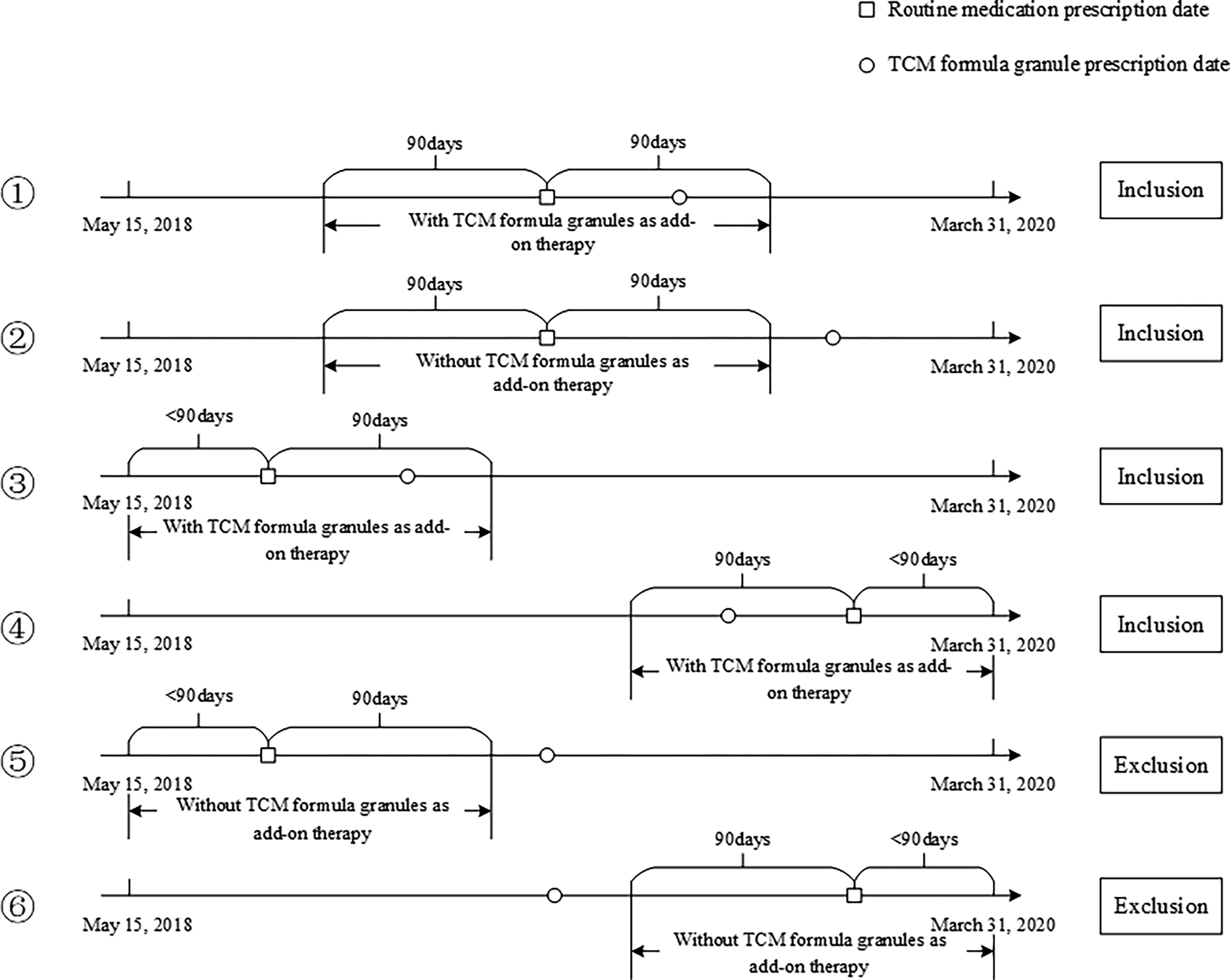
Schematic diagram of inclusion and exclusion criteria for part one analysis.
In the second part of the analysis, all T2DM patients who used TCM formula granules between May 15, 2018, and March 31, 2020 were included. The analysis focused on the number of times these patients used TCM formula granules, as well as the types, prescription intervals, and costs associated with the TCM formula granule prescriptions of these patients. It should be noted that this part only discusses the use of TCM formula granules by T2DM patients but not the use of routine medications. Having a prescription of routine medications was only used as one of the criteria to identify T2DM patients. In this part, we used the term “a prescription containing TCM formula granules” to refer to any prescription that includes TCM formula granules as one of its components. A prescription may also contain other types of drugs besides TCM formula granules, but for the sake of brevity, we may sometimes use the shorthand “a TCM formula granules prescription” in other parts of this article, which had the same meaning as “a prescription containing TCM formula granules.” This study identified T2DM patients who met any of the following criteria: (1) at least one hospital diagnosis of T2DM, (2) at least one outpatient diagnosis of T2DM, and (3) at least one outpatient prescription containing conventional medicine.
Statistical analysis
In the first part of the analysis of this study, all the included prescriptions containing routine medications were divided into two groups, one group with TCM formula granules as add-on therapy and the other group without TCM formula granules as add-on therapy. In this part of the analysis, chi-square tests were used to compare whether there was a statistical difference in the proportion of specific categories of routine medications in the two groups of prescriptions and to compare the difference in the proportion of prescriptions without routine medication combination therapy between the two groups. The t-test was also used in this section to compare differences in the number of types of routine medications contained in one prescription. In the second part of the analysis in this study, we used descriptive statistical methods to analyze the overall situation of T2DM patients using TCM formula granules. We first calculated the proportion of T2DM patients who used TCM formula granules, and then, we performed descriptive statistics on the following five aspects of TCM formula granules prescription characteristics: (1) the average number of times that patients used TCM formula granules, (2) the average number of types of TCM granules contained in TCM formula granule prescriptions, (3) the average number of days between TCM formula granule prescriptions, (4) the average cost of TCM formula granules in each TCM formula granule prescription, and (5) the most common types of TCM formula granules in prescriptions. We used histograms to show the distribution of these characteristics and used bar charts to visually display the top 10 most common types of TCM formula granules.
Data processing and analyses were conducted using SAS 9.4 software. Two-sided tests with a significance level of α = 0.05 were performed.
Results
The sample selection process is shown in Figure 2.

Sample selection flow chart.
Use of TCM Formula Granules as Add-On Therapy to Routine Medications
Among the 38,350 prescriptions containing routine medications that were included in this study, 1036 (2.7%) prescriptions were associated with add-on TCM formula granules therapy. Out of the 6415 patients corresponding to the 38,350 prescriptions containing routine medications, 269 (4.19%) patients had used TCM formula granules as add-on therapy to routine medications between May 15, 2018, and March 31, 2020. On average, each of these 269 patients had 3.85 routine medication prescriptions that included TCM formula granules as add-on therapy.
The 38,350 included routine medication prescriptions contained a total of 61,870 records of different routine medications because one prescription might correspond to one or more types of routine antidiabetic medications. A total of 19,227 (50.14%) prescriptions containing routine medications included two or more types of routine medications (i.e., there was combination therapy of routine medications). As displayed in Table 1, the proportions of routine medication records that utilized TCM formula granules as add-on therapy differed across categories of antidiabetic medications. SGLT2i had the highest proportion of prescriptions that included TCM formula granules as add-on therapy, at 10.94%. This was followed by dipeptidyl peptidase-4 inhibitors (DPP-4i) and thiazolidinediones, with proportions of 3.87% and 3.55%, respectively.
The Situation of Using TCM Formula Granules as Add-on Therapy to Different Categories of Routine Medications
Table 2 displays the differences between prescriptions containing routine medications with and without TCM formula granules as add-on therapy in terms of medication categories and routine medication combination therapy. As shown in Table 2, compared to that among routine medications with TCM formula granules as add-on therapy, the proportions of DPP-4i (3.88% vs. 5.73%, p < 0.001) and SGLT2i (0.1% vs. 0.43%, p < 0.001) accounted for significantly lower proportions among those without TCM formula granules add-on therapy. There were no significant differences between the two groups in the proportions of other categories of routine medications.
The Differences in Drug Categories and Combination Therapy between Prescriptions Containing Routine Medications without TCM Formula Granules as Add-on Therapies and Those with TCM Formula Granules as Add-on Therapies
Note: Only the value corresponding to “the average number of routine medications per prescription” represents “mean (standard deviation),” and the rest of the values represent “number (percentage).” When describing the types of routine medications, “total” means the total number of routine medication records, that is, the sum of the times that various routine medications are prescribed in the prescriptions. One prescription can prescribe multiple medications, so there can be multiple routine medication records. When describing the combination therapy situation, “total” means the number of prescriptions, and one visit can have up to one prescription at most.
The chi-square test was used to calculate p-values.
*p < 0.05, **p < 0.01, ***p < 0.001.
As shown in Table 2, compared with prescriptions without TCM formula granules add-on therapy, those with TCM formula granules add-on therapy had a higher rate of routine medication monotherapy (54.44%/49.74%, p < 0.01). However, there was no significant difference between prescriptions associated and not associated with TCM formula granules add-on therapy in the average number of types of routine antidiabetic medication records contained in each prescription (p = 0.056).
Overall Situation of T2DM Patients Using TCM Formula Granules
From the outpatient records of CHCs and the inpatient records of hospitals, a total of 10,939 T2DM patients were identified, among whom 447 (4.09%) used TCM formula granules between May 15, 2018, and March 31, 2020. Among these 447 patients, 212 (47.4%) were male and 235 (52.6%) were female. These 447 individuals received a total of 1160 prescriptions associated with TCM formula granules, averaging 2.6 (standard deviation [SD]: 0.14) per person. Figure 3 shows the distribution of the number of prescriptions associated with TCM formula granules. From the figure, it can be seen that the majority (n = 321, 71.8%) of patients only received one or two prescriptions associated with TCM formula granules between May 15, 2018, and March 31, 2020.

The distribution of the number of prescriptions containing traditional Chinese medicine (TCM) formula granules among 447 patients.
The 1160 prescriptions containing TCM formula granules included a total of 12,698 TCM formula granule medication records, involving 354 types of TCM granules, with an average of 10.9 (SD: 0.14) types per prescription. Figure 4 shows the distribution of the number of types of TCM granules contained in each prescription.

The distribution of the types of TCM granules contained in 1160 prescriptions with TCM formula granules.
Among the 447 patients who received prescriptions containing TCM formula granules, 218 (48.8%) received two or more prescriptions associated with TCM formula granules between May 15, 2018, and March 31, 2020. The average interval for these 218 individuals to receive prescriptions associated with TCM formula granules was 43.41 days. Figure 5 shows the distribution of the number of days between prescriptions, and 41.1% of the prescriptions associated with TCM formula granules were obtained again within 7 days after receiving the previous prescription.

The distribution of the interval days of 713 prescription intervals.
Between May 15, 2018, and March 31, 2020, the total expenditure on TCM formula granules for T2DM patients amounted to CN¥125,221.6. Among the 1160 prescriptions containing TCM formula granules, the average cost of TCM formula granules per prescription was CN¥107.95 (SD: 3.24). Figure 6 shows the distribution of the cost of TCM formula granules for each prescription.
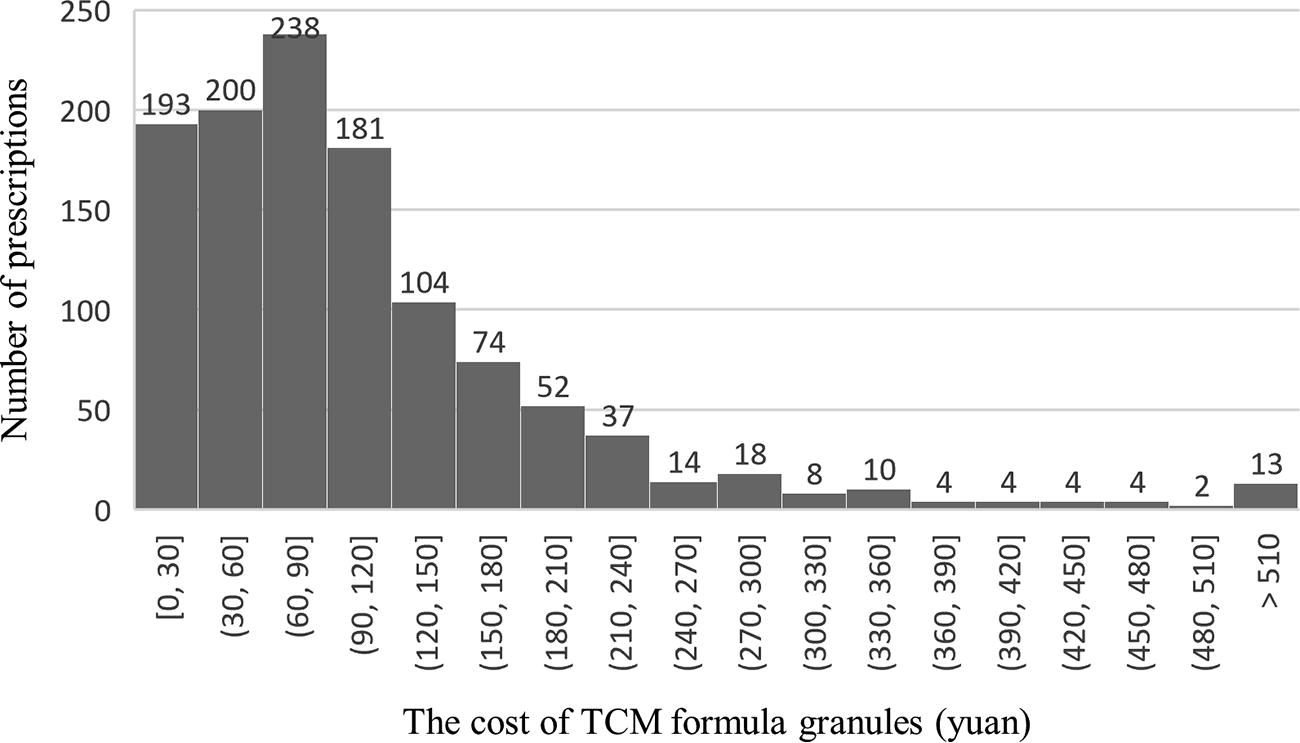
The distribution of the cost of TCM formula granules in 1160 prescriptions with TCM formula granules.
Among the 12,698 TCM formula granule medication records of the 447 patients, a total of 354 types of TCM formula granules were involved. The 10 most prevalent TCM formula granule drugs were Poria cocos, Licorice, Codonopsis pilosula, Radix Scutellaria, Baked licorice, Atractylodes macrocephala, Astragalus membranaceus, Pericarpium citri reticulatae, Radix Paeoniae Alba, and Cassia twig. Figure 7 shows the proportions of medication records corresponding to the 10 TCM formula granules among all TCM formula granule medication records.
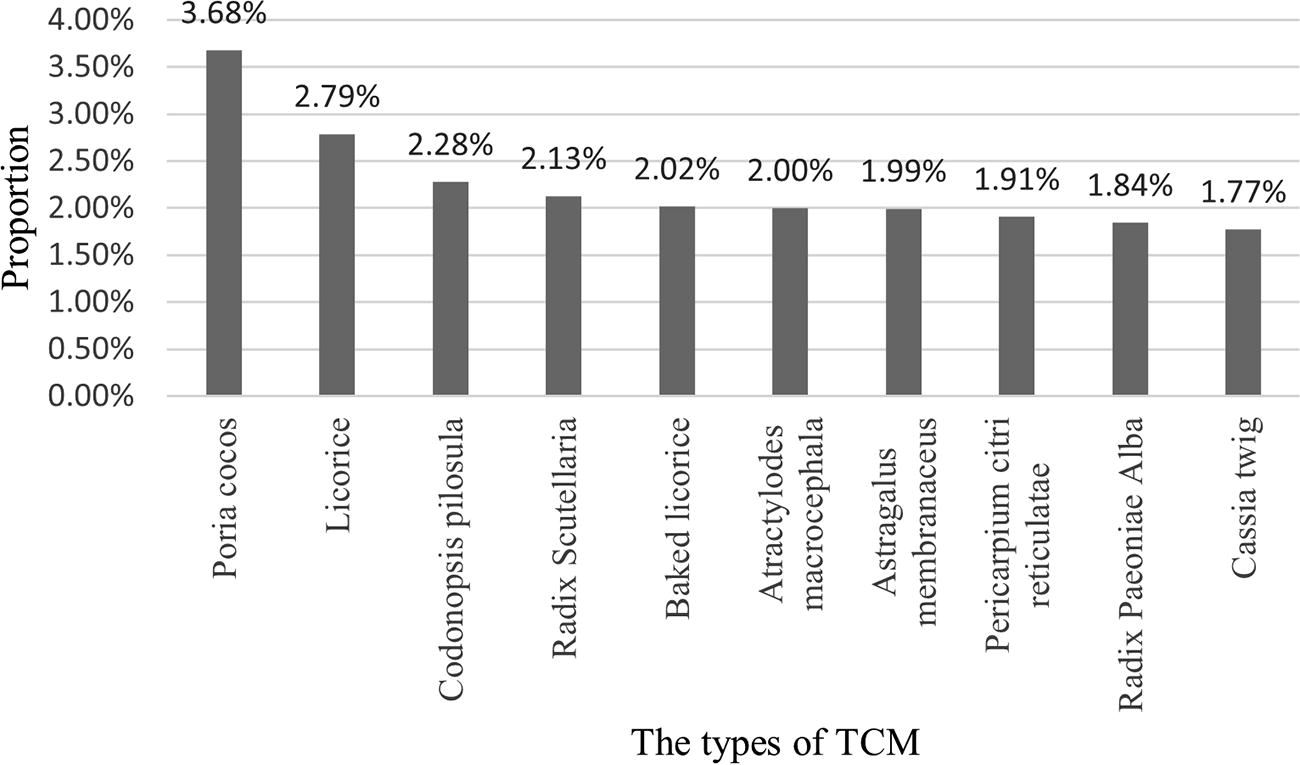
The top 10 most frequently used TCM herbs in 12,698 TCM formula granule drug records.
Discussion
This study utilized data from multiple medical institutions in Longhua District of Shenzhen, China from May 15, 2018, to March 31, 2020 to explore the patterns of using TCM formula granules in T2DM patients. The results of the first part of the analysis showed that, compared with other types of routine antidiabetic medications, DPP-4i and SGLT2i users have higher proportions of TCM formula granule add-on therapy. There is still a paucity of evidence on the utilization of TCM formula granules among the users of novel hypoglycemic drugs. With the increasingly popular use of TCM formula granules and the fast development of TCM formula granule regulations, it is important to shed light on the patterns of clinical use of these drugs. The current study provides preliminary insights in this regard.
Among currently available antidiabetic medications, the drug classes of DPP-4i and SGLT2i are relatively novel. They demonstrate several clinical benefits over conventional antidiabetic medications. For example, DPP-4i stimulate insulin secretion and inhibit glucagon secretion by increasing endogenous GLP-1 concentration, with a relatively low risk of causing hypoglycemia. 18 In addition, SGLT2i can promote glucose excretion by inhibiting renal tubular reabsorption of glucose, thereby lowering blood sugar, and may also have effects on reducing the risks of cardiovascular and renal diseases in T2DM patients. Accordingly, SGLT2i are commonly used in T2DM patients with high risks of complications such as atherosclerotic cardiovascular disease, heart failure, or chronic kidney disease.19,20 However, these agents are often used as second or third-line treatment drugs after insufficient response to metformin. Hence, the conditions of patients using DPP-4i and SGLT2i are usually more severe than other patients.18,20–22 Therefore, doctors may tend to prescribe TCM formula granules as add-on therapy to the users of these relatively severe patients to boost hypoglycemic effects and to treat complications.
The results of the second part of the analysis show that only 4.19% of T2DM patients who used routine hypoglycemic drug prescriptions had used TCM formula granules as add-on therapy between May 15, 2018, and March 31, 2020. In addition, only 2.7% of all prescriptions of routine antidiabetic drugs were also prescribed with TCM formula granules as add-on therapy. Moreover, among the patients who had used TCM formula granules, the majority (71.8%) had only used them once or twice during this period. These results indicate that the uptake rate of TCM formula granules is low among T2DM patients. Given that the relatively old formulations of TCM have a long history of clinical use among chronic disease patients in China, the low uptake rate of TCM formula granules among T2DM is not in line with their physical and clinical advantages for patients over the old TCM formulations. This may be attributable to a lack of experience with TCM formula granules among physicians, the absence of high-grade evidence on the effectiveness of TCM formula granules, and insufficient patient understanding of this new type of TCM preparations.
Furthermore, this study found that in the prescriptions of TCM formula granules for T2DM patients, Chinese herbs such as Poria cocos, Licorice, Codonopsis pilosula, and Radix Scutellaria had the highest uptake rates. These herbs are relatively common in the management of diabetes. 23 Previous studies based on animal experiments and clinical trials have partially documented the hypoglycemic effects of Poria cocos, Licorice, Codonopsis pilosula, and Radix Scutellaria among patients with diabetes, and the history of treating diabetes with these types of TCMs is also long standing.23–28 This finding may further reflect that the evidence on the clinical effectiveness and the experience with the therapeutic agents among physicians are important for the utilization of TCM formula granules. However, the chemical and biological components of TCMs are complicated, which makes the ascertainment of the mechanisms of action and the establishment of effectiveness challenging. Further research is needed to verify the effectiveness, safety, mechanisms of action, and regulations of TCM formula granules in treating T2DM.
Limitations
The research only describes the patterns of TCM formula granule usage without exploring the impacts of these medication patterns on clinical outcomes of patients. To understand the effectiveness of TCM formula granules in lowering blood glucose level and reducing the risks of complications, future clinical research is mandatory. In addition, some patients with T2DM may prefer to purchase medicines from pharmacies or through online shopping websites, and the drug information for this part of the medication cannot be obtained. Therefore, the study might not have captured the universe of medication records of drug use by the patients. However, TCM formula granules can only be purchased in medical institutions and cannot be obtained from pharmacies or online shopping channels. 29 Consequently, the estimates in the current study may be overestimated. Furthermore, the electronic medical records we obtained did not include detailed demographic information beyond sex. As a result, we were unable to provide a detailed description of the patient demographics.
Conclusions
This study found a low utilization rate of TCM formula granules among T2DM patients. Due to their physical and chemical properties, TCM formula granules are more concentrated and more convenient to use than herbs. To rationalize the use of TCM formula granules among T2DM patients, future research should focus on investigating the mechanism of action, efficacy, and safety of TCM formula granules.
Funding Information
This work was supported by Guangdong Basic and Applied Basic Research Foundation (2021A1515220170).
Footnotes
Ethics approval
The study procedure was approved by the Medical Ethics Committee of School of Public Health (Shenzhen), Sun Yat-sen University [no. 2021 (045)].
Data Sharing Statement
The datasets generated or analyzed during the current study are not publicly available due to the protection of the participants’ privacy.
Authors’ Contributions
J.C.: Methodology, Formal analysis, Writing—Original Draft, and Visualization. Y.J.: Methodology, Conceptualization, Writing—Review & Editing, Supervision, Project administration, and Funding acquisition.
Author Disclosure Statement
No competing financial interests exist.

Abbreviations Used
References
Supplementary Material
Please find the following supplemental material available below.
For Open Access articles published under a Creative Commons License, all supplemental material carries the same license as the article it is associated with.
For non-Open Access articles published, all supplemental material carries a non-exclusive license, and permission requests for re-use of supplemental material or any part of supplemental material shall be sent directly to the copyright owner as specified in the copyright notice associated with the article.
