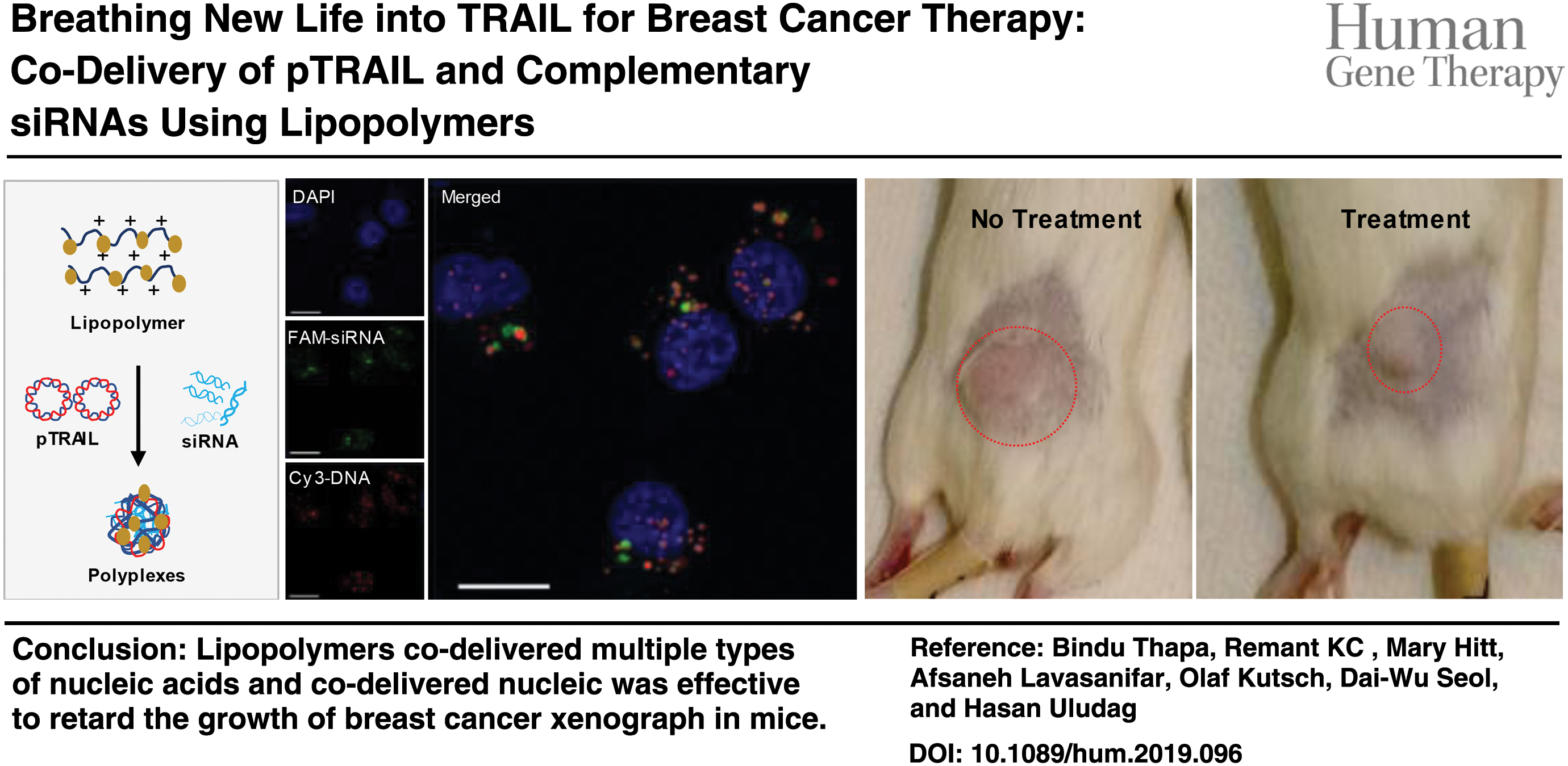
Preclinical studies showed that tumor necrosis factor-related apoptosis-inducing ligand (TRAIL) therapy is safe and effective to combat cancers, but clinical outcomes have been less than optimal due to short half-life of TRAIL protein, insufficient induction of apoptosis, and TRAIL resistance displayed in many tumors. In this study, we explored co-delivery of a TRAIL expressing plasmid (pTRAIL) and complementary small interfering RNAs (siRNAs) (silencing Bcl2-like 12 [BCL2L12] and superoxide dismutase 1 [SOD1]) to improve the response of breast cancer cells against TRAIL therapy. It is desirable to co-deliver the pDNA along with siRNA using a single delivery agent, but this is challenging given different structures of long/flexible pDNA and short/rigid siRNA. Toward this goal, we identified an aliphatic lipid-grafted low–molecular weight polyethylenimine (PEI) that accommodated both pDNA and siRNA in a single complex. The co-delivery of pTRAIL with BCL2L12- or SOD1-specific siRNAs resulted more significant cell death in different breast cancer cells compared with separate delivery without affecting nonmalignant cells viability. Ternary complexes of lipopolymer with pTRAIL and BCL2L12 siRNA significantly retarded the growth of breast cancer xenografts in mice. The enhanced anticancer activity was attributed to increased in situ secretion of TRAIL and sensitization of breast cancer cells against TRAIL by the co-delivered siRNAs. The lipid-grafted PEIs capable of co-delivering multiple types of nucleic acids can serve as powerful carriers for more effective complementary therapeutics.
Graphical Abstract
Get full access to this article
View all access options for this article.
References
1.
WileySR, SchooleyK, SmolakPJ, et al.Identification and characterization of a new member of the TNF family that induces apoptosis. Immunity, 1995; 3:673–682.
2.
WalczakH, MillerRE, AriailK, et al.Tumoricidal activity of tumor necrosis factor-related apoptosis-inducing ligand in vivo. Nat Med, 1999; 5:157–163.
3.
LemkeJ, von KarstedtS, ZinngrebeJ, et al.Getting TRAIL back on track for cancer therapy. Cell Death Differ, 2014; 21:1350–1364.
4.
StuckeyDW, ShahK. TRAIL on trial: preclinical advances in cancer therapy. Trends Mol Med, 2013; 19:685–694.
5.
HerbstRS, EckhardtSG, KurzrockR, et al.Phase I dose-escalation study of recombinant human Apo2L/TRAIL, a dual proapoptotic receptor agonist, in patients with advanced cancer. J Clin Oncol, 2010; 28:2839–2846.
6.
TolcherAW, MitaM, MeropolNJ, et al.Phase I pharmacokinetic and biologic correlative study of mapatumumab, a fully human monoclonal antibody with agonist activity to tumor necrosis factor-related apoptosis-inducing ligand receptor-1. J Clin Oncol, 2007; 25:1390–1395.
7.
Forero-TorresA, InfanteJR, WaterhouseD, et al.Phase 2, multicenter, open-label study of tigatuzumab (CS-1008), a humanized monoclonal antibody targeting death receptor 5, in combination with gemcitabine in chemotherapy-naive patients with unresectable or metastatic pancreatic cancer. Cancer Med, 2013; 2:925–932.
8.
TodaroM, LombardoY, FrancipaneMG, et al.Apoptosis resistance in epithelial tumors is mediated by tumor-cell-derived interleukin-4. Cell Death Differ, 2008; 15:762–772.
9.
KelleySK, HarrisLA, XieD, et al.Preclinical studies to predict the disposition of Apo2L/tumor necrosis factor-related apoptosis-inducing ligand in humans: characterization of in vivo efficacy, pharmacokinetics, and safety. J Pharmacol Exp Ther, 2001; 299:31–38.
10.
ChaeSY, KimTH, ParkK, et al.Improved antitumor activity and tumor targeting of NH(2)-terminal-specific PEGylated tumor necrosis factor-related apoptosis-inducing ligand. Mol Cancer Ther, 2010; 9:1719–1729.
11.
JoM, KimTH, SeolDW, et al.Apoptosis induced in normal human hepatocytes by tumor necrosis factor-related apoptosis-inducing ligand. Nat Med, 2000; 6:564–567.
12.
MullerN, SchneiderB, PfizenmaierK, et al.Superior serum half life of albumin tagged TNF ligands. Biochem Biophys Res Commun, 2010; 396:793–799.
13.
GantenTM, KoschnyR, SykoraJ, et al.Preclinical differentiation between apparently safe and potentially hepatotoxic applications of TRAIL either alone or in combination with chemotherapeutic drugs. Clin Cancer Res, 2006; 12:2640–2646.
14.
WangH, DavisJS, WuX. Immunoglobulin Fc domain fusion to TRAIL significantly prolongs its plasma half-life and enhances its antitumor activity. Mol Cancer Ther, 2014; 13:643–650.
15.
WuX, WangS, LiM, et al.Nanocarriers for TRAIL delivery: driving TRAIL back on track for cancer therapy. Nanoscale, 2017; 9:13879–13904.
16.
LawrenceD, ShahrokhZ, MarstersS, et al.Differential hepatocyte toxicity of recombinant Apo2L/TRAIL versions. Nat Med, 2001; 7:383–385.
17.
KimTH, JoYG, JiangHH, et al.PEG-transferrin conjugated TRAIL (TNF-related apoptosis-inducing ligand) for therapeutic tumor targeting. J Control Release, 2012; 162:422–428.
18.
DongF, WangL, DavisJJ, et al.Eliminating established tumor in nu/nu nude mice by a tumor necrosis factor-alpha-related apoptosis-inducing ligand-armed oncolytic adenovirus. Clin Cancer Res, 2006; 12:5224–5230.
19.
KockN, KasmiehR, WeisslederR, et al.Tumor therapy mediated by lentiviral expression of shBcl-2 and S-TRAIL. Neoplasia, 2007; 9:435–442.
20.
BaumC, KustikovaO, ModlichU, et al.Mutagenesis and oncogenesis by chromosomal insertion of gene transfer vectors. Hum Gene Ther, 2006; 17:253–263.
21.
HeoJ, ReidT, RuoL, et al.Randomized dose-finding clinical trial of oncolytic immunotherapeutic vaccinia JX-594 in liver cancer. Nat Med, 2013; 19:329–336.
22.
LiJ, GuB, MengQ, et al.The use of myristic acid as a ligand of polyethylenimine/DNA nanoparticles for targeted gene therapy of glioblastoma. Nanotechnology, 2011; 22:435101.
23.
HuangS, LiJ, HanL, et al.Dual targeting effect of Angiopep-2-modified, DNA-loaded nanoparticles for glioma. Biomaterials, 2011; 32:6832–6838.
24.
MangipudiSS, CanineBF, WangY, et al.Development of a genetically engineered biomimetic vector for targeted gene transfer to breast cancer cells. Mol Pharm, 2009; 6:1100–1109.
25.
LuoC, MiaoL, ZhaoY, et al.A novel cationic lipid with intrinsic antitumor activity to facilitate gene therapy of TRAIL DNA. Biomaterials, 2016; 102:239–248.
26.
ChaSS, KimMS, ChoiYH, et al.2.8 A resolution crystal structure of human TRAIL, a cytokine with selective antitumor activity. Immunity, 1999; 11:253–261.
27.
HymowitzSG, ChristingerHW, FuhG, et al.Triggering cell death: the crystal structure of Apo2L/TRAIL in a complex with death receptor 5. Mol Cell, 1999; 4:563–571.
28.
KimMH, BilliarTR, SeolDW. The secretable form of trimeric TRAIL, a potent inducer of apoptosis. Biochem Biophys Res Commun, 2004; 321:930–935.
29.
ThapaB, Bahadur KcR, UludagH. Novel targets for sensitizing breast cancer cells to TRAIL-induced apoptosis with siRNA delivery. Int J Cancer, 2018; 142:597–606.
30.
KCRB, ThapaB, Valencia-SernaJ, et al.Nucleic acid combinations: a new frontier for cancer treatment. J Control Release, 2017; 256:153–169.
31.
GaryDJ, PuriN, WonYY. Polymer-based siRNA delivery: perspectives on the fundamental and phenomenological distinctions from polymer-based DNA delivery. J Control Release, 2007; 121:64–73.
32.
ThapaB, PlianwongS, Remant BahadurKC, et al.Small hydrophobe substitution on polyethylenimine for plasmid DNA delivery: optimal substitution is critical for effective delivery. Acta Biomater, 2016; 33:213–224.
33.
KCRB, KucharskiC, UludagH. Additive nanocomplexes of cationic lipopolymers for improved non-viral gene delivery to mesenchymal stem cells. J Mater Chem B, 2015; 3:3972–3982.
34.
AkhtarLN, QinH, MuldowneyMT, et al.Suppressor of cytokine signaling 3 inhibits antiviral IFN-beta signaling to enhance HIV-1 replication in macrophages. J Immunol, 2010; 185:2393–2404.
35.
WangY, MostafaNZ, HsuCY, et al.Modification of human BMSC with nanoparticles of polymeric biomaterials and plasmid DNA for BMP-2 secretion. J Surg Res, 2013; 183:8–17.
36.
LivakKJ, SchmittgenTD. Analysis of relative gene expression data using real-time quantitative PCR and the 2(-Delta Delta C(T)) Method. Methods, 2001; 25:402–408.
37.
MiaoL, ZhangK, QiaoC, et al.Antitumor effect of human TRAIL on adenoid cystic carcinoma using magnetic nanoparticle-mediated gene expression. Nanomedicine, 2013; 9:141–150.
38.
WuX, HuiKM. Induction of potent TRAIL-mediated tumoricidal activity by hFLEX/Furin/TRAIL recombinant DNA construct. Mol Ther, 2004; 9:674–681.
39.
HanS, MahatoRI, KimSW. Water-soluble lipopolymer for gene delivery. Bioconjug Chem, 2001; 12:337–345.
40.
FanH, HuQD, XuFJ, et al.In vivo treatment of tumors using host-guest conjugated nanoparticles functionalized with doxorubicin and therapeutic gene pTRAIL. Biomaterials, 2012; 33:1428–1436.
41.
NeamnarkA, SuwantongO, BahadurRK, et al.Aliphatic lipid substitution on 2 kDa polyethylenimine improves plasmid delivery and transgene expression. Mol Pharm, 2009; 6:1798–1815.
42.
DahlmanJE, BarnesC, KhanO, et al.In vivo endothelial siRNA delivery using polymeric nanoparticles with low molecular weight. Nat Nanotechnol, 2014; 9:648–655.
43.
LuS, MorrisVB, LabhasetwarV. Codelivery of DNA and siRNA via arginine-rich PEI-based polyplexes. Mol Pharm, 2015; 12:621–629.
44.
Chang KangH, BaeYH. Co-delivery of small interfering RNA and plasmid DNA using a polymeric vector incorporating endosomolytic oligomeric sulfonamide. Biomaterials, 2011; 32:4914–4924.
45.
BishopCJ, TzengSY, GreenJJ. Degradable polymer-coated gold nanoparticles for co-delivery of DNA and siRNA. Acta Biomater, 2015; 11:393–403.
46.
JeonSY, ParkJS, YangHN, et al.Co-delivery of SOX9 genes and anti-Cbfa-1 siRNA coated onto PLGA nanoparticles for chondrogenesis of human MSCs. Biomaterials, 2012; 33:4413–4423.
47.
BouayedJ, BohnT. Exogenous antioxidants—double-edged swords in cellular redox state: health beneficial effects at physiologic doses versus deleterious effects at high doses. Oxid Med Cell Longev, 2010; 3:228–237.
48.
MooneyLM, Al-SakkafKA, BrownBL, et al.Apoptotic mechanisms in T47D and MCF-7 human breast cancer cells. Br J Cancer, 2002; 87:909–917.
49.
LiuJW, ChandraD, RuddMD, et al.Induction of prosurvival molecules by apoptotic stimuli: involvement of FOXO3a and ROS. Oncogene, 2005; 24:2020–2031.
50.
BraeuerSJ, BunekerC, MohrA, et al.Constitutively activated nuclear factor-kappaB, but not induced NF-kappaB, leads to TRAIL resistance by up-regulation of X-linked inhibitor of apoptosis protein in human cancer cells. Mol Cancer Res, 2006; 4:715–728.
51.
PapaL, ManfrediG, GermainD. SOD1, an unexpected novel target for cancer therapy. Genes Cancer, 2014; 5:15–21.
52.
PapaL, HahnM, MarshEL, et al.SOD2 to SOD1 switch in breast cancer. J Biol Chem, 2014; 289:5412–5416.
53.
SanliogluAD, DiriceE, AydinC, et al.Surface TRAIL decoy receptor-4 expression is correlated with TRAIL resistance in MCF7 breast cancer cells. BMC Cancer, 2005; 5:54.
54.
ZhangY, ZhangB. TRAIL resistance of breast cancer cells is associated with constitutive endocytosis of death receptors 4 and 5. Mol Cancer Res, 2008; 6:1861–1871.
55.
SinghA, NieH, GhosnB, et al.Efficient modulation of T-cell response by dual-mode, single-carrier delivery of cytokine-targeted siRNA and DNA vaccine to antigen-presenting cells. Mol Ther, 2008; 16:2011–2021.
Supplementary Material
Please find the following supplemental material available below.
For Open Access articles published under a Creative Commons License, all supplemental material carries the same license as the article it is associated with.
For non-Open Access articles published, all supplemental material carries a non-exclusive license, and permission requests for re-use of supplemental material or any part of supplemental material shall be sent directly to the copyright owner as specified in the copyright notice associated with the article.