






Abstract
In 2022, the Pentagon Force Protection Agency found threat agnostic detection of novel bioaerosol threats to be “not feasible for daily operations” due to the cost of reagents used for metagenomics, cost of sequencing instruments, and cost of labor for subject matter experts to analyze bioinformatics. Similar operational difficulties might extend to many of the 280,000 buildings (totaling 2.3 billion square feet) at 5,000 secure US Department of Defense military sites, 250 Navy ships, as well as many civilian buildings. These economic barriers can still be addressed in a threat agnostic manner by dynamically pooling samples from dry filter units, called spike-triggered virtualization, whereby pooling and sequencing depth are automatically modulated based on novel biothreats in the sequencing output. By running at a high average pooling factor, the daily and annual cost per dry filter unit can be reduced by 10 to 100 times depending on the chosen trigger thresholds. Artificial intelligence can further enhance the sensitivity of spike-triggered virtualization. The risk of infection during the 12- to 24-hour window between a bioaerosol incident and its detection remains, but in some cases it can be reduced by 80% or more with high-speed indoor air cleaning exceeding 12 air changes per hour, which is similar to the rate of air cleaning in passenger airplanes in flight. That level of air changes per hour or higher is likely to be cost-prohibitive using central heating ventilation and air conditioning systems, but it can be achieved economically by using portable air filtration in rooms with typical ceiling heights (less than 10 feet) for a cost of approximately $0.50 to $1 per square foot for do-it-yourself units and $2 to $5 per square foot for high-efficiency particulate air filters.
Introduction
The Pentagon Force Protection Agency (PFPA) has been at the forefront of innovations in threat agnostic, bioaerosol security operations, 1 such as the use of barcoded DNA for mapping indoor aerosol transport between dry filter units (DFUs) in 2016.2,3
On June 28, 2022, in an unclassified forum at an international conference, PFPA presented its experience with detection and identification of emerging/novel bioaerosol threats (NBTs) as being “not feasible for daily operations.” 4 NBTs may include the universe of artificially designed (synthetic or engineered) pathogens or natural pathogens, such as those with pandemic potential like SARS-CoV-2 or H5N1. 5 Through testing of metagenomic bioaerosol monitoring on a large spatiotemporal scale, the Pentagon case study provides insights about operational difficulties that are not readily apparent in previous smaller scale studies of current approaches. These difficulties are likely generalizable and could extend to many of the 280,000 buildings (totaling 2.3 billion square feet) at 5,000 secure US Department of Defense (DOD) military sites, 6 250 active Navy ships at sea, 7 and civilian buildings around the world. PFPA currently conducts biothreat testing 24 hours-a-day/7 days-a-week for mail and environmental samples at an onsite biosafety level (BSL) 2 or 3 laboratory. Using aerosol samples collected from a network infrastructure of DFUs located across the Pentagon campus, PFPA conducts routine surveillance to track aerosolized biothreats, such as one that might be released from an improvised bioaerosol device (eg, perfume bottle) or through aerosol contagion among people inside the Pentagon. PFPA uses molecular polymerase chain reaction (PCR) assays and immunoassays, which are sensitive, specific, timely, and cost-effective, to detect the presence of and identify biological select agents and toxins (BSATs) that are already known. However, the Pentagon lacks a similar capability for NBTs due to the tough economics of genomic sequencing technologies necessary for real-time, accurate detection and identification of aerosolized pathogen species, variants, and single nucleotide polymorphisms (SNPs) needed to differentiate human-threatening (true positive) viruses/bacteria from, for instance, those that infect animals or plants (false positive). In the context of gathering biological intelligence, Knight and Sureka 8 recently observed that for pervasive environmental sampling and analysis using agnostic sequencing, “actual impacts of resource limitations in the intermediate term often are overstated.” However, PFPA presents a case study in which resource limitations have turned out to be the main barrier to the utilization of agnostic sequencing for this purpose.
On January 10, 2023, after learning from the COVID-19 experience, the DOD announced that preparation for future and unknown chemical and biological threats—not limited to a defined list of known biological and chemical agents and including infectious emerging pathogens—is now a top priority.9,10 The DOD officially recognized and budgeted for broad-spectrum medical countermeasures such as vaccines and therapeutics 11 that “supplement or enhance the Warfighter's (host) immune system.”9,10 The US Food and Drug Administration has not yet approved universal or broad-spectrum medical countermeasures for all novel or unknown biochemical threats, and as such, questions remain about their safety, cost-effectiveness, and manufacturing scalability.
On March 2, 2023, PFPA and the Department of Homeland Security Countering Weapons of Mass Destruction Office issued a joint request for information on research and development for “rapid assay biosensor redesign.” 12 It appears that the main purpose of the request for information is to improve public safety by enabling the detection and identification of bioaerosol threats in real time. The request mentioned not only traditional biological weapons agents but also emerging and unknown (novel) biological threats. The desired requirements included rapid detection and identification of fixed targets at high accuracy (ie, less than 5 minutes, BSATs with expandable target assays, PCR-like sensitivity, near-zero false positives). Even if all desired requirements were met, 3 countermeasures remain that adversaries could anticipate. First, fixed targets fail with unknown pathogens lacking validated targets, as noted by the US Government Accountability Office. 13 Significant advance notice is typically needed for library expansion and then validation of new targets, such as PCR-based amplification of target DNA. The cost and control of synthesis of novel pathogens continues to fall with the availability of technology that enables benchtop synthesis. 14 In recent years, many biothreats were novel and contagious but were not on the BSAT shortlist at the time. 15 For instance, SARS-CoV-2 spread undetected for weeks through Washington state during the early days of the pandemic before initial detection in hospitals was later documented.16,17 Such undetected contagion could easily happen with a new virus, for example, at the Pentagon. Second, even if detection occurs within 5 minutes of the release of bioaerosols, people can be infected during that time. The human reaction time to “turn on” protection in response to detection events (eg, respirators, air filtration, ultraviolet light [UV]) can take longer than 5 minutes. Third, even if known or novel/emerging pathogens are detected, the “treat” component of the detect-to-treat approach can be unreliable, unavailable, delayed, or unsafe (as discussed in further detail later). Continuous protection from pathogen exposure, without delay, is needed to ensure safety, regardless of the actual duration.
To ensure public safety against all bioaerosol threats, broad-spectrum technical countermeasures are needed, in addition to target-specific biodetection and identification and broad-spectrum medical countermeasures. Technical countermeasures need to incorporate cost-effective continual surveillance for BSATs and NBTs with air cleaning options to control or remove threats between the time of release and detection and identification.
On August 17, 2023, the DOD released its first Biodefense Posture Review with the purpose of maintaining readiness for and resilience to biological threats, whether natural, accidental, or deliberate in origin. 18 Although the review acknowledged that some nations maintain offensive biological weapons programs, the most likely infectious disease threats will come from endemic diseases, including novel respiratory pathogens such as COVID-19. Furthermore, the review highlighted the risk of a deliberate biological weapons attack being masked by a naturally occurring disease or accidental laboratory release. The review prioritized early warning and mitigation efforts, including increased sequencing capabilities, respiratory protection, and air purification for unknown or novel biothreats, not just a defined list of known biological and chemical agents.
Current sequencing technologies are cost-prohibitive due to the costs of reagents, instruments, and specialized labor needed to interpret sequencing results. The next section outlines a path forward to make metagenomic sequencing feasible for daily detection and identification of novel bioaerosols using virtualization and artificial intelligence (AI). It also identifies cost-effective, 24 hours-a-day/7 days-a-week air cleaning options to bridge the gap between the release of bioaerosol and its initial detection and identification up to 24 hours later.
Pentagon Pilot Study of Metagenomics
From March 2021 to March 2022, PFPA piloted metagenomic sequencing technologies to characterize the environmental background and evaluate it as a potential threat agnostic method to detect and identify emerging and advanced biological threats. 4 According to Foddrill, a total of 105 DFUs located indoors and outdoors were sampled once a month. The metagenomic sequencing revealed that the “microbial background community is large and complex: it contains many different species of naturally occurring and human-associated bacteria and viruses.” In some instances, samples contained high levels of fungi and human DNA, which complicated analysis. In conclusion, PFPA found the metagenomic method was “not feasible for daily operations” due to its excessive cost, time consumed, large quantities of genetic data requiring high computational capability, and subject matter expertise required to analyze the data. Furthermore, the Pentagon highlighted several other operational challenges including bioinformatic biases, microbial background in sampling devices, and high-abundance organisms inhibiting the detection and identification of low-abundance organisms. The Pentagon found that bioaerosol metagenomic sequencing of the environment can be useful to improve the PCR assay design; however, further technological advances are needed to reduce both the cost of resources and the ambiguity of results to make metagenomics feasible as a threat agnostic method to identify emerging threats. When asked what the costliest and most time-consuming elements of the solution are, the Pentagon specifically identified the reagents used for metagenomics are 2 orders of magnitude more costly than PCR, in addition to the cost of sequencing instruments (machines) and the labor (expertise) necessary to analyze the bioinformatic data.
For environmental background sampling applications seeking to examine the microbes captured in each DFU, emerging pathogen detection and identification turned out to be cost-prohibitive in the Pentagon pilot. A quick calculation explains why: the density of novel pathogens in the air ranged from 10 to 10,000 per cubic meter of air in quantitative measurements of some contagious pathogens such as SARS-CoV-2 in hospitals. 19 The number of SARS-CoV-2 virions needed to induce infection was estimated to be in the range of 300 to 2,000, 20 which, at a density of 1,000 virions per cubic meter of air may be inhaled by a typical adult over a period of about 1 hour (at complete rest, for a ventilation rate of about 6 liters of air per minute 21 or 0.4 cubic meters per hour). However, a cubic meter of air may also contain 10 million other microbes or more. 22 If the target threshold chosen for detection and identification (eg, estimated minimum infectious concentration) is of the order of 1,000 per cubic meter, as many as 10,000 microorganisms may need to be sequenced to find 1 novel human pathogen. In that case, a DFU collecting air typically at the rate of 1 cubic meter per minute can easily result in several hundreds of millions of microbes in each sample. Depending on the desired breadth and depth of the sequencing, the cost of a single run of short-read sequencing can easily exceed 23 $1,000 and can generate hundreds of gigabytes of data to be analyzed. 24
Another potential approach to reduce the time and cost of daily sequencing would be to use a nonspecific, lower-cost, faster biological detector (eg, laser-induced fluorescence) to trigger sample collection and analysis using costlier and lengthier metagenomic sequencing. Trigger-based approaches may be successfully employed for bioaerosols if they appear in high concentrations relative to the microbial background. However nonspecific, triggers may also fail to trigger and could result in a missed detection—for example, as discussed earlier, if an infectious pathogen's concentration is orders of magnitude lower than the ambient microbial background.
It is important to note that during the Pentagon pilot, 4 the DFU samples were collected and analyzed monthly, and only 105 DFUs were used, which is small considering the size of the Pentagon (approximately 6 million square feet). As such, the Pentagon pilot was not able to fully test metagenomics for detection and identification of novel pathogens in air by observing daily and weekly trends (first derivative) of bioaerosol concentration in pooled DFU samples.
During the pandemic, wastewater has frequently been run through metagenomics on a daily and weekly basis to identify SARS-CoV-2 variants in a cost-efficient manner. To avoid sequencing all microbes present in the sample, except for those of interest, target genetic material (SARS-CoV-2) can be amplified followed by sequencing of the amplicons.25-27 Weekly changes can be seen for COVID-19 variants in wastewater data, according to data aggregated by the US Food and Drug Administration 28 (Figure 1). Amplicon sequencing demonstrates the benefit of tracking variants using metagenomics; however, the target to amplify must be known in advance, which is infeasible for previously unseen, novel, or emerging pathogens, unless a finite range of amplicons is chosen.
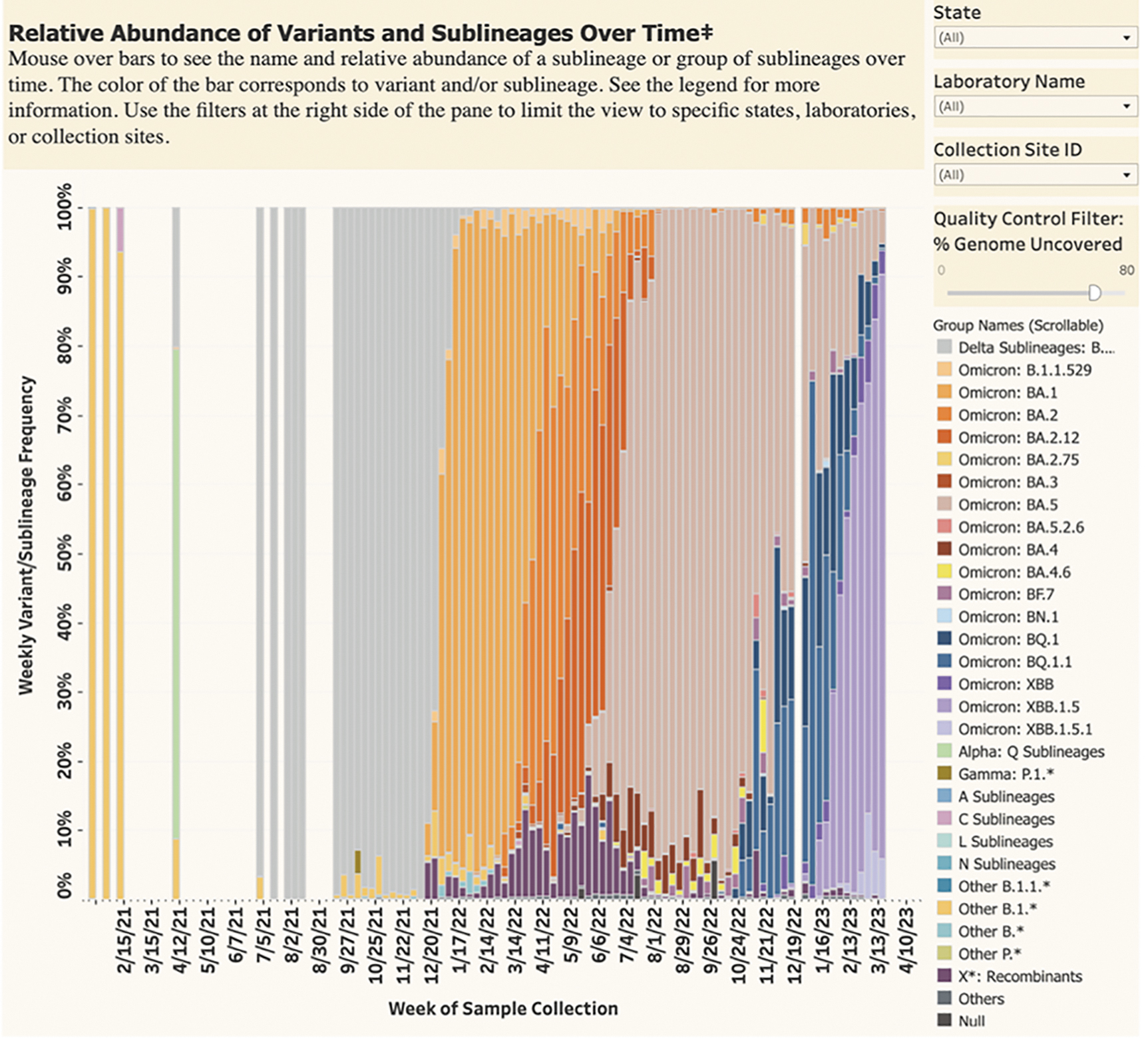
Amplicon sequencing example: relative abundance of variants and sublineages over time March 28, 2023 from the US Food and Drug Administration. 28
In principle, what has been done in wastewater analysis can also be done to improve the economics of air sampling for novel and emerging pathogens in an unbiased manner, by pooling multiple DFUs on a daily basis across the Pentagon campus to observe the trend. Rapid increases in the concentration of a specific microbial species or variant would serve as an early warning for a virus or bacteria in the air growing unexpectedly. In response to such a warning signal, an increased rate/depth of sequencing would be needed to confirm (eg, SNP or variant) and narrow down the location to identify the DFU it is coming from (typically not easy to do with wastewater), as discussed in the next sections.
Spikes and Artificial Intelligence
Spatiotemporally Correlated Spikes
Detection and identification of the smallest quantities of a pathogen may be needed for environmental background sampling. If the stringent requirement for detecting the smallest quantities is relaxed, aggregation or “pooling” of a larger number of DFUs in the network across fewer sequencing machines can substantially reduce the average daily cost and time within a budget targeted by PFPA. As explained in the US Air Force tactics for bioaerosol collection and identification, 29 the operational benefits of pooling a large number of DFU samples for analysis include a substantial reduction in expenditures on consumable materials, increased sample throughput, and lower total analysis times. However, pooling also theoretically increases the risk of a false negative due to sample dilution. If conducting genomic sequencing on all samples to retain full sensitivity is cost-prohibitive, how much pooling can still reduce risk by enabling daily genomic sequencing operations without excessive loss of sensitivity?
A “spike” in concentrations across the DFU network can be a cost-effective signal for a potentially novel pathogen. The US Air Force tactical doctrine for bioaerosol collection and identification 29 also points out that although it is unlikely, the possibility exists that a covert aerosol release of a biological agent would only be captured by a single DFU. The risk of this possibility can be mitigated by deploying more DFUs in the network. Because it is too expensive to use metagenomics to analyze all DFUs daily to search for pathogen signatures (eg, BSAT) at PCR-like sensitivity, an alternative is to detect unexpected spikes or sharp rises in the concentrations of pathogens across multiple DFUs. Although mixing or pooling “N” DFUs can result in slightly lower sensitivity due to sample dilution, this may be offset by the ability to detect spikes in bioaerosols (greater than “N” times higher concentration than original minimum sensitivity level for 1 DFU). Spike detection can be a cost-effective tradeoff if the pooled DFU network density is high enough to capture emissions near the source of bioaerosol release. In the case of contagious pathogens exhaled by infected people, such as SARS-CoV-2, spatially localized spikes of bioaerosol can be observed both as a result of proximity to a rising number of infected people and because bioaerosol emissions can vary by 1 or 2 orders of magnitude due to physiological differences among infected people.19,30,31 Temporally correlated spikes across an enterprise were measured by diagnostic test positivity among people infected asymptomatically with SARS-CoV-2. 32 These spikes closely tracked the rise and fall of test positivity within cities over 2 years, during which ancestral, Delta, and Omicron waves can be clearly seen.
Spike-Triggered Virtualization
Unlike PCR, the genomic sequencing process introduces errors into the reads of a pathogen's sequence; however, the error rate can be overcome by increasing the depth—the number of times a given nucleotide in the pathogen's genome has been sequenced (from repeated instances) in the sample. At a lower depth, it may be possible to confidently recognize the species of an emerging pathogen but not necessarily individual mutations within that species. At a higher depth, confidence in the characterization of the novel pathogen can be increased by more accurately recognizing features of that pathogen's genome, including SNPs, which have been implicated in increased pathogenicity or transmissibility of viruses.33-35 Once a spike at a chosen threshold concentration in the air indicates the presence of a potentially novel bioaerosol, to increase confidence it is necessary to confirm the presence of the novel pathogen at a higher depth and potentially also narrow its specific filter location. This can be done by reducing the pooling factor in subsequent sequencing of DFU samples, which increases the sequencing cost per filter in response to the detection of the spike. Multiplexing samples from different DFUs in a first sequencing run may be useful to immediately narrow down the locations of the spike, followed by increasing the depth in subsequent runs from the sample locations where the spike was detected.
Using a computer to concurrently run multiple tasks (in this case also genomic sequencing machines) and dynamically adjusting the resources up or down as needed by a task is known as “virtualization” in computer science. After a spike in RNA/DNA is initially discovered in a pooled sample at a low depth chosen to control daily costs, it is then necessary to sequence at a greater depth and reduce pooling in subsequent cycles, which is termed “spike-triggered virtualization” (STV). The purpose of sequencing at a higher rate (depth) is to rule out false positives, increase confidence in adopting temporary precautions (eg, N95, faster filtration, UV), and narrow down specific DFU locations. STV is illustrated in the model showing how the maximum allowable pooling factor per sequencing run or per machine (Figure 2), sequencing cost per filter (Figure 3), and annualized cost for the Pentagon pilot study (Figure 4) would vary as a function of minimum pathogen concentration and minimum sequencing depth of the trigger. By running at a high enough average pooling factor in the absence of spikes, the daily and annual cost per DFU can be reduced by 1 to 2 orders of magnitude (Figure 2) depending on the trigger thresholds chosen.
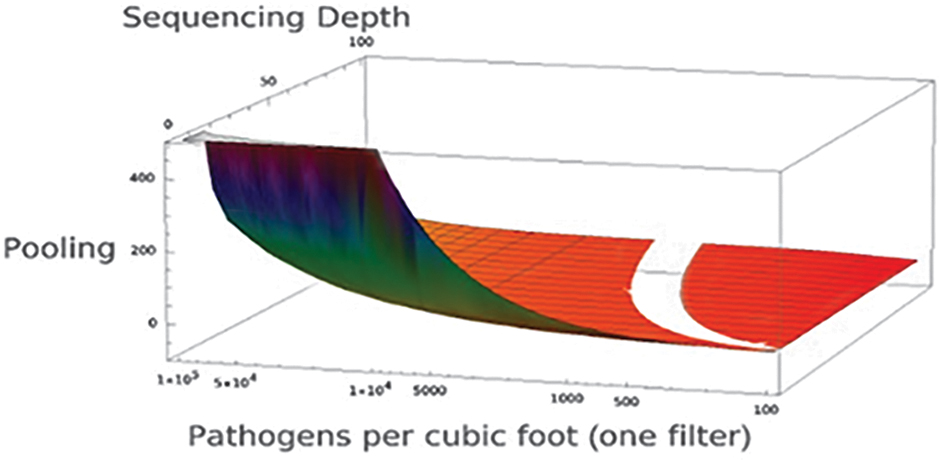
Pooled filters per sequencer in spike triggered virtualization.
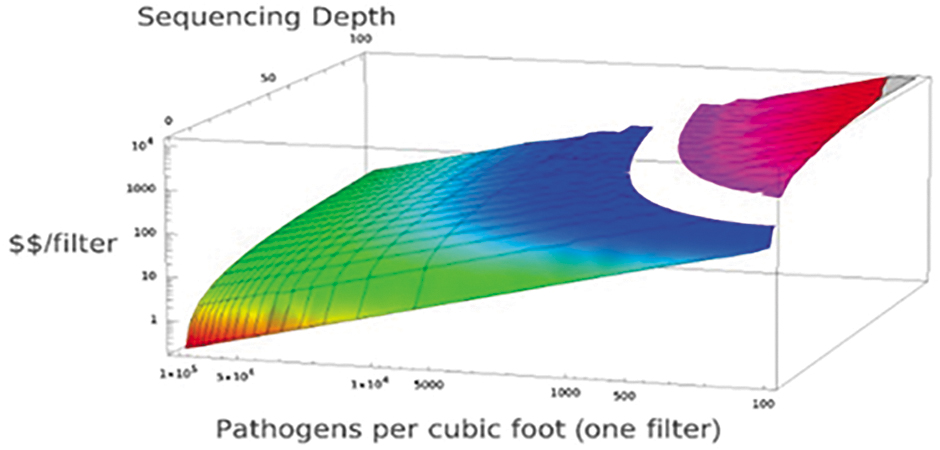
Costs per filter per day in spike triggered virtualization.
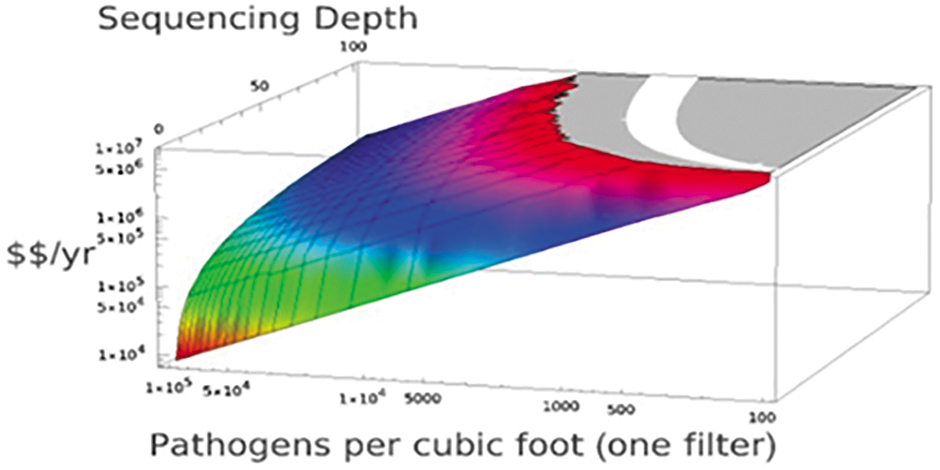
Estimated annualized costs for Pentagon pilot with spike triggered virtualization.
The pooling factor and costs are computed based on certain model assumptions (Supplemental Table S1; supplemental tables and figures may be found at www.liebertpub.com/doi/suppl/10.1089/hs.2023.0048) with varying pathogen density and depth (Figure 2). Although model assumptions can vary, the shape of the curves, as seen in Figures 2, 3, and 4, is similar. As the desired depth increases further, pooling may not be feasible at all pathogen concentrations, and instead, multiple sequencing runs (or machines) become necessary for each filter. This is depicted as a negative pooling factor in Figure 2, which is based on Supplemental Table S2. As with Supplemental Table S1, although model assumptions may vary, the shape of curves, as seen in Figure 2, remains similar.
Artificial Intelligence
The use of AI can further enhance the sensitivity and specificity of STV triggers. The sensitivity of the trigger for detection of pathogenic novelty in STV depends on the chosen threshold concentration to detect and identify the spike. Higher concentration relative to expected levels increases confidence in the detection of novelty (eg, “reference normalized reads” used by the Pentagon, which means rank-specific read count normalized by the number of reference genomes hit by the sequence read). However, to maintain efficiency and reduce daily cost, pathogens triggering a spike would need to be further filtered to exclude viruses that affect other kingdoms (eg, plants), which in 1 study comprised the bulk of sequenced microbes. 22 There are a few opportunities to enhance the sensitivity of the STV trigger with AI. First, some suggest that AI can be trained to recognize mutants of cross-kingdom viruses that are more likely to affect humans such as influenza. 36 In the Pentagon pilot study, contractors used alignment tools (bioinformatics analysis platforms) such as BLAST, 37 PanGIA, 38 and Kraken 38 to recognize novel pathogens and differentiate them from other pathogens that primarily affect plants and animals. However, novel human pathogens may not be entirely captured in the databases of known pathogens with these tools, and in some cases, they can be cross-kingdom (eg, plant viruses that can infect humans). 39 Second, AI could potentially be improved if it is trained to recognize novel sequences that match virulence markers or human cell entry receptors. 40 Third, AI can be trained to more robustly recognize novel pathogens present with artifacts from the sequencing process, such as multiple genome segments incompletely assembled with sequencing errors.
Infectious Disease
Subclinical Person-to-Person Contagion
PFPA recommends masks for high levels of COVID-19 in communities (see “Pentagon Reservation Services and Restrictions by HPCON Level,” specifically “Face Masks & Physical Distancing Indoors” for levels “Charlie” and “Delta”) 41 despite available measures such as ventilation, filtration, and UV light disinfection 42 for long-range risk reduction. Even with good ventilation, people who socialize or work with others in close proximity (eg, while eating lunch less than 3 feet from each other for 30 minutes) or who have fleeting contact in hallways are at risk for pathogen transmission. 43 A study of COVID-19 transmission in prisons found that inmates were much more likely to be infected if they were exposed to another infected person within their own cell than within the same cell block, possibly because exposure within the same cell is much closer and for a longer duration. 44 A study of digital contact tracing of SARS-CoV-2 among 7 million close contacts (eg, within about 6 feet) similarly concluded that although many exposures were short in duration, recorded transmissions typically resulted from exposures lasting from an hour to multiple days. 45 Reflecting the increased risks of transmission from extended durations of close contact, in 2020 the US Navy recommended that sailors should sleep in alternating head-to-foot positions where berthing configuration allows. 46
Multiple case studies show person-to-person spread can be subclinical or asymptomatic, which might be called a “stealth” airborne pathogen because it could infect a substantial portion of the population before resulting in symptoms that cause a visit to a clinic.46–51 In 2020, the US Navy reported that roughly 35% of sailors infected with COVID-19 among the uniformed navy population had “few to no symptoms.” 46 For example, in 2020, of approximately 5,000 sailors onboard the aircraft carrier USS Theodore Roosevelt, 416 tested positive for COVID-19 and 229 (55%) were asymptomatic, 47 resulting in the ship returning to shore. A similar situation was described on a French aircraft carrier, Charles de Gaulle. 48 Also in 2020, half of a nuclear submarine crew tested positive within 11 days, of whom 11% were asymptomatic at the time of testing, which also resulted in the submarine returning to port. 52 After these incidents, the US Navy implemented 14-day restriction of movement, testing, and “bubbles” without reporting another serious outbreak 53 ; these precautions were subsequently relaxed for vaccinated sailors. 54 The Marine Forces Special Operations Command highlighted that bubbles can still be breached by partner forces 55 (or potentially by peers during littoral suboperations). In a challenge trial inoculating healthy, unvaccinated young adults (ages 18 to 30 years) with SARS-CoV-2 and measuring their viral emissions using an air sampler, the extent of symptoms did not correlate well with measured viral emissions, and an asymptomatic individual was found to emit large amounts of virus for several days, including viable virus within a mask. 49 In a study documenting local transmission among Marine recruits during a supervised 2-week quarantine period, most who tested positive for SARS-CoV-2 were asymptomatic. 50 In 2021, 18% of 72 high school classrooms in South Africa had tuberculosis, likely subclinical infection, which was discovered only through bioaerosol sampling. 51
Same-day or next-day detection and identification can provide the early warning capability needed to break the transmission chains of a subclinical, contagious novel bioaerosol in the Pentagon (that spreads from person to person). For instance, experimental adaptation studies suggest that a few gene edits (SNPs) could turn a virus that is from the same family as measles, which is about 50% fatal in dogs, into a human virus.56-58 If an emerging, airborne measles-relative lacks vaccines or treatments, a 2-day delay in its detection and identification would result in most of the employees across the Pentagon campus being infected, based on the Monte Carlo simulation of contagion (Figure 5). Because the hypothetical human subvariant has only a small number of SNPs different from the more commonly occurring dog variant, expanded the sequencing depth in response to a detected spike is necessary to differentiate them.
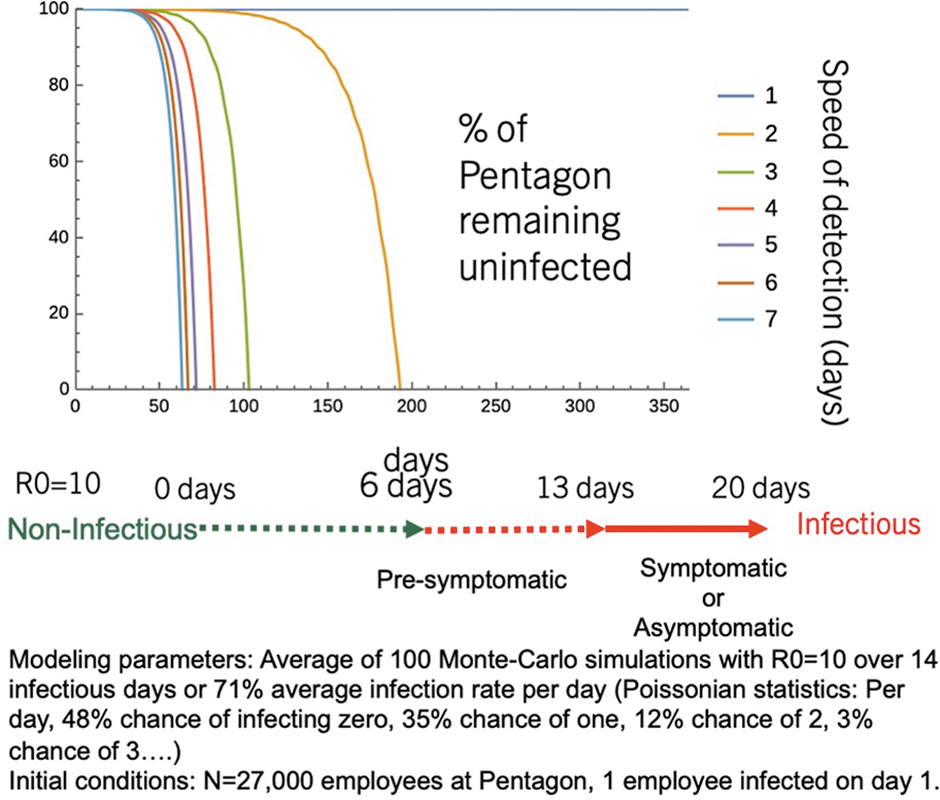
Monte Carlo simulation of contagion at the Pentagon.
Subvariants and Single Nucleotide Polymorphisms
An illustrative model is shown in Figure 6, depicting how increased sequencing depth improves the accuracy of detection and identification for single-SNP subvariants, such as the example dog variant discussed in the previous section. It is based on binomial distribution. It assumes the fraction of subvariants with that SNP is 1 in 15 (also known as allelic fraction), and it also assumes the error rate of the sequencing technology itself that could cause a false read of that SNP is 1 in 30. Figure 6 is a receiver–operator curve. It shows true positives versus false positives at different detection thresholds for the SNP, and it includes different sequencing depths of 100, 150, 300, and 1,000. In general, for true positives to exceed false positives, the base error rate must not exceed the allelic fraction of the subvariant being detected and identified. Otherwise, the positives would mostly be caused by sequencing errors, not actual SNPs.
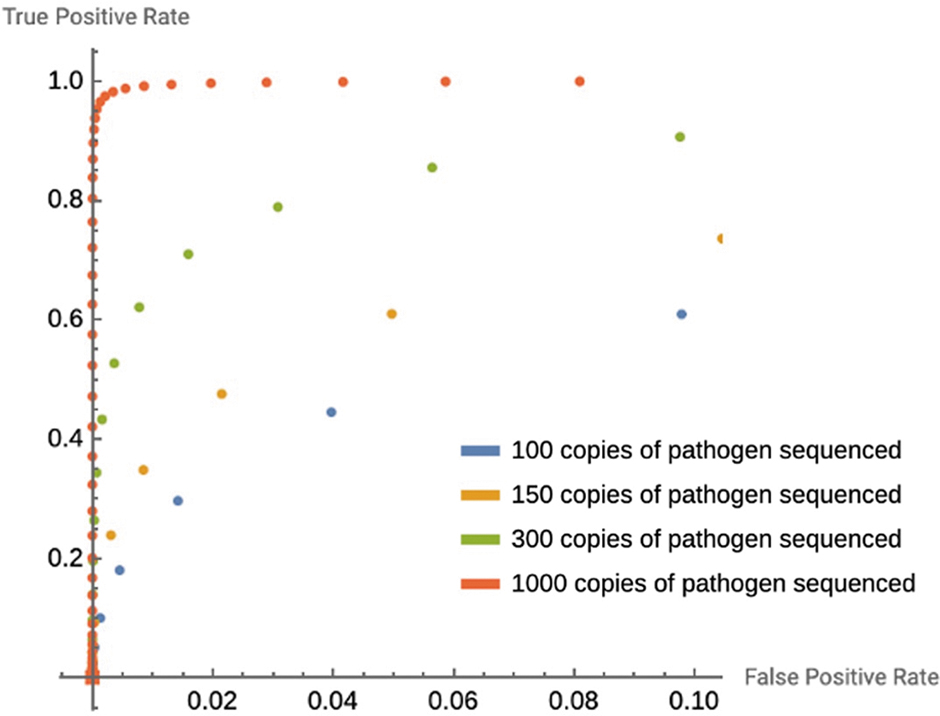
Receiver–operator curve detection for single-nucleotide polymorphisms.
A range of sequencing technologies is available, including long-read (nanopore) and short-read with differing error rates and other tradeoffs. Short-read sequencing has been reported to sequence at lower error rates, permitting detection and identification of subvariants at lower allelic fraction, 59 such as in the wastewater variant analysis illustrated in Figure 1. In contrast, long-read sequencing offers faster turnaround times and portability, with the tradeoff of higher error rates, which means that variants with low allele frequencies would remain a challenge; however, some solutions have been proposed to address this tradeoff. 60 The turnaround time (to detect and identify) with long-read sequencing is expected to be approximately 30 to 45 minutes 61 for certain sample types with a high abundance of the organism of interest and low background (eg, liquid cultures, colonies from a plate, powders) based on targets set for the Far Forward Biological Sequencing program by the Joint Program Executive Office for Chemical, Biological, Radiological and Nuclear Defense. 62 Even with rapid, long-read sequencing, detection and identification in bioaerosol samples is expected to take significantly longer than 30 to 45 minutes, including time for sample preparation, because the organisms of interest would be in lower abundance (high background). The optimal, cost-effective combination of sequencing technologies—such as potentially using long-read for early detection and identification of pathogen species within a few hours, followed by short-read for confirmation of subvariants within several hours to a day—remains an open question.
Detect-to-Treat Vulnerability
If daily metagenomic surveillance were to become feasible for daily operations at the Pentagon (with STV), it would still require sample collection and laboratory processing, introducing a delay within the 24-hour time period. This delay necessarily creates a window of vulnerability between when the incident occurred (“boom”) and when protective actions are taken (“right of boom”). This delay is typically no less than 12 to 24 hours, according to Air Force tactics, 29 during which people can still be infected. This residual risk remains with a contagious person-to-person pathogen, especially at close contact (Figure 7). The model compares infectious particle concentration in the absence of detection and identification to the reduction seen with 24-hour detection and identification (daily) and immediate use of protection after detection and identification. This model is based on linear decay in infectious particle concentration with distance from the infectious source. 63 Although assumptions for infectious particles can vary, this model mainly illustrates that daily metagenomic surveillance can substantially reduce risk a day after the initial incident, but it cannot alter what transpires between “right of boom” before initial detection and identification of NBTs up to or more than 24 hours later. To address this window of vulnerability, Air Force tactics describe the primary purpose of DFU network infrastructure deployment, sample collection, and screening of ambient air samples as providing “detect-to-treat” notification of a biological attack. The detect-to-treat approach allows time for commanders to recognize the need for effective medical treatment protocols and to implement them. While treatments exist for many BSATs, treatments for novel threats are unknowable in advance. In 2023, the DOD announced programs using advances in supercomputing-based drug discovery, like the discovery of Paxlovid, 64 to model new threats and generate potential treatments by modulating the immune system through 6 metabolic routes. 10 Although Paxlovid for SARS-CoV-2 was a breakthrough, it took years to discover it among many alternatives, verify its safety and efficacy in humans, and then manufacture and distribute it, at first in very limited quantities to the public. It is unclear if such breakthroughs are safely replicable in real time for an emerging bioaerosol threat that comes along in the future. Even with future biomedical advances, treatments are at high risk of being unavailable in the event of bioaerosol threats for several reasons. For NBTs, novel treatments may be unsafe, ineffective, or delayed. For BSATs, treatment-resistant variants of a BSAT may emerge, 65 or even if they work, there may not be enough doses or treatment facilities during a surge, especially at the population level (eg, as seen during the 2014-2016 West African Ebola epidemic and more recently with COVID-19 and Paxlovid early on after its release). Due to limited manufacturing facilities, treatments are also hard to manufacture on demand during a surge unless they are stocked in advance.
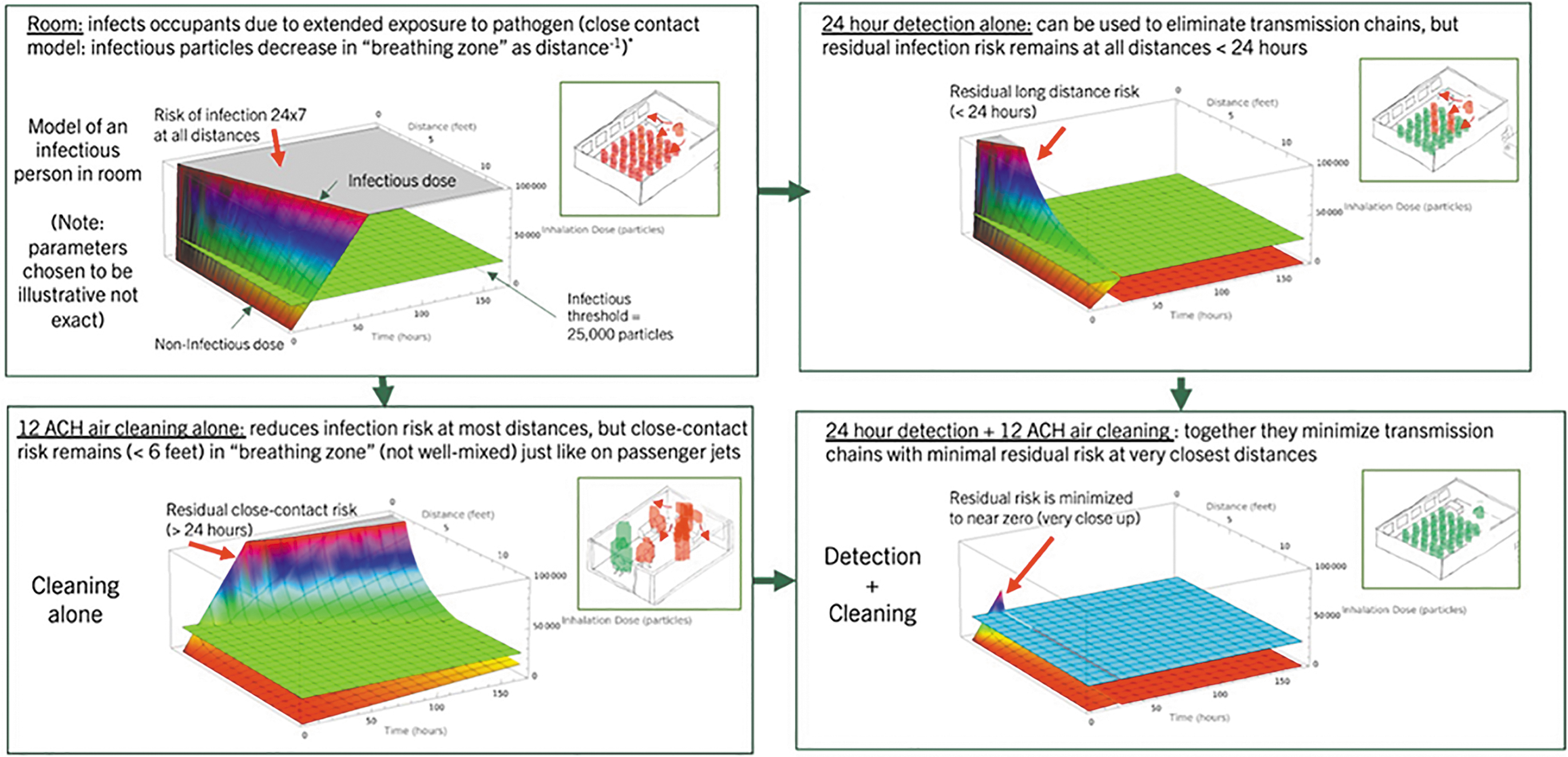
Model of reduction of infectious particle concentration combining both detection with and air filtration. 63
Air Cleaning
Indoor Air Cleaning to “Close” the Detect-to-Treat Window
The use of continuous air cleaning indoors to remove bioaerosols can help defuse the “boom” by reducing risks during the detect-to-treat window of vulnerability, since approximately 90% of people's time is spent indoors at school, work, home, or asleep. 66 During the Delta and Omicron waves of COVID-19, an 80% lower infection risk (person-to-person) was observed in Italian classrooms that were ventilated at the rate of an estimated 5 to 6 air changes per hour (ACH).67,68 To use a nuclear analogy, if NBTs are like radioactive air, then the “half-life” (= loge(2) ÷ ACH) is inversely proportional to the ACH (Figure 8). The half-life illustrates that the higher the ACH, the faster any pollutant impulse is mixed, diluted, and attenuated, thereby reducing cumulative exposure to occupants in the room. The residual level of particle concentration remaining (Supplemental Figure S1) depends directly on the rate of particle entry or emission into the room and is inversely proportional to the ACH. 69
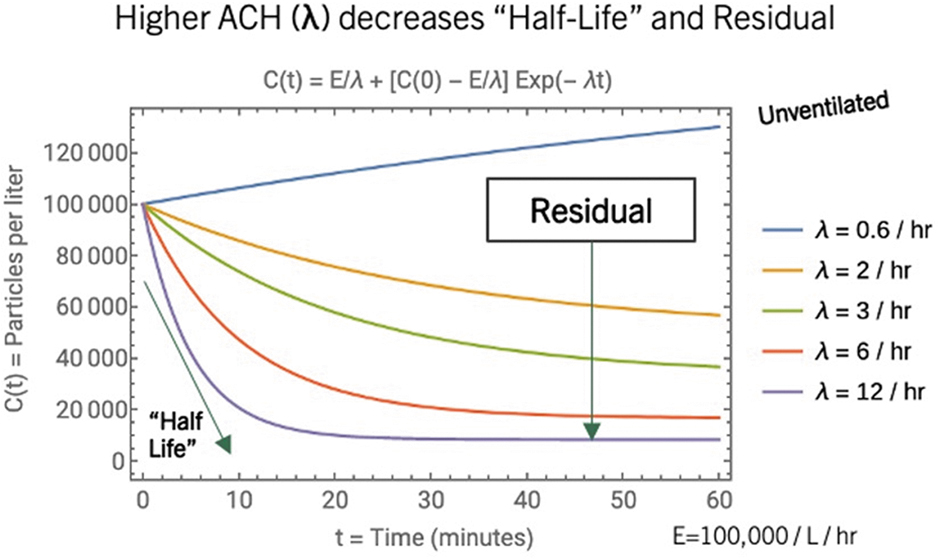
Relationship of air changes per hour to particle concentration.
Air Changes Per Hour Needed for Infection Control
A rate of at least 12 ACH is needed for infection control, as suggested by 3 data points, described as follows.
First, on May 12, 2023, for the first time, the US Centers for Disease Control and Prevention (CDC) recommended a universal target of 5 ACH as the minimum air cleaning rate needed to reduce the risk of aerosol-transmitted infections like COVID-19 in occupied indoor spaces, such as offices and homes. 70 However, in 2022, CDC experts indicated that more than 12 ACH (half-life < 3.5 minutes) may be necessary to stop the spread of SARS-CoV-2 in some scenarios, even though they were not aware of outbreaks in spaces ventilated at 5 to 6 ACH.71,72 The volumetric rate of clean air (CADR) needed in a room to meet 6 ACH is 100 cubic feet per minute (cfm; 100 cfm=60×100 cf per hour) for every 1,000 cf. Accordingly, to achieve 12 ACH, the CADR needs to equal to 200 cfm per 1,000 cf.
Second, real-world evidence of the relation of infection risk with high-speed air filtration can be seen with infection rates aboard passenger aircraft. According to the CDC, jet aircraft built after the late 1980s recirculate cabin air through filters, and through high-efficiency particulate air (HEPA) filters in most newer-model airplanes. 73 Measurements conducted by the author of the ACH on 3 passenger jets inflight (Airbus A319, Airbus A321, Boeing 737 Max 8/9) were in the range of 11 to 12 ACH, suggesting that 12 ACH could substantially reduce infection risk from aerosolized pathogens.
Variability of viral emissions among infected people is a possible explanation for the superspreading phenomenon because “a few individuals account for a large portion of spreading,” as described by the US Navy. 46 In a preprint of COVID-19 infected patients, 31 the number of viral RNA copies exhaled per minute varied by 3 to 4 orders of magnitude between people, and it did not decrease significantly until day 8 from onset of symptoms. The study also found that levels of exhaled viral RNA increased with self-rated symptom severity but did not differ across age, sex, time of day, vaccination status, or viral variant.
Multiple authors have observed that superspreading incidents aboard airplanes with high passenger densities occurred less frequently than might be expected with so many passengers contained in such a small space.74,75 Contact tracing is not conducted for most flights, but Australia and New Zealand tracked infections on arriving international flights in the early days of the pandemic and required passengers to be tested during mandatory quarantine. As of October 20, 2020, out of 62,698 arriving passengers, New Zealand identified 215 who tested positive but reported only 1 instance of inflight superspreading. 76 Australia reported 3 flights with superspreading.77,78 If we expect approximately 10% of infected people to be superspreaders, 79 this would equate to about 20 out of 215 passengers arriving in New Zealand who tested positive, and dozens more in Australia, given its larger size. Several researchers have hypothesized about why we do not see more superspreading aboard flights. Some initially credited the institution of mandatory masking for dramatically reduced superspreading aboard flights.74,75 However, even before mandatory masking aboard aircrafts, there were relatively few published reports of superspreading events. 75 Another possible explanation may be low levels of passenger mixing involving close contact because passengers are confined to seats most of time; however, a study of 10 transcontinental flights showed ample mixing opportunities. 80 If masking or mixing do not account for lower than expected superspreading on flights, a possible remaining explanation is air filtration.
Indoor testing of ACH typically involves generating test aerosols (eg, saltwater, smoke, tracers), which may be unsafe or disallowed, for example, in occupied rooms or passenger aircraft. The procedure used by the author to verify ACH on the aircraft relied on ambient aerosols and is based on the model for ambient aerosol decay in the Supplemental Appendix (www.liebertpub.com/doi/suppl/10.1089/hs.2023.0048). At each point in time, the aerosol concentrations (count per liter) were measured using a 7-channel handheld optical particle counter called the Temtop PMD 331 (calibrated to meet ISO-2150). Each measurement was taken for 30 seconds at the most penetrating particle size (MPPS) of 0.3 μm. In multiple studies, SARS-CoV-2 was cultured from submicron aerosols.81-83
Since an airplane is an uncontrolled environment, several transient aerosol fluctuations can also be observed in aerosol particle counts by the handheld optical particle counter at MPPS (0.3 μm) after takeoff for the following 3 airplanes:
Third, in general it takes a 20-fold reduction of aerosol concentrations to reach the equivalent of 95% filtration, as nominally required for N95 respirators, which needs at least 12 ACH if not more. Miller et al 69 describe a time-dependent approximation (Equation 3) for viral particle concentration (C) with 1 or more infected persons emitting virus at rate (E per hour) in a well-mixed room of volume (V) with ACH (λ per hour), which at equilibrium is: C = E / (λ V). In an unventilated room (ie, without any indoor ventilation or air filtration), the particle removal still includes surface deposition with a contribution to λ estimated in a wide range of 0.3 to 1.5. In experiments conducted by the author, described in the Supplemental Appendix, the ACH from surface deposition in a room was measured to be approximately 0.6. Assuming surface deposition contributes 0.6 to λ, a 20-fold reduction in aerosol concentrations to achieve N95-equivalent filtration at far-field—at a larger distance when air is well-mixed within the room—requires the rate of ACH (λ) from air filtration to be 12.
One caution is that indoor air cleaning, in general, is predicted to reduce near-field exposure—less than 6 feet—to exhaled aerosols to a limited extent 63 dependent on aerodynamic factors. 84 Modeling studies report that the air “jet” exhaled by a person infected with a virus is entrained (mixed) with surrounding air indoors as it flows from the infected person; therefore, the cleaner the indoor air, the lower the virus density and infection risk, even at short range. 63 However, a CDC laboratory 85 experiment found that in-room air filtration does not reduce exhaled breath exposure to simulated participants sitting very close to an infected person (near-field) to the same degree that it can do so at a larger distance when air is well-mixed within the room (far-field). Respirators remain useful for reducing risk to both near-field and far-field exposures, whereas air filtration can mitigate far-field exposure in a well-mixed environment.
Retrospective analyses showed that the use of KN95 and N95 respirators by both community members 86 and in healthcare settings 87 resulted in lower COVID-19 infection compared with the use of cloth and surgical masks. Across a variety of manufacturers, the average filtration efficiency of N95 respirators at 0.3 μm particle size was found to be much higher at 98% and more consistent than KN95 respirators at 81%. 88 A level of 98% filtration efficiency is reassuringly higher than the 95% filtration efficiency nominally required for N95, although N95 fit 89 and filtration efficiency 90 may degrade with reuse over several hours (and wearing an N95 with poor fit is like closing the windows of a car door but leaving a crack open). The N95 average of 98% filtration efficiency requires a 50-fold reduction in inhaled aerosols (ACH=30) and the KN95 average of 80% filtration efficiency requires 5 times (ACH=3) in an unventilated room assuming surface deposition contributes 0.6 to ACH.
Portable Air Filtration
It is not possible to ensure protection from NBTs or BSATs using outdoor air for indoor ventilation if the source of the bioaerosol release is from outdoors, unless the outdoor air is nearly 100% disinfected or filtered when entering the building, which is often cost-prohibitive. The infection rate of a simulated anthrax release from any localized source (eg, point or line) has distance-dependent dilution of bioaerosols. 91 Below a certain threshold, the infection risk decreases sharply when the inhaled dose is reduced by 1 order of magnitude or more.
With some exceptions, a rate of more than 4 ACH of filtered, recirculated air using centralized heating ventilation and air conditioning (HVAC) systems is also uneconomical because the cost of energy needed to transport the air remotely to an HVAC rises approximately as the cube of ACH (ACH 3 ). 92 This is not including the costs of conditioning the air temperature at these higher airflow rates.
To push above 4 ACH to 12 ACH and beyond, in-room air cleaning methods, such as air filtration and germicidal ultraviolet (GUV) technology, can be used economically. The cost of recycling indoor air, by locally cleaning it within the same room rather than in a remotely located HVAC system, scales up linearly proportional to target ACH (ACH to the power of 1) and the room's volume. Public health authorities including the CDC, 70 US Environmental Protection Agency (EPA), 93 White House,94,95 and California Department of Public Health 96 recommend the installation of portable air filtration, HEPA or do-it-yourself (DIY), for use in all schools, homes, and businesses. HEPA air purifiers are widely available in retail channels and are in widespread use in US households to cut down ambient aerosol concentrations, not only from infectious pathogens such as SARS-CoV-2, influenza, and respiratory syncytial virus, but also allergens, cooking pollution (eg, frying, toasting), wildfire particulates, wood-burning particulates, road pollution (eg, diesel soot), and industrial pollution.
In 1 experiment conducted by the author (Supplemental Figure S5), ambient particle counts at 0.3 μm MPPS in a room within a California home were reduced by almost 50-fold from outdoors to indoors within 40 minutes after closing the windows and running 9 ACH of DIY air filtration. This is easy to replicate except near bioaerosol sources or in close contact with infectious people (Figure 7).
GUV (eg, far UV) has been used in applications across the DOD, 42 in hospitals for infection control, and to some extent for short-term or temporary exposure in public spaces. The CDC describes far UV as a “promising technology” with ongoing research and testing to validate claims of safety and efficacy. 70 At this time, a debate also remains unresolved about long-term safety and appropriateness for extended, daily use of GUV, 97 especially in regard to excessive generation of volatile organic compounds, ozone, and formation of secondary aerosols,98-103 which may be carcinogenic. 104 Multiple studies also report instances of UV-resistant pathogens,105-109 possibly including Clostridium botulinum 110 and its toxin.111,112
Portable air filtration exceeding 12 ACH may have additional security applications beyond aerosolized biothreats. As discussed earlier, some biological agents could be UV resistant, but they can be filtered from indoor air because they are aerosolized. Chemical warfare agents may be either aerosolized or in the form of gas/vapor.113-116 Radiological agents117-119 and nuclear fallout from a ground burst120-126 can both be aerosols. To simultaneously protect from chemical, biological, radiological, and nuclear (CBRN) airborne threats, the DOD designs buildings with collective protection (“ColPro”) by combining 3 essential elements: overpressure, air filtration (HEPA for aerosols, ASZM-TEDA-activated carbon for gas/vapors), and controlled entry and exit. 127 ColPro dates back to the 1980s, and for a medium-sized ship in the Navy, it costs between $100,000 and $300,000 to replace the bank of M98 filters used for air filtration approximately every 18 months128,129 (each M98 has a capacity of 200 cubic feet per minute and costs over $1,000 129 ). The same M98 filters are also used for ColPro systems in some medical shelters, tents, combat vehicles, and permanent buildings. The design of ColPro also relies on tightly sealing the indoors from outdoors to minimize leaks. According to DOD criteria, the internal air filtration rate is determined by the air leakage rate at design overpressure, ventilation rate for exhaust requirements, and amount of outdoor air to satisfy indoor air quality requirements, 130 all of which may be well below 12 ACH. The integrity of ColPro hinges on strictly maintaining low leakage, preventing internal release, and ensuring operation/maintenance of the entire system including high-pressure fans, filter system, airlock, and decontamination station. ColPro is fragile to breaches in the building structure that cause leaks, security gaps permitting outsiders to enter, contagious aerosol exhalations by insiders, and breakdown of the multiple system components. Apart from a limited number of facilities, ColPro cannot be economically deployed and maintained in most locations and it appears to be uneconomical for larger structures such as aircraft carriers.131,132 In the large proportion of buildings with leaks, low-cost portable air filtration with 12 or more ACH may not offer 6-log reduction of outside aerosols, but it can be cost-effective to quickly mitigate the operational costs/challenges with ColPro by extending a 2-log or more collective protection umbrella to reduce CBRN risks among a much wider range of buildings including those with leaky construction. As noted earlier, protection from chemical agents may also require gaseous filtration capability in addition to particulate filtration. Testing by EPA suggests that filters made of activated carbon, including those derived from coconut husk (Ionex 03-001), were effective for filtering some chemical agents such as sarin and sulfur mustard. 133 As discussed later, such forms of activated carbon are found in some low-cost, commercial off-the-shelf air filters and fans, which would need to be tested for their efficacy in the filtration of chemical agent gases and vapors.
Combination of Detection and Air Cleaning
With continuous indoor air cleaning to reduce bioaerosol concentration, treatment is not the only option upon detection of an NBT. After detection, exposure to bioaerosols can be further reduced by establishing emergency protocols for use during the detected disaster-incident. These temporary measures include well-fitting, comfortable respirators 134 (eg, N95, N99, P100) both outdoors and indoors, and optionally with temporary indoor use of GUV and higher speed air filtration. The model of Figure 8 is used to estimate the combination effect on reduction of infectious particle concentration (person-to-person contagion) using both detection and filtration in Figure 7. Specifically, Figure 7 shows the combined effect of 24 hours-a-day/7 days-a-week detection with 12 ACH air filtration in the room. In the model, detection alone allows a window of infection and filtration (and/or UV) alone still allows infection in the “breathing zone,” but in combination they minimize risk. At each distance from the bioaerosol source (infected person), the air filtration reduces exposure to the bioaerosol until detection of the incident (during the detect-to-treat window), and subsequently postdetection risk is minimized due to additional protections or treatment that maybe used. Unlike GUV, which gradually deactivates pathogens suspended in aerosols, the addition of indoor air filtration removes biological aerosols that would have otherwise been captured by DFUs for collection/sequencing, that in turn is likely to require sequencing of the genetic material captured on the air filters themselves instead of DFUs.135-138 In the experiments conducted by the author, described in the Supplemental Appendix, the ACH from surface deposition in a room was measured to be approximately 0.6. This suggests that a potential alternative to bioaerosol sampling to be evaluated is the use of environmental surface sampling within the room, 139 although much more biological material would likely accumulate within air filters running at multiple air changes per hour.
MERV 13 and Higher DIY Air Filtration
DIY air filtration using HVAC filters with a minimum efficiency reporting value (MERV) of 13 or higher, in conjunction with box fans, can achieve indoor air filtration results comparable to HEPA filtration but at a cost of up to 10 times less. 140 To reach more than 10 ACH in rooms with typical 8- to 10-foot ceiling heights, HEPA purifiers running at tolerable noise levels cost in the range of $2.00 to $5.00 per square foot, whereas MERV 13 and higher DIY air purifiers cost $0.50 to $1.00 per square foot, as verified in tests described later. In 2022, NIOSH conducted a “crash test” of MERV 13 and higher DIY air purifiers, using aerosols at 0.3 μm to 0.6 μm MPPS, to verify whether they are capable of stopping viruses between test dummies. 141 In these tests, findings showed that 12 or more ACH was achievable in a typical classroom size of 6,000 or more cubic feet, but it took more than 1 DIY air purifier. In 2021, EPA-sponsored testing of DIY air filtration by Underwriters Laboratories found that popular box fan models remained safe after stress tests with loaded and blocked filters. 142 DIY air purifiers not only reduce bioaerosol risk and improve air quality in general, but they may also double as low-cost bioaerosol collectors in lieu of DFUs.135,136
Using similar methods for measurement of ACH as used in the passenger airplanes described earlier, the ACH-derived CADR is estimated below (Supplemental Table S3) for a variety of HEPA and DIY models tested using a uniform methodology relying on ambient aerosols. The author assembled MERV 13 or higher DIY models using the Patient Knowhow instructions for Supplementary Air Filtered Exchanges. 143 As a general trend, the cost per 1,000 cfm is significantly lower for MERV 13 or higher DIY configurations ($279 to $699) than for HEPA purifiers ($334 to $1,300). Noise is an important aspect for end-user acceptance, and 20-inch box fans made by Lasko running at their lowest speed are widely used in classroom applications. The HEPA purifiers were tested at their highest speed. Notably, the lowest noise for MERV 13 and higher DIY air purifiers used 10 PC fans (“Tower of Power,” 429 cfm). The lowest noise HEPA purifier was the SmartHealth Blast, 829 cfm. Both had comparatively high levels of CADR compared with most other models. A typical classroom size of 10,000 cubic feet would require 1,000 cfm to reach 6 ACH, and 2,000 cfm to reach 12 ACH. Of these models, the lowest cost approach would be to use the DIY box fan with 2-inch MERV 13 from Nordic Pure as assembled 143 and tested, 140 which translates to approximately $0.50 per square foot for rooms with typical 10-foot ceiling heights to reach more than 10 ACH. The cost per square foot would increase proportionally for other models based on the cost per 1,000 cfm below.
Supplemental Figure S6 shows the percentage difference between ACH-derived CADR (Supplemental Table S3) and the expected CADR reported by the manufacturer of HEPA purifiers and derived from airflow/efficiency measurements for MERV 13 and higher DIY purifiers. 140 Supplemental Figure S6 also compares this percentage difference to the maximum airspeed measured at the output of each purifier. The ACH-derived CADR (at MPPS) for MERV 13 and higher DIY air purifiers and for 1 HEPA purifier was lower than that expected from airflow/efficiency measurements for DIY, and those reported by that manufacturer for HEPA, but it was also significantly higher for the remaining HEPA purifiers. One possible explanation may be the maximum airspeed (not airflow) measured at the output of each of the purifiers. The purifiers with higher airspeed may contribute to higher rates of mixing within the room, resulting in a higher rate of air cleaning and observed CADR, and, conversely, lower airspeed may contribute to lower mixing, resulting in some degree of recirculation of clean air near the purifier. This suggests that a possible way to improve air purifier design is to enhance the airspeed to promote better mixing.
Air filters tested that incorporate some amount of activated carbon for gas/vapor filtration include the 5-inch Lennox MERV 16, Honeywell Turbo HPA-5100B, Coway AP-1216L, Coway Airmega 400, and SmartHealth Blast. Like CADR is to particles, a new metric called chemical-CADR (C-CADR) has been derived by the Association of Home Appliance Manufacturers to measure the ability of commercial air cleaners to filter chemicals (gases) and was released in 2022 as part of a standard called AC-4. 144 Due to differential rates of filtration based on different chemicals, whether C-CADR is also useful to select air cleaners for chemical agent filtration is a question that remains unanswered.
Operation and Maintenance: Filter Longevity and Replacement Cycle
With air filtration products, the filters experience a drop in filtration efficiency and may need to be replaced at some point after they have been used.145,146 All experimental data in this section were collected by the author. Measurements of the filtration efficiency for 5-inch Lennox MERV 16 filters used in DIY air purifiers at the MPPS of 0.3 μm using the technique based on ambient aerosols 140 are shown in Supplemental Figure S7. These filters installed in February 2022 were used daily for approximately 6 months and compared with fresh filters installed in an elementary school in October 2022, with all measurements taken in October 2022. 147 The usage pattern was 5 days per week during school hours. Supplemental Figure S7 shows that some filters appear to have lower filtration efficiency than others, possibly due to gradual loss of electrostatic charge since these are electret filters. The lower the efficiency, the lower the clean air delivery rate, although the efficiency typically remains higher at larger particle diameters. Depending on the chosen threshold for replacement, policies for replacement intervals can be chosen based on testing the filters individually, or they may be replaced periodically (eg, annually) without testing each. Generally, HEPA filters are expected to retain filtration efficiency longer than HVAC filters, but actual results will vary based on usage and environmental conditions.
In Supplemental Figures S8 and S9, the filtration efficiencies of the same filters measured in October 2022 are compared with longitudinal measurements of these filters in June 2023 after a full academic year of daily usage. The average filtration efficiency of the batch of filters installed in February 2022 changed from 77% in October 2022 to 74% in June 2023 (Supplemental Figure S8), and filters installed in October 2022 changed from 93% in October 2022 to 91% in June 2023 (Supplemental Figure S9). In contrast to Supplemental Figure S7, each x value in Supplemental Figures S8 and S9 represents 1 unique filter instance comparing its filtration efficiency at different time points (October 2022 and June 2023). Although the filtration efficiency of some filters appears to have dropped, others appear to have increased, possibly reflecting random variation in measurement of ambient aerosols. However, most filters experienced minimal change in filtration efficiency over the course of the year.
Supplemental Figure S10 shows the filtration efficiencies of the same filters that had been measured in October 2022 and June 2023 compared with longitudinal measurements in February 2024 after 2 full academic years of usage, and compared with filtration efficiencies of 2 types of HEPA purifiers (HEPA A and HEPA B) in daily use at the school since 2021. Each dot represents a different filter instance for each type of filter, and the x-axis is in ascending order of filtration efficiency (not time). As measured in February 2024, the filtration efficiencies of the Lennox MERV 16 (installed in October 2022) and both types of HEPA purifiers were similar, but the average filtration efficiency of the Lennox MERV 16 (installed in February 2022) degraded significantly from 74% in June 2023 to 63% in February 2024. Although the filters installed in February 2022 are still useful, this suggests the Lennox MERV 16 needs to be replaced after 2 years of daily usage during school hours.
A lower-grade MERV 13 filter from Lennox costs about half as much as the MERV 16. Measurements (tests) of the filtration efficiency for both grades of 5-inch Lennox filters used in DIY air purifiers at the MPPS of 0.3 μm using the technique based on ambient aerosols 140 are in Supplemental Figure S11 (MERV 13) and Supplemental Figure S12 (MERV 16). These filters were installed in summer 2023 and were used daily for approximately 6 months in a middle school. Each value represents 1 unique filter instance comparing its filtration efficiency at different time points (summer 2023 and February 2024). In summer 2023, the average filtration efficiencies of the MERV 13 and MERV 16 were 91% and 96%, respectively, but by February 2024 they had dropped to 78% and 90%, respectively. This suggests the MERV 16 is likely to significantly outlast the MERV 13 over time, but because the MERV 13 costs less, it can be replaced more frequently with the same budget.
The wide variance of filtration efficiency seen in Supplemental Figures S7 through S12 suggests that a conservative approach to filter management is to first test the filters semiannually or annually and replace them only when they show degraded performance.
Reusable Options for Personal Respiratory Protection
Indoor filtration such as HEPA, DIY, or ColPro offer mask-free protection from indoor ambient aerosols; however, as noted earlier, they do not provide protection outdoors and provide limited protection when in close contact with infectious people indoors. Respirators such as N95, N99, or P100 (if well-fitted with working filters) provide protection both indoors and outdoors, including during close contact with infectious people. The 2023 Biodefense Posture Review 18 stressed the need for advance stockpiling, manufacturing, supply chain management, and planning for respirators, which becomes critical especially for disposable respirators because they are quickly used up in a short time. In contrast, reusable respirators, known as elastomerics, can last for a year, 148 avoiding much of the supply limitations.149-152 However, a downside of both disposable and elastomeric respirators is that they obstruct facial expression. Powered air-purifying respirators are airtight and cover the entire head and neck with transparent facial shields and built-in air filtration to permit facial expression, but the airtight sealing limits eating or drinking while worn.
Positive pressure face shields with eating ports are an alternative concept that may overcome the difficulties with respirators and powered air-purifying respirators by simultaneously providing (1) personal respiratory protection, (2) close contact, (3) facial visibility, (4) and the ability to eat and drink. As shown in Supplemental Figure S13, 99% filtration of ambient particles (at 0.3 μm or MPPS) was still observed with a battery-powered, air-circulating, industrial face shield after cutting a hole for easy access to the mouth as an “eating port.” The face shield is a commercial off-the-shelf industrial helmet with “high-efficiency solid particulate filtration” (HEPA-like) used primarily by carpenters to protect their face and lungs from woodworking dust. 153 The airflow (5 cfm) is projected like a curtain from vents just above the face, creating positive pressure throughout the facial enclosure but without relying on an airtight seal. The particle counts measured by the handheld optical particle counter (Temtop PMD 331) directly at input versus output of its air filter and fan show a filtration efficiency of 99.5% at 0.3 μm. Once a rectangular hole was cut in the plastic face shield to permit eating and drinking, outdoor counts (0.3 μm) were greater than 56,000 per liter, but inside face shield counts were less than 500 per liter, demonstrating a filtration efficiency exceeding 99%. Airspeed via the hole was measured by an anemometer exceeding 150 feet per minute. With the hole, it was possible to easily eat a candy bar and see facial expressions. The positive pressure face shield proof-of-concept needs further development and should not be used for personal protection until it has been fully tested and validated under a broader range of test cases. However, it demonstrates possibility, with some refinement to overcome limitations of traditional respiratory protection to enable facial expressions and eating and drinking that could perhaps be integrated as an option into existing helmets with a 2-log or more protection factor.
Next Steps
The accuracy of a trigger for detection and identification of pathogenic novelty in STV depends on the chosen threshold concentration to detect and identify the spike. There are opportunities to enhance the sensitivity of the STV trigger further with AI. The quality of AI prediction is fundamentally limited by the training data, which includes both positive and negative training examples. The negative examples (background) are abundant, but the positive examples are relatively scarce because the database of known human pathogens available to train from are relatively few. The latter may limit the predictive capability of AI for as-yet undiscovered human pathogens.
Exposure to bioaerosols postdetection can be reduced by establishing protocols for the duration of the detected incident, including the use of well-fitting, comfortable respirators (eg, N95, N99, P100) both outdoors and indoors, optionally with temporary indoor use of GUV and higher speed air filtration. However, people can still be infected during the 24-hour window between a bioaerosol incident and its detection. In large-scale studies of classrooms, airborne infections were reduced by 80% with indoor air cleaning at 5 to 6 ACH, which was cited by the CDC when recommending a minimum 5 ACH in all occupied spaces. 70 This infection risk can be further reduced economically with high-speed indoor air cleaning of more than 10 ACH, similar to the ACH level observed on passenger airplanes in flight. A level of 4 ACH or more is likely to be cost-prohibitive using central HVAC systems, but 10 ACH or more can be achieved economically using portable air filtration in rooms and the cost scales linearly with ACH. For typical ceiling heights (less than 10 feet), 10 or higher ACH can be installed for a cost of approximately $0.50 to $1.00 per square foot for DIY and $2.00 to $5.00 per square foot for HEPA.
It is unlikely that a covert aerosol release of a biological agent would be captured only by a single DFU, but the possibility exists. The risk of this possibility can be mitigated with deployment of more DFUs in the network. If infected people exhale contagious pathogens, such as SARS-CoV-2, spikes of bioaerosol can be observed, not only as a result of increasing numbers of infected people (temporally correlated “waves”) but also likely because bioaerosol emissions can vary by 1 or 2 orders of magnitude due to physiological differences among infected people.
The daily cost of detection and identification of NBTs (using STV) scales linearly proportional to the daily cost of metagenomic sequencing, number of bioaerosol collectors (DFUs or air filters) sequenced, and inversely proportional to the desired, average daily STV pooling factor. If detection within 24 hours is achievable, the detect-to-treat doctrine for BSATs becomes a risk with NBTs because novel treatments either may not exist, or if they do, they may be hard to access.
The next steps are to develop and execute a test plan for a fieldable “clean room” to measure and validate the reliability and cost-effectiveness of detecting and identifying simulated biological agents using STV and AI alongside “collective” portable air filtration at 12 or higher ACH for CBRN threats. These tests need to be conducted in a controlled environment of buildings lacking the tightly sealed design of ColPro (representative for the target application), such as an array of small shelter systems of approximately 650 square feet or rooms in an office or school campus. An indoor air filtration system in test rooms using DIY air cleaners with an ACH or 12 or higher helps to close the gap between simulated biothreat release and its detection in DFUs to secure from emerging bioaerosol threats. Tests of air filtration include measuring any differences in the efficacy of filtering simulated aerosols and gases from CBRN, externally (outdoors) and internally (indoors) released. The simulated agents may include both ambient and generated aerosols such as saltwater 141 and solid particles. 154 The US Army uses 0.3 micrometer polyalphaolefin for aerosols and dimethyl methylphosphonate for chemical warfare agent testing (surrogate for nerve agents). 155
The following list is made up of 3 sets of tests in order of dependency, the first 2 are lab tests and the last is a real-world test. The first set is to verify the feasibility of filtering simulated contaminants in the air and detecting the simulated pathogens from these filters efficiently using STV. The second set is to verify the ability of AI to improve detection of novel pathogens amidst the background. The last is a test of the scalability of filtration, STV, and AI to a campus the size of the Pentagon to verify economical daily operations over an extended timeframe.
Testing AI requires verifying the accuracy of its predictions of known harmful pathogen sequences (true positives) and benign background sequences (true negatives) that the AI has not yet been trained on. The following tests address the question of how AI improves detection of novel pathogens:
Building on the groundwork in the Pentagon pilot study, a DFU and/or air filter network infrastructure in a campus or office at a similar scale as the Pentagon pilot is needed to verify economical daily operations of using metagenomics for detection and identification of novel bioaerosol threats, based on STV to detect spatiotemporally correlated spikes.
Conclusion
Biothreats in the air are not limited to BSATs and can include novel SNPs. Accurate detection of NBTs and bioaerosols requires high-quality gene sequencing, which is costly and time-consuming. The Pentagon pilot highlighted economic barriers to adoption of metagenomics for emerging bioaerosol threat detection and identification on a daily or routine basis. If the Pentagon is experiencing these economic barriers, they are likely to be experienced at many other secure facilities as well as civilian buildings around the world. Barriers included the reagents used for metagenomics being 2 orders of magnitude more costly than PCR, in addition to the cost of sequencing instruments and labor to analyze the bioinformatic data. These economic barriers can be addressed in principle by dynamically pooling samples from the network of DFUs, called spike-triggered virtualization, whereby the pooling factor and sequencing depth are modulated automatically based on novel biothreats in the sequencing output. For contagious pathogens, same-day or next-day detection and identification is necessary to provide early warning capability to break transmission chains, as verified by a Monte Carlo model of contagion by the Pentagon. By running at a high enough average pooling factor, the daily and annual cost per DFU can be reduced by 1 to 2 orders of magnitude depending on the trigger thresholds chosen. As a rough order of magnitude estimate, if 1,000 bioaerosol collectors (eg, DFUs or air filters) are distributed throughout the Pentagon at a cost of $1,000 daily to sequence each collector without pooling, for 1,000 filters the annual cost would range from $3.7 million (at a pooling factor of 100) to $37 million (at a pooling factor 10) to $365 million (without pooling).
Exposure to bioaerosols postdetection can be reduced by establishing protocols for the duration of the detected incident, including the use of well-fitting, comfortable respirators (eg, N95, N99, P100) both outdoors and indoors, optionally with temporary indoor use of GUV and higher speed air filtration. However, people can still be infected during the 24-hour window between a bioaerosol incident and its detection. This infection risk can be reduced economically with high-speed indoor air cleaning of more than 10 ACH, similar to the ACH level observed on passenger airplanes in flight and the cost scales linearly with ACH. For typical ceiling heights (less than 10 feet), 10 or higher ACH can be installed with MERV 13 or higher for a cost of approximately $0.50 to $1.00 per square foot that also collectively protects from aerosolized CBRN risks.140,156 By comparison to the annual costs of metagenomic sequencing estimated in the preceding paragraph, the annual cost of 10 or higher ACH would be in the range of $3 to $7 million. This estimate is based on an area of approximately 6.5 million square feet and the annual replacement of filters at approximately $0.50 to $1.00 per square foot for MERV 13 and higher (estimated for ceiling heights less than 10 feet). Because high-speed indoor air filtration reduces the concentration of bioaerosols that would otherwise be captured by DFUs for collection and sequencing, air cleaning may necessitate sequencing of the genetic material captured on the air filters themselves instead of DFUs. An approach to further reduce the cost and extend the lifespan of filters would be to conservatively replace only the filters or fans that show degraded performance after testing them semiannually or annually. 140
Footnotes
Disclaimer
The resources and information in this article are for informational purposes only and should not be construed as professional advice. The content is intended to complement, not substitute, the advice of your doctor. You should seek independent professional advice from a person who is licensed and/or qualified in the applicable area. No action should be taken based upon any information contained in this article. Use of the article is at your own risk. The author is not associated with any of the manufacturers mentioned in this research. Patient Knowhow, Inc. takes no responsibility and assumes no liability for any content made available in this article.
References
Supplementary Material
Please find the following supplemental material available below.
For Open Access articles published under a Creative Commons License, all supplemental material carries the same license as the article it is associated with.
For non-Open Access articles published, all supplemental material carries a non-exclusive license, and permission requests for re-use of supplemental material or any part of supplemental material shall be sent directly to the copyright owner as specified in the copyright notice associated with the article.
