






Abstract
The Biological Threat Reduction Program, part of the Nunn-Lugar Cooperative Threat Reduction Program since 1991, is mandated by the US Congress to regularly provide public reporting as part of its accountability. The Biological Threat Reduction Program recently designed a metrics and evaluation framework to measure its impact and effectiveness in partner countries. The framework focuses on capacity and capability strengthening related to biosafety, biosecurity, and biosurveillance. This is a marked shift from the previous approach, which relied on more tangible outcomes such as the elimination of weapons of mass destruction production assets, delivery devices, munitions, and construction activities. The new metrics and evaluation framework tracks the program's impact across 24 biosafety, biosecurity, and biosurveillance metrics and numerous capability, capacity, sustainability, and regional leadership indicators for human and animal health systems. The framework uses quantitative and qualitative inputs to generate measurement scores for program investment in partner countries. Overall, the framework provides a robust feedback loop between requirements, plans, and implementation processes throughout each step of the program's annual management lifecycle.
Introduction
Founded in 1991 by US Senators Sam Nunn (D, Georgia) and Richard Lugar (R, Indiana), the Department of Defense Nunn-Lugar Cooperative Threat Reduction (CTR) Program was created with a clear and concrete goal in mind: to secure and dismantle weapons of mass destruction (WMD) and associated infrastructure in the former Soviet Union. 1 The CTR Program aimed to secure or eliminate the large WMD arsenals and infrastructure inherited by former Soviet Union countries after the Soviet Union's collapse. 2 In its early years, the program focused mostly on demilitarization of chemical and biological weapon production facilities, destruction of chemical munitions and nuclear missiles, and demolition of WMD delivery vehicles in the former Soviet Union partnering countries, including Armenia, Azerbaijan, Georgia, Kazakhstan, Russia, Ukraine, and Uzbekistan.1,3
Since the inception of the CTR Program, Chapter 48 of US Code Title 50 requires that congressional investments in CTR demonstrate concrete evidence of threat reduction: “The Secretary of Defense shall implement metrics to measure the impact and effectiveness of activities of the Program to address threats arising from the proliferation of chemical, nuclear, and biological weapons and weapons related materials, technologies, and expertise.” 4 To meet these requirements, the CTR Program, through its Biological Threat Reduction Program (BTRP), implemented a scorecard (Figure 1) to showcase programmatic metrics progress to its stakeholders.
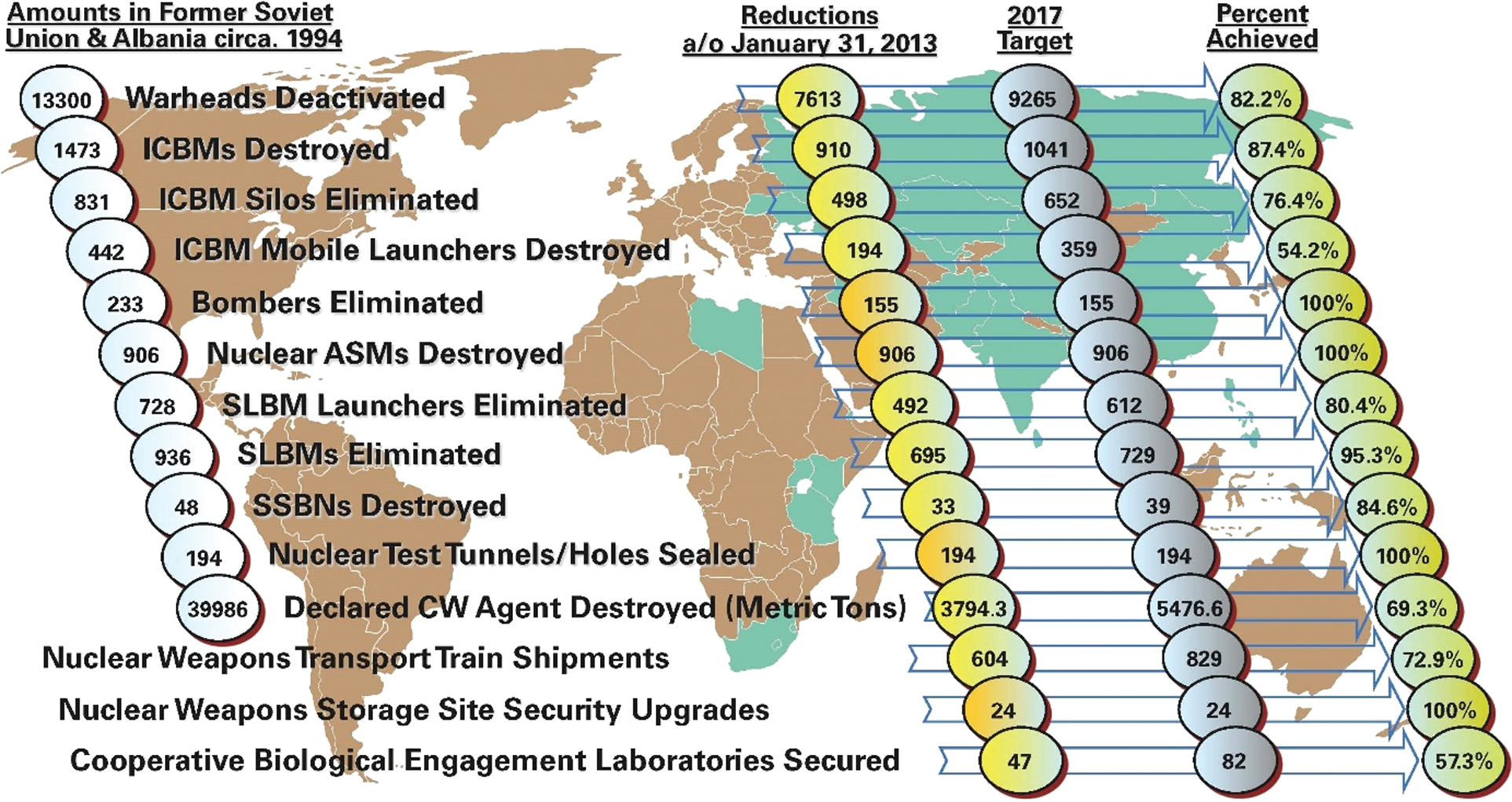
Cooperative Threat Reduction Program's 2013 metrics scorecard.
The scorecard focused heavily on tangible outcomes such as the elimination of WMD production assets, delivery devices, munitions, and construction activities completed under the CTR Program. However, the BTRP information provided in the scorecard counted the number of facilities BTRP built and equipped but did not fully consider capabilities BTRP supported in conjunction with construction or its cooperative biological research program.*
This approach aligned well with the majority of CTR activities being conducted at the time and provided simple and reliably quantitative measurements, wherein the number of destroyed missiles, bombers, submarines, or facilities constructed clearly demonstrated the CTR Program's threat reduction value to the US Congress and the American public. 1
With the conclusion of the former Soviet Union's demilitarization 3 and a changing geopolitical environment, the CTR Program evolved and expanded into a broader countering WMD mission through implementation of capacity and capability strengthening programs around the globe. Over the years, BTRP has evolved from a narrowly scoped bioweapon infrastructure elimination program to a broader national security program, focusing on reducing natural, accidental, or intentional outbreaks that can cause potential harm to the United States or its allies. 6 The program now aims to enhance biosurveillance † and biosafety ‡ and biosecurity § systems in partner countries around the world. BTRP's desired end state is that partner countries have effective and sustainable biological threat mitigation systems that meet recognized international standards. BTRP's current mission is to improve the ability of partner countries to: 7
Rapidly and accurately survey, detect, diagnose, and report biological terrorism and outbreaks of pathogens and diseases of security concern**
Identify, consolidate, and secure collections of especially dangerous pathogens to prevent the sale, theft, diversion, or accidental release of such pathogens
BTRP's evolved mission focuses exclusively on the less prevalent but more impactful group of especially dangerous pathogens (as defined by the US Select Agent List), whereas other US government offices predominantly work on more commonly occurring pathogens in partner countries.
In contrast to the original CTR scorecard, BTRP's shift from dismantling and destroying bioweapon infrastructure and stockpiles to improving global health security capacities and capabilities presented unique challenges for measuring and communicating the program's impact in partner countries. BTRP may have had occasional case studies that clearly demonstrated the program's impact on 1 or more discrete objectives at a point in time, the program impact on a larger scale was inconsistently measurable. A new metrics framework was needed to more accurately measure the progress and impact of BTRP's national security mission, which is focused on complex capacity and capability strengthening components.
Methods
As early as 2009, the RAND Corporation recommended that the WMD community develop a common framework to assess the effectiveness of strengthening partner capacity programs and noted that assessing capability and capacity is difficult. 9 Recognizing that the original CTR scorecard methodology no longer applied to its diversified programmatic activities, BTRP embarked upon a 4-phased approach to develop a revised programmatic measurement framework.
Phase 1: Obtain Third-Party Recommendations
BTRP commissioned the National Academy of Sciences (NAS) in 2012 to review its evolved mission and metrics process to make recommendations on rectifying them. NAS published a 2012 report, Improving Metrics for the Department of Defense Cooperative Threat Reduction Program, 10 which found that the program had reasonable metrics for consolidating and eliminating WMD but was unprepared to measure the newly added capacity and capability strengthening components. NAS recommended that BTRP shift their focus from the numbers of activities implemented, people trained, or facilities constructed, and instead focus on measuring biological threat reduction capabilities and capacities that demonstrate what countries could do after engaging with BTRP that they could not do before.
To develop the NAS recommendations into a regular, repeatable, and reliable methodology for the program, BTRP commissioned RAND to provide suggestions for an initial metrics framework. In addition to the NAS recommendations, RAND's 2014 report on Measuring Cooperative Biological Engagement Program (CBEP) Performance 11 relied on extensive interviews with BTRP personnel to develop an initial logic-based metrics framework for the BTRP domains: biosecurity, biosafety, and biosurveillance. For each domain, RAND identified and characterized potential BTRP metrics according to validity, feasibility, utility, reliability, and relevance. Overall, RAND identified 73 potential metrics and further divided BTRP domains into subelements, with capacity and capability rating schemes to quantify program efficacy.
Phase 2: Develop Guiding Principles
Upon receiving the recommendations, BTRP embarked on analyzing suggested metrics and evaluating them for the feasibility of implementation. The program's goal was to develop and implement a multitier metrics system to measure and report the program's progress and impact in partner countries. To achieve this end, BTRP established the following guiding principles and parameters for finalizing the metrics framework:
Use a tiered approach to information analysis and reporting to address decision making needs of multiple levels of stakeholders, such as US Congress, Defense Threat Reduction Agency (DTRA) and CTR leadership, BTRP division chief, and BTRP project officers Address only BTRP's scope, mission, and engagement realities Make it measurable and quantifiable to the maximum extent possible Use a standardized and repeatable approach Use data that are feasible to obtain Make it practical to implement
Phase 3: Evaluate and Adapt
BTRP used the guiding principles to review, evaluate, and adapt the recommendations from NAS and RAND. The program then used qualitative methods, such as focus groups, document analysis, and facilitated workshops, to complete the process of developing the metrics framework. BTRP focus groups included BTRP leadership, interdisciplinary subject matter experts, and other relevant stakeholders. The BTRP mission and scope dictated the composition of the subject matter expert focus groups, which included medical doctors, epidemiologists, laboratorians, veterinarians, health information technologists, and biosafety and biosecurity experts.
To evaluate the recommendations, the focus groups analyzed a set of relevant, discipline-specific metrics data against the guiding principles and evaluated the feasibility and applicability of each metric. BTRP consolidated individual evaluations and recommendations into a single change log for tracking and further adjudication, which BTRP presented to a broader subject matter expert panel to finalize the metrics framework. Two notable examples of metrics evaluation are described in Table 1.
Metric Evaluation Examples
Abbreviations: BTRP, Biological Threat Reduction Program; N/A, not applicable; NAS, National Academy of Sciences; RAND, RAND Corporation.
Once BTRP finalized the list of programmatic metrics, the subject matter experts developed a set of supportive indicators for each metric. They conducted further stakeholder interviews and document analysis to identify measurable and repeatable indicators that aligned with the programmatic metrics. Finally, they developed a proposed measurement scale and a descriptive methodology for each metric. Throughout development, BTRP conducted multiple peer reviews to seek external validation of the approach, including input from experts at the Walter Reed Army Institute of Research, the US Centers for Disease Control and Prevention, and Sandia National Laboratories.
Phase 4: Refine and Finalize
To further refine and operationalize the measurement approaches, BTRP revised the metrics framework on 2 separate occasions. The first revision occurred in 2014, when BTRP conducted country capability assessments to collect real-time data from 2 partner countries. This effort resulted in minor adjustments to the metrics framework. BTRP then conducted a second and more extensive metrics framework refinement and validation by conducting assessments of 21 countries and integrating lessons learned as further adjustments to the metrics methodology. 12
Results
As noted in Table 2, the BTRP metrics framework measures the program's impact across 2 main pillars: (1) biosurveillance and (2) biosafety and biosecurity. BTRP subdivided the pillars into 7 associated lines of effort, 24 programmatic metrics, and 170 capability, capacity, sustainability, and leadership indicators. BTRP measures the pillars separately for human and animal health sectors. BTRP's Cooperative Biological Research Project supports all lines of effort in both sectors.
Biological Threat Reduction Program Pillars, Lines of Effort, and Example Indicators
Abbreviations: BS&S, biosafety and biosecurity; PPE, personal protective equipment.
The biosafety and biosecurity pillar includes 3 lines of effort: (1) national-level regulatory frameworks, (2) consolidating and securing pathogens, and (3) facility-level biorisk management systems and culture. The biosurveillance pillar includes 4 lines of effort: (1) disease detection, (2) laboratory diagnostics, (3) epidemiological analysis and investigation, and (4) reporting and communications. All programmatic metrics and indicators measured within the 2 pillars focus exclusively on BTRP's congressionally mandated mission. For example, indicators associated with disease detection do not cover medical treatment components, as patient treatment is outside of BTRP's mission.
As noted in Table 3, BTRP measures progress on a scale of 1 to 5. Pillar scores are aggregated from line of effort scores, which are aggregated from programmatic metric subscores. Full descriptions of the pillar metrics by line of effort are located in Table 4 and Table 5.
Biological Threat Reduction Program Metrics Scale
Biological Threat Reduction Program Biosafety and Biosecurity Lines of Effort and Descriptions
Abbreviations: BRM, biorisk management; BS&S, biosafety and biosecurity; BTRP, Biological Threat Reduction Program; EDPs, especially dangerous pathogens.
Biological Threat Reduction Program Biosurveillance Lines of Effort and Descriptions
Abbreviations: BSV, biosurveillance; BTRP, Biological Threat Reduction Program; EDPs, especially dangerous pathogens.
Finally, the BTRP metrics framework calculates 4 distinct measurement scores for each pillar, line of effort, and programmatic metric: start, current, threshold, and objective. The start score measures conditions before BTRP engagement with partner countries; the current score measures scores during period metrics reviews (no less than 1 per year); the threshold score is the realistic “target” determined by BTRP based on actual plan and available funding; and the objective score is the potential score that could be achieved in 5 years based on a country's technical capabilities, with no funding, legal, or political/cooperation constraints. Calculations for each score are generated from the 170 capacity, capability, regional leadership, and sustainability indicators. BTRP uses all 4 scores to inform requirements generation and key planning documents. BTRP does not publicly share the annual review scores. However, the program encourages partner countries to use relevant BTRP data in their decision-making process for improving capabilities in biosurveillance, biosafety, and biosecurity.
Discussion
BTRP launched the program-wide metrics framework implementation in 2016 and has conducted annual reviews of metrics performance since 2017. Annual metrics measurements occur through internal desktop reviews or in-country operational evaluations performed by third parties. Annual measurements capture progression and regression along the 5-point scale and result in programmatic course corrections and provide accountability to Congress. To date, the metrics framework demonstrates a reliable and repeatable ability to measure program progress and determine capability maturation. Overall, BTRP is achieving expected incremental progress in strengthening capacity and capability across the 2 pillars in most partner countries and uses metric scores to identify lines of effort that require a more targeted focus. In addition, the system captures not only progress but also regression due to political or other external factors, thereby enabling course correction.
The metrics framework development and implementation process has had a positive impact well beyond BTRP's ability to measure progress. For example, the approach has triggered widespread refinements to BTRP's internal program acquisitions and planning processes. As a result, the metrics framework now underpins most components of BTRP's annual management cycle, provides a baseline for the entire program, and ensures that BTRP measures progress in each partner country using standardized language, pillars, lines of effort, and indicators. The metrics also support every programmatic requirement development in BTRP's individual country project plans and cooperative biological research projects. Lastly, BTRP uses the metrics framework to structure its approaches to internal program management reviews. Consequently, BTRP now has a functioning, integrated annual management cycle, in which the metrics framework plays a key role by providing a consistent feedback loop between programmatic requirements, project plans, and the implementation process throughout each step of the cycle.
By integrating the lessons learned from BTRP, other CTR programs are in the process of updating their own metrics frameworks. Streamlining and standardizing an impact measurement process across CTR programs ensures common reporting protocols within DTRA and enables data analysis and harmonization in reporting to the US Congress. By building upon the BTRP metrics framework and lessons learned, partner CTR programs can more rapidly develop and implement their own metrics frameworks.
Externally, BTRP is becoming known for its robust metrics framework and expertise. The program's efforts have both influenced and strengthened collaborative efforts with interagency partners. For example, BTRP recently worked with US Centers for Disease Control and Prevention and the United States Agency for International Development to develop an interagency framework for reporting on US government contributions to the Global Health Security Agenda. The goal of the effort is to deconflict measurement tools and techniques across the interagency, reduce redundancies, and address reporting gaps with the purpose of drafting an all-encompassing metrics framework across the US government for measuring Global Health Security Agenda progress within partner countries across the US government. In addition, BTRP's framework complements and contributes to Joint External Evaluations. 13
Developing and implementing a robust new metrics framework comes with challenges. First, the metrics framework has significant technical requirements including data storage, validation, and analysis. Second, integrating legacy engagements or new types of future engagements into the framework requires further development. Third, large-scale implementation across all BTRP engagements requires organizational culture shifts, with associated change management considerations, including gaining adoption and buy-in from the program managers. Finally, while the framework measures the program's progress in an individual country, the framework does not yet consistently measure more complex regional impact nor return on relationships.13,14
During the development of this article in 2020, NAS published a report entitled A Strategic Vision for Biological Threat Reduction: The U.S. Department of Defense and Beyond. 6 The report noted that BTRP has a complex mission that relies on coordinating with many partners domestically and internationally. The program is also challenged with ongoing revolutions in the life sciences, ease of access to information, rapid transportation of people, and widespread trade in animals and plants. All point toward novel threats from new actors, shorter timelines, and less geographic protection. The NAS report discusses the following key areas for a 5-year vision: embrace an integrated view of biological threats, identify needs and opportunities, select international partners, select partners in the United States, strengthen relationships and build networks within the department of defense, and evaluate progress and refine approaches. Engaging new partners or expanding partnerships with other implementation programs requires a good understanding of where impact can be made in partner countries. This will require further analysis to provide a common operating picture to help determine where the most impact can be made with the overall limited resources dedicated to health security and preparedness. The BTRP metrics framework will be used as a tool to determine how to best implement key recommendations from NAS and measure their impacts.
To build upon the momentum established during implementation of BTRP's metrics framework and revised annual management life cycle, a critical next step is to implement a more robust technology application for gathering, analyzing, and visualizing metrics data that is easily understood by all stakeholders. Moreover, the effort to harmonize metrics between BTRP, DTRA counterparts, and interagency partners operating in health security must continue in order to have a common operating picture of partner country progress. Lastly, the metrics framework needs to be further developed to measure regional progress and assess sustainment of engagements that have met capability goals where partner countries have moved into self-sustainment.
Footnotes
Acknowledgments
Immense appreciation and deepest gratitude are extended to the following organizations that contributed to making this manuscript possible: National Academy of Sciences, RAND Corporation, US Centers for Disease Control and Prevention, Walter Reed Army Institute of Research, Defense Threat Reduction Agency, Cooperative Threat Reduction Program, Office of the Deputy Assistant Secretary of Defense for Countering Weapons of Mass Destruction, Deputy Assistant Secretary of Defense for Threat Reduction and Arms Control, Biological Threat Reduction Program, Cooperative Threat Reduction Assistance and Advisory Support contract. The authors also wish to thank Peter Hare, Rebecca Dunfee, Jill Rowley for their support reviewing and editing the manuscript.