






Abstract
We conducted a comprehensive, multi-phase laboratory evaluation of the Tularemia BioThreat Alert® (BTA) test, a lateral flow assay (LFA) for the rapid detection of Francisella tularensis. The study, conducted at 2 sites, evaluated the limit of detection (LOD) of this assay using the virulent SchuS4 strain and the avirulent LVS strain of F. tularensis. In 6-phase evaluation (linear dynamic range and reproducibility, inclusivity, near-neighbor, environmental background, white powder, and environmental filter extract), 13 diverse strains of F. tularensis, 8 Francisella near neighbors, 61 environmental background organisms, 26 white powders, and a pooled aerosol extract were tested. In the 937 tests performed, the Tularemia BTA demonstrated an LOD of 107 to 108 cfu/mL, with a sensitivity of 100.00%, specificity of 98.08%, and accuracy of 98.84%. These performance data are important for accurate interpretation of qualitative results arising from screening suspicious white powders in the field.
Tularemia is a zoonotic disease caused by Francisella tularensis, a Gram-negative facultative intracellular bacterium. F. tularensis is one of the most infectious pathogens known, with an estimated ID50 for humans of <10 colony forming units (cfu).1-3 There are 2 primary subspecies of F. tularensis that vary in virulence: F. tularensis subsp. tularensis (type A) and F. tularensis subsp. holarctica (type B). 4 Infection with as few as 25 aerosolized organisms is established with F. tularensis subsp. tularensis. 5 Humans can become infected through diverse environmental exposures (eg, blood-feeding arthropods, direct contact with an infected animal, or indirectly via tools used for animal dressing) and can develop severe and sometimes fatal illness; however, they do not transmit their infection to others. 6 Infection can occur through inhalation or inoculation of the skin or mucous membranes. When bacteria enter through the skin or oral mucous membranes, enlarged and tender regional lymph nodes will be noted on physical examination. 4 Primary clinical forms of tularemia vary in severity and presentation according to the virulence of the infecting strain, inoculum size, and site of inoculation. Primary disease includes ulceroglandular, glandular, oculoglandular, oropharyngeal, pneumonic, typhoidal, and septic forms. 6 The incubation period for tularemia is 3 to 5 days (range 1 to 14 days) and is characterized by an abrupt onset, with fever, headache, chills and rigors, generalized body aches, coryza, and sore throat. 6 Before the use of antibiotics, the fatality rate for tularemia caused by type A strains was 5% to 15% and, in the more severe respiratory form, 30% to 60%; currently, the fatality rate is <2%. 6 Tularemia caused by type B strains is generally nonfatal but may have a protracted course with complications. 4
F. tularensis has long been considered a potential biological weapon. The Japanese purportedly studied this organism at their germ warfare research unit (Unit 731) operating in Manchuria between 1932 and 1945. 7 This microorganism was also weaponized by the Soviet Union and included strains that were engineered to be resistant to antibiotics and vaccines. 8 F. tularensis was developed as a nonlethal agent by the US military through devices that would disseminate aerosols of F. tularensis. 9 WHO estimated 10 that the release of 50 kg of F. tularensis by an aircraft along a 2-km line upwind of a population center of 500,000 would result in 30,000 deaths and 125,000 people incapacitated. Because of prior weaponization, low infectious dose, dissemination potential, public health impact and needs for broad-based public health preparedness efforts (eg, improved surveillance, laboratory diagnosis and stockpiling of specific medications), F. tularensis was assigned to Category A 11 and is a Tier 1 select agent. 12
The environmental niche occupied by F. tularensis is not well characterized. The bacterium can grow in vitro on rich laboratory media, but its nutritional requirements make it unlikely that it is a free-living microorganism in nature. 13 Infected rodents, hares, and rabbits are important sources of human infection; 14 however, they may not be the true reservoirs of infection, because, in these species, tularemia is an acute infection. Outbreaks of human disease often parallel outbreaks of tularemia in animals. 13 Several outbreaks of tularemia due to type B strains have been associated with contaminated water supplies15,16 Water contamination could result from the presence of infected urine, feces, or carcasses; however, it could also be due to the presence of organisms in the cysts or trophozoites of fresh water amoebae. 17 F. tularensis is often difficult to isolate from environmental samples, 18 but a selective medium has been developed for the isolation of F. tularensis and its near neighbors. 19 To complicate matters, a number of Francisella-like bacteria have been identified in environmental samples (eg, soil, water, air)20,21 and ticks, 22 indicating considerable diversity within the Francisellaceae and suggesting that these organisms are more common and more widely distributed than previously thought. The presence of these near neighbors has complicated the detection of F. tularensis on filters from environmental aerosol collectors using real time PCR assays.23,24
A biological attack involving F. tularensis might involve dispersal of the agent by aerosol.25,26 Other modes of delivery could mimic the 2001 anthrax attack, which used the mail to disseminate spores of Bacillus anthracis.27,28 During the 2001 anthrax attack, many public health laboratories and first responders were inundated with suspicious white powders because of fear and panic among the public. 29 When first responders encounter unknown white powders in the field, it is important to quickly evaluate them for the presence of biological threat agents to support appropriate public safety actions such as evacuation, closure of facilities to prevent additional exposure, decontamination of potentially exposed individuals, collection of samples for law enforcement and public health purposes, containing the material as appropriate to prevent secondary dissemination, and expediting the transfer of samples to the nearest laboratory response network (LRN) laboratory for immediate testing.
In order to support first responders with the appropriate tools to carry out their mission, there is a need to develop, evaluate, and validate rapid screening tools for testing suspicious white powders for the presence of biological threat agents of concern. A number of biodetection technologies are available for use by first responders for this purpose, including rapid antigen detection assays. 30
The purpose of this study was to evaluate the limit of detection, sensitivity, specificity, reproducibility, and limitations of an LFA for F. tularensis (Tularemia BTA Test, Tetracore®, Inc.). The goal of this study was to determine whether the Tularemia LFA can provide reliable results, so that appropriate and effective decisions can be made by first responders to support public safety actions and avoid unnecessary fear, panic, and costly disruptions to society. This study was designed to provide an understanding of assay performance, including the likelihood of a false-negative result (ie, assay is negative but the analyte is present at a concentration above the limit of detection), a false-positive result (ie, assay is positive but the target analyte is not present in the sample), and the robustness and reproducibility of this assay for use in the field. This study was designed and executed through an interagency collaboration with participation from subject matter experts from the Department of Homeland Security (DHS), the Department of Health and Human Services (HHS), the Department of Justice (DOJ), the United States Department of Agriculture (USDA), and the United States Secret Service (USSS).
Materials and Methods
Biosafety Considerations
Strains used in this study were handled with appropriate biosafety conditions in accordance with Biosafety in Microbiological and Biomedical Laboratories (BMBL, 5th ed) 31 and Federal Select Agent Regulations.
Tularemia BTA Test and BTA Reader MX
Tularemia BTA Kit, BioThreat Alert Reader MX (BTA Reader MX), and Tetracore BTA Buffer were obtained from Tetracore, Inc. (Rockville, MD). The performance of the Tularemia LFA and reader was evaluated at 2 test sites: samples containing viable virulent strains (including SchuS4) of F. tularensis (a Tier 1 Select Agent) and near neighbors were evaluated at the Centers for Disease Control and Prevention (CDC), and all other samples and the avirulent F. tularensis live vaccine strain (LVS) were evaluated at Omni Array Biotechnology (Rockville, MD). Samples for analysis were prepared at the CDC, Lawrence Livermore National Laboratory (LLNL), and Omni Array Biotechnology. Samples were diluted and analyzed and results were captured both visually and with the BTA Reader MX according to directions provided by the manufacturer—that is, between 15 and 30 minutes after adding the sample (150 μL) to the sample well of the lateral flow strip. The BTA Reader MX measures the ratio of incident light and absorbing light intensities on the surface of the lateral flow test strip. The resulting ratio, converted into a BTA Reader MX value by the instrument, is expressed without units. Samples with BTA reader MX readings of <200 were considered negative, and LFA tests on which the control line failed to develop were noted and discarded. The study consisted of 7 phases, which are described below. For Phases 1, 2, and 3, at least 1 negative control (BTA buffer) and 1 positive control (F. tularensis LVS, 106 to 107 cfu/mL) were tested each day of the study. For Phases 4, 5, and 6, at least 4 negative control (BTA buffer) and 2 positive control (F. tularensis LVS, 106 to 107 cfu/mL) test were run at each test site during each day of the study.
Phase 1: Linear Dynamic Range and Repeatability Study
The linear dynamic range and repeatability of the Tetracore Tularemia BTA test was determined using suspensions of F. tularensis SchuS4 in BTA buffer at the following concentrations: 103 to 104 cfu/mL, 104 to 105 cfu/mL, 105 to 106 cfu/mL, 106 to 107 cfu/mL, 107 to 108 cfu/mL, and 108 to 109 cfu/mL. For preparation of cell suspensions, F. tularensis strains were subcultured from frozen stocks onto cysteine heart agar containing 9% sheep blood (CHAB) and incubated at 35°C for 24 hrs. Isolates were subsequently subcultured 1 to 2 times using well-isolated colonies and minimal growth times (24 hours) to ensure maximum viability. A bacterial suspension was prepared in 0.85% sterile saline and lightly vortexed to ensure homogeneity. The density of this stock suspension was adjusted with sterile saline to an absorbance of 0.7 (1.4 x 10¹⁰ cfu/mL) at 600 nm, using a Microscan turbidity meter (Dade Behring, Inc., Deerfield, IL). The cfu/ml for a F. tularensis cell suspension with an OD600 of 0.7 was determined by colony counts, and this absorbance subsequently used for preparing suspensions of known concentrations.
Suspensions for testing were prepared by performing 10-fold dilutions of the stock suspensions in BTA buffer. The diluted suspensions were quantified by spreading 100 μl onto CHAB, in triplicate, and counting colonies after incubation for 48 hours at 35°C. The diluted suspensions were lightly vortexed and immediately tested by adding 150 μL of each concentration to the sample well of a test. Results were read visually and with BTA MX Readers. The lowest concentration of bacteria that yielded positive results in 5 out of 5 LFA tests (LOD) was further evaluated for repeatability with an additional 123 tests; results were read visually and with 1 of 2 BTA MX Readers.
Linear dynamic range samples for the F. tularensis LVS strain were prepared using stock suspensions of F. tularensis LVS in BTA buffer at the following concentrations: 103 to 104 cfu/mL, 104 to 105 cfu/mL, 105 to 106 cfu/mL, 106 to 107 cfu/mL, 107 to 108 cfu/mL, and 108 to 109 cfu/mL. Positive control samples containing F. tularensis LVS strain were prepared at 106 to 107 cfu/mL. Each dilution was tested in triplicate by 2 operators. The diluted suspensions were gently vortexed before testing and immediately tested by adding 150 μL of each concentration to the sample well of a test. Results were read visually and with 2 BTA MX Readers.
Phase 2: Inclusivity Panel
To determine whether this assay could detect diverse strains of F. tularensis, 13 additional strains (Table 1) were tested. Colonies, grown overnight on CHAB plates, were selected and suspended in BTA buffer to a final concentration of 108 to 109 cfu/mL (1 log above LOD). A 150-μL volume of each suspension was tested 5 times.
Francisella tularensis Strains (N = 13) Used for Testing
Phase 3: Near Neighbor Panel
In order to understand the specificity of the Tularemia BTA test, 8 near neighbors (Table 2) were grown overnight on CHAB agar plates. Colonies were selected and suspended by vortexing in BTA buffer and diluted to a concentration of 1010 to 1011 cfu/mL (3 logs above LOD). A 150-μL volume of each suspension was tested 5 times.
Francisella tularensis Near Neighbors (N = 8) Used for Testing
Phase 4: Environmental Background Panel
Table 3 shows the information about the 61 strains of diverse environmental background organisms used in the study. 32 Each of the microorganisms was inoculated onto optimal medium and incubated under appropriate conditions for 24 to 48 hours. A single, isolated colony was selected and inoculated onto a second agar plate and incubated for 1 to 6 days, depending on the organism and its growth rate. Plates were then sealed with parafilm, coded, and shipped to Omni Array Biotechnology. For testing, colonies were suspended in 4 mL BTA Buffer to a final density of 109 to 1010 cfu/mL (2 logs above LOD). Once suspended, 150 μL of each cell suspension was added to the sample well of a test. Each organism was tested once by 5 different operators.
Environmental Background Panel
Phase 5a: White Powder Panel
A stakeholder panel consisting of representatives from industry, the first responder community, state public health laboratories, CDC, DOD, EPA, FBI, and other federal entities identified 26 white powders (shown in Table 4) that were commonly encountered by first responders and LRN reference laboratories. 33 These materials were evaluated for their ability to affect the performance of the assay. Five milligrams of each of the 26 white powders were sent to the test sites. After the addition of 500 μL of BTA buffer (final concentration = 10 mg/mL), each tube was vortexed for 10 seconds. The suspension was allowed to settle for at least 5 minutes, and then 150 μL of the supernatant was removed and added to a test. Each powder was tested once by 5 operators.
White Powder Panel
Phase 5b: White Powders Spiked with F. tularensis LVS
The white powders were also evaluated for their ability to interfere with, or inhibit, the detection of F. tularensis in the assay. After the addition of 450 μL BTA buffer to 5 mg of each of the white powders (final concentration = 10 mg/mL), 50 μL of a suspension of F. tularensis strain LVS (108 to 109 cfu/ml) was added to the tube and vortexed for 10 seconds. The spiked powder suspension was allowed to settle for at least 5 minutes, and then 150 μL of the supernatant was removed and added to the test. Each spiked powder was tested once by 5 different operators.
Phase 6a: Environmental Filter Extract
Thirty BioWatch filters that had been subjected to 24 hours of environmental aerosol collection were extracted by shaking with phosphate-buffered saline containing 0.1% Tween-20 (PBST) and pooled. The protein concentration was adjusted to 6 μg protein/μL with PBST containing 1% BSA (PBSTB), then shipped to the testing site. Protein concentrations were determined using Bradford Assay Reagent (Pierce Chemical Company, Rockford, IL) using a standard curve prepared with bovine serum albumin (EM Sciences, Cole-Parmer, Vernon Hills, IL).
A 500-μL volume of the pooled environmental filter extract containing 6 μg protein/μL was added to 500 μL BTA buffer. After mixing for 10 seconds, the suspension was allowed to settle for at least 5 minutes followed by removal of 150 μL of supernatant for testing. Each filter extract was tested 5 times, once by 5 different operators.
Phase 6b: Environmental Filter Extract Spiked with F. tularensis LVS
A 1.0-mL volume of pooled filter extract was added to a pellet containing 108 to 109 cfu/mL of F. tularensis strain LVS. After mixing for 10 seconds, the suspension was allowed to settle for at least 5 minutes followed by removal of 150 μL for testing. The spiked filter extract was tested 5 times, once by 5 different operators.
Statistical Analysis
Dot density plots, titration curves, and Receiver Operator Characteristic Curves (ROC) based on BTA Reader MX values were generated using GraphPad Prism version 7.01 for Windows (GraphPad Software, La Jolla, CA, www.graphpad.com). BTA test values were used for generating the interactive dot plots of LFA sensitivity and specificity calculations and assay performance evaluation using MedCalc Statistical Software version 17.2 (MedCalc Software bvba, Ostend, Belgium; https://www.medcalc.org; 2017).
Results
In this study, a total of 937 tests were performed, consisting of 380 positive tests and 557 negative test results. Thirty-eight positive control LFAs were run using a suspension of F. tularensis strain LVS containing 106 to 107 cfu/mL or 109 to 1010 cfu/mL), and 36 negative control LFAs were run (using just BTA buffer as the sample) during the course of this study. All positive control and negative control samples tested in each phase gave expected results.
The number of LFA tests performed in each phase of the evaluation is shown in the Table 5. In Phase 1 (range finding and repeatability studies), a total of 168 tests were performed; 30 samples were tested at CDC using the virulent strain, F. tularensis SchuS4, for determining the LOD. All samples tested at a concentration >107 cfu/mL to108 cfu/mL were positive. Fifteen samples were tested at Omni Array Biotechnology using the vaccine strain F. tularensis LVS, and the LOD was determined as 106 cfu/mL to 107 cfu/mL. In Phase 1 repeatability testing, 123 tests were performed with F. tularensis SchuS4 at a concentration of 107 to 108 cfu/mL. Of these, 121 were positive as expected. The 2 remaining tests were visually positive and BTA reader negative. When the 2 test cassettes were read on a second BTA reader, both of them showed positive result. In Phase 2 (inclusivity), a total of 65 tests were performed, of which all 65 tests were visually positive as expected. Four tests were BTA reader negative, and when tested on a second BTA reader were positive. In Phase 3 (near neighbor), a total of 55 tests were performed, and all were visually negative as expected. Five tests were BTA reader positive, but when tested on a second BTA reader were negative. In Phase 4 (environmental background), 305 tests were performed, of which 295 were negative and 10 were positive based on both visual and BTA reader results. False-positive test results were observed with all 5 replicates, Myroides odoratus, and Staphylococcus aureus. In Phases 5 and 6, 260 tests were performed, of which 130 were negative and 130 were positive, as expected, based on visual and BTA reader results.
Details of the Number of Samples Tested, including the positive and negative controls by Ft LFA testing in each of the 6 phases
Before analyzing the linear dynamic range using BTA reader values, visual reading data were tabulated and a probit regression was performed to determine the concentration of F. tularensis SchuS4 and LVS strains that would correspond to a probability of detection of 0.95. These concentrations were estimated LODs (Figure 1). For SchuS4, the estimated LOD is 4.3 × 10⁶ cfu/mL (6.4 × 10⁵ cfu/assay), and for LVS, the estimated LOD is 4.3 × 10⁵ cfu/mL (6.4 × 10⁴ cfu/assay).
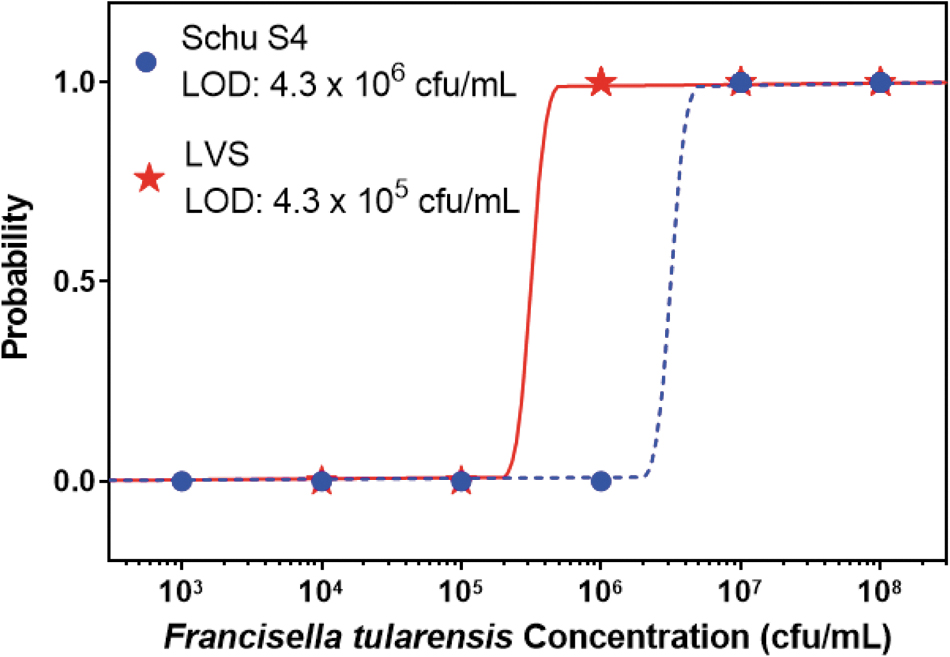
Probit Regressions for the F. tularensis SchuS4 and LVS Strains. The curves are calculated probability of detection as a function of bacteria concentration. The estimated limit of detection is calculated by finding the bacteria concentration with a probability of detection at 0.95. For SchuS4, the LOD is 4.3 × 10⁶ cfu/mL (6.4 × 10⁵ cfu/assay), and for LVS the LOD is 4.3 × 10⁵ cfu/mL (6.4 × 10⁴ cfu/assay).
The true LOD of the assay was determined using the BTA reader values and the designated cutoff at 200. The LOD had to be a concentration where every replicate test produced a positive result above the cutoff of 200. The linear dynamic range study found that the lowest concentration of F. tularensis strain SchuS4 that gave a consistent positive result was 107 cfu/mL to 108 cfu/mL (Figure 2). The F. tularensis strain LVS was also tested, and the LOD was found to be approximately 1 log lower, at 106 cfu/mL to 107 cfu/mL. The 2 strains had different reactivity profiles when tested, and this can be seen in Figure 2. The SchuS4 strain has a lower BTA Reader MX value consistently through the various concentrations but demonstrates a steady increase in BTA Reader MX value as the concentration of F. tularensis cells increases. Conversely, the LVS strain has a significantly higher BTA Reader MX value at a concentration of 106 cfu/mL and higher. However, there is a possible Hook effect after 107 cfu/mL, where the BTA Reader MX value is at 108 cfu/mL. The LOD that was determined for the SchuS4 strain was used as the concentration to assess repeatability, in which 123 tests were performed.
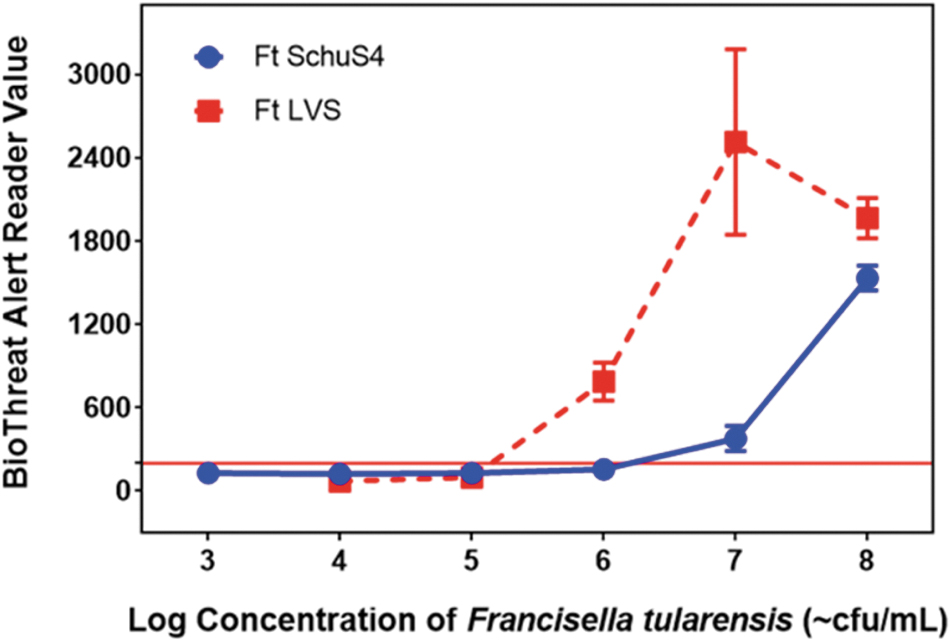
Range-finding for SchuS4 and LVS Strains. These 2 curves are the titrations performed for the 2 F. tularensis strains (SchuS4 and LVS). The SchuS4 strain curve was generated with an average of 5 tests per concentration, while the LVS strain curve was generated with an average of 3 tests per concentration. The error bars are standard deviations of the BTA Reader MX values.
Sensitivity, specificity, and accuracy were used to measure performance of this assay, ascertaining whether, based on visual reads, the test could properly discriminate between samples with the analyte present versus samples where the analyte is absent. Each test result can be placed in 1 of 4 categories: true positive (TP, F. tularensis antigen present and test positive), true negative (TN, F. tularensis antigen absent and test negative), false positive (FP, F. tularensis antigen absent and test positive), and false negative (FN, F. tularensis antigen present and test negative). Sensitivity is defined as the proportion of true positives that are correctly identified by the test and is calculated as:
Specificity is defined as the proportion of true negatives that are correctly identified by the test and is calculated as:
Accuracy is the overall probability that a F. tularensis test correctly classifies the presence of this bacteria in the test sample and is calculated as:
Table 6 is a 2x2 contingency table that shows the totals for each category and the resulting sensitivity (100%), specificity (98.1%), and accuracy (98.86%) of this assay.
2x2 Contingency Table
To further evaluate the assay, the BTA Reader MX values, which included the reruns on the second reader, were used to generate a Receiver Operating Characteristic (ROC) curve. Even though the reader values are not quantitative, the values can be used to further evaluate the accuracy of a detection test to discriminate the test-positive samples from those that are test negative using ROC analysis. The sensitivity and specificity are calculated for every possible cutoff point selected to discriminate between the positive and negative populations. This curve is created by plotting the true-positive rate as a function of the false-negative rate for every possible cut-off point. Figure 3 shows the ROC curve for the Tularemia BTA evaluation, and the area under the curve is 0.990. Interactive Dot Plot in Figure 4 provides a summary of all testing performed grouped into positive and negative results, with the cutoff line separating false positives from true negatives and false negatives from true positives.
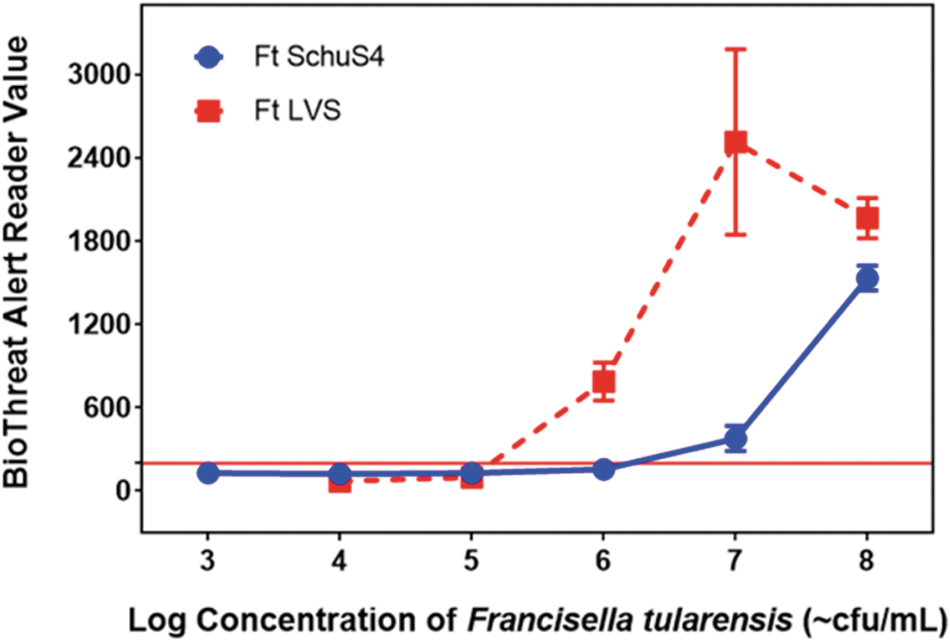
Receiver Operator Characteristic (ROC) curve provides a visual representation of the sensitivity and specificity of this assay. Each point on the curve is a possible cut-off value, and its place on the curve is determined by its specificity and sensitivity. The calculated assay sensitivity at the cutoff of 200 is 100.00%, and the specificity is 98.08%.
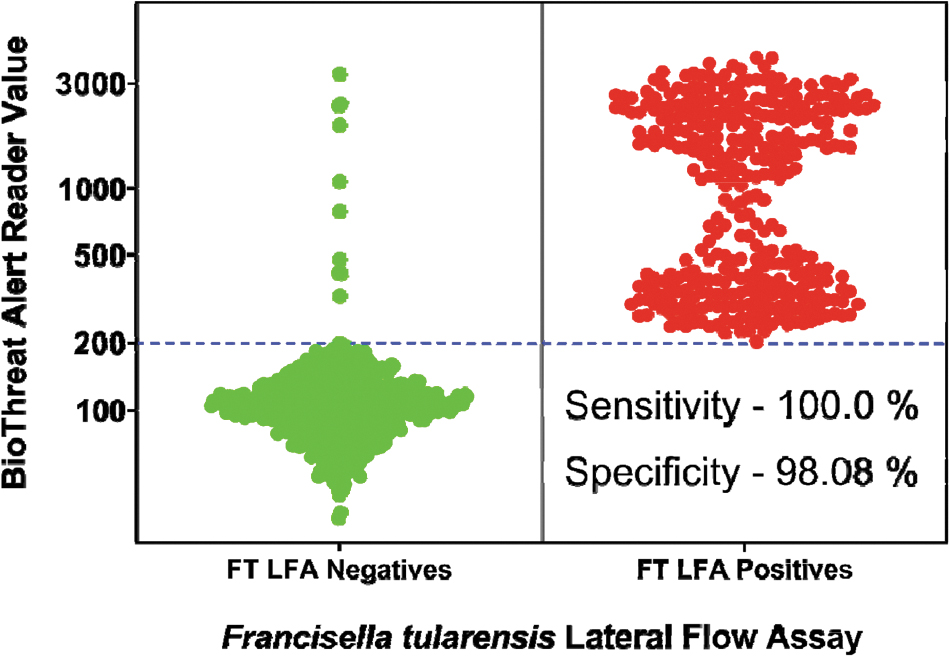
Interactive Dot Plot provides a summary of all testing performed grouped into positive and negative results, with the cutoff line separating false positives from true negatives and false negatives from true positives.
Discussion
F. tularensis is a biological agent that can pose a tremendous public health risk because of its potential to be used in bioterrorism attacks. To have an effective response, it is important for there to be rapid, specific, sensitive, and robust tests that are portable and easy to use by first responders. Lateral flow immunochromatographic assays were first commercially introduced for pregnancy testing in 1988. 34 LFA assays require minimum samples and no specialized equipment 35 and could be used by first responders and law enforcement officers to test suspicious materials in field settings. Berdal et al 16 used a lateral flow immunoassay, which employed a monoclonal antibody specific for F. tularensis lipopolysaccharide, to investigate an outbreak of water-borne tularemia. They were able to detect F. tularensis in both lemming carcasses and the well water in which the carcasses were found; however, this assay was less sensitive than PCR. Rapid BTA assays have previously been evaluated for the detection of biothreat agents including orthopoxviruses, 36 ricin, 37 abrin, 38 Bacillus anthracis,32,39 and Yersinia pestis. 40 Limited evaluations have also been conducted with assays for the detection of Yersinia pestis, 41 botulinum neurotoxins,42,43 and staphylococcal enterotoxins. 44
The Tetracore Tularemia BTA test for F. tularensis is available for screening of suspicious powders and/or materials in the field to support necessary public safety actions. It is a rapid qualitative lateral flow test that can be used for the detection of F. tularensis using a combination of a polyclonal capture antibody and a monoclonal detection antibody. The purpose of this study was to evaluate the sensitivity, specificity, reproducibility, and robustness of this assay for its intended use in the field with environmental samples. When used in conjunction with the BTA Reader MX and using the cutoff value of 200, the LOD was found to be 107 cfu/mL to 108 cfu/mL. This LOD is supported by the testing performed where the LOD was 108 cfu/mL through using only visual results. 41 Using the BTA Reader MX in conjunction with the strips can potentially enable detection of faint lines that are not easily perceived through visual reading, but this also increases the likelihood of calling visually negative tests as false positives due to potential streaking effects. When comparing BTA LFAs to other commercially available tests for F. tularensis detection, this lateral flow has limited sensitivity, while more time-consuming tests such as the larger volume immune-filtration ABICAP tests came with the benefit of greater specificity. 41 The LOD determined here is also lower than reported in an earlier study in which Zasada et al demonstrated an LOD of 108 cfu/mL for F. tularensis using the Tularemia BTA assay. 41 The difference in LOD may be because, in the previous study, F. tularensis organisms were inactivated by heating at 60°C for 22 hours prior to testing.
In this validation study, to assess the ability of the test to detect F. tularensis, suspensions prepared from 13 strains of F. tularensis (Table 1) were tested at a final concentration of 108 cfu/mL to 109 cfu/mL (1 log above LOD). For 4 strains, 1 of 5 replicates was negative when read on the BTA Reader MX. These strips were subsequently read on a second reader and were positive. To verify the specificity of this test, 8 near neighbor strains were tested at 3 logs above LOD, and 61 environmental background organisms were tested at 2 logs above LOD. The near neighbors gave negative results both visually and with the BTA Reader MX with the following exceptions. One F. philomiragia–like strain demonstrated a streaking effect on the lateral flow test strip (1 of the 5 replicates), resulting in a visual positive but BTA reader negative result. Repeat testing of another 5 replicates tested negative both visually and with the BTA reader. For 3 strains, 1 or 2 of the 5 replicates were visually negative and BTA Reader positive, but these same strips were re-read in a second reader and found to have negative values. Finally, 1 strain had 1 replicate testing positive in 2 BTA Reader MXs despite being visually negative, and it was noted by the operator that there was a streaking effect, which likely resulted in the false-positive call. When this strain was tested at a 1 log lower concentration of 109 to 1010 cfu/mL, all 5 replicates had no streaking effect and tested negative visually and on the BTA reader. Of the 61 environmental background strains tested, 59 yielded negative results both visually and with the BTA Reader MX. False-positive results may in some cases be expected when testing bacteria containing Protein A, as the antibodies used in this lateral flow assay were purified on a Protein A column.
Limitations of this test include a relatively high LOD as compared to laboratory-based technologies such as real-time PCR and ABICAP, and any results obtained in the field should be verified by further analysis in a laboratory setting. In addition, the BTA readers were found to yield results that were not consistent with visual readings. These findings highlight the importance of these assays being performed by trained and experienced users with an understanding of the limitations of sample testing and result interpretation.
It should be noted that the screening of white powders was evaluated using 5 mg of powders. This test was evaluated only for suspicious materials, such as white powders, and has not been evaluated for other environmental specimens, such as soil, vectors, and the like. However, Berdal et al demonstrated that a rapid immunochromatography test similar to the BTA could be used with environmental samples like well water without any further processing. 16 Benefits of the smaller footprint in its handheld format as well as the ability to test various sample materials made it the ideal field test at the time.
In conclusion, the results presented here demonstrate a sensitivity (100%), specificity (98.10%), and limit of detection (107 cfu/mL to 108/ cfu/mL) for the Tularemia BTA LFA. These performance data are important for accurate interpretation of qualitative results arising from testing suspicious white powders and aerosol samples in the field. The rapid 15-minute time frame between sample addition and result make this type of rapid diagnostic test suitable for first responders and law enforcement officers, especially when dealing with suspicious samples and, possibly, environmental samples. Highly suspicious samples should be tested by other methods in a reference laboratory. It is recommended that follow-up laboratory testing be performed after lateral flow result is obtained for an appropriate public health response.