






Abstract
Introduction:
To understand how mixed-immigration status families—families with a mixture of people with and without documentation—in the United States (U.S.) fared during the COVID-19 pandemic. Specifically, this study highlights how health inequities were exacerbated during the height of the pandemic due to the implementation of anti-immigration policies such as Public Charge Rule, which stipulates that receiving public benefits is grounds for inadmissibility for immigrants seeking naturalization.
Methods:
In-depth semistructured interviews were conducted over Zoom with 14 members of mixed-status families between February and April 2021. The interviews were audio recorded, transcribed, and analyzed using Atlas.ti. Using grounded theory, we assessed the level of awareness about Public Charge Rule and the health challenges these families faced during the COVID-19 pandemic.
Results:
Themes that emerged included financial problems, job insecurity, housing insecurity, food insecurity, mental health problems, distrust of government and health officials, and a fear of Public Charge Rule. We present a framework for understanding health inequities for mixed-status families during the COVID-19 pandemic.
Discussion:
Public Charge Rule caused fear and confusion for mixed-status families during the COVID-19 pandemic, resulting in individuals not receiving public benefits they urgently needed. This created heightened mental health problems due to job, housing, and food insecurity.
Health Equity Implications:
We discuss how trust between mixed-status families and the government needs foundational rebuilding. In addition to streamlining the process for these families to apply for legal status, it is important to protect and support mixed-status families through programs and policies during public health emergencies.
Introduction
The COVID-19 pandemic has laid bare disparities for the most socially disadvantaged communities in the United States (U.S.), including those disadvantaged due to immigration and documentation status.1–5 This was especially true for mixed-status families, who were often overlooked during the pandemic. These are families that consist of a mix of undocumented residents, legal immigrants, and/or American citizens—with many of the latter, including the U.S.-born children of undocumented parents. 6 In the nation as of 2016, about 20.2 million people lived in households with at least one undocumented person, and of these, 9.5 million are U.S.-born minor or adult children. 7 While these families qualify to receive government support due to the presence of U.S. citizen family members, the parents were hesitant to receive any support on their children's behalf.
The goal of this research is to examine how fears of repercussions from anti-immigration policies affected mixed-status families' health and access to desperately needed resources during the COVID-19 pandemic.
Families' decisions on whether to receive support have been impacted by anti-immigration policies such as zero tolerance policies and Public Charge Rule.8–10 Public Charge Rule is a policy stating that receiving public benefits would be grounds for inadmissibility for immigrants seeking naturalization through the legal process. 11 Public Charge Rule was approved by the Trump Presidential Administration in August 2019, and the U.S. Department of Homeland Security began implementing the rule on February 24, 2020, 12 just before the World Health Organization declaring COVID-19 a pandemic in March 2020. A report published by the Urban Institute revealed that the threat of Public Charge increased fear among immigrant families regarding accessing benefits or assistance for themselves or their children due to the possibility of doing so leading to deportation or jeopardizing the legal process for naturalization. 13
During the COVID-19 pandemic, Public Charge Rule was slightly eased for extreme cases of need deemed credible by the federal government. 8 However, this easement of the Public Charge Rule was not advertised widely, and undocumented individuals likely still feared receiving any help from the government during the public health emergency. 14
Although the U.S. federal government allocated resources to help families during the COVID-19 pandemic, mixed-status families were either ineligible or fearful of receiving needed help. Federal health benefits such as the Affordable Care Act excludes undocumented individuals, forcing them to pay for medical care out of pocket. 15 Locally in places such as Los Angeles County, there are programs that offer health care for the undocumented community, but health care providers report that they suspect many individuals do not seek these services due to Public Charge Rule. 15 The Coronavirus Aid, Relief, and Economic Security (CARES) Act passed in March 2020—which provided economic relief, increased unemployment benefits, and direct cash payments to individuals—also excluded undocumented people. 16 With the lack of financial support, undocumented individuals suffered economically and likely further avoided health care due to the expense, even if infected with COVID-19.3,11
While the CARES Act was updated in late December 2020 to include some mixed-status families during the second round of stimulus checks, those with two undocumented parents and U.S. citizen children still were not included within the package. 17 To qualify, one household member needed a social security number, which was not the case for many mixed-status families. Lacking support from governmental and public benefits likely exacerbated health disparities, worsening the impact of COVID-19 on the undocumented community. 18
Current studies emphasize how people marginalized at the intersections of race, socioeconomic status, and immigration status have been affected by the COVID-19 pandemic.5,19 This article seeks to fill a major gap in research on mixed-status families, to understand how they were affected by COVID-19 and how they navigated accessing resources in an anti-immigration policy environment. Using qualitative methods, this research aims to answer two major questions: (1) How did the anti-immigrant sociopolitical environment, including fear of Public Charge Rule, impact mixed-status families' help-seeking behavior during the COVID-19 pandemic? 20 and (2) How did these decisions affect mixed-status families' mental health, financial, job, housing, and food insecurity?21,22 Understanding the impact of COVID-19 on mixed-status families will help to develop more equitable policies and programs to increase resiliency for these contributing members of American society.23,24
Methods
This study consisted of semistructured qualitative interviews with adult members of mixed-status families conducted by the lead researcher between February and April 2021. Online recruitment consisted of convenience sampling through digital flyers distributed on Facebook, Instagram, and Twitter. Flyers were also posted on newsletters of the Cross-Cultural Center, Latinx Resource Center, and Dream Center for the University of California, Irvine (UCI). UCI has a relatively large population of students from mixed-status families. Participants were 18 years or older, part of an immediate mixed-status family, and residents of the Southern California region. Recruitment was conducted in both Spanish and English. All participants provided informed consent and received a $15 Amazon gift card. The research protocol was approved by the Institutional Review Board of UCI. A total of 14 individuals from mixed-status families participated.
Interviews were conducted over Zoom for 45-min with each participant. Interviews were audio recorded and were conducted in Spanish or English, according to participants' preferences. The interview consisted of general introduction questions that included the collection of the documented statuses of participants and their family members, as well as information such as age, employment, and breadwinner status (whether they were the primary household income producer). The second portion of the semistructured interview included questions related to their families' experiences with COVID-19. Sample questions included: “How fearful are you of your susceptibility to COVID-19?” and “How familiar are you with the Public Charge Rule?” During the interview, the lead researcher wrote down patterns or main ideas to create memos.
The lead researcher transcribed audio recordings of the interviews and then destroyed the transcripts after analysis. Data were analyzed based on the constant comparative method using Atlas.ti software to code the data. 25 The constant comparative method is a core component of grounded theory, and it provides guidelines to construct a theory based on comparing incidents within collected data.25,26 Transcribed interviews were coded into analytic notes using line-by-line coding, which consisted of reading the transcripts to conceptualize main ideas. Afterward, the lead researcher used memos plus other analytic notes coded through Atlas.ai to engage in focused coding to separate, sort, and synthesize data. Finally, data were used to create a theory that provided an overall explanation of how mixed-status families faced social and health disparities during the COVID-19 pandemic.
Results
Of the participants (n=14), 10 individuals identified with she/her/hers pronouns, 2 identified with he/him/his pronouns, and 2 identified with they/them/their pronouns. All participants lived within the Greater Los Angeles Region and were between the ages of 19 and 29 years. Table 1 summarizes that major interview themes with key quotations under each theme.
Mixed-Status Family Interview Questions
Financial need
Every single interviewee disclosed some financial need in their mixed-status family from March 2020 to about a year later at the date of interview. While this varied from anticipated/minimal financial need to experiencing extreme financial need, all participants emphasized this challenge during their interview. As seen in the quotes in Table 2, financial need stemmed from work insecurity as many family members were essential workers earning a minimum wage. Half of the participants indicated that their families depended on a single main income producer to support the family throughout the pandemic. Financial need caused fear of not being able to afford rent, food, medical care, and/or immigration lawyer fees.
Major Themes and Quotations from Participants Belonging to Mixed-Status Families
Quotes have been edited slightly for readability.
ICE, U.S. Immigration and Customs Enforcement's.
Participants mentioned family members refinancing their homes, selling personal valuables, and/or taking out loans to be able to make payments for rent, food, and medical expenses. Mixed-status family members noted varying levels of financial need: extreme during only the beginning of the pandemic, prolonged throughout the pandemic, or at certain moments during the pandemic.
Job insecurity
All participants similarly revealed that their families dealt with work insecurity. Participants mentioned how, due to the pandemic, they or their family members experienced job loss or reduction of hours from their jobs. Especially in the beginning of the pandemic, participants expressed how many of their family members were furloughed or received a reduction of hours due to the stay-at-home orders. Participants also expressed how if they or a family member were essential workers, they had instability in their work environment, especially if they became infected with COVID-19. For participants with family members who were at high-risk of mortality from COVID-19, some family members quit or left their jobs due to fear of exposure and infection. Interviewees or their family members who were undocumented experienced job loss from their “under the table” jobs and found it hard to find employment elsewhere.
Housing insecurity
Of participants interviewed, the majority spoke about housing insecurity. Many participants addressed how their biggest challenge was to pay rent during the pandemic. They spoke about having to move during the pandemic, and/or moving in with other family members to be able to afford rent on time. Several of participants expressed having to live in overcrowded housing. Participants noted the high cost of rent in Southern California, and some even mentioned how their rent increased during the pandemic.
Food insecurity
Participants spoke about food insecurity, not having enough money to buy food on their own during the pandemic. Members of mixed-status families depended in food banks/pantries for food. Some used resources such as federal Supplemental Nutrition Assistance Program (SNAP), known in California as CalFresh, for food. Volunteer participants also addressed how they also received food or money to buy food from extended family or community members during the pandemic.
Mental health
Of all participants, many spoke about dealing with problems related to mental health. As seen in Table 2, participants spoke about how they and their family members endured heightened and extreme stress throughout the pandemic. When participants mentioned the death of a family member due to COVID-19, they expressed feelings of loss and depression. Due to the pandemic and threat of infection, participants expressed feelings of depression, anxiety, isolation, and panic. Participants addressed how these feelings of panic, stress, and anxiety were also closely tied to and exacerbated by the financial needs their families were facing during the pandemic.
Distrust of government and health officials
Regarding distrust of government officials, the vast majority of participants spoke about this topic. Participants or their family members did not trust the resources that local and the California state government were providing for undocumented and mixed-status families during the pandemic. Mixed-status family members did not want to report that they or a family member were undocumented, so they preferred to not receive resources, even when they were suffering due to financial, job, housing, and food insecurity. This was also expressed in the form of distrust in health officials, noted by many of the participants. They expressed how they or their family members did not receive COVID-19 testing or treatment due to their fear of being exposed as undocumented.
Some participants even discussed how this distrust toward health officials created vaccine hesitancy. Volunteer participants and their families expressed how they did not want to be labeled as burdens to the government and therefore preferred not to receive any governmental help.
Fear of public charge rule
Related to this distrust of government, participants spoke about their fear Public Charge Rule. Even when participants were not familiar with the term “Public Charge Rule,” they spoke about it with regard to their fear of being seen as a burden to the government, which would jeopardize any process of seeking legal citizenship. Some participants spoke about how they received benefits to survive, but they were always considering how it could affect their legal process of citizenship in the future. People who were undergoing the legal process of residency or citizenship were less likely to receive support from governmental resources or any nongovernmental resources (e.g., food banks) that could imply reliance on public aid. Some participants also spoke about how they did not have health insurance nor receive health care due to wanting to avoid receiving governmental benefits.
Discussion
Due to job insecurity—job loss and/or a reduction of work hours—from their low-wage and often “essential” occupations, mixed-status families dealt with extreme financial need during the pandemic. This financial need caused housing and food insecurity for mixed-status families, which contributed to poor physical and mental health. Housing insecurity necessitated moving into overcrowded housing situations with family members to afford high rents, increasing susceptibility to COVID-19 infection. These insecurities contributed to worsened mental health among mixed-status family members, who struggled with anxiety, panic, and depression.
Many of these families needed resources to survive the COVID-19 pandemic but were afraid to receive any help due to distrust in the government and Public Charge Rule. Even if resources were highly publicized as not affecting Public Charge status, volunteer participants and their families distrusted the government, believing these resources were a trap made to expose them or their family members as undocumented under an anti-immigrant political regime.
While some volunteer participants and their families received support from sources such as food banks, governmental resources, and public health benefits, they still feared that using these resources could one day hurt them when they want to apply for their residency or citizenship. The majority of participants who accepted support received public nongovernmental resources instead of governmental resources. However, many participants and their families refused to accept help altogether as they did not trust government officials. This fear of the government expanded to distrust in health and medical officials, creating a situation in which families would not get tested for COVID-19 or go to the hospital for medical care if infected due to fear that the government might deport them or let them die in the hospital.
Due to their financial need, they also could not afford routine medical care, so they avoided receiving any health care for mental or physical health due to cost. This is despite participants noting experiences with mental and physical health problems stemming from financial burden, death of family members, or being infected by COVID-19 themselves. Figure 1 provides a visual outline of the interconnectedness of each theme discussed previously in relationship to health disparities among members of mixed-status families.
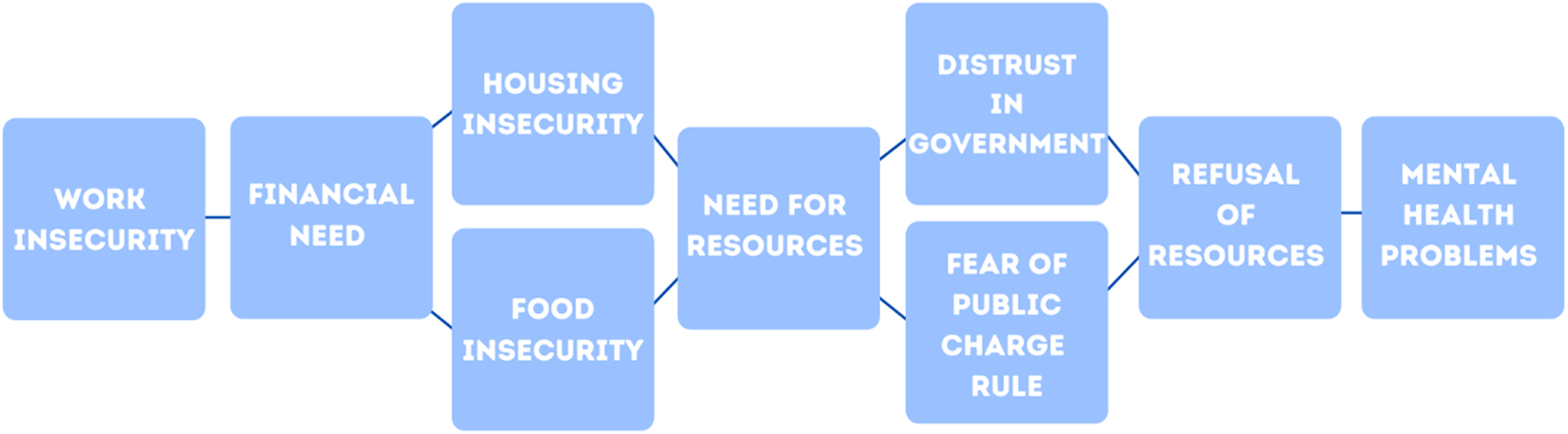
Framework for understanding lack of resources and mental health problems among members of mixed-status families during the COVID-19 pandemic.
Scholars predicted that Public Charge Rule would have a chilling effect on immigrant families receiving government and public benefits during the COVID-19 pandemic,1,3,11 and a few studies using quantitative data have suggested that this is the case among immigrant populations broadly.13,14 However, this is the first study to our knowledge to explore this phenomenon in-depth using data collected directly from members of the undocumented community and their families in the U.S. This study shows how mixed-status families navigated the precarious situation of COVID-19 while grappling with fears of retaliation from the government—whether in the form of immediate threats of deportation and detention, or future threats to the process of legalization or naturalization. Our findings highlight how these dual pandemics of COVID-19 and anti-immigrant sentiment resulted in food insecurity and poor mental health outcomes among members of mixed-status families.
Strengths and limitations
It is typically difficult to recruit study participants who belong to a historically marginalized community, such as those who are part of the undocumented community and their family members. While this study made efforts to not collect or store identifiable information, there is nevertheless understandable hesitancy for participation due to fear that doing so would expose their own or their family members' undocumented statuses. Despite this challenge, the lead researcher was able to successfully recruit and interview a small but valuable sample of 14 participants from mixed-status families during the COVID-19 pandemic. As a bilingual and first-generation undergraduate student, the lead researcher was able to establish rapport and trust with interviewees, many of whom were themselves college students or young adults. Inherent biases likely exist in this sample, with those who were most hesitant not taking part. Middle- and older-age adults were not captured in the sample.
Furthermore, as recruitment and interviews took place virtually due to the nature of the COVID-19 pandemic, this study excluded individuals who did not have access to the Internet. Even so, this study provides valuable insights into the lives of mixed-status families from the perspectives of the young adult volunteer participants on navigating the difficult COVID-19 pandemic. Future research should consider capturing from an intersectionality perspective the effects of anti-immigration policies like Public Charge Rule on the experiences of people in mixed-status families at the intersections of compounding marginalized identities such as age, race, gender, immigration status, and socioeconomic status.5,27,28
Health Equity Implications
The trust between mixed-status families and the government needs foundational rebuilding. Policies such as Public Charge Rule cause so much damage to the relationship between mixed-status families and the government that these families endure extreme and preventable suffering during a public health emergency such as the COVID-19 pandemic.1,11 As anti-immigration policies only cause fear and confusion among the most vulnerable, the government needs to work on reconstructing trust with mixed-status families to reduce health disparities and have more effective population health interventions. 15 In addition to the social determinants of health previously mentioned, many individuals in this study expressed that they or family members had started the legal process to receive permanent residency or citizenship, but due to lawyer expenses and confusing policies were unable to complete the process.
One recommendation is to make the procedure to gain legal status in the U.S. for individuals within mixed-status families easier and more accessible. Doing so would enable more members of mixed-status families to gain permanent residency and citizenship, reducing health disparities. 29 Finally, there is a need for specific policies that protect and support mixed-status families during public health emergencies. In moments of public health crisis such as the COVID-19 pandemic, mixed-status families must be protected through policy from extreme forms of financial need, housing instability, and food insecurity. Every individual in the U.S. deserves to have their basic need met during challenging times such as the COVID-19 pandemic, regardless of documentation status, especially as the pandemic has shown how interwoven our lives and livelihoods truly are. 30
Footnotes
Authors' Contributions
S.I.: conceptualization (lead); writing—original draft (lead); writing—review and editing (supporting); methodology (lead); data collection (lead); formal analysis (lead); and funding (lead); B.N.M.: conceptualization (supporting); writing—review and editing (lead); methodology (supporting); and funding (supporting).
Author Disclosure Statement
No competing financial interests exist.
Funding Information
This study was funded by the UCI Undergraduate Research Opportunities Program, received by S.I.