






Abstract
Khanna, Kunjan, Kamla Prasad Mishra, Sudipta Chanda, Lilly Ganju, Shashi Bala Singh, and Bhuvnesh Kumar. Effect of synbiotics on amelioration of intestinal inflammation under hypobaric hypoxia. High Alt Med Biol. 22:32–44, 2021.
Aim:
High-altitude exposure alters the gastrointestinal (GI) system, which may be a cause of hypobaric hypoxia (HH)-induced microbial dysbiosis. Therefore, we investigated the effect of a combination of beneficial bacteria and nondigestible fiber popularly known as “synbiotics” (Syn) to mitigate intestinal inflammation and microbial dysbiosis post-HH exposure.
Methods:
Syn, that is, a combination of probiotics and prebiotics, was given to male Sprague-Dawley rats 3 days prior and along with the HH exposure to assess its effect on mucosal barrier injury and inflammation. Changes in the gut microbiota and functional analysis were assessed using 16S rRNA and whole-genome sequencing (WGS) analysis.
Results:
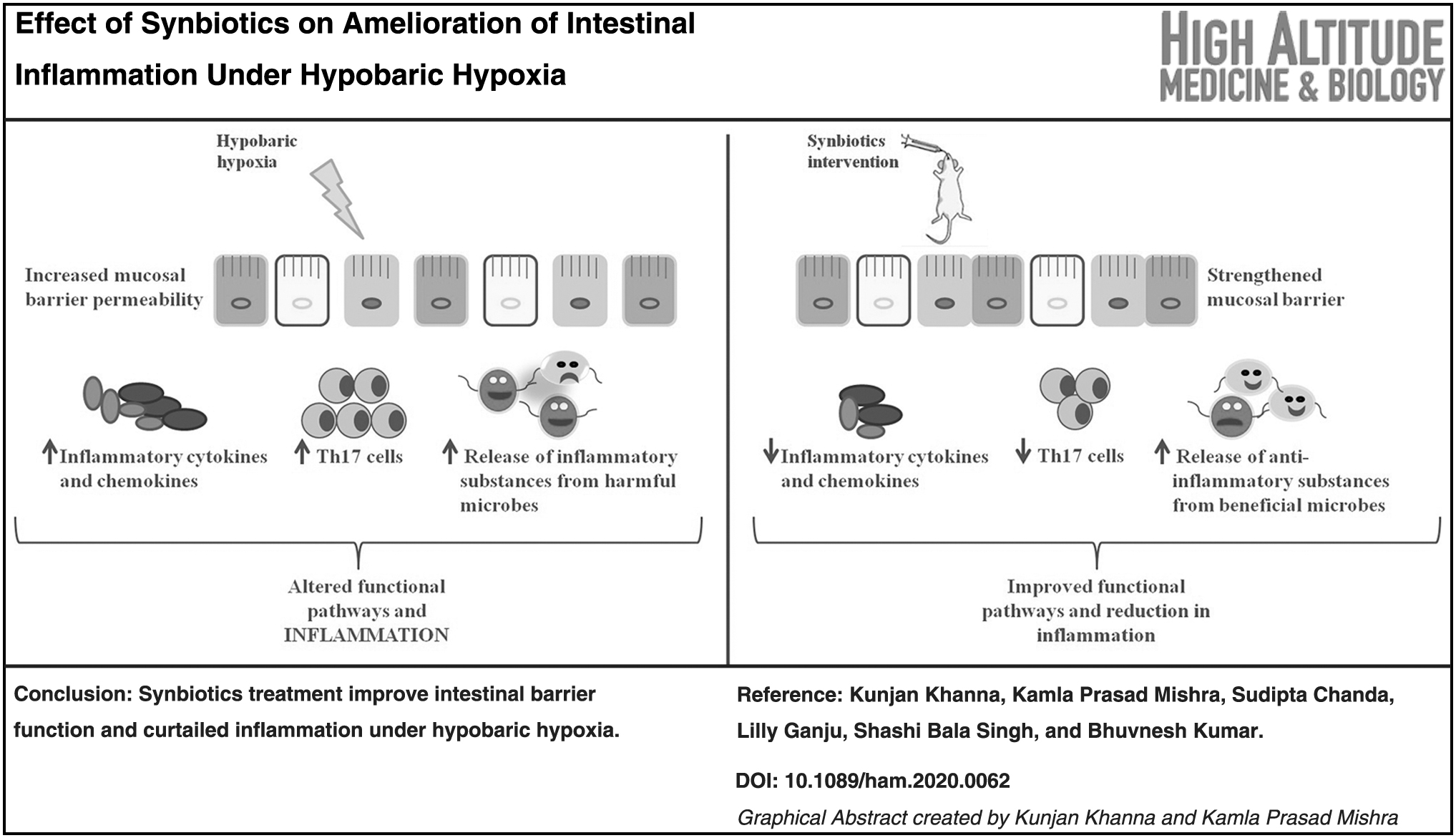
Syn treatment significantly improved mucosal barrier injury in terms of decreased serum fluorescein isothiocyanate dextran from 96.1 ± 7.95 μg/ml in HH-alone group to 38.35 ± 4.55 μg/ml in HH + Syn group (p < 0.01) and decreased serum zonulin levels, that is, from 134.7 ± 19.05 ng/ml (HH alone) to 64.02 ± 7.33 ng/ml (HH + Syn) (p < 0.05), along with improvement in the intestinal villi under HH exposure. Levels of proinflammatory cytokines and chemokines significantly reduced upon Syn treatment, indicating attenuation of inflammation and immune cell migration. Syn treatment significantly reduced Th17 biased immune response preventing interleukin (IL)-17-induced inflammatory response with 8.1 ± 0.5 ng/mg protein in HH exposure group, while treatment with Syn in HH-exposed group reduced IL-17 levels to 2.01 ± 0.3 ng/mg protein (p < 0.001). Analysis of 16S rRNA showed significant (p < 0.05) alterations in Deferribacteres, Firmicutes, and Verrucomicrobia at the phylum levels, whereas Prevotella, Paenibacillus, Clostridium, Turicibacter, Bacillus, Anoxybacillus, Enterococcus, SMB53, Mucispirillum, Allobaculum, and Lactococcus were significantly altered (p < 0.05) in abundance at the genus level. WGS analysis revealed improvement in GI health by regulating functional pathways post-Syn treatment.
Conclusion:
Our findings indicate that Syn treatment improves intestinal barrier function and curtailed inflammation in the HH-exposed rat models, proving it to be a promising potential countermeasure for HH-induced gut problems.
Graphical abstract
Get full access to this article
View all access options for this article.
References
Supplementary Material
Please find the following supplemental material available below.
For Open Access articles published under a Creative Commons License, all supplemental material carries the same license as the article it is associated with.
For non-Open Access articles published, all supplemental material carries a non-exclusive license, and permission requests for re-use of supplemental material or any part of supplemental material shall be sent directly to the copyright owner as specified in the copyright notice associated with the article.
