






Abstract
Literature surrounding the ethics of neurotechnology surfaces important questions about the potential for the technology to serve only narrow populations due to flaws in hardware design, coded bias, and restrictive access to technologies. By addressing challenges in early-stage research and development upstream, teams can reduce the risk of exclusive design/features being incorporated into a product further downstream. This article suggests that strategies in hiring, experimental design, research participant recruitment and retention, and ethics engagement in early-stage research represent meaningful ways for companies to build inclusive technologies and maximize value for their end users.
Introduction
The neurotechnology market is growing: between 2010 and 2020, private investment increased 22-fold, reaching a total of $33.2 billion. 1 As the applications for neurotech grow even broader—ranging from medicine to productivity to entertainment to enhancement 1 —there are increasing calls for attention to diversity, inclusion, and accessibility within the field: that is, working to ensure that a diverse range of people can use neurotechnologies and working to consider the impact of neurotechnologies. 2
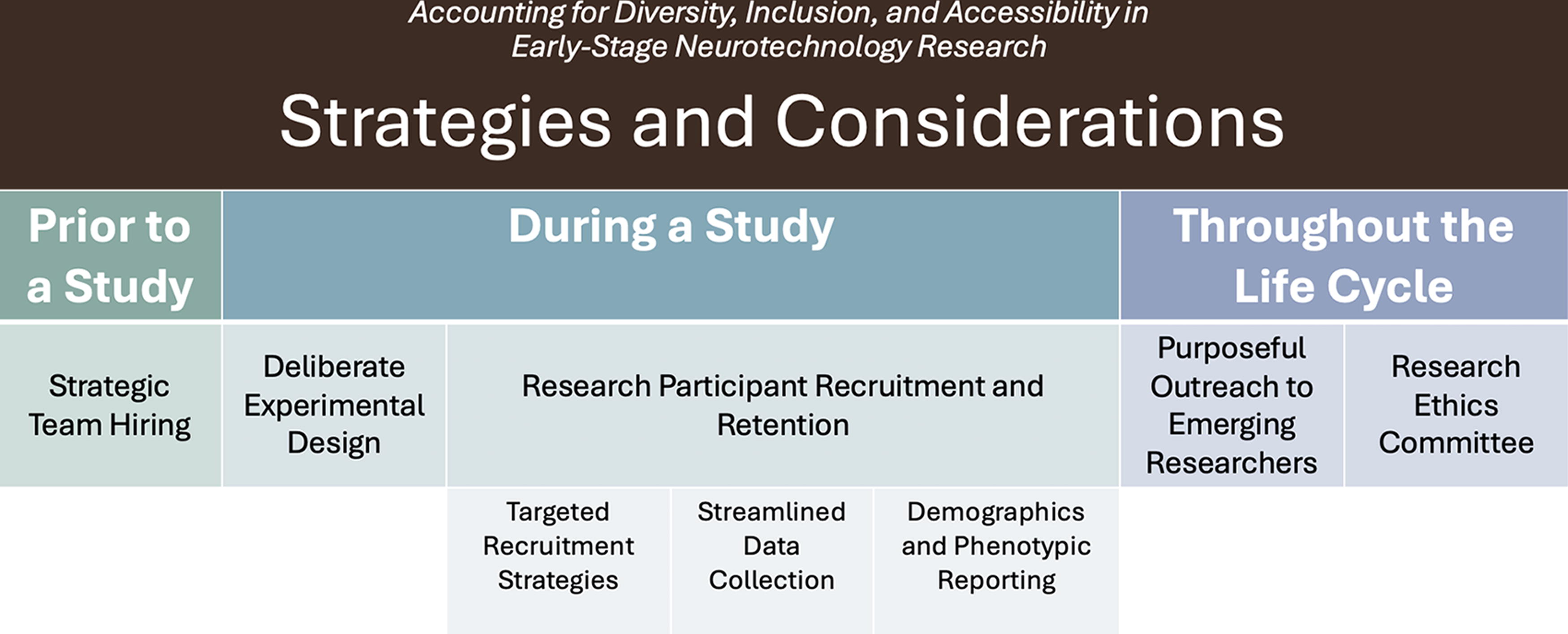
Much of the current literature highlights the challenges ahead for industry to collectively mitigate the potential issues surrounding equity, flaws in hardware design, coded bias, restrictive access to technologies, and reduction of an individual’s sense of identity/responsibility.3,4,5 By identifying and addressing opportunities in early-stage research and development upstream, teams can innovate responsibly, reducing the risk of exclusive design/features being incorporated into a product further downstream. While experiments, products, and company resources will vary, this article offers multiple approaches for industry organizations that might be deployed to improve inclusive product design and to account for the social impact of emerging technologies. This article suggests that strategies in hiring, experimental design, research participant recruitment and retention, and ethics engagement in early-stage research represent meaningful ways for companies to mitigate potential exclusion and negative impact on historically marginalized groups, and to add value for their end users (see Fig. 1).
Hiring
A multidisciplinary research team with diverse backgrounds and experiences—with considerations for many dimensions of diversity including race, gender, socioeconomic status, education, sexual orientation, age, etc.—may be best positioned to influence emerging neurotechnologies. Recruiting a diverse team has not only been shown to drive solutions, creativity, and innovation, 6 but can also support ethical experimental and prototype design.
As early-stage research commences, diverse teams with members of many backgrounds may be able to help identify gaps in experimental design, participant recruiting, and prototype direction. In one example, a student at Carnegie Mellon University, Arnelle Etienne, recognized that electroencephalography (EEG) electrodes were not functional for her due to the texture of her hair and learned that researchers and medical practitioners were either asking people of color to style their hair in damaging ways or shave parts of it to use EEG devices. 7 Although scientists have been using EEG technology for decades, research teams had not identified or addressed this challenge. She worked with her team to define a method for improving the interface between skin and electrode that ultimately reduced impedance by 95%, well below the threshold for optimal signals.8,9 This has significant implications for future neuroscience research and data collections, which can be seriously skewed when not representative of the population. 10 Subsequent research involving EEGs will be significantly more inclusive, and likely, more accurate.
When interviewing or recruiting for a team that develops neurotechnologies, it may be necessary to consider guidance around hiring. Harvard Business School estimates 75% of U.S. companies leverage algorithms to conduct resume reviews, with 99% of Fortune 500 companies using these tools. 11 Artificial intelligence can sometimes help mitigate human bias when deployed responsibly during the recruitment process. 12 However, the technology is still developing with calls for more transparency and understanding, 13 and has been subject to criticism for implicit discrimination. 14 In some cases, it has been shown to screen out diverse and multidisciplinary candidates, as hiring algorithms are often trained on data from existing or previous employees, and therefore are likely to be biased to promote candidates that align with their characteristics 15 (which may not actually be appropriate proxies for a candidate’s ability to succeed in a position). Similarly, sometimes research and technology organizations leverage technical interviews, 16 interviews with a cultural fit component, or interviews where the screener might have a bias toward a certain personality type or way of working, 17 to screen candidates; when positioned as heavily weighted portions of the interview process, these strategies may perpetuate the hiring of people from similar backgrounds. Ultimately, without attention to these issues, certain hiring practices can produce a homogeneous team that is not well-equipped to raise novel considerations or develop solutions.
Instead of merely looking at a candidate as an individual, one strategy is to think about the team holistically, instituting policies to consider qualities, perspectives, and experiences that might be lacking collectively, and targeting the gaps when hiring. This helps ensure that diversity is reflected throughout an organization, not just specifically one team or one level. Once an individual is hired, the team can encourage the integration of new hires on the team, thereby creating an environment where individuals feel empowered, counteracting attrition rates for underrepresented groups and demonstrating to stakeholders the value of diverse backgrounds and perspectives. Some effective tools include assigning mentors to all new hires who can help with advocacy, structuring meetings to enable all members to participate equally by disseminating questions in advance or moderating discussions, actively welcoming feedback from all team members or enabling channels for anonymous feedback, modeling open communication, and allowing space for discussions surrounding ethics in product design. Managers can be particularly integral in practicing and encouraging these behaviors, to lay the groundwork for an environment where potentially exclusive experiments or elements can be discussed and workshopped.
It is important to acknowledge here that while teams with diverse members may be better positioned to identify gaps, the responsibility ought not to fall directly or indirectly to team members from underrepresented backgrounds to flag issues. While a person’s traits, experiences, or background might organically inform their work or research, team members should never be tasked as “spokespersons” for a community, as this can create exclusion for the individual and fail to capture nuances between members of a given community.
Outreach to emerging researchers
It is especially important to identify, support, and amplify the voices of emerging researchers. It is necessary to note here that there are barriers to entry for people from historically vulnerable or disenfranchised backgrounds to become involved in neuroscience. A 2020 letter from the National Institute of Health states that just 20% of BRAIN-funded neurotechnology principal investigators are women, and just 7% are from under-represented minority groups (https://braininitiative.nih.gov/funding/funded-awards). 18 Members of underrepresented groups continue to face challenges in admissions and support in higher education. Equally, for the students who earn a place in a program, discrimination and financial difficulties can make these long, intensive programs unsustainable. 19 Industry organizations can prioritize combating these inequities by supporting neuroscientists early in their academic pursuits. This may include identifying promising students at hackathons or other events, in addition to funding stipends, scholarships, internships, fellowships, and grants.
Experimental Design
As teams begin their research, there are a few questions that must be asked. First, “Who is this device supposed to serve? What are the potential barriers to this? Who is potentially being left out?” By virtue of asking these questions, teams may better understand for whom the device may not be positioned to serve and why this could be the case. It is likely that some people who are members of marginalized groups—related to their age, race/ethnicity, gender identity, medical conditions, disability, body type, socioeconomic status or education level, language, location, etc.—might be identified. It is at this point that teams can expand for whom the product is designed. Involving these communities promotes a comprehensive representation of a population during these conversations. Through engagement with focus groups, conversations with advocacy groups which represent marginalized groups, academics who have published on a population, journalists who have covered a community, etc., researchers can help ensure that there is ample opportunity for inclusion and are able to contextualize various views and intersections within a community to a respective research aim. 20
With the information gleaned from the research above, teams can then define specific objectives and key results for inclusion and accessibility, with particular attention to software algorithms and hardware design. For example, an objective related to optical brain–computer interfaces might be: “Build optodes for functional near-infrared spectroscopy (fNIRS) that can make contact with the scalp for hair types A through D.” Researchers can also consider including experiments that quantify or otherwise examine performance changes across diverse individuals, or that compare the distribution of some aspect of a research population to a more global population.
Research Participant Recruitment and Retention
While some neurotechnologies are designed for specific end users, such as a technology designed for a specific clinical population, technologies designed for a broad population can be tested for diversity, inclusion, and accessibility through comprehensive research participant recruitment. Here, we consider challenges related to participant recruitment, addressing two ends of the spectrum, where the participant pool is not reflective of the end-user population, because the demographics are often a gradient of too narrow or too broad. The circumstances surrounding data collections (for example: time, location, compensation, etc.) may also prevent diverse subjects from participating or prevent them from continuing to participate after initial engagement.
Recruitment strategies—too narrow
As teams consider recruitment and retention, defining when participant pools must be expanded can be key in promoting inclusive product design. Sometimes it may make sense to initially test in a subject with “optimal characteristics” during the prototyping phase to understand system performance under specific conditions, then explore limitations. For example, the model subject for an fNIRS device would likely be someone with certain “personality” traits such as the ability to stay awake/focused during an experiment; physically, an individual who is bald with light skin might be the most appropriate, as the physical traits would promote scalp-optode contact and avoid pigments that scatter and absorb near-infrared light. 21 From a utilitarian lens, this may be acceptable in instances where researchers must allocate limited time and resources.
Ultimately, moving as efficiently as possible to ensure that products can work across a diverse subject pool ought to be a matter of utmost importance. Researchers committed to diversity can include participants from diverse groups or define when inclusion will be broadened at the outset of experiments, but ought not to expand the participant pool any later than after the technology is validated. Committing to diversity, inclusion, and accessibility in subject recruitment and participation upstream during the initial phases of neural research will mitigate or even prevent the incorporation of exclusive features or design.
Recruitment strategies—too broad
However, there are occasions where subject recruitment is too broad. A team might look to expand their population by widening inclusion criteria. It is possible that despite these efforts, the subject population might not be inclusive enough: the criteria are too broad such that certain groups are not represented because specific characteristics are not explicitly requested. That is, because there are no specific recruiting strategies for inclusion for people based on their age, gender, body type, education level, etc., teams may indirectly and inadvertently exclude people from certain, marginalized communities.
For example, perhaps a group of researchers is seeking to capture information from participants ages 18–80, it would be important to define strategies specifically targeting populations of older adults 65+, as older adults often face challenges in applying for studies and end up excluded from research. It is imperative that when working to reflect a real-world population, researchers include multiple features of identity to avoid this pitfall.
Data collection
Targeting diverse groups for research participant recruitment is important, but working toward long-term inclusion and ensuring that a participant can complete all necessary data collections, is central to accessible product design. The methods leveraged by a team for experiments or data collections might favor people from historically privileged groups, making participation convenient, while constraining the participation of people from marginalized groups. In these cases, it follows that a person from a marginalized background might simply not participate, or might join a study but not complete their data collections, due to barriers. Strategies for mitigating exclusion due to these factors might include appropriate compensation. Additional incentives might be considered to accommodate a broader variety of participants: for example, childcare, after-hours data collection, language assistance, transportation support, and safe parking and waiting areas for in-person collection. Equally, face-to-face informed consent and warm opportunities for open communication with researchers (i.e., surrounding comfort, pain, “side effects,” etc.) can foster long-term trust and provide teams with insights surrounding a product.
Beyond experiments with actual research participants, there are other strategies that might help researchers capture diverse characteristics from various groups. For example, a research team might consider creating mathematical simulations or even physical models of the brain, head, and hair that mirror the varying characteristics of a research participant. These simulations will be subject to many assumptions, and should be reviewed with those in mind. Still, they may provide an informative supplement to human research studies, especially given the practical limitations of being able to record data from individuals, across each group and intersection.
Reporting
As researchers seek to include diverse study participants, researchers might also consider reporting demographics and phenotypes. A recent article by Kwasa et al. noted in an analysis of basic fNIRS papers that, “the vast majority of studies report gender (90.8%), but do not report race/ethnicity (97.7%), skin pigmentation (100%), or hair type (96.6%).” 22 When researchers report demographic and phenotypic data, inclusion and exclusion trends within neurotechnology research are easier to measure. Moreover, including this information may allow external researchers to better understand the study’s range and limitations, promoting advancements in the field.
Research Ethics Committee
A final potential strategy for neurotechnology researchers seeking to enhance diversity, inclusion, and accessibility involves employing an embedded ethicist, research ethics committee, or in cases where there might be potential for a conflict of interest, consulting with an external ethicist. While some might equate this sort of expertise to a compliance coordinator, Institutional Review Board, or human subjects review board, subject-matter experts in ethics can surface ethical considerations around particular research, specifically relating to autonomy, beneficence and nonmaleficence, justice, utility and stewardship—advancing responsible innovation and attention to marginalized populations. Ethics experts can further equip teams with the language and tools to ask “morally aware” questions and devise solutions.
This strategy would allow teams to discuss current ethical concerns, but also document and develop strategies surrounding surfaced ethical concerns that might have implications as the product continues to be developed: for example, preventing repeated ethical conversations and ethical paralysis, providing structure and process for addressing ethical dilemmas and opportunities, ensuring that discussions inform future decisions, and supporting the operationalization of strategy to improve product accessibility and functionality. Similarly, a research ethics committee or embedded ethicist might be leveraged to gather observations about effective ethical strategies—including diversity, inclusion, and accessibility initiatives and objectives and key results—to determine which effectively mitigated ethical risk. An embedded ethicist or ethics committee might also assist with other strategies discussed in this article, including research for experimental design and recruitment/retention strategy.
Discussion
It is important to reiterate that these are recommendations and not an exhaustive list, nor a checklist: teams committed to accounting for diversity, inclusion, and accessibility in early-stage research will be the best-positioned to appropriately leverage these and other strategies depending on their respective experiments, technologies, and timelines. Furthermore, some organizations may not have the resources to immediately implement all recommendations. These strategies can be scaled up or down depending on the resources of organizations. For example, smaller organizations or startups that might not have the funds to be able to hire an embedded ethicist or research ethics committee, could prioritize purposeful researcher hires and deliberate experimental design.
Some critics of these strategies might argue that employing them to account for diversity and inclusion (D&I) represent a cost center for neurotech companies, limiting growth and research and development. However, evidence suggests that diversity, inclusion, and accessibility strategies have implications for a company’s revenue: studies have shown a positive correlation between a commitment to D&I and innovativeness. 23 Moreover, promoting diversity, inclusion, and accessibility often widens the total addressable market, which could lead in to an increase in “sales revenue, more customers, and greater relative profit.” 24 And with the rise of responsible investing, many investors are scrutinizing an organization’s commitment to inclusivity. 25 Investing time and resources into inclusive and accessibility-driven strategies will likely also increase the number of end users able to engage with neurotechnology. Therefore, a commitment to diversity, inclusion, and accessibility may also represent a strong business strategy.
Engaging with these strategies may not create immediate or radical change. Instead, these proposals represent a starting place to develop devices that serve the needs of a broad population. In a vacuum, these recommendations will not be enough: ultimately, buy-in and accountability from a majority of neurotechnology organizations will be required to truly reduce disparity in technology. However, by employing some or all of these strategies, early-stage neurotechnology companies can begin to impact the inclusivity and accessibility of their products.
Footnotes
Acknowledgments
The author thanks Dr. Stephanie Naufel and Dr. Chloe Bakalar for their valuable feedback on the work, and Dr. Timothy Brown at the University of Washington for a thoughtful discussion related to inclusivity and consideration of vulnerable populations.
Author Disclosure Statement
No competing financial interests exist.
Funding Information
No funding was received for this article.