






Abstract
Risk assessment is a formal process of identifying hazards and assessing the risk associated with them (risk is a combination of the severity of illness and the probability of occurrence). This review highlights foodborne disease hazards reported in beverages consumed in Nigeria for the period between 2000 and 2020. Based on a preregistered protocol and search syntax, studies were retrieved from the PubMed, Google Scholar, and ScienceDirect databases. Rayyan QCRI software was used to screen the articles. Data were then extracted from the included full-text articles, into a standardized excel workbook. A total of 18,762 articles were identified, from which 126 were included in the final analyses. The common beverages studied were sachet water (14.9%), borehole/well water (13.9%), cereal-based beverages (12.1%), raw/fresh milk (8.3%) and nono/nunu, which is a fermented milk-cereal beverage (7.2%). Sufficient data were available to undertake pooled prevalence estimates for some hazards within select beverages and revealed contamination rates for Staphylococcus spp. in raw/fresh milk, 12.3% (95% CI 6.3–20.0); Salmonella spp. in borehole/well water, 19.8% (95% CI 13.1–27.4); Klebsiella spp. in sachet water, 40.0% (95% CI 12.4–71.7); Staphylococcus spp. in nono/nunu, 32.6% (95% CI 14.7–53.8), and Escherichia spp. in nono/nunu, 30.7% (95% CI 21.9–40.2). Heterogeneity was present in the aggregate summary estimates. This review has highlighted the presence of several hazards of high importance to public health in commonly consumed beverages in Nigeria. The data presented here provide an entry point for future quantitative risk assessments both to determine the level of exposure of the community to these hazards and also for the identification of the most effective mitigation strategies to reduce these risks and improve health outcomes in Nigeria.
Introduction
Globally, 420
Food safety has been flagged as a significant barrier toward social and economic development and in the attainment of Sustainable Development Goals 1–3, “No Poverty,” “Zero Hunger,” and “Good Health and Well-being” (Havelaar et al., 2015). The inverse relationship between a decline in economic prosperity and foodborne illness in developing societies suggests that addressing food safety may positively contribute to economic gains (Akhtar et al., 2014). Foodborne disease costs developing countries at least $100 million a year (Jaffee et al., 2020).
Subregion “AFR D,” to which Nigeria belongs, was found to have the highest burden of foodborne illness: 1276 (459–2263) DALYs per 100,000 population (Havelaar et al., 2015). The frequency of illnesses related to the consumption of contaminated food could imply the lack of efficient food safety control systems (Mensah et al., 2012; Paudyal et al., 2017). For Nigeria, this assertion is supported by outputs from anthropometric surveys that report a stunting and malnutrition prevalence of 36.8% and 8.9%, respectively, in children younger than 5 years (NPC and ICF, 2019). Bacterial and parasitic diseases are known risk factors for malnutrition in developing countries (Muller and Krawinkel, 2005). The burden due to aflatoxins has also been shown to be high in some African countries, including Nigeria (Havelaar et al., 2015).
Interventions to address hazards in foods are urgently needed. Determining what strategies can be used, alongside other key health burdens across society, should, however, be done in a rational and, where possible, objective manner. It is not only the burden of disease attributable to pathogens or products that should be considered, but also the cost-effectiveness or net economic benefit of potential control interventions. The initial process in such systematic prioritization processes is a risk analysis where, in a stepwise manner, hazards and the population at risk are identified (risk ranking), a quantification (or semiquantitative evaluation) of the risk posed by the hazards is made (risk assessment), risk mitigation steps are identified (risk management), and finally, risk communication is undertaken. This study contributes to the first steps of risk ranking and risk assessment by identifying foodborne hazards of potential risk to Nigerian consumers. Many foodborne pathogens can be found in common beverages, with water being a well-known example of a beverage with a high burden of disease attributable to the pathogens it may carry. Beverages consumed in Nigeria have been reported to harbor various hazards and are thus a public health concern.
A Systematic Literature Review (SLR) was undertaken to establish the current evidence on foodborne hazard occurrence in a myriad of beverages consumed in Nigeria between the year 2000 and the year 2020. The information will inform further risk assessment work in Nigeria. It will assist in determining the riskiest beverage products, potential mitigation activities, and their impacts. This review, therefore, highlights hazards associated with commonly consumed beverages in Nigeria. The findings will inform the scope of further risk assessment work in foods in formal and informal markets in Nigeria, and other countries with similar situations.
Materials and Methods
Protocol development
A protocol to guide the SLR process was developed and registered in PROSPERO and is searchable in
Literature search
Searches were done in three search engines, namely PubMed, Science Direct, and Google Scholar. The search was set to identify articles published in the period 2000–2020. An initial syntax covering most beverages and safety terms was developed for PubMed using Medical Subject Headings (MeSH) terms and Boolean search operators (Supplementary Data S1). Since ScienceDirect has a syntax string limit of 8 Boolean expressions, therefore a series of 40 short syntaxes, including all the beverage and safety terms in the PubMed syntax, was developed. These articles were exported to the Mendeley reference manager from where duplicates were identified and removed. The resulting unique file was treated as a single output from ScienceDirect. Similarly, for Google Scholar, which has a character limit of 256, a series of 20 syntaxes was developed to include all the beverage and safety terms in the syntax used in PubMed. For each search output, the first 300 hits were considered for the review (Haddaway et al., 2015) and were exported to Mendeley via its Web Importer function. All the search outputs were pooled in the Mendeley reference manager, and the duplicates were identified and removed, resulting in a unique Google Scholar file.
Article screening
This review included observational studies published between 2000 and 2020. Only studies conducted in Nigeria and those published in English were included in the review. Studies with experimental design, on water quality/safety not associated with drinking water, antimicrobial resistance, and those not considering biological or chemical hazards associated with beverage consumption were excluded.
The screening process was facilitated by the Rayyan QCRI (
Quality assessment and data extraction
Data extraction and quality assessment happened concurrently. Quality assessment of individual articles was based on the Cochrane assessment of bias (Higgins et al., 2021). The articles were classified as being of good, medium, and poor quality. Articles that had an unbiased selection of subjects, where the methods were judged to be scientifically sound, and appropriate data analysis had been conducted with complete and accurate results were judged as good quality. Medium-quality articles had acknowledged and accounted for selection bias of subjects, limitations in data analysis, understandable methods, and valid results. Articles that did not acknowledge selection bias of subjects had incomplete and inaccurate methods, inappropriate data analysis, and incomplete results judged to be of poor quality were excluded from the study, and data were not extracted from them.
A data extraction template in Microsoft Excel was developed and piloted. The template was designed to capture the following data: article identifiers (article ID, the title of the publication, authors, year of publication), type of study, geographical locality, name of the beverage, name and category of hazard, point of sampling, sampling technique, specific laboratory test used, number of samples analyzed, number positive for the hazard, and raw data on the concentration of hazards. For review articles, data were not extracted directly from them but from the primary data, articles cited.
Data management and analysis
The data were cleaned and validated to check for any errors and omissions. They were analyzed using the R platform for statistical computing software (R Core Team, 2018). Data on type of beverage, type of study, category, and specific hazards, point and method of sampling, and laboratory test used were summarized as proportions and presented as tables and figures. A random-effects model was selected for estimating pooled prevalence due to the interstudy differences (Bown and Sutton, 2010). To ascertain stronger statistical inference, pooled prevalence was estimated for hazard/beverage combinations where 5≥ good-quality studies were available (Jackson and Turner, 2017). Forest plots and summary tables including estimates of heterogeneity were generated using the metaviz package of R software. Heterogeneity thresholds were derived from Deeks et al. (2019), where I 2 of 0–40% represented low heterogeneity or homogeneity.
Results
Database search output and screening
A total of 20,100 articles were retrieved from the 3 databases: PubMed (1315), ScienceDirect (14,406), and Google Scholar (4289). Seven additional articles were identified from review articles. A total of 1255 duplicates were removed (either in Mendeley or in Rayyan QCRI). After title and abstract screening, 18,338 articles were excluded, resulting in 424 articles that were subjected to full-text screening. Two hundred ninety-eight articles were excluded at the stage of full article review on the following basis: low quality (130), wrong study design or outcome (77), inaccessible articles where the full text was not available (28), nonbeverage or nonfoodborne studies (20), articles with a geographical focus outside Nigeria (16), review articles (15), additional duplicates not previously identified (11), and articles outside the time frame of interest (1). A total of 126 articles were thus included in the qualitative analyses, of which 21 articles were included in pooled prevalence analysis. The PRISMA 2009 flowchart is given in Figure 1.
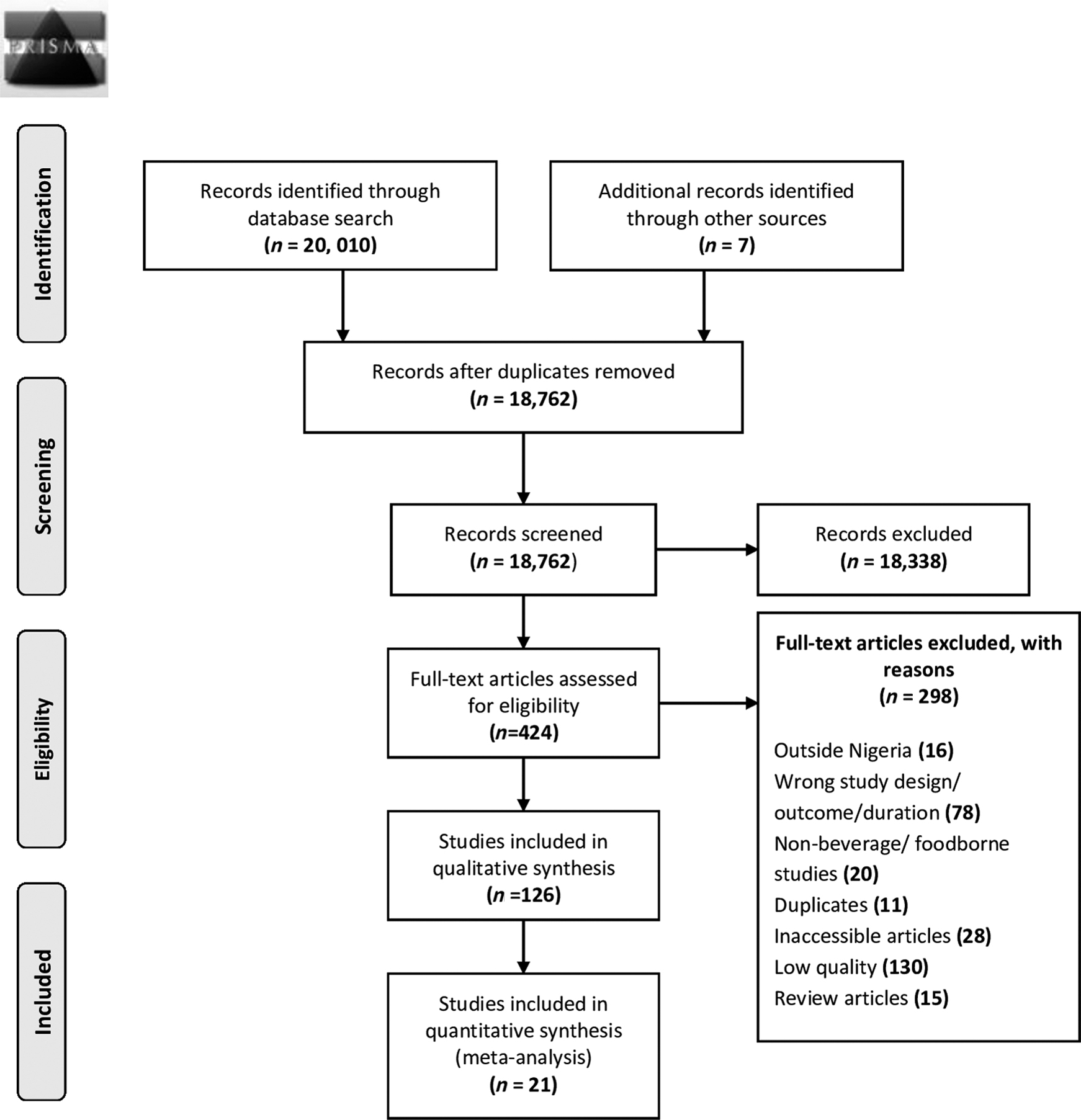
PRISMA 2009 flow diagram occurrence of FBD hazards in beverages consumed in Nigeria. FBD, foodborne disease. From Moher et al. (2009). Fore more information, visit
Characteristics of articles included in the qualitative synthesis
The 126 articles included in the qualitative analyses resulted in a total of 787 records. Among the 126 articles, 73.8% had some details lacking in the methods section, but bias in the selection of subjects and limitations in data analysis had been acknowledged and the articles were therefore deemed to be of medium quality. Only 26.2% of the articles were judged to be of good quality, as they had an unbiased selection of subjects, scientifically sound study methods, appropriate data analysis, and complete and accurate results. The majority (76.2%) of the studies retrieved had been published between 2010 and 2018. Sampling was done at the point of retail/trader (57.6%), processing plant (3.8%), or source/farm/point of harvest/manufacture (29.6%). Nine percent of the studies did not specify the point at which sampling was conducted.
The distribution of the studies was varied. Notably, the following states Kebbi, Kwara, Adamawa, Yobe, Zamfara, Jigawa, Kogi, and Katsina were not represented in the reviewed literature. The selected studies covered 28 of the 36 federal states of Nigeria.
Beverage types reported in the review
The most common beverages studied (n = 787) were sachet water (14.9%), borehole/well water (13.9%), cereal-based beverages (12.1%), raw/fresh milk (8.3%), and nono/nunu (7.2%). Other beverage types included river/canal/stream water, processed nonalcoholic beverages, fruit juice, traditional alcoholic beverages, soya milk/tigernut, bottled water, tap/piped water, traditional nonalcoholic drinks, processed milk, processed alcoholic beverages, and rainwater (Table 1).
Number of Studies Investigating the Contamination of Specific Beverages (Total 787)
For example, Kesham, Kindrimo, Manshanu, Wara.
Kunu, Kunun-zaki, Kunu-aya, Akamu, Ogi.
For example, herbal teas.
Canned and noncanned beverages, soft drinks.
For example, beer.
For example, Burukutu, Gin Ufofop, Pito.
Hazards reported in the studied beverages
The 5 main hazard groups reported in this review include bacteria, fungi, parasites, biotoxins, and chemical contaminants (a total of 754 records). The most common hazards, or hazard proxies, studied were bacterial (483 records, 64.1%) and chemical contaminants (179 records, 23.7%). A few studies on fungi (55 records, 7.3%), toxins (24 records, 3.2%), and parasites (13 records, 1.7%) were identified. Thirty-three records did not specify the identity of the hazard. The most often studied bacterial genus (n = 483) was Escherichia spp. (16.1%, six studies had negative findings), Staphylococcus spp. (14.3%, one study had a negative finding), Salmonella spp. (11%, two studies had negative findings), coliforms (8.7%, two studies had negative findings), and Klebsiella spp. (6.6%, one study had negative findings). The common fungal and parasitic contaminants studied and reported were as follows (n = 55; n = 13, respectively): Aspergillus spp. (27.3%), Penicillium spp. (14.5%), Rhizopus spp. (12.7%), Giardia spp. (38.5%), Entamoeba spp. (30.8%), and Ascaris spp. (23.1%).
Commonly studied chemical contaminants (n = 179) were lead (14.5%, seven reports had negative findings), iron (8.9%, seven studies had negative findings), and chromium (8.4%, six studies had negative findings). The fungal metabolites (n = 24) investigated included acetyl-deoxynivalenol/deoxynivalenol (33.3%), zearalenone (33.3%, three reports had negative findings), and fumonisin (25%). See Tables 2 –5 for more details.
Hazards Reported in Different Types of Beverages in Nigeria Between the Years 2000–2020
PPCPs, pharmaceuticals and personal care products.
Number of Studies Investigating Bacterial Contamination of Specific Beverages (Total 483)
Number of Studies Identified Investigating Parasitic (Total 13) and Fungal (Total 55) Contamination of Specific Beverages
Number of Studies Identified Investigating Chemical (Total 179) and Mycotoxin (Total 24) Contamination of Beverages
PPCPs, pharmaceuticals and personal care products.
Pooled prevalence estimates
Sufficient data were available to allow estimation of pooled prevalence for four hazards in four different beverage types (as described in Table 6). Key hazard/beverage combinations with sufficient data (>5 high-quality articles) available to undertake this included Klebsiella spp. in sachet water, 40.0% (95% CI 12.4–71.7), I 2 = 97.3%; Staphylococcus spp. in nono/nunu, 32.6% (95% CI 14.7–53.8), I 2 = 97.5%; and Escherichia spp. in nono/nunu, 30.7% (95% CI 21.9–40.2), I 2 = 95.7%. Salmonella spp. in borehole/well water, 19.8% (95% CI 13.1–27.4), I 2 = 58.4%-moderate heterogeneity and Staphylococcus spp. in raw/fresh milk, 12.3% (95% CI 6.3–20.0), I 2 = 34.22%. Heterogeneity based on the I 2 statistic was moderate-considerable in 4/5 hazard/beverage pools. The aggregate summary estimates from these studies are therefore to be interpreted with caution. Only one pool was homogenous, and that was Staphylococcus spp. in raw/fresh milk. Forest plots illustrating the data are shown in Figure 2.
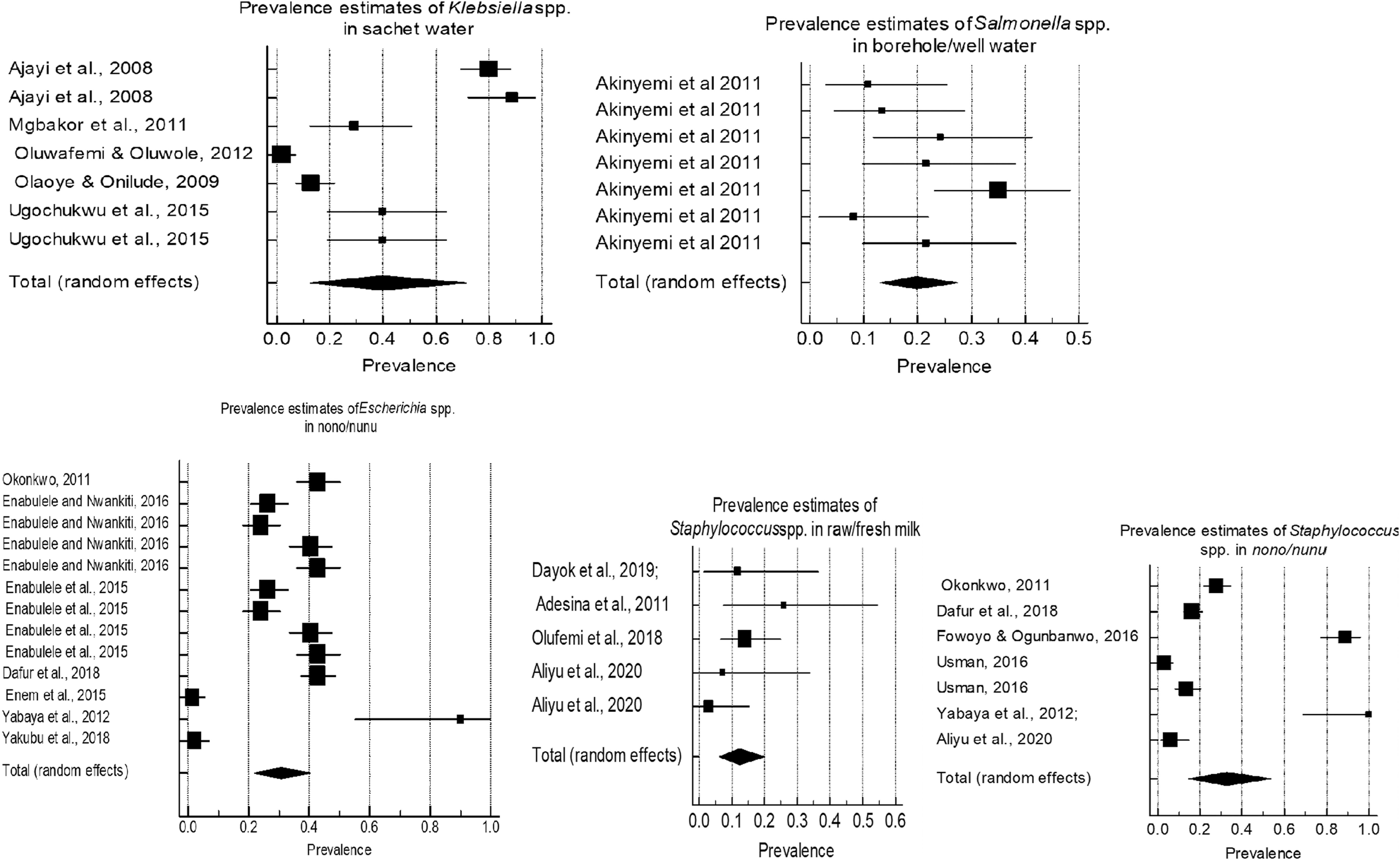
Forest plots of 5 hazard/beverage combinations showing hazard prevalence estimates in individual studies and the pooled prevalence (random effects model). Staphylococcus spp. in raw/fresh milk pool was homogenous. Salmonella spp. in borehole/well water, pool had moderate heterogeneity. Heterogeneity was considerable in all the other hazard/beverage combinations as denoted by the non-overlapping confidence intervals of the prevalence estimate in several individual studies in these pools.
Pooled Prevalence Estimates of Select Biological Hazards in Beverages
CI, confidence interval; DF, degrees of freedom.
Discussion
This review identified beverage types consumed in Nigeria ranging from traditional, nonindustrial, to processed alcoholic and nonalcoholic drinks. However, the five most studied beverages were sachet water, borehole/well water, cereal-based beverages, raw/fresh milk, and nono/nunu. Sachet and borehole water are important sources of potable drinking water in Nigeria. The affordability and availability of sachet water make it the primary source of potable water for most of the Nigerian populace (Izah et al., 2016). A survey conducted by Dada and Awotunde (2017) noted a consumer preference for home-prepared beverages as opposed to carbonated drinks. They reported a preference for fruit juice and kunun-zaki (cereal-based beverage). Nono constitutes part of the crucial staple food for the nomadic Fulani, of Northern Nigeria, and its consumption, together with that of raw milk and milk by-products, is popular among the rural and urban population, a preference that is partly attributed to a belief that it is more nutritious than pasteurized milk products (Egwaikhide et al., 2014).
The spatial assessment revealed an unequal distribution of studies on beverage-associated hazards in Nigeria. This difference may suggest different research priorities by research institutions within these states. It could also imply inadequate resource allocation, to support research, by the states. This is likely the case in neighboring countries given the report by the Global Food Safety Partnership, which highlights the fact that investments that support food safety work are lacking in sub-Saharan Africa, especially in the dominant informal markets (Global Food Safety Partnership, 2019). The paucity of information on the hazards in beverages from Adamawa, Yobe, Jigawa, Katsina, Kwara, Kogi, Kebbi, and Zamfara states may be indicative of underreporting, or reduced research prioritization in the areas. Notable is that each state in Nigeria has at least two universities (Mogaji, 2019). With the growing interest in food safety, regionally and globally, it is expected that more research will be undertaken to generate evidence on current gaps and effects of interventions.
It was found that much of the literature identified, which was otherwise eligible for review, was deemed of poor quality (130/256) and therefore excluded from this literature review, indicating a potential capacity gap in research design and scientific writing. Limitations in resources, infrastructure, and training have been highlighted as barriers to the generation of high-quality scientific publications in Nigeria and several other African countries (Ajao and Ugwu, 2011; Kumwenda et al., 2017).
This review identified studies on a wide range of biological hazards with records on bacterial hazards constituting the bulk (64%) with genera Escherichia, Staphylococcus, Salmonella, and Klebsiella being the most common bacterial pathogens studied. This agrees with a review in selected African countries where Escherichia coli, Salmonella spp., and Staphylococcus aureus were the most frequently studied pathogens in ready-to-eat foods and beverages in the selected studies (Paudyal et al., 2017). These pathogens have been widely associated with foodborne outbreaks and sporadic cases of foodborne toxicity in humans (Ivbade et al., 2014). Characterization of E. coli into pathotypes was done in 17/78 records, all reporting enterohemorrhagic E. coli in milk and milk products. These pathogens are important causes of diarrhea especially in children younger than 5 years (Havelaar et al., 2015). The pooled prevalence estimate of Staphylococcus spp. in raw/fresh milk derived from this study may be useful in complementing other baseline data in milk-safety interventions in Nigeria.
This review revealed a paucity of studies incriminating Campylobacter spp., Vibrio spp., and Shigella spp. as contaminants in beverages yet they are major contributors to foodborne disease burden and have been ranked among the top 10 priority hazards in Africa (Havelaar et al., 2015). Vibrio cholerae, the causal agent of cholera, is a significant cause of mortality associated with the consumption of contaminated water. Together with Shigella spp. and Campylobacter spp., they are common contaminants of water sources in developing countries, stemming from pollution by animal and human feces (Cabral, 2010; Thomas et al., 2020).
Fungi and their metabolites were also reported in beverages. Genera Aspergillus, Penicillium, and Rhizopus were the commonest reported in this review. Aspergillus spp. was found to be the most abundant fungus based on pooled prevalence estimates, and high contamination rates were detected in traditional nonalcoholic beverages. Aspergillosis results in symptoms ranging from allergic reactions, saprophytic lung disease, and otomycosis to a systemic disease characterized by immune system failure (Barnes and Marr, 2006). Aspergillosis poses a serious diagnostic and management challenge, hence a threat to the public (Garbino, 2004; Barnes and Marr, 2006). Rhizopus spp. and Penicillium spp. are important opportunistic pathogens. Their presence additionally introduces the risk of food intoxication and spoilage. Fungal metabolites such as zearalenone, fumonisin, and acetyl-deoxynivalenol were studied and reported. Mycotoxins produce acute to chronic long-term health effects, varying from enteric disease to induction of cancers and immune deficiency (Onuorah and Odibo, 2018). Aflatoxins whose burden was found to be highest in the AFR D subregion (Havelaar et al., 2015) are a particular concern to children who are weaned primarily on cereal (AFB1) and milk-based products (AFM1).
The relatively small number of studies on mycotoxins may present a research gap, considering the vulnerability of the production process of traditional alcoholic beverages to contamination by toxigenic fungi (Olaniyi and Akinyele, 2020). According to Adeloye et al. (2019), Nigeria has a high prevalence of alcohol abuse and high consumption of cereal-based alcoholic beverages. This is therefore an area of public health concern. Similarly, the occurrence of parasitic contamination of beverages was scantily documented as a meager 13 records were identified, with all reporting positive findings, despite utilizing relatively insensitive detection techniques (microscopy) (Stensvold and Nielsen, 2012). Ascaris spp., Giardia spp., and Entamoeba spp. were the most common parasites reported from sachet water. Sachet water is a crucial source of drinking water, consumed by over 120 million Nigerians (Izah et al., 2016); this population is potentially at risk of enteric disease caused by parasites, and therefore, quality issues are of significant concern. These parasites have been estimated to account for the ill-health of 68 million people and 765,000 foodborne DALYs in a year (Havelaar et al., 2015). Notably, of the biological hazards identified, no viral pathogens have been reported. This is despite a significant burden from viral hazards, including norovirus (2.5 million DALYs and 35,000 deaths per year, globally), which can be transmitted through contaminated water (Havelaar et al., 2015).
Chemical contaminants, particularly heavy metals, were reported in beverages at levels above the recommended level by the Nigerian regulatory authorities and the WHO. The reported occurrences of heavy metal contamination suggest a growing concern about the potability of beverages consumed in Nigeria. Heavy metals are toxic to animals, humans, and the environment. Due to their toxicity and potential bioaccumulation, serious and mandatory monitoring especially in food should be implemented (Morais et al., 2012). Water is a fundamental element in food processing and a key constituent in the production and preparation process of beverages, including cleaning and sterilization of equipment, and quality issues in water are therefore likely to be transferred to other food. Mogborukor (2012) attributes the decline in potability in Nigeria to environmental deterioration brought about by the increase in population and urbanization. The chemical hazards outlined here have significant health effects, including brain damage, liver damage, kidney damage, enteric disease, damage to the reproductive system, anemia, cancer, osteopathy, oxidative stress, and oxidation of biological molecules among others (Izah et al., 2016; Engwa et al., 2019).
Food hygiene and safety management systems (FHSM) in many developing African economies are still in their infancy. Its progression has been greatly impeded by the absence or/and underutilization of economic data on the impact of foodborne diseases (Akhtar et al., 2014). Subsequently, there is low prioritization of food safety concerns evidenced by scanty food safety policies, weak supportive legislative environment, and underreporting of foodborne disease outbreaks (Akhtar et al., 2014). Among the components of FHSM is a dynamic and robust risk analysis, which entails hazard identification, characterization, determination of the level of occurrence in food, and exposure assessment among others (Iro et al., 2020). This review outlines deficiencies in quality research outputs at this level. The gaps identified are in alignment with the report by Iro et al. (2020) on food safety and management in Nigeria. Iro et al. (2020) suggest an integrated approach to Nigeria's food safety concerns, involving the adoption of a Hazard Analysis Critical Control Points (HACCP) system.
The limited capacity of food control laboratories in Africa significantly weakens the surveillance infrastructure both at the national and subnational levels (Akhtar et al., 2014). The main causes include inadequate funding, lack of equipment and personnel, lack of recurrent expenditure to facilitate maintenance of equipment and replenish disposables, and inadequate quality assurance procedures (FAO/WHO, 2005). Developing economies are urged to allocate resources for establishing effective food safety management systems. Accurate, timely, and pertinent information is paramount to compelling policymakers to prioritize investments in food safety systems. Integrated efforts led by research and academic institutes, and encompassing other stakeholders in food safety in a “One Health” framework, should ensure that policymakers receive reliable information on the economic and health implications of food safety management systems and on the measures required to attain quality data (FAO/WHO, 2005; FAO, 2011).
Conclusion
This review has highlighted the presence of several hazards of high importance to public health in commonly consumed beverages in Nigeria and an apparently low investment in the investigation of other significant foodborne hazards known to occur in the African region. The data presented here provide an entry point for future quantitative risk assessments both to determine the level of exposure of the community to these and other hazards, and also for the identification of the most effective mitigation strategies to reduce these risks and improve health outcomes in Nigeria. In addition, the disparity in both the geographic scope and the low consideration of other important hazards may be a useful input in the national foodborne surveillance planning.
Footnotes
Authors' Contributions
D.O.O.: protocol development, methodology, and writing—original draft preparation and editing.
E.K.: protocol development, methodology, and writing—original draft preparation and editing.
L.T.: conceptualization, protocol development, and writing—review and editing.
D.G.: conceptualization, funding acquisition, protocol development, and writing—review and editing.
F.M.: conceptualization, protocol development, and writing—review and editing.
All authors read and approved the final draft of the article.
Acknowledgments
Special thanks to Silvia Alonso for contributing to the development of the study protocol and Elisabetta Lambertini for reviewing the final draft.
Availability of Data and Material
The data are not publicly available but can be provided on request.
Disclosure Statement
No competing financial interests exist.
Funding Information
This study was made possible through support provided by Feed the Future through the United States Agency for International Development (USAID), under the terms of the EatSafe Cooperative Agreement number 7200AA19CA00010. The opinions expressed herein are those of the author(s) and do not necessarily reflect the views of USAID, the U.S. Agency for International Development, or the U.S. Government. This article is based on a report developed as part of the EatSafe project.
Supplementary Material
Supplementary Data S1
References
Supplementary Material
Please find the following supplemental material available below.
For Open Access articles published under a Creative Commons License, all supplemental material carries the same license as the article it is associated with.
For non-Open Access articles published, all supplemental material carries a non-exclusive license, and permission requests for re-use of supplemental material or any part of supplemental material shall be sent directly to the copyright owner as specified in the copyright notice associated with the article.
