




Abstract
The South Bronx in New York City is an economically disempowered community that is overburdened by environmental injustice, including traffic-related air pollution. Through a partnership between South Bronx Unite, a local nonprofit organization 1 , the Laboratory School of Finance and Technology (X223), and Columbia University, a STEM initiative was launched. Together the team developed a curriculum in which high school students used the Arduino open electronics platform to build air monitors. The students then engaged in grass-roots efforts to launch the installation of the monitors to create a locally managed air monitoring network in the South Bronx. Here we describe the development of a curriculum as an educational air monitoring tool and explore the increased capacity of youth to address environmental health concerns.
PURPOSE AND MOTIVATION FOR THE TOOL
The South Bronx in NYC is an economically disempowered community 2 and has continuously been overburdened with environmental injustices related to unequal exposures to traffic-related air pollution. Like many other environmental justice communities, the South Bronx has been at the frontlines of air pollution impacts. 3 While it is clear that traffic-related air pollution is detrimental to human health, historically there have been virtually no interventions that reduced traffic in the South Bronx. The South Bronx community has long rung the alarm on its asthma burden linked to traffic-related air pollution.4,5,6,7,8 In 2019, the prevenance on childhood asthma (1–13 years old) was reported to be 20.9% in the Bronx, which is higher than the rest of New York City (12.1%). 9 With the addition of a municipal waste transfer station for the Bronx in 1998 10 and the opening of an online grocery store warehouse in 201811,12, truck-traffic-intensive operations have intensified. The environmental injustices present in the neighborhood led to the formation of South Bronx Unite (SBU), a grassroot community organization that advocates for measures that reduce traffic and air pollution in the community.
Community-academic partnerships grounded in community-engaged and community-driven approaches can be more effective for advancing public health than investigator-initiated strategies.13,14 In recent years, communities have turned to low-cost sensors to not only document their environmental injustices but also increase their understanding between the environment and health.15,16,17 These efforts have resulted in improved engagement activities and refined surveys and highlight the need for improving environmental health education. 18 Direct involvement of multiple community members in the planning, design, implementation, and evaluation of projects is necessary to successfully translate research findings into public health actions. 19
In 2016, a community-academic partnership was started that addresses the high traffic-related air and noise pollution experienced by this frontline community. Through this partnership it became evident that to sustain these advocacy efforts, it was essential to have a strong evidence-based program and engage youth.20,21 An educational air monitoring tool was built to provide STEM opportunities for local high school students. In this paper we: (1) explain how we trained and supported students from a South Bronx public high school to build and operate low-cost air pollution monitors and (2) describe the educational programming and building of an air monitoring tool that can be implemented as a community science tool.
PROCESS USED TO DEVELOP THE TOOL
The team
In the environmental justice space, it is often said that a key for partnerships is relationship building.
22
The building of the low-cost monitors through the citizen science program has been the result of many different key individuals and various milestones. In 2016, SBU and Dr. Diana Hernández, then co-director of the Community Engagement Core of the
The citizen science program
In 2019, SBU and Dr. Hilpert began strategizing on how they could get local youth involved in their community science initiatives. They decided to pursue an initiative where high school students would build air monitors based on the ArduinoTM electronics platform, which Dr. Hilpert had used in his e-cigarette research.29,30 The motivation to work with high school students was twofold. (1) SBU had previously been reached out to by local high schools to conduct tours on environmental issues in the neighborhood, and (2) the team felt passionate about working with youth to advance community science initiatives. A pilot proposal entitled “Community-based Mapping of Air Pollution and Noise in the South Bronx to Mitigate Traffic-related Emissions” was submitted to and funded by the P30 CEHNM in December 2019. Dr. Hilpert and Mr. Johnson (SBU) visited two public high schools to discuss the potential implementation of a STEM course to create an air monitoring network in the South Bronx. The SBU and Columbia team met with the principal and science teachers of the Laboratory School of Finance and Technology (X223) and discussed launching a curriculum on STEM focused on air pollution. The project was significantly delayed by the COVID-19 pandemic. However, the curriculum was developed during the pandemic by remote calls between then X223 Assistant Principal Latir Primus, two X223 science teachers, Mx. Wengerter and Ms. Tobias, and Dr. Hilpert.
With the reopening of schools after the COVID-19 pandemic, the citizen science after-school program was launched in February 2022. The program was opened to any junior or senior high school student wishing to participate in the citizen science program. The science teachers put up flyers and reminded students about the citizen science program. While participation varied, we had consistent participation from 6–10 students. The rest of the team included a science teacher and the Columbia team.
In September 2022, the team was joined by Dr. Ornelas Van Horne, who helped design the community outreach, data analysis, and communication lessons for the students. From September 2022 to May 2023, the citizen science program met 2–3 times a week for 1 hour. During these meetings the team constructed 20 air pollution and noise monitors, which are based on the Arduino open-source electronics platform. The monitors are low-cost and were built for about $85 each. Beginning in September 2023, after the installation of the monitors was completed, the team switched to meeting weekly.
Technical aspects of the monitors
The monitors were co-developed and co-built with our partnering high school through an iterative process. The physical and technical design of the monitors was discussed at length with the students, with SBU and Dr. Hilpert offering suggestions to ensure consensus on ideas could be reached. The monitors were designed to assess specific community exposures of concern in the South Bronx (i.e., PM and noise). Due to safety concerns, a prototype of the whole monitor was built and tested by Dr. Hilpert before engaging students in the physical construction. The monitors built with the students were designed to connect to local password-protected WiFi networks so they could upload data every 5 minutes and have a 110V constant power supply. The monitors are customizable and can be modified to store the collected data on SD cards if no WiFi connection is available or be powered by batteries potentially recharged by a solar panel. The outer shell of the monitors consisted of 3” diameter PVC pipe usually used in plumbing. A PVC end cap was used to close the top of the PVC pipe shell and to protect the electronics from precipitation. All parts were ordered from online e-retailers, except for the PVC pipes and end caps, which were purchased from local hardware stores.
Software installation
Once the monitors were assembled in October 2022, students were guided on how to upload the software and to test each sensor in the monitors. Teams of two to three students uploaded various Arduino codes from laptops owned by the teachers and researchers onto the Arduino microcomputer part of each monitor. The students were instructed to test each component to ensure the monitor had been assembled correctly. Code for testing each sensor (i.e., noise, T/RH/gas, GPS, and PM) was uploaded separately. A list of the codes used and developed is provided in the manual. For example, once the noise code had been compiled and uploaded to the Arduino, students could see the noise data in real time on the screen of a laptop connected to the monitor via a USB cable. If the noise data were not registering or if the measured noise levels were unrealistic, students were instructed to troubleshoot.
Troubleshooting
The process of troubleshooting involved the students checking the motherboard of the monitor to ensure the wiring was done correctly. The students would then check each individual component (i.e., GPS, plant tower, noise, or Wifi) and swap them one by one (Fig. 1). For example, the students would remove the noise monitor and replace it with a new monitor. The students would then reupload the software and check the quality control of the data using their computers. These steps were repeated for each component until consensus was reached between the two students.
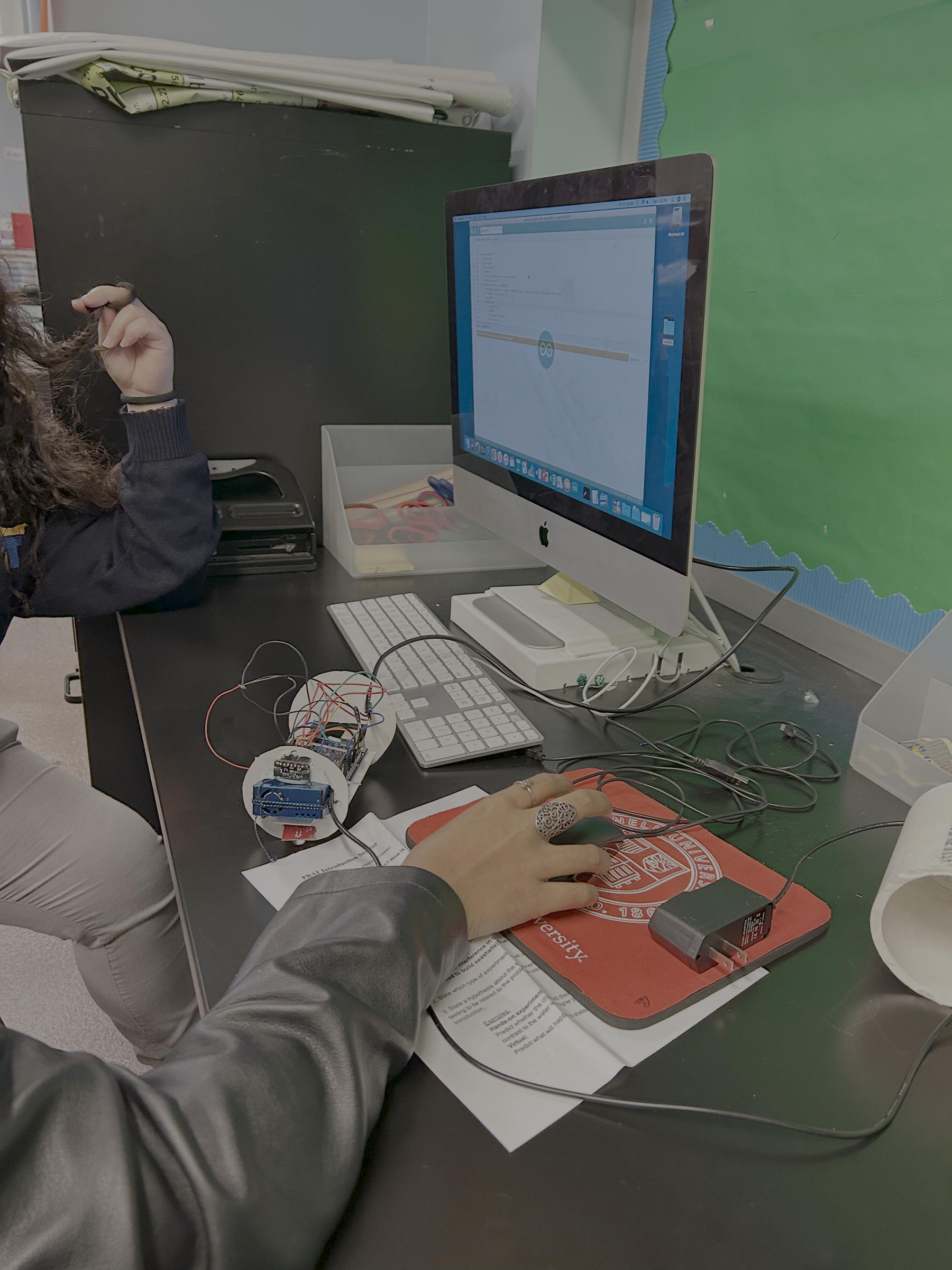
Students test and troubleshoot the monitors they built.
Recruitment of sites for installation
The students strategized on who they would target to host the monitors. The students compiled a list of businesses in the area that they would reach out via e-mail and phone. Together, an e-mail and phone script were developed to reach out to businesses and are included in the manual. In November 2022, the students began to reach out to businesses. While people seemed interested in hosting, most did not respond or follow through. The teachers and students then led the discussion on changing the recruitment strategy. The ideas that were mentioned included installing the monitors in their own houses and reaching out to other schools to host the monitors. Since the students had already begun the process of reaching out via e-mail and phone to local businesses, the recruitment strategy was then changed to go door-door in the surrounding neighborhood. Teams composed of students, the teacher, and Columbia faculty visited businesses. The students took the lead in conversing with the manager or owner of the business to explain the project and to show them the monitor to be installed on their premises. Of the 10 businesses we visited, six agreed to host a monitor (Fig. 2).
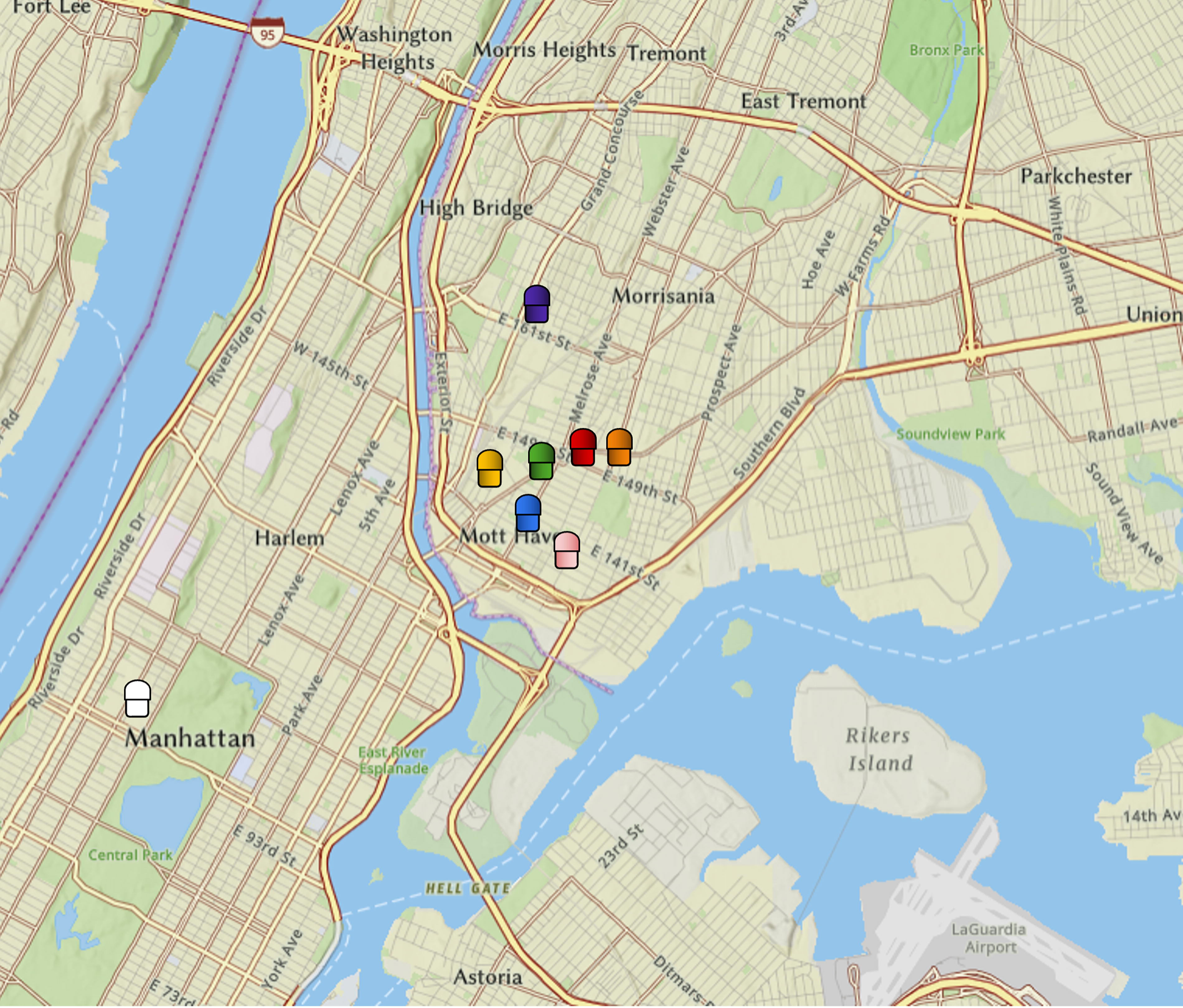
Location of air monitors (Map made by X223 students). Purple and White monitors are New York City Community Air Survey (NYCCAS) sites.
Monitor installation
The monitors were completed in November 2022, and were deployed beginning in February 2023. The placement of the monitors was decided by the students from X223, with input from their science teachers and Columbia researchers. During visits to the business that gave permission, the following items were taken, a flyer with the project information, the monitor, a computer, and duct tape or cable cords. The software in the monitors were finalized with the correct WiFi information. As the monitor required power, most were mounted on double-hung windows. A flat power cord to ensure windows would still close was chosen. Once installation was complete, students thanked the host and returned to the classroom to debrief.
Data access and storage
The monitors uploaded measurements every 5 minutes to a secure data server run by the Study Design and Data Analytics Facility Core of CEHNM. Access to the data was initially only password-protected; however, later, SMS-based multi-factor authentication (MFA) was required. User accounts could not be created by the study team but only by a system administrator.
USES FOR THE TOOL
The main uses of the tool have been education of engineering, environmental justice, and research process principles. In addition, the tool has also served as a community monitoring tool. Prior to the installation of these six monitors, there were no other low-cost monitors in the area.
Student engagement
Working with youth through school-based programs is always an adventure. There are multiple levels of approvals to navigate and competing opportunities for students. Part of our approach was ensuring that we provided a space for students to learn about various STEM fields (e.g., environmental justice, engineering, and community science). We also wanted to provide support to students in applications to other programs, letters of support, or additional initiatives they felt passionate about. Instead of providing honorariums, we opted to support students to attend Columbia Engineering’s Summer High School Academic Program for Engineers (SHAPE) in the summers of 2022 and 2023, as requested by Assistant Principal Latir Primus. Another engagement approach was providing support for students to use the data gathered from the citizen science project in their performance-based assessment tasks (PBAT). The PBAT is a graduation requirement where students can choose to write a research paper and present their findings to a committee. Five of the students participating in the citizen science program chose to leverage the air monitoring data for their PBAT project. Since launching the monitors, the students have become more vocal on initiatives to advance their reach with the citizen science program. For instance, the students requested a greening initiative. In October 2023, the students planted daffodil bulbs around the neighborhood with the assistance of SBU, who graciously provided the materials.
Community monitoring tool
The tool can also be used as a community air monitoring tool. Community groups have different levels of funding, resources, and goals. Current low-cost monitors retail for about ∼$200 USD, and while they are user-friendly, they do not allow for the co-learning through the building of monitors process.
RESEARCH FINDINGS
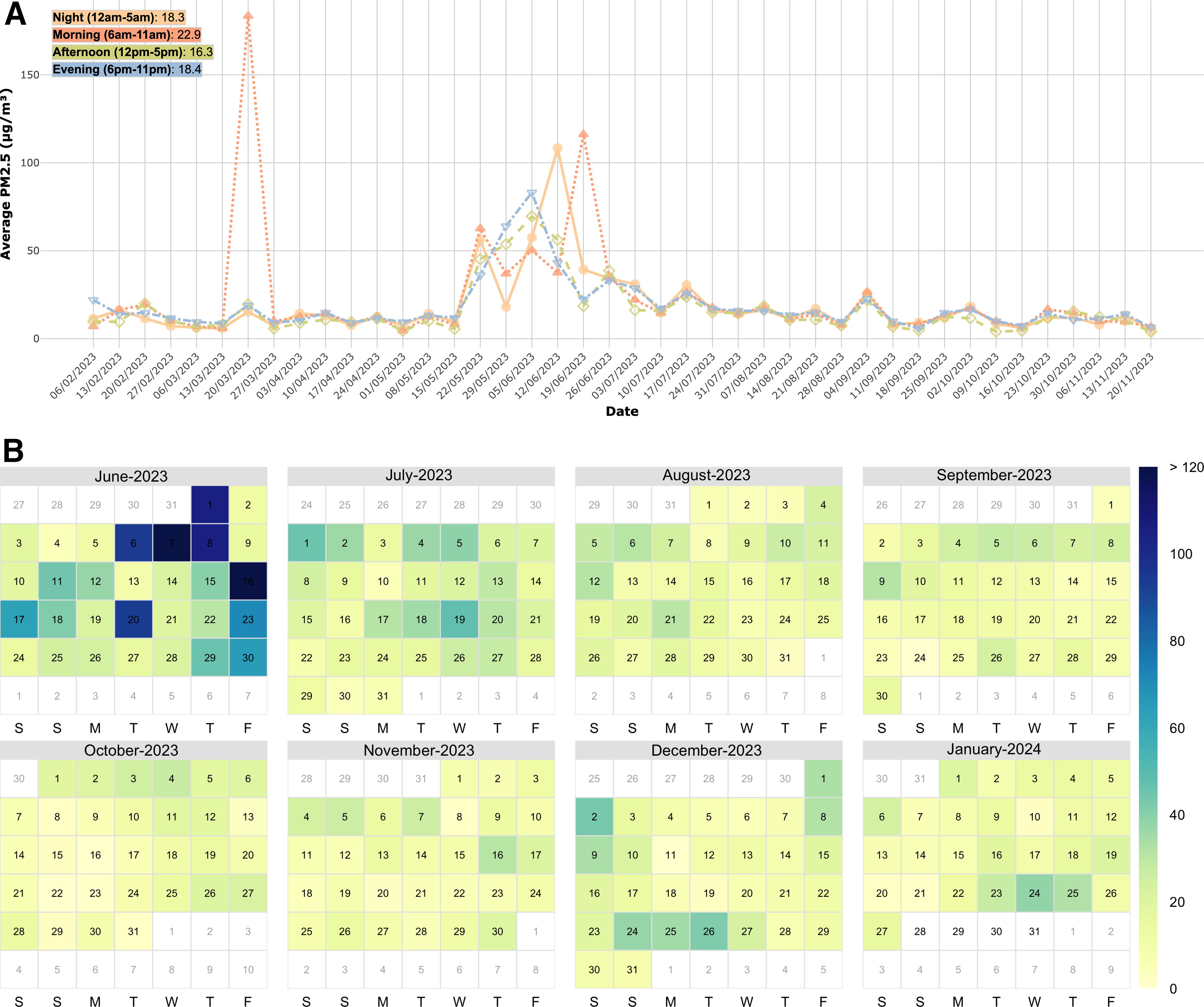
While we never intended for the monitors to be used as research-grade instruments, they have been used to teach research principles. One of the main research findings by the students has been that PM2.5 as measured by the monitors varied by time of day (i.e., morning, afternoon, evening) (Fig. 3a). In June 2023, the air quality in NYC was severely impacted by the Canadian wildfires. The monitors the students built were able to capture this event by summarizing PM2.5 by day (Fig. 3b).
LIMITATIONS, LESSONS LEARNED, AND BEST PRACTICES
In this project, high school students from a public high school in NYC built a local air monitoring network in their community. They used the air data to explore various hypotheses the students developed. These hypotheses were usually related to local air pollution sources; however, students also took the opportunity to analyze an unforeseen air pollution hazard, smoke from the 2023 Canadian wildfires.
The partnering high school committed substantial resources to the project. Columbia University’s involvement was only possible through internal departmental pilot awards and the continued commitment to the community by the team. The initial pilot award was funded by the P30 CEHNM in December 2019. One of the major limitations was the compensation structure for the students. Students were compensated through the tuition for a 3-week-long summer research program at Columbia University. The 3-week program (SHAPE) was taught by the Columbia University engineering school, a division different from the PI’s division, making it therefore difficult to waive tuition fees. The SHAPE program graciously agreed to waive 50% of the tuition. The remainder has been covered by pilot funds that were originally allocated for a research assistant or foundation money secured by the high school. Since this funding model is not robust, we sought additional support through other grant mechanisms.
Lessons learned and possible solutions
The ChromeBook computers supplied by the Department of Education could not be used by the students for two main reasons: (1) ChromeBooks were unable to support the WiFi version of the Arduino microcomputer we used, and (2) administrative rights to overcome the software issue on the ChromeBooks were needed but difficult to waive.
Brainstormed solution: Use foundation funding or unrestricted university accounts to purchase computers that will allow for open-source programs to be installed.
Using a public health-based server, which has been designed to store Protected Health Information, to upload the measured data was suboptimal. Currently data can only be accessed through the Columbia server using MFA, and user accounts cannot be easily created. This is a barrier when attempting to democratize data and further complicates data sharing with affected communities and student citizen scientists.
Brainstormed solution: In the time since launching the program, we learned that data from the monitors could have alternatively been uploaded to Google sheets. While our team has not attempted this, online tutorials are available for those choosing this option.
It is extremely helpful to be flexible with the scheduling of lessons and planned activities. There will be times when it will be impossible to meet due to days off, testing, or other competing demands in high school educational environments.
Brainstormed solution: Create a group chat with the teachers and researchers to ensure timely contact amongst the group. Our team relied on a group chat to communicate with the teachers and confirm the day that the students were planning on meeting.
For implementing this tool, we recommend that approvals through all institutions be done in parallel. As we were working with minors and at a school, we had to obtain approval from the Columbia University and NYC Department of Education Institutional Review Boards. Ultimately both review boards determined that this was not human subjects research and exempted the project. We also recommend that individual kits with all components be part of the curriculum; this will assist with learning the components and materials needed by the students. We also recommend that there be a routine checkup on monitors to ensure that they are functioning properly. Lastly, for best practices, we recommend that students be encouraged to pursue their own scientific inquiries and use the air monitoring data for their own educational endeavors.
CHANGE IN THE MAKING
We have not set out to make a formal evaluation of this tool or its impact on student development. Instead, we opted to integrate students involved in the process as co-authors in this article. We have also seen its impact on the students, as many have opted to pursue STEM fields. Additionally, the students have on their own written a story for their school’s newspaper. 31 Furthermore, the students have the following to say when reflecting on the program:
“Now, reflecting on my experience and all the time that has progressed, I see myself becoming more and more closer to STEM because of my ability to contribute to one of the most pressing issues that plagued my community - Air Pollution … Seeing all of working together was truly enlightening and summed up what science is all about, informing and enacting change. As I transition into pursuing Engineering, I hold this project close as it showcases what STEM can do not only for my community but others around the world.” —Graduate of X223
“I had always known that environmental issues like pollution harmed my neighborhood, but I had never explored these issues in depth. Through Citizen Science Program, I was able to learn about environmental problems from experts and contribute to real change by installing air quality monitors and analyzing environmental data. These new experiences made me realize I had a deep passion for environmental justice … I plan to pursue a PhD and a career in environmental research and policy. Without being a part of Citizen Science Program, I would have never seen myself in academia or a research-based career.” —Current Senior at X223
“I initially joined Citizen Science as a way to get some extra credits, but I would end up staying because of the fire that it lit within me. I never knew the South Bronx was named “asthma alley” or that the cause behind my own asthma could have been the conditions of my community. Citizen Science was a beacon of hope and where I’d channel my desire to change this. It was an opportunity to show that we care about our community and want to make it better, and it gave us the power to do it.”—Graduate of X223
This tool and its accompanying curriculum can be adapted for either school-based or community-based initiatives. In meeting with the administrators and teachers throughout the 2022–2023 school year, we inquired about applying for an R25 NIEHS grant. With this mechanism, the group felt that a few things could be implemented to improve the program. The citizen science program operated on a year-by-year basis throughout the school year. With the R25, the team thought that the program would benefit from becoming a summer research program based in the school instead of an afterschool program. Additionally, the team felt that securing an R25 would allow for longer-term sustainability of the program, as there would be 5 years of funding available. The citizen science program was also only focused on air pollution. With a new grant, the team hoped that the program could grow so that students could research other environmental issues in their neighborhood important to them. Lastly, the team felt that a new grant would allow us to compensate the teachers for their time and effort in the program. In 2023, we submitted an R25 titled ‘Bronx Environmental Health Summer Training for Justice.’ The grant received favorable reviews but was not funded that cycle. The grant was resubmitted in early 2024 and received an improved score; in early 2025, a Notice of Award was received.
Centering youth in environmental justice initiatives
The initial partnership with SBU began as a way to assess the traffic impacts of a food-delivery warehouse; it has now grown to include youth and teachers from X223. It is recognized that each research study is different, and more importantly, each community is likely to have unique political, cultural, environmental, and/or social characteristics that affect their exposures. As an ally, it is important to center youth needs, utilize an iterative approach, and co-develop sustainable programs to nurture their growth as researchers. Ultimately, change happens when both allies and members impacted by environmental injustice set out to uplift each others’ efforts.
Footnotes
ACKNOWLEDGMENTS
The authors would like to thank Mr. Latir Primus, Ms. Kieran Tobias, and Mr. Eric Lincoln for their support throughout the project. They would love to thank the additional members of the Citizen Science team Safa Qahtan Ali Al-Omari, Saniah Etienne, Jeremy Montes, Hailey Santiago, Oscar Flores, John De La Cruz, and Raul Garcia.
AUTHORS’ CONTRIBUTIONS
All authors contributed to the conceptualization of the study. Y.O.V.H. performed the literature search and assembly of the first written draft of the article. M.H., Y.O.V.H., K.W., and M.J. contributed to project administration. M.H. and Y.O.V.H. contributed to the supervision, review and editing of the article, and Y.O.V.H. and M.H. secured the funding. All authors read and approved the final article. The authors have no interests to disclose.
AUTHOR DISCLOSURE STATEMENT
No competing financial interests exist.
FUNDING INFORMATION
Research reported in this publication was supported by NIEHS grant

Supplementary Material
Please find the following supplemental material available below.
For Open Access articles published under a Creative Commons License, all supplemental material carries the same license as the article it is associated with.
For non-Open Access articles published, all supplemental material carries a non-exclusive license, and permission requests for re-use of supplemental material or any part of supplemental material shall be sent directly to the copyright owner as specified in the copyright notice associated with the article.
