




Abstract
In January 2024, the Tishman Environment and Design Center (Tishman Center or TEDC) at The New School hosted the Centering Justice Symposium to explore how the rapid uptake of environmental and climate justice missions at university centers, together with increased federal and philanthropic funding opportunities, is shaping the relationship between higher education and the environmental justice (EJ) movement. The symposium addressed grounding principles, opportunities, and challenges that can accompany this emergent interest and explored ways to foster equitable partnerships with EJ communities. This article offers a summary of the event and reflects on some of the key aspects and outcomes of the symposium, including (1) investing in inclusive planning practices and agenda setting grounded in EJ principles, (2) relationship-building as a cornerstone of EJ-focused missions, (3) committing to changing the rules of higher education to center EJ movement needs, (4) institutionalizing and modeling practices that center justice, (5) creating a manifesto to disseminate and act on shared commitments, and (6) building a community of practice for co-learning and accountability.
INTRODUCTION
The past decade has witnessed a growth in the number of university-based centers and research institutes explicitly focusing on environmental justice (EJ) or climate justice (CJ) issues. This growth is in large part a product of the success of the EJ movement in bringing equity and justice considerations to the forefront of public policy and academic inquiry. This, in turn, has led to historic levels of federal funding and a growing interest in CJ action across multiple sectors, including philanthropy and higher education. Federal funding from the Biden−Harris administration over the last 4 years represents one of the largest targeted investments in EJ communities, including the Justice40 initiative and climate and clean energy funding in the Inflation Reduction Act and Bipartisan Infrastructure Law. 1
The relationship between academia and the EJ movement has historically been shaped by several factors. First, there is often a disparity of resources and political power between universities and community-based, grassroots organizations that make up the EJ movement. 2 EJ communities may also suffer from public disinvestment and the impacts of global economic forces that breed distrust for elite institutions like universities. Second, there may be a general distrust of academia based upon a history of unethical or exploitative research practices in Black, Indigenous, of Color, and low-wealth communities that make up the EJ movement. 3 Also, higher education institutions can reflect broader neoliberal interests that can lead to the commercialization of research agendas aligned with industry interests. 4 In this way, academic research priorities may lend credibility and stature to industry positions that run counter to EJ movement priorities. 5
Despite these challenges, academics, and more specifically EJ scholar-activists, have played a crucial role in the evolution of the EJ movement in the United States. 6 EJ scholars helped to frame nascent EJ research agendas, conducted consequential research providing the empirical evidence base for later policy reforms, and provided technical support and expert testimony for communities.
Historically, these university contributions were confined mostly to individual scholar activists operating within their respective institutions. 7 Over the last several decades, as the EJ movement has grown in stature, environmental inequities have become an increasing focus of academic programs and research agendas. Community-based participatory action research (CBPAR) approaches including citizen/civic science have also evolved alongside the growth of EJ research agendas. These participatory approaches are widely used across disciplines and can increase the coproduction of knowledge, enhance problem-solving, and ensure that processes and outcomes are rooted in community needs. 8 Collaborative approaches, such as the collaborative problem-solving model, have also been adopted by federal agencies such as the US Environmental Protection Agency (US EPA). 9 While these research models advanced community–academic engagements, they still faced challenges such as misaligned objectives, fluctuating resources, and organizational changes. 10
Beyond embracing CBPAR approaches and an increased focus on EJ research agendas is the adoption, by research centers, of EJ principles such as the Principles of Environmental Justice adopted at the First National People of Color Environmental Leadership Summit in 1991 and the Jemez Principles for Democratic Organizing adopted in 1996. 11 These commitments to EJ principles implicate these centers in a more diverse range of collaborative engagements with EJ communities, movement actors, and other stakeholders beyond pure research. 12
New opportunities, new challenges
The Biden−Harris administration committed significant resources and attention to EJ through initiatives such as Executive Order 14096 on Environmental Justice, Executive Order 14008 on Justice40, and the implementation of funding through bills such as the Inflation Reduction Act. 13 These initiatives led to historic levels of federal funding targeted to “disadvantaged communities” facing environmental and climate injustice. Funding opportunities came in the form of multimillion-dollar grants in programs such as the Thriving Communities Grant program, administered by several federal agencies. 14 Due to the size and complexity of these grants, many large institutions such as universities were eligible to serve as intermediaries or lead applicants in funding applications. Over 50 universities nationwide were awarded federal grants for EJ and CJ activities with partner groups through the US EPA’s Thriving Communities Technical Assistance Centers (TCTACs), Community Change Grants, and Environmental Justice Thriving Communities Grantmakers. 15 The philanthropic sector also has a history of supporting community–academic initiatives with funding to support partnerships and research agendas focused on EJ and CJ. 16
Concurrently, universities are also being called in to support “community engagement” and “equity” for initiatives and technologies with known EJ risks. In one example, the US Department of Energy allocated nearly $4 million to “Equitable Hydrogen Technology Community Engagement” projects for the development of hydrogen technologies. Two of the four projects in this funding category are led by universities. 17 Hydrogen and other so-called carbon management 18 technologies have revealed high EJ stakes. 19 Meanwhile the federal government has funded universities to assist in their deployment under the premise of community engagement and equity. 20
Motivated by this context, in January 2024, the Tishman Environment and Design Center (Tishman Center or TEDC) at The New School hosted the Centering Justice Symposium to explore how the rapid uptake of EJ and CJ missions at university centers, together with increased federal and philanthropic funding opportunities, is shaping the relationship between higher education and the EJ movement. The symposium sought to uncover the grounding principles, opportunities, and challenges that can accompany this emergent interest. The symposium participants explored ways to institutionalize support for community-based groups and foster equitable partnerships between universities and EJ communities. Approximately, 120 participants from over 25 EJ organizations, 30 academic institutions, and over a dozen philanthropic and federal agencies attended the symposium. The convening covered a range of topics, including the historical context of partnerships, the risks of co-optation, models and best practices for justice-centered partnerships, and funding opportunities for community–academic initiatives.
This article reflects on some of the key outcomes of the symposium and the attendant processes pre- and post-convening, including (1) investing in symposium planning practices and agenda setting grounded in EJ principles, (2) relationship-building as a cornerstone of EJ-focused missions, (3) committing to changing the rules of higher education to center EJ movement needs, (4) institutionalizing and modeling practices that center justice, (5) creating a manifesto to disseminate and act on shared commitments, and (6) building a community of practice for co-learning and accountability. The following sections detail the symposium’s planning, themes, and outcomes.
SYMPOSIUM PLANNING PROCESS
The planning of the symposium itself sought to reflect the participatory and community-centered principles of EJ and CJ and therefore relied on grounding in (1) EJ and CJ community voices and priorities, (2) multisectoral engagement, and (3) inclusive ways of knowing, beyond academic knowledge production. These three orientations served as guides for planning and operations, especially informing who would be included, the crafting of the agenda, and budgetary priorities.
While Tishman Center staff led the planning efforts, input was also provided by a team from Frontline Solutions, who facilitated the development of the agenda; over 20 activists and academics who raised topics for discussion; government and philanthropy representatives, who were consulted about strategies for impactful engagement; and a five-person EJ advisory committee, who identified critical EJ and CJ perspectives. 21 In the early stages of the symposium’s planning process, frontline EJ organizations were identified to join the advisory group from the pool of groups represented in the Center’s EJ movement fellowship and the Center’s steering committee advisors, which also includes frontline organizations. These advisors identified priority goals for the event, relevant agenda topics, and other frontline organizations to include as speakers and invitees. The advisors were consulted before the agenda and invitations were established so that their insights could be incorporated into the shaping of the agenda. For example, the advisors suggested that culture keepers and artists be integrated not just as accessory performers but also as active contributing participants in the agenda and outcomes of the symposium. They also suggested inviting EJ organizations without any formal ties to university partnerships but with deep experience in community-owned and community-led research practices that would be invaluable to the discussions. Overall, the deep involvement of frontline groups in the planning of the symposium helped establish an agenda that centered on-the-ground community-based work and reduced theoretical or abstract discourse that might otherwise have predominated a university-based convening.
The symposium’s budget prioritized inclusion of EJ and CJ community members, with approximately half of the operating budget accounting for their expenses. Local artists who participated were also provided financial support and honoraria equivalent to that of panelists and academics. Though such practices are increasingly more prevalent, they are far from commonplace in academic settings and administrative barriers often exist for compensation.
The desire for a catalytic symposium and space constraints led to targeted invitations and limits to the number of attendees. Within this context, the symposium’s invitees reflected a multisectoral approach, with approximately one-third of invitations going to EJ or CJ leaders, one-third to academics, and the remainder to philanthropy, government, and other intermediary organizations (e.g., Community First Fund, Environmental Protection Network). Parity in the number of grassroots EJ and CJ participants, in relation to those from higher education, also intentionally sought to decenter primacy of academic knowledge production. In this vein, every session except one included equal or greater EJ participants as compared with university representatives.
To highlight place-based identities and culture, local artists and cultural bearers participated throughout the symposium. The symposium opened with Chief Vincent Mann from the Turtle Clan of the Ramapough Lenape Nation, whose opening went beyond a land acknowledgment to include local history, guidance, and a supplication. Day 2 opened with Bomba, traditional drumming from Puerto Rico performed by local musician BombaYo, and a libation ceremony performed by symposium participant, Dr. Qasimah Boston. Drumming recurred throughout and the event closed with a final blessing. Throughout, graphic notetaker Crystal Clarity documented key moments of the symposium by illustrating themes on posters in real time in the meeting space. These cultural practices were intended to be more than symbolic; their inclusion tangibly offered different ways of knowing and embodied forms of learning and sense-making. 22
SYMPOSIUM THEMES
The symposium included five panels, two plenary talks, and a breakout session for facilitated small-group discussions, bookended by an opening reception and a closing town hall. 23 Ahead of the gathering, the Center curated, crowdsourced, and shared a list of resources for centering justice in community–academic partnerships, which included foundational documents including the Jemez Principles for Democratic Organizing, the Environmental Justice Principles, the People of Color Environmental Justice “Principles of Working Together,” and the 1990 letter sent by Southwest Organizing Project and others to the “Group of Ten” national environmental organizations. 24 The resource list also included an example memorandum of understanding (MOU) between the Tishman Center and a community partner and additional MOU templates, principles, and working agreements.
Over the 2.5 days, symposium attendees engaged in rich, candid dialogue about the challenges and experiences of advancing EJ and CJ between movement partners and academic institutions. Key themes included the following:
Academic centers eager to advance EJ or CJ solutions should channel this urge into building relationships with EJ communities, following the lead of movement partners.
From the initiation of the symposium, there was a focused framing on the opportunities arising from unprecedented targeted EJ and CJ investments along with increased interest in EJ within higher education. There was an observation among some academic participants that universities without a track record of working closely with communities may have engaged extractively or transactionally with communities, both historically and in this moment of federal funding opportunities. Dr. Kyle Whyte, from the University of Michigan, described the problematic nature of the status quo relationship, whereby community and indigenous knowledge are tapped and then repackaged by academics to advance their careers. 25
EJ representatives recognized that academics may have useful skills, knowledge, or resources to offer and that many may be genuinely motivated to advance EJ beyond the “ivory tower.” However, EJ leaders emphasized that these academics should channel their urge appropriately. As Eddie Bautista, Executive Director of the New York City Environmental Justice Alliance, put it: “We tell academic partners, as technical assistance providers, you are like a mechanic. Your job is to diagnose the problem and hand the car back to the community. [It is] not your job to fix the problem by getting into the car and driving it.” 26 Dr. Whyte similarly emphasized: “There is a power for academics to wield if they use their job security as a way to protect their capacity to operate behind the scenes to amplify impacts for communities.” 27
To implement just partnerships, participants provided examples of “do’s and don’ts” and seeded the idea of a tangible and specific code of conduct by which university centers and other intermediaries can abide. This call for principles ultimately became one of the main outcomes of the symposium—a manifesto for higher education and EJ—described in the next section. For example, Maria López-Nuñez, Deputy Director at the Ironbound Community Corporation, encouraged academics to invest in building relationships before funds are made available. 28 In a similar vein, Darryl Molina Sarmiento, Executive Director of Communities for a Better Environment, observed that the best partnerships begin as individuals building relationships rather than starting as partners. 29
Participants across sectors emphasized the need for other actors—philanthropic and government agencies as well as universities—to play a role in ensuring equitable partnerships. Many attendees noted that funders could help level the playing field between universities and community-based organizations by funding the latter directly, providing them with multiyear general operating funds where possible, giving them the resources to commission their own research and select their academic partners so that they can set the terms of those partnerships.
Another recommendation that arose from one of the breakout group discussions was that philanthropy could help hold universities accountable by making adherence to community codes of conduct a consideration in funding decisions. There was a sense of urgency to reform existing funding practices, given the newly available federal funds for EJ and its capture by those not representing CJ and EJ interests. As Dr. Sacoby Wilson, Professor and Director of the Center for Community Engagement, Environmental Justice and Health at the University of Maryland, warned, entities started in the past year have been “allowed to lead on environmental justice grants” when they had not been “at the table” on EJ previously.
30
Institutional partners can challenge themselves—exploring multiple roles and tactics for bending or changing the rules—to better serve and center the needs of communities.
Throughout the symposium, EJ leaders called on university, philanthropic, and federal partners to think more expansively about how they could adapt or “bend” the limits of their institutional practices and policies so as to better serve EJ goals and communities. This call to be creative “disruptors” within institutions applied to various aspects of community–academic partnerships—from the finance and administrative roles to the possibilities for research and advocacy. Angela Mahecha, Director of the EJ Disrupt Design Fellowship at the Tishman Center, highlighted different roles that individuals and organizations could consider for advancing more justice-centered partnerships: those with the ability to leverage power or “hack” systems could serve as “rule-benders,” those positioned to recruit people and maximize resources could serve as “activators,” those able to create connections and mend relationships could serve as “weavers,” and those poised to disrupt the status quo and change power dynamics could serve as “disruptors.” As one breakout group participant put it, “When you do community work, you change a structure that has existed.” 31
Participants provided examples of operating creatively to center communities. Several panelists named the Tishman Center’s EJ movement fellowship as one example. The funder’s original proposal was to create a new academic program, but the Center secured seed funding for a fellowship program to support EJ movement leaders and their organizations, cultivating a unique space for senior leaders to scale and innovate frontline solutions. In a breakout session on changing and bending the rules, one participant described how a university’s $300 limit on honorarium compensation for community members was surmounted by contracting community members as senior advisers instead, which had no limits on compensation.
As both an academic and an EJ advocate, Dr. Nicky Sheats, Director of the Center for the Urban Environment at Kean University, also shared one of his principle rules was to decline funding if his EJ partners are not included or not interested in the project being proposed. Participants in several of the breakout groups brought up trying to bend their university’s rules to ensure that community members could be compensated for their time, which involved engaging university administration.
This could range from engaging university deans and presidents to research ethics boards or offices of community partnership and engagement. Dr. Wilson and Dr. Sheats gave advice on how to negotiate MOUs so that communities could own and manage the data and so that Black, Indigenous, and People of Color academic researchers could serve as lead researchers or co-principal investigators.
Both Mahecha and Dr. Manuel Pastor, Director of the Equity Research Institute at the University of Southern California, stressed the importance of academics not only being honest and humble but also being very clear about what they could contribute when engaging with communities. 32 Related to this point, several symposium speakers noted the importance of having an “inside-outside” strategy for diverse sectors, ranging from academia to the government. Participants were fully cognizant of the challenges insiders face as they operated within institutional boundaries and commended those able to bend and break rules to center justice. Scholars Debra Meyerson and Maureen Scully have dubbed individuals in this position, “tempered radicals,” reflecting the sentiment in the room as they write: “The labor of resistance may be divided among those who push for change from the inside, from the outside, and from the margin, each effort being essential to the others and to an overall movement of change. Tempered radicals may be playing parts in movements bigger than themselves and their organizations. In the course of effecting change, they are helping prepare for bigger changes that more radical outsiders may be better positioned to advance.” 33 (See Fig. 1.)
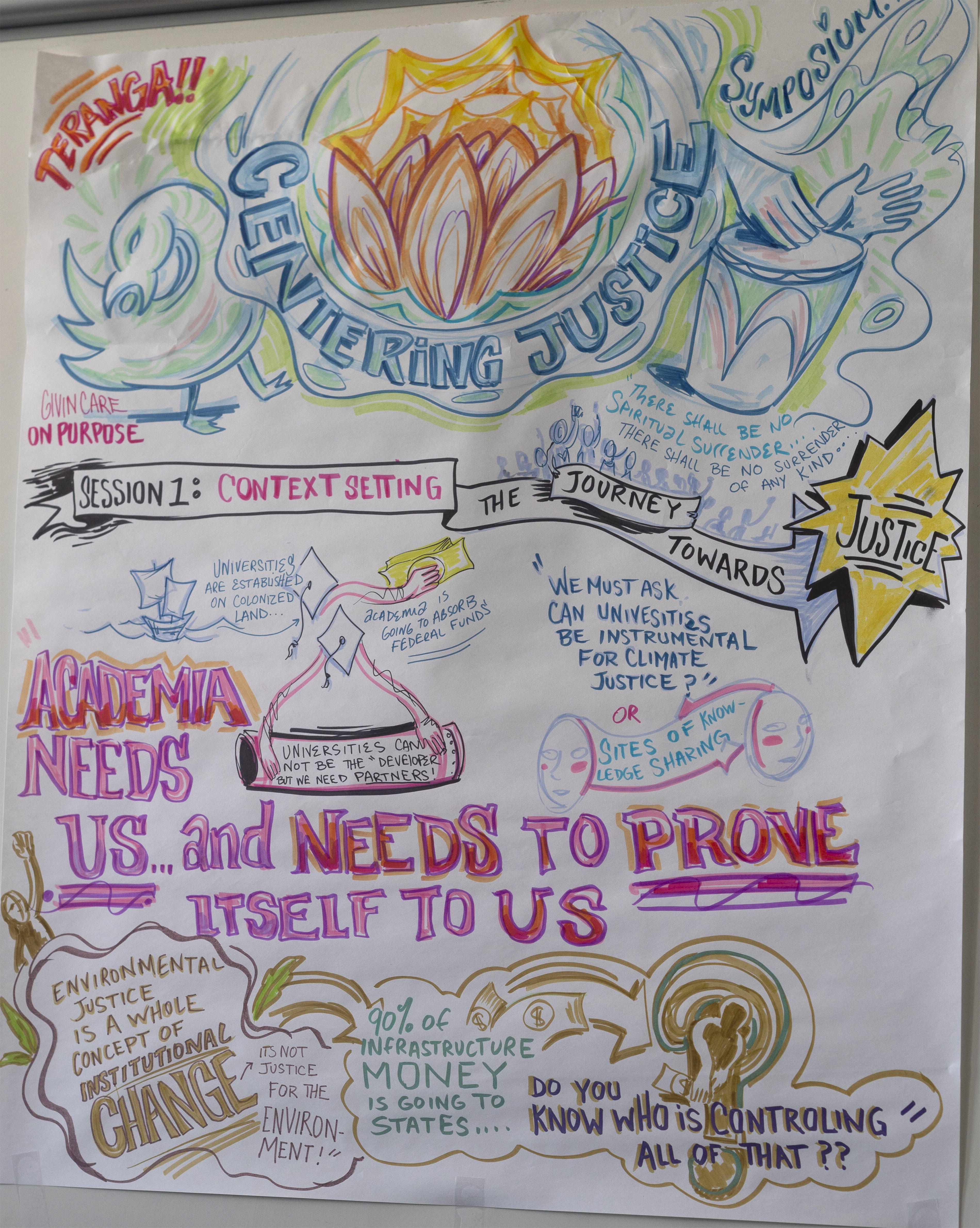
Graphic notetaking on the context for the Centering Justice Symposium. Crystal Clarity, January 2024.
There is a culture of practice around centering justice in higher education, but it is often invisible or not modeled.
The symposium’s participants brought to light many examples where academic actors and public and private resource providers have fallen short of centering justice, but they also amplified successful case studies, too. In Washington State, the Front and Centered coalition that came together to work on federal and state policy aimed to set up community “co-governance procedures that become more permanent over time, regardless of the political administration in place.” 34 A participant shared how their HBCU, being regarded as “the community,” was able to train community scientists, reflecting the sentiment shared by others that minority-serving institutions such as HBCUs were embedded within communities of Color and therefore understood community priorities. In another example, Tribes were brought together to create an institution of higher education, the Salish Kootenai College, which gave Tribes the option to publish or not publish research they reviewed. Others asked how this model could be adopted by non-Tribal colleges as a standard of practice that includes informed consent and deeper consultation.
Amid these positive examples, however, there was a fear that the positive practices and learnings were being insufficiently documented. For example, a government agency representative called attention to the entities receiving EPA funding to serve as TCTACs for EJ and CJ groups, asking: “Folks receiving large [amounts of] funding like TCTACs will have a lot of feedback—how do we memorialize this and fix future processes?” 35
Other speakers also spoke to the challenge and importance of institutionalizing good practices, codifying them and making them more visible. One of the barriers identified in a breakout group discussion was the siloed nature of institutions, both topically and geographically. A potential solution offered was creating more opportunities for sharing and reflection, to “bring more groups into the fold by showing them the work” and cultivate “more co-conspirators.” 36 Convenings were also viewed as an opportunity for critical self-reflection by institutions and to call in peers. But as a former philanthropic foundation program officer noted: “I have not yet seen a space where there are sustained spaces for dialogue.” 37
The symposium was regarded as a good step to fill this gap. Multisectoral convenings with space to nurture co-learning and critical reflection could be the foundation for an affiliation of centers focused on EJ and CJ. In addition, participants called for independent tracking and evaluation of universities’ work, which could serve as a system of accountability that helps to build relationships of trust among universities and community organizations. Both the desire for memorialization and the need for sustained reflective spaces drove the two major symposium outcomes—a call to action represented by a manifesto for higher education and EJ and supporting a “community of practice,” described in greater detail below.
SYMPOSIUM OUTCOMES: A MANIFESTO FOR HIGHER EDUCATION AND EJ AND SUPPORTING A COMMUNITY OF PRACTICE
On the final day of the symposium, participants discussed the need to document and share the most pressing demands and principles emerging from the forum. A summary report seemed ill-suited to convey the urgency and movement perspective. Instead, participants gravitated toward the idea of a manifesto as a way to concretize commitments and good intentions (see Fig. 2). The use of manifestos has a rich history in the EJ and CJ movements, where they are used to assert demands, principles, and alternative visions of the future. 38
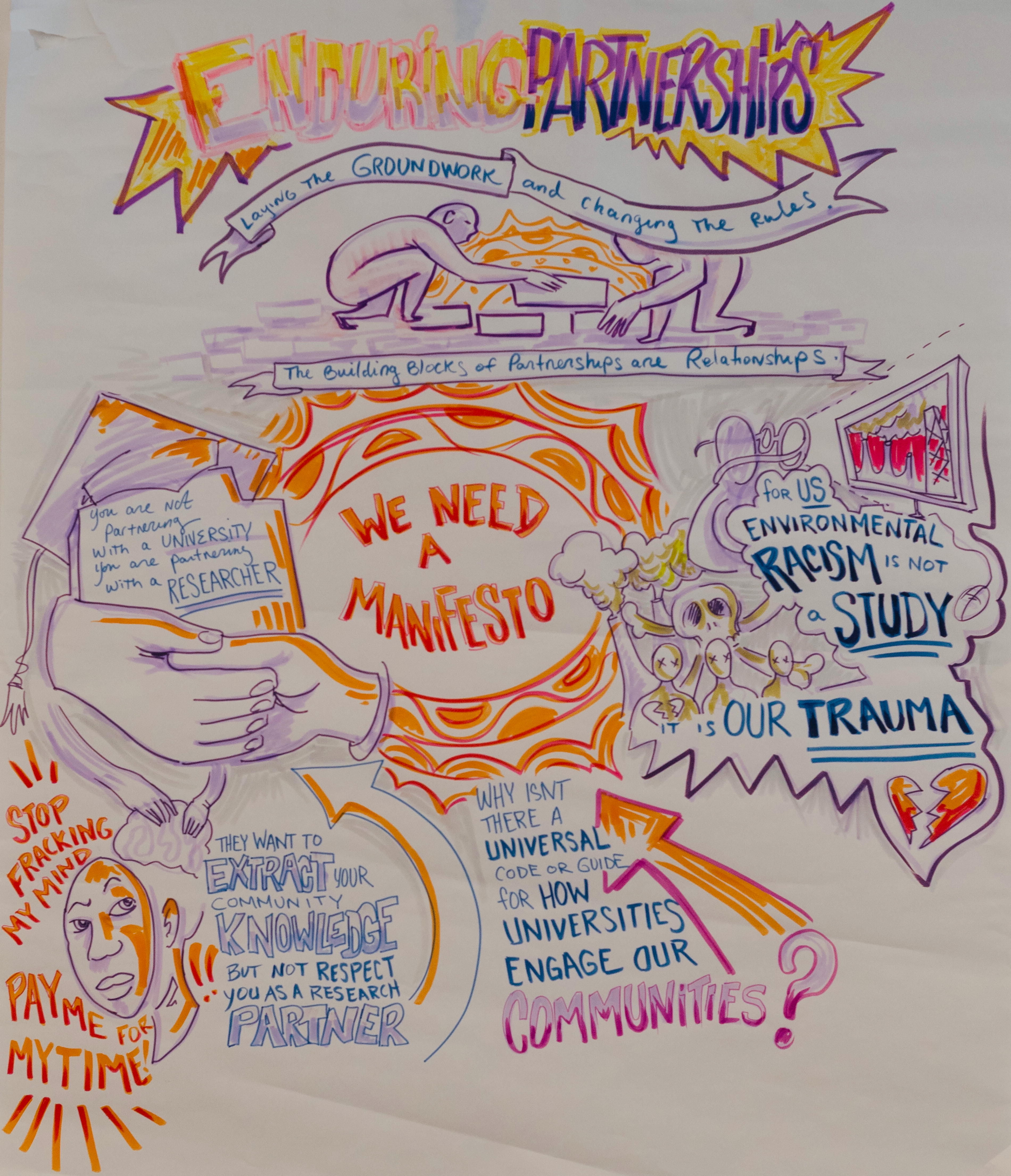
Graphic notetaking calling for a “manifesto.” Crystal Clarity, January 2024.
The distinguishing features of manifestos made it a fitting vehicle for the multisectoral, justice-centered symposium. A manifesto is a political, often transgressive form of writing that is public-facing. It is typically a declarative statement that breaks with conventions or norms. Most importantly, manifestos challenge systems of power and can offer up shared visions and commitments. 39
The Centering Justice Manifesto was developed with a public-facing aim that could call in peer institutions across higher education and amplify a set of practices and commitments grounded in EJ principles. 40 It sought to complement those historic EJ principles by providing additional foundational guidance specific to academic institutions so that they can cultivate justice-centered pathways and outcomes. The manifesto format was also useful in responding to the urgent context of historic levels of funding earmarked for EJ and CJ, much of it passing through universities as intermediaries. While there are several examples of reports and convenings that address best practices and guidelines for working at the intersection of higher education and community-based organizations, the manifesto emerging from the symposium takes on a decidedly movement-centered voice that could be applied even after the latest federal funding opportunities have passed. 41
This EJ voice is reflected in the main calls to action in the manifesto. These three action items focus on reforms in higher education, with calls to:
“Establish just, equitable, transparent partnerships, based on reciprocity and trust; Ensure internal assessment and accountability systems within universities, while promoting alignment from philanthropy and federal agencies; and Explore the formation of a community of practice with trusted university centers and EJ partners that model and support academic-community partnerships.”
The first action item disrupts the relational power structures that are common in academic–community partnerships. The second action demands systemic change from within nodes of power like academia and federal or philanthropic sectors. The third call to action invites an exploration of possible future formations of communities built upon shared commitments. Each of these calls is further expounded upon using prompts that ask what tangible examples of these ideas would “look like” in practice. The examples listed in the Manifesto come directly from participants who shared stories, brainstormed, and generated recommendations during the symposium. Grounding the three central action items in real-world examples is in and of itself a disruptive tool meant to connect abstract ideals to tangible examples of how these commitments show up in action. Many of the examples are drawn from the expertise of EJ advocates with a long history of community-led research and university partnerships. These insights include practical guidance around funding partners fairly, as well as the recommendation for university partners to step back when opportunities arise that are best suited to movement organizations. Representatives from academia also provided best practices drawn from their experiences navigating systems within higher education. Some examples included “[t]ackling institutional barriers to justice-centered partnerships, such as contracting, procurement, general counsel, or intellectual property rules” and “[p]romoting accessible, non-technical outputs (i.e., public comments, policy briefs, technical assistance, etc.).” 42
The third action item on exploring a “community of practice” is an invitation more than a declaration. It gives examples of the purpose and opportunities that could be realized from nurturing such a community, including “[u]sing a strategic position to advocate for EJ community-driven environmental and climate justice solutions” and “[e]nsuring community agreements are in place before faculty, staff, students, and other affiliated individuals initiate research, projects, or funding proposals/applications.” 43 The symposium itself was an experiment in convening the existing community or “hubs” of practice where academic centers and EJ movement partners were already actively engaged, many of them with long-term relationships of trust. The symposium also “called in” universities that were serving as intermediaries for federal or private funding. The notion for a sustained community of practice post-symposium was borne from the desire to continue to deepen ties among university centers and EJ partners, as well as funders, interested in supporting each other’s work and setting up standards of accountability, particularly when it comes to funding. In this regard, the signatories to the Manifesto also expressed a desire to continue to disseminate the document and socialize it among peer institutions and convenings where it can serve as a measure of accountability and an invitation to learn and practice how to be in right relationships with EJ partners.
The Manifesto can serve another useful purpose, which is to pre-figure and manifest the relationships we hope to build in a world that is increasingly fractured. As resources and opportunity structures shift, the Manifesto can help ground our shared commitments to each other and to EJ and CJ. While EJ and CJ ascended in popularity and led to record levels of funding support, these conditions can change rapidly and leave the most vulnerable, impacted EJ communities marginalized, under-resourced, or under attack. The Manifesto, as well as a sustained community of practice, or affiliation of aligned centers and EJ groups, can withstand the inevitable swings of power and resources. They also have the potential to harness the power of multisectoral partnerships, founded on the principles of justice and forged in real world actions to lift up EJ communities.
CONCLUSION
As attention and financing for EJ and CJ grows, the need for right relationships with communities and equitable partnership expands, as well. In spite of the growing awareness of collaborative approaches and participatory methods, all too often, harms stemming from historic power differentials, misaligned priorities, and co-optation can persist among institutions. In fact, as the Centering Justice Symposium surfaced, such risks can be heightened when significant resources are unleashed. The symposium not only foregrounded the critical role of higher education in advancing just relationships with EJ and CJ communities but also sought to model and uplift specific actions and commitments essential for community-centered engagement.
During the second day of the symposium, Dr. Manuel Pastor called on participants to build an ecosystem, warning that “we, in the academy, often think about building empires, not an ecosystem.” 44 Throughout the planning, execution, and follow-up of the symposium, we have aimed to nurture this ecosystem. The Centering Justice Manifesto and burgeoning community of practice stand as tangible steps toward heeding community voices and centering power with community partners. There is clearly a long journey ahead to ensure that our ecosystem translates into sustained outcomes for justice. Future convenings could explore topics such as accountability measures and delve more deeply into how academic centers can invest in, pilot, and deploy best practices more broadly. They could also be used to reaffirm allies and identify new allies across sectors in the face of changing political contexts. The Centering Justice Symposium has already generated some initial momentum for future in-person and virtual convenings, as well as increased interest from several academic centers, funders, and other stakeholders to invest in institutionalizing community-oriented, justice-centered work within academia and more sustained multisectoral support for the CJ and EJ movements.
The issues and outcomes outlined in this article are particularly urgent in the face of shifting political dynamics, as a new administration takes office and recalibrates national priorities and federal programs. With potential changes to regulatory frameworks, funding streams, and agency leadership, EJ and CJ communities may find opportunities for progress and renewed challenges to their autonomy and survival during the next administration. By grounding our shared commitments and partnerships in justice and community power, we can ensure that the CJ and EJ movements endure and thrive, regardless of the ebbs and flows of political will or funding.
Footnotes
AUTHORS’ CONTRIBUTIONS
A.I.B contributed to the conceptualization, data analysis, project administration, resources, supervision, writing (original draft), reviewing, and editing. Y.L. contributed to the conceptualization, analysis, writing (original draft), reviewing, and editing. J.S.R. contributed to the conceptualization, analysis, and writing (original draft). J.V. contributed to the writing (original draft), reviewing, and editing. S.A. contributed to the conceptualization, project administration, supervision, writing (original draft), reviewing, and editing.
AUTHOR DISCLOSURE STATEMENT
The authors have no personal or financial conflicts of interest to disclose.
FUNDING INFORMATION
This article was funded in part by the Mellon Foundation.
1
The Justice40 initiative directs that 40% of the benefits of climate and clean energy investments go to disadvantaged communities, identified as a census tract that meets the threshold for environmental, climate, or other burdens and an associated socioeconomic burden. The White House, “Executive Order 14008: Tackling the Climate Crisis at Home and Abroad” (2021), https://www.federalregister.gov/documents/2021/02/01/2021-02177/tackling-the-climate-crisis-at-home-and-abroad
2
3
4
Sarah T. Romano and Wendy Highby, “Environmental Activism of Teacher-Scholars in the Neoliberal University,” New Political Science 40, no. 3 (July 3, 2018): 581–598, https://doi.org/10.1080/07393148.2018.1487112; Douglas Almond, Xinming Du, and Anna Papp, “Favourability towards Natural Gas Relates to Funding Source of University Energy Centres,” Nature Climate Change 12, no. 12 (December 2022): 1122–1128,  .
.
5
Penn Loh, “Community–University Collaborations for Environmental Justice: Toward a Transformative Co-Learning Model,” NEW SOLUTIONS: A Journal of Environmental and Occupational Health Policy 26, no. 3 (November 1, 2016): 412–428, https://doi.org/10.1177/1048291116662690; Sofia Hiltner et al., “Fossil Fuel Industry Influence in Higher Education: A Review and a Research Agenda,” WIREs Climate Change, September 5, 2024, e904, .
6
Renowned academics such as Dr. Robert Bullard and Dr. Beverley Wright were among the early supporters and leaders of the EJ movement, lending their expertise and reputations to causes that were largely marginalized by mainstream environmental organizations, public officials, and their peers in higher education. Luke W. Cole and Sheila R. Foster, From the Ground up: Environmental Racism and the Rise of the Environmental Justice Movement, Critical America (New York: New York University Press, 2001).
7
8
Jason Corburn, “Environmental Justice, Local Knowledge, and Risk: The Discourse of a Community-Based Cumulative Exposure Assessment,” Environmental Management 29, no. 4 (April 1, 2002): 451–466, https://doi.org/10.1007/s00267-001-0013-3; Sacoby Wilson et al., “A Critical Review of an Authentic and Transformative Environmental Justice and Health Community — University Partnership,” International Journal of Environmental Research and Public Health 11, no. 12 (December 11, 2014): 12817–12834, .
10
London et al., “Weaving Community-University Research and Action Partnerships for Environmental Justice.”
11
Southwest Network for Environmental and Economic Justice (SNEEJ), “Jemez Principles for Democratic Organizing” (Southwest Network for Environmental and Economic Justice (SNEEJ), December 1996), https://www.ejnet.org/ej/jemez.pdf; “Principles of Environmental Justice” (Washington, DC: First National People of Color Environmental Leadership Summit, October 24, 1991), .
12
13
The White House, “Executive Order 14096: Revitalizing Our Nation’s Commitment to Environmental Justice for All” (2023), https://www.energy.gov/sites/default/files/2023-04/eo-14096-revitalizing-commitment-to-environmental-justice.pdf; The White House, Executive Order 14008: Tackling the Climate Crisis at Home and Abroad; John A. Rep. Yarmuth, “Inflation Reduction Act of 2022,” Pub. L. No. H.R.5376 (2022), .
14
15
16
For example, the Waverley Street Foundation has worked with eight universities, including Historically Black Colleges and Universities (HBCUs) and Minority Serving Institutions (MSIs), to establish “climate hubs” that can support collaborative partnerships with community groups.
17
18
“Carbon management” is a term used to describe a suite of technologies, carbon reduction strategies, and fuels intended to remove carbon dioxide from point sources and the atmosphere. WHEJAC, “White House Environmental Justice Advisory Council Recommendations: Carbon Management Workgroup” (White House Environmental Justice Advisory Council (WHEJAC), November 17, 2023), .
19
TEDC, “Statement by Environmental Justice Organizations on the National Symposium on Climate Justice & Carbon Management,” Tishman Environment and Design Center (blog), June 6, 2023, https://www.tishmancenter.org/blog/statement-by-environmental-justice-organizations-on-the-national-symposium-on-climate-justice-amp-carbon-management; TEDC et al., “Environmental Justice Concerns with Carbon Capture and Hydrogen Co-Firing in the Power Sector” (TEDC, Kean John S. Watson Institute for Urban Policy & Research, CEED, NJEJA, June 2024), https://static1.squarespace.com/static/5d14dab43967cc000179f3d2/t/6697cde06e59501da45d2535/1721224673312/CCS+%26+EJ+White+Paper+-+Final+Draft.pdf; WHEJAC, “White House Environmental Justice Advisory Council Recommendations: Carbon Management Workgroup”; Jacob A. E. Nielsen, Kostas Stavrianakis, and Zoe Morrison, “Community Acceptance and Social Impacts of Carbon Capture, Utilization and Storage Projects: A Systematic Meta-Narrative Literature Review,” PLOS ONE 17, no. 8 (August 2, 2022): e0272409, https://doi.org/10.1371/journal.pone.0272409; David Rojas-Rueda, Kelly McAuliffe, and Emily Morales-Zamora, “Addressing Health Equity in the Context of Carbon Capture, Utilization, and Sequestration Technologies,” Current Environmental Health Reports 11, no. 2 (June 2024): 225–37, https://doi.org/10.1007/s40572-024-00447-6; Duncan P McLaren, “Procedural Justice in Carbon Capture and Storage,” Energy & Environment 23, no. 2–3 (May 1, 2012): 345–365, .
20
In another example, a recent research agenda from the National Academies of Sciences, Engineering, and Medicine to “Speed Efficient and Equitable Industrial Decarbonization” demonstrates how academic institutions are being signaled to engage in research to “navigate community dynamics” and opposition to certain carbon management approaches. National Academies of Sciences, Engineering, and Medicine, Developing and Assessing Ideas for Social and Behavioral Research to Speed Efficient and Equitable Industrial Decarbonization: Proceedings of a Workshop (Washington, DC: The National Academies Press, 2024), .
22
23
TEDC, “Centering Justice Symposium Agenda,” January 2024, https://drive.google.com/file/d/1hS7Ucl20MG7b6ay5Egv1v2cIH2lqmRXT/view?usp=drive_fs&usp=embed_facebook.
24
25
26
“Centering Justice Symposium.”
27
“Centering Justice Symposium.”
28
“Centering Justice Symposium.”
29
“Centering Justice Symposium.”
30
“Centering Justice Symposium.”
31
“Centering Justice Symposium.”
32
33
Debra E. Meyerson and Maureen A. Scully, “Tempered Radicalism and the Politics of Ambivalence and Change,” Organization Science 6, no. 5 (1995): 598.
34
“Centering Justice Symposium.”
35
“Centering Justice Symposium.”
36
“Centering Justice Symposium.”
37
“Centering Justice Symposium.”
38
39
The authors of “A Manifesto for Shadow Places” reflect on the power of this tool to inspire collective action: “It is thus unsurprising that the manifesto genre persists and even flourishes now, at this time of extreme environmental pressure and social inequality, reflecting both a growing sense of urgency regarding the trouble we are in, as well as a recognition of the need for our words to cut through, to have greater political effect, and to build coalitions from common ground.” Emily Potter et al., “A Manifesto for Shadow Places: Re-Imagining and Co-Producing Connections for Justice in an Era of Climate Change,” Environment and Planning E: Nature and Space, December 2, 2020, .
40
41
Second Nature, “Higher Education’s Role in Advancing Climate Justice” (Cambridge, MA: Second Nature, December 2022).
42
“Centering Justice Manifesto for Environmental and Climate Justice Centers,” 2.
43
“Centering Justice Manifesto for Environmental and Climate Justice Centers,” 2.
44
“Centering Justice Symposium.”