




Abstract
The lands on which Indigenous creation stories take place are centrally connected to Indigenous personhood, identity, and culture. Despite the importance of these lands, non-Indigenous institutions continue to degrade and usurp these spaces. Two studies provide evidence of the cultural and psychological consequences for Indigenous Peoples when access to their ancestral homelands is threatened. In the first study (N = 341), qualitative analyses revealed that Indigenous individuals who live on their homelands were more likely to report engaging in cultural practices and feeling pride and certainty toward their Indigenous identity than those living away from their homelands. Indigenous individuals living away from their ancestral homelands were more likely to report loss of place-based traditions and feeling uncertainty and insecurity toward their Indigenous identity than those living on their homelands. These results were replicated in a second quantitative study (N = 398). Indigenous individuals living on their homelands reported greater identity security (M = 3.39) compared to Indigenous individuals living away from their homelands (M = 3.17; t[330.54] = 3.11, p = 0.002). Mediation analysis further revealed that this difference was, in part, because Indigenous individuals living on their homelands were more embedded in cultural practices than those who live away from their homelands (β = −0.21, 95% confidence interval [−0.32, −0.11]). To uphold Indigenous Peoples’ rights to self-determination over their culture, personhood, and well-being, these findings suggest that ancestral homelands must be protected from threats posed by environmental exploitation and degradation.
INTRODUCTION
To Indigenous Peoples, the lands on which their creation stories took place (henceforth referred to as ancestral homelands) are essential contexts for their identity and culture.1,2 Given their significance, many Indigenous communities traditionally believed these lands could not be owned, bought, or sold.3,4 This understanding conflicts with settler colonial views of land as an inextinguishable resource to extract, an understanding that developed out of systems of industrialization, capitalism, and imperialism. 5 This settler orientation to land, which positions humans hierarchically above and separate from the natural world,6,7,8,9 has contributed to the ongoing dispossession and degradation of Indigenous lands for profit and control.
Take, for example, the ongoing threats to the Menominee Nation’s ancestral homelands. The Menominee Nation’s creation story takes place at the mouth of the Menominee River. The Menominee were forcibly removed from this location to a reservation 60 miles away, yet they regularly return to collect traditional foods and to hold ceremonies. Reflecting the river’s significance to their identity, a Menominee member expressed the “river is a part of me; its essence is within my soul.” 10 Despite such significance, Gold Resource Corporation proposed construction of an open-pit metallic sulfide mine at the mouth of the Menominee River. While wastewater and acid drainage will threaten the river’s endangered ecosystem, the corporation’s community impact evaluation emphasized that cultural protections were not necessary due to the absence of contemporary Indigenous Peoples in the area. The evaluation further described the river as a “historical” mode of transportation and water source for the Menominee, erasing their ongoing spiritual connection with and cultural use of the area. 11 Despite the river’s significance and resistance from the Menominee, the proposed mine was set to begin construction in 2024.12,13
While the Menominee example represents one case study, their experience reflects countless Indigenous communities resisting threats to their ancestral homelands globally, such as elsewhere in North America, 14 the Pacific, 15 South America, 16 and Asia. 17 To uplift Indigenous Peoples’ right to protect and steward their homelands, the current studies examine the vital role ancestral homelands play in shaping their culture and identity. To make this case, we first review the literature on the importance of ancestral homelands for Indigenous identity and culture, and then we discuss the psychological consequences for Indigenous individuals who have access to their ancestral homelands, verus Indigenous individuals who do not.
Caveat
In this article, those who have access to their ancestral homeland are defined as individuals who currently live on their ancestral homelands and those who do not have access are defined as individuals who do not live on their ancestral homelands. This definition and operationalization offer one way to ascertain information about the importance of having access to one’s ancestral homeland(s). However, the current definition does not diminish the nuances that reflect the everyday experiences of place for Indigenous Peoples, such as the historical or contemporary reasons why someone may not have access to their homelands and/or the experiences of individuals who visit their homelands but do not live there. Although these nuances are beyond the scope of this paper, future research can build on the findings presented here to work towards an increasingly nuanced understanding of this topic.
Importance of ancestral homelands for Indigenous identity and culture
Indigenous Peoples’ ancestral homelands are inextricably tied to identity and culture, in part, because of the role they play in creation stories. Creation stories communicate beliefs about the origin of the world and depict how the natural elements, animals, and plants of a particular land base come together to give life to Indigenous Peoples. For instance, in one of many creation stories of Kānaka Maoli, the daughter of Sky Father and Earth Mother gave birth to two children. The first was a stillborn baby who was planted in the ground and grew into kalo (taro), a staple food of Kānaka Maoli. The second child became the first Hawaiian. This story depicts how Kānaka Maoli are descendants of the Hawaiian Islands and siblings to kalo.18,19,20,21,22 Creation stories underscore the importance of ancestral homelands for Indigenous identity.
Cultural lifeways such as subsistence, ceremonial practices, and modes of self-expression are also informed by ancestral homelands. In other words, Indigenous Peoples depend on their ancestral homelands to access and maintain traditions and practices across generations.23,24,25 For example, many tribes in the Pacific Northwest region of the United States refer to themselves as the “Salmon People” due to their sacred relationship with and subsitent reliance on salmon.26,27 In their creation stories, all nonhuman relatives were asked to offer gifts so that their people would survive. Salmon offered their body to feed the people and Water offered itself as the salmon’s home.28,29 The Salmon People honor these gifts by maintaining and stewarding their relationship with salmon. In doing so, salmon continue to be a staple food source and used in visual arts, spiritual practices, and feasts marking significant life stages that reflect the salmon life cycle, such as births, coming-of-age ceremonies, and death.30,31 Indigenous Peoples’ engagement in place-based cultural practices fosters a sense of purpose and pride in their identity.32,33
Ancestral homelands further inform Indigenous identity and culture by providing epistemological frameworks that contribute to how Indigenous Peoples understand themselves in relation to the world around them. 34 For example, the Salmon People are obligated to honor, care for, and steward the salmon and waterways in return for their gifts. 35 This obligation imparts a relationality framework or an understanding of the interconnectedness of all living and nonliving entities, as well as our responsibilities to them. This teaching from their ancestral homelands expands beyond the Salmon People’s relationships with the salmon and water and also informs their kinship obligations to other living and nonliving entities around them.36,37,38,39 For instance, the Swinomish Indian Tribal Community has applied their understandings of relationality in their environmental and cultural stewardship practices by building the first known present-day traditional clam garden in the United States. The clam garden supports tribal food security by reviving native marine populations, such as salmon, and reduces the severity of storm surges and ocean acidification in the Puget Sound. 40 The Tulalip Tribes have enacted a strategy of relocating beavers from urban areas back to traditional watersheds with the goal of lowering river temperatures to support native salmon populations.41,42 Together, the Kānaka Maoli’s and the Salmon People’s creation stories illustrate how culture and identity are intrinsically tied to ancestral homelands.
Ancestral homelands also inform Indigenous Peoples' understanding of how their communities and cultural lifeways persist continuously across generations and time. 43 Indigenous individuals who are connected to their ancestral homelands may feel connected to their ancestors who walked the land before. This connection to past generations may also motivate individuals to sustain their culture and identity for future generations.44,45 Previous research asserts that maintaining personal and cultural continuity across time promotes a coherent and stable sense of self46,47 and protects individuals against negative well-being outcomes, including suicide risk. 48 This work suggests that ancestral homelands are vital to informing the construction of Indigenous Peoples' sense of self, and in turn, to their well-being.
Threats to ancestral homelands and psychological implications
Despite the significance of ancestral homelands for Indigenous Peoples, environmental threats to these places continue to undermine access to culturally significant ecosystems and practices. For the West Moberly First Nations and Halfway River First Nations, the encroachment of coal mines and dams resulted in the total loss of traditional berry harvesting sites and a decline in vital caribou and salmon populations. 49 Additionally, qualitative interviews conducted by Navajo scholar Aresta Tsosie-Paddock found that, as a result of being away from their ancestral homelands, second-generation Diné relocatees felt less embedded in their culture and traditions. Some interviewees expressed an inability to perform traditional ceremonies at sacred sites to mark significant life stages and others encountered challenges to learning their language. 50 These experiences suggest that loss of access to ancestral homelands creates barriers to cultural practices.
Environmental threats to ancestral homelands also have negative implications for an individual’s ability to develop and maintain security in their Indigenous identity. In a self-narrative, Indigenous scholar Lou Netana-Glover explains that their lack of access to their ancestral homelands and culture fostered insecurity and uncertainty about their Indigenous identity. 51 Additionally, South Pacific Indigenous communities, who were displaced from their homelands due to climate change, described feelings of grief, less social cohesion, less belonging, and being “robbed” of their identities and ancestral ties. 52
Together, prior work suggests that threats to Indigenous Peoples’ ancestral homelands disrupt access to place-based cultural practices, which adversely affects the maintenance and evaluations of one’s Indigenous identity. The present work aligns with this research by providing further evidence of the importance of protecting Indigenous Peoples’ ancestral homelands. To do this, we conduct an empirical examination into the cultural and psychological implications among Indigenous individuals who have access to their ancestral homelands versus Indigenous individuals who do not.
METHODS
A sequential mixed-methods design (i.e., qualitative findings inform subsequent quantitative data collection) 53 was utilized to investigate how access to ancestral homelands impacts an Indigenous individual’s cultural embeddedness and identity. First, open-ended responses were collected to understand the implications for identity and culture as a result of living on versus away from one’s ancestral homelands (N = 341). The qualitative responses then informed the development and adaptation of quantitative measures to further understand these experiences (N = 398), in which we hypothesized that individuals living on their homelands would report greater levels of identity security, in part, because they are more embedded in their culture. These studies were approved by the institutional review boards at the University of Michigan in 2022 and Northwestern University in 2025.
Participants
Across two independent samples, Indigenous adults participated in a 25- or 30-minute online survey and were compensated with a $25 or $30 Visa e-gift card, respectively. Participants were primarily recruited via email listservs from two national Indigenous organizations: Native Organizers Alliance, which advocates for and mobilizes efforts toward Indigenous self-determination, and the Institute for Tribal Environmental Professionals, which focuses on environmental protection of Indigenous lands. The first study was collected from January to April 2023, and the second study was collected from June to October 2023. Eligible participants identified as Native American, Alaska Native, Native Hawaiian, or First Nations. See Table 1 for demographics.
Demographics
Columns may not add up to total N or 100% due to missing data or rounding error. “Native community” includes those who live on a Tribal Reservation, Native Hawaiian Homeland, Rancheria, Alaska Native Village, Pueblo, or Oklahoma Tribal Statistical Area. Participants could also select “Rural Area” as their residence. No participants selected this option, so it is not reported.
M, mean; SD, standard deviation.
Procedure and measures
All studies were developed in collaboration with Indigenous climate and environmental justice experts. After providing consent, participants completed the online surveys. We first collected open-ended responses to examine how, in their own words, Indigenous Peoples describe the implications of living on versus away from ancestral homelands for their cultural embeddedness and identity. Following the analysis of the open-ended responses, we collected close-ended data to further explore the relationship between access to ancestral homelands, cultural embeddedness, and identity security.
For each sample, participants were asked to think about the land that is described in their creation story. Participants were informed that this land would be referred to as “ancestral homelands”. They were then were asked “Do you currently live on your ancestral homelands?” Participants were identified as living away from their ancestral homelands if they selected No. Participants were identified as living on their ancestral homelands if they selected Yes.
Qualitative approach
Participants were presented with one of two versions of the following open-ended question: “How, if at all, has living (on/away from) your ancestral homelands shaped your identity as a Native person?” Responses were coded using a reliability thematic analysis approach.54,55 Four themes were identified: Cultural Connection, Cultural Loss, Identity Security, and Identity Insecurity. Two research assistants independently coded responses according to the themes and reached reliability for all themes (κ > 0.70). The research assistants and one research team member resolved coding discrepancies.
Quantitative measures
Identity security
Nine items adapted from Massey and Cionea assessed how often participants experience feelings of identity security (e.g., “I don’t feel confident about who I am as a Native person [reverse scored]”; 1 = Never, 4 = All of the time). 56 Item responses were reverse scored and averaged to create an Identity Security composite score. Higher values indicate higher levels of identity security (α = 0.93).
Cultural embeddedness
Seven items assessed the degree to which participants are embedded in their culture (e.g., “I am comfortable following the customs and traditions of my Native community”; 1 = Strongly disagree, 6 = Strongly agree). These items were adapted from Fox et al.’s Māori Cultural Embeddedness Scale, specifically the subscale labeled Practices: Tikanga. 57 Item responses were averaged to create a Cultural Embeddedness composite score. Higher values indicate higher levels of cultural embeddedness (α = 0.88).
RESULTS
Qualitative results
In the following sections we provide theme definitions and the overall percentage of responses coded within each theme and identify the prominence of themes among participants living on versus away from their ancestral homelands. See Table 2 for the chi-square analysis results.
Thematic Differences Across Participants Who Live on Versus Away from Ancestral Homelands
Cultural connection
Cultural connection was defined as participants engaging in cultural practices and understanding traditional knowledge and worldviews. Overall, 17% of responses were coded for cultural connection. Participants described the ways they engage with place-based cultural practices and discussed how connecting to their ancestral homelands facilitates engagement in traditional lifeways, such as accessing staple foods, medicines, and materials (Quotes 1–3 and 6, Table 3). Participants also explained how the land connects them to their culture and shapes their worldviews (Quote 4–5, Table 3). For example, participants referenced traditional knowledge about the environment and mentioned that their relationship with the natural world strengthens Indigenous identity. Those living on their ancestral homelands were more likely to express these sentiments than those living away from their ancestral homelands (p < 0.001). Of the 17% of responses coded for cultural connection, 93% of responses were from participants living on their ancestral homelands compared with 7% from participants living away from their ancestral homelands (see Table 2). These quotes illustrate how having access to one’s ancestral homelands supports cultural embeddedness.
Definition and Example Quotes of Cultural Connection Theme
Cultural loss
Cultural loss was defined as a participant’s loss of cultural practices and traditional knowledge. Overall, 31% of responses were coded for cultural loss. Participants expressed losing cultural practices, such as language, traditional foodways, and ceremonies (Quotes 1–4 and 6, Table 4). For example, participants shared that they felt disconnected from and lacking an understanding of their people’s environmental and community-based values. Another participant expressed that they experienced difficulty relearning their language and how that contributes to feeling “not Native enough” (Quote 5, Table 4). Those living away from their ancestral homelands were more likely to express these sentiments than those living on their ancestral homelands (p < 0.001). Of the 31% of responses coded for cultural loss, 97% of responses were from participants living away from their ancestral homelands compared with 3% from participants living on their ancestral homelands (see Table 2). This theme identified that those with less access to their ancestral homelands struggle to maintain cultural practices and knowledge.
Definition and Example Quotes of Culture Loss Theme
Identity security
Identity security was defined as participants feeling confidence, certainty, or connection toward their Indigenous identity. Overall, 22% of responses were coded for identity security. Participants expressed feeling a strong connection to their Indigenous identity and a sense of pride resulting from their ability to access their ancestral homelands (Quotes 1–3, Table 5). Others shared that they have certainty toward knowing who they are as an Indigenous person and feel grounded in their identity (Quote 4, Table 5). For example, participants expressed that connecting to their ancestral homelands makes them feel whole and complete in regards to their Indigenous identity (Quotes 5–6, Table 5). Those living on their ancestral homelands were more likely to express these sentiments than those who live away from their ancestral homelands, however this difference was marginal (p = 0.08). Of the 22% of responses coded for identity security, 60% of responses were from participants living on their ancestral homelands compared with 40% from participants living away from their ancestral homelands (see Table 2). This theme conveys that access to one’s ancestral homelands plays an important role in supporting an individual’s sense of pride and certainty in their Indigenous identity.
Definition and Example Quotes of Identity Security Theme
Identity insecurity
Identity insecurity was defined as participants feeling uncertainty, invalidation, or disconnection toward their Indigenous identity. Overall, 19% of responses were coded for identity insecurity. Participants conveyed that they experience an internal process of invalidating their Indigenous identity and questioning whether they have the right to engage with their culture and to claim their identity (Quotes 1–2 and 5–6,Table 6). For example a participant expressed that, despite their connections to other Indigenous communities, they feel confused about their Indigenous identity (Quote 3, Table 6). Other participants shared that being away from their ancestral homelands made them feel disconnected from their communities and prevented them from feeling whole (Quotes 4–5, Table 6). Those living away from their ancestral homelands were more likely to express these sentiments than those living on their ancestral homelands (p < 0.001). Of the 19% of responses coded for identity insecurity, 98% of responses were from participants living away from their ancestral homelands compared with 2% from participants living on their ancestral homelands (see Table 2). This theme identified that, among Indigenous Peoples, lack of access to ancestral homelands results in feelings of uncertainty and invalidation towards their Indigenous identity.
Definition and Example Quotes of Identity Insecurity Theme
Quantitative results
First, to further investigate the potential impact of access to ancestral homelands on identity security and cultural embeddedness, two respective two-sample t-tests were conducted. Next, a path analysis was conducted predicting identity security from access to ancestral homelands (living on ancestral homelands = 0; living away from ancestral homelands = 1) through cultural embeddedness (see Fig. 1). Analyses were conducted with the stats 58 and process 59 packages in R studio. 60 See Table 7 for simple bivariate relationships between measures.
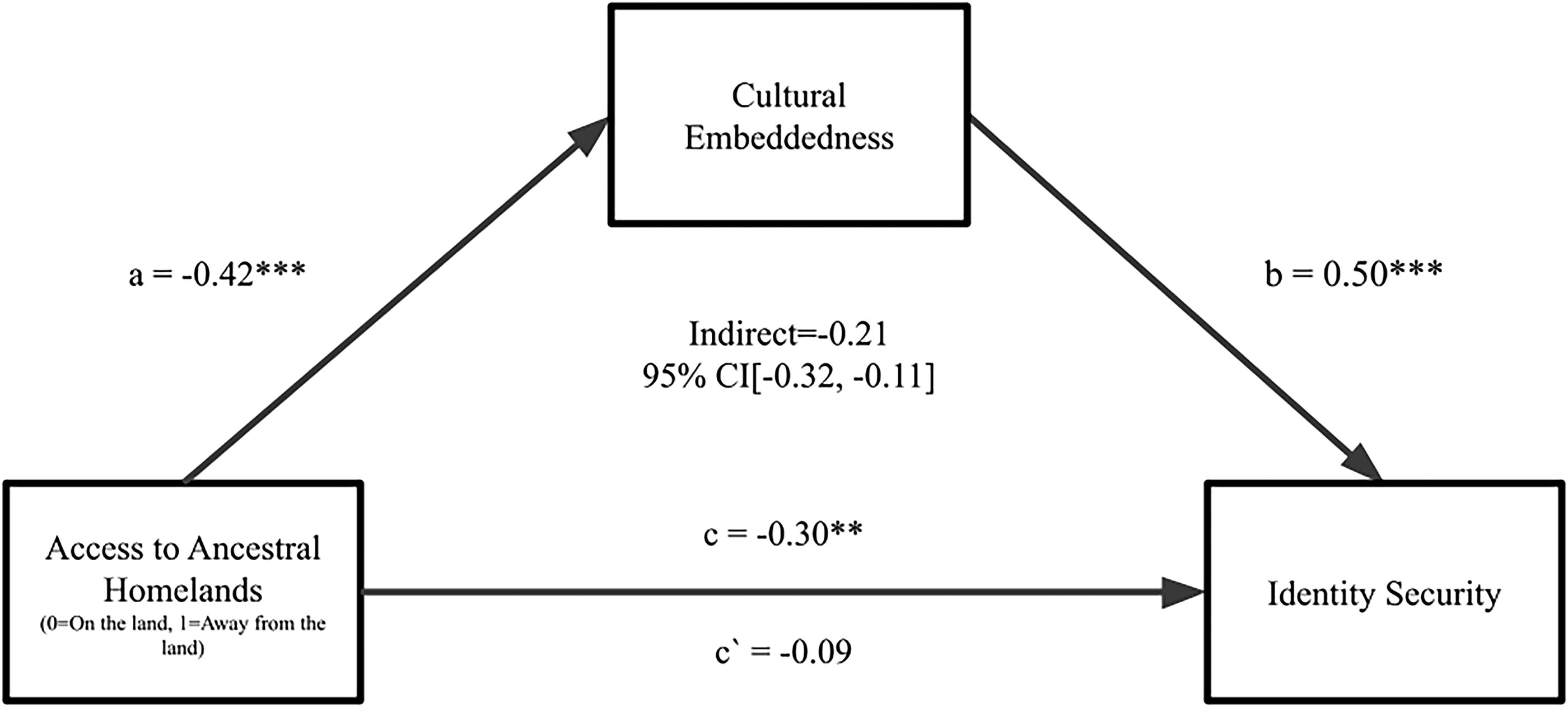
Standardized regression coefficients for the relationship between access to ancestral homelands and identity security mediated by cultural embeddedness. ** p < 0.01, *** p < 0.001.
Bivariate Relationships
Individuals living on ancestral homelands coded as 0; individuals living away from ancestral homelands coded as 1 for access to land.
p < 0.01.
p < 0.001.
Effects of access to ancestral homelands
The average identity security score across participants was 3.25 with a standard deviation of 0.70. The average cultural embeddedness score was 4.39 with a standard deviation of 1.00. As predicted, there were significant differences in both the identity security (p = 0.002) and cultural embeddedness (p < 0.001) scores between participants living on versus away from their ancestral homelands. Compared with participants living away from their ancestral homelands, participants living on their ancestral homelands reported higher levels of identity security (see Fig. 2) and cultural embeddedness (see Fig. 3).
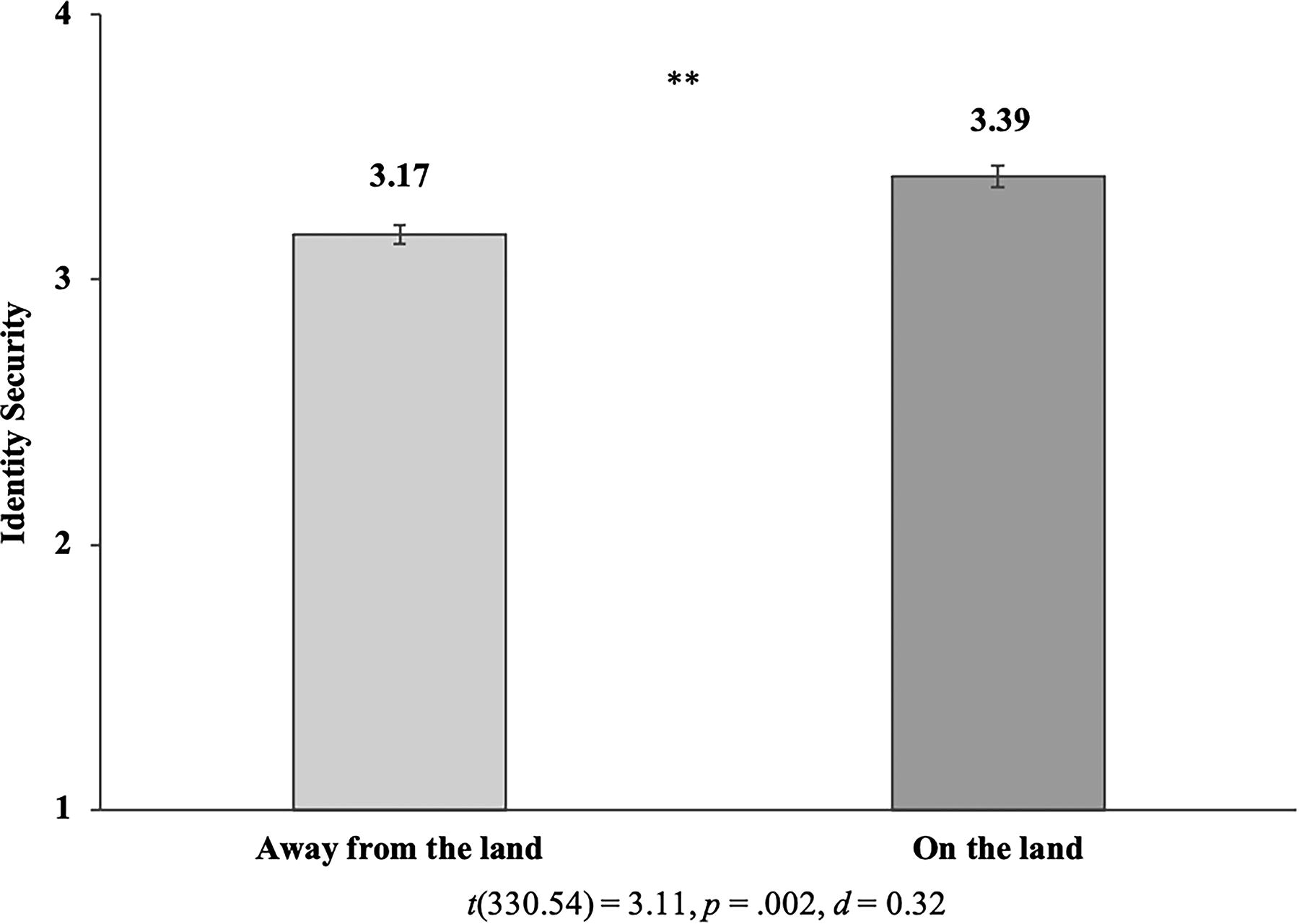
Mean difference in identity security between participants living away from versus on ancestral homelands.
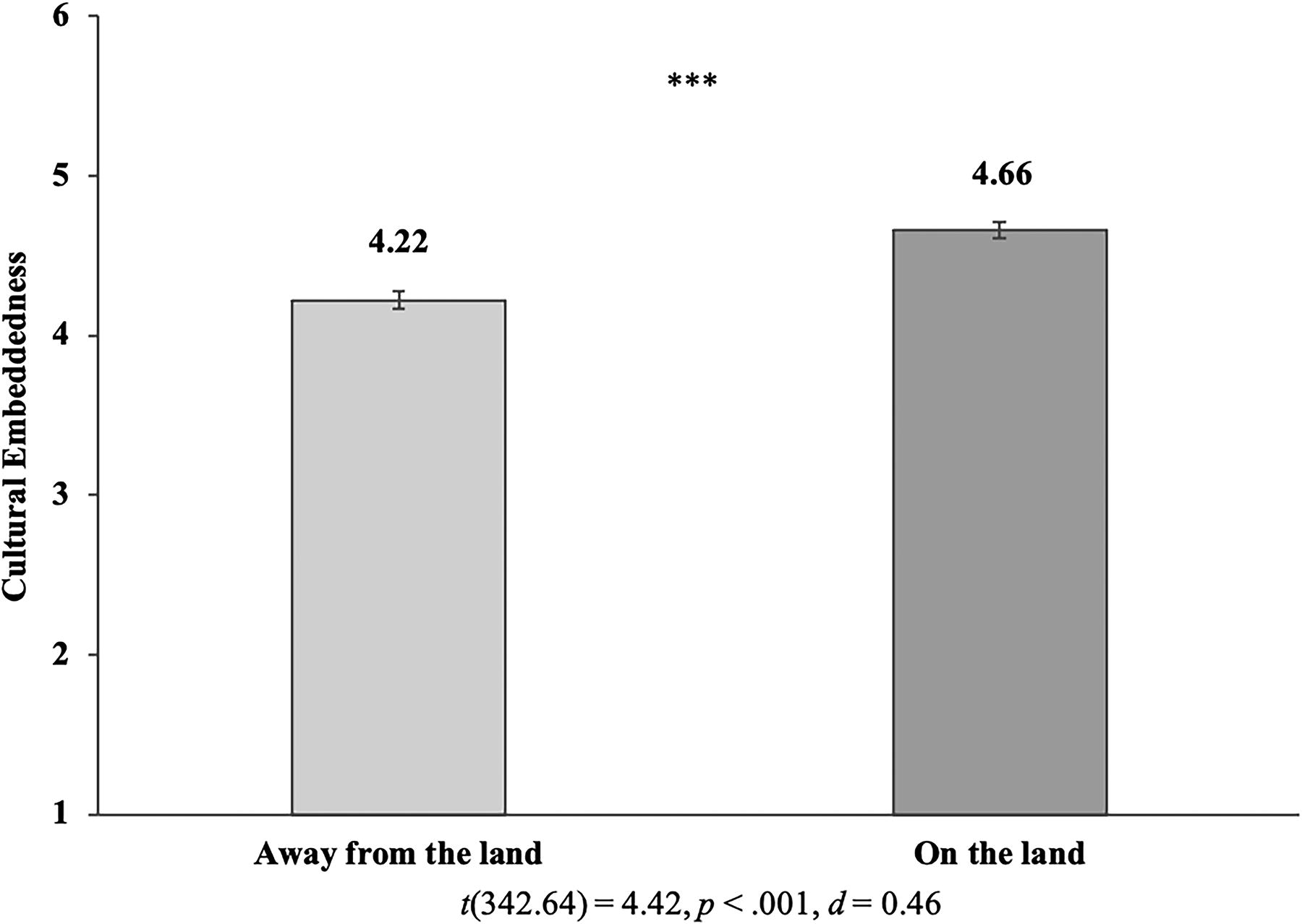
Mean difference in cultural embeddedness between participants living away from versus on ancestral homelands.
Although participants living away from their ancestral homelands reported less identity security and cultural embeddedness, on average, these participants reported relatively high levels of identity security (M = 3.17; i.e., scored between often and all of the time). Similarly, participants living away from their ancestral homelands, on average, reported relatively high levels of cultural embeddedness (M = 4.22; i.e., reported somewhat agree to agree). Together, these results suggest that, while access to ancestral homelands plays a role, there are likely other factors that have implications for an Indigenous individual’s level of identity security and cultural embeddedness.
Cultural embeddedness as a mediator
A path model revealed no significant direct effect of access to one’s ancestral homelands on identity security (p = 0.35). However, there was a significant indirect effect of cultural embeddedness on this relationship (95% confidence interval [−0.32, −0.11]). Specifically, living on one’s ancestral homelands was positively related to cultural embeddedness, and cultural embeddedness was positively related to identity security (see Fig. 1 for results). Indigenous individuals living on their ancestral homelands experience more identity security, and this is, in part, because these individuals have more opportunities to engage in cultural practices than those living away from their ancestral homelands.
DISCUSSION
Indigenous Peoples’ ancestral homelands are critical in shaping their culture, self-understanding, and identity. Access to these spaces is being diminished due to ongoing environmental exploitation and degradation, which is compounded by historical and contemporary displacement. 61 The current studies provide evidence that recognizing Indigenous Peoples’ soverign right to their ancestral homelands has clear positive outcomes for culture and identity and illustrate what is at stake when these rights are ignored and access to these places is undermined. The qualitative findings revealed that participants living away from their ancestral homelands were more likely to report loss of place-based traditions and lifeways and feelings of uncertainty and insecurity toward their Indigenous identity. In comparison, participants living on their ancestral homelands were more likely to report that they engage in place-based cultural practices and feel pride and certainty towards their Indigenous identity. Modeling these themes in a mediation model, the quantitative findings revealed that, compared with participants living away from their ancestral homelands, those living on their ancestral homelands reported greater identity security, in part, because they were more embedded in their culture. These results affirm the importance of ancestral homelands for supporting Indigenous Peoples’ engagement in cultural practices, which can, in turn, foster positive psychological outcomes (e.g., identity security).
Methodological and theoretical contributions
The present studies offer important contributions to the existing research on place, culture, and Indigenous identity. First, previous research primarily employs qualitative methods and focuses on specific populations or case-studies. For example, non-Indigenous scholar Nightingale and Biigtigong Anishinabe scholar Richmond found that the reclamation of culturally significant territories for Biigtigong Nishnaabeg supported social relationships, engagement in traditions, sense of community belonging and pride, and the ability to exercise self-determination.62,63 Additionally, Indigenous scholars Cooper, Delormier, and Tuali‘i’s qualitative findings assert that Indigenous individuals witnessing the desecration of their sacred spaces experienced physical, psychological, and spiritual pain related to the disruption of their personal and cultural connection to these spaces. 64 The present work contributes to previous literature by taking a mixed-methods approach. Specifically, we collected qualitative data to inform the operationalization of constructs for quantitative analyses. The quantitative findings replicate the previous qualitative findings discussed above, suggesting that the psychological and cultural consequences of an Indigenous individual living on versus away from their ancestral homelands generalize across a larger and more diverse sample of Indigenous Peoples.
Second, the limited empirical research on place, culture, and Indigenous identity has primarily focused on cultural and health outcomes for those who are disconnected from reservation lands specifically. 65 While this work is vital for understanding contemporary Indigenous experiences, the reservation system was forced upon Indigenous communities 66 and the majority of Indigenous Peoples in the U.S. do not live on reservations. 67 Thus, the focus on these settler geopolitical definitions of Indigenous land obscures the importance of other contexts, 68 such as Native urban spaces69,70 and ancestral homelands.71,72,73 The current studies heed recent calls to center Indigenous conceptualizations of place and land in empirical research by asking participants to think of the place(s) described in their creation stories. 74
Finally, the existing work on land, culture, and Indigenous identity has primarily focused on physical 75 and clinical mental health outcomes, such as depression and post-traumatic stress disorder. 76 Social psychological research asserts that racially marginalized individuals’ mental well-being improves (e.g., greater self-esteem, life satisfaction, and resilience against psychological distress) when they have a secure and clear sense of their ethnic and/or cultural identity.77,78,79,80 The present findings suggest that in order to foster identity security and, thereby, improve mental well-being among Indigenous Peoples, ancestral homelands must be protected and Indigenous Peoples’ soverign rights to these lands must be recognized.
Limitations and future directions
Despite the robust findings, there are limitations to note. First, participants were collected via listservs distributed by national Indigenous organizations. These organizations engage in efforts to mobilize Indigenous action for securing environmental and cultural self-determination. Given the participants' involvement in such organizations, the present sample may have more opportunities to engage in cultural activities and Indigenous social issues regardless of whether they live in urban, rural, or tribal/Indigenous lands or contexts. The current findings support this assumption given that, on average, both participants who live on or away from their ancestral homelands scored well above the midpoint for both identity security and cultural embeddedness. Moreover, the high rates of identity security and cultural embeddedness, particularly among those living away from their homelands, affirms previous research that those who are “disconnected” or displaced from their homelands seek out alternative opportunities to maintain their culture and identity. 81 Considering that both samples are highly engaged and identified with their Indigeneity, our results may be a conservative test of the psychological (i.e., identity security) and cultural (i.e., cultural embeddedness) consequences for Indigenous individuals living on versus away from their ancestral homelands. Future research should test whether the current findings generalize to a more representative sample of Indigenous Peoples in the United States and in other Indigenous communities globally.
Second, we collected responses from Indigenous Peoples across the United States, which gave us a general view on the impact of living on or away from ancestral homelands. The reasons for living away from one’s ancestral homelands vary widely from the forced removal of Indigenous Peoples, to extraction projects and environmental hazards, climate change–related disasters, and seeking employment and educational opportunities. Future research is needed to better capture the nuances as to why someone may or may not live on their ancestral homelands and how these nuances may inform the current findings. Lastly, efforts to maintain culture and identity in the face of ongoing displacement and oppression signify Indigenous Peoples’ resiliency. Research on the consequences of coping with such chronic stress related to systemic injustices suggests that resiliency may be maladaptive for well-being within certain oppressive contexts.82,83 Future research is needed to examine the long-term effects of the resiliency developed by Indigenous Peoples, resulting from the ongoing desecration of and displacement from their ancestral homelands.84,85,86,87,88
CONCLUSION
In 2007, the United Nations declared that Indigenous Peoples have a human right to self-determination, land, cultural resources, and adequate physical and mental health. 89 The present studies provide evidence that Indigenous Peoples’ cultural engagement, self-understanding, and well-being are shaped by whether they live on their ancestral homelands. One way to uphold these rights to culture and personhood is by protecting Indigenous Peoples’ relationships with their ancestral homelands from ongoing threats, such as those posed by displacement, climate change, and extractive corporations. To achieve true justice and ensure these rights are maintained for future generations, ancestral homelands must be returned to the care of their original stewards.
POSITIONALITY STATEMENT
First author, A.M.S., is a mixed Kanaka Maoli woman and a third-year PhD student in the social psychology program at Northwestern University. Despite being born on the island of O‘ahu among her ‘ohana nui, she was primarily raised with her immediate family in the traditional territory of the Coast Salish people. Her experiences negotiating identity and culture in two places, with and without her kūpuna and ancestral homelands, shaped her commitment to developing a critical understanding of the varied experiences of contemporary Indigenous Peoples, Indigenous identity construction, and Indigenous well-being, especially in relation to land and settler-colonial injustices such as climate change and displacement. J.J.L. is Mexican American and a member of the Amah Mutsun Tribal Band from the central coast of California and is the Chancellor’s Postdoctoral fellow at UC Santa Cruz. A.M.F. is a member of the Bay Mills Indian Community located in Michigan’s Upper Peninsula. J.B. is Diné and Tesuque Pueblo of New Mexico. K.R.L. comes from Tahltan, Kaska, and Black American ancestry. Both J.B. and K.R.L. are climate and environmental policy experts. K.P.W. is a citizen of the Potawatomi Nation and a George Willis Pack Professor at the School for Environment and Sustainability at the University of Michigan. S.A.F. is a member of the Tulalip Tribes and the James E. Johnson Professor in the Department of Psychology at Northwestern University. The article’s authorship and research personnel come from diverse Indigenous backgrounds and experiences with expertise in psychology, education, and environmental justice. We share a collective interest in undoing Indigenous inequities by conducting rigorous research that uplifts the voices, well-being, and visibility of Indigenous Peoples. We orient ourselves as social justice scholars and are committed to conducting research that centers Indigenous racial justice, collaborating on research with community organizers to enact social change, and supporting the next generation of Indigenous scholars.
Footnotes
ACKNOWLEDGMENTS
We want to offer an extra special thanks to Sarah Allen and Okilani Hautau for assisting with coding our participants' qualitative responses. We also want to extend our gratitude to our collaborator Judith LeBlanc and our partnership with Native Organizers Alliance.
AUTHORS’ CONTRIBUTIONS
A.M.S.: Conceptualization (lead); data curation; formal analysis (lead); investigation (equal); methodology (equal); project administration (equal); visualization; writing—original draft (lead); and writing—review & editing (equal). J.J.L.: Conceptualization (equal); funding acquisition (equal); formal analysis (equal); investigation (equal); methodology (equal); project administration (equal); supervision (equal); writing—original draft (supporting); and writing—review and editing (equal). A.M.F.: Conceptualization (equal); funding acquisition (equal); formal analysis (equal); investigation (equal); methodology (equal); supervision (equal); project administration (equal); and writing—review and editing (equal). J.B.: Conceptualization (supporting) and writing—review and editing (supporting). K.R.L.: Conceptualization (supporting). K.P.W.: Conceptualization (equal); funding acquisition (lead); formal analysis (equal); investigation (equal); methodology (equal); project administration (equal); resources (lead); supervision (supporting); and writing—review and editing (equal). S.A.F.: Conceptualization (equal); funding acquisition (equal); formal analysis (equal); investigation (equal); methodology (equal); project administration (equal); resources (equal); supervision (equal); and writing—review and editing (equal).
AUTHOR DISCLOSURE STATEMENT
The authors declare no conflicts of interest.
FUNDING INFORMATION
This project was supported by the University of Michigan Office of the Vice President Anti-Racism Grant (U078664) and the Spencer Foundation (202200253).