






Abstract
Anti-Micronesian bias and colonialism are harming efforts to protect and manage waters surrounding U.S. overseas territories in the Pacific Islands. The Biden administration’s proposal to designate a national marine sanctuary in the Pacific Remote Islands Area (PRIA) would potentially create the largest noncontiguous protected area on the planet. However, the proposal is problematic because it has failed to meaningfully include the Indigenous people who live closest to the region and who have the strongest historical and cultural ties to the islands—Micronesians and Samoans. The article reviews the history and context of the PRIA, who bears the costs and receives the benefits of conservation there, and analyzes the perspectives and concerns of the political and community leaders in the U.S. Pacific territories, who have expressed near-universal opposition to the plan. The article concludes with some recommendations for improving the equity and justice of the proposal, such as engaging in meaningful dialog, respecting the rights and interests of the Indigenous people, and ensuring their input and consultation in the decision-making process and management of the PRIA.
INTRODUCTION
President Joe Biden of the United States has issued an ambitious call to action through his “America the Beautiful” initiative to conserve, connect, and restore 30% of U.S. lands and waters by 2030 1 (sometimes referred to as 30 × 30). In terms of the ocean, this means delivering conservation within the United States’ exclusive economic zones (EEZ)—the ocean area that extends 200 miles beyond American coastlines.
The 11.4 million square kilometers of ocean controlled by the United States is vast. The U.S. territories in the Pacific, in particular, have some of the largest EEZs in the country, making this region critical for delivering conservation and climate goals on the ocean. The U.S. Pacific territories are also the traditional lands and waters of Indigenous Micronesians, Chamorros, Refaluwasch, and Samoans. The combined ocean surrounding the U.S. Pacific territories is 3.3 million square kilometers—nearly twice the land area of Alaska—accounting for 29% of the total EEZ of the entire United States. 2
The Pacific Remote Island Area (PRIA) consists of seven, mostly uninhabited islands in the Western and Central Pacific Ocean claimed by the United States. During the 20th century, these islands were mostly used for military purposes, despite being designated as national wildlife refuges. 3 In 2009, President George W. Bush used the Antiquities Act to designate 50 miles of waters surrounding each island as the Pacific Remote Islands Marine National Monument. The marine monument was expanded in 2014 by President Barack Obama and is under consideration for further expansion by President Joe Biden.
On March 24, 2023, President Biden directed the Secretary of Commerce to consider initiating the designation process for a proposed national marine sanctuary in the PRIA, 4 which would augment protection for the existing marine monument. The proposed sanctuary would expand protection to currently unprotected submerged lands and waters to the full extent of the U.S. EEZ, growing the protected area from 1.3 million sq km to nearly 2 million sq miles, 5 potentially making it the largest noncontiguous protected area on the planet. The Biden administration has suggested that this action would achieve 30 × 30 on the ocean for the United States. 6 The decision was celebrated by leaders in Hawaii. 7
Disconcertingly, this campaign to expand and designate the sanctuary in the Pacific Remote Islands has failed to meaningfully include the Indigenous people who live closest to the region and who have the strongest historical and cultural ties to the islands—Micronesians and Samoans. Furthermore, although the conservation burden of fishing restrictions is carried by the U.S. Pacific territories, 8 most of the social and economic benefits have accrued to Hawaii and the continental United States in the form of conservation prestige, jobs, research, and funding. 9 This is not an equitable sharing of costs and benefits of marine protection, and leads to “parachute science and conservation 10 ” in the territories.
The Biden administration defines “environmental justice 11 ” as “the just treatment and meaningful involvement of all people, regardless of income, race, color, national origin, Tribal affiliation, or disability, in agency decision-making and other Federal activities that affect human health and the environment so that people: (i) are fully protected from disproportionate and adverse human health and environmental effects (including risks) and hazards, including those related to climate change, the cumulative impacts of environmental and other burdens, and the legacy of racism or other structural or systemic barriers; and (ii) have equitable access to a healthy, sustainable, and resilient environment in which to live, play, work, learn, grow, worship, and engage in cultural and subsistence practices.” The people living in the U.S. Pacific territories, many of whom are Indigenous, did not have meaningful involvement in the sanctuary designation process before its announcement in March 2023.
As a result, political and community leaders in the U.S. Pacific territories have proclaimed near universal opposition to the plan.12,13 American Samoa Governor Lemanu Peleti Mauga said of the proposal, “The misinformation that has been circulated by the proponents of this sanctuary is insulting and misconstrues the reality of the importance of these waters to our territory. 14 ” A letter co-signed by Northern Mariana Islands Governor Arnold I. Palacios, Guam Governor Lourdes Leon Guerrero, and governor Lemanu read, “Our already disadvantaged and marginalized communities carry a disproportionate burden for meeting national conservation goals.” 15
This course of action is neither equitable nor just, and antithetical to the “America the Beautiful” Initiative 16 and the UN Declaration on the Rights of Indigenous People’s principle of Free, Prior, and Informed Consent. 17 For example, no government representative from the territories was invited to participate in the March 24, 2023, White House event, where the proposed sanctuary was announced, 18 nor were they informed ahead of time that a sanctuary announcement was taking place, 19 nor were they involved in designing the first public comment period, 20 or organizing federal public hearings on their own islands. 21 Months later, in September 2023, a sanctuary designation workshop co-hosted by the United States National Oceanic and Atmospheric Administration and the American Samoa government was held, but issues of consent had not been yet addressed as Governor Lemanu issued a memorandum directing participating government staff to support “the Governor’s staunch opposition to the marine sanctuary designation.” 22 Micronesians, Chamorros, Refaluwasch, and Samoans should have inputs and be consulted in every step of the decision-making process and management of the Pacific Remote Islands, and any proposal to change them, not after announcements are made.
The United States needs to do a better job of engaging with Indigenous people in the U.S. Pacific territories, and backing their ideas to manage their waters, rather than forcing ideas on them.23,24 Ultimately, these may be the same ideas, but the process and the people involved matter.
The Biden administration must reassess the proposed plan as it was developed without input from the Indigenous people living in the U.S. territories. Without meaningful dialog, a designation has the potential to violate many of the conservation commitments the administration has made toward Native people and will ultimately harm conservation efforts in the region in the long term. Understanding the history, culture, and context of these islands and surrounding waters is critical for developing conservation policies that benefit local people, and this is missing from the existing proposal. This essay examines some of that context and offers a pathway toward Indigenous-led conservation that truly engages the Native people who have lived in the Pacific for millennia, heals contemporary intra-Pasifika harm, and concludes with the goal of decolonizing conservation in the Pacific Remote Islands Marine National Monument.
UNDERSTANDING PLACES AND PEOPLE IN HISTORICAL CONTEXT
The specifics of how the Pacific Ocean basin, which occupies a third of the earth’s surface, was populated, have been lost in time, but cultural and linguistic studies have pieced together how voyagers over centuries traversed thousands of kilometers of open ocean in dugout canoes using only the stars, waves, and biological cues as their guides. 25 Recent archaeological 26 and paleoenvironmental 27 evidence suggests that humans reached the Mariana Islands, the first islands to be populated, about 3,500–4,300 years ago, and from there, populations spread eastward across the Pacific. Traditionally, the lines between Micronesia, Melanesia, and Polynesia never existed, 28 as territories, cultures, and trade overlapped over distances of thousands of kilometers. 29
Over the last few centuries, political borders in the Pacific Islands were repeatedly redrawn and geographies renamed as the islands were colonized, dominated, and ruled by foreign, often Western, countries. Colonization goes back more than 500 years to when Magellan visited the Marianas and committed the first act of European genocide in the Pacific. 30 Colonial rule of the region existed under Spanish, German, Dutch, Japanese, British, and American empires. In 1893, the U.S. government backed and supported an illegal overthrow and annexation of the Kingdom of Hawaii. Following World War II, many of the islands in Micronesia were part of the Trust Territory of the Pacific Islands, a United Nations trust territory administered by the United States. Today, politically, Micronesia is politically organized as a constellation of sovereign countries and U.S. territories. Some islands were taken as a spoil of war or broken off from the Trust Territory of the Pacific Islands to become what they are today. The Republic of Palau, the Federated States of Micronesia, Republic of the Marshall Islands, Commonwealth of the Northern Mariana Islands, the Territory of Guam, and several of the PRIA islands (described in detail in the following paragraphs) are either owned by or have compacts of free association 31 with the United States. They all use the U.S. postal system and the U.S. dollar as their currency. Republic of Nauru and Republic of Kiribati have closer political and economic ties with Australia. Guam is the largest and most developed island in the region. All the islands in Micronesia have their own unique cultures and history of colonization, with at least 20 Indigenous languages still spoken across the region.
The Pacific Remote Islands, specifically, are all part of the American empire as a result of a mid-nineteenth century law called the Guano Islands Act of 1856, 32 which was passed to help meet America’s demand for fertilizers to feed its growing population. The Guano Island Act allowed that, “Whenever any citizen of the United States discovers a deposit of guano on any island, rock, or key, not within the lawful jurisdiction of any other government, and not occupied by the citizens of any other government, and takes peaceable possession thereof, and occupies the same, such island, rock, or key may, at the discretion of the President, be considered as appertaining to the United States.”
Geographically, Wake Island lies northwest of what is today the Republic of the Marshall Islands. Howland and Baker border the Phoenix Islands archipelago, whereas Kingman Atoll, Palmyra Atoll, and Jarvis Island are part of the Line Islands. These political lines and place names are all modern inventions; they have changed in recent history and may change again. Midway Atoll, for example, was first claimed by the United States using the Guano Islands Act and was considered part of the PRIA for many years, but is now considered part of the Northwest Hawaiian Islands.
Another example is Palmyra in the Line Islands, which was claimed by the United States in 1859, but was later given up when no guano was found. The island was later claimed by the Kingdom of Hawaii in 1862. When the United States illegally overthrew the Kingdom of Hawaii in 1893, Palmyra became part of the Republic of Hawaii, and then the Territory of Hawaii in 1898. However, when Hawaii became a state in 1959, Palmyra remained a territory, which is why it is the only incorporated U.S. Pacific territory, meaning it is part of the United States, as opposed to the other territories, which are all owned by, but not part of, the United States. The Nature Conservancy purchased the island from the Fullard-Leo family in 2000 for $37 million. 33
The United States and the Republic of the Marshall Islands both claim Wake Island. In 2016, the Marshalls made their claim formal when they filed maritime coordinates with the United Nations. 34 The Marshallese people have ancient cultural ties to the island. UN Ambassador Doreen de Brum once told this author the story of how her ancestors named the island Enen-Kio—the island of the orange flower.
With the 1979 Treaty of Tarawa, the United States gave up claim to several islands, which today are part of the Republic of Kiribati. While this treaty recognized Kiribati’s sovereignty over eight Phoenix Islands and six Line Islands, the United States held on to the five nearby Pacific Remote Islands, so that they could continue to be used for national defense purposes. Four years later, in 1983, President Reagan claimed the U.S. EEZ, and the 200-mile ocean area surrounding each island came under control of the U.S. government, as well.
Except for Johnston Atoll, absent in this history of colonization, all the islands within the Pacific Remote Islands Marine National Monument would today be a part of sovereign Micronesian nations. From the perspective of the United States, these were unknown, unowned islands, but this narrative of pristine, unpeopled lands is but an extension of Manifest Destiny to the Pacific. Even the Catholic Church has disavowed the legal and political Doctrine of Discovery, as it fails to “recognize the inherent human rights of Indigenous people. 35 ” The Native people who owned and used these islands survive today, living in the surrounding archipelagos.
Speaking at the Tales with Futuran I Tasi: Finding Our Voices symposium in December 2023, Saipan resident and Ocean Elder Ignacio V. Cabrera said, “The ocean is our heritage. It’s ours by culture, (even if) it’s not ours by law.” 36 Guam resident and activist Dakota Camacho attended a May 2023 sanctuary public hearing and said, “I’ve heard stories that in the old days, our navigators would go and meet in all of these islands and have ceremonies. We’re not allowed to do that anymore. Because the federal government is making the rules about what we’ve supposed to be doing in our waters.” 37
The islands comprising the Pacific Remote Islands Marine National Monument are Micronesian islands 38 . The Micronesia region stretches from Palau in the west to Kiribati in the east (Fig. 1). Six of the seven islands within the monument’s noncontiguous borders abut Micronesian archipelagos, including the Marshall Islands, Phoenix Islands, and Line Islands. The seventh island, Johnston Atoll, is in an area between Micronesia and Hawaii.
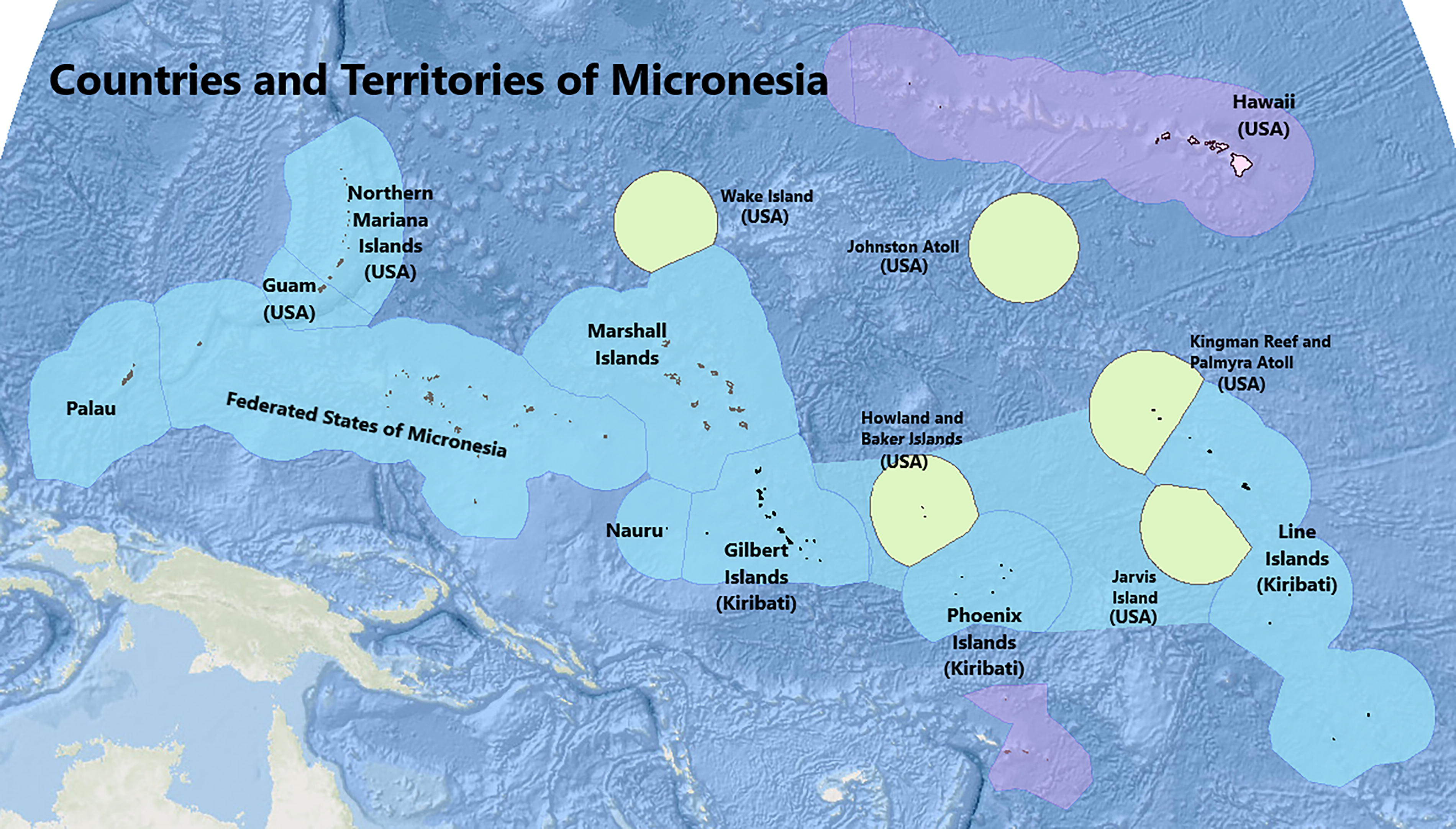
The region of Micronesia stretches from Palau in the west to the Line Islands of Kiribati in the east (highlighted in blue). Six of the seven islands within the Pacific Remote Islands Marine National Monument (Wake, Howland, Baker, Jarvis, Kingman, and Palmyra) lie within Micronesia. Johnston lies between Micronesia and Hawaii.
Understanding Pacific Islander identity can be complicated. The great Pacific scholar Epeli Hau’ofa was perhaps a bit idealistic when he wrote, “anyone who has lived in our region and is committed to Oceania is an Oceanian,” but he was correct in observing, “our present regionalism is a direct creation of colonialism,” and that “we have not been able to define our world and ourselves without direct and often heavy external influences. 39 ”
Colonialism has historically pitted Indigenous people against one another, and to avoid this today, when we explore our shared Pasifiku histories, cultures, and identities, we must do so in a respectful and intentional manner to ensure pluralistic advocacy encompassing multiple perspectives. The value of the proposed sanctuary can and should be interpreted through its connection to Hawaii, but it must center its connection to Micronesia.
In a letter to President Biden dated October 31, 2022, Hawaii’s Representative Ed Case echoed the importance of including Native Pacific voices beyond those in Hawaii:
“Some stakeholders have expressed hesitancy with what has been to this point a primarily Native Hawaiian-driven effort to protect the cultural heritage of the PRIMNM expansion zone. To address the concerns voiced by stakeholders throughout the Pacific, I especially encourage you to continue to engage with all indigenous communities tied to the PRIs throughout the renaming process so that the importance of this unique ecosystem place can be articulated and deeper connections to this place can be forged.
While many of the most active voices in protecting the cultural seascape of the PRIs are Native Hawaiian, protection of these islands must be inclusive of Micronesian and Polynesian indigenous communities, including American Samoans, Chamorros, and Native Hawaiians. The expanded monument’s proposed boundaries contain key areas in which the diverse Indigenous peoples of the Pacific can connect with their shared culture and history. We must consider its cherished cultural history along with its ecological importance and scientific value.”
COLONIZED CONSERVATION IN THE PRIA
Despite their history and cultural connections to Micronesia and the U.S. territories, the conservation and management of the Pacific Remote Islands have been dominated by people living in Hawaii and the continental United States. Anti-Micronesian bias and colonialism play a role in creating this dynamic.
Author Villagomez currently serves on the government-organized Pacific Remote Islands Marine National Monument Community Group. 40 In this capacity, Villagomez participates in workshops and webinars to advise the government agencies drafting the monument management plan, and fills the Conservation Representative role for the group, tasked with bringing the perspectives of conservation organizations. Coincidentally, Villagomez happens to be Micronesian. There is no official role in the group for Micronesian expertise, despite the monument being in Micronesia. Meanwhile, there is a role for Native Hawaiians.
During workshops and meetings to develop the monument management plan, Villagomez identified areas where including Micronesia or Micronesian ideas would be appropriate. Although these suggestions appear in draft versions, they were always deleted later by government managers. For example, Villagomez would recommend that monument staff “engage with Micronesian and Hawaiian communities,” and this recommendation would be edited into “Pacific Island and Native Hawaiian Communities.” Villagomez attributes this experience to the anti-Micronesian bias that, unfortunately, is prevalent in Hawaii.41,42
There are about 15,000 Micronesian immigrants in Hawaii today. The compacts of free association treaties signed in 1982 allow Micronesian people with the “right to live, work, and receive some public welfare benefits in the United States.” 43 As with all previous waves of new arrivals to the United States, they face racism in their new homeland. University of Hawaii professor Jonathan Okamura has described Micronesians as “the most racially oppressed and denigrated group in Hawaii.” 44 His research has shown how Micronesians deal with systemic racism in Hawaii through “institutional discrimination, racist stereotypes and narratives, and maintenance of socioeconomic inequalities.” 45
The visibility of anti-Micronesian bias has also been elevated by a social media campaign using the hashtag
University of Hawaii Law Professor Charles R. Lawrence (who identifies as Black) compares Hawaii’s treatment of Micronesians to the racist treatment of the Black community in the United States with Hawaii’s “shared understanding about Micronesians, about their blackness, their foreignness, their dirtiness, their scariness, their bestiality, their less-than-human-than-the-rest-of-us-ness. I use these hard-to-hear words to describe our shared beliefs quite intentionally. They come from a lexicon that Americans have used to imagine and construct my own people. They are the words that inhabit and share the narrative of white supremacy, words and images that at different moments in history meant and signified Chinese or Japanese, that still often mean Filipino, or Samoan or Native Hawaiian, but in this moment in Hawaii’s history we have designated our brothers and sisters from the Micronesians islands to assume the role of blackness, I will not use the “N” word, but you get my meaning.” 47 This bias has played a role in the exclusion of Micronesians from the Pacific Remote Islands conservation and management and can be found impacting Micronesian experiences across other societal sectors.48, 49
The main cultural narrative used by advocates in support of the expansion of the monument points to the exploitation of the Hui Panalā‘au (translated as “society/club of colonizers”)—the 130 young men, mostly Hawaiian, who colonized three of the Pacific Remote Islands in the years before World War II. 50 Between 1935 and 1942, the United States recruited the service of young Native Hawaiian men for continuous occupation of Howland, Baker, and Jarvis Islands to solidify American claims to the islands. The advocates point to the tragedy and sacrifice of the young men, and the hardship of surviving on these remote islands as reason for protecting the surrounding waters today; several men lost their lives to illness and attacks by the Japanese military. The advocates rightfully bring attention to the noble sacrifice of these men, but overlook the role they played in helping the U.S. government with the ongoing colonization of other Pacific peoples.
The anti-Micronesian bias is both explicit and implicit. It is not just the vitriol aimed at Micronesian communities in Hawaii that is harmful but also the silencing and ignoring of the Micronesian experience and story. The presidential memorandum 51 directing the secretaries of Interior and Commerce to consider a sanctuary designation disappointingly does not once mention Micronesia and while it celebrates the Hawaiian “Society of Colonizers” mentioned above, it ignores the Native Chamorros who protected Wake Island from invading Japanese soldiers during World War II, several of whom gave their lives. 52 This is a parallel story of heroism and sacrifice that has the potential to weave together the shared bravery of Chamorro and Hawaiian men during this era. There is also a push in Hawaii to rename all the islands with Hawaiian Names 53 —implicitly to the exclusion of Micronesia. American Samoa’s delegate to the U.S. Congress tweet called the announcement of the proposed sanctuary, “Confiscation without consultation.” This has turned the advocacy into a one-sided celebration of colonization, rather than one of cultural connections among Pacific people.
CELEBRATE CONNECTIONS, NOT COLONIZATION
There are many cultural and biological connections between Micronesia and Polynesia that can be explored using the Pacific Remote Islands. So, rather than celebrating the exploitation of young Native Hawaiians to colonize Micronesian islands, the Pacific Remote Islands should be used to tell the story of Micronesian and Polynesian cultural exchange.
Ironically, the most obvious shared connection between Hawaii and Micronesia is colonization itself. Native Hawaiian activist Haunani-Kay Trask wrote, “The continuing ravages of colonialism are what the United States has bequeathed to Hawaiians, Micronesians, and Samoans.” 54 This history includes the mid-nineteenth century blackbirding of Micronesians to work as slaves on Hawaiian plantations, 55 historical and ongoing military testing on our islands, 56 and marginalization and disenfranchisement of American citizens and nationals of the U.S. Pacific territories. 57
However, while the modern history of the Pacific Islands is a story of colonization, there are older, deeper connections between our people. Birds, sea turtles, whales, and coral larvae still ignore the lines on maps created by Europeans and traverse the winds and waves just as our ancestors did in their canoes for centuries. It was during this voyaging of old that we evolved into Pacific Islanders. The ancient world was very different from the world we live in today, one where biological abundance occurred on nearly every island, yet only exists today on remote Pacific islands like those in the monument. The richness of life was so great that people today can scarcely imagine it. 58
The resurgence of traditional voyaging facilitates a rediscovery of our identities through connection with these thriving ecosystems. All aspects of our unique ways of life are derived from the ocean and the land, including art, song, chants, dance, carvings, religion, myths, stories, architecture, and even economies, world views, and governing systems. We are a product of our environment, and our very existence is dependent on a healthy, abundant, thriving ocean. 59
These islands and their surrounding waters also offer Pacific Islanders a chance to reconnect with the past—ecological refugia and cultural havens that act as windows into the time before we fished the ocean with the help of satellites. They are a reminder of the ocean’s prosperity and provide hope that with better management and increased protections, what we can restore the ocean to for future generations. 60
As self-proclaimed “colonizers” of these islands, people living in Hawaii have a role to play in managing these islands, of course, but they are not exclusively Hawaiian islands, and people living in Hawaii should use their privilege, access to funding, and outsized political power to empower and advocate for Micronesian leadership. Micronesians need to be involved in the planning, design, co-management, and stewardship of these islands. Plainly, this means access to funding, careers, and first rights of refusal. In doing so, this will build better connections not just between ecosystems but also between islands and people.
PATHWAYS TO DECOLONIZE
Historically, protected areas have been a tool of colonization,61,62 and not a tool of decolonization. There are also larger questions about the militarization of the PRIA and other Pacific Islands,
63
but steps can be made toward greater Indigenous control of natural resources under the existing colonial framework:
64
Follow the best practices of working with Indigenous communities and seek to co-create a proposal for conservation in the Pacific Remote Islands between the U.S. territories and Hawaii, and possibly members of the Micronesian and Samoan diaspora living in Hawaii. The Biden administration should consult with governments and communities in the territories, and be open to recommendations the Hawaiian advocates did not consider. Move sanctuary and other natural resource management decision-making power out of Hawaii and back to the territories, both in terms of where full-time employees are located, and with co-management or co-stewardship agreements. Prioritize the U.S. Pacific territories with jobs, programs, and funding, and consider headquartering the proposed sanctuary in one of the U.S. Pacific territories. In particular, efforts should be made to engage the Indigenous American Samoan, Chamorro, and Micronesian peoples and territorial governments who are long-time stewards and owners of these resources.
65
This would increase access for several Indigenous people to engage in natural resource management and is in line with the Biden administration’s Justice40 Initiative.
66
Going further, the federal government should engage with territorial governments to determine the unique needs their citizens have when it comes to ocean conservation. There are several models of consultation being used in the United States today and the federal and territorial governments could work together to figure out which one, or if something totally different, would work to improve communication and relationships between the governments. For example, the Biden administration recently announced a federal policy establishing a consultation policy with Native Hawaiians
67
and Representative Grijalva has introduced legislation that would establish special advisors for insular areas in each executive department.
68
In addition, the federal government uses other models to engage with Native people in Alaska and the contiguous United States (i.e. the Northern Bering Sea Climate Resilience Area
69
), and these models of consultation should be explored to determine the most appropriate way to engage with Indigenous Pacific Islanders. NOAA should consider creating a fund or endowment, similar to the Western Pacific Sustainable Fisheries Fund, to ensure that sanctuary jobs, programs, and funding make their way to front-line communities in the U.S. Pacific territories, in line with the Justice40 initiative. A similar fund was created for designations of Tristan da Cunha in 2021
70
and Niue in 2023,
71
with seed funding from several philanthropic partners. In addition, in line with Justice40, 40% of funding available for the proposed sanctuary should go into the fund, and through territorial co-management agreements, local governments could determine how this funding is used to support sanctuary projects and make investments in future Indigenous Pacific Islander scientists and leaders.
72
CONCLUSION
President Joe Biden committed to putting the United States on a path toward conserving 30% of its lands and waters by 2030 through the “America the Beautiful” initiative, but just as with any journey, there are multiple roads the United States could take to get there. And the journey can be just as important, if not more so, as the destination. It is possible for a person to support the end goal, but to oppose the direction someone else is taking to get there.
When it comes to ocean conservation, the who and the how need to be just as important as the what and the where.73,74 Achieving 30 × 30 on the ocean and in the spirit of the America the Beautiful initiative will require free, prior, and informed consent in designating a large network of geographically representative marine protected areas that are equitable, just, well-designed, well-managed, funded, and staffed.
This is not the first time or the last where difficulties will arise among Micronesian and Hawaiian communities. As a pair of authors, one Chamorro and the other Kanaka Maoli, we invite both our communities to gather under a tree to discuss these very important and sensitive topics in a constructive manner. In 2022, Master Navigator Ali Haleyalur, a very prominent Micronesian, lobbed a very hurtful accusation of cultural appropriation at an equally prominent Native Hawaiian in an essay, “When permission is absent.” The accusations were difficult for many Polynesians and Micronesians to read, but they came from a place of truth. 75
In his essay, Haleyalur accuses the Polynesian Voyaging Society (PVS) of “robbing” him and other Micronesians of “our heritage, history and truthful place in the world” by misrepresenting Micronesian culture, knowledge, and the role that Micronesian voyagers play and have played in the perpetuation of navigation culture. Haleyalur accuses the PVS of appropriating the Micronesian Pwo ceremony and creating the title of “Pwo navigator,” which he calls a “fake title” bestowed on Polynesians who are to be recognized as master navigators “even though they do not have the permission, authority or knowledge to conduct this important initiation ceremony.”
While Hawaiian and Polynesian readers were probably hearing of these accusations for the first time, for nearly two decades, the same sentiments expressed in Haleyalur’s essay could be heard, while conversing with our elders and relatives in the Mariana Islands. Our essay may create a similar level of discomfort, but it also comes from a place of truth, and we hope that readers can understand that. We call for a reflection on the ethics at play here: if upholding Hawaiian indigeneity in ocean governance and conservation comes at the cost of denying Micronesians their heritage, history, and truthful place in the world, what grounds do we stand on?
Footnotes
AUTHOR DISCLOSURE STATEMENT
The authors declare that the research was conducted in the absence of any commercial or financial relationship that could be construed as a potential conflict of interest.
AUTHORS’ CONTRIBUTIONS
A.V. conceptualized and wrote the original draft of the article. S.M.J. edited and contributed to the text.
FUNDING INFORMATION
No funding was received for this article.