






Abstract
In August, 2022, Sierra Leone passed one of the most progressive laws on land, environmental, and climate justice in the world. Among other things, the Customary Land Rights Act grants every community across the country the right to free prior informed consent over any industrial activity on their territory. As practitioners involved in this legislation (one of us served as coauthor of the bill), we reflect on the way the law grew directly from a decade of local fights against land grabs and pollution. We show how key provisions in the law, related to community consent, women's land rights, and responsible investment, each stemmed from specific grassroots struggles. Having shaped the contents of the bill, the people involved in those struggles led a nationwide movement to get the bill passed. This story holds lessons for organizers, advocates, and communities who seek to build from local fights against environmental injustice toward fundamental positive shifts in laws and systems.
CONTEXT AND FRAMEWORK
In August 2022
This article explores both the substance of the CLRA and the process that led to its passage.
In this section, we situate the new law in the history of two decades of grassroots justice work in Sierra Leone. We also offer a framework—the legal empowerment cycle—for envisioning the potential connection between, on the one hand, efforts to solve immediate lived problems and, on the other hand, the pursuit of fundamental shifts in laws and systems. This framework highlights two dimensions—learning and leadership—which are the focus of the next two sections respectively.
The second section, on learning, shows how key provisions in the CLRA reflect learning that emerged from grassroots struggles against environmental injustice over the past decade. Leadership: How Community Members Shaped and Drove Passage of the CLRA section shows how people involved in those struggles led the fight to get the law passed. By setting out how the CLRA came into being, and the ways in which communities influenced its content and passage, we hope to share an experience that could be beneficial for other groups, countries, or contexts looking to influence or pursue systemic change on land rights, environmental protection, or indeed any area of human development.
The legal empowerment cycle
In Sierra Leone and many other parts of the world, law making is often an elite exercise. The passage of the CLRA 2022 is an exception; it is the culmination of years of work with communities affected by large-scale land investments. Helping communities know and use the law to secure their land and protect their environment from the actions of corporations and governments is an arduous but critical part of what we call the legal empowerment cycle.
We have seen that communities seeking justice can make strategic use of law and legal provisions, no matter how imperfect those laws are. In the process, communities generate learning about the current system's adequacy or effectiveness. The practice of knowing and using existing rules to tackle a concrete problem also builds leadership: the sense that you can stand up for yourself, for your community, and even for a systemic change that could benefit everyone.
Coming together across their specific challenges, people can draw on the learning and leadership that emerges from grassroots struggles to envision, and fight for, new and better laws and policies. These new laws then get tested by use, and the cycle repeats itself (Fig. 1).
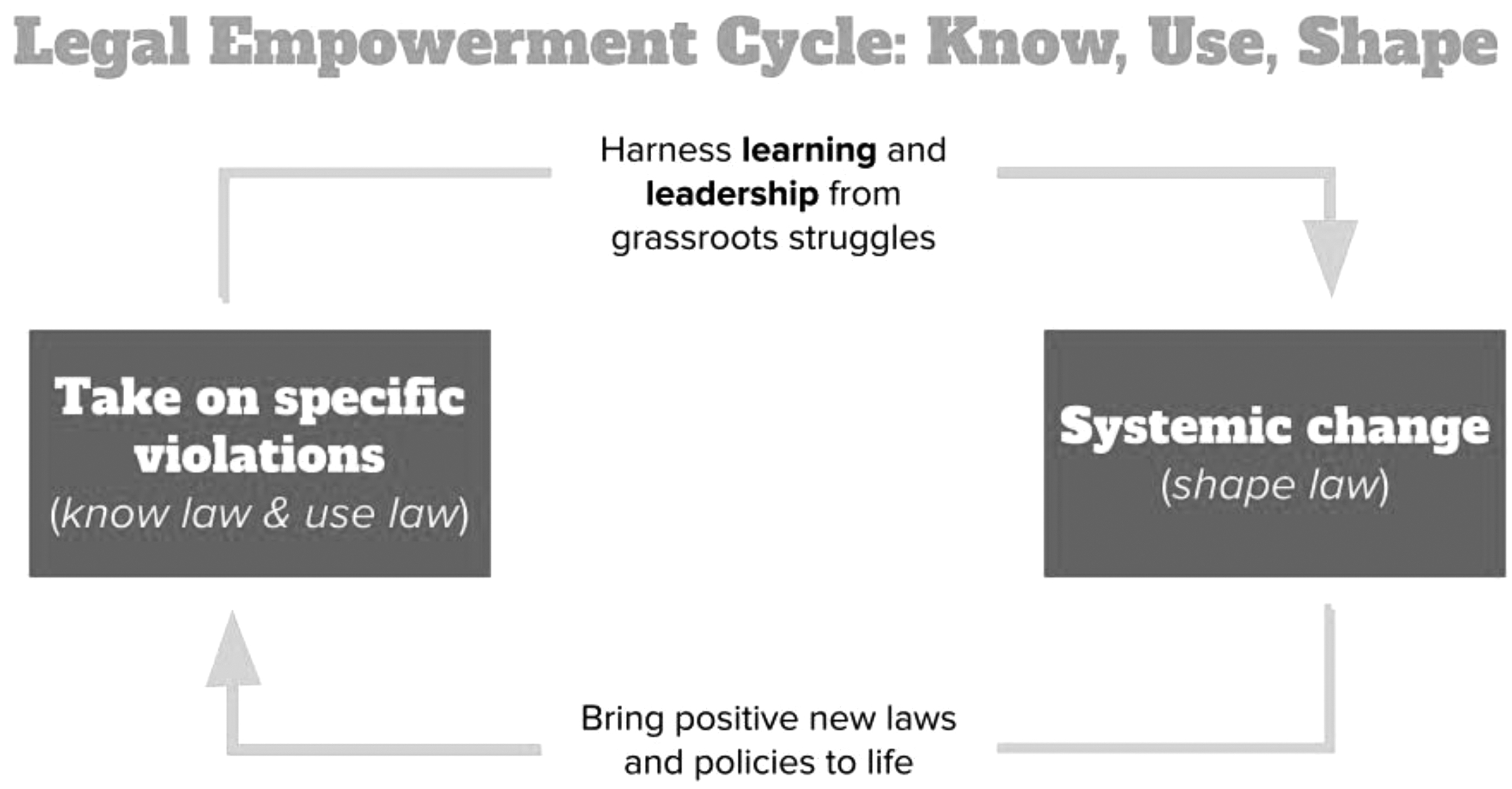
The legal empowerment cycle: know, use, shape.
In many places including Sierra Leone, laws are written in alienating ways, including archaic language that only lawyers can decipher, and discouraging structure—parts, sections, subsections, roman numerals, etc. The same applies to legal documents such as leases. With an adult literacy rate of 49%, 2 most Sierra Leoneans find the law and legal processes intimidating to interact with. This challenge with accessing the law in part gave birth to the country's experiment with “community paralegals.” 3
As part of postwar reconstruction and faced with the reality of a paucity of lawyers in the country, civil society organizations attempted to bridge the gap by training and deploying nonlawyers as community paralegals to address basic justice disputes in rural areas. At the forefront of this effort was a local NGO, Timap for Justice, cofounded by one of us Vivek in 2003. Paralegals learn the basics of the law, dispute resolution methods, and community organizing. They work in their communities to provide legal information in the local language, mediate individual and group disputes, and help people navigate government institutions to seek relief.
Over time, this method proved successful in addressing the country's justice deficit at the community level, resulting in the formal recognition of the paralegal approach as a mechanism for accessing justice nationally. 4 Today, at least a dozen civil society organizations and the country's legal aid board deploy paralegals in the major towns, cities, and communities, who help tackle a plethora of justice problems including labor, debt, and tenancy, and undertake legal empowerment. 5 The board, which is the largest legal aid institution in the country, employing >60 paralegals, handles an estimated 60,000 cases a year and has an office in every district. 6
The work described here draws inspiration from and builds on that history. Since 2013, we have partnered with a team of community paralegals working across every region of the country, focusing in particular on land and environmental justice. Paralegals do not provide retail legal services nor do they treat communities as victims needing help. Rather, paralegals treat the people with whom they work as agents of change, partners in the pursuit of justice. The relationship of trust between paralegals and communities was crucial in sustaining the organizing effort around the CLRA. This major milestone would not have been achieved without it.
LEARNING: BUILDING THE CLRA FROM THE GROUND UP
Since 2013, paralegals have supported 382 communities with a combined affected population of 114,000 people to address environmental injustices, negotiate fair lease agreements, and secure community land rights across all the regions of the country. Nearly a third of these people took an active part in pursuing remedies for their cases. Working together, paralegals and communities managed to secure >80 distinct remedies positively affecting more than half of the communities. 7 A few of these remedies were obtained through the courts as a last resort, when front line methods failed. Even in litigation, community participation was paramount, with community representatives attending court and following the proceedings. 8
In 2019, the government of Sierra Leone contracted one of us Sonkita, along with another colleague, Eleanor Thompson, to develop two bills, one of which was on customary land rights, using the National Land Policy 2015 as a base document. 9 The ministry of lands selected us because of our proximity to the issues the draft law was meant to address. Over a period of 3 months, the draft took shape, guided by policy provisions and drawing from what we had learned from the case docket and grassroots experience of communities we have worked with in the past decade or so.
Those cases document the struggles of communities seeking to exercise their land rights or protect their environment and their relationship with regulatory bodies they seek redress from. Although the act contains many examples of responsive law making, only three areas are discussed in this piece. These are the right to free, prior, informed consent (FPIC); women's right to land; and responsible investment.
Free, prior, and informed consent
Between 2011 and 2013, an oil palm company obtained >74,000 acres of land from the government to establish a plantation in the south of the country. For context, 74,000 acres is five times the size of Manhattan. The government had previously leased the land from the chiefdom council under the terms of the Provinces Land Act of 1927, the colonial-era law governing the acquisition of land in the provinces. This law vests land in rural areas in the chiefdom council to hold on behalf of land-owning communities and families. The acquisition in 2013 led to protests against the company.
A similar major acquisition had occurred in 2010 when a Swiss company obtained 140,790 acres of land from chiefdom authorities for a sugarcane/bioethanol project in the north of the country. In both of these acquisitions, although the company and the government obtained the signature of the chiefdom council, the people most directly affected and whose lands were acquired did not have much of a say in the process. 10 They did not have the opportunity to agree or disagree with the acquisitions before they were finalized, and they were not informed of the likely negative impacts of the investments.
In the case of the Swiss company, a lone village called Masethele requested help from paralegals to renegotiate the size of land the company was entitled to under the lease, which was virtually the entire village. The community wanted to limit the company's landholding to one-third of the village. They needed the rest of their land for farming, raising animals, and living. Renegotiation was successful despite initial resistance by the company. 11
Once word of Masethele's success spread, 30 other villages wanted a similar reduction. Although the company eventually released some 24,700 acres back to the villages, it was apparent that had consent been directly sought from the affected communities, the lease agreements and the relationship between the investors and communities would have been less conflictual from the start.
Across Sierra Leone, dozens of investments have skirted direct engagement with landowners and land users in acquiring land, opting instead to deal with local chiefs or government officials, who do not adequately represent the interest of communities. Every year, paralegals attempt to walk back some of these transactions by helping communities renegotiate existing lease agreements. “This,” in the words of a paralegal, “is a harder endeavour than helping to negotiate a new agreement.”
The two examples we have just described relate to agricultural operations, but mining investments are equally as bad if not worse for FPIC. The country's 2009 mining law undercuts FPIC completely for large-scale mining operations. It allows for the grant of large-scale mining licenses by the state before the acquisition of rights to use the land. 12
Once a mining license is granted by the state, land acquisition becomes a fait accompli. Little wonder why most of the large-scale mining operations do not have registered land lease agreements with communities on whose lands their operations take place. They simply dish out yearly rent payments. In the rare case where a lease does exist for a large-scale mining operation, the other party is always the chiefdom council. This failure to seek the consent of the people and communities with right to the land has resulted in protests and skirmishes in mining areas over the years. 13
The CLRA codifies clear demands voiced by communities whom we have worked with over the past decade. Section 28 of the act provides that no investment shall take place on customary land unless the investor obtains the “written, informed consent of at least 60% of the male and female adult members of the family or a fair representation of the community with rights to the land.” According to section 31, investors must sign lease agreements with the family or community before the investment starts.
This set of provisions on FPIC in the act ranks among the most progressive in the world. 14 For decades, communities wrecked by mining and other destructive forms of investment have struggled to get their voices into the important discussion of what gets done to their land and on whose terms. The law is now on their side.
Women's right to land
While working with communities on the sugarcane/bioethanol project mentioned above, paralegals received a complaint from a woman. Usually, our paralegals provide assistance to groups and communities and do not take on individual cases. They, however, made an exception in this case after listening to the story of the lady. She belonged to a landowning family whose land formed part of the hefty chunk leased by the Swiss company. For 2 years, the paramount chief would summon her octogenarian uncle and hand over a certain amount of money to him. This was the family's portion of the rent paid by the company. In 2012, the uncle died.
When no one was called to collect their family's share of the rent for that year, she went to see the chief. The chief told her that the family's share of the rent was being withheld because after the uncle died there was no other adult male to represent the family. The chief reminded her that under Temne customary law, women had no role in land matters. So, none of the adult women could receive the rent on behalf of the family. Faced with a potential double loss—no land and no rental income—she reached out to the paralegals for help.
Ultimately, her family's right was reluctantly restored after paralegals engaged the chief. The latter was adamant that he was merely following customary law. 15 The paralegals used a provision in the 1965 Courts Act to counter this position. Section 76 of the law provides that only customary law that is not contrary to “natural justice, equity and good conscience” may be enforced. The paralegals argued that this rule, which would deprive the family of resources that should accrue to them, was fundamentally inequitable.
Unfortunately, this case is not unique. Across the north of the country, customary rules systematically discriminate against women on issues of leadership and land. Women cannot aspire to the high office of paramount chief, and they are not qualified to represent their families or make decisions regarding land issues. Often, they do not, in their own right, enjoy land-related benefits accruing to their family.
In the south, however, women's circumstances are much better as they can become paramount chiefs and represent their family in land transactions. Discrimination against women under customary law has over the years been significantly bolstered by a provision in the country's 1991 constitution that excuses such practice. Section 27 of the constitution prohibits discrimination against any person but allows it, if it is part of that person's personal law. 16 Customary law is the personal law for the vast majority of women in the country.
In their interaction with communities, paralegals work double time to ensure that women's right to land and their participation in decision making on land are prioritized. Community meetings do not start until there is at least equal representation of the genders and seating arrangements and plenary discussions are organized to ensure women actively participate. Where needed, women-only meetings are convened to allow them the space to speak freely. In many of our cases, we observe a noticeable positive difference in women's confidence and participation over time.
However, contending with discriminatory customary rules and their intransigent supporters on a case-by-case basis is certainly wearying and does only little to change the overall picture. Thus, when the opportunity to dislodge gender discrimination by means of legislation presented itself, we grabbed it. The CLRA now guarantees the “right to own, use, inherit, succeed to or deal with land under customary law” to women and men equally. 17 Any customary rule that seeks to undermine this right is void. The act also confers equal right to act on behalf of the family in land matters on both female and male members and voids any contrary customary rule. Transactions of family land now require the consent of adult male and female members of the family. 18
In addition to these provisions to tackle discrimination in the private sphere, the law takes steps to improve women's participation in public decisions about land. The National Land Commission Act 2022 (NLCA), a companion law that Sonkita codrafted alongside the CLRA, sets up land administration and management institutions from the national to the village level, and mandates that women make up at least 30% of all of those bodies. These provisions are the clearest and most definitive set of guarantees for gender equality in land ownership, use, and administration in the country. They cut through discriminatory customary rules and set the foundation for a more equal society.
Responsible investment
Two villages within the concession of the largest iron ore mine in Sierra Leone complained to paralegals in 2017 about a severe case of pollution. Their water sources and swamplands had been contaminated by ore sludge and tailings flowing downhill from the dams in the mines. Crops were destroyed, and the land became unusable for farming. On the other side of the mountain being mined, three other villages complained that their land had flooded every rainy season since the construction of a rail track meant to transport the ore. Their swamplands were now polluted by poorly secured construction debris.
In 2010 the company had obtained a 25-year mining license from the government over an area measuring 56,000 acres. The company did not sign a lease agreement with the communities but made annual rent payments to local authorities. In 2011 the ore miner forcibly relocated three villages to make way for mining operations. The houses in those new settlements were shoddily constructed, and the new location offered little access to water or farmland.
Irresponsible behavior by corporations is not an unusual occurrence in Sierra Leone, nor is it limited to mining companies. In 2016 it was reported that an agriculture investor in the south had operated since 2013 without an environmental license. The same company had signed a flimsy land acquisition memorandum of understanding (MoU) with local authorities in an area where arable land was in short supply. At the time the company signed the MoU, it already owed the communities 2 years of back rent. 19 Communities across the country have suffered serious harm from the actions of bad faith corporate players. From environmental destruction to unpaid rent, every community hosting investment has its own tale of woes. 20
Drawing on the hard-earned wisdom of paralegals and communities, the CLRA now provides critical safeguards against harmful investment practices. It starts off by outlawing mining or plantation agriculture on wetlands, steep slopes, wildlife habitat, old growth forests, and other ecologically sensitive zones. 21 The act requires investors to provide land-owning communities with information such as the nature, scope, risks, business plan, and expected profits from the business. 22 Investors must sign a lease agreement before the start of operations. 23
All environmental, social, and health conditions set by regulators are automatically incorporated in lease agreements. 24 This means that communities are aware of what a company has committed to and can directly bring legal action against companies that violate their environmental and social commitments. Affected communities do not have to wait for regulators, who sometimes fail to take action even when complaints are made to them.
Investments, according to the law, should be designed to avoid displacement or resettlement of communities, and relocation is only allowed if it is unavoidable. In those instances, the law requires an upfront disclosure by the investor of the likelihood of displacement, that is, during negotiations. 25 Relocation requires the consent of the affected communities and approval by the government. 26 Investors bear the full costs of relocation and must provide a 5-year guarantee for all structural work. 27
By setting out such a robust framework for responsible investment, the CLRA is setting the stage for an era of sustainable development that puts to shame the last century of unrestrained exploitation of the country's land and natural resources. Furthermore, by giving communities a role in enforcement of environmental and other standards, the CLRA enacts a shift in the approach to regulation, from an exclusively top-down technocratic model to one that honors the voice and insight of those whose land is being used.
LEADERSHIP: HOW COMMUNITY MEMBERS SHAPED AND DROVE PASSAGE OF THE CLRA
The CLRA and its sister law the NLCA are perhaps two of the most “consulted on” laws ever passed by the Sierra Leone Parliament. Between 2019 and 2020, both laws were discussed in large district halls across the country and under mango trees in small villages. The big meetings brought together stakeholders—women's groups, chiefs, landowners, land users, youth groups, civil society organizations, local council officials, government ministers, and the media—with differing opinions about how customary land should be managed and who should enjoy what right.
In the formative years of our organization, “community participation” in shaping the law was mostly secondary—through the aggregation of case data generated during attempts by paralegals and communities to use often imperfect laws to solve land or environmental justice problems. Patterns from these cases were then packaged as policy briefs and submitted to the relevant government institutions for remedial action.
These advocacy efforts were led by the lawyers who backstopped the paralegals. In 2013, using this approach, we won an invite to the land policy development process that culminated in the adoption of the National Land Policy, the precursor of the CLRA. Part of the reason the 2015 land policy is deemed progressive is because it captures the experiences of communities using the law to problem solve.
Over time, however, our advocacy approach evolved to place greater emphasis on collective action by community members themselves. Although policy briefs continue to be an important tool for communicating findings and patterns, nothing trumps hearing from the people most directly affected by an issue. This change was informed by two significant developments. First, in pursuing resolution of their land or environmental justice problems, community members accompany paralegals on that journey. In the process they learn to interact with regulators, negotiate with company personnel, and engage with government officials at various levels. They have thus been able to build their capacity and confidence to engage at the highest level.
Second, it became evident early on that members from our team could be targeted by those with power and influence because of their work with communities. During our handling of the case concerning the Swiss company, one of us (Sonkita) was summoned to the office of the president after a complaint of “incitement” was made to the presidency by the holding company in Switzerland. The message from that high office was clearly meant to scare us into withdrawing our support to the communities seeking to take back some of their land.
An official said that unlike the government, we were not elected to serve the people and that any problems communities faced with investors should be forwarded to the presidency for action. Although the impracticability and lack of logic in this reasoning was acknowledged by the end of the meeting, it, however, drove home the point that community members needed to be the face and voice of their demands in interactions with policy makers.
In the journey to develop a law that truly responds to the realities of the people, a number of grassroots leaders have emerged. These individuals hold no official position but because of their dedication to a cause far bigger than them, they won the hearts and respect of their communities. FD 28 emerged as a competent and passionate women's leader. She came from a community that was relocated by an iron ore mine and was one of the plaintiffs in a class action suit against the company.
FD began engaging those with power during the 2018 elections, when communities and a group of civil society organizations launched a campaign to get contesting political parties and their leaders to commit to protect land rights and the environment. 29 At a conference that brought political leaders and community members together, she challenged the former to commit to change by sharing her community's story. She and other community voices were instrumental in persuading 17 political parties to commit to the We Land na We Fucho (Our Land is Our Future) pledge. 30
Later, in advance of the public meetings on the CLRA and NCLA, paralegals organized small discussions with civil society organizations, women's groups, landowners, land users, and youth groups on the substance of the draft laws, in which people flagged issues that should be dropped, incorporated, or tweaked. Critically, these grassroots stakeholders also developed strategies for dealing with opposition to some of the provisions in the draft laws that they expected to come from chiefs and government officials.
A key strategy was simply showing up in numbers, out-representing all others. The preparatory meetings were also used as a training ground for speaking up at the big meetings and in front of authority figures. The latter point is critical as it helped to counter the “deference for authority” complex that seems to affect rural communities' interactions with leaders. Community members learnt how to respectfully disagree with their leaders to their face and remain firm despite platitudes or veiled threats. By showing up in numbers and vocally affirming their positions, they made it difficult for any one of them to be simply dismissed as a “disagreeable individual.”
The regional consultations were tense affairs. Lines were clearly drawn between those who wanted change and those who preferred the status quo—grassroots stakeholders on the side of change were unwavering in their resolve. They resisted attempts by the authorities to cajole or cower them. They used facts on the ground to make a case for the robust provisions in the draft CLRA. Perhaps the most memorable and pivotal parts of the consultations were the stories from community members. Women recalled losing valuable farmlands to investors without being consulted by their male folks or benefitting from rent payments. Young community members talked about the challenges of losing access to water sources that were polluted by mining companies and their struggle to get regulators to come to their aid.
These testimonials were emotionally powerful and impossible to ignore or downplay. Across the north, south and east, these kindred communities united around a desire to protect and preserve their land and environment, their common heritage, and refused to break. The CLRA as we know it today was sustained by the will of those bodies that packed the halls of consultation.
When, after such hard work, it appeared that the legislative process had stalled, communities kept faith, reorganized, and took action. They formed Whatsapp groups, selected a drafting committee, and penned a letter to the president urging him to expedite enactment of the laws. 31 They gave radio interviews and engaged their members of parliament and officials in the ministry of lands.
Communities did not take for granted the enactment of the CLRA. In a world riddled with vested interests and affected by massive power imbalances, the risk of derailment was always present. Among those who contested the law were powerful chiefs who also double as members of parliament, bad faith corporate players who are interested only in profit, and government officials fearful of the changes that the CLRA and NLCA would bring. This was a classic case of “David versus Goliath” or more accurately “David versus several Goliaths.”
Although they stood their ground on the foundational principles underlying the bills, supporters did make some minor concessions to countervail the disruptive posture of chiefs and, to a lesser extent, government officials. For example, it was agreed that chiefs would chair the various land management committees (instead of election for a chair) but decision making would be by majority vote. Landowners and users have an overwhelming majority in those committees. Another concession, this time to the government, was in relation to the percentage of women in those committees.
The government negotiated for and obtained a reduction from 50% to 30% minimum representation for women because its national gender empowerment policy provided for 30%. These relatively minor compromises took the wind out of the sail of efforts to stymie the passage of the bills.
Once it became clear that the bills were headed to parliament, communities mobilized for the final push, mindful of the power of the chiefs in parliament and the reach of corporate influence. Supported by ours and a network of civil society organizations, >700 community members from across the country journeyed to Freetown, many for the first time, to attend parliamentary sittings.
With their placards and banners displaying messages of support for their laws, they made it clear that they would not take kindly to any adverse changes at the last minute. Their presence and messages in parliament could not be ignored. They were recognized by every parliamentarian who debated the bills, which were unanimously passed without any adverse change. Without a doubt, the presence of community members in parliament made a difference. Their commitment to follow the process through to its conclusion paid off. At the end of the day, they were able to get parliament to enact laws that reflected their aspirations. 32
So, what lessons have we learnt from undertaking this journey with communities? Several come to mind. The first is that systems change is a process and not an event. As a result, communities need to be prepared for the long haul. It took 3 years from consultations on the draft laws to enactment in August 2022 with a lot of plot twists in between. Expectations for quick results should be tempered with a healthy dose of realism. 33
Another lesson is that every stage of the systems change process is important, requiring the same investment of vigilance, planning, and commitment. Things could get scuppered at the first or last moments, nothing should be taken for granted. Having succeeded in maintaining the provisions in the draft CLRA during the consultations, communities became concerned when they did not hear back from the government for some months regarding the next steps. Alarmed by the radio silence, they took action to keep the issue alive. Similarly, there was no back patting when the bills were finally laid in parliament. They showed up to ensure no adverse last-minute changes were made.
Usually people affected by a problem, especially a difficult one in their backyard, are only concerned about addressing that problem and nothing else. They are consumed by their need and often fail to recognize the bigger picture and the opportunity that is presented when they recognize the problems of others and combine to tackle them systematically. When connected, diverse communities can, and in our case did find a common purpose. They worked together to change a system-wide problem that manifested as specific community-level injustices.
Critical to building a movement is the use of stories as a galvanizing tool. Many of the far-flung communities that came together to advocate for the CLRA were united by stories, sometimes shared in person by a member of another community or through our community paralegals. These stories transported communities in the southern region to those in the north and vice versa, generating a sense of familiarity and connectedness. The stories also allowed them to refocus their lens from primarily their own problem, outward. In the words of one community member, “injustice over land is happening everywhere and those of us who suffer it must work to stop it.”
Ultimately, the overarching lesson to be drawn from the efforts of these communities scattered across different regions and districts is that there is power in organizing. When the common heritage is under threat and as individuals, people feel like they can do little to effect positive change, they could make a difference by pooling their individual strengths and forming a movement.
The passage of a law, of course, is only one turn of the wheel. The task before us now is bringing this new law to life, by ensuring that communities nationwide know what the CLRA says and are able to insist on its implementation. It is a challenge worthy of a movement, and one only a movement can meet.
CONCLUSION
With the CLRA, Sierra Leone hopefully starts a new journey of stewardship and sustainable development, some 60 years after its independence. Almost every citizen believes that the country's land and natural resources have been poorly managed, with severe consequences for its population. The country scores near the bottom of the human development index. 34 In terms of arguably the most severe threat to human existence, climate change, Sierra Leone is extremely vulnerable. 35
The journey of the CLRA, some of which is captured here, has been in the words of FD “an exercise in atonement…beginning to make up for a lot of the wrong things we did to nature, that has nourished and sustained us.” If that is the case, then the road to full redemption is far. What we do with the CLRA will determine whether the country gets to the future that it promises.
The reason for this piece is not just to celebrate a Sierra Leonean milestone. It is also an attempt to lay bare the struggles of ordinary folks in difficult circumstances making a stand for the piece of earth that they call their home. They used their complaints of polluted water and damaged farmland, some of which are still ongoing, to help build a new system that responds to their need to preserve, steward, and protect nature's gift to humankind. Communities across the world, who are in similar or worse circumstances, can draw inspiration from the story of the CLRA and do something amazing with their challenges. 36
Footnotes
ACKNOWLEDGMENTS
Thank you to the communities across Sierra Leone who fought for these new laws, and who taught us lessons we will never forget. Thank you to our teammates, including our intrepid crew of paralegals. Thank you to the many supporters who have backed the work we describe, some of whom are listed on the Namati website.
AUTHORs' CONTRIBUTIONS
S.C. and V.M. contributed to conceptualization, writing—original draft, and writing—review and editing.
AUTHOR DISCLOSURE STATEMENT
This is a practitioner's case study in which the authors reflect on work in which they were directly involved.
FUNDING INFORMATION
No funding was received for this article.