






Abstract
In recent years, journalists and researchers have used mixed methods to characterize a pattern of prison landscapes being exposed to environmental hazards such as air pollution, proximity to hazardous facilities, and inadequate mitigation in extreme weather—a pattern frequently referred to as “prison ecology.” However, no studies have sought to characterize the perceptions of organizers across U.S. cities who work at the intersection of prison and the environment, and the potential or limitations of data to support ongoing activities. We conducted 22 semi-structured interviews with organizers that work on issues related to prison and the environment to understand the tactics and challenges in prison ecology organizing, and opportunities or limitations of geospatial data and technology development to support desired outcomes. Results indicate that prison ecology organizers regularly engage data and mapping to support their campaigns and challenge the state's control over information. However, activists reported that some data tools are overly burdensome, insufficient, or difficult to master. They also report a desire for new and accessible data and mapping tools since there are numerous gaps in knowledge about prisons and environmental concerns. Finally, activists articulated specific changes that they would like to see in the U.S. carceral system as a result of mobilizing around the use of key data sources. Our findings advance the study of the data practices of community organizers by providing insight into how different mediums of data and digital tools are currently integrated into activism. This article also offers constructive reflections into how datafication, and specifically remote sensing (RS) technology, can further be brought to bear on prison ecology. This work can be useful to any scholar-activists aiming to develop RS for prison ecology organizing or environmental justice more broadly.
INTRODUCTION
“D
The potentials of datafication for social change are also harnessed by the environmental justice (EJ) movement where stakeholders participate in citizen science campaigns and use geographic information systems (GIS) and screening tools to document evidence of disproportionate exposure to environmental burdens (such as pollution) or disproportionate access to environmental benefits (such as green space) along lines of race, ethnicity, class, and other socioeconomic characteristics. 9 , 10 , 11 The perceived necessity of data for validating claims about environmental hazards was crystallized by the urgency of the Environmental Data and Governance Initiative (EDGI) to archive vulnerable data in the wake of the Trump administration's overt efforts to undermine the U.S. Environmental Protection Agency. 12 EDGI advocates for what they call “environmental data justice” where data (and the technologies that mediate data) are embraced as part of envisioning and enacting just futures through participatory knowledge making. 13
One technology that has recently received more attention for its potential to support the EJ movement is the satellite. 14 , 15 Satellites can monitor physical characteristics of the Earth by measuring its reflected radiation at a distance—a process commonly known as satellite remote sensing (RS). 16 Satellite RS has been used to study disparities in exposure to air pollution, extreme heat, and access to green space. 17 However, the existing literature mostly focuses on using RS data to document disparities, but not in partnership with grassroots actors—the backbone of the EJ movement. 18 Grassroots activism, and specifically activism that considers solutions outside the state, is important to consider as scholars have critiqued the EJ movement's reliance on the state to fix harms the state has largely been complicit in producing. 19 , 20
They thus urge activists and researchers to consider analyses beyond the state, and as Pulido said, “view the state as a site of contestation, rather than as an ally or neutral force.” 21 Furthermore, considering participatory approaches to data production is important as scholarship has shown that collaborative approaches, designed to ensure and establish structures for participation by communities affected by the issue being studied, 22 yield more complete science about environmental health concerns and greater community impact compared with state-centric approaches. 23 , 24 , 25 The few examples of participatory RS research for EJ are technical reports outside the peer-reviewed literature that build important foundations for identifying relevant RS applications but present limited narrative analysis to contextualize RS data needs or design considerations for EJ, and are largely conducted with city governments, institutions, or nonprofits, rather than grassroots actors. 26 , 27 , 28
Prison ecology is a ripe context in which to consider these intersecting ideas of satellite RS for EJ, grassroots activism, and participatory research. Prison ecology refers to the environmental hazards that occur within and around prisons and other carceral facilities (e.g., such as jails and immigrant detention centers), and how they impact incarcerated populations and surrounding communities. 29 Carceral facilities face hazards including proximity to pollution sources, contaminated drinking water, raw sewage leaks, insufficient heating or cooling systems, and disasters such as flooding and forest fires. 30 , 31 , 32 Several studies have performed spatial analyses of prison ecology, 33 , 34 , 35 , 36 but at the time of this writing, few studies have leveraged satellite RS. 37 , 38 , 39
The ability for satellite data to provide global coverage at high spatial and temporal resolutions makes it well poised to advance insights on the scale and severity of prison ecology, and EJ more broadly, because it provides information that may be unavailable otherwise. When pursued through a participatory approach, we can employ RS in service to a community's interests, which can enable more rigorous knowledge production about injustices and expand our collective understanding of the possibilities for liberatory practices with satellite RS technology. Yet, as discussed, there is sparse literature employing participatory efforts to characterize RS data needs for EJ organizations, and, to date, there has been no consideration of grassroots or prison ecology data needs specifically.
We present analysis of 22 semi-structured interviews with activists who work on issues related to prison and the environment to understand the tactics and challenges in prison ecology organizing, and opportunities or limitations of geospatial data and technology development to support desired outcomes. The focus on prison ecology is a relevant and timely case study amidst a broader need to demonstrate how participatory RS can provide pertinent information to support EJ and grassroots organizing. This article provides insights for researchers aiming to develop RS analyses or mapping tools for prison ecology organizers and grassroots EJ actors more broadly.
METHODS
Interview recruitment was assisted by the authors' multiyear project collaboration with the Campaign to Fight Toxic Prisons (FTP), a grassroots advocacy group whose stated mission is “to conduct organizing, advocacy, and direct action at the intersection of incarceration, health, and ecology.” 40 We first conducted interviews with several FTP members, followed by respondent-driven sampling, as well as email and social media outreach for additional recruitment. Eligibility for the interviews required that participants were older than 18 years and had experience participating in advocacy at the intersection of incarceration and environmental hazards.
Between July 2022 and January 2023, a total of 22 participants, with 16 unique organizational affiliations, were recruited and interviewed for this study (Table 1). The pool of interviewees included people from nonprofits, legal services, and unofficial coalitions, and people who were formerly incarcerated (eight participants), with many participants holding more than one of these affiliations. The geographic scope represented by the interviewees included California, Florida, Illinois, Kentucky, Louisiana, Massachusetts, Pennsylvania, and Texas, with several participants active across regions or on a national level.
Pseudonyms, Context of Organizing, and Regional Focus of Respondents Included in the Study
N/A, this participant was not affiliated with a specific organizing effort.
We designed a 12-question semi-structured interview protocol 41 to elicit responses related to environmental hazards in carceral facilities, tactics and tools utilized in organizing, challenges in organizing, and desired data, tools, and outcomes (Table 2). Twenty-one interviews were conducted via Zoom by U.O., and each lasted ∼1 hour. Each interview was recorded, and live interview notes were taken for each participant. The recordings were processed through an online transcription service, 3Play Media, and then compared by hand to ensure accuracy and remove personal identifiers from the data. One participant requested not to use recording software so the interview was conducted via a phone call, and we relied on detailed handwritten notes as the transcript.
Twelve-Question Semi-Structured Interview Protocol
We used a combination of deductive and inductive analytical approaches to develop a thematic framework from the interview data. 42 First, we developed predetermined codes that represented topics related to the interview objective. These codes were applied to each interview transcript, extracting and categorizing pertinent data. Then, we utilized an inductive approach, iteratively applying more specific codes line-by-line to each transcript. Each coded transcript was reviewed by two authors for agreement. The complete list of codes applied and the frequency with which each was mentioned are shown in Figure 1. The coded interview data were sorted into a document and then condensed and renamed iteratively into main themes and subthemes for clarity and relevance. Finally, we wrote descriptive paragraphs of each theme, each of which directly sourced representative interview data.
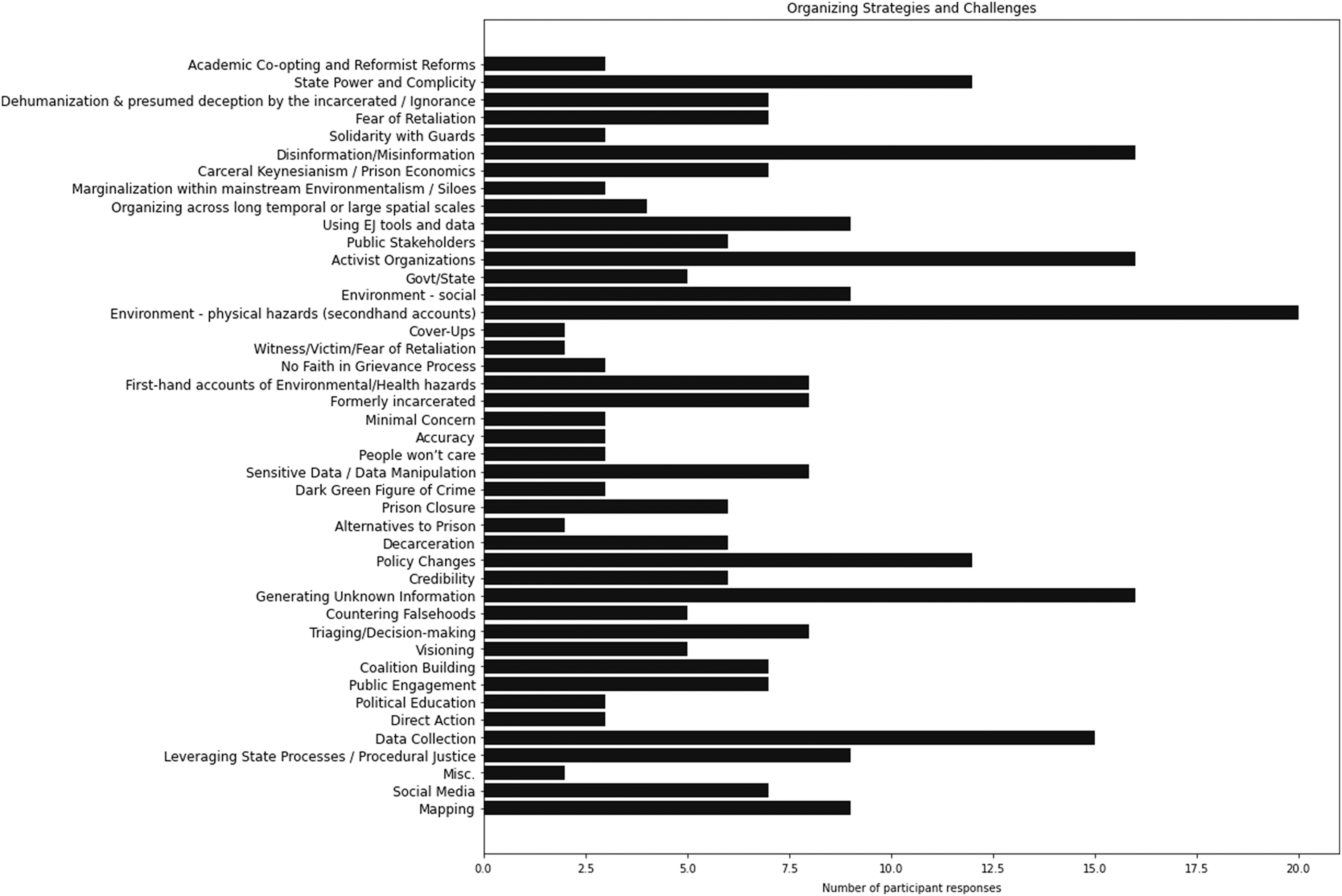
Topics frequently mentioned by the interviewees: The vertical axis shows the most frequently mentioned codes. The horizontal axis represents the number of interviews in which each item in the vertical axis was mentioned. Physical environmental hazards in carceral facilities (e.g., air pollution, extreme heat) were the most mentioned (n = 20), followed by challenges in prison ecology organizing related to disinformation (n = 16), and a desire for data for generating unknown information about prison ecology issues (n = 16). EJ, environmental justice.
RESULTS
“I was in [prison in] Pekin, Illinois, and we were right across the street, literally, right across the street from a power plant that was just belching this sulfurous smelling stuff. I don't know what it was. And I know that I have asthma. And that was really aggravated there. There were times when we just couldn't go outside … because it wasn't just the smell you'd breathe in—it was like your lungs would … hurt.”—Taylor
As prior research has found, prisons and other carceral facilities are often colocated with sites of undesirable land use in proximity to toxic exposures. 43 , 44 All eight of the formerly incarcerated participants described witnessing toxic environmental hazards external to or within the facilities where they were held, with many detailing the development or aggravation of adverse health effects during their confinement. Organizers fight against these environmental injustices using what one participant called a “fully fledged diversity of tactics.” In the following analysis of 22 interviews, we describe themes related to the use of data and mapping, challenges to organizing, opportunities and cautions of data collection and technology design, and desired outcomes for prison ecology organizing.
Data and mapping in prison ecology organizing
“We were able to use environmental data or sometimes even the lack of clear data to present [to the state] that they didn't really know the true effects of what they were doing. They hadn't taken into account how damaging this [prison] construction could be as well as the long-term running of the facility.”—Jamie
In keeping with previous literature on data practices of community organizers, the interviews suggest that prison ecology organizers used data and digital tools to legitimate demands in the eyes of either the public or the state. 45 , 46 The interviews further describe how specific mediums of tools, such as mapping, social media, PowerPoint, Excel, and infographics, are employed in prison ecology organizing, which includes mitigating harm for people who are incarcerated during disasters, challenging the state, and engaging the public to achieve demands.
During disasters, people who are incarcerated are sometimes abandoned and left without agency to evacuate or mitigate their exposure to a hazard.
47
,
48
,
49
Eight of the 22 interviewees described how they use Google Maps, public information, and news media to identify carceral facilities that are at risk to a hazard and advocate for the safety of incarcerated individuals during these events:
“You'll pull up the image that they'll use for an evacuation zone, and then you'll go into Google and type in where the jail is and zoom out. It's the same sort of topographical map system. So you can just compare. And then we'll take that evacuation zone image that they've sent out for the graphics and then put a star [to] highlight where the jail or the prisons or whatever it is to show the visual of them being directly impacted.”—Dominique
After obtaining maps of a hazard, organizers use these in graphics disseminated on social media such as Twitter and Instagram to engage the public in “phone zaps,” which are campaigns to call staff in carceral institutions and elected officials to urge them to evacuate before an environmental disaster. These data are also used to challenge the state. In one instance, an organizer who participates in disaster response described how they used mapping data to counter claims from the Department of Corrections that they had evacuated facilities to higher ground during Hurricane Laura that impacted Louisiana in 2020:
“[The Dept of Corrections] claimed that they had evacuated two of their local facilities to two other facilities, one of which they talk specifically about, and they were like it was—it's newer, which was true and they're also claiming it was on higher ground which wasn't true. So we had to—I basically had to locate it on Google Earth to prove that it was at sea level, and it was.”—Avery
Several respondents described how independent collection of map data was used to delay construction of a new prison near coal mining operations in Letcher County, Kentucky. As required by the 1969 National Environmental Policy Act, certain federal building and infrastructure projects must produce an Environmental Impact Statement (EIS) assessing the potential impacts of said project on its surrounding environment.
50
The data that organizers collected
51
showed that the project owners, the Bureau of Prisons (BOP), failed to consider legitimate environmental hazards such as coal waste in the EIS, thus forcing the BOP to revise the report:
“The folks that did the EIS actively were like, ‘there's no coal slurry impoundment near the site’. And they were citing federal data that doesn't keep track of coal slurry impoundments to prove their case. And I just went and took a screenshot of goddamn Google Maps that shows the coal slurry impoundment right next to it.”—Frankie
One respondent further described how data are implicated in efforts to engage the public in demands oriented toward the state. During the Letcher County campaign, Jamie noted that organizers were “able to use data to convince a lot of people to submit public comments on these environmental impact statements.” The campaign culminated in a lawsuit filed against the BOP on behalf of 21 people in federal prison highlighting that the BOP “failed to notify inmates” about the opportunity for public comment on the EIS, among other claims. 52 Data about the health risks of the proposed location were a key component of the argument that potential inmates of the facility should have been notified. These cumulative organizing efforts consequently forced the BOP to halt the prison construction for several years. 53 These results show that prison ecology organizers routinely harness data and mapping for narrative building and contestation.
Technological limitations and state power
Organizers face several challenges related to the technical capabilities or limitations of existing tools, and in navigating a context where state power is exercised to make data inaccessible or to disincentivize data collection. While organizers were accustomed to using tools such as Google Maps and PowerPoint for identifying facilities at risk to environmental hazards, they also lamented the difficulty of the task. This was implied by statements from 45% of interviewees such as “[it's] a lot of time spent on Google Maps,” “it's very hard to get a good sense on what type of response is necessary,” and “I want to more quickly identify things.” One participant elaborated how inconsistencies in how states disseminate information about emergencies contribute to difficulties:
“Every state has a different system- if they [even] have any system for showing evacuation orders. Some places they just do a verbal description of the area that's under evacuation orders. Some might have a static graphic that does show them in a map, but it's not like a GIS system. And then some, like I think California has its own GIS system that shows evacuation zones but—you can't generalize to other states … There's a lot of manual work to try to figure out how to correlate the information being released officially and then what facilities are in those locations.”—Avery
In recent years, EJ screening and mapping tools, developed at the federal and state level and by independent organizations, have been embraced to help identify communities that are most affected by pollution and inform remediating actions. 54 Of the six participants who aimed to leverage these tools, everyone noted that they were not useful to their needs at the time. Two specifically noted concerns around usability with sentiments such as “after looking at CalEnviroScreen, it was really difficult. It's not the most user-friendly,” and “one big challenge [with EJScreen] is I still don't know how to operate the damn thing very well … I don't know how to produce something from EJScreen that has any meaning.” These same two organizers also shared concerns related to the data offered or obscured by these tools.
“I remember looking up a certain prison [on CalEnviroScreen v2], like DVI [Deuel Vocational Institution]—and it was actually whited out because they don't have data on that place. I specifically remember the map being all these colors and then the shape of the prison land being just white and no color because there was no data.”—Lee
“We found out the EJScreen mapping tool has severe limitations when it comes to Appalachia because it only uses national level data, and because mining is not a national level activity, EJScreen doesn't have the coal ash dumps. It doesn't have the coal slurry impoundments. It doesn't have the mountaintop removal sites on it.”—Frankie
Another interviewee discussed the limitations of available tools. Referring to a mapping tool that an independent organization had developed to visualize prison ecology issues, one organizer said, “I'm really glad the map exists, it's a good educational tool for the public, but I don't really trust it as an actual tool we can use.” They explained that the tool primarily maps risk, rather than current or past events, which can be misleading as some facilities that are labeled “low flood risk” have experienced flooding before. The interviews reveal a notable interest in mapping tools to mediate organizing but point to difficulties in the use and inadequacy of their offerings.
Organizers also face challenges related to the exercise of state power in ways that are adversarial to their goals. When discussing efforts to raise concerns about environmental hazards with state or federal government personnel who oversee prisons, four organizers said statements including “they lie all the time,” “they stonewall you,” “they become very protective” and “when it comes to the feds, it's always zip, zilch, mum. We ain't telling you all shit.” In some cases, information may not be available. Five interviewees expressed not knowing if prison officials had emergency preparedness plans—a sentiment that one interviewee had confirmed in a phone call. They recalled, “I've been on the phone with the Bureau of Prisons and they've literally said, ‘the feds never evacuate’. They have no protocol except leaving people for dead.” The same participant further explained how this mis- and disinformation and lack of preparedness impacts their organizing efforts:
“The impact is that there is no accountability. There is nothing documented to go against their lies. We can't pursue a lawsuit or increased media scrutiny without on the ground data.”—Morgan
Generally, participants felt that responding to the concerns of people who are incarcerated was not in the interest of carceral institutions. This was further exemplified by perspectives from interviewees who were formerly incarcerated who recalled haphazard attempts of facilities to remedy an environmental hazard:
“I think that there is a lot of misinformation and disinformation that's fed to the regional office from the local prison. I think they've probably received money for repairs that were not completed. They put tarps over those holes on the roof. That's not a repair. I have actually seen instances of fraud taking place working in an administrative capacity in the prisons. They will tell you to do things like shred invoices. And then they will type up new ones. I have a friend who actually worked in the business office. And she said that she was regularly directed to do things that were defrauding. And she's like, ‘I'm in here for fraud, why are you doing this?’”—Taylor
Interviewees also reported witnessing prison staff paint over mold, tape over thermometers, or purposely take air quality samples far away from problem areas. They felt that many hazards are covered up or ignored outright and in the words of one participant, “your concerns or grievances are not leaving the institution.” Similar sentiments were shared by all seven of the other interviewees who were formerly incarcerated who shared stories of attempting to or observing others attempting to elevate grievances and facing retaliatory measures including solitary confinement (sometimes referred to as “seg”) or being transferred to facilities far from their loved ones:
“A lot of the information that the public receives about prison conditions are either skewed or watered down. You've got to remember that our information is censored. Our letters are monitored. Our calls are recorded. And so there have been instances where women have been said to try to convey information about conditions inside and they've been reprimanded for it. They've been taken to seg. Or the mail doesn't get out. Somehow it gets ‘lost’. No one ever received it.”—Randy
Activists find their goals to mitigate environmental hazards in carceral facilities hampered by limitations of existing tools and by various ways that government officials exercise power to mislead, suppress, and intimidate those who seek to fight for the rights of the incarcerated to live in safe environments. Despite these challenges, as the next section shows, activists feel that there are opportunities for data and mapping tools to support their organizing.
Opportunities and cautions of data and mapping for prison ecology
When asked directly how data collection or digital mapping could be important to their efforts, activists identified many ways it would support their goals, emphasizing its centrality to triaging and building a long-term movement that elevates information about the bidirectional toxicity of prisons to both people who are incarcerated and the communities where prisons are located.
Ten activists described how they desire to have more accurate information about facilities that may be impacted by disasters such as hurricanes and fires. As one noted:
“When it comes to disaster response, we operate off the rule of triage. We have limited resources and a limited amount of time in which this disaster is oncoming, and we're not going to be able to save everybody. We need to prioritize certain people. So how do I know who I need to prioritize if I don't know which prisons and jails are within the flood inundation zones, for example?”—Frankie
A subtle component of this response, which was also captured by other participants, was a desire for data and mapping tools to enable activists to establish “priorities” and as another participant noted, “do [their] own research,” that may or may not align with the priorities or research findings of public officials. This point exemplifies the need for participatory research in the design of technology for EJ. In the context of RS, participatory approaches could be embraced at any point from conception of a satellite mission to the design of tools to deliver satellite data.
Sixteen participants described how environmental data and mapping could be useful in educating the public, especially communities that support prisons because of the claims that they improve local economic livelihood, about the long-term impacts of prisons on the health of the workers and environmental degradation of the surrounding community. One activist described a community in California called Susanville that has been very active in opposing prison closures. They said “[Susanville] want[s] to keep their prisons open because their economy is centered around that and because the state—instead of building other things, they built prisons and people have jobs.” The activist expressed that if communities could see evidence of prisons impacting their air and water quality, they might be less embracing of prison-based economies. Similarly, another activist noted a need to show the cumulative health impacts for incarcerated people and facility workers:
“One of the arguments that needs to be made loudly is that the average life expectancy of a person who works in a prison is 60 years old, actually 59. So we're asking the community to sacrifice almost 20 years of their life expectancy just to have a prison. And a lot of that has to do with—in my opinion, but there's no data to support it, not only the toxic culture that is pervasive within the institutions, but also the toxic environment in which they are situated.”—Aubrey
Another aspect of the use of data pertained to credibility. Seven participants expressed sentiments describing the tendency for the public to dehumanize the incarcerated and view them as deceptive or deserving of environmental harm because they may have committed crimes. As one participant said:
“There is this mentality in our society that, well, they're just prisoners. They are just liars … And if you can't do the time, don't do the crime.”—Chris
In the face of this challenge, six organizers expressed that they felt the public's distrustful perception of the incarcerated could be combated with quantitative data about environmental hazards.
“If we had data, it would add a lot of legitimacy and trust. We have general cred with other abolitionists and organizers, they just kind of trust us. Data would help us build trust with the public, with officials, and to change policy.”—Morgan
Organizers had many other ideas about how data and mapping could be useful to document information about current or proposed facilities such as blackouts, impacts on habitats, soil contamination, land subsidence, cumulative climate change impacts and more, and two noted an important design consideration for any mapping tool development. They advocated that the tool be made accessible via mobile devices as many of the impacted populations may not have access to computers.
Interviewees were also asked about any concerns they had regarding expanding the use of data and mapping in their organizing. Responses centered around cautions against (1) over-relying on visible data and (2) leaving out voices of those directly impacted. There were also concerns around data manipulation. Regarding point number 1, three participants explained issues relating to what one described as “the dark green figure of crime,” referring to hidden and undocumented environmental hazards that may not be captured by public or satellite data:
“In criminology, we have a concept called ‘the dark figure of crime’ … essentially what that means is [that] the state legally defines what crime is. But within that legal definition, there's no way we can know all the crime that happens so there's only a certain amount of crime that's actually reported, and the vast majority goes unreported. But that dark figure of crime is all the things we don't know that are happening, all the harms that are going on. If we apply this thinking to environmental harms, it raises the question, what about the
To counter this challenge, several interviewees emphasized the necessity of including the voices of those directly impacted alongside any quantitative data. One respondent underlined the importance of asking, “who's at the table?” when beginning data collection, and another said that they “would want to have a way to verify map information from inside sources.” These responses further illustrate the importance of a participatory approach to RS and mapping for EJ as a method for strengthening the knowledge production.
Despite these concerns, all 22 interviewees responded positively about new data collection and tool development for prison ecology. Still, the cautions noted above should be considered by any researchers seeking to conduct data collection and tool development for this application.
Desired outcomes: preparedness, decarceration, and abolition
Activists have long-term visions for what outcomes they would like to see brought to fruition through organizing, that they hope data collection and mapping could support. Eighteen participants self-identified as prison abolitionists, a political philosophy referring to a belief that prisons and policing exacerbate rather than solve societal harms and thus advocate for abolishing prisons and building alternative justice systems rooted in care and restorative processes. 55 Interviewees described a range of desired outcomes including but not limited to abolition.
Twelve interviewees said that they would support the creation of policies related to temperature regulation, evacuation procedures, and transparent communication from the state. One noted the shortcomings of current practices in prisons:
“Sometimes we'll call places and they'll be like, ‘well, we don't have any plan in order.’ And it's like, why isn't there a plan? I feel like that's just really silly for units
56
to have to scrap together like, ‘oh, OK, where would we evacuate our people to? … [As an abolitionist,] I would never advocate for the creation of a new unit designated for evacuation but I definitely say that if every single unit was mandated to have a plan in place should disaster strike, I feel like that would really help facilitate evacuation.”—Sam
Other organizers strongly pushed back against any actions, such as installing air-conditioning, that would invest more money into prisons. One said, “we don't want more money being funneled into repairing prisons. We really want to see that shifted to communities.” Thus, many organizers primarily emphasized decarceration and abolitionist approaches making statements such as “just release everyone. Just let them go home to their families” and “get as many people out as possible.” Describing why decarceration should be taken seriously, one said:
“The question of evacuation is also a question of just the sheer number of people incarcerated. And it's well, how do we evacuate all these people? Where are they going to go? The other facilities they could evacuate them to are already crowded … We need less f*cking people incarcerated because this is just not tenable.”—Avery
While interviewees had different desired outcomes, all 22 expressed a hope that new data collection and mapping would lead to more public engagement in prison ecology and anti-prison activism. They noted that more public engagement could mean more electoral power:
“I think that with more public awareness and access to this data, we could unseat judges. And put people in power who balance justice with mercy.”—Randy
Although most of the participants supported prison abolition, they also embraced leveraging the democratic process for immediate change because, as another noted, “the power is in the people.”
DISCUSSION
In our sample of 22 interviews with prison ecology activists, we arrived at several important insights. First, in alignment with previous literature, 57 , 58 , 59 activists regularly engage the tools of datafication to support their campaigns and challenge the state's control over information. Second, despite their comfort using many data sources, activists reported that some data tools, even those with explicit aims to be used for EJ, are overly burdensome, insufficient, or difficult to master, a problem compounded by the state's routine efforts to obfuscate and prevent access to information. While other literature has revealed resistance to EJ screening tools based on other factors 60 and highlighted the need for capacity building with geospatial data, 61 , 62 our interviews present a new finding on how the limited applicability of technologies designed without certain end users in mind, paired with the complexity of using said technologies, and a context that aims to protect itself from investigation, hampers prison ecology organizing.
Third, activists report a desire for new and accessible data and mapping tools since there are numerous gaps in knowledge about prisons and environmental concerns. And finally, activists articulated clear and specific changes that they would like to see materialize in the U.S. carceral system as a result of mobilizing around the use of key data sources. Taken together, this sample of prison ecology activists' interviews reflects opportunities and challenges of the use of data to achieve social change in grassroots organizing at the intersection of multiple social problems (i.e., prisons and EJ).
RS and GIS specifically present generative opportunities for advancing prison ecology scholarship and social change, particularly through participatory research methods. The interviews point to several data needs that satellite RS could support including monitoring disasters, blackouts, pollution, temperature, and ecosystems. We can look at a recent collaboration between the authors and FTP as an example. In September 2022 when Hurricane Ian was set to impact Florida, we codeveloped a map that used satellite-derived data and GIS to identify that Hillsborough County Jail was in a mandatory evacuation zone (Fig. 2).
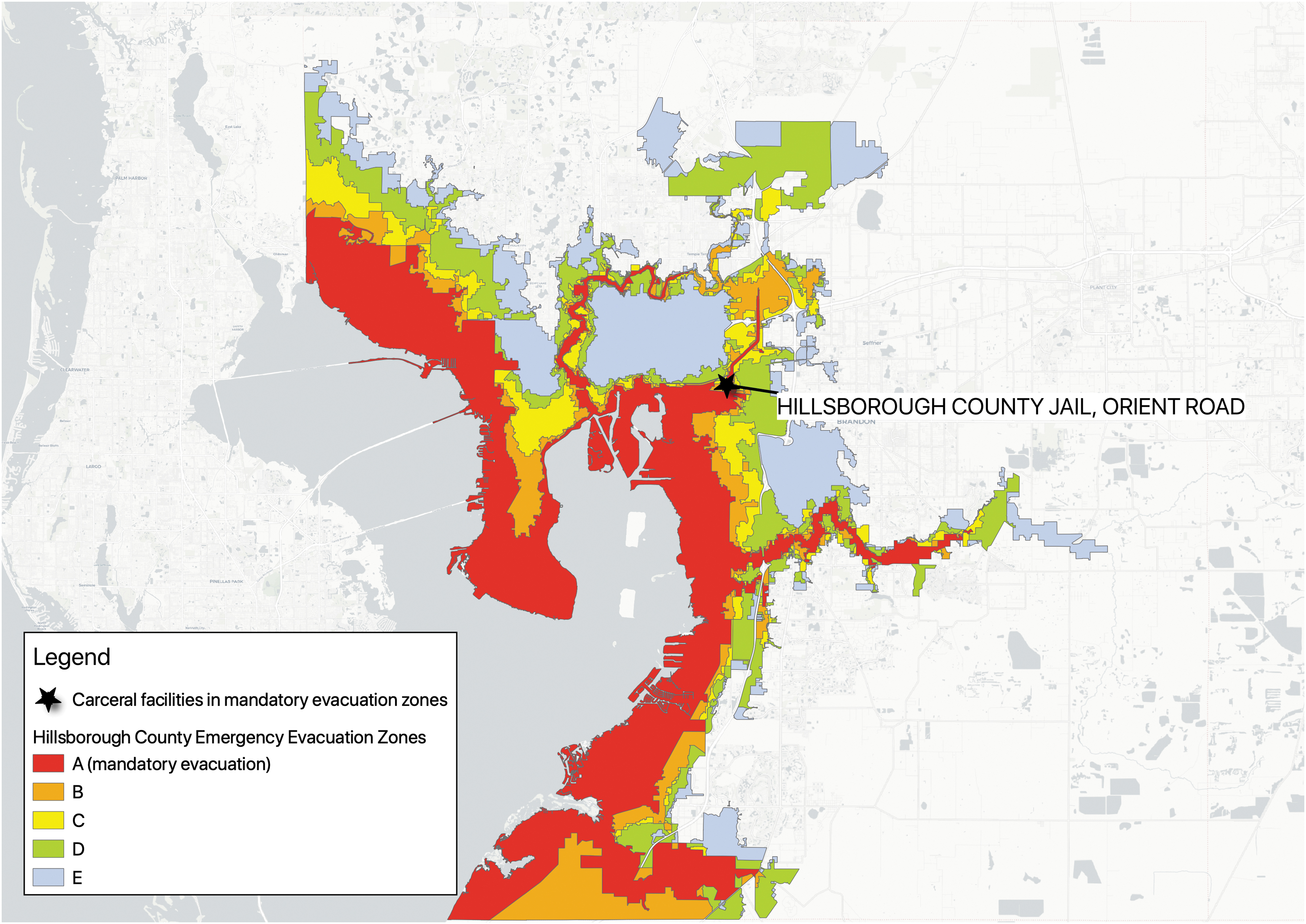
Map developed using satellite-derived data and geographic information system to identify that Hillsborough County Jail (indicated by the star) was in a mandatory evacuation zone (indicated by the color red) in advance of Hurricane Ian's impact on Florida in September 2022.
Upon calling staff to see if they planned to evacuate, organizers recounted that the staff “laughed,” indicating an absence of any such procedure. After widely distributing imagery on social media showing the jail at risk and mounting public pressure via a phone zap, the jail officials reported that they would indeed evacuate. While we cannot prove that the jail evacuated as a result of the organizing, we see RS and mapping are effective for documenting injustice, motivating public participation, and contesting the state. This example is part of ongoing work to develop RS-informed analyses of prison ecology nationwide, pair this alongside interviews from those directly impacted, and cocreate technological tools to support organizing.
We do not endorse a techno-positivist view of RS for social justice, a perspective that ignores the ways that data from satellites are also relied on for non-neutral military, political, and commercial applications. 63 , 64 Our interviews demonstrate that prison ecology organizers have a similarly complex relationship to the use of data for political projects, reflecting the description by Lehtiniemi and Ruckenstein of two social imaginaries of data activism: a socio-critical imaginary that openly questions and names the limits of data and technology, and a technological imaginary that supports the use of data as a means of pursuing social justice. 65 Reflecting the socio-critical imaginary, many interviewees were generally aware and cautious of the risks and limits of data, naming concerns such as data manipulation and the dark green figure of crime.
Yet, embracing the technological imaginary, all 22 participants viewed data and mapping as necessary instruments for social change in this context, especially given the potential to exercise agency to generate their own research. While some scholars critique the EJ movement and other social justice movements for the tendency to document harms already known to the state, often called “the burden of proof,” 66 in the context of prison ecology, the sheer scale of harm created and perpetuated by the prison industrial complex is worth the labor it demands of those with the capacity to contribute to knowledge production. These findings thus present a counterpoint to the predominantly critical view of technology and incarceration, 67 , 68 , 69 toward a more nuanced view wherein there is a key role for participatory technology development to advance justice in abolitionist organizing.
This article speaks to a number of emergent radical frameworks that scholar-activists have articulated in recent years, particularly around questions of how researchers can collaborate with grassroots activists to confront institutional violence and promote various forms of liberation. Abolition ecologies is one framework that is relevant for our purposes. 70 Its core premise is that if we seek EJ, we must work to build and maintain radical democracy; and if we seek radical democracy, then we must work to confront major systems of domination, with particular attention to the histories, legacies, and continuing practices of plantation logics, settler colonialism, enslavement, and conquest associated with racial capitalism, which can oft be seen in the prison system. 71
The project featured in this article is an example of how scholars and activists can collaborate to coproduce knowledge in the service of abolition ecology, as it facilitates making visible a range of policies and practices contributing to harm against marginalized communities while offering opportunities for collaboration with allies in the struggle to address these challenges. As noted earlier, environmental data justice is another such relevant framework, and this article illustrates the important method of taking affirmative steps to build alliances with marginalized populations to ensure that they have access to, and some degree of ownership and control over, data affecting their communities. Grassroots social movements and university scholars routinely engage in knowledge production; the key questions are who is producing that knowledge, for whom is the knowledge being produced, and for what purposes? These questions and the practices detailed in this article reflect the intent of satellite remote sensing for environmental data justice where RS is embraced as a relevant tool in the pursuit of liberation.
CONCLUSIONS
Our findings advance the study of the data practices of community organizers and provide insight into how different mediums of data and digital tools are integrated into activism. This article also offers constructive reflections into how datafication, and specifically RS technology, can be brought to bear on prison ecology and EJ methods, theory, and practice. Future work should aim to elucidate additional data practices by incarcerated peoples and how their experiences can inform the design and development of technology-mediated activism.
Footnotes
ACKNOWLEDGMENTS
The authors thank the community organizers who participated in the study for their insights and contributions to the project.
AUTHORs' CONTRIBUTIONS
U.O.: Conceptualization, data curation (lead), formal analysis, investigation, methodology, writing—original draft preparation (lead), funding acquisition (lead). A.D.: Data curation, visualization, writing—original draft preparation. D.N.P.: Writing—original draft preparation. D.W.: Writing—reviewing and editing, funding acquisition.
AUTHOR DISCLOSURE STATEMENT
No competing financial interests exist.
FUNDING INFORMATION
The article is based on work supported by the National Aeronautics and Space Administration under award Number 80NSSC22K1673 and a grant from the Massachusetts Intitute of Technology's Institute for Data, Systems and Society's Initiative on Combatting Systemic Racism.