






Abstract
Jackson, Mississippi is a city with an ongoing water crisis due to underfunded aging water infrastructure. The predominantly Black city has experienced environmental racism due to historical white flight, funding allocation and conditions, tension between local and state governments, and maintenance and workforce development issues. This policy brief examines these factors that have contributed to the Jackson water crisis and how funding for drinking water infrastructure has been distributed, especially considering the historic investment in environmental justice by the Justice40 Initiative. This analysis informs the provided policy recommendations for the utilization of water infrastructure funding that advances environmental justice. This policy brief was prepared by researchers in partnership with water justice advocates in Jackson.
PROBLEM
The Jackson water crisis and historical environmental injustice
Maintaining drinking water infrastructure is fundamental to public health. As water systems age, the number of cities with infrastructure in need of repair and maintenance grows. 1 Low income and minoritized populations in these cities disproportionately face drinking water infrastructure issues. 2 This deteriorated state of infrastructure is hazardous due to the risks of failure to provide safe drinking water and increased vulnerability to natural disasters and climate change.
In August 2022, a state of emergency was declared in Jackson, Mississippi because its drinking water infrastructure failed to supply water to most of its residents for several days. 3 The lack of running water was attributed to pump failures at the city's aging water treatment plants after a large storm. 4 Consequently, Jackson's water system did not have enough water pressure to supply safe drinking water. The residents of this predominantly Black city have historically struggled for reliable access to safe drinking water: the Environmental Protection Agency (EPA) issued warnings to Jackson about its water infrastructure in the 1970s and 2020. 5
The case of Jackson exemplifies that challenges in accessing resources to improve aging infrastructure are an environmental justice issue deeply entwined with race. Jackson's struggle for safe drinking water is rooted in historical patterns repeated across the United States in cities that have a (or history of a) majority Black population, such as Flint, Detroit, and New Orleans. 6 The pattern is one of disinvestment due to white flight and Jim Crow politics, which build upon colonial histories of white supremacy and the dispossession and enslavement of African people. 7 ,8
The legacies of slavery and white supremacy form the socioeconomic landscape and are evident in high levels of spatial segregation and unequal distribution of resources, both of which impact drinking water infrastructure. 9 Consequently, the Jackson water crisis is the culmination of decades of exclusionary practices that systematically underfund Black communities 10 and allow infrastructure serving them to deteriorate and inevitably fail. The Jackson water crisis is a contemporary example, and its timing aligns with monumental investment in environmental justice through the Bipartisan Infrastructure Law (BIL) and Justice40 Initiative.
This brief, prepared by researchers in partnership with water justice advocates and in conversation with water utility consultants in Jackson, will assess the issues that Jackson faces in accessing funding to repair its drinking water infrastructure and provide recommendations for improving equity in funding distribution in the face of historic environmental justice investments.
FINDINGS
Aging water infrastructure and funding needs
Jackson is served by the O.B. Curtis and J.H. Fewell water treatment plants. The J.H. Fewell plant was built in 1914. 11 The larger-capacity O.B. Curtis plant was added to meet increased demand, but was completed in the late 1980s amidst white flight caused by federal courts ordering school desegregation in Jackson. 12 ,13 The tax base expected to maintain the expanded water system was severely reduced, and Jackson faced major disinvestment from this population loss. Table 1 provides a comparison of Jackson's demographics and poverty rates from 1980 to 2021, which reflects the reduced tax base.
Demographic Shifts Due to White Flight from 1980 to 2021 in Jackson, Mississippi
U.S. Department of Commerce Bureau of the Census. 1980 Census of the Population: General Population Characteristics, Mississippi. <https://www2.census.gov/prod2/decennial/documents/1980a_msABCD-02.pdf>. (Last accessed on May 12, 2023).
U.S. Census Bureau. U.S. Census Bureau QuickFacts: Jackson City, Mississippi. <https://www.census.gov/quickfacts/jacksoncitymississippi>. (Last accessed on December 21, 2022).
National Equity Atlas. An Equity Profile of Jackson. <https://nationalequityatlas.org/sites/default/files/JacksonProfile_Final.pdf>. (Last accessed on May 12, 2023).
Ward Schaefer. “Jackson ‘White Flight’ Slows In Last Decade.” Jackson Free Press. March 16, 2011. <https://www.jacksonfreepress.com/news/2011/mar/16/jackson-white-flight-slows-in-last-decade/>. (Last accessed on May 18, 2023).
Both plants are in deteriorating conditions, and Jackson has stated that $1 billion is needed to repair its water system. 14 To meet these needs, Jackson must utilize both short-term funding for immediate issues and long-term funding for building resilience. The funding sources articulated in this brief are presented in a Strengths, Weaknesses, Opportunities, and Threats (SWOT) analysis in Table 2. By examining favorable and unfavorable factors, the SWOT analysis assesses obstacles and assets in equitable funding allocation. 15
Strengths, Weaknesses, Opportunities, Threats Analysis of Water Infrastructure Funding Sources for Jackson, Mississippi
Alex Rozier. “State Awards $180 Million in ARPA Water and Sewer Funds, Includes $36 Million for Jackson.” Mississippi Today, November 4, 2022. <https://mississippitoday.org/2022/11/04/arpa-funds-awarded-water-sewer/>. (Last accessed on December 22, 2022).
Anthony Warren. “Congress Launches Inquiry into State's ‘Disinvestment’ in Jackson Water.” WLBT, October 17, 2022. <https://www.wlbt.com/2022/10/18/congress-launches-inquiry-into-states-disinvestment-jackson-water/>. (Last accessed on December 23, 2022).
Ibid.
Federal Emergency Management Agency. “Emergency Declaration for Mississippi,” September 2, 2022. <https://www.fema.gov/fact-sheet/emergency-declaration-mississippi>. (Last accessed on December 23, 2022).
Ibid.
Federal Emergency Management Agency. “Simplifying the Public Assistance Program,” October 3, 2022. <https://www.fema.gov/assistance/public/simplifying-public-assistance-program>. (Last accessed on December 22, 2022).
“Recurring Problems with FEMA's Grants Management Places Billions of Dollars at Risk.” Office of Inspector General Department of Homeland Security, December 7, 2016. <https://www.oig.dhs.gov/sites/default/files/assets/pr/2017/oigpr-120716.pdf>. (Last accessed on December 23, 2022).
U.S. EPA. “Bipartisan Infrastructure Law: A Historic Investment in Water,” November 18, 2021. <https://www.epa.gov/system/files/documents/2021-11/e-ow-bid-fact-sheet-final.508.pdf>. (Last accessed on December 22, 2022).
Mississippi Department of Health. “State of Mississippi Drinking Water Systems Improvements Revolving Loan Fund Program FFY-2022 Intended Use Plan,” August 26, 2021. <https://msdh.ms.gov/msdhsite/_static/resources/17153.pdf>. (Last accessed on December 22, 2022).
Janette McCarthy Wallace, Carol M. Browner, and Gary S. Guzy. “NAACP Files Discrimination Complaint for Mishandling of Jackson Water Crisis,” September 27, 2022. <https://naacp.org/articles/naacp-files-discrimination-complaint-mishandling-jackson-water-crisis>. (Last accessed on December 22, 2022).
Adam Ganucheau, Geoff Pender, and Bobby Harrison. “Legislative Leaders Kill Key Proposal to Address Jackson Water Crisis.” Mississippi Today, March 24, 2021. <https://mississippitoday.org/2021/03/24/legislative-leaders-kill-key-proposal-to-address-jackson-water-crisis/>. (Last accessed on December 22, 2022).
Anthony Warren. “Congress Launches Inquiry into State's ‘Disinvestment’ in Jackson Water.”
DWSRF, Drinking Water State Revolving Fund; EPA, Environmental Protection Agency; FEMA, Federal Emergency Management Agency; MCWI, Municipality & County Water Infrastructure.
Reactive short-term funding sources: American Rescue Plan Act and Federal Emergency Management Agency's
Shortly after the water outage, Jackson applied for funding from the American Rescue Plan Act. 16 This resulted in a total award of $46.9 million for drinking water system repairs, including a 50% match through the Mississippi Municipality and County Water Infrastructure Grant. 17 Jackson is also receiving funding through the Federal Emergency Management Agency's (FEMA) Public Assistance Program. These funds provide reimbursements to Hinds County, which encompasses Jackson, for management of the declared emergency at a rate of 75% for 90 days after the emergency declaration. 18
Mississippi's public agencies have received large sums of reactive funding, most notably due to Hurricane Katrina in 2005 19 and the BP Gulf of Mexico oil spill in 2010. 20 FEMA provided Mississippi with nearly $3.2 billion for Hurricane Katrina recovery efforts, but there has been controversy with lack of funding usage and use on projects unrelated to disaster recovery. 21 ,22 As a result, grassroots organizations are skeptical regarding the management of this funding and its capabilities to address the needs of low-income and Black communities most impacted by emergencies.
Long-term funding sources: The Drinking Water State Revolving Fund and the BIL
Drinking Water State Revolving Fund (DWSRF) is a long-term federal funding source for drinking water infrastructure that has consistently allotted millions of dollars to Mississippi since 1997. 23 The DWSRF was recently bolstered by the BIL, which contributed $30.7 billion to the DWSRF, 24 $19.3 million of which is expected to reach Mississippi, and none of which has been allotted to Jackson. 25 ,26 The only BIL funding designated to Jackson was $5 million through the U.S. Army Corps of Engineers for the long-term resiliency of Jackson's water system. 27
BIL funding channeled through DWSRF falls under the Justice40 Initiative, meaning 40% of funding must be designated for disadvantaged communities (DACs). 28 The Justice40 Initiative defines DACs using the Climate and Economic Justice Screening Tool, which compares census-level data across the nation. 29 However, because the tool identifies 65% of Mississippi's census tracts as disadvantaged, it is not particularly useful in specifying funding allocation within and across Mississippi (Fig. 1). 30
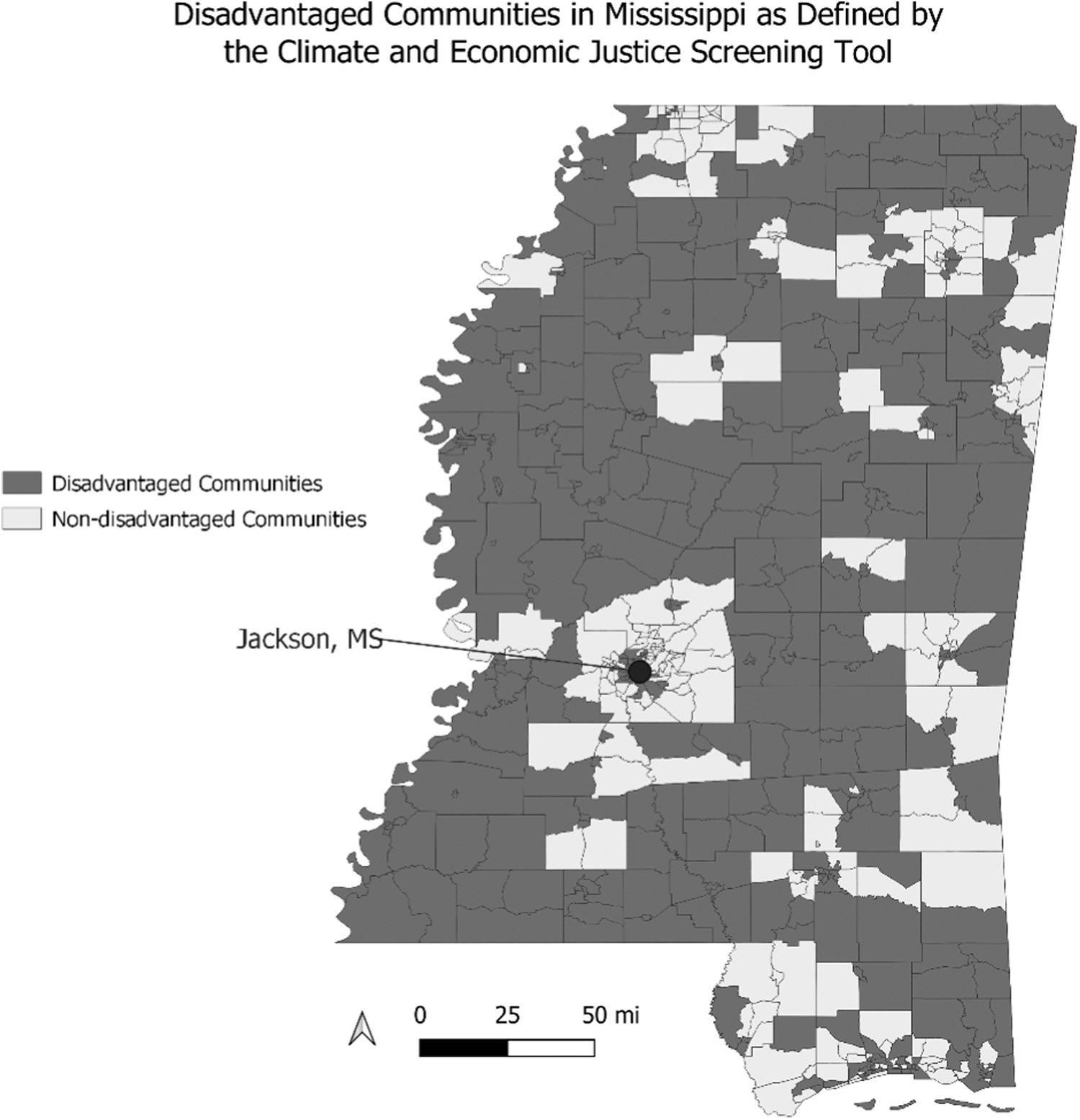
Mississippi's disadvantaged communities as determined by the Climate and Economic Justice Screening Tool. Source: Climate and Economic Justice Screening Tool. <https://screeningtool.geoplatform.gov/>. (Last accessed on May 14, 2023).
Jackson has only received DWSRF funding three times, 31 which can be attributed to the unfavorable loan terms of the DWSRF. Funding is provided as a loan with eligible principal forgiveness capped arbitrarily at $500,000 in Mississippi and at 49% of the loan federally. 32 With Jackson's immense need for funding, $500,000 in principal forgiveness is not enough.
Jackson has been disproportionately disadvantaged by Mississippi's low eligible principal forgiveness, and the cost burden is too large to put upon local governments and Jackson residents, as 24.5% of the city's population lives below the poverty line 33 and a significant portion of the city's water infrastructure serves visitors of the state capital that often use water in establishments that may qualify for reduced water rates within the consumption-based billing system. 34
Tensions between city and state legislation
The tension between city and state governments about Jackson's funding sources have made water infrastructure improvement increasingly challenging. Governor Tate Reeves has denied Jackson water infrastructure funding and instead directed the city to improve its revenue collection with the belief that Jackson should be responsible for its water system repairs. 35 The city, however, faces issues with revenue collection due to water bill debt with which Governor Reeves vetoed state assistance. 36
State legislatures have also rejected the city's efforts to increase its sales tax to fund water system improvements. 37 Jackson seeks external funding because the city is home to the Mississippi State Capitol, six colleges, and a Veterans Affairs Medical Center. Many of these entities do not proportionately contribute to water infrastructure funding because they may qualify for reduced water rates of up to 25% less than the rate charged to Jackson residents. 38
The problem of the state government's continuous discrimination and neglect of funding for Jackson's water infrastructure has been flagged by the National Association for the Advancement of Colored People, and a Title VI complaint was filed to the EPA. 39 The report attributes the water crisis to racial discrimination and historical and political tensions between the Democratic City of Jackson and the Republican state legislatures. 40
Maintenance and workforce development
An underlying cause of Jackson's water crisis is the water sector's lack of maintenance and workforce development. Mississippi Department of Environmental Quality, which handles funding disbursement from the American Rescue Plan Act and the corresponding fund-matching program has a historic low of staff with 10–15 years of experience and 30.75% of the agency has experience of <5 years with the agency. 41 High turnover rates and loss of employees to resignation, retirement, and competitive salaries make retaining institutional knowledge difficult and slow the agency's operations.
There are also severe staffing problems within Jackson's water treatment plants due to low wages and unfavorable work environments. 42 Jackson's water treatment plants have been operating without enough Class A operators. 43 With a shortage of workers, employees are more prone to being overworked: the J.H. Fewell plant timesheets indicate hundreds of hours of overtime in June 2022 to maintain plant operations. 44 In November 2022, however, the Jackson City Council approved wage increases. 45
STAKEHOLDERS OF CONCERN
The following are stakeholders of concern who are affected by or involved in decision making regarding the water infrastructure in Jackson.
Jackson residents, who are faced with unreliable access to safe drinking water.
The Mississippi state government and agencies, who are responsible for making funding decisions to protect drinking water systems and public health.
Local governments on the city and county levels that make funding decisions for their water supply systems.
The EPA, which is responsible for enforcing Title VI compliance and safe drinking water standards.
The Federal government, as the provider of federal funding.
Grassroots organizations of Jackson, who are fighting for water justice.
POLICY ALTERNATIVES/RECOMMENDATIONS
Aging water infrastructure and funding needs
Historical and political factors such as white flight and Jim Crow politics have caused disinvestment in Jackson. To contribute to tax-sourced funding available for drinking water infrastructure and build wealth within Jackson, it is recommended that Jackson's tax base be expanded by bringing in culturally relevant and community-oriented businesses, industries, factories, retailers, and quality grocers for disadvantaged areas.
Short- and long-term funding sources
Loan terms and funding allocation should be adjusted alongside an overall increase in investment to build drinking water infrastructure resilience and reduce reliance on reactive funding sources. Funding can be made more accessible to Jackson by the following:
Increasing the maximum principal forgiveness from $500,000 to a percentage amount of total project costs, which will increase the feasibility of DWSRF loan terms for fiscally limited communities that need larger projects. Adapting the Climate and Economic Justice Screening Tool that Justice40 uses to identify DACs to include state-level comparisons. Without state context, the indicators can fail to highlight DACs that should be prioritized within Mississippi. Increasing overall investment in drinking water systems to build long-term resilience and meet the immediate needs for repair, maintenance, and staffing. The water sector receives 5% of total investment through the BIL, which is much less than the needs of water systems across the nation.
46
Tensions between city and state legislation
To progress infrastructure repair despite political tensions and account for the number of nonresidents using Jackson's infrastructure as the state capital, it is recommended that the city modify its model for water utility financial relief and provide clarity about how large entities are held responsible for water utility use. 47 Larger entities should be held responsible for their water use at an equal or higher price rate compared with Jackson residents.
Maintenance and workforce development
Water system maintenance and workforce development in public agencies and water treatment operations should be improved through increased wages, career development training, and recruitment. 48 This will improve employment opportunities for Jackson residents, reduce the strain on the current workforce, and begin the recruitment of longer-term employees. A strong workforce will broaden opportunities for Jackson's water infrastructure contracts to be awarded to contractors within Jackson and/or Black and other minoritized contractors. 49 These efforts should be in partnership with grassroots organizations that reflect Jackson's demographics. This will advance environmental justice in Jackson by rebuilding wealth and drinking water infrastructure for the Black communities that have faced historical disinvestment.
Footnotes
ACKNOWLEDGMENT
We thank Operation Good of Jackson, Mississippi for providing contextualizing support and local perspectives for this article.
AUTHORs' CONTRIBUTIONS
Conceptualization (lead) and writing—original draft (equal) by F.H.O. Writing—original draft (equal) by K.C. Writing—review and editing (supporting) by F.W. Supervision (lead), conceptualization (supporting), and writing—review and editing (lead) by M.C.
AUTHOR DISCLOSURE STATEMENT
There are no conflicts of interest in relation to the publication of this brief.
FUNDING INFORMATION
This article is based on the study supported by the National Science Foundation Graduate Research Fellowship under Grant No. 2146752.