






Abstract
The Problem:
In 2014, Dominion Energy proposed a large compressor station in Buckingham County, Virginia to pressurize its Atlantic Coast Pipeline. Dominion and regulators presented demographic data that erased African Americans living near the compressor site in the community of Union Hill, to circumvent environmental justice concerns during the permitting process.
Theoretical Framing:
The erasure of African Americans in Union Hill for the construction of a compressor station was a recognitional injustice. Art is useful for contesting misrecognition by generating affective solidarities among various and dispersed groups of people concerned about injustice.
Case Study Design:
Qualitative methods are used to study how protestors deploy creativity to overcome misrecognition in Union Hill and Greater Buckingham County, Virginia. We focus, in particular, on two photographic series created to generate affect against the compressor station and pipeline.
Case Study Results:
Photography as art is a powerful protest tool combating misrecognition by publicly highlighting the link between people and place. While the photos highlighted are not maps in a conventional sense, they are ‘cartographic-affective’ because they (re)map the contours of life for otherwise unseen people living in Union Hill and Buckingham County.
Conclusion:
Cartographic-affect in the featured photographs results in recognitional justice as protesters are not only made public, but reconnected to places from which they were previously erased. In the process, the site of struggle against a petro-hegemony in North Carolina is (re)situated and (re)scaled away from the hegemon's disempowering state and census tract levels toward empowering bodily, community, and national scales.
THE PROBLEM
In 2014
At 54,000-horsepower, it would be an exceptionally large compressor station. 2 Major problems with compressor stations include their impact on local air quality and public health due to “blowdowns” among other problems. 3 Unsurprisingly, the planned construction of a compressor station caused nearby residents concern.
Buckingham County is a rural community in Central Virginia, located south of the James River, and flanked to the west by the Blue Ridge Mountains (Fig. 1). The county has a population of 16,824, of whom 34.87% identify as black or African American alone; its median household income is $36,378. 4
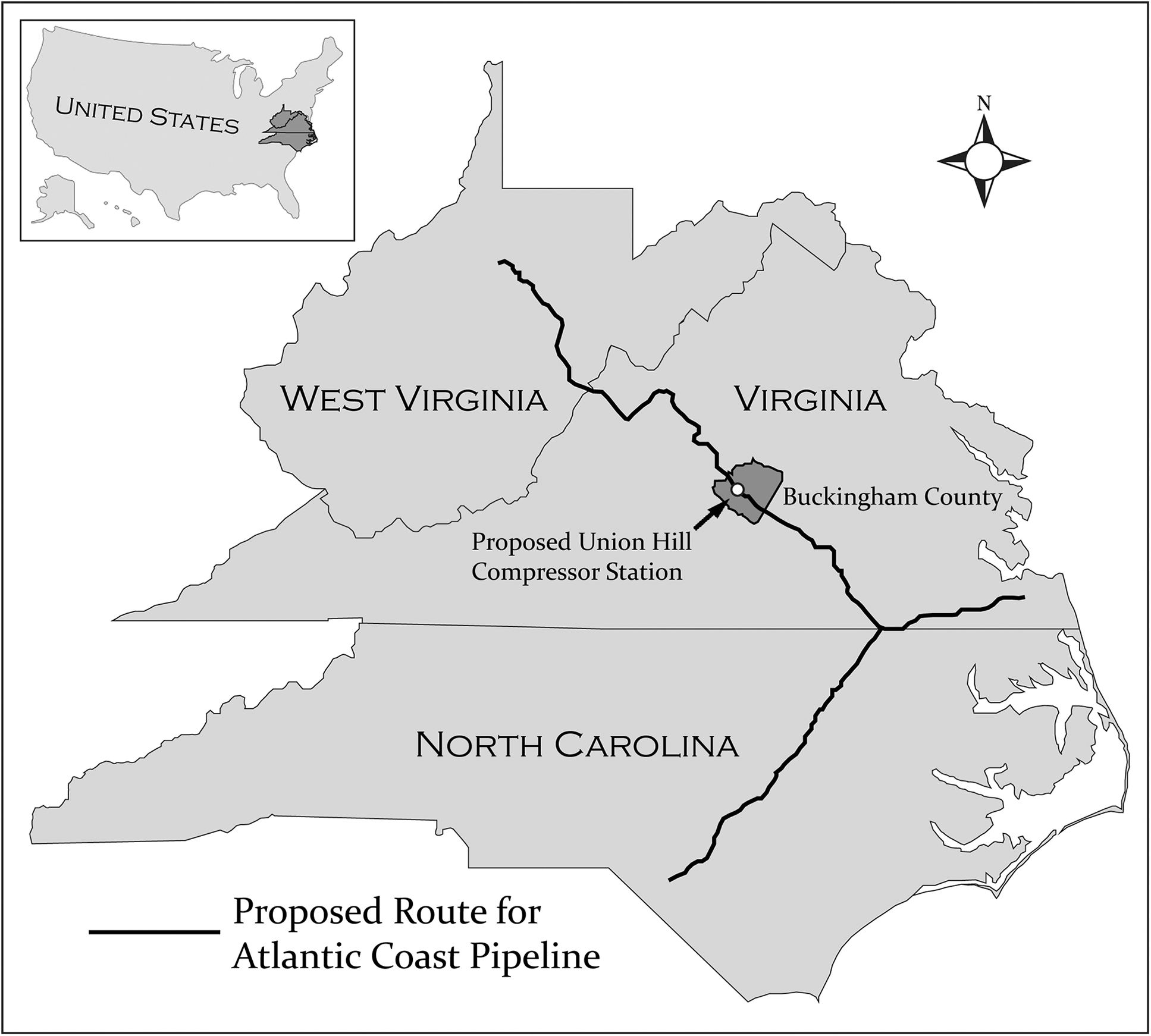
Map of proposed Atlantic Coast Pipeline route. Map by Harold A. Perkins.
The parcel on which the proposed compressor station was to be built was in the unincorporated hamlet of Union Hill, founded by freed slaves after the Civil War. Many of its homesteads were built during the postbellum era and remain in the same families ever since. Seventy percent of the community's residents are African American and more than one-third are direct descendants of freed slaves. 5
Planning a large compressor station in Union Hill was an act of environmental racism. 6 Virginia's Department of Environmental Quality (VDEQ) filed an environmental justice (EJ) report as part of the permitting process with the Virginia Air Pollution Control Board (VAPCB). However, the agency utilized demographic data generated by Dominion. Those figures were based on demographic averages across all census tracts in the county, thus no EJ community was determined to exist within a 1-mile radius of the proposed site.
A subsequent community survey determined, though, that the number of African Americans living within 1.1 miles of the Union Hill site was much higher than the county averages reported and should trigger a community impact review under Executive Order 12898. 7 As a resident of Buckingham County commented at a rancorous VAPCB hearing for the proposed compressor station, VDEQ, “masked the true environmental justice statistics and how it affects [Union Hill], and it's just nuts.” 8
VAPCB remained unmoved, however, voting 4-0 to permit the compressor station. 9 Another resident said: “I go to all the meetings… but my voice is just not heard… neither are the voices of the Union Hill community. The [Buckingham County] board of supervisors don't listen to us and nobody from the federal government has come to talk to our community. It just seems like no one cares.” 10 This comment, and others documented elsewhere, 11 suggests that residents in Union Hill and Greater Buckingham County were frustrated about being unrecognized by regulators, politicians, and company officials during the compressor station permitting process.
Dominion ultimately abandoned the ACP in 2020 due to rising costs and construction delays associated with mounting legal challenges. 12 We, nonetheless, explore a subset of ACP protesters' creativity, in this instance two series of photographic images of Union Hill and its residents called “We Are All Union Hill” and “Gas Mask Future”—to better understand the import of art in the pursuit of EJ.
In doing so, we ask: why, and to what ends, do people engage in creative forms of protest, like photography, despite apparently long odds for success in stopping a pipeline? Our findings indicate that protesters use photography not to stop the pipeline outright, but to achieve recognitional EJ through the forging of community solidarity and by bringing impacted residents into the public realm.
We suggest that protest photography also combats misrecognition by (re)connecting people and place, thus using affect to (re)situate and (re)scale the struggle for EJ. Before discussing this in finer detail, however, relevant literature and case study methods are addressed. We conclude with suggested pathways for future research regarding protest art, affective mapping, and EJ.
THEORETICAL FRAMING
Distributional and procedural injustices 13 occur in places like Buckingham County, according to LeQuesne, where governing institutions are ostensibly democratic, because the power of “petro-hegemony” supersedes political norms regarding environmental decision-making. 14 In Virginia, for example, regulatory authority is reserved exclusively at the scale of the state for the purpose of serving as a bulwark for energy firms against community protesters. 15
Indeed, former Governor Northam's dismissal of VAPCB members sympathetic to Union Hill residents' concerns with the proposed compressor station reveals the degree to which petro-capital enjoys a privileged relationship with the state. 16 In this arrangement, the energy (infrastructure) industry possesses what Malin et al. refer to as “meta-power” to set rules for regulation and public engagement, thereby precluding open debate on matters important to impacted communities. 17
Concerned residents in Union Hill and elsewhere are thus, according to Malin and DeMaster, bullied into submission as a structurally violent, procedural injustice is perpetuated against them. 18 In the remainder of this case-study, we build on these important insights regarding distributional and procedural environmental injustice by focusing on how protesters sought to achieve recognitional justice in Union Hill and Greater Buckingham County.
According to Schlosberg, recognitional justice is a precursor to procedural justice involving respect for, and meaningful inclusion of, all affected parties in environmental decision making. 19 This can only happen if according to Whyte, policies and programs “meet the standard of fairly considering and representing the cultures, values, and situations of all affected parties (201).” 20
These standards often go unmet, as, for example, scholars highlight instances of misrecognition particularly in Indian Country in the United States, 21 but also in the case of international conservation, 22 and climate engineering scenarios that impact indigenous communities around the world. 23 A common assertion across these studies is that recognitional justice is only achieved once cultural difference is respected and constructive negotiations occurred between all affected parties. It cannot result from superficial or colonial forms of recognition that do little more than acknowledge the existence of impacted groups. 24
Recognition is, according to Staeheli, rarely achieved without struggle and usually requires novel ways of “being in public” for those otherwise rendered invisible (562). 25 Art is one such example of a broad-based medium people deploy to put their struggles for recognition directly into the public realm. 26 Though art rarely topples power structures outright, it instead instills affect in its viewers that, according to Johnson and Fürst, “changes how people see the world” (75). 27
The hope by many socially engaged artists then is to use their work to mobilize public opinion against dominant narratives by polluters that make people invisible and sick. 28 In doing so, art creates “affective alignments” dedicated to social and environmental change. Johnson and Fürst note, for example, that China's Communist Party prioritized reducing air pollution after Chinese artists used gas masks to sway public opinion on the matter. 29
Capelli studied this affective process in the field of struggle against the Dakota Access Pipeline on the Standing Rock Reservation. 30 Pipeline resisters put their art on social media and in doing so established connections with sympathizers; some traveled to Oceti Sakowin Camp to stand with protesters, whereas others protested in their own communities around the world.
Following the work of Fraser, this kind of recognition is about affirming the importance of difference. 31 Art in the case of Standing Rock was a medium indigenous activists used to affirm their presence and solidarity through a shared history of struggle against oppression; it differentiated them from neocolonial government regulators and the profit-motivated fossil fuel industry.
Art, thus, affirmed and conveyed indigeneity as an affective “category” of recognition, bringing indigenous and non-indigenous individuals to a collective cause that, for a period of time, helped delay a permit to extend the pipeline under Lake Oahe. 32 A similar case study of art in the service of protest against pipeline infrastructure—this time in rural Virginia—can further our understanding of the power of affect in generating recognitional justice across a variety of categories and contexts. But first, we briefly elaborate the methods for our case study.
CASE STUDY DESIGN
This case study is designed as a preliminary, qualitative exercise in interpreting the affective potential of protest art to cognitively (re)map the terrain of struggle for recognitional EJ against Virginia's petro-hegemony. 33 We used qualitative research methods for this case study, because they elucidate protesters' connections to place and environment. 34
We began by analyzing documents as part of a larger content analysis, reviewing relevant sources of data about the ACP protest from dozens of newspaper articles, social media postings, YouTube videos, and citizen complaints filed with regulatory agencies during the compressor station permitting process. We conducted a document analysis, because it is useful for revealing conceptual insights among empirical evidence existing in readily accessible data sources published mostly online. 35 This was important because it allowed us to gather data, despite fieldwork constraints including limited travel funding and difficulty securing interviews (even virtual ones) in the contexts of the pandemic and our status as outsiders to local residents. 36
From our document analysis we identified the “We Are All Union Hill” and “Gas Mask Future” photo series posted to social media accounts for ARTivism, Virginia (ARTV) and the Water is Life, Protect It (WILPI) coalition. Although we were unable to interview the series photographers themselves, we were able to conduct semi-structured interviews with five key informants either using the photo series, or using their own art alongside the photo series to protest the ACP and its proposed compressor station in Union Hill. 37
Semi-structured interviews gave our key informants control in guiding the interview process so we could better understand their experiences using the photo series 38 and their own forms of art to resist the ACP/compressor station. 39 Our key informants were Laura, 40 an organizer for the Blue Ridge Environmental Defense League who created and displayed works of art at protest rallies against the ACP/compressor station; Rebecca, founder of ARTV and an organizer for the WILPI coalition; Kacy, a resident farmer near Union Hill participating in both photo series featured in this case study; Cindy, a member of Friends of Buckingham County (FBC) who engaged in performance art at ACP/compressor station protest rallies and hearings; and Daniel, an artist contributor to ARTV and WILPI campaigns against Dominion. 41 Each interview lasted between an hour and an hour and a half and was immediately transcribed. 42 After data collection, we began coding.
Researchers use coding to organize their data into analytic categories that, through comparison, should reveal thematic relationships within the data set. 43 To start, the first author employed open coding to interpret and assign meaning to the data, paying close attention to terms or phrases frequently found within it. 44 She then moved to focused coding, where initial open codes were sorted into larger thematic categories.
The introduction of bias is a potential problem in the process of coding qualitative data for thematic analysis, given our positionality as white scholars interested in EJ, but from far outside the study area. To minimize this concern, the first author wrote analytical memos throughout the coding process to better reflect on her discovery of themes and their connections. 45 The second author also reviewed the first author's codes and categories to help confirm thematic findings identified in the data. This self-reflexive coding process allowed us to reason inductively from our data set while minimizing our distortion of its original content. 46 For a sample of sources, codes, and themes (Table 1).
Sample Codes and Derived Themes
VA, Virginia; VDEQ, Virginia's Department of Environmental Quality.
CASE STUDY RESULTS
We examine two creative photo series to better understand why, and to what ends, people engage in creative forms of protest despite long odds of success. These were only two examples of art activism among many in the campaign against ACP. But they indicate the motivations and efficacy of socially engaged art in the pursuit of recognitional justice, while helping articulate questions for future research. Our findings suggest that creative protesters through their art, articulate and therefore “map,” identities, alliances, and places through which struggles for recognitional EJ occur.
This is not cartography in a traditional sense; instead, it involves what we call cartographic-affect, where creative representations of people in their historical, geographical, and cultural contexts cognitively (re)articulate the terrain and scale of social and environmental movements. This, we maintain, results in a considerable degree of recognitional justice.
The first photo series we highlight in this regard is called “We Are All Union Hill” (Fig. 2). This photo series was shot by photographer Will Kerner, for FBC and WILPI. The images capture the faces of African American residents living in Union Hill; not pictured are photos included in the series of several allies living in Greater Buckingham County who also opposed ACP and its proposed compressor station. 47 WILPI posted the individual photos on its social media pages between October 2018 and January 2019.
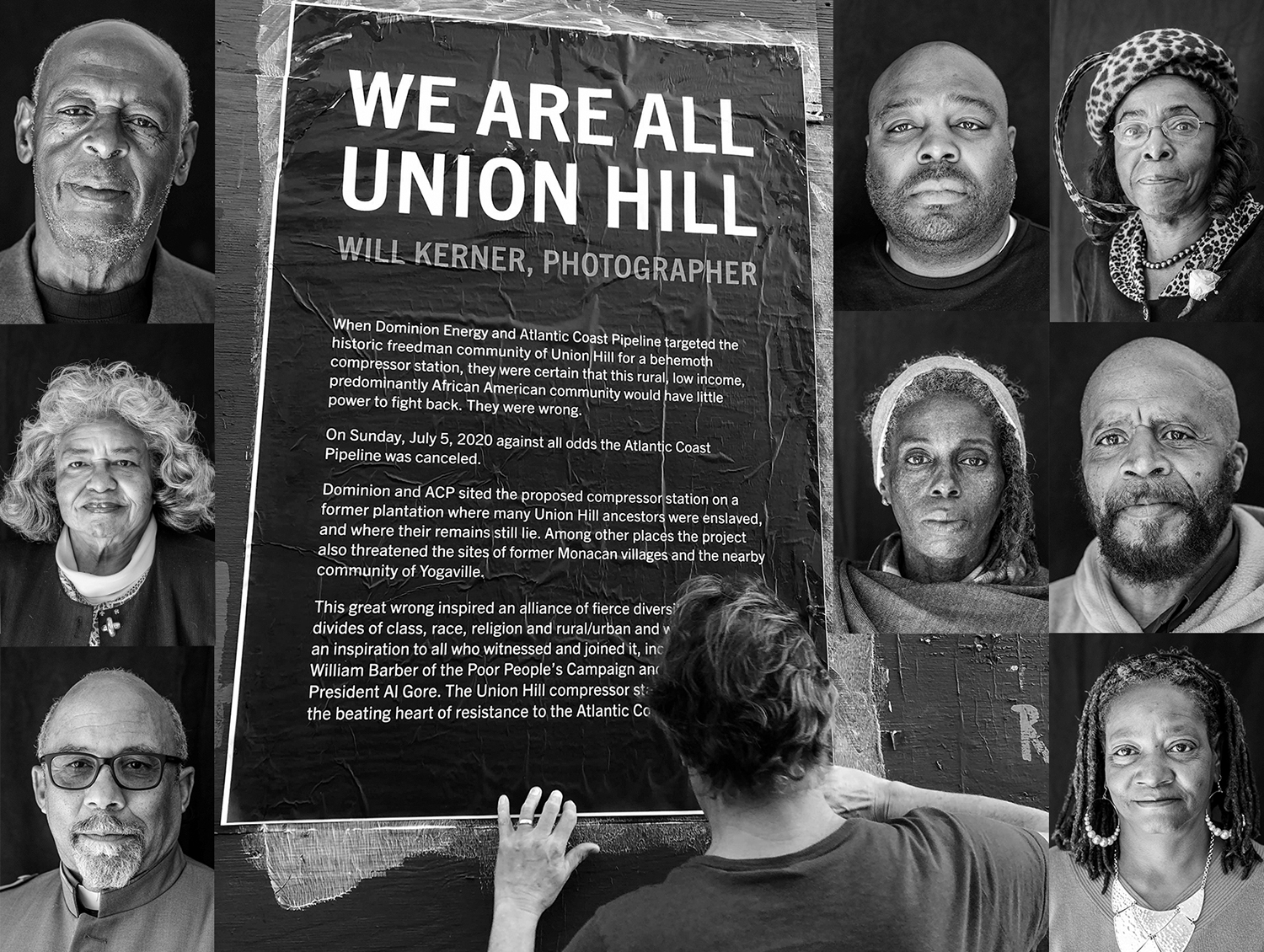
“We Are All Union Hill.” Images by Will Kerner, reproduced with permission.
In this context, they were accompanied with messages encouraging people to attend protest rallies and speak out at public hearings. One message said: “This week WE ARE ALL UNION HILL as this community and its state and nationwide allies fight for our air, our lives and for community itself as the thieves of our future try to divide and rob us” [emphasis original]. 48 WILPI and ARTV turned the images into tee-shirts and posters prominently displayed in Union Hill protests and also at multiple ACP rallies around Virginia.
The series was widely distributed in the United States as the New York Times and other prominent news outlets featured Kerner's images in their coverage of the Union Hill EJ movement. 49 Following Staeheli, 50 then, “We Are All Union Hill” put these residents “back into the public” as they literally became the faces of a movement high enough in profile that Reverend William Barber II and Vice President Al Gore spoke out against the compressor station in Union Hill on February 19, 2019.
It is unclear to what degree portraiture was responsible for bringing Union Hill to the attention of nationally-prominent activists. Clearly, the photos had a role to play in raising Union Hill's profile, or the series would not have turned up at so many protest sites, in videos posted online, and in news feeds. Our objective in this case study (as a preliminary exercise), however, is less about measuring socially engaged art's degree of affect and more about interpreting the kind of affect it produces.
To achieve this, we start with the premise that these photos were created to counter the misrecognition of African American residents in Union Hill by the petro-hegemony as part of its compressor station permitting process. As Kerner himself suggests in the wording in the photo above, “When Dominion… targeted the historic freedman community of Union Hill for a behemoth compressor station, they were certain this rural, low income, predominantly African American community would have little power to fight back. They were wrong.”
Kerner's photo project produced cartographic affect by changing the scale and terrain of struggle over the compressor station away from the hegemony's preferred state and census tract levels, toward the bodily scale of the individuals who make up Union Hill. “We Are All Union Hill” thus provided an inclusive, cognitive “remapping” of Union Hill to counter the petro-hegemon's spatially manipulated statistics that erased residents from their place in the community.
The distribution of Kerner's series, we suggest, created affective alignment with a larger, sympathetic audience far beyond Union Hill and subsequently upscaled the site of the community's struggle to the national level as well. The photos' simple, but powerful ability to provide residents recognitional justice is likely a reason the series was effective at putting public pressure on the petro-hegemony regarding the compressor station site.
This fits well with the response we received from interviewee Daniel, who, like Kerner, provides works for ARTV and WILPI. He said, “The point of our effort is not to stop the pipelines outright. We know that isn't going to happen with art alone. But we hope to get others to care and help do something about it.” 51
The second series of photographs featured in this case study is by Ash Hobson Carr, on behalf of ARTV and the WILPI coalition. It is titled “Gas Mask Future” and the photos were posted individually to WILPI's social media pages between August and October 2018. The series was posted to generate interest in attending public hearings and rallies concerning the proposed compressor station.
All posted photos were accompanied by emphatic pleas to join the protests and speak at hearings, along with dates, times, and locations; most were also accompanied by captions relating the photographic content to the threat the compressor station posed to people's health and/or the environment.
The first example is a picture of a woman and her dog in their home, wearing gas masks (Fig. 3). The caption posted with the photo reads: “This is the future Dominion plans for Buckingham County after their proposed Atlantic Coast Pipeline Pressure Station at Union Hill.” 52
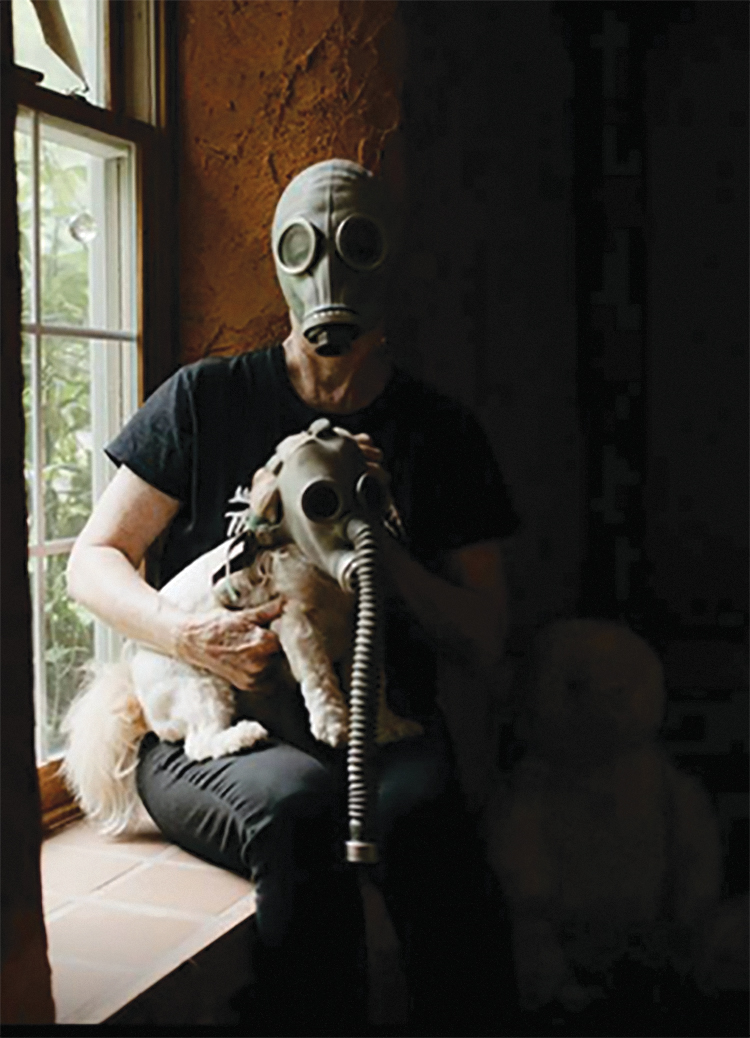
Woman and her dog wearing gas masks while at home. Photo by Ash Hobson Carr, reproduced with permission.
Another dystopian image in the series depicts a woman wearing a gas mask while tending her sunflowers (Fig. 4). The photo is accompanied by the following caption: “In the garden with a brave leader of the pipeline resistance. Say no to Dominion's plan for a gas mask future for Buckingham County…” 53 A third photo in the series (Fig. 5) shows a woman wading in the James River while wearing a gas mask. WILPI posted the following caption with it:
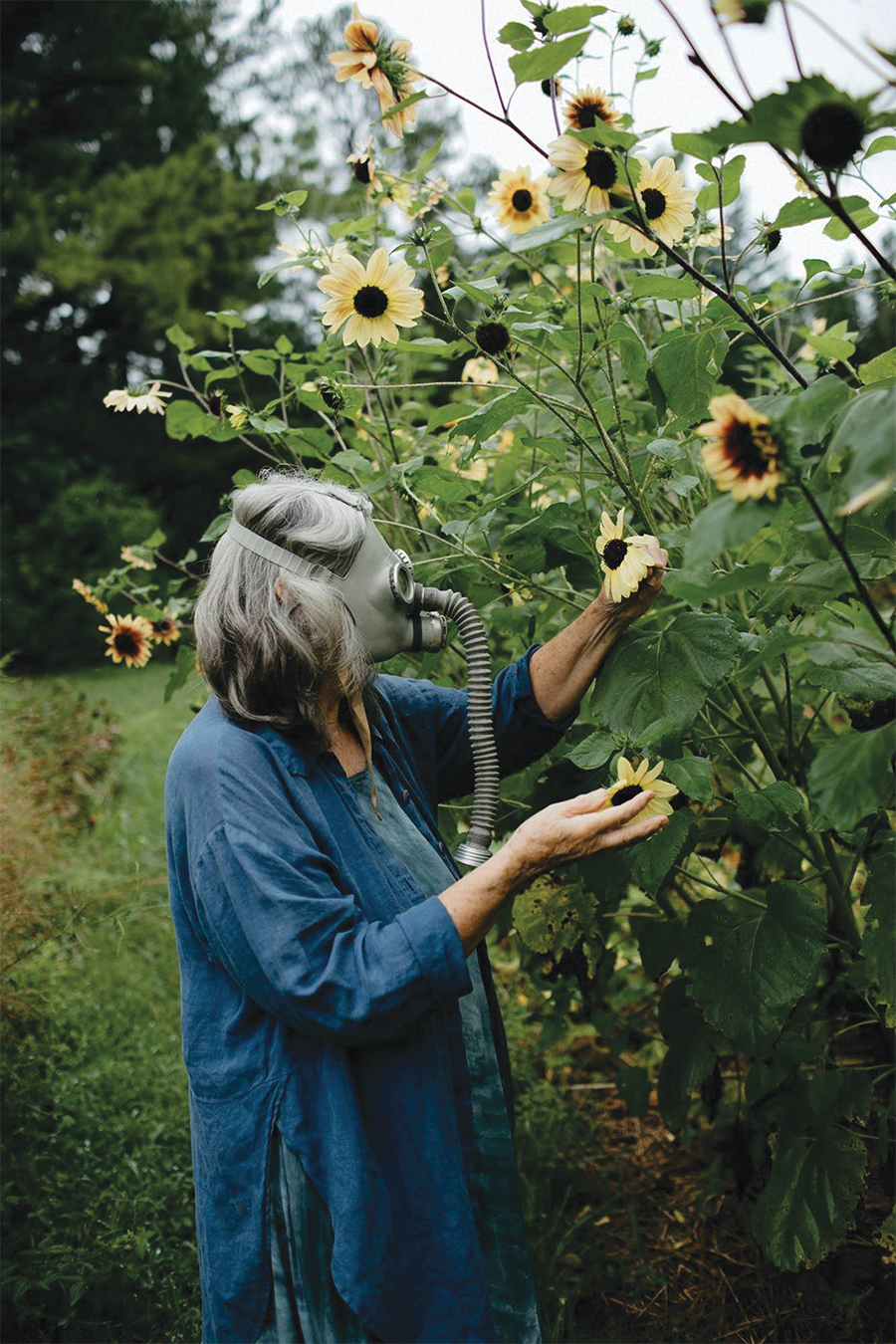
Resistance leader in her garden. Photo by Ash Hobson Carr, reproduced with permission.

Woman wearing gas mask while wading through the James River. Photo by Ash Hobson Carr, reproduced with permission.
Wading in the James River might look like this if the proposed compressor station in Buckingham County is permitted by the Air Pollution Control Board. That is, if you can still wade in these treasured waters. The ACP would drill under and threaten the James River, which supplies the drinking water to 2.7 million people. Stop them. 54
In a fourth photo (Fig. 6), a married couple stands in their cow pasture wearing masks with their cattle in the background. The caption posted along with it reads: “Stand with Union Hill today! Challenge the gas mask future Dominion has planned for Buckingham County after their proposed ACP Compressor Station.” 55 In the fifth photo of the series (Fig. 7), a man sits with his goats while wearing a mask. Finally, in the sixth photo in the series (Fig. 8), a woman stands next to a tree cut down to make way for the ACP. The caption reads:
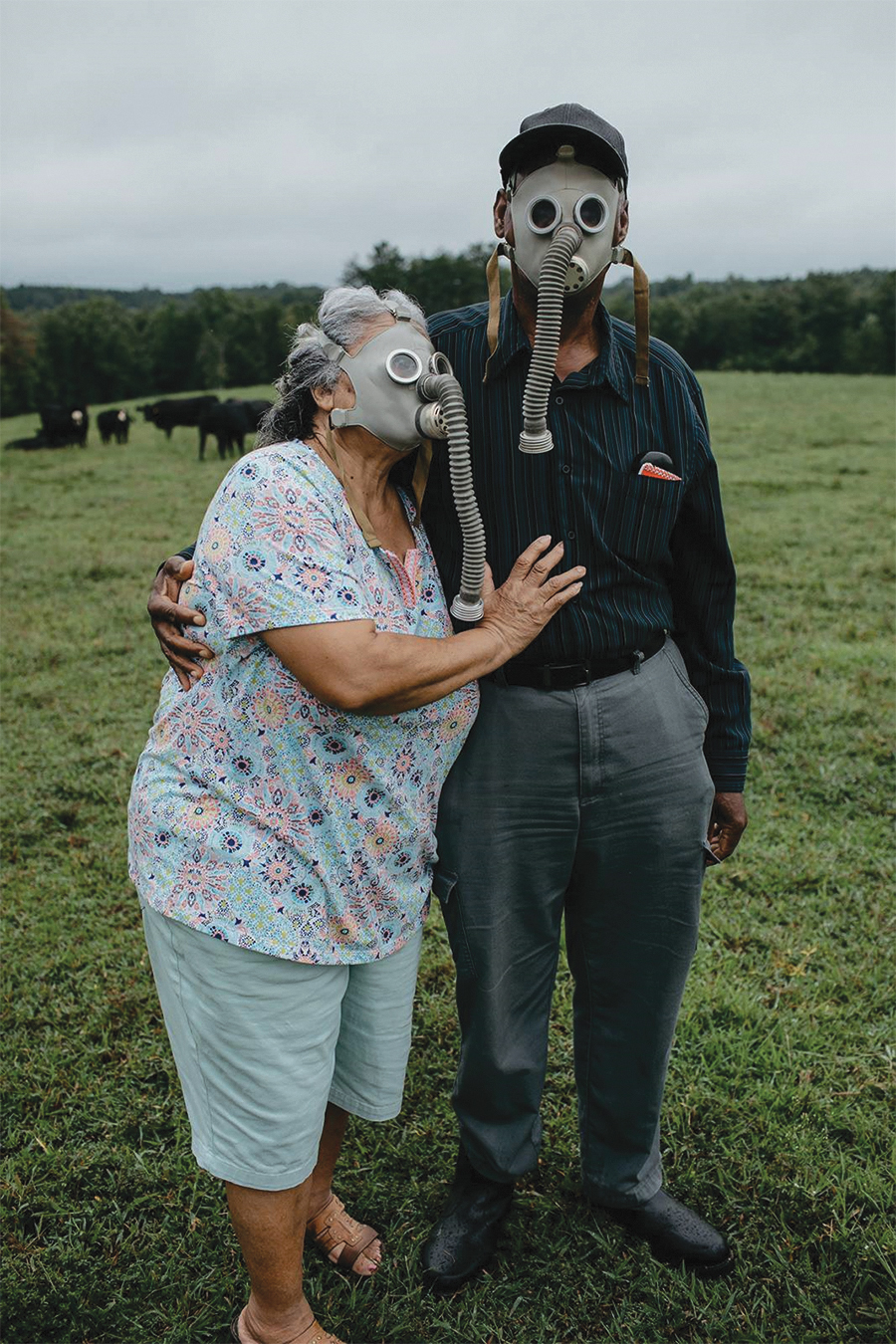
Union Hill farmers wearing gas masks in their pasture. Photo by Ash Hobson Carr, reproduced with permission.
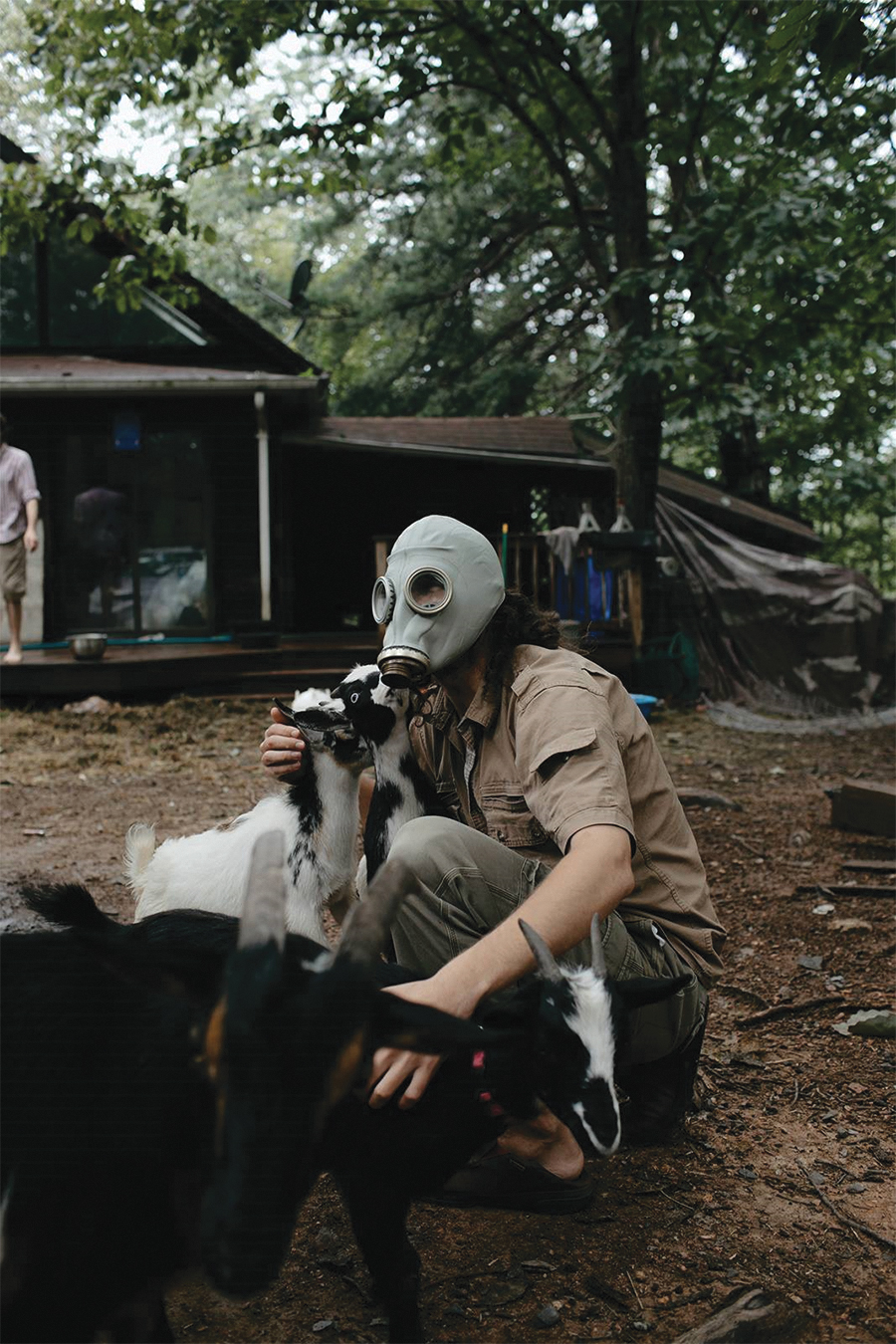
A farmer wears a mask while tending his goats. Photo by Ash Hobson Carr, reproduced with permission.

A person in mourning for the “murder” of a tree along the pipeline's path. Photo by Ash Hobson Carr, reproduced with permission.
Hundreds of trees have already been destroyed by the Atlantic Coast Pipeline and those who visit the fallen understand deeply they are witnessing a murder. Dominion plans a gas mask future for Buckingham County with the proposed ACP Compressor Station in Union Hill. Our answer is no. 56
As Johnson and Fürst suggest, masks are effective tools artists use for raising awareness among the public about the perils of air pollution 57 ; this is especially the case in the “Gas Mask Future” series given their stark contrast to the bucolic settings in which they are worn. ARTV and WILPI, as their captions indicate on social media, used the series to attempt to generate solidarity in opposition to the compressor station, and in doing so they ask consumers of their content to voice their dissidence publicly by commenting at hearings, attending rallies, and calling their representatives, among other actions.
Like the “We Are All Union Hill Series,” it is difficult to know the exact degree to which this series was successful in making the public aware of the struggle around the proposed Union Hill compressor station. 58 Instead, we again focus on the kind of affect generated by the photos with the goal of better understanding what the photos potentially accomplish in terms of affective alignment.
Like the “We Are All Union Hill” photo set, we interpret the “Gas Mask Future” series in a way that links their creativity with the production of cartographic-affect because they rescale the struggle for recognitional justice from the ambiguous and disempowering levels of the state and census tracts, per the petro-hegemony, to the level of the corporeal body. The gas masks depict existential anxiety individuals have about living near a compressor station.
One of our interviewees, Kacy, agreed to be photographed with his wife for this series (Fig. 6) because of his anticipatory justice 59 concerns in this regard. In keeping he asked, “Will the community be alerted if large amounts of pollution are released into the air or will we be evacuated? Who will be informing us about what is taking place inside the compressor station, if there is something wrong?” 60
Protesters also believe their connections to their animals, land, and environment will be severed if Dominion is successful. For example, a comment on social media responding to the picture of the woman with her sunflowers says, “My sunflower sanctuary “Living Love.” How would it survive the toxic air from a monstrous compressor station?” 61
These photos focus attention onto the personal geographies of residents and force a cognitive “remapping” of “at-risk” individuals back into the landscapes where they live, work, and play, in this case the otherwise safe spaces of their homes, gardens, farms, and rivers. Cartographic affect, by re-establishing Union Hill/Greater Buckingham County as an actual community in the public mind, attempts to forge solidarity with people elsewhere who may be sympathetic to the prospect of being forced to live under existential threat.
In this way, “Gas Mask Future” attempts to upscale the struggle over ACP as it uses the James River photo to suggest millions more people who get their water from it are put at risk by pipeline infrastructure and should therefore care. This is critical, because as interviewee Cindy stated, “I think people in general, don't have any knowledge about what is really happening. I think if they understood what it meant for people outside of their community, and really understood, they would not support the pipeline.” 62
Ultimately, however, the power of “Gas Mask Future” lies not only in generating cartographic-affective alignments beyond Greater Buckingham County, but also in generating those alignments locally. When asked about the motivation behind creating socially engaged art, Rebecca, who founded ARTV and published the “Gas Mask Future” series online, responded:
ARTivism serves as a way to bring people together, whose paths would not normally cross. The process of creating art allows people to talk, connect and envision new ideas. When resisting projects like the ACP headed by large, powerful companies like Dominion Energy… you need a strong sense of community and find a way to give people hope.
63
Laura, during our interview, also commented on her art activism in this regard:
Those kinds of folks who are willing to put their bodies [in harm's way] to protect not just their land… it's about wanting to protect their community. They are fighting to protect all of that… I admire that. For people who are just everyday people, they are just courage and heroic. It honestly made me want to do more.
64
CONCLUSION
Why, and to what ends, do people engage in creative forms of protest despite apparently long odds of success in stopping a pipeline? Interviews with individuals using creativity to protest the ACP and its compressor station in Union Hill/Greater Buckingham County indicate that motivations for their art are relatively simple and realistic: raising awareness, forging alliances, and providing hope for their community.
Content analysis of the photoseries and related materials suggests the affect generated through their creativity, however, is complex and involves cognitive (re)mapping of a community erased through spatially manipulated data. Our preliminary interpretation of the photo series using cartographic affect sees recognitional justice achieved in part through making erased residents public.
But just as importantly, cartographic affect rescales and resituates the terrain of struggle against the petro-hegemony away from the state and its reliance on the easily manipulatable census tract, to more humanized scales of individuals, their community, and their environment.
Paradoxically, reconnecting people with their local place—as both photo series do—likely creates upscaled, extended alignments of affect where people living far away can support the struggle. Recognitional success is possible because cartographic affect helps people cognitively (re)map the world.
The spatial justice implications of cartographic affect remain underexplored, however. We, thus, recommend further study regarding the geographies of socially-engaged art. There are questions that remain unanswered. For example, what are the intersectional implications of studying protest art from the perspective of cartographic affect? Neither Union Hill nor Greater Buckingham County are home to homogenous populations.
Race, ethnicity, gender, and sexual orientation are all factors that bear on affective alignment and struggles for recognition of difference, none of which are thoroughly addressed in this preliminary case study. This is important because, as the literature on art in service to protest indicates, the situatedness of creative protesters means that every new case study potentially provides new and unique insights into the pursuit of recognition. Lessons learned will not be merely academic, but could inform future EJ activisms.
Footnotes
AUTHORs' CONTRIBUTIONS
J.P.: Conceptual (equal), data curation (lead), formal analysis (equal), funding acquisition (n/a), investigation (lead), methodology (equal), project administration (equal), resources (n/a), software (supporting), supervision (supporting), validation (supporting), visualization (supporting), writing-original draft (lead), writing-review and editing (supporting). H.A.P.: Conceptual (equal), data curation (supporting), formal analysis (equal), funding acquisition (n/a), investigation (supporting), methodology (equal), project administration (equal), resources (n/a), software (lead), supervision (lead), validation (lead), visualization (lead), writing-original draft (supporting), writing-review and editing (lead)
AUTHOR DISCLOSURE STATEMENT
No competing financial interests exist.
FUNDING INFORMATION
No funding was received for this article.
Appendix A1.Interview Protocol Sample Questions
(This protocol tailored for each interviewee as appropriate, and as new data emerge throughout the interview and observation process).