






Abstract
“Justice 40” Executive Order 14008 is a whole-of-government initiative that commits that at least 40% of overall benefits of the federal climate and infrastructure investments are realized by communities that experience disproportionate environmental burdens. Engineering research and practice will both be essential to realizing Justice 40 by identifying infrastructure problems, improving designs, conducting novel studies, and developing new technologies, with the collective goal to provide environmental safety to the public. While engineering can be effective in assessing and improving infrastructure in general, however, not only are traditional engineering theories of change ineffective at addressing fundamental inequities, but also many aspects result in the further perpetuation of environmental injustice. In addition, there exists no cross-sector structural template from which to connect, design, execute, and evaluate engineering infrastructure research and practice through an environmental justice (EJ) framework. In the absence of such a connective template, different sectors continue to conduct engineering efforts under traditional sector-specific paradigms or theories on how to effect change. The work herein presents a cross-sector theory of change framework, or a working structure for how to adopt and systematically integrate EJ principles into engineering research and practice processes to advance EJ. We assess common theories of change practised in the market-based sector, philanthropy, academia, government, and community-based sector and provide analysis, critique, and recommendations as to how engineering research and practice processes can be improved to equitably realize “Justice 40.”
INTRODUCTION
The American Society of Civil Engineering has given the United States' infrastructure a “C-” grade, indicating the need for significant investment in many categories. Forty-three percent of public roadways are in poor or mediocre condition, ∼20% of the country relies on inadequate septic tanks, 45% of Americans have no access to transit, and 60% of all non-federal Superfund hazardous waste sites are in locations prone to flooding. 1 Marginalized status in society and dominance hierarchies are significant precursors for the burden of environmental injustices faced, disproportionately by communities that are low-wealth, indigenous, and of color. 2 , 3 , 4 , 5
Manifestations include, but are not limited to, unequal access to safe drinking water, safe sanitation, recreation facilities, healthy food, clean air, and other environmental necessities, often a result of landfills, industrial manufacturers, air pollution, and other environmental hazards. 6 This includes planning, mapping, and zoning that fail to include historic Black and Indigenous communities, places of worship, and burial grounds.
Changing climate patterns of rising sea levels, floods, droughts, and other extreme events stress already compromised infrastructure and exacerbate vulnerabilities and failures that disenfranchised communities experience. 7 , 8 , 9 , 10
The federal government understands the vital need for infrastructure investments and environmental justice (EJ) approaches. “Justice 40” Executive Order 14008 is a whole-of-government initiative that commits that at least 40% of overall benefits of federal climate and infrastructure investments are realized by communities that experience disproportionate environmental burdens.
However, there exists no tool to design, execute, and evaluate engineering infrastructure efforts through an EJ framework. Equitable outcomes to Justice 40 will not be realized if there are failures to address oversight, compliance, enforcement, and corrective actions under Title VI of the Civil Rights Act-1964 (legal foundation for EJ) at all government levels. As written, Justice 40 leaves measurable outcomes to cities, counties, and states that openly acknowledge barriers to justice for people of color, where engineering, planning, mapping, and zoning support permanent physical and social barriers to public and environmental health.
Here, we propose a theory of change framework to provide insight and guidance to engineering-related disciplines, sectors, and organizations that work to realize Justice 40. Theory of change is a methodology used to develop a strategy, action plan, and evaluation framework to realize social change. It is a backwards-design process that identifies a desired impact and maps out step-by-step causal events in reverse order (impact, outcomes, outputs, activities, and inputs) as to how that outcome will be achieved.
This manuscript suggests that centering an EJ-based theory of change can significantly improve the traditional paradigms of how engineering research and practice engage to address environmental injustices. The manuscript starts by providing context to various root causes of inequities followed by a description of essential EJ principle-based factors, and a presentation of some EJ-based tools. We then illustrate how the theory of change framework can be used to systematically integrate EJ-based elements to improve engineering research and practice.
The manuscript concludes by providing context as to how traditional theories of change manifest among different engineering sectors; we illustrate a theoretical strategy that integrates all engineering sectors while centering EJ principles; we provide a supporting case study; and then, we conclude with key takeaways.
ROOT PROBLEM IDENTIFICATION
Before engineering solutions can be offered for how to address environmental inequities, there must first not only be an accurate definition of the inequities themselves, but also strong understanding of the root causes of the inequities. 11 , 12 Understanding how and where engineering can have adverse impacts does not require degrees from academic institutions.
As impacted communities are experts of their own context, they are best equipped to define what problems they experience. Universal access to safe and affordable infrastructure (i.e., equality) will never be realized without intentionally prioritizing resource allocation to improve life for those most disenfranchised (i.e., equity). Similarly, liberation from inequities (i.e., EJ) will never be realized without a thorough understanding of the institutional systems of oppression that create, perpetuate, and exacerbate those inequities (i.e., the causes of injustice). Of the many that exist, we present three examples of systemic root issues that contribute to environmental inequities.
Racial discrimination
Communities of color are intentionally denied safe, sustainable, and resilient drinking water and sewer infrastructure installation as a result of institutionalized racial discrimination. 13 , 14 Many municipalities have established their zoning and extraterritorial jurisdiction (ETJ) boundaries to intentionally exclude racially minoritized communities from their city limits, denying them basic municipal services. Racial discrimination is such a strong driving force of environmental injustices that nationally race has been, 15 and continues to be, the strongest predictor of which communities have access to affordable safe and drinking water and sanitation. 16
Colonization and neo-colonization
Globally, environmental injustices can be directly linked to colonization. For example, the duration of the extractive colonial era for any given African country accounts for to up to 34% of the variability in the percentage of the urban population with access to improved water and sanitation, consistent despite identity variability of the colonizing nations. 17
Further, despite having the resources to significantly improve environmental conditions in their previous colonies, countries including Britain, France, the United States, Spain, Portugal, and the Netherlands continue to economically reap colonial benefits while their corresponding colonial countries such as India, Haiti, the Philippines, Guatemala, Angola, and Indonesia, respectively, continue to bear the burden of widespread poverty and environmental injustice. Effects of colonization must be accounted for to address environmental inequities.
Capitalism
Domestically, the top 1% have extracted over $50 trillion from the bottom 90%. 18 Globally, despite trillions going to the global south via forms of foreign aid, investment, and income, since 1980, there has been a total net flow of $16.3 trillion flowing from the global south to the global north every year. 19 Capitalism's massive wealth extraction through inequitable corporate trade deals, tax havens, for-profit corporate social responsibility, and other mechanisms significantly exacerbate environmental injustice. 20 , 21 , 22 , 23 Eco-socialist theory attributes economic exploitation and the profit incentives of capitalism to be the predominant drivers of environmental injustice. 24
THE ROLE OF ENGINEERING
The first Fundamental Canon of Engineering, according to the National Society of Professional Engineers, is to “Hold paramount the safety, health, and welfare of the public.” This implies the entirety of the public, including communities who are overburdened by environmental and infrastructure inequities. Engineering disciplines, whether through education, employment, interaction with marginalized communities, or application of construction, have a professional obligation to adequately address systemic root causes and exacerbators of injustice to ensure the safety, health, and welfare of the entire public. 25
However, inequities from root causes of environmental inequities are not only perpetuated by engineering disciplines, but can also be further exacerbated through its traditional processes. 26 , 27 Similar to how environmental injustices result from racial discrimination, engineering research and practice traditionally excludes racial minorities from participation in its processes. 28 Similar to how environmental injustices result from colonization, research can extract and exploit information and expertise from community members and take credit for it. 29
Similar to how environmental injustices result from capitalism, the engineering research industrial complex is capitalistic in nature and prioritizes quantity over quality, speed over thoroughness, efficiency over effectiveness, knowledge production over action-based positive tangible impact to communities, and intentionally distances itself from involvement in activism. 30 , 31 , 32 Engineering reform literature affirms that research and practice processes must improve to better address systemic environmental inequities and societal culture is shifting to expect more equity from technological systems and practices. 33 , 34 , 35 , 36 , 37 , 38 , 39 , 40
These processes can be improved by widening the scope of problem-solving to include three key elements: specific components of equity, corrective actions/execution tools, and a framework to conceptualize and integrate EJ principles. Here, examples of each of these key elements are presented.
EQUITY FACTORS TO INTEGRATE
Trusting relationship
A relationship that is built on mutual understanding, reciprocity, and trust should be the foundation of all EJ-related efforts. 41 , 42 It is only possible for engineering researchers or practitioners to be invited in to collaborate in a true service capacity of community-led initiatives if an authentic relationship is first established with the community.
Diversity
Engineering teams and decision makers from all sectors should be diverse with respect to wealth, race, ethnicity, gender, and more, and should reflect the demographic identities of the communities that they work with. 43 Engineering team and leadership diversity should be applicable, but not limited, to all infrastructure planning and design, construction implementation, research and development, government EJ advisory committees, technology innovation, and more.
Inclusion
According to the U.S. Environmental Protection Agency (EPA), “[Environmental Justice] will be achieved when everyone enjoys the same degree of protection from environmental and health hazards and equal access to the decision-making process to have a healthy environment in which to live, learn, and work.” 44 Engineering research must be community-inclusive, meaningful, actionable, and have continuous participatory processes. 45
“Responsible parties” should include paid contractors and subcontractors who design, procure, and construct infrastructure as well as government offices and planning boards that produce mapping and zoning that determine the inclusion or exclusion of communities from installation of basic public health amenities.
Equity and capacity building
Engineering efforts must allocate resources to communities proportionate to what they need. Co-creating and sharing information, resources, and power with impacted communities is vital to building their capacity to rectify environmental injustices. 46 To build community capacity, engineers should allocate project funds to compensate for community labor and expertise, provide access to analysis tools, assist with education campaigns, help communities write their own grants for funding, etc.
Self-determination
Communities should have agency to define their narratives, identify their experienced problems, prioritize their needs, self-determine appropriate solutions, and be able to lead, manage, and facilitate any engineering initiative pertaining to them. Communities must be presented with all necessary information and implications of engineering efforts to be able to provide thorough informed consent regarding decisions that affect them.
Transparency and accountability
There should also be opportunities for frequent community feedback, input, and project course correction throughout any process of research, development, design, planning, or implementation of engineered infrastructure. Accountability mechanisms must also exist to ensure process satisfaction.
Acknowledgement and funding parity
There should be appropriate acknowledgment of expertise and contribution to solutions. Communities deserve authorship on all written documents and equitable compensation for their expert labor and consultation in helping to fulfill the government's responsibility of ensuring EJ. Engineering program management should acknowledge communities as expert consultants and should compensate them accordingly.
Regulation and warranty
There must be regulatory compliance and assurance that communities have appropriate, functioning engineering infrastructure. Warranties and guarantees are needed such that if infrastructure is performing inadequately, systems can be quickly remedied.
Reparations
The 17 Principles of Environmental Justice, drafted at the First National People of Color Environmental Leadership Summit, states: “Victims of environmental injustice [should] receive full compensation and reparations for damages.” 47 Reparations are needed and resources must be redistributed to those whose resources were taken away or denied. This includes restitution, damage compensation, rehabilitation, satisfaction, and guarantees of non-repetition. This is applicable to all contributions to injustice, including engineering research and practice.
ENGINEERING RESEARCH AND PRACTICE EXECUTION TOOLS
Community Owned and Managed Research and Memorandum of Understanding and Memorandum of Agreement
It is vital that communities are centered at the forefront of engineering processes. The West End Revitalization Association (WERA) of Mebane, NC (Alamance County and Orange County) has established The Community Owned and Managed Research (COMR) Model, which includes pillars of funding equity, management parity, science for compliance, legal leverage for corrective actions, compliance and enforcement using research results, and more. 48
This framework creates transparency and accountability to address inequitable power dynamics between collaborating parties. It is considered to be the best-practice gold standard by the National Institute of Environmental Health Sciences for how to conduct EJ research with communities. COMR has been successfully integrated into state and federal policy and legislation and should serve as a standard rubric as to how Justice 40 should be conducted.
The national Citizen Science Association's board recently adopted the WERA Model's core MOU/MOA (Memorandum of Understanding and Memorandum of Agreement) to protect “community science” data and fosters measurable outcomes at ground level (Appendix A1). Similar to a research context, WERA's COMR model and MOU/MOA can be adapted and used to integrate fundamental mechanisms of transparency and accountability and facilitate collaborative efforts in engineering practice.
Training
Engineers' interest to engage in EJ research and practice does not mean that they are adequately trained or have the skills required to do so. Conducting equitable EJ work requires holistic, multi-dimensional, interdisciplinary approaches that are very different from paradigms of how engineers are traditionally trained. Pro-social and translational engineering is necessary for grassroots organizations representing the interests of adversely impacted communities. 49 , 50 , 51
All sectors should co-develop workshops and modules with communities to train engineers how to holistically design, execute, and evaluate infrastructure research and practice with cultural, economic, and communal humility. For example, the Center for Diverse Leadership in Science asks graduate students who are working with tribal communities to take coursework from UCLA's American Indian Studies Center and participate in workshops.
Evaluation and stakeholder analysis
Equity-based evaluation is needed to ensure that no harm is caused and to effectively build community capacity to combat injustices. 52 , 53 Communities should be centered in how engineering research and practice are evaluated, regardless of sector. All key factors discussed in the previous section should be converted into metrics and used to evaluate engineering efforts with respect to funding parity, level of community ownership and management, feelings of inclusivity, levels of transparency and accountability, effectiveness to address environmental injustice, and more.
A comprehensive comparative benefit analysis should be performed for all stakeholders to evaluate whether the processes and outcomes of the engineering work were equitable. 54 Supplemental stakeholder benefit analysis and evaluation questions can be found in the Appendix A1. Institutional standards of what defines successful engineering research and practice need to evolve to incorporate these crucial aspects.
EJ-based engineering paradigm
The theory of change framework can be used as a novel way to structure, contextualize, and organize systemic root issue problem identification, equity components, and execution tools to improve engineering research and practice processes. In Table 1, we break down each theory of change component and provide an example of what a traditional engineering paradigm looks like.
Theory of Change as a Framework to Incorporate Environmental Justice Principles into Engineering Research and Practice
Note: aRoot problem identification.
Equity factors to integrate.
Execution tools.
General engineering processes.
COMR, Community Owned and Managed Research; MOU/MOA, Memorandum of Understanding and Memorandum of Agreement.
We then provide a contrasting example of what an improved EJ-based engineering paradigm looks like after incorporating elements of EJ principles, suggestions from engineering reform literature, and contributions from this manuscript. Table 1 also contains elaborations on how centering EJ principles for each process step is an important improvement to traditional engineering paradigms. We offer the idea of “Theory of Change” as a new mechanism for scholars, practitioners, and collaborators of engineering professions to use as a tool and template to better align project efforts to EJ principles.
THEORIES OF CHANGE BY ENGINEERING SECTOR
Researchers have called for systemic comparisons between the private sector, academia, philanthropy, government, and community-based organizations in how each sector exercises fundamental differences in approaches to environmental injustices engagement. 55 Each sector has different institutional goals, and have developed theories of change that align with their institutional incentive structures. We present the following theories of change traditionally used to conduct engineering research and practice in different sectors.
Market-based sector
The private sector can be defined as for-profit entities that are not owned or operated by the government. A common theory of change of engineering efforts in the market-based sector is to develop engineering products or services to maximize profit or to invest in research to better understand needs for potential target markets to profit. An example is construction engineering companies using materials that are not the most robust or sustainable but are the most profitable to use. In addition to decreasing operational costs, there are also incentives to lobby in favor of decreasing regulations and allowancing further optimization of profitability. 56
Local governments also issue permits that allow for profit private corporations to mine construction resources (granite, steel, soil, etc.) near communities of color and then dump construction waste in these same communities where they deny access to first-time infrastructure installation. 57 , 58 , 59 Corporate lobbying also colludes to award contracts that install old engineering technology not adequate to address climate challenges such as rising water tables, extreme weather events, and other problems of today and the future. 60
The private sector often does not effectively combat the systemic roots of environmental injustices, as it incentivizes profits over the health, safety, and well-being of people. Even corporate social responsibility initiatives, under the guise of charitable acts, are heavily calculated strategic acts of relatively small investments to ultimately net larger returns as a result. 61
Philanthropic sector
Philanthropies or foundations are non-government organizations that operate using donated assets that are managed by the organizations. These entities aim at improving the well-being of humankind by addressing societal problems, as defined and prioritized by the philanthropy or foundation. A common theory of change is to invest in engineering initiatives to fill governmental and corporate funding gaps.
For example, the Gates Foundation's “Reinvent the Toilet Challenge” funds innovative engineered on-site treatment and reuse technologies to be privatized in establishing for-profit start-up sanitation companies (that may not be approved and permitted by most local governments, especially former slave holding states). 62 Private philanthropies and foundations have incentives to inflate the social change implications of their investments to garner more guilt-alleviating donations, an effective mechanism for tax mitigation. 63
Despite having aims to address public issues, most philanthropies are private, act in their own self-interest of accumulating even more economic, social, and political capital, and do not have thorough mechanisms to be held accountable by the communities they engage with. 64 As engineered infrastructure is for the public good, the philanthropic sector needs more regulation and accountability for engineering efforts that affect the public.
Government sector
Government is the political and legal authority that controls the actions and affairs of a society. The government sector determines the priorities of its constituent body and allocates resources to support societal needs. A common theory of change is allocating funds into external sectors and within itself, in the form of internal departments, agencies, institutes, and sub-government units. An example is federally allocating funds to the Department of Transportation, which then develops and awards grants to an academic research group, a private asphalt corporation, or a State Department of Transportation to research and develop infrastructure technologies.
The executive and legislative branches of our government sector have incentives to serve its constituents to the extent to which voters will maintain political parties' positions of authority. However, it is worth noting that government priorities, and thus governmental engineering efforts, can significantly and swiftly change, as a result of its leadership changing with election cycles.
The “theory of change” is greatly challenged and impaired when it comes to super-conservative state general assemblies and congressional representation in Washington, DC. 65 , 66 , 67 The power of planning, mapping, zoning, and permitting construction still lies with local and state governments that will receive Justice 40 money and billions in new federal infrastructure appropriations.
This provides a gateway that may not use government resources to mitigate the long history of denying infrastructure installation and improvements where Black, Indigenous, Latinx, and other people of color struggle for a better quality of life. 68 , 69 Because of administration changes, lack of inter-agency coordination, and the nature of outsourcing both engineering research and practice among other sectors, there is significant variability in how equitable government initiatives are as a result. 70
Academic sector
Academia is considered to be institutes of higher education and research, with primary goals of knowledge production through research and degree conferment through teaching. A common theory of change is to generate knowledge, publish findings, and disseminate information with the expectation that other parties use their generated knowledge to effect change.
Academia has incentives to create innovative technologies, to sell or license intellectual property to other sectors, often for profit. 71 When this is not profitable through other sectors, knowledge generated from research serves as a product in and of itself, in the form of published manuscripts. 72 The academic research industrial complex is capitalistic in nature and incentivizes a high quantity of research production. 73
There are disincentives to develop and execute action plans around discovery research, because this does not yield a high return on investment under its capitalistic publish-or-perish operation model. 74 Significant measures are usually not taken to redistribute power, influence, or resources to communities and results in academia benefiting disproportionately more than impacted communities.
As academic culture values individual productivity and differentiation from competing colleagues, there are incentives to extract novel information and resources from disenfranchised communities and take credit for produced works. It is common to use federal grant funds to study the pain and suffering of Black, Indigenous, and Latinx communities for the benefits of student degrees and faculty advancement, without making efforts to correct the disparities that they research, in some cases in their own backyards. 75
Such research is often conducted by majority groups and outsiders, who operate under a model of disempowerment and benefit from exploitative research practices. This is magnified when academic initiatives are funded by other entities, such as the private sector, and further operate under a capitalistic paradigm. The significant lack of diversity in academia upholds and perpetuates exploitative practices of marginalized groups, which further hinders progress in environmental and social justice efforts.
Community-based sector
Non-profit community-based organizations are usually developed by communities seeking to improve well-being and functioning, without seeking a profit. These entities strive to build the capacity of communities to increase economic stability, health, safety, education, etc. A common theory of change is to leverage and center community knowledge, resources, influence, and leadership to explore their own research questions to drive community-driven solutions.
For example, the North Carolina Environmental Justice Network uplifts community voices, experiences, expertise, and ingenuity to advance advocacy, investment, and equity in achieving safe and affordable infrastructure for disenfranchised communities. These entities have incentives to empower and uplift a community's capacity to improve collective well-being and have disincentives to adopt paradigms that decrease a community's capacity to thrive.
However, leadership at non-profits does not always represent the demographic that they claim to support and hinders the effectiveness of non-profit efforts. The lack of diversity in this sector also perpetuates the “savior complex” motivations to realize self-fulfilling or guilt-alleviating efforts. While it is not uncommon for this sector to incorporates principles of inclusion, diversity, equity, and reparations into their theory of change, they often systemically lack adequate economic, social, and political capital to effect change on a large scale.
Funding for infrastructure upgrades or first-time installations often go directly to local governments, which pay contractors for construction for public infrastructure, as directed by government planners, without investing in community-based organizations as a part of the process. A lack of community investment is often a result of local governments and city planning boards not reflecting the diversity of the communities they serve. Investments from other sectors, in the form of donations, grants, etc., into community-based organizations to support their missions, could be a mechanism that increases effectiveness to combat environmental injustice.
EQUITABLE INTEGRATION OF ALL ENGINEERING SECTORS
While there is complexity and variability among engineering labor sectors, involved in independent or collaborative efforts, they must all operationalize EJ frameworks that incorporate equity factors and generate equitable solutions. 76 If the government has allowed for environmental injustice to manifest, it is responsible for taking active roles to rectify those injustices.
In its responsibilities to define problems, appropriate solutions, and appropriate strategies and action plans, government entities should build the capacity of communities and community-based organizations to co-determine these items. Communities need to drive each process and have the information, resources, and power to do so. If a community is not driving each process, then it should only be because the community chose not to.
Equitable integration, having power and capacity, and the space to lead efforts are essential components of needed reparations and allow for self-determination. Memoranda of agreement, third-party facilitators, established expectations and retribution, for example, can incorporate transparency and accountability into processes and lead to more equitable outcomes.
Only after communities define the problems and develop overall strategic plans of action should outside entities be invited as collaborators. These partners could then help refine a more contextually appropriate plan of action, which still fits the community's overall strategy. For example, if it is co-determined that infrastructure needs to be developed and the private sector has the capacity to fulfill such a task more effectively and efficiently than other sectors, then it could be appropriate to solicit the private sector for novel infrastructure design, procurement, and construction.
If it is co-determined that more information is needed to better understand problems that communities face, then it might be appropriate to solicit the academic sector to conduct research that aligns with the community's needs and recognizes their contributions with authorship and funding parity. If there is a funding gap that is identified within available government resources that result in the inadequate support of solutions that were co-determined by communities, then philanthropy could be useful in this context.
Regardless of sector, communities need to be an integral part of the diverse leadership of every initiative, partnership, and collaboration. The following section presents a case study that illustrates how equitable integration of all engineering sectors can play out in practice (Fig. 1).
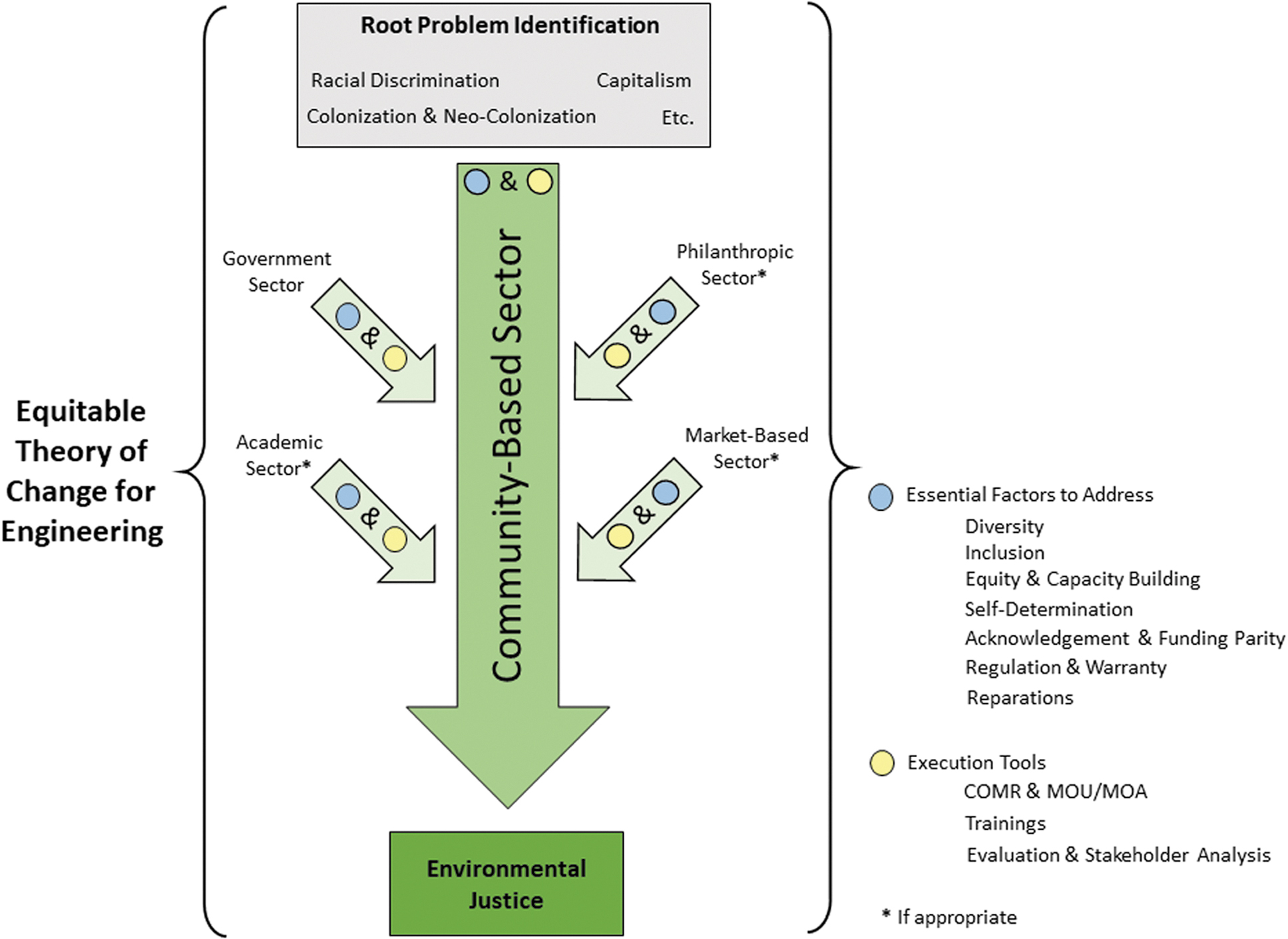
An illustration of an equitable theory of change paradigm with integration across all engineering sectors.
Case study: the Center for Rural Enterprise & Environmental Justice
The Center for Rural Enterprise & Environmental Justice (CREEJ) is a national community-based, non-profit organization based in Alabama. CREEJ was established to increase the capacity of communities to advocate, organize, strategize, and mobilize to realize EJ. Among CREEJ's goals is making sure marginalized communities have access to safe, affordable, and reliable sanitation, thereby addressing the negative effects of systemic root issues such as racial discrimination and capitalism.
A CREEJ-government partnership worked successfully to determine the problems and the root issues at play, to define desirable outcomes, to map available resources and constraints, and to prepare a strategic plan of action. With community leaders and the academic sector, CREEJ co-conducted a scientific study with engineers about the prevalence and magnitude of exposure to biohazards from untreated wastewater that aligned with community goals and adequately credits community members with authorship and funding parity.
While policy was being drafted to expand governmental resources, CREEJ partnered with the philanthropic MacAurthur Foundation to increase their capacity to raise awareness and disseminate information to the public. They supplement governmental funding for engineered sanitation solutions and provide CREEJ access to new resources and networks. CREEJ is also currently exploring appropriate collaborations with entities in the engineering private sector to develop innovative treatment systems and technologies that contextually address the engineering infrastructure needs of their community.
Each collaborative effort was community-led and integrated mechanisms of transparency and accountability. Under an EJ framework, all sectors of government, community-based organizations, academia, philanthropy, and private sector effectively engaged to address environmental injustice while incorporating fundamental aspects of trusting relationships, diversity, inclusion, equity, self-determination, acknowledgment and funding parity, transparency and accountability, regulation, warranty, capacity building, and reparations.
CONCLUSION
Engineering research and practice can be powerful tools to address infrastructure issues. However, these tools must be utilized in an equitable manner for them to be effective to address environmental injustices. While Justice 40 is a step in the right direction, the federal initiative needs to ensure that engineering sectors do not further exacerbate inequities and will operate under an EJ framework. Communities are the experts of their own context.
They should have the agency to choose to lead every step of engineering research or practice processes that are equitable in nature, effective in addressing the community-defined questions of exploration, and actionable to build the capacity of communities in their efforts to advance EJ. Theories of change, regardless of sector, should be co-assessed by the government and impacted communities to determine what initiatives, programs, and projects are deemed worthy of receiving Justice 40 funds. Even Justice 40 itself should be evaluated.
The concept of only allocating 40% of funds to combat environmental injustices, without guarantees that the other 60% majority investment will not perpetuate or exacerbate inequities, is in itself inequitable. Root issues of racism, colonialism, capitalism, and more must be adequately addressed and fundamental aspects of trusting relationships, diversity, inclusion, equity, self-determination, acknowledgment and funding parity, transparency and accountability, regulation and warranty, capacity building, evaluation, and reparations must be incorporated into engineering theories of change. Only then will engineering research and practice be effective at advancing EJ.
Footnotes
AUTHORs' CONTRIBUTIONS
B.H.: conceptualization, data curation, formal analysis, funding acquisition, investigation, methodology, project administration, resources, software, supervision, validation, visualization, writing—original draft preparation, and writing—review and editing; A.T.: conceptualization, data curation, formal analysis, funding acquisition, investigation, methodology, project administration, resources, validation, visualization, and writing—review and editing; C.C.F.: conceptualization, data curation, formal analysis, funding acquisition, investigation, methodology, resources, validation, and writing—review and editing; O.W.: data curation, formal analysis, investigation, methodology, resources, validation, and writing—review and editing; and B.W.: data curation, formal analysis, investigation, methodology, resources, validation, and writing—review and editing.
AUTHOR DISCLOSURE STATEMENT
No competing financial interests exist.
FUNDING INFORMATION
This article has been funded by the National Science Foundation Graduate Research Fellowship Program, Center for Diverse Leadership in Science, Center for Rural Enterprise & Environmental Justice.