






Abstract
Background:
People and wildlife can both be the subjects of environmental injustice. Although their experiences are clearly not the same, shared logics of oppression often impose harms through the environment on vulnerable and marginalized people and free-living nonhuman animals. Critical environmental justice provides a matrix for analyzing and addressing arrangements of power across categories of difference, whereas human ecology approaches offer frameworks for analyzing interactions across human and environmental systems in urban contexts. We develop a new analytical model—critical population, organization, environment, technology (POET)—to strengthen approaches to studying human–environmental problems by integrating the four pillars of critical environmental justice with the four dimensions of the human ecology POET model.
Methods:
This article uses a case study approach of coyotes living in urban areas to demonstrate one use of the critical POET model to analyze linkages between injustices across humans, wildlife, and the environment.
Results:
Urbanization as a core spatial logic—through the twin forces of institutional racism and speciesism—has perpetrated harms against people of color and coyotes.
Discussion:
Identifying shared logics of oppression is a key step toward the realization of a robust multispecies approach to environmental justice.
Conclusion:
The critical POET model provides a matrix for analyzing interactions and relationships that produce and maintain social and environmental injustices for historically and contemporarily marginalized groups, both human and nonhuman.
ENVIRONMENTAL JUSTICE FOR ALL SPECIES
Living with wildlife, though frequently understood as important to animal conservation from growing threats posed by humans, is less often understood as a matter of justice. Although environmental justice research and activism have long focused on the unequal distribution of environmental harms that are concentrated in low-income communities and communities of color, 1 , 2 , 3 only more recently have scholars begun to call for multispecies justice—an extension of justice frameworks to nonhuman animals. 4 , 5 At the same time, critical environmental justice theories have argued for the necessity of systemic changes by linking together environmental justice with racial capitalism, abolitionist scholarship, and scholar activist approaches to advance environmental justice in vulnerable human communities. 6 , 7
Critical environmental justice, then, offers a powerful theoretical framework for identifying the ways in which systems uphold and perpetuate environmental and social oppressions. Thus, linking multispecies justice with a critical environmental justice framework is one way to advance both fields of study by expanding categories of difference requiring multiscalar approaches to show the indispensability of both marginalized peoples and other species. Although recent advances in environmental justice have made admirable strides in recognizing the linkages between human and animal oppression, more work is needed to understand the embeddedness of human–ecological interdependencies.
Here we link these new theories of justice with earlier theories in human ecology, which were groundbreaking for their time, but have since been subject to criticism for inattention to issues of justice. In particular, we link human ecology's population, organization, environment, technology (POET) model 8 , 9 for analyzing human–environment relations with critical environmental justice to articulate a “critical POET” model that draws from the strengths of each approach.
THEORETICAL FRAMEWORKS
In his study developing critical environmental justice, David Pellow articulates its four pillars to move beyond additive kinds of inquiry toward intersectional analysis of injustices by expanding categories of difference, engaging in multiscalar approaches, identifying institutional inequality, and promoting indispensability—which further our understanding of and ability to address the systems that perpetuate socioenvironmental oppression. 10 , 11 , 12 , 13 In brief, expanding categories of difference provides a wider view of intersectional and transversal processes that create and maintain oppression.
Multiscalar approaches similarly widen our frames for seeing, analyzing, and addressing oppressions that are neither constrained nor contained by space and time. Although a longstanding question of environmental justice research and activism regards whether institutional reform or transformation is necessary to achieve environmental justice, critical environmental justice points toward the need for social and environmental transformation to secure environmental justice for disproportionately impacted communities.
Finally, historically marginalized and excluded peoples, their communities, and communities of other species have been treated as dispensable, as have the lands they live, work, and play on. To rectify environmental injustice, these same communities must be understood as indispensable to society and treated as such.
Environmental justice research has also begun to pay attention to questions of justice beyond our species, building on longstanding traditions and ideas in Indigenous communities. 14 For example, multispecies justice has emerged to expand notions and boundaries of the subject of justice with an initial focus on recognition justice. 15 , 16 Recognition justice “requires that policies and programs must meet the standard of fairly considering and representing the cultures, values, and situations of all affected parties.” 17
In the case of nonhuman animals, recognition justice would require that policymakers give greater consideration to the “situations” of more than human populations. Building on research in animal studies that explores human–wildlife relationships in urban spaces, 18 expanding the “who” when we talk about environmental justice to include other species takes seriously the impacts and consequences of the social systems that oppress humans and species alike. 19 , 20 , 21
Doing so is not to offer preference to other species at the expense of marginalized and oppressed peoples, but to acknowledge that the injustices experienced by both are produced by the same systems and logics. Similar to ecofeminist approaches that argue the twin destructive forces of capitalism and patriarchy oppress both women and the earth, 22 , 23 , 24 multispecies justice approaches seek to identify the ways in which such social systems affect other species and our shared planet. More recent research has begun to link the fate of such animals, such as large carnivores, with the harm done to women living in patriarchal societies. 25 , 26 , 27
To understand the shared logics of oppression that results in injustice for coyotes as well as for different human social groups, it is necessary to engage with human ecology approaches that center the ecological embeddedness of humans and their societies across urban contexts. Human ecology has a long tradition within sociology of providing a holistic framework for understanding complex human–environmental problems, including coupled human natural systems that integrate a holistic perspective of the processes that connect human and natural systems 28 , 29 ; structural human ecology that seeks to bridge such linkages with animal studies 30 ; and, recent quantitative models such as STIRPAT (a stochastic model of Impact = Population × Affluence × Technology) that identify inequality and impact by quantitatively analyzing environmental–societal interactions. 31 , 32 , 33 , 34 , 35 , 36 , 37 , 38 , 39
Although not a quantitative tool like STIRPAT, the POET model developed by Otis Dudley Duncan is a flexible and robust theoretical framework for understanding and analyzing social and environmental interdependencies through the linkages across POET that was first used to understand impacts from smog in Los Angeles in the 1960s. 40 Population is understood as the unit of analysis (e.g., a human population in a particular place and time), organization as a functional apparatus a population uses to sustain itself, the environment is that which is external to the population and from which it sustains itself, and technology is the set of techniques that a population uses to sustain itself and its organization. 41
And although this approach is a powerful tool for understanding the linkages among humans and the environment, it has been critiqued for its lack of engagement with social justice and systemic inequality, for example, by failing to recognize social categories of difference within a “population.” Thus, although the POET model has the potential to make novel contributions to studying human–species interactions, particularly in urban environments, it requires a complementary critical environmental justice approach to address its shortcomings.
Bringing together critical environmental justice theory with the POET model provides an opportunity to further develop our understanding of the intimate relations among humans, other species, and the environment in working toward and achieving more just environmental and social outcomes. To advance critical environmental justice theory, we put forward a critical POET model, in which we theorize new linkages among justice, humans, and the environment. We, then, offer an example that illustrates how social and ecological conditions produce shared experiences of injustice not only across groups of people, but also across a range of species with which people share their habitats.
A CRITICAL POET MODEL
To consider novel connections between justice and ecology, like those apparent in the case of urban coyotes, we develop a critical POET model, outlined in Figure 1, requiring a multiscalar and temporal approach to investigate the structural inequalities that drive species loss and environmental injustices. 42 The critical POET model is characterized by expanding populations to include categories of difference across species, multiscalar environments to account for injustices experienced at a range of scales including those of wildlife, transforming organizations to identify how functional apparatuses maintain social and environmental inequalities, and technologies of dispensability or the set of techniques used to create and promote the devaluation of certain human groups and species.
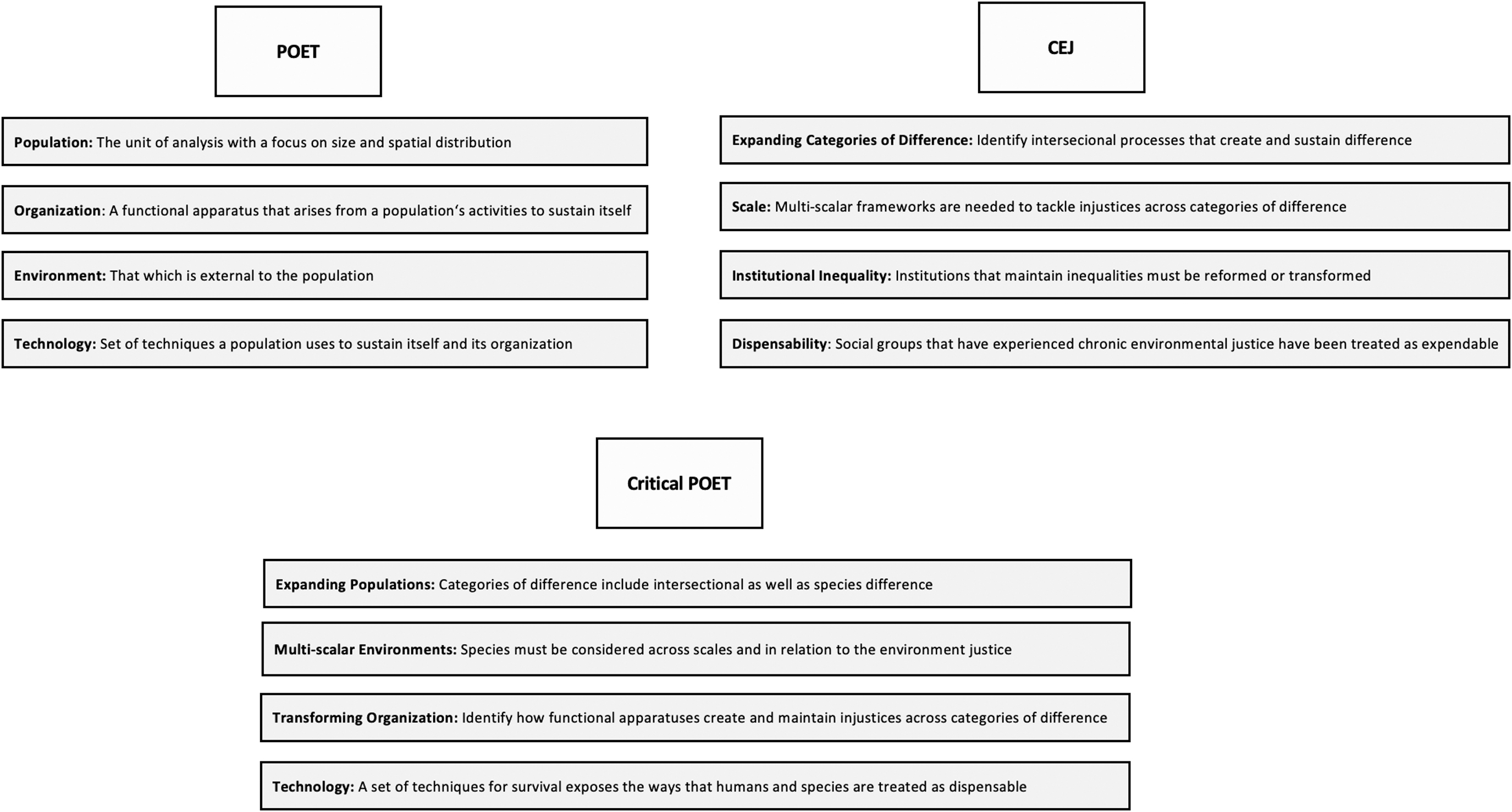
Description of categories in the two complementary theoretical frameworks, POET and CEJ, and the novel critical POET model. CEJ, critical environmental justice; POET, population, organization, environment, technology.
Urbanization as a core spatial logic has, through the twin forces of institutional racism and speciesism, perpetrated harms against people of color and wildlife, including coyotes. 43 , 44 As a process of transforming the landscape, urbanization drives and is driven by logics of oppression that prioritize and uphold current power arrangements. 45 , 46 To demonstrate the critical POET model's utility to advance our understanding of injustices for marginalized humans and other species, we apply it to the case of coyotes living in urban areas.
THE CASE FOR CRITICAL POET: URBAN COYOTES
Today, the coyote (Canis latrans) is one of North America's most common and widespread mammals in the order Carnivora. But this was not always the case. Since 1800, despite enduring one of the most violent and sustained campaigns of persecution ever waged against any wildlife species, coyotes have expanded from their ancestral hearth in the great plains and southwest to almost every corner of North America. 47 They now live in at least 5 Central American countries, all 32 Mexican federal jurisdictions, and 12 of 13 Canadian provinces and territories, as well as 49 U.S. states. Their habitats range from tropical forests to deserts and arctic tundra. Over the past few decades, they also have become increasingly common in some of the continent's largest cities, including Los Angeles, New York, Chicago, Toronto, and Mexico City. 48 , 49
Coyotes' increasing visibility in cities 50 has both revealed and provoked complex cultural and political dynamics. Despite the relatively small risks these animals pose, 51 debates about them often focus on public safety using language that echoes long-standing racial and class prejudices. Mass and social media references to coyotes as “interlopers,” “criminals,” “immigrants,” or “gangs” are fairly transparent, but perceptions of coyotes may vary in more complex ways among social groups. To urban and suburban residents more accustomed to trained pets than wildlife, for example, the sight of a coyote may seem normal, natural, and unthreatening.
To those who live in neighborhoods with fewer trees, less green space, and large number of stray or ferocious guard dogs, a coyote may seem like a greater threat. 52 Research suggests that once coyotes become established in new urban areas, diverse residents tend to become accustomed to, tolerate, or even embrace them. 53 This support can be tenuous—conflict incidents reported in the media may temporarily reduce local tolerance—but such risks can be mitigated through education, communication, and targeted management.
By expanding populations using multiscalar approaches to include both coyotes and humans, researchers and decision makers are able to consider complex interactions between the two and the impacts these interactions may have on both urbanizing processes and how such processes shape the landscape.
Urbanization has been a boon for coyote populations, enabling them to colonize human-dominated habitats well outside their native range (Fig. 2). Yet urban life also renders individual coyotes vulnerable to the negative consequences of pre-existing social inequalities. 54 , 55 , 56 , 57 , 58 Some coyotes fall victim to “ecological traps.” Lured into urban areas by rich resources—such as plentiful food waste and lush ornamental vegetation typical of wealthy suburbs, a phenomenon known as the “luxury effect” 59 —individual coyotes may become conditioned to expect easily accessible nutrients from bipedal primates.
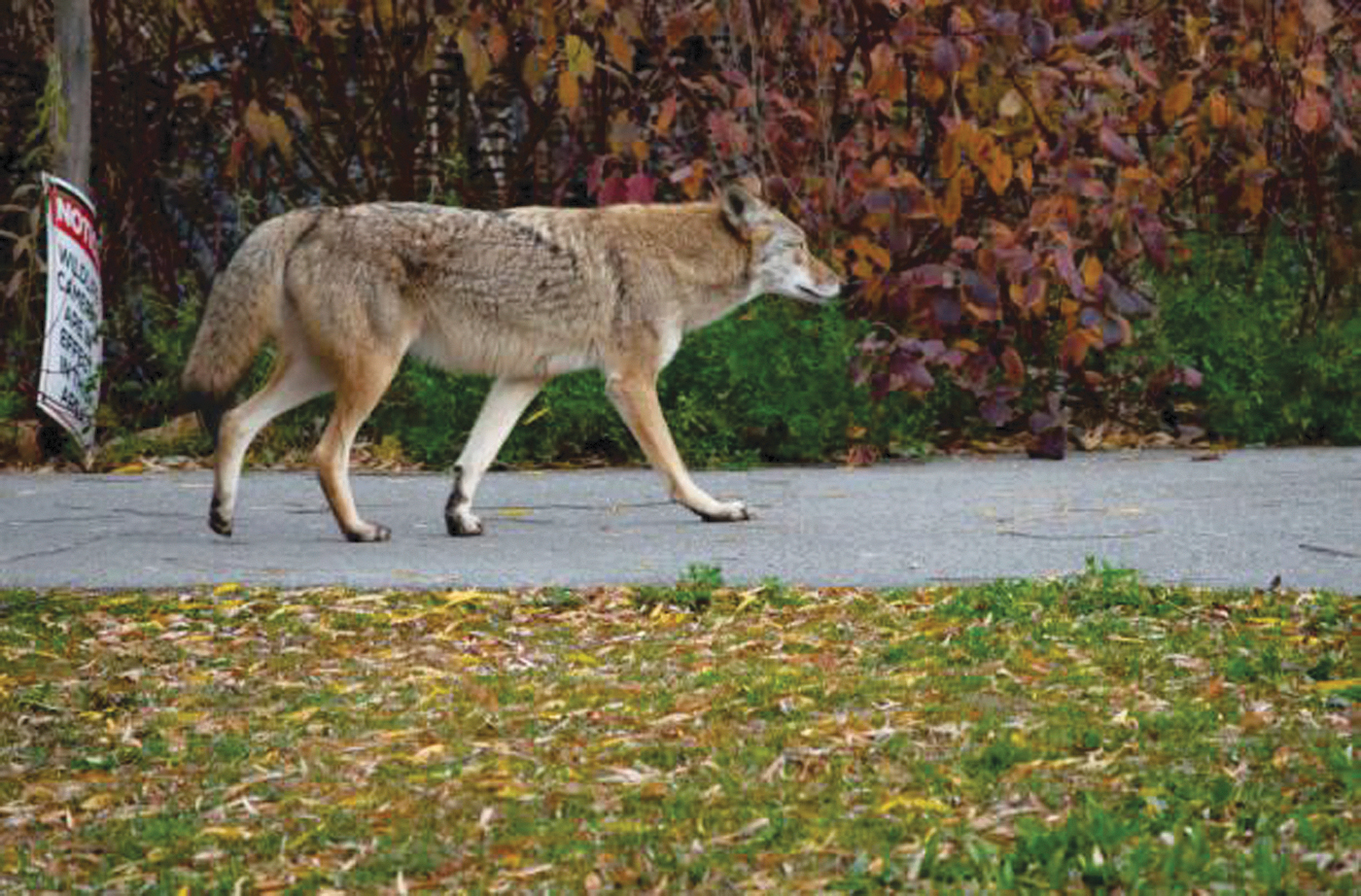
Coyote sighting in urban area | Photo credit: Seyedomid Mostafavi.
Food-conditioned coyotes may eventually adopt bolder riskier behaviors. 60 Since private for-profit pest control, rather than conservation for the public good, remains the dominant form of wildlife management in many cities, aggressive behavior by coyotes is often met with a lethal response. Such management strategies and the policies and entities that support them are one example of Duncan's concept of “organization” in need of transformation to ensure more just outcomes for humans and wildlife.
At the same time, lethal control of baited coyotes, which is usually ineffective as a long-term wildlife management solution, offers a vivid example of a set of techniques that operationalize Pellow's “dispensability” concept in critical environmental justice.
Urban animals, including coyotes, exhibit health outcomes that resemble those of their human neighbors. 61 , 62 Animals with access to safe green spaces and plentiful wild prey may reproduce more successfully, grow larger, live longer, and achieve higher population densities than their rural counterparts. Those that live in areas with less vegetation, easier access to junk food, higher rates of soil and water contamination, and chronic exposure to stressors such as toxic odors, noises, and persistent night light are exposed to greater risks.
Individuals may suffer from cancers, 63 cardiovascular illnesses, parasitic autoimmune-related diseases such as mange, contagious viral diseases including distemper, and injury or death from violence or accidents—recalling the unequal health outcomes of people living in the same hazardous urban environments. 64 Such shared outcomes begin to shed light on the ways in which the same logics of oppression drive injustices for humans and wildlife demanding new ways of thinking and analyzing human–wildlife–environmental interactions.
These arrangements have distinct outcomes for people and wildlife, but we emphasize here that shared logics of oppression inherent to contemporary urban racial capitalism are driving forces behind these distinct unjust forms of injustice experienced by both people and, in this case, coyotes. Such a process drives injustices for coyotes, putting them at risk 65 and for communities of color through widening housing inequality contributing to the lack of housing affordability, adequacy, and access. 66 , 67
Urbanization has metabolized so-called wild–urban interfaces in outlying areas, increasing the likelihood of negative interactions between people and coyotes. 68 Simultaneously, urbanization creates low tree densities in majority Black and Brown neighborhoods with implications for a range of adverse health outcomes such as heat stress and depression. 69
Such structural forces that support, maintain, and promote urbanization not only influence interactions between coyote and human populations (P↔P) by changing both their environments through human expansion (P↔E), which is made possible by organizations—such as for humans through real estate development corporations and planning commissions and for coyotes through changing pack size and dynamics—(E↔O), but also through a population's use of certain technologies—in this case the use of bulldozers and the like to physically metabolize the environment and the adaptive techniques and strategies coyotes must use to avoid humans (P↔T).
DISCUSSION
As already outlined, the critical POET model provides an adaptive framework to characterize interactions among and between analytic categories for both humans and wildlife. The model also considers the four pillars of critical environmental justice in mapping out how such interactions result in environmental and multispecies injustices, such as through human–wildlife conflict. For example, given the dynamic ranges of coyotes as well as distinct spatial and ecological character of city neighborhoods and through urbanizing and periurbanizing processes, 70 studying human–wildlife relationships requires a multiscalar approach.
Similarly, centering the linkage between humans and coyotes by investigating the same structural forces that marginalize and oppress humans based on categories of difference and coyotes based on species difference expands our notions of difference in intersectional and transversal (i.e., across species difference) ways. Urbanization of periurban spaces, in particular, allows for human expansion beyond urban areas, thereby increasing the likelihood that some people may take it upon themselves to kill “problem animals,” thus marking coyotes as dispensable. 71
The same forces that incentivize and prioritize urbanization also mark Black, Indigenous, and people of color as dispensable through the expansion of human settlements often into environmentally polluted areas. 72 Using the critical POET model, through the first two pillars—multiscalar approaches and expanding categories of difference—we provide a justice-oriented robust framework for conceptualizing and analyzing human and coyote interactions across populations, organizations, technologies, and environments to promote the last two pillars of critical environmental justice—the indispensability of Black, Indigenous, and people of color and nonhuman species and the transformation of approaches and organizations fighting for environmental and multispecies justice.
Researchers are already beginning to use multiscalar and transdisciplinary approaches to understand the structural forces that shape wildlife's life chances by using urban ecology to study species genomics, 73 while also working to transform research collaborations, such as the Urban Wildlife Information Network, to improve our understanding of and ability to address social, environmental, and multispecies injustice. 74 In sum, the critical POET model is a toolkit that can be used to guide future research and decision making, one that helps advance our understanding of the linkages among social, environmental, and multispecies oppression.
CONCLUSIONS
Bringing together critical environmental justice and human ecology approaches provides a matrix for analyzing interactions, relationships, and pathways that produce and maintain social and environmental injustices for historically and contemporarily marginalized humans and species. Doing so provides an adaptive and robust framework for analyzing socioenvironmental problems. In the example of this article, we developed and applied a critical POET model to shared logics of oppression across species in urban spaces, specifically coyotes living in urban areas, to further understand and help to address the systems of power at work producing injustices for humans and species alike.
Such applications extend both critical environmental justice and human ecology research in studying and addressing complex problems stemming from a social–environmental–wildlife nexus that for too long have resulted in injustices born by the most marginalized of us, including other species. Critical POET shows us that addressing environmental injustices is essential for promoting coexistence with wildlife.
Pushing conservation in this direction first requires that researchers address the following key questions: (1) how, in what ways, and to what extent can impacted populations have a seat at the decision-making table; (2) what are the largest roadblocks to collaborative human–wildlife relationships; and (3) are there ways of improving human–wildlife relationships for everyone? Building on this study, we also suggest future research can adapt the critical POET to sociol–environmental–wildlife dynamics but also develop additional frameworks that bring together critical environmental justice and human ecology approaches to address such problems. This kind of work is needed to advance environmental justice research, advocacy, and social mobilization across the twenty-first century and beyond.
Footnotes
ACKNOWLEDGMENTS
We thank the editors and anonymous peer reviewers for their insight into our study.
AUTHORs' CONTRIBUTIONS
C.E.B.C., A.M., P.A., and D.P. developed the project concept and drafted the article. C.E.B.C. and A.M. revised for publication.
AUTHOR DISCLOSURE STATEMENT
We have no known conflicts of interest.
FUNDING INFORMATION
A.M.'s postdoctoral funding is provided by CONVIVA.