






Abstract
Demolishing the smokestacks of the former Tonawanda Coke Corporation in the summer of 2021 marked a critical milestone in the community's 16-year-long struggle for clean air, water, and soil. This history of the fight for environmental justice in the community of Tonawanda, NY, located on the industrialized Niagara River, details how community and regulatory science data were leveraged for monumental advancements of environmental health and self-determination. At the heart of this long-term campaign's successes—that includes regulatory enforcement, criminal prosecution, and closure of the plant—was the labor of establishing and maintaining working relationships between stakeholders. This article is written by and with community members, nonprofit staff, an academic, and a retired state regulatory scientist to collectively document the ways that the traditional pitfalls of community-initiated pursuits of accountability for environmental polluters were overcome.
It all started with a Buffalo News article in January of 2002. At that time, the prevailing hypothesis was that the slew of strange illnesses plaguing the predominantly white community in Tonawanda, NY were a legacy of the Manhattan Project. A ceramics plant, owned by Union Carbide, had been converted to a uranium rolling operation in the mid-1940s in the process of developing the atomic bomb. Uranium refined in Tonawanda was then enriched in Oak Ridge, Tennessee before making its way southwest to the testing grounds, and some eventually to Japan. In the Buffalo News article, above a photo of four solemn men, appears the quotation: “This neighborhood is killing us. There is death all around us.” Laborers who had worked in the war effort and then at other local plants were getting vocal about their manifold illnesses that had been gripping them since the 1990s. 1
When the New York State Department of Health conducted a cancer surveillance study from 1994 to 1998 they indeed found that locally both specific and overall cancers were significantly higher than state averages. 2 In a follow-up study that focused more specifically on the area around the facilities handling radioactive materials, they found that ionizing radiation from uranium was not associated with the documented cancers that were found to be elevated. State officials validated local observations of illness without providing an explanation of their cause. The paper spread out over the kitchen table, Jackie James, a nearly lifelong resident of Tonawanda and mother concerned about her health and that of her family's, read this article with ever-deepening interest. She thought to herself “If it's not that, then what is it? I want to find out.”
In this article we document the community-initiated environmental health research efforts and the community's fight for their right to live in a clean and safe environment, that were, at least in part, spawned from that morning read of the newspaper. The 16 years (and counting) of work on airborne and soil-deposited residues of industrial pollution within this small city offers vital insights into practices of collaboration that are conducive to unlikely environmental justice triumphs. The many environmental governance successes outlined below are rooted in reciprocal relationships that were fostered and maintained by a commitment to addressing the problem that transcended egos, recognition or prestige, and a willingness on the part of the state agency scientists to listen closely to a group of community scientists who publicly challenged them. This article helps substantiate what exactly is meant by the sometimes nebulous goal of “trust-building” and supplements existing conversations that center on the quality of community science data as compared with regulatory monitors or those deemed admissible in court. 3
Additionally, this history documents a means of destabilizing an all-too-common friction between community members and regulatory scientists, routing the collective work toward monumental victories: criminal prosecution of the polluter, including the environmental manager being sent to jail, over $12.2 million dollars awarded by the courts toward health and soil studies, and eventually one of the authors pressing the plunger to demolish the stacks of the offending facility.
COMMUNITY SCIENTISTS AND THE STATE
When James was reading the paper that winter morning, a community environmental group in Tonawanda had not yet formalized. Yet, the heavy industrialization of the Niagara River from the bottom of Lake Ontario to the top of Lake Erie had yielded nearby wells of experience. James was invited to speak on a Toxic Tour in the summer of 2003 to commemorate the 25th anniversary of the infamous injustices of Love Canal, just 12 miles upriver. As the bus passed through Tonawanda and James spoke about the proven harms and unproven etiologies, a North Buffalo resident, Adele Henderson, approached her and said, “You know, I think it's something in our air that is making us sick.” James responded, “I think maybe you're right.” Henderson, Bob Hirsch (Henderson's husband), Tim Logsdon, and James started a new citizens group in Tonawanda. Mike Schade joined the group, lending his experience working with Lois Gibbs on environmental justice campaigns related to Love Canal.
Together they learned that there were 54 air-regulated facilities in Tonawanda—the highest concentration of regulated facilities in all of New York State. Schade was aware of a group out of California called Global Community Monitor that was using a low-cost tool for air grab sampling, known as “the bucket.” 4 Denny Larson of Global Community Monitor flew out to western New York to assist the group in conducting a good neighbor campaign using data from bucket monitors as leverage. 5 In a basement in 2004, Larson and a handful of community members gathered to conduct a training (Fig. 1).
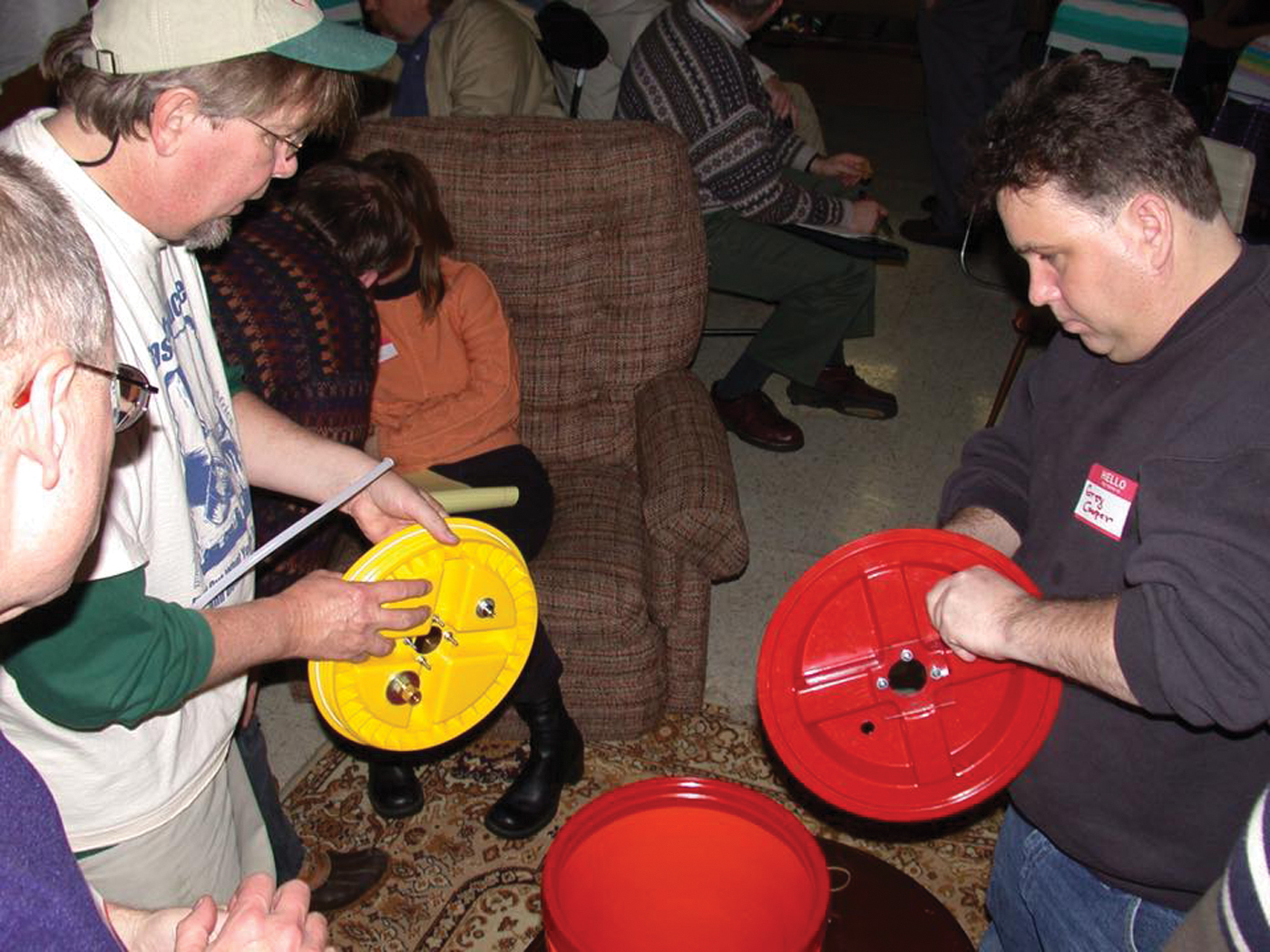
Image of the bucket sampling training from Denny Larson. 2004. Photo by Adele Henderson. Used with permission.
The hardware of the bucket method is less expensive than its professional alternative, a stainless steel evacuated sphere called a summa canister, but the laboratory analysis of its sample remained expensive. The group would go out at night, when the factories were most likely to release fugitive emissions, and rely on their noses to signal when to begin the 3-minute sampling process. False starts or ephemeral noxious plumes could prove costly when it came time for analysis, so they had to be extremely discerning in determining when to sample.
When they received the results from two of their first moonlit sampling runs in a thicket of facilities, they were immediately concerned by high benzene and carbon disulfide levels. The group, previously dubbed Toxic in Tonawanda, decided to rebrand as the Clean Air Coalition (CACWNY) 6 when releasing their results, to “sound less militant.”
While the name may have appeared more neutral, their press conference announcing their findings infuriated several staffers at the state Department of Environmental Conservation (DEC) who felt blindsided for not being consulted before the group publicly released data, skeptical of the 3-minute grab sample's validity, and less-than-pleased that the media inferred that the DEC was not doing their job. In an initially heated phone call, the procedural disconnect between grassroots community science and governmental regulatory science was overcome through a conversation that revealed the lack of consultation to stem from not knowing how to get regulators to take action and rather than an attempt to undermine state authority. In the call James admitted that they should have considered the standpoint of the regulators, a misstep of inexperience. This was the first of many interactions where both parties in turn took responsibility for their actions and listened to the other's needs.
Reciprocally, James remembers moments where DEC staff privately admitted that they were embarrassed about past regulatory failures and apologetic about the agency's bureaucratic slowness. Using Toxics Release Inventory data available on the U.S. Environmental Protection Agency (EPA) website, the team was able to tie the relatively unique carbon disulfide signature of their July 20, 2004, run to a nearby 3M sponge factory. Equipped with their book on good neighbor campaigns, the community group met with the owners of the plant alongside the same engineer from the New York State DEC that had initially made contact to reproach the group—Al Carlacci. The 3M flew someone out from headquarters to give a presentation on what they would do to reduce emissions, and then set those plans into motion.
Elated that their campaign to improve their community's air quality were progressing as hoped, they moved on to benzene. CACWNY's data appeared to be the perfect fulcrum for the community to gain leverage with their industrial neighbors, but figuring out the source of the benzene, which is a much more common emission, proved difficult. 7 Was there a single facility to blame or was it an aggregate level from dozens of facilities? The group held meetings on Saturday mornings at a local fire station. On April 1, 2005, the same New York State engineer suggested the group focus on the Tonawanda Coke Corporation (TCC) due to the wind direction present during CACWNY's bucket sampling.
At this time, the fledgling collaboration and trust with the state DEC was growing more robust. Al Carlacci of NY DEC Air Resources, with the support of his immediate supervisor and the DEC team in Albany was transitioning from supporting the group on weekends to actively attempting to replicate their findings using longer duration samples and the more conventional industrial hygiene tool of summa canisters. Carlacci's official data indicated ambient benzene levels just as concerning as the initial CACWNY bucket samples. Tom Gentile, Chief of the Air Toxics Section for the Division of Air Resources at DEC then utilized this second round of monitoring to secure a $300,000 grant from the EPA (matched in-kind by DEC) 8 to place four high-quality real-time monitoring stations in Tonawanda from 2007 to 2008 as a full year of data are needed for a violation of the Clean Air Act to be identified (Fig. 2).
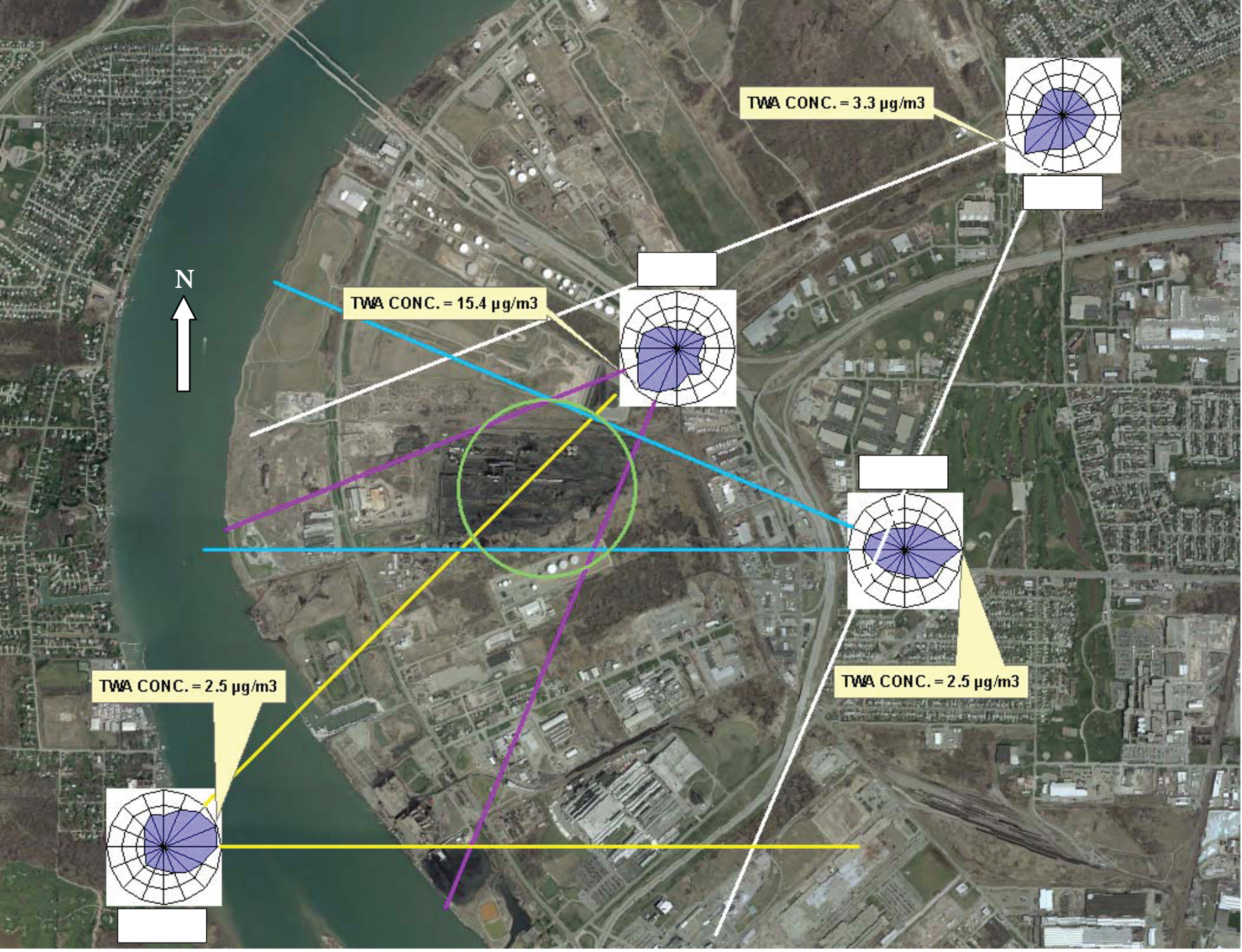
Benzene pollution wind roses indicate the primary source to be TCC, shown in the green circle. Image by NYS DEC 2009. TCC, Tonawanda Coke Corporation.
As Jackie James has noted, “People ask me all the time, “wow what kind of data did you have? How did you get it?” “We got valuable data because we worked with certain agency scientists that we could trust. We kept the lines of communication open and we all pulled in the same direction. There were two camps within the DEC—one that Al and Tom were our points of contact for and one that was complacent and not interrogating the lies TCC fed them. This created roadblocks for the rest of us. We were straight up and didn't pull any punches. Being direct made everything much easier. The trajectory of ‘data for civic action’ is not nearly enough. Relationships are the backbone of any successful collaboration. And you can build that trust by doing what you say you'll do.”
Tom Gentile recalls that James told him once that she did not like him, but that this was a step of honesty on the way to developing profound trust. 9 As James further notes, “I may disagree with a partner, but that doesn't mean I'm going to go low and throw them under the bus. This would be a sure way to lose trust in any collaboration.” The CACWNY and DEC made an agreement on a “code of ethics” pertaining to how they would not speak negatively about each other in public. 10
Glenn and Jennifer Ratajczak, founding board members of CACWNY, recall previous discussions with other DEC officials who directly regulated the TCC. Their concerns with TCC were met with repeated dismissal, “Being treated by the regulator as if we could not have pertinent information just because we were citizens developed an underlying distrust between us.” 11 When the regulator would take community complaints to TCC and believe TCC's dismissals that were later revealed as lies, the community grew suspicious of that regulator's alliances. Working relationships with Carlacci, Gentile, and James were developed separately from and survived alongside these tensions through the processes James discusses above. Having relationships with engaged constituents who are focused on colearning the problem made it possible for agency staff to commit to sorting out what was really going on in the face of a system, which officially did not acknowledge any harm. As Gentile notes in the genre of bureaucratic understatement, “Not being adversarial, goes a long way in some cases.” 12
The preliminary data from the DEC study supported the hypothesis that Tonawanda Coke was a disproportionate benzene emitter. CACWNY wrote a letter to the owner of the plant, J.D. Crane, asking to meet. He summarily rejected the request and insisted that they are already a good neighbor. The early data from the DEC also spurred a joint DEC/EPA special investigation of the facility in April of 2009 with renewed federal enforcement interest due to the dawn of the Obama administration. These investigations so clearly identified the source of the problem that the need for official action was undeniable. Federal and state agencies worked in lockstep, without jurisdictional friction and with shared resources and institutional knowledge, to root out the cause of the city's compromised atmospheres. This robust state–federal cooperation was key for advancing the community's concerns.
Two months later, the DEC presented their findings supporting what CACWNY had known for years: that hazardous air pollutants were elevated in Tonawanda, and benzene was the contaminant of the highest concern. The results pinpointed Tonawanda Coke as the predominant culprit. TCC claimed to emit 4.9 tons of benzene into the air of Tonawanda in 2007 and 5.2 tons in 2008. Stack DIAL tests later revealed that the company was grossly underreporting their benzene emissions, exceeding more than 10 tons each year. One assessment, likely an overestimation due to co-contaminants, calculated a release of 91 tons. 13 , 14 Importantly, 10 tons in annual emissions is the upper threshold for a single facility to be labeled a “minor emissions source.” By reporting under that level, TCC was able to maintain a much less onerous permit than that of major emitters.
James remembers the audience bursting into a standing ovation at the community center auditorium when these results were presented to over a hundred community members in early June, 2009. At that moment, she remembers breathing a sigh of relief. Having studied chemistry in undergrad, she felt sure that having this smoking gun of robust data would be the key to reducing pollution from Tonawanda Coke. Yet, after the projector was turned off and the crowds funneled out, there seemed to be no enforcement activities underway at the state or federal level. “How could they definitely know that we're living in a gas chamber and not do anything about it?” James remembers remarking to her collaborators with dismay (Fig. 3).
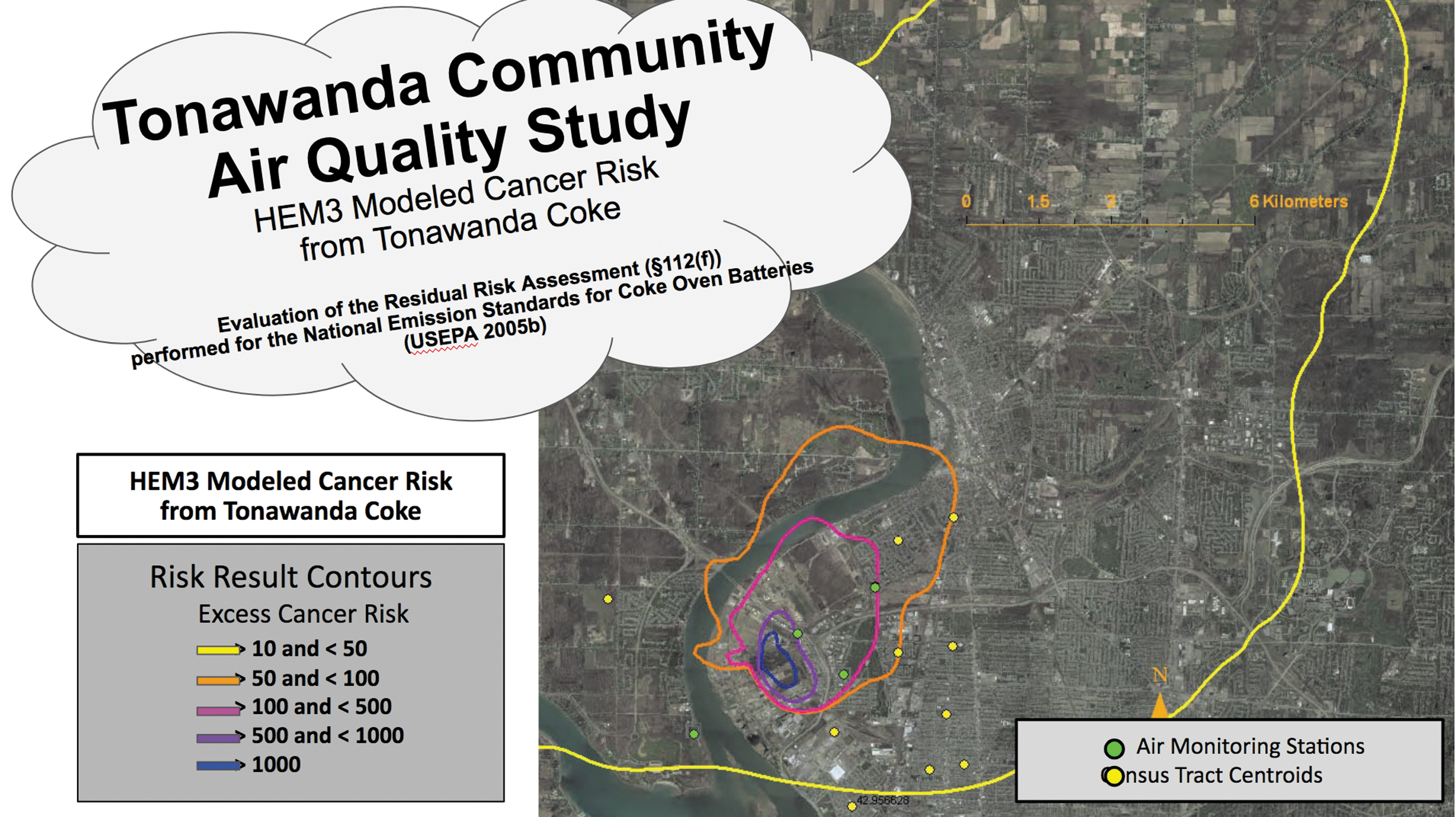
Residents were shocked to learn how far the emissions and Associated cancer risks spread past the TCC fenceline. Slide created by Jake Klau, Citizen Science Community Resources (CSCR).
As TCC continued business as usual, the immediate next steps involved elected officials who had reached out to James after reading about the results in the news. 15 June 22, 2009: New York State Senator Charles Schumer wrote a letter requesting to meet with J.D. Crane, owner of Tonawanda Coke. Crane declined the meeting, stating in his August 21st reply that the EPA's claim “cannot be substantiated.” His counsel continued, “Nor does, in our view, the [DEC+EPA] Tonawanda Community Air Quality study, an ambient air quality study, stand for that proposition. It's a red herring, bun with no burger claim” and attempted to shift the blame from his facility to the incomplete combustion of automobiles. 16 Concurrently, in July 2009, New York State Senator Kirsten Gillibrand wrote a letter to EPA head, Lisa Jackson, regarding the benzene levels, requesting that Jackson meet with the Clean Air Coalition, accelerate enforcement of mitigation activities, and establish an environmental benefits program to study health and remediate the soot that has been contaminating their soil for decades. There was no response.
PROTEST MOVES SCIENCE AND ORGANIZING TO THE COURTROOM
James' fibromyalgia was wearing her down again. She was exhausted by both the disease and the huge amount of work needed to make these large strides toward environmental justice. The community group she had cofounded with Tim Logsdon, Adele Henderson, and Bob Hirsch years earlier, CACWNY, was formalizing into a nonprofit and she had been appointed as the Executive Director in 2007. Having fundraised to fill her position, James stepped down in September 2009 to take care of her health. They hired someone with more organizing experience and energy to assemble a protest at the gates of Tonawanda Coke—Erin Heaney. The protest was tremendously successful and was featured above the fold in The Buffalo News. 17 Aaron Mango, an Assistant United States Attorney working for the Department of Justice (DOJ) in the Western District of New York, stumbled upon the story when he visited his parents' house in Buffalo that Sunday, October 11, 2009 and saw the paper sitting on their kitchen table. The next working day Mango e-mailed criminal agents with EPA stating his intentions to investigate the company on criminal charges.
As the criminal investigation progressed, a search warrant was executed at the plant on December 17, 2009, which included law enforcement agents from the DEC, EPA, U.S. Coast Guard, Federal Bureau of Investigation, and others. On the day before Christmas Eve in 2009, and as a result of what was found during the search warrant, law enforcement officials returned to the plant and arrested Mark Kamholz, the plant's environmental manager, taking him out in handcuffs. After almost 9 years of data collection and organizing, they had achieved their first regulatory intervention and first national news coverage (Fig. 4). 18
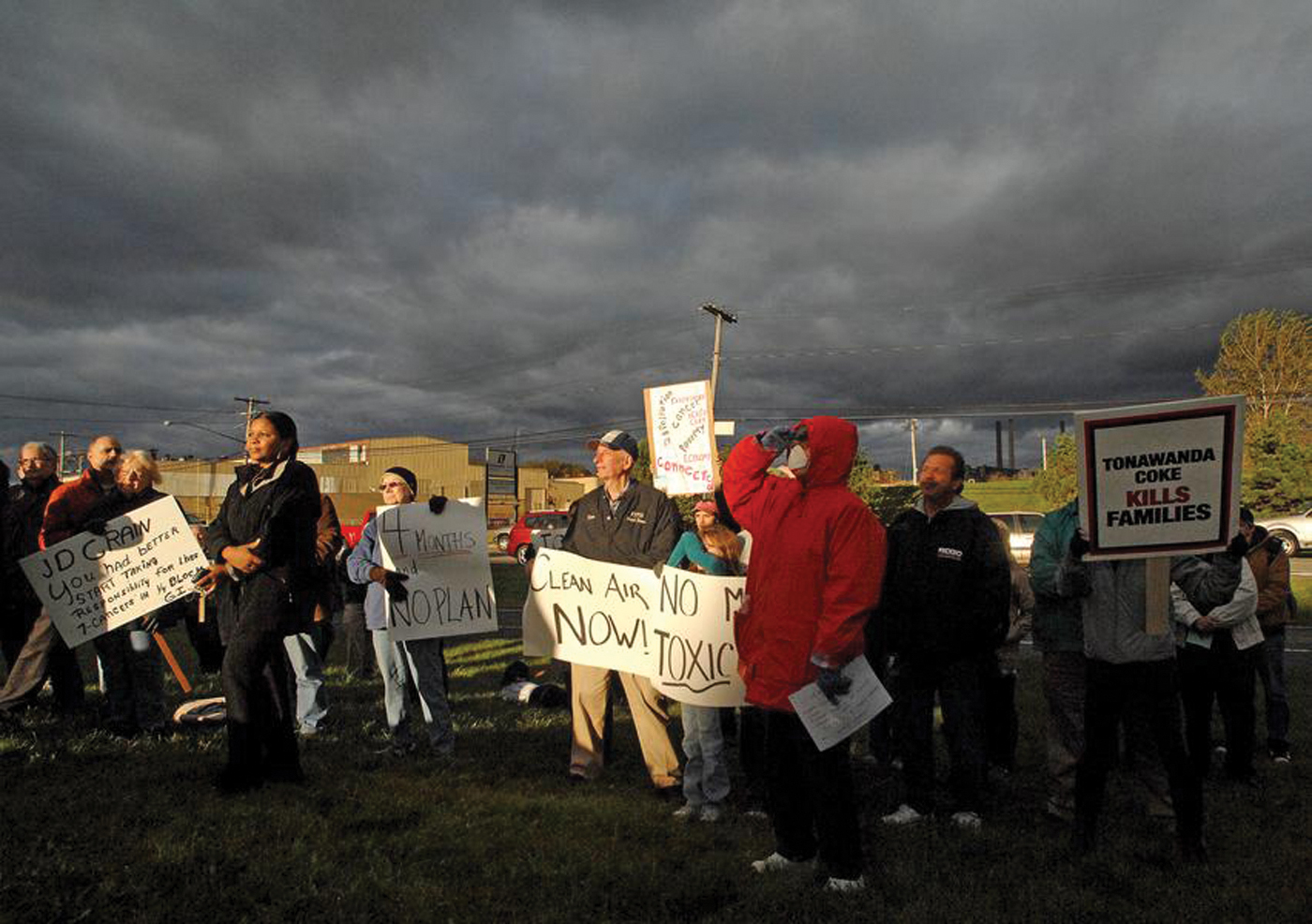
Protest outside the gates of TCC, 2009. Image by Eric Duvall (Tonawanda News). Used with permission.
In July 2010, Tonawanda Coke and Kamholz were indicted by a federal grand jury in a 20-count indictment, and the resulting prosecution required additional labor from community organizers, such as collecting impact statements from residents. The protracted work prompted many to burn out, sometimes repeatedly. Many from CACWNY, like James, always came back. The DOJ criminal prosecution then spurred the EPA to advance civil litigation, yielding two parallel tracks of accountability. Key details emerged through the litigation, such as the identification of an unregulated pressure release valve as a primary source of fugitive benzene emissions, the existence of which employees were directed to conceal (Fig. 3). A worker in active employment at Tonawanda Coke courageously took the stand and testified that he was instructed to conceal the valve from regulators. 19
Trial in the criminal case lasted from February 26 to March 28, 2013, with the jury finding Tonawanda Coke guilty of 14 counts, including violations of the Clean Air Act and the Resource Conservation and Recovery Act. Kamholz was personally facing the same counts with an additional obstruction of justice charge. Kamholz was convicted on all of the same counts as the plant, as well as the additional obstruction of justice charge (Fig. 5).
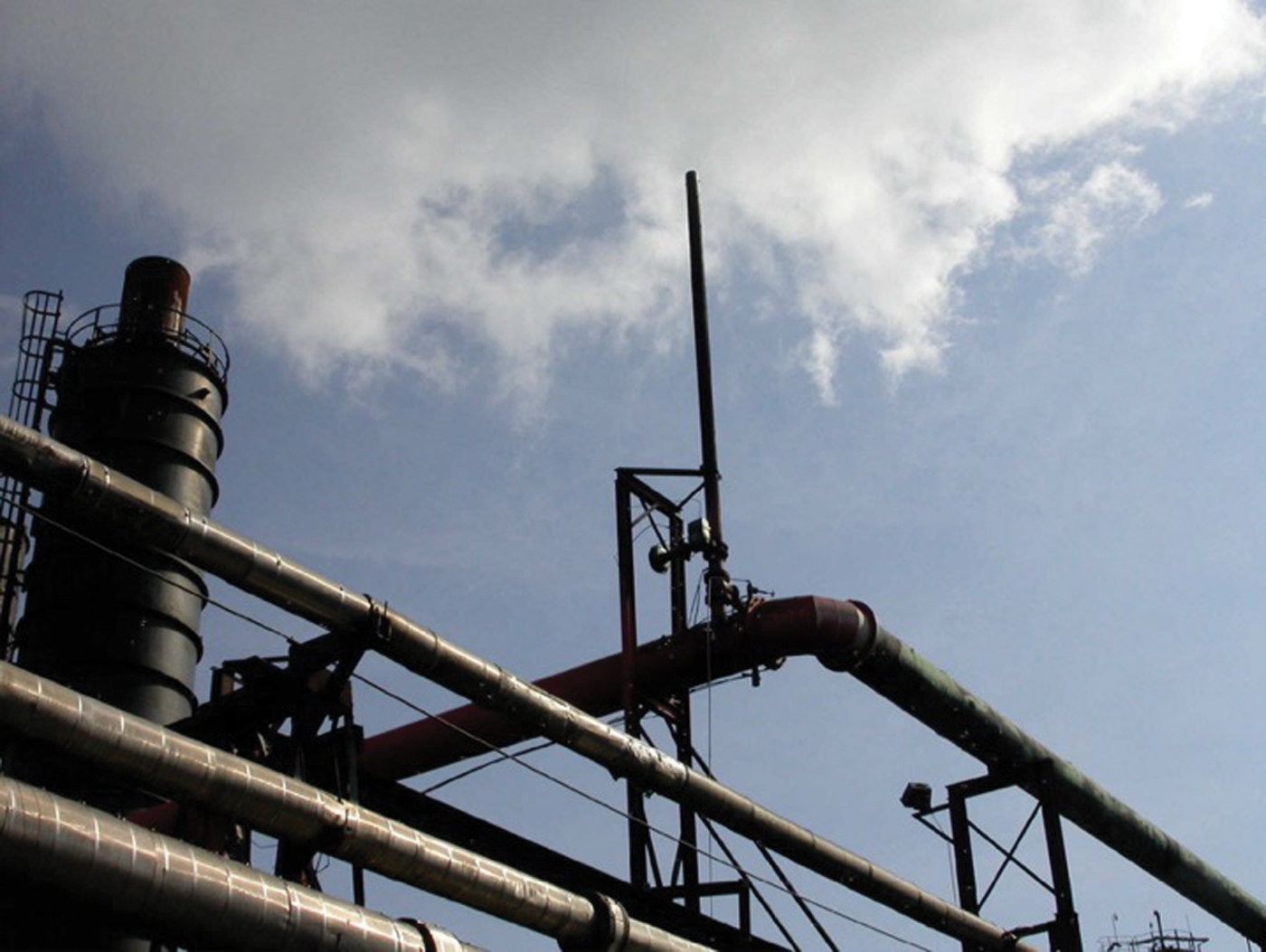
“A steaming pipe was the smoking gun.” Picture of the unregulated valve responsible for much of the fugitive benzene emissions. Image by the Department of Justice.
This was only the second time that a company had been convicted following a jury trial for violating Title V of the Clean Air Act. Indicative of the many false summits along the path to accountability and harm reduction, James and colleagues thought that the declaration of guilt was the threshold of victory for environmental health. Yet, EPA Special Agent Robert Conway, turned to her and explained, “if you have a guilty verdict, we're only halfway there. We need a good sentence.” A year passed between the verdict and sentencing. The presiding judge, Judge Skretny, invited the community to provide their stories about the air quality's impact on their lives to help him determine the sentencing. He additionally invited the impacted community to submit scientific project proposals to better understand the emissions and their impacts. These projects could potentially be funded through court-mandated community service projects, 20 where polluters pay money not only to the government in fines but also pay money to third parties for environmental restoration or study.
James and collaborators put in a $711,000 project proposal to continue the soil testing they had already begun and submitted it to the judge. In March of 2014, Judge Skretny ordered Tonawanda Coke to pay $12.5 million in a criminal fine and $12.2 million in community studies including the study proposed by the first author and colleagues. The environmental manager was sentenced to a year and a day in prison and subject to a $20,000 fine in addition to community service.
After their losses in court to the DOJ, TCC agreed to settle with the EPA and installed pollution control equipment, reducing their benzene emissions by 86% (NYS DEC 2013: 1). Their settlement also included $1.3 million for community-focused research, totaling over $13 million for environment and health projects across both lawsuits. While the reductions were major accomplishments, the 100-year-old plant was unable to be retrofitted with adequate environmental protection systems without an investment sizable enough to outweigh its cost efficacy. A broad array of issues continued, from failures in safety controls that led to a worker being pulled into the furnace by his jacket snagging on a conveyor belt to an underground waste heat tunnel collapsing in January 2018 that caused a black billowing smoke cloud to be released (Fig. 6).
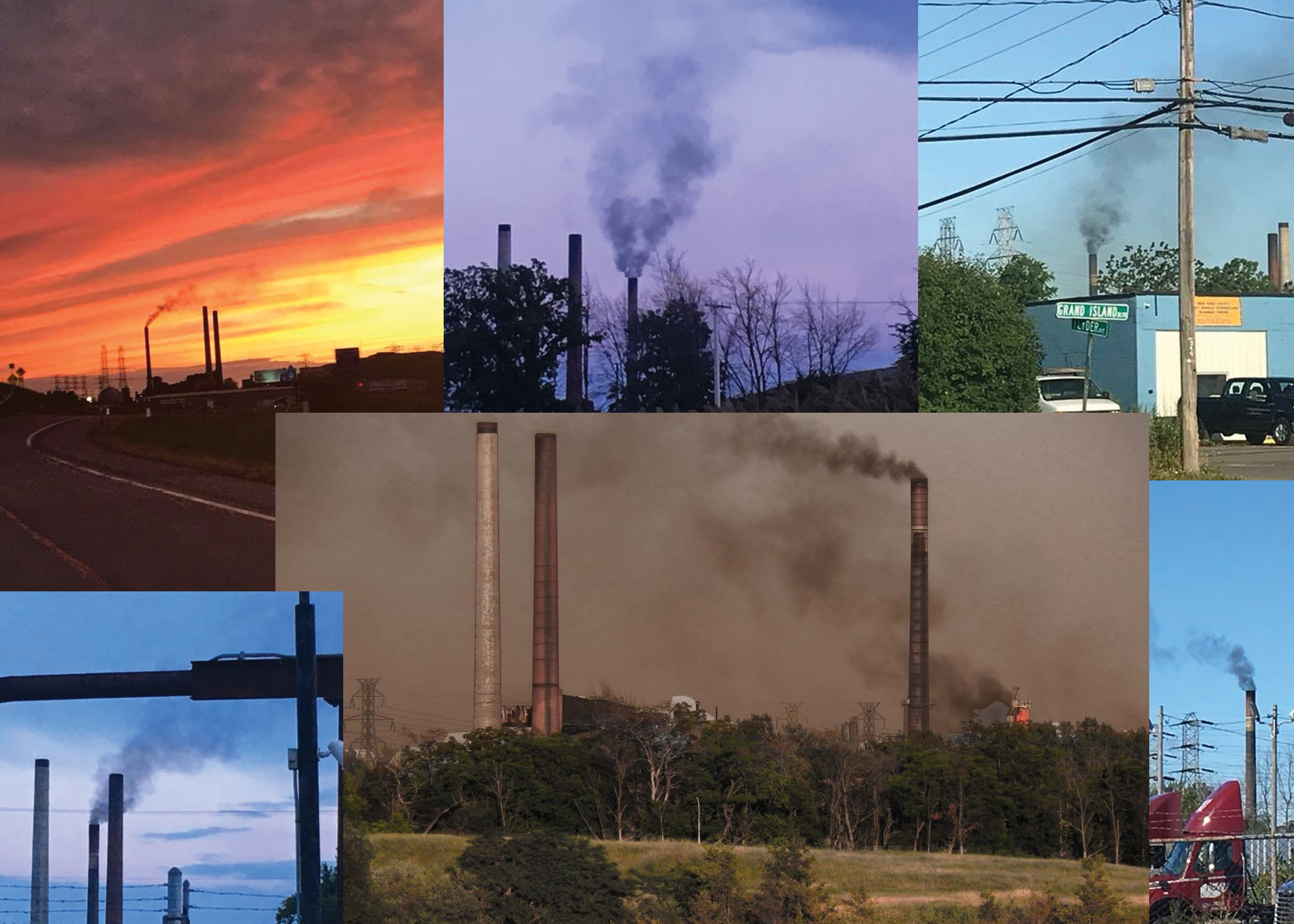
Photos from the “Stop the Stacks” campaign. Images by Annmarie Kozlowski Schneider, Matt Creedon, Paul Leuchner and Jackie James, 2018. Used with permission.
Company denials persisted. A few of the original CACWNY team formed an additional group, Citizen Science Community Resources (CSCR), and in May, CSCR began a “Stop The Stacks’’ campaign. They held a press conference with elected officials (City of Tonawanda Mayor Rick Davis, Grand Island Supervisor Nate McMurray and Town of Tonawanda Supervisor Joe Emminger) and community leaders (Joyce Hogenkamp and Jenn Pusatier), and launched a Facebook social media photo-documentation campaign of the company's site. 21 These community photos were used by the DOJ in their September 2018 brief that resulted in hauling TCC back into court. In July of that year, fire broke out at the facility and workers drove a forklift to the entrance blocking fire trucks from entering.
As a result of these collective problems, the DEC refused to renew their environmental permits that were up for renewal. At that point the facility was already on probation, the public was on high alert, and the DOJ and the DEC were not only keeping close tabs on these happenings but local politicians too were getting fed up. Town of Tonawanda Supervisor Joe Emminger and the town board all went on record saying that Tonawanda Coke needed to be shut down.
Finally, in October of 2018, TCC was forced to close and declared bankruptcy. With the plant's shuttering, safely overseen by the DEC and EPA, what had once been a benzene cancer risk that was 75-times above New York State guidelines was reduced to New York State averages. By December 2019, ambient benzene levels had dropped 92% since the end of DEC's sampling in 2008 (Fig. 7). 22 , 23
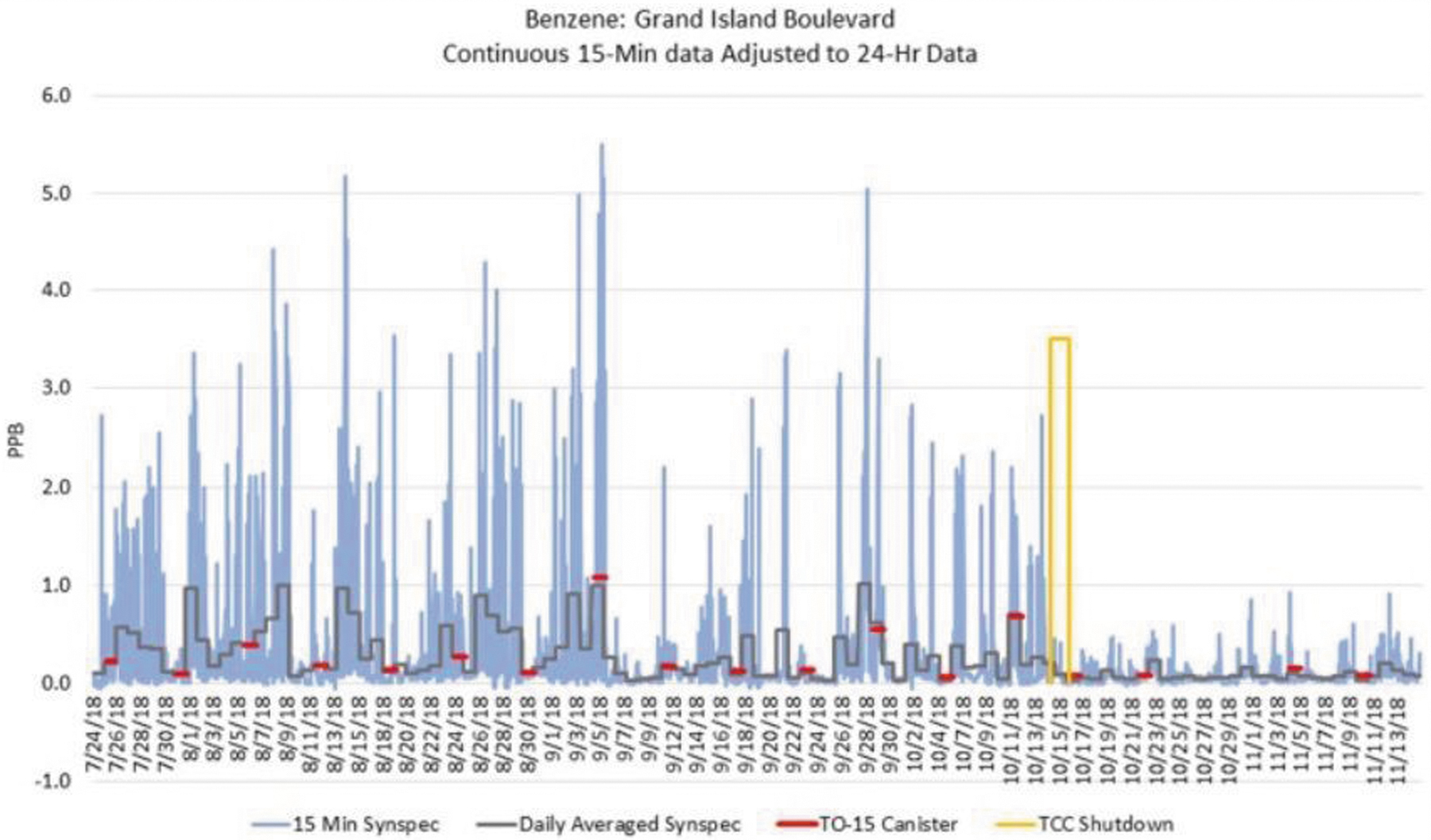
Benzene levels on Grand Island Boulevard, 1500 feet northeast of TCC.
In June of 2021 the smokestacks of the defunct coke processing plant were detonated and redevelopment of the site moved forward (Fig. 8).
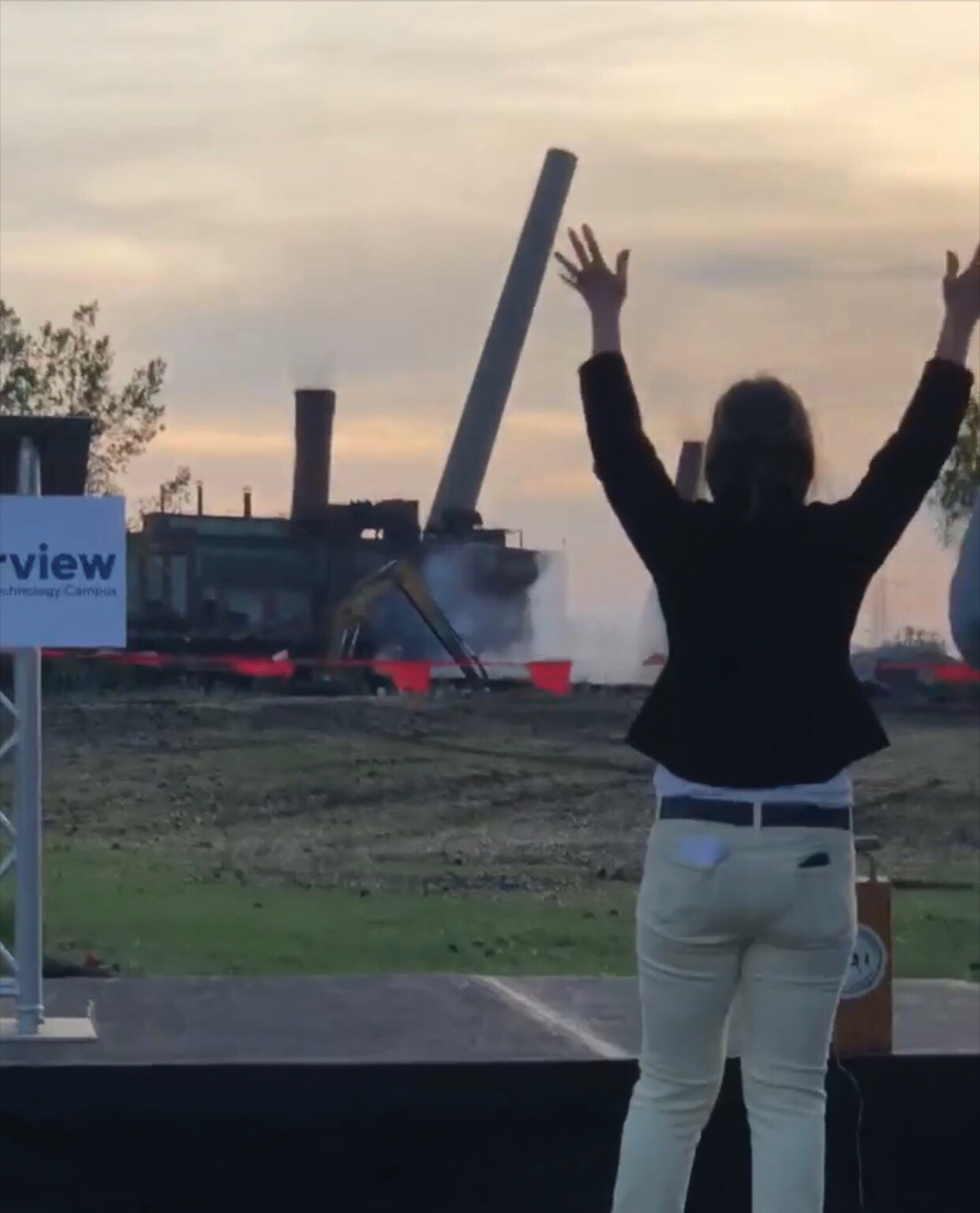
June 5, 2021 Jackie James celebrates after depressing the ceremonial plunger on the stacks at Tonawanda Coke. Photo by Dean Bogart. Used with permission.
CONCLUSION
The collective action started with just a few neighbors sitting around a table discussing their individual health struggles and their collective right to a cleaner environment. These few residents had the tenacity to figure out how to collect an air sample with a homemade air sampler they put together themselves with parts from a hardware store. After they received their data back from an accredited laboratory, they worked alongside their state scientists to figure out where the high levels of benzene were coming from. These exact same tools used by the community to quantify the hazards of the air, bucket samplers, do not always spur this kind of collaborative reaction from the state, 24 but interested and engaged regulatory scientists (and then attorneys) were able to continue and formalize the evidentiary momentum achieved by the community group in a relatively anomalous way. The town of Tonawanda bears twice the concentration of white people as other towns in southern Louisiana where community groups similarly attempted to utilize the bucket sampler to bring accountability to their industrial neighbors.
The campaign in New Sarpy, for example, resulted in direct negotiation with the polluting company's engineers rather than regulation by the state and much smaller concessions were made from similarly concerning data. 25 Racial factors likely played an invisible role in advancing justice in a largely white town where all of the primary actors were of the same race, 26 yet Black and brown-led coalitions have utilized the bucket for massive change such as the passage of South Africa's Air Quality Act in 2004. 27 Joining other successes, how this group was able to achieve these successes can hopefully serve as a template of sorts for other communities facing similar problems.
Like the work in Louisiana, Tonawanda's search for answers emerged out of public outrage and government dismissal. Erin Heaney, who took over from James as Executive Director at the Clean Air Coalition of Western New York in September 2009, described the early efforts being constantly called into question, “We [Clean Air Coalition] were continuously told that it was not possible that these wrongdoings were taking place at TCC. If TCC were performing these acts, the DEC engineers would be aware of it.” 28 However, between these groups emerged a set of individuals who were willing to work with each other (within and around the system) to determine if there was indeed compromised air quality and, if so, whose stacks were to blame. The initial release of bucket data had the goal of compelling the DEC into action, but it did so in an unexpected way by introducing the community group to other DEC staff that were more open to listening and collaborating.
Figuring out that the DEC was not a monolith through finding new, receptive contacts at the agency was a key, and potentially transferable, lesson in establishing favorable conditions for collaboration. That racism and racial tension were not part of the dynamics of a white regulatory scientist expressing frustration over the public release of data by a group of white community members was a vital privilege that enabled this conflict to more easily transform into a reciprocal relationship and limits the exact replicability of this work in diverse contexts. The brazen illegality of the fugitive emission source, once pinpointed, also facilitated state and federal intervention. From the first Buffalo News article that piqued James' attention, to the coverage that prompted new DEC contacts, to the article that caught the DOJ's attention, keeping the public conversation alive in the media proved to be a vital catalyst for new relationships in ways that were both intentional but unpredictable.
These would-be collaborators experienced common conflicts around speed of work and information flow. For example, when the government's science process and enforcement moved slower than resident-activists deemed acceptable due to the continuous impact of the emissions on their health, angry residents took to protesting at the refinery gates. Despite tensions, the collaborators' commitment to figuring out what was falling through the cracks in the system endured. Together, they put in the time to build trust. They did this by demonstrating follow-through on agreed-upon small tasks and by being frank about their differently situated impacts, accountabilities (such as accountability to the community or accountability of government officials to their greater power), and institutional limitations. Government scientists and community organizers alike grew in their ability to communicate their ways of knowing, attitudes, and conceptualization of the problem(s), which ultimately helped align what was both important to the public and within the governmental regulatory purview.
This relational foundation was more durable than official modes of government–public interaction alone. Relationships with workers at the plant, DOJ prosecutors, and tight communication between state and federal regulators and community leaders added further momentum toward substantive change.
Footnotes
ACKNOWLEDGMENT
The authors would like to thank all of the community members who made these changes happen as well as all of Clean Air Coalition of Western New York and Chris Murawski for their helpful feedback on the manuscript as well as incisive feedback and corrections from Aaron Mango of the Department of Justice and feedback from two anonymous reviewers.
AUTHOR DISCLOSURE STATEMENT
No competing financial interests exist.
FUNDING INFORMATION
No funding was received for this article.