






Abstract
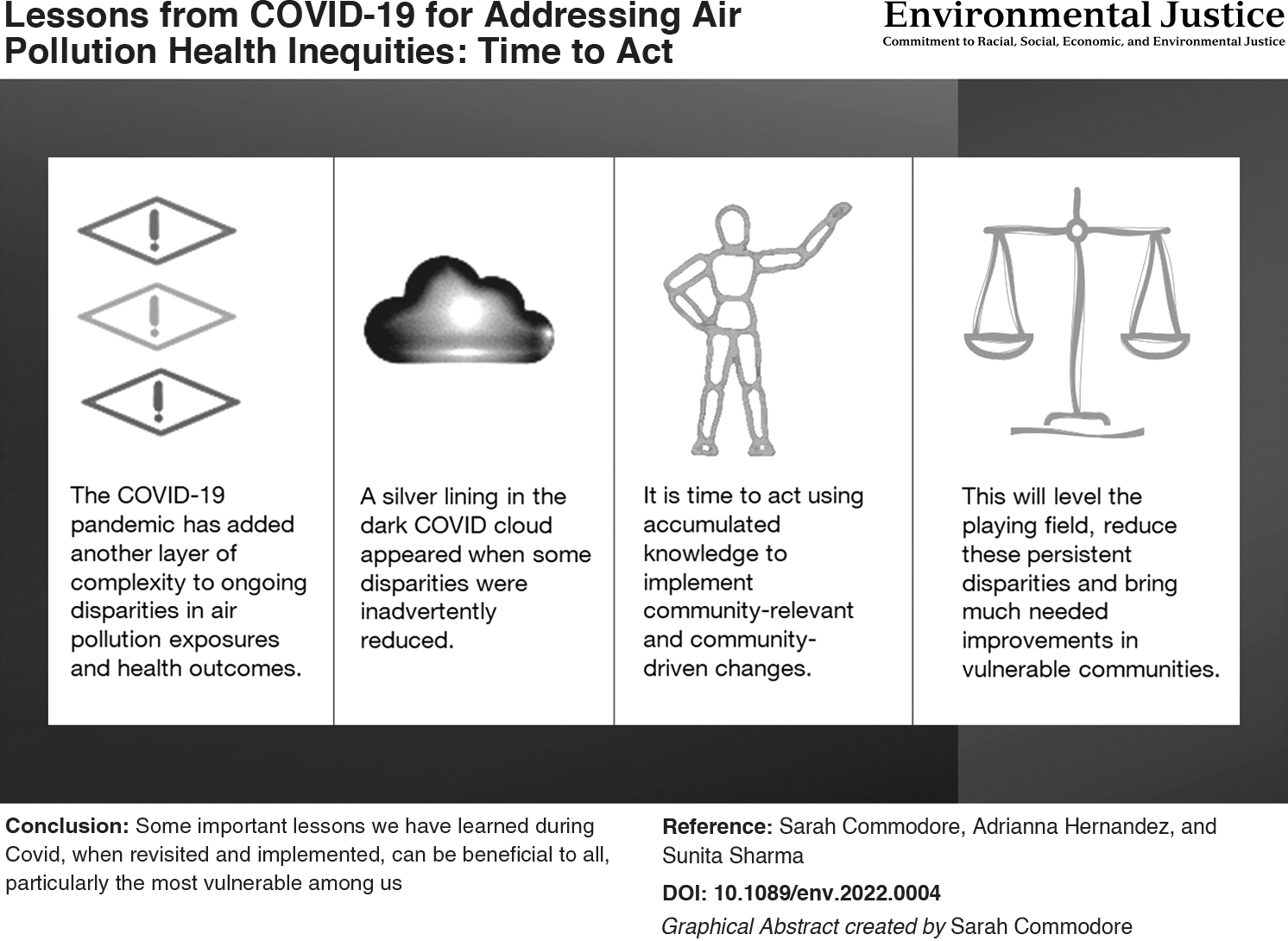
Air pollution health disparities can be reduced. The ‘triple jeopardy’ of air pollution exposures, health disparities and the COVID-19 pandemic presents a unique situation from which lessons we can learn. During the surge of the pandemic, there was evidence of reductions in ambient air pollutant concentrations during forced lockdowns, reductions in asthma hospitalizations and medication prescriptions, as well as expansion of telemedicine. It is time to use the accumulated knowledge to prepare for imminent COVID variants and future pandemics and implement informed changes to reduce air pollution health disparities. The lessons we have learned, when revisited and implemented, can be beneficial to all, particularly the most vulnerable among us. Such lessons are important starting points that can inform sustainable intervention strategies to reduce current air pollution and health disparities.
INTRODUCTION
The COVID-19
AMBIENT AIR POLLUTION: DISPARITIES AND IMPACTS DURING COVID-19
With the emergence of SARS-CoV-2 leading to the COVID-19 pandemic, several studies have reported that minority populations had increased hospitalizations and higher mortality. 1 In fact, this spotlight on racial disparities has been termed “the color of coronavirus.” 2 A study that looked at data up to April 2020 reported that ∼90% of black counties had a case and 49% had a death due to COVID-19; this is in comparison with 81% and 28%, respectively, for all other counties. 3 In addition, counties with higher proportions of nonwhite residents had more COVID-19 diagnoses (rate ratio [RR]: 1.24, 95% confidence interval: 1.17–1.33) and deaths (RR: 1.18, 95% confidence interval: 1.00–1.40). 4
Consistent evidence points to demographic, environmental, and health care factors that can influence the prevalence, severity, and/or persistence of health disparities, particularly among racial and ethnic minority populations. 5 Although there are many reasons why these disparities exist, environmental exposures such as air pollution are a known contributor to these disparities. 6 These said populations often have higher prevalence of comorbidities and greater air pollution—a pandemic on its own.
The COVID-19 pandemic has highlighted the urgent need for action. Looking through the lens of the accumulated evidence identified before and during the COVID-19 pandemic at a national scale, we can begin to change what is possible by adapting sustainable intervention strategies to combat current disparities in vulnerable communities. Herein, we discuss how certain measures taken during the pandemic can potentially inform future interventions and help address air pollution health inequities. We highlight these examples because they are lessons that can be learned from the COVID-19 pandemic. We posit that taking tangible actions to implement these measures that reflect some of the lessons learned before and during future pandemics can reduce health disparities.
Ambient air pollution is the fifth largest risk factor contributing to the global burden of disease. 7 Air pollution exists in solid, liquid, or gas states and can result from sources such as wildfires, vehicles, industrial processes, inefficient fuel combustion, and atmospheric chemical reactions. In fact, exposure to ambient air pollution, particularly, in the particle form, is reported as the greatest environmental risk factor for human health, with an estimated 4.1 million attributable deaths worldwide. 8 Although ambient air pollution varies in source and magnitude, local environmental conditions also play a role in determining its impact on human health.
The intersection between health disparities and air pollution exposures is an ongoing public health issue and has been highlighted during the COVID-19 pandemic. Disparities in health among ethnic minorities and individuals of low socioeconomic status (SES) have been consistently reported in the United States and throughout the world. 9 Ambient air pollution exposures add another burden to groups already at higher risk of disease such as those living in vulnerable and economically distressed communities. Several studies report that ethnic minorities, individuals of lower SES, and other disadvantaged groups are disproportionately exposed to outdoor air pollution. 10 More importantly, this unequal exposure to air pollution further contributes to health disparities. 11
The combination of air pollution exposures, health disparities, and the COVID-19 pandemic is a “triple jeopardy” for certain high-risk populations. Air pollution has been shown to compromise the immune system, no matter the age of the person. Thus, an abnormal immune response compounded with vulnerability such as environmental hazards (e.g., traffic proximity and hazardous waste facilities) and demographic indicators (e.g., low-income, race/ethnicity, and low education) is a pandemic on its own. The extra layer of the COVID-19 pandemic has worsened the situation and has been termed a “syndemic,” 12 since the synergy between these pandemics aggravates the other.
Numerous studies have reported that ambient air pollution exposures increase the risks of COVID-19 infections, severity, symptoms, and worse prognoses in the United States and throughout the world. 13 An additional and potential impact on “long haul” COVID-19 cannot be ignored and warrants further investigation. Evidence points to the fact that there may be long-term consequences of SARS-CoV-2 infection, together with socioeconomic and racial disparities. 14
With the unprecedented reduction in human activity during the COVID-19 lockdown, there appeared a brief window to investigate whether this restriction would at least partially reduce some of the noted health disparities. Kerr et al. (2021) reported ∼50% reduction in passenger vehicle traffic and nitrogen dioxide (NO2) levels throughout the United States using data from the TROPOspheric Monitoring Instrument. 15 However, racial and ethnic minorities, low-income, and low educational attainment communities still had higher NO2 levels in comparison with most white communities. 16 Although there were reductions in overall ambient air pollution, these data argue that the sources and/or components of the ambient air pollutants may still be unequally distributed. 17
However, we would like to point to two unique augmented exposure situations that the pandemic created. The first is exposure to excessive disinfection products. A recent study reported the presence of and exposure to quaternary ammonium compounds in the indoor environment. 18 The second is increased household air pollution exposures in developing countries. As many were forced to quarantine at home, exposure to household air pollution increased. This is particularly true for households that use solid fuels for cooking and heating. 19
SILVER LININGS: EXPOSURES, HEALTH OUTCOMES, TELEMEDICINE
Potential silver linings in a rather dark and ominous COVID-19 cloud appeared due to some of the necessary adjustments we all had to make at the individual, community, national, and international levels. A closer look at such actions can help us plan and successfully execute future tangible opportunities through which air pollution health disparities can be reduced. Reducing health disparities needs to go beyond awareness of disparities to effective action. One such action would be preparation for future COVID-19 variants and pandemics. We posit that it is time to stop spectating and commenting on disparities 20 ; it is time to implement effective interventions for significant public health benefits.
It is also of great public health importance that communities that benefit from such intervention measures are involved at every stage of the process (community-centered, community-driven, and community-relevant). 21 This is because characterizing air pollution levels in communities without dealing with the root causes of the problem may not lead to any meaningful or lasting changes. Indeed, when the community is engaged from the onset, public health initiatives can be sustained from the bottom up, because they are grounded in local systems and culture. 22 Such community-driven and relevant approaches can address structural racism that will reduce air pollution health inequities.
The first silver lining was from the notable reductions in ambient air pollution. Beyond the debate on adapting stringent air pollution regulations to protect human health, ambient air pollution concentrations did decrease globally during COVID-19–related lockdowns. 23 A case study in Pittsburgh, Pennsylvania, aimed to quantify the impact of modifiable factors on air pollution levels throughout the city. 24 This natural experiment revealed ∼50% reductions in commuter traffic, along with ∼50% reductions in carbon monoxide and NO2 concentrations at high traffic sites. The study demonstrates the importance of reducing air pollution-related disparities (e.g., reducing acute and chronic exposures in neighborhoods in proximity to traffic-related air pollution).
Second, there have been reports of improved respiratory health outcomes, particularly in patients with asthma. 25 These reductions were observed at hospitals and medical centers in the United States, as well in Singapore and the United Kingdom. This is another silver lining. A study from the Children's National Hospital in Washington DC compared prepandemic (April–September 2019) and pandemic (April–September 2020) morbidity among children hospitalized for asthma exacerbations and observed reductions in pediatric asthma hospitalizations. 26
The authors reported that there was an 80% decrease in emergency department visits and hospitalizations among children at their center, as had been reported by other centers around the country. It is possible that fewer people sought medical care for asthma during the pandemic to avoid hospital exposures. However, older children with nonallergic and more severe asthma presentations were hospitalized, suggesting that subjects with allergic asthma phenotypes may have been protected during the pandemic, probably due to reduced exposures to allergens. Future studies are needed to examine these effects further. It has been hypothesized that drastic behavior modifications such as the introduction of mask usage, social distancing, remote work, and schooling options were probably protective to asthmatics. 27
Another protective effect on asthmatics may have been due to reduced exposures to outdoor air pollutants. 28 There was also reduced hospital admissions and systemic steroid prescriptions. 29 Since exacerbation-prone asthma is associated with ∼50% of all asthma-related costs (e.g., frequent health care encounters, numerous prescription medications, and reduced quality of life), this reduction in asthma exacerbation rates may have had significant savings in health care expenditures. 30 Thus, if changes are made to implement measures such as emission reduction, health care improvements, and community and individual level protection, many of the lessons learned during the COVID-19 pandemic can have important long-term impact on individuals with underlying chronic conditions such as asthma.
Telemedicine—which can improve provider access among socioeconomically disadvantaged persons worldwide 31 —recently expanded to accommodate massive health care utilization. In the heat of the pandemic, as the number of COVID-19 testing sites increased, health care systems developed and integrated appropriate testing into their telemedicine workflows.
This minimized exposure to health care workers 32 and granted much needed health care access to some who would have been otherwise deprived of access to health care services. This was a third silver lining. Indeed Campos-Castillo and Anthony have reported that before the pandemic, black and Latino patients were less likely to use telehealth than white patients. 33 However, when the pandemic was perceived as a threat, some of the patients accessed care through telehealth.
POLICY LESSONS
The surge of the omicron variant was another reminder that COVID-19 has been unpredictable and long. Yet, even as we continue to learn how to live through it, we can also learn a few lessons, which when revisited and implemented can be beneficial to all, particularly the most vulnerable among us. Several studies have unanimously concluded that telemedicine reduces the carbon footprint of health care, since transport-associated emissions and traffic-related air pollution are reduced. 34 Certainly, reducing transport-associated emissions can be of great benefit.
For instance, a recent analysis combined counterfactual scenarios, epidemiological evidence, and detailed spatial resolution to assess the health benefits of on-road emission reductions between 2008 and 2017 in the contiguous United States. The authors estimated a total benefit worth $270 (190–480) billion, with vehicle-related PM2.5-attributable deaths decreasing from 27,700 in 2008 to 19,800 in 2017. 35 More of such studies are needed to determine telehealth-specific benefits. Looking at the big picture, these conclusions may need to be viewed with caution since there is a high risk for widening the disparities gap further, due to limited access to the very resources (e.g., internet) necessary for telemedicine use and other challenges such as inequitable access to care and unsustainable costs in a fee-for-service system. 36
These examples are specifically highlighted because scientific evidence shows that proximity of homes to major roadways and higher lifetime exposure to air pollution during childhood is associated with increased asthma symptoms, 37 as well as the onset of asthma. 38 This means reducing exposure to transportation-related air pollution can be prioritized by clinicians and public health practitioners well after the pandemic ends.
In addition, telemedicine has and can be used to effectively deliver health care for children with asthma and this may remain an essential service particularly in a post-COVID-19 era. 39 With such knowledge in hand, this asthma disparity gap can be closed through informed personalized therapeutic approaches and interventions. The reward would be priceless: reductions in (1) missed school and workdays, (2) acute care visits, and (3) hospitalizations while simultaneously maintaining good asthma control and managing comorbidities. 40
Beyond the silver linings previously described, there are other factors that can sustain any future reductions in air pollution health inequities. First, there are differences in global and local social determinants of health (e.g., treatment frequency and access), so intentional community-relevant and community-driven interventions are key factors that can help lower these disparities. Then, coupled with appropriate follow-up and modifications, these actions can lead to inclusive and just efforts that can address these disparities. 41 For instance, at locations with high traffic-related air pollution, reducing vehicular traffic as and when necessary could improve health.
Other interventions such as improved home microenvironments (e.g., integrated pest management, ventilation in cooking areas, cleaner burning cookstoves, and secondhand and thirdhand smoke exposure reduction and elimination) are steps in the right direction. 42 Furthermore, availability of social services in the community (e.g., indoor sports facilities to reduce prevalence of obesity and prevent ambient air pollution exposures, improved food quality and security, housing services with high-speed internet, and appropriate telehealth technology) can reap immense rewards. 43
CONCLUSION
The combination of health disparities, air pollution exposures, and the COVID-19 pandemic represents a “triple jeopardy.” This phenomenon results from the fact that ambient air pollution exposures increase the risks of COVID-19 infections, severity, symptoms, and worse prognoses in the United States and throughout the world. Air pollution negatively affects the immune system, and a compromised immune system compounded with vulnerability at the environmental and socioeconomic levels creates worse pandemic outcomes for susceptible individuals. There were records of reductions in ambient air pollutant concentrations during forced lockdowns, reductions in asthma hospitalizations and medication prescriptions, as well as expansion of telemedicine.
It is time to stop spectating and commenting on disparities. It is time to act. It is time to use the accumulated knowledge to prepare for imminent COVID-19 variants and future pandemics and implement informed changes to reduce air pollution health disparities. This is the only way to level the playing field, reduce these persistent inequalities, and bring much needed hope and improvements in vulnerable communities.
Footnotes
AUTHORs' CONTRIBUTIONS
All authors contributed equally to the development of this idea. All writers contributed equally to the writing and editing of this article. S.C. led the submission process.
AUTHOR DISCLOSURE STATEMENT
No competing financial interests exist.
FUNDING INFORMATION
No funding was received for this article.