






Abstract
Background:
Between 2015 and 2020, a binational and interdisciplinary team collected and analyzed data from San Diego, USA, and Tijuana, Mexico. Their goal was an earthquake scenario that addresses conditions in these two closely related cities to stimulate new popular awareness of seismic hazard and update risk management policy at city and regional levels to help protect people in the region. Despite the efforts of the team involved in the project, the scenario that was eventually published focused on San Diego and left Tijuana out entirely.
Methods:
We draw evidence from Scenario reports, 3 years of participant observation in the Scenario, and interviews with key participants to explore and demonstrate the implications of inequities between participants employed in Mexico and those working in the United States.
Results:
We show how the disparities between Tijuana- and San Diego-based Scenario contributors' experiences had significant implications for the project. Data inaccessibility, financial constraints, and lack of institutional support were key challenges for this effort to study and mitigate environmental risks.
Discussion:
Scenarios demonstrate and reproduce the values of the social institutions that develop them. In the context of this work, we attend to how systemic inequities inform not only our understanding of the exposures to environmental hazards, but also influence knowledge production related to the potential impact of those hazards. Focusing on knowledge offers an opportunity to consider how environmental hazards and the dangers they pose to different communities are understood and become available for intervention. We consider the Scenario project's challenges and propose strategies to support effective and just environmental risk mitigation.
Conclusion:
Although members of the Scenario team sought to build a collaborative project including team members in San Diego and Tijuana, they were unable to maintain binational coordination. Consequently, the Scenario project could only describe exposure to earthquake risk within the region to a limited extent. We highlight the importance of meaningful inclusion within the systems of research practice, technical analysis, and application; we call for scholarly and practical attention to the political and economic conditions and systems in which knowledge about environmental hazards, as well as exposures themselves, is produced.
INTRODUCTION
Geologist Adam Muller* did consider the border between the United States and Mexico to be a key feature in his work. 1 Starting in 2015, Muller analyzed geological data for a volunteer-led earthquake scenario report about the region, which included the cities of San Diego in the United States and Tijuana in Mexico. The report promised to help decision makers and members of the public alike better understand, and potentially prevent, earthquake disasters. Muller explained that in his analysis on ArcGIS, he could choose to consider the region as consistent; and to approach it without interruption by the kind of political structures that organize social life. He described this operation in plain language: “I can erase the border.” 2
Erasing the U.S.-Mexico border by clicking buttons to reveal regional soil qualities in a mapping program is easy. Muller's work frequently involves such activities. As a geologist, he studies the materials that began accreting and changing on what is today the West Coast of North America through sedimentary or volcanic processes long before humans evolved, much less states with mutually exclusive borders. His statement about erasing the border, made in the winter of 2018, was nonetheless notable. The border had shaped the project that Muller was working on. It contributed to the importance of the work, but also posed significant challenges for Muller's teammates. This border may sometimes look like nothing but a line on a geologist's map, but as a political and social construct, it shaped the experiences of everyone residing around it—including the geologist and his collaborators 3 (Fig. 1).
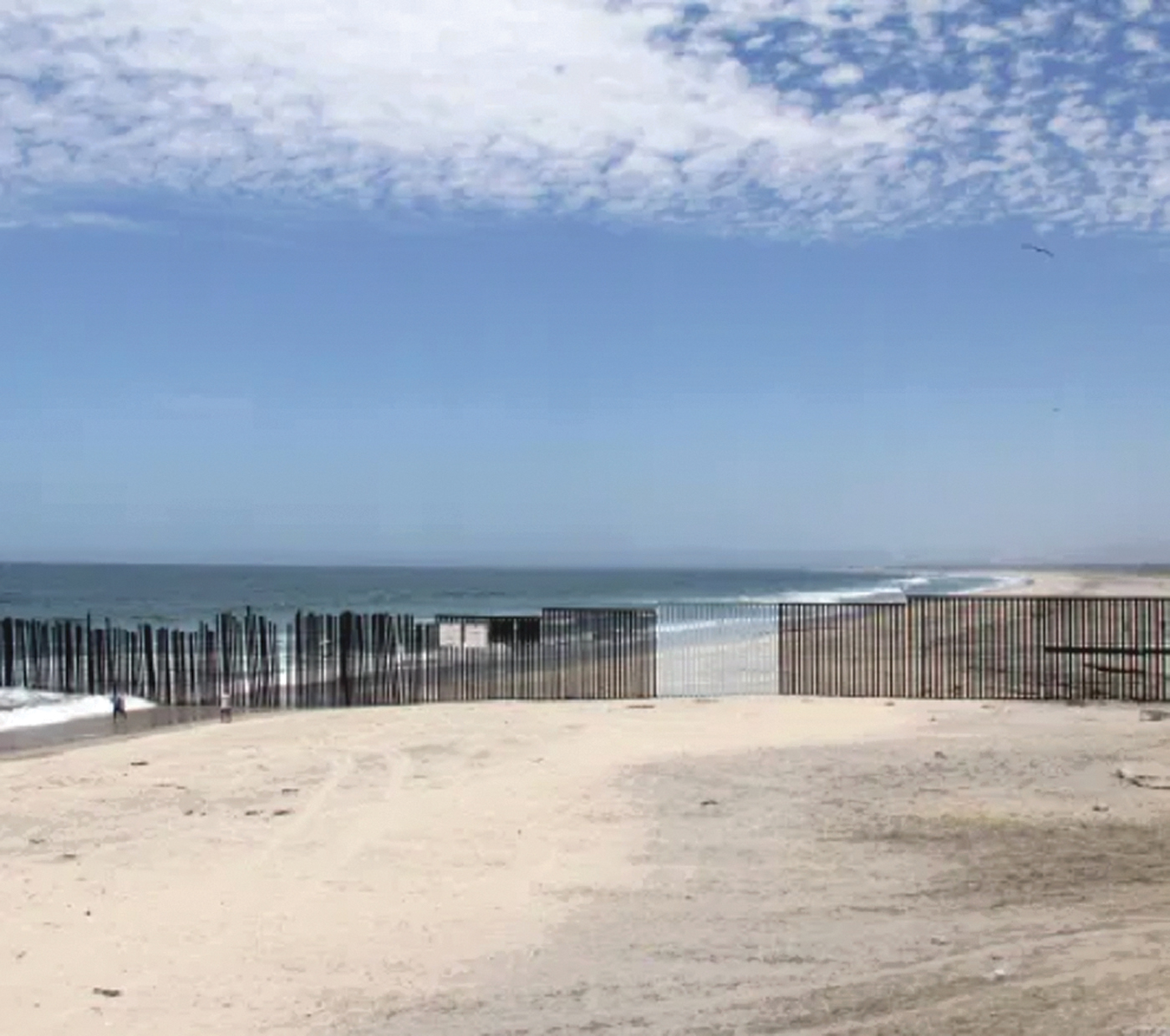
Borrada: Erasing the border. Source: Ana Teresa Fernández (2020).
This article is focused on the Rose Canyon Fault Scenario, a project in which the U.S.-Mexico border became unavoidably important. In the past 30 years, earthquake researchers have learned that the Rose Canyon fault stretching from offshore the coastline of La Jolla to south of the San Diego Bay has the potential to cause dangerous earthquakes. The Scenario was meant to identify geological, physical, and socioeconomic conditions in the region considering what they might mean if, or rather when, the Rose Canyon fault ruptured. The Scenario team took on the project in the hopes that a variety of agencies could incorporate findings into emergency response and recovery planning across the region. However, the binational project presented problems that the team was unable to overcome.
At the time of this writing, published Scenario findings pertain only to San Diego, neglecting a wide geographic swath of territory likely to be affected by a quake on the Rose Canyon fault and failing to account for the essential cross-border nature of economic and social welfare in the region.
We open our discussion of the Scenario with Muller's statement on erasing the border to illustrate a systemic challenge relevant for environmental justice work. We argue that disparities between Tijuana- and San Diego-based Scenario contributors' experiences require explicit attention because they were a key challenge for this effort to learn about, and someday mitigate, the unequal distribution of exposure to environmental hazards in the region. In this article, we contribute to ongoing conversations among risk mitigation scholars and practitioners about how the production of knowledge related to environmental hazards may be conditioned by inequities within expert communities.
We seek to do so through analysis of data from participant observation and interviews as well as material from publicly available reports and presentations produced as part of the Scenario outreach. 4 We first discuss knowledge production related to environmental exposures, situating scenario work as an opportunity for steps toward environmental justice. We lay out the different conditions in the region that make an earthquake scenario of the sort that contributors took on so potentially useful. Next, we consider life on the border. We move on to address the process of building the Rose Canyon Fault Scenario, referring to published reports, documents, and our participant observation as we do so. Finally, we report on interviews with five key Scenario participants to highlight the role they saw the border play in their collaborations.
These five semistructured interviews with key participants such as Muller were conducted in 2019 and 2020, offering insight on work up to this point. Four of these interviews were with people employed in the United States and integrated into the U.S.-focused Scenario work. The fifth was working from Mexico. 5
As we consider how the Scenario represents regional seismic risk and how it came to take its published form, we reflect on how expert communities span national borders and conditions. 6 We call for scholarly and practical attention to the conditions and systems in which knowledge about environmental hazards, as well as exposures themselves, are produced.
ENVIRONMENTAL JUSTICE, HAZARDS, AND KNOWLEDGE PRODUCTION
Compounding forms of social marginalization are crucial determining factors of the negative impact that any hazardous event might have. 7 As Ottinger and Cohen have argued, an environmental justice movement focused on inequities has had a powerful impact on diverse technical and scientific fields, drawing attention to these issues and to the importance for respectful inclusion of populations at risk in decision making and highlighting opportunities for transformation. 8 The recognition of inequities has been a key topic for critique and practical transformation in disaster research and mitigation work throughout the late twentieth and early twenty-first centuries, too. Disaster risk reduction scholarship and practice alike attend to the roles that social structures and human agency have in disasters. 9 Meanwhile, international policy discussion asserts the importance of coordinated local and regional action for risk reduction and effective response. 10
This article responds to calls for critical environmental justice scholarship that focuses on, among other things, how environmental injustices may be enabled by and embedded in extant social systems and power structures; the complexities of marginalization related to variously scaled spatial practice and intersectional forms of difference; and how indispensable communities at risk are to projects seeking to make sense of vulnerability and imagine meaningful change. 11 In the context of this work, we attend to how systemic inequities inform not only exposures to environmental hazards, but also knowledge production related to the potential impact of those hazards.
Focusing on knowledge work offers an opportunity to consider how environmental hazards and the dangers they pose to different communities are understood and become available for justice-oriented intervention. This kind of research can lay bare both “how knowledge claims regarding the environment are generated, packaged, promoted, and accepted by the diversity of actors” (as Goldman et al. put it, p. 4) 12 and the implications of such knowledge claims. Indeed, the production and circulation of knowledge related to hazards can be a crucial opportunity for the very same inequities that already condition effects of hazards to impact lives of the most marginalized communities in ways that compound their exposure. 13
Scholars and practitioners of environmental justice have acted as thoughtful advocates for participatory knowledge production. Environmental data justice efforts, in particular, challenge us to consider producing, safeguarding, and working with data to do the least possible harm and most possible good for minoritized and marginalized populations. 14 Their work with the specific tensions and challenges related to justice has led these scholars to consider issues of accountability, accessibility, and collaborative processes. They contribute to a movement in environmental justice scholarship centering “recognitional justice,” which addresses what meaningful participation in research and advocacy means for marginalized people. 15 We write to interrogate a breakdown in recognitional justice and its effects for the Scenario.
As scenario projects similar to the one we describe here are increasingly common in risk mitigation work, the way they facilitate and confound knowledge production related to environmental hazards merits attention. Wodak and Neale show that scenarios often involve diverse agencies and expertise over periods of years to catalyze policy changes and personal action. 16 Although goals and methods may vary, scenarios run on anticipatory logics. They work to, in the words of Lakoff, “generate an affect of urgency among officials in the absence of the event itself; and… generate knowledge about vulnerabilities in response capability that could then guide anticipatory intervention” (p. 401). 17 Whether a real-time exercise, a tabletop exploration, or a report of the sort that the Rose Canyon Fault Scenario team created, scenarios demonstrate and reproduce the values of the social institutions that develop them.
Many scenarios demonstrate methodological nationalism: that is, they use national statistics and maps rather than approaching risk and hazard with sensitivity to multiple legal and regulatory domains that may be implicated in their work. The Rose Canyon Fault Scenario started as an attempt to approach scenario work differently. In the San Diego–Tijuana region, ordinary life happens across the U.S.-Mexico border and in relation to it. 18 Disaster response and recovery efforts have been shown to do so too. 19 The Scenario team set out to work internationally to create better assessment and to create better policy recommendations for all, but creating a border scenario presented confounding challenges.
ONE REGION, TWO CITIES
The cities of San Diego and Tijuana are often described as a “conurbation” because of their close proximity and mutual dependence. They share a regional population of more than 4 million. 20 There are three main crossings along the 60 miles of national border near San Diego and Tijuana:San Ysidro/El Chaparral, Otay Mesa, and Tecate even farther east. San Ysidro/El Chaparral alone, which brings travelers to and from Tijuana's city center, is the busiest land crossing in the world. 21 Whether crossing as pedestrians or in vehicles, frequent commuters estimate that a trip from one city to another through the border checkpoint at San Ysidro may take as little as 35 minutes. During emergencies, border shutdowns, or busy days, it can take much longer, though. Waiting at the border can eat up hours for many of the region's highly mobile population (Fig. 2).
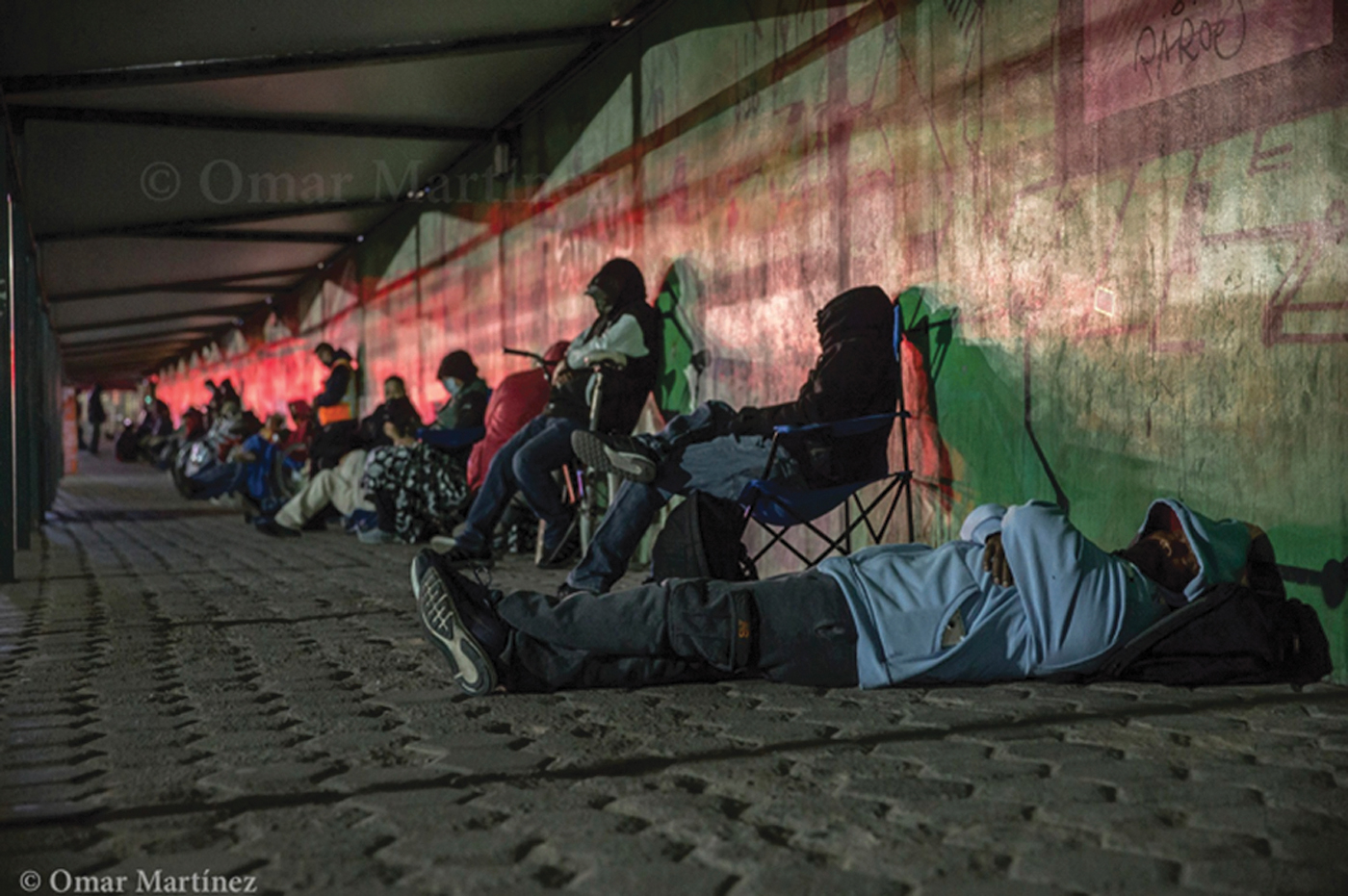
People wait to cross the border from Tijuana to San Diego on a slow day. Photograph: Omar Martinez (May 20, 2020).
People cross the border for many reasons, including work, school, social visits, and practical trips. These people, whether they start their journeys in the United States or in Mexico, are sometimes called transfronterizos. 22 Transfronterizos are not the only people that the border affects, though. The border and the various conditions it makes possible shape the experiences of those who do not cross too. It is a bridge and an obstacle at once. 23 Whatever it is for any individual person, though, it is a necessary condition of the region.
In broad terms, not only have both these cities each come to depend on the international trade and tourism that the border permits, but their different conditions support each other as well: San Diego's high housing costs and Tijuana's comparatively lower ones; the cities' complementary economic sectors and the extreme discrepancies between the average wages offered in the two cities have made them into a single “transborder metropolis.” 24 The cities are simply heavily reliant on each other and movement of people and goods between them. An earthquake of the sort that the Scenario explored would both disrupt life on either side of the border and flows across it, with tremendous ramifications.
The border was not only one condition of a deeply connected region, it was also the subject of international political attention. In fact, the interview with Muller with which this article opened took place only months after U.S. news cycles had become dominated by descriptions of an invasion force of migrants, caravanning together north to the same border that Muller spoke about erasing. U.S. President Donald Trump had taken a confrontational stance toward Mexico, and made a border wall the signature project of his government well before then. 25 While the United States focused on shows of force around the border to bolster Trump's internal support, experiences related to the border wall and related politics in Mexico were different. U.S. leadership's focus on building a wall and limiting migration was seen as insulting and potentially detrimental for international relations by some. 26
However, under Mexican Presidents Enrique Peña Nieto and, subsequently, Andrés Manuel López Obrador, the U.S. and Mexican governments collaborated on border security issues. 27 This was particularly notable during the years of Obrador's presidency, in light of his nationalist policies and reputation for outspokenness.
As polemics and partnerships were conducted at the national scale, Scenario contributors continued to work and travel across the border as so many other people did. The cities are, as detailed above, subject to similar geological conditions. They both have soft and clayey soils. Steep slopes and proximity to fault lines create the potential of landslides and liquefaction. 28 In Tijuana, risks may be greater than those in San Diego due to steeper slopes, urban expansion, and aggravated soil stability. In the event of an earthquake, landslides would be extremely destructive in both cities but impacts are not equally distributed across their communities. In 2018, at least 53% of Tijuanenses were living in informal settlements on live slopes and in flood zones, 29 likely to suffer in earthquakes. A smaller number of San Diego residents lived in informal settlements, but that still meant 5000–9000 homeless individuals. 30
While people throughout the region are likely to suffer in a seismic event, these people will be immediately exposed to dangers. 31 Furthermore, these people are likely to have access to fewer personal resources and institutional support to aid their recovery than people in formal settlements do. While both cities are home to wealthy and poor people, the exposures and vulnerabilities suggested here suggest a need for robust regional attention to the conditions of soils, built environments, and social life—as well as the ways in which we expect impacted populations to react.
Binational social and economic dependence, shared physical seismic hazard conditions, and unequal exposure to the most severe effects that an earthquake might have are all basic conditions of the region. The people who live in and move through this space must navigate inequities with consequences for the knowledge that they can produce and share. However aware of this region's relationships they were, the team working on the topic for the Scenario could never truly “erase the border” from their lives the way that they might from a GIS map.
BUILDING A SCENARIO
A planning scenario for a major earthquake in the San Diego–Tijuana region had been published in 1990. 32 However, changes in the urban space and in geological knowledge suggested to area experts that the plan required updating. 33 In November 2014, earthquake risk mitigation experts came together to discuss the possibility of revisiting the project. By January 2015, a large event space at the University of California-San Diego was filled with interested people from Mexico and the United States. There, academics, policymakers, and emergency management practitioners discussed what it might take to develop an earthquake scenario that would address the implications of the newly characterized Rose Canyon Fault seaming San Diego as well as contemporary regional development while engaging a wide variety of identified stakeholder organizations in the region.
The meetings, and the Scenario effort more broadly, were coordinated by the Earthquake Engineering Research Institute (EERI), a U.S.-based nonprofit technical society focused on reducing earthquake risk through technoscientific advancement, public outreach, and policy development. 34 EERI partnered with RADIUS, a Tijuana-based group focused on providing practical tools for seismic risk management in urban areas, which has been involved in advising policy, organizing drills and events, and conducting community outreach since 1999. 35 Together, a shifting collection of collaborators set out to produce a Scenario that would meet current regional needs.
The Scenario was developed as an effort in research application, not a scientific study to be peer reviewed but a gray literature planning tool. 36 The Scenario would take the form of a report that could be used by policymakers and other local service providers responsible for maintaining utilities, transportation, medical services, as well as contribute to part of outreach efforts. No communities or stakeholder groups were discussed in the Rose Canyon Fault Scenario's mission statement, which highlighted the potential to produce “a vision for a Seismically Resilient San Diego and outline of next steps to take action towards improving the San Diego region's resilience to earthquakes.” 37
During the period in which this research was undertaken, the core group of Scenario contributors comprised roughly a dozen experts based in California and Baja California who might be more or less active depending on the phase of the project, the activities necessary, and their own schedules. The majority of those active at any given time were men, and were employed in San Diego.
Work on the Scenario was divided into projects for three working groups: the first focused on physical seismic effects, the second on structural repercussions, and the third on social and economic factors. These had to be planned, staffed with volunteers and funded consultants, and resources to support computing and work time had to be searched out from EERI and the employers of Scenario contributors. Consequently, work happened in waves. Working Group 1 developed projections of the seismic effects of a rupture along the Rose Canyon Fault quickly, with support from United States Geological Survey scientists. They chose to consider a magnitude of 6.9 scenario earthquake. This would include surface fault rupture, extending from La Jolla along the I-5 corridor and downtown San Diego and splintering into the San Diego Bay, Coronado, and the Silver Strand. They calculated ground shaking that would extend across the international border 38 (Fig. 3).
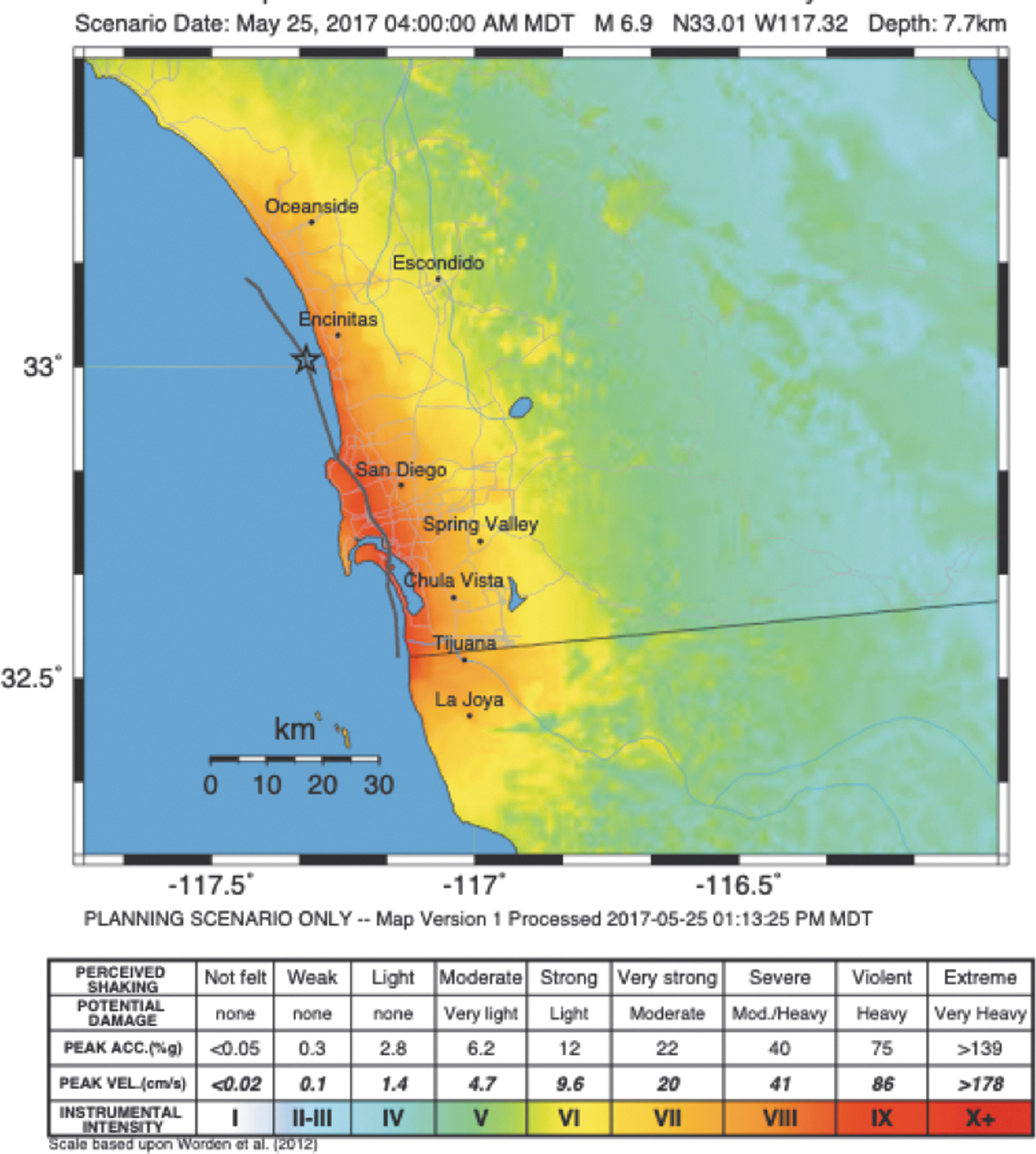
USGS ShakeMap depicting the shaking intensity of a scenario earthquake. Source: EERI (2020). EERI, Earthquake Engineering Research Institute; USGS, United States Geological Survey.
The other working groups built on these analyses. Working Group 2 could develop analyses of structural effects of ground motion using earthquake loss estimation software, Hazus. While this tool has some significant limitations with respect to its inventory and ability to model complex conditions, it allowed contributors to draw on somewhat contemporary data about the San Diego County to produce a rough estimate of what the Scenario earthquake might do. Using Hazus, Working Group 2 could calculate that this earthquake might cause 38 billion USD in harm to buildings and infrastructure. 39 This provided some data for the San Diego team to work with, but it did little to help collaborators in Tijuana.
No software similar to Hazus, with building stock information already uploaded, existed in Mexico. Instead, the leaders in Tijuana decided to use an analogous tool that they would need to upload data into themselves. Creating compatibility with Hazus required at least a year's worth of assessment and database creation. 40 With no funding available to support this work, progress slowed considerably.
Working Group 3 focused on trying to understand the potential social and economic impact of the Scenario earthquake. After long debate about its role and the scope of investigation that it could take on, the working group conducted focus groups with 27 institutions providing essential services based primarily in San Diego rather than attempt to engage U.S.-based community organizations or significantly involve Tijuanense groups. They presented the Scenario preliminary findings and then discussed how emergency services, transportation infrastructure, utilities, and businesses might respond in the moments, days, months, and years after such an event. This work was time-consuming, and EERI found funding to support the U.S.-based leaders of Working Group 3 to undertake it.
Working Group 3 found that disruption to life in the region might extend for months or years, as many structures and infrastructures in the area were built without consideration of what an earthquake in the Rose Canyon Fault Zone might do. Those interviewed often noted the importance that cross-border movement and various forms of agency coordination would have after an earthquake.
While the Scenario teams set out to produce and share knowledge about both Mexico and the United States, doing so became increasingly challenging. Mexican Scenario contributors were able to collaborate on the process to different degrees and at different paces than their colleagues working in the United States. Mexicans were involved in the initial stages of the project, but their involvement decreased over time. The report that was finally published in 2020 did not attempt to tell any story about Mexican possibilities.
Over the development of this report, team members engaged Mexican partners to identify and analyze impacts to infrastructure and challenges to emergency response for an earthquake. Unfortunately, the Tijuana analysis was not complete at the time of this report release. 41
The report that contributors could put together in 2020 was circumscribed by the data that they could collect and analyze. Some of these people, with new colleagues still continue to work to develop a bi-national scenario, but no new work has yet been published.
A BORDER IN SCENARIO PRACTICE
While Muller was erasing the border in ArcGIS, members of Working Group 2 were unable to access similar data on the north and south of the border. Tijuanense members labored to create a database of structural information that would allow them to do calculations analogous to those performed in San Diego. By the time that Working Group 3 began the bulk of its work, in early 2018, the steering committee directed them to focus primarily on San Diegan institutions for social and economic analysis. The border was having practical effects. All five of the core contributors to the Scenario project who were interviewed as the project began to wind down, in late 2018, were sensitive to these. The Scenario was San Diego-focused by this time, but contributors still made strong cases for understanding the region as an integrated binational unit.
One San Diego-based Scenario contributor affirmed the interdependence of San Diego and Tijuana by describing “…economic interaction and transportation.” People and trade, she said “move back and forth across the border, all of which would be affected by the consequences” of an earthquake like the one that the Scenario proposed. The two cities share a great deal and, indeed, are necessarily interdependent. As this contributor put it, there was a great deal in terms of “commonality in terms of earthquake hazard and geology, seismic tectonics… social, economic, trade, et cetera, between San Diego and Tijuana.” 42 Scenario contributors presented the cities as sharing a great deal and as mutually dependent. They described a situation in which any serious analysis would need to take conditions in both cities into account.
However, they themselves did not take responsibility for analyzing the ways in which the cities depended on each other. That was a matter of “people and trade”—topics for Working Group 3, which had been directed to attend only to San Diego. Instead of “people and trade,” these five core contributors' attention to seismic hazard was focused on static things, particularly related to the potential for structural damage of buildings in San Diego and Tijuana. They associated each city with its own uniquely problematic building practices. They discussed how, while historic buildings in downtown San Diego might have been updated to current code, the informal settlements that had been built on ground subject to landslides in Tijuana were of even more concern. Tijuana's building code enforcement has been a problem, especially in the city's informal settlements. All members of the Scenario project team acknowledged this reality as a part of their work.
Indeed, in an interview, the last remaining volunteer based in Tijuana noted that his real interest in the project had to do with the importance of dealing with the challenges in his city. Tijuana's density and disorder were of greater concern to him. He considered anything that advanced safety in Tijuana to be potentially useful. Unfortunately, the kinds of analysis that could be done about San Diego structures were simply more difficult for Tijuana. It was so complicated that it was left to him, and his work was left behind.
It was not difficult for the San Diegans to simply move forward with their work without their Tijuanense collaborators. One reason for this was that, despite the explicit binational focus of the work, the Scenario was mainly coordinated from San Diego. That is where the core team leaders spent most of their working lives. That is where meetings happened. This had implications for how contributors thought about the Scenario. One explained that Tijuana was “more remote from the epicenter of the study” than San Diego was. This was true in terms of the fault rupture being mapped as well as in relation to Scenario organization. He highlighted the San Diego-based team's regular meetings and the plans they were making for the Scenario as the things that made them “epicentral.”
Mexican collaborators were rarely personally in attendance, as these meetings always happened in San Diego. They called in when they could. For all transfronterizos crossed the border regularly, the one remaining Tijuanense contributor noted that it was no small thing to do in the middle of the workday, especially when Mexican President Lopez Obrador's anticorruption regulations could make using work time to cross the border prohibitively difficult for public university professors similar to himself. Decision making and project planning all took place in San Diego, sometimes leaving those in Tijuana without input or feedback to operations and management plans.
The idea of using the Scenario to help spread awareness of seismic risks was accepted with enthusiasm by Mexican contributors and members of the Mexican emergency management organization Protección Civil. Participants on both sides of the border noted that funding was tight, though. Without sufficient funding, participants from both sides of the border described Scenario work as slow. “…A substantial budget for the project would've put an urgency to it and a form to it that would've been able to get through the process much more quickly…,” one San Diego-based participant explained.
The remaining Mexican participant concurred. Mexicans had significantly more time constraints than those based in San Diego, as most of the project leads in San Diego were either retired or compensated by their jobs for dedicating a few work hours each month to volunteer labor, while project leads in Mexico worked multiple jobs. Elaborating on this distinction from his own perspective, one contributor based in San Diego recalled someone leaving:
She's no longer involved because frankly… she just doesn't have the bandwidth between teaching, and doing all the teaching she needs to do to make enough money to live because their salaries are much lower than ours.
43
When EERI was not able to make funding available to Tijuana contributors, their practical ability to participate was limited and they were unable to provide key information in order for the scenario to include the Mexican side. Even though, as one participant reflected, there were always “people willing to participate, people interested in the project, people understanding the need of the project,” participation remained inconsistent. Indeed, contributors described the lack of engagement between Mexico and California as a matter of lack of resources rather than a lack of effort or interest. Researchers from California were able and driven to move forward, and waiting for contributors in Mexico to complete their work was unfeasible for them.
CONCLUSION
It is one thing to recognize that there are both connections between and different capacities related to employment on either side of the border. It is another to consider how these factors may result in technology and data inaccessibility, and even a lack of community and political support. These differences presented a collective challenge, and in failing to meet this challenge the Scenario lost both contributors and knowledge related to Tijuana.
Critical environmental justice theory reminds us how environmental injustices are embedded in and enabled by extant social systems and power structures. Systemic inequities inform exposures to environmental hazards as well as knowledge production related to the potential impact of those hazards. This consideration can support more inclusive scenarios. For example, if a project is undertaken within two culturally, economically, and politically different groups, then it is critical to consider which resources are available to whom, and how best to share those resources and opportunities. Future scenario projects might do well to pursue extra funds and dedicate them to those who most need support, or allow participants with fewer resources to scope plans. Capacity to participate is contextually defined, and having equitable participation may mean dedicating more funds to contributors and participants than traditionally defined.
Tijuanense Scenario contributors were highly educated professionals, not representatives of the most marginalized communities of the region in the conventional sense. Even still, they could have provided crucial insights into issues in Tijuana. When they were unable to participate meaningfully in the Scenario during this time period, none of Tijuana's conditions or effects on the binational region was explicitly considered at all in the resulting report. This is a loss, not only for Tijuana, but also for the Scenario's potential to set out a useful analysis of a complicated region and its seismic vulnerabilities. It is our hope that this article can inspire and inform future researchers and scientists to work more collaboratively, equitably, and justly with communities and participants so as to better reduce the impact of disasters.
As we reflect on the effects of a lack of recognitional justice within the Rose Canyon Fault Scenario during the period of research, it is worth asking what kinds of processes of collaboration and analysis—as well as products—could best create and strengthen regional relationships through conversations regarding earthquake safety. Descriptions of communities in the San Diego–Tijuana region suggest that they have strong capacities related to their connectivity and ability to organize beyond the support of institutions. A Scenario could support these capacities and demonstrated them in its reports. As Julianna Valenzuela, the second author of this paper, wrote in a recent conference paper, “if what we envision is not possible today, in our current system, then we need to change the system.” 44 We hope that, with such efforts, we may find ways to advocate for change within systems of research practice technical analysis, and application that we are still, necessarily, part of.
Footnotes
AUTHORs' CONTRIBUTIONS
This article is the product of participant observation in Scenario project work between 2015 and 2019. As part of this participant observation, E.R. worked as a volunteer. She was later hired by EERI to plan and help lead a series of focus groups with stakeholders identified by the Scenario planning team.
Over this period of time, the first author also observed in internal meetings and larger events held as part of the Scenario effort. After this work was completed, she conducted a series of four semistructured interviews with key participants such as Muller, asking them to reflect on their experiences working on the Scenario, the importance of this kind of Scenario, the importance of making a binational Scenario, and distinctions between U.S. and Mexican participation and products. At this point, this represented the core U.S. team driving the Scenario to completion. She drafted and edited this article.
J.V. became part of the research and writing team in the spring of 2020, after the active research on this project had been completed. She inductively coded and analyzed interview transcripts to discern trends in the ways that the border and collaborations related to the Scenario work were described. She contributed substantially to drafting and editing this article.
G.M. participated voluntarily in the Scenario project without any economic retribution in its early years. Throughout the 2 years she was involved, she participated in the project working on a proposal for the assessment of negative social and cultural impacts, she was the outreach agent with Mexican authorities and institutions and participated in meetings and events in San Diego related to the Scenario. She contributed to drafting and editing this article, and was particularly active in developing theoretical bases for analysis. G.R. joined the Scenario team later. She was hired by EERI as part of a San Diego-based team for the Scenario Working Group 3, investigating social and economic conditions by conducting focus groups with over 27 identified stakeholders.
Focus groups were conducted primarily with San Diego-based emergency services, government, utilities, military, transportation, health, education, business, and NGO groups, although some data were collected from Tijuana-based organizations too. These focus groups helped to identify emergency planning procedures and capabilities, and learn about organizational and infrastructural dependencies and cross-border cooperation. She contributed to the drafting and editing of this article, and was particularly active in developing descriptions of regional conditions.
AUTHOR DISCLOSURE STATEMENT
This paper draws in part on research undertaken while authors E.R. and G.R. were both employed by EERI to contribute to the San Diego-Tijuana Earthquake Scenario.
Funding Information
Elizabeth Reddy and Gabriela Rubio Moreno were hired by EERI as research consultants for research related to the work.