






Abstract
The environmental justice movement (EJM) in the United States has grown in size and in its cultural and political importance in climate and environmental policy circles. This growth has meant that the organizations and leaders that make up the EJM and their respective areas of focus are also evolving. The social movement capacities of the EJM are important predictors of the future success of the movement as the climate crisis bears down on vulnerable communities worldwide. As a part of designing a leadership program for environmental justice (EJ) activists based at The New School, this landscape assessment surveyed and interviewed more than 200 EJ movement activists across the country to explore the priorities, strategies, challenges, and social movement capacities of the EJM. The study reveals that EJM activists work across a diverse set of issues and rank climate justice among their highest priority issues. They overwhelmingly rely on base building, coalitions, and organizing strategies to do their work. In reflecting on the movement's contemporary approaches, activists articulated the importance of shared frameworks such as climate justice to shift popular narratives and action on climate change. The climate justice frame reflects a critical, intersectional, and reconstructive conceptualization of the climate crisis that requires disrupting the status quo approaches to climate change. The study points to some of the challenges and opportunities ahead for realizing such a contentious and transformative climate justice vision led by EJM activists in a moment of expanding political opportunity and risk.
INTRODUCTION
The Environmental Justice Movement (EJM) in the United States has grown and evolved over the past several decades. This movement is composed primarily of grassroots organizations representing frontline and fenceline, Black, Indigenous, People of Color, and low wealth communities. The EJM has not only grown in terms of the total number of organizations self-identifying as environmental justice (EJ) but it has also expanded the landscape of issues and tactics used among movement actors. 1
There is also evidence that the vertical (across movements) and horizontal (within the movement) expansion of the EJM is resulting in greater involvement of EJM actors in decision making at multiple scales. 2 Although EJ organizations have expanded their missions and reach, many share a critical perspective grounded in an analysis of the root causes of environmental injustice produced by dominant political and economic forces that require systemic change. 3 , 4 These critical perspectives carry over into the EJM's articulation of climate justice as well.
The literature on social movements helps inform our understanding of the strategies and impact of the EJM. According to Sydney Tarrow, social movements such as the EJM require certain capacities to be successful, including (1) developing social networks created around solidarity and connections built on a shared identity, (2) putting in place organizations that mobilize these social networks, (3) creating alternative frames and narratives to help people create meaning and make sense together, (4) taking advantage of political opportunities, and (5) employing repertoires of contention in moments of political opportunity, which push for changes in the status quo. 5
Although the study explored these various dimensions of effective social movement capacities, this article focuses specifically on (1) how the EJM prioritizes an alternative, critical framing of the climate crisis focused on climate justice and (2) how this salient framing implicates repertoires of contention to effectively move a more transformative climate agenda. This assessment sheds light on the potential of the EJM for advancing climate justice by using this critical, contentious framing.
METHODS
A landscape assessment study was conducted in an effort to gather input for the design of a national EJ leadership program to be housed at The New School. The assessment set out to better understand the dimensions of social movement capacities that exist and incorporate this input into the program's design. The assessment used qualitative methods, including surveys and semi-structured interviews with individuals identifying as part of the EJM. Although the study reflects the views of respondents self-identifying as part of EJ organizations (surveys) or as part of the EJM (interviews), the EJ movement is not a singular, homogeneous grouping.
The interview instrument included a question asking respondents to reflect on their engagement with/in relation to the EJM. This provided some insight into the views within and among movement actors, while recognizing that this movement is diverse and reflects a broad spectrum of perspectives that may not be fully captured by the scope of this study.
A smaller, purposeful sampling of mainstream environmental organizations was also conducted as part of the survey for comparative purposes, but those results are not included in this article as the focus is on the social movement capacities of EJM actors specifically. 6 The research proposal underwent IRB review and was approved, and informed consent was secured from all participants. This study includes a total of 48 semi-structured interviews with representatives from 39 EJ organizations. 7 Subjects for the semi-structured interviews were identified by using purposive and snowball sampling from a database of 124 EJM activists representing 71 EJ organizations across the country.
Transcripts were provided through the online program REV and were then coded by using inductive, pattern matching analysis of the text. NVivo software was utilized to aid in the grouping and identification of themes across the interview data. All interviews were conducted confidentially unless the respondent indicated a desire to be identified in the study results, and respondents were anonymized by using NVivo.
A total of 167 surveys were completed, out of which 116 were self-identified as affiliated with an EJ organization. Only the responses of individuals self-identified as part of an EJ organization are reflected in this article and characterized as EJM responses. The survey was disseminated primarily through 17 movement networks, representing more than 640 member organizations. 8 A uniform survey instrument was administered through a Qualtrics platform, ensuring anonymity and was designed by using a Likert scale and close-ended multiple-choice questions and two open-ended questions.
One of the key limitations of the study was the inability to capture the full spectrum of EJ organizations across the United States, particularly those that are less networked or more geographically or digitally isolated. The database developed for this study represents a snapshot of the EJM, with a bias for those organizations that are well represented in the EJM networks used for sampling.
RESULTS
Movement Priorities
An understanding of the issues that are at the forefront of a movement's efforts helps reveal how the movement is framing problems and prioritizing their agenda. 9 Among respondents, climate justice (76%) was ranked most frequently as a priority issue, followed by air pollution and cumulative impacts (52%), just transition (47%), energy democracy (46%), and toxics and chemicals (30%). The interview results further support the survey findings of priorities, with more than half of the interview respondents specifically naming climate justice and just transition as priority areas of work.
One of the reasons behind this focus on climate justice and just transition may be the importance of integrating the intersecting issues that the movement addresses. One activist describes these priorities, “What we are seeing are intersections and the need for alignment between the issues in our communities and being able to put more of a just transition lens on the work that we do in addressing, not only, climate justice but the many harms that communities face” 10 (Interview 3).
Movement strategies
The strategies employed by the surveyed organizations reflect the underlying values and theory of change that shape EJM actions. In the survey, EJM respondents ranked grassroots organizing and base building (72%), followed by coalition-building (56%), and policy or public advocacy (52%) as their top strategies. Even with the rise of horizontal and vertical movement networks, activists still identified grassroots, place-based work as critical for movement success: “We need spaces where EJ folks nationally or regionally have spaces to network, coordinate, and work together to become more powerful for their local work. But in order for the EJ and CJ [movements] to continue and not die, it's so important to continue the model of grassroots work too.” 11 (Interview 6)
Grassroots organizing plays an important role in a social movement's effectiveness by mobilizing collective action frames and building political pressure for larger societal change. 12 For some organizations, base-building is explicitly tied to a political project of building power and deepening a critical framework and collective consciousness, “We really invite people to join because of the commitment to a vision, not just to whatever issue is sort of the hot thing of the moment, that could be part of building a movement and building power at a scale that we need to see” 13 (Interview 33).
Direct action and civil disobedience were among the least frequently selected tactics (5%) by survey respondents, despite this being a large part of the legacy of the EJM. The social movement theory suggests that repertoires of contention are critical to a movement's effectiveness and that conflict is also a productive catalyst for cognitive liberation in which communities awaken to the possibilities for challenging and then transforming systems that produce inequality. 14
One interviewee reflects on how direct action builds collective identity and solidarity: “…and we do marches, direct actions, we incorporate this into creating a new participatory democratic way that differs from just electoral politics…and more and more people participate and your consciousness starts opening up and you start finding a lot of commonalities within different communities that are also struggling or also want to organize” (Interview 23).
One activist reflected on the need to invest in more oppositional, disruptive forms of activism to be able to achieve success at a scale needed to impact global systems, “if are we taking EJ seriously, then it's not just about being steeped in our stories, it's about real tactical strategic thinking that I don't think a lot of our [EJ] movement has….Not knowing the difference of when you should escalate or when to consider more options…There's so many ways to fight a war and we will verbally say we're at war but then not educate ourselves on war tools…How do you get real militant about this and organize like the Zapatistas…what we're messing with is an empire” (Interview 43).
Direct action may not be the only expression of contention in use by the EJM. The tactics most frequently ranked in the survey responses may reflect a spectrum of approaches that embed contentious forms of organizing, policy making, and coalition building. The prioritization of a climate justice framework suggests that EJM activists are adopting approaches that can upend status quo approaches to climate change. Although interviewees recognize the disruptive nature of these models, there are still questions about how well equipped the EJM is to deploy the contentious strategies that these frameworks necessitate. 15
Challenges to the success of the EJM
Despite the growth and influence of the EJM, there are key challenges that face the success of the movement. 16 In the survey responses identifying the greatest challenges to the EJM, “funding” ranked first (56%), “political climate and receptiveness” was second (47%), and “capacity to organize/expand base” and “inadequate regulatory and government responses” were tied for third (40%). The EJ organizations have been historically under-resourced relative to mainstream environmental groups, thus it is not surprising to see a lack of funding ranked as one of the greatest challenges. 17
This under-resourcing is particularly important to consider in the context of trying to deploy repertoires of contention and using alternative climate justice framings to shift popular narratives in the face of well-funded and politically powerful reformist groups, the state, and industry opposition: “A material difference between the environmental justice movement and other civil rights, or even human rights movements, is that we're regularly going against industries with very deep pockets and political influence. And the industries' power, the sheer financial and political weight and the narratives they're able to craft and embed in society, will continue to be our main opposition to overcome.” 18 (Interview 17)
Among the challenges faced by the EJM is not just government and industry opposition, but also repression, violence, and criminalization of activists. These concerns were detailed by one activist, “I don't think a lot of folks that we work with are paying attention to the new laws that are coming, that are making it illegal to protest, and the militarization of police forces…I think we'll see these types of laws turned in the most sinister way against Black bodies” (Interview 48). As more and more EJ groups deploy contentious climate justice tactics, these repressive actions may pose a greater threat to EJM activists.
Another critical challenge facing the EJM that leaders reflected in the interviews was the sheer scale and pace of change needed to move systemic change, particularly around climate justice. The EJ leaders discussed both the pragmatic and theoretical struggle to connect their local work to global efforts, to disrupt the status quo, and to advance alternatives that can replace current systems, “To think about rewiring, over a period of time, a new system is a huge challenge…the big obstacle is at the rate we need to do it, to get to the level of functional understanding, to begin to truly disrupt the systems that we see now. And at the same time, be prepared with the alternatives. Then to have the ability to make mistakes and experiment along the way, knowing that new systems don't emerge just because the past system is in crisis or is failing” (Interview 46).
In this context, tackling climate change is viewed as both an ecological and a structural problem with an important temporal element, “With climate we have a short time to do something meaningful and the communities most directly impacted are least resourced. The nonprofit structure is not conducive to addressing the reality of the problem we face” (Interview 14). The interviews further reveal some of the challenges of scaling or connecting the grassroots work of EJ organizations to national policy wins and global struggles for deeper transformations on climate justice, “…working with groups on the ground, detecting a pattern from that work, and then marshaling an effort that can go beyond what any particular community could do. I think that mode of work is absolutely essential to the survival and the advancement of the [EJ] movement at the scale that we need to build in environmental justice” (Interview 46).
These challenges represent some of the current political opportunities and risks facing the EJM. 19 The following discussion delves into some of the insights about the transformative potential of the use of climate justice as an alternative framing shaping the EJM as well as the contentious and critical nature of such a framing to advance climate action.
DISCUSSION
One of the most interesting findings resulting from this snapshot of the EJM is the shared articulation and prioritization of climate justice as a critical framework animating the work of movement activists. This salient theme can be seen in Figure 1, which illustrates the themes, strategies, or needs identified from the interviews conducted with EJM activists. The themes that were most often mentioned by interviewees included climate justice, just transition, and energy democracy, with climate justice being the most frequently mentioned.
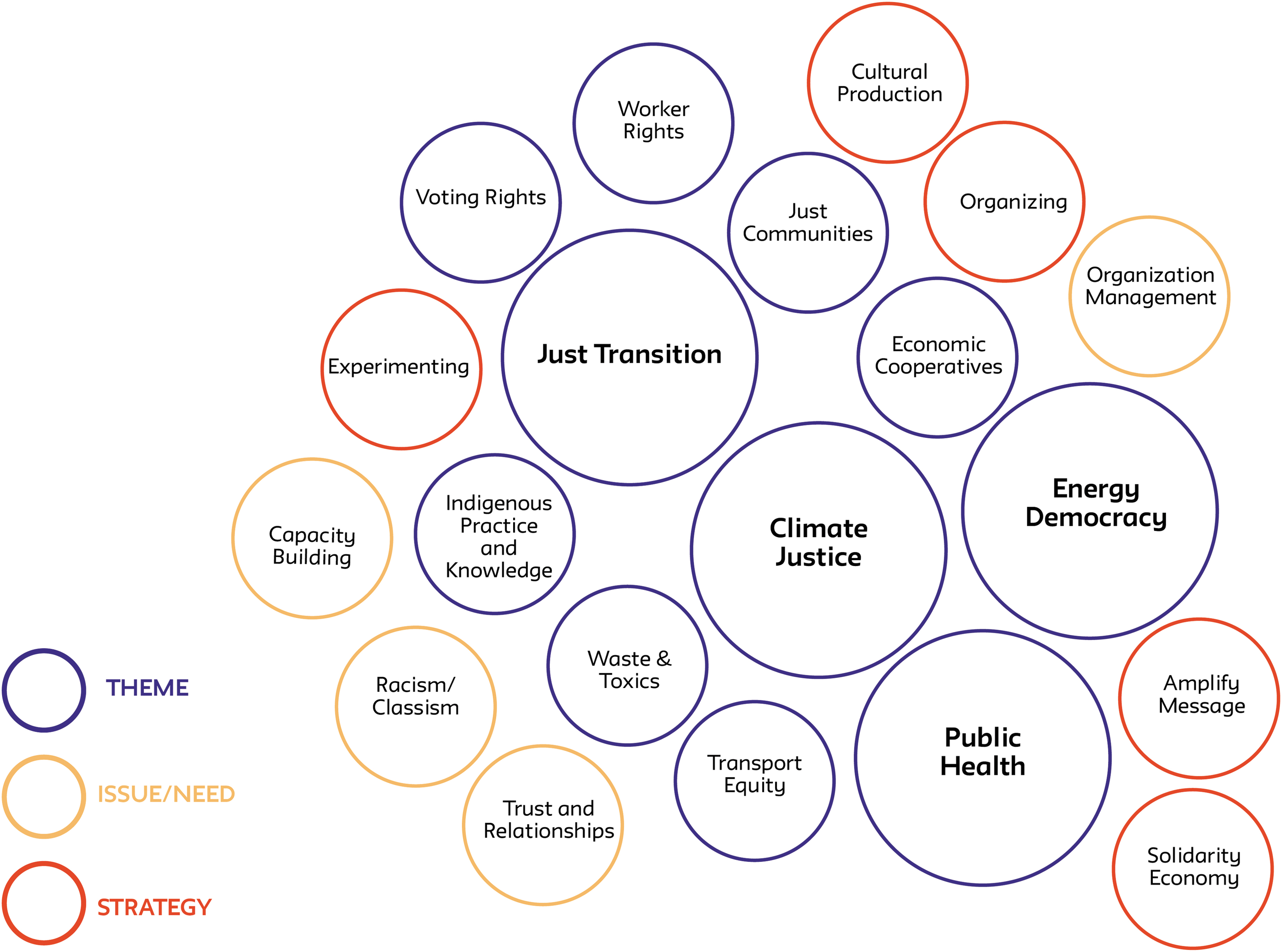
Emergent themes from EJ leader interviews. The yellow circles indicate issues or needs, the red circles indicate strategies used by the field, and the purple circles are the overarching themes or frameworks. The size of the circles reflects the frequency of mention of these terms in interviews or open-ended survey responses. EJ, environmental justice. Color images are available online.
Climate justice is not a new issue for the EJM but this issue has become a more prominent priority issue over the past two decades. This climate justice framing also reflects a critical perspective on climate change, challenging dominant political economic systems, that diverges from more reformist climate advocacy. 20 The lineage of the EJM's climate justice framing can be traced from the Bali Principles to the Durban Group on Climate Justice to the World People's Conference on Climate Change in Cochabamba (2010). 21
Brian Tokar also details four aspects of the climate justice framework used by the EJM that make it a transformative and critical approach to climate change: (1) focus on disproportionate impacts and frontline solutions, (2) links economic policies that drive climate change to inequality, (3) intersectional approach to climate, and (4) link up resistance to reconstructive activities that articulate alternatives. 22 These characteristics suggest that climate justice framings require a robust set of social movement capacities that can disrupt the status quo political and economic systems that are driving inequality and climate change.
These four characteristics are evidenced in the interviews with EJM activists as they reflect on how they approach climate change. For example, one activist reflects on these distinctions, “These wealthy folks who care about climate change are coming up with a set of strategies and solutions. We already know that what they're going to come up with are (A), not really going to get to the root causes of these crises and (B), aren't going to really be representative of what frontline communities need. So where are the examples where frontline strategies and solutions have arisen or are rising?” (Interview 10).
Another interviewee reflects on their ability to move a much more ambitious climate agenda as an alternative to market based approaches, “….we're moving a pretty big climate justice agenda that draws on intersectionality using the moment that the Green New Deal has allowed for our scrappy little organization in [the State] to be able to get some airtime around what real climate policy looks like, outside of the marketplace mechanisms that seem to have captured the imagination of our quote-unquote ’climate champions' ” (Interview 18).
The climate justice frame also embodies both resistance to the status quo and a reconstructive view of alternative futures. One of the most dramatic examples of this are the reflections by interviewees (mentioned in 10 interviews) on the significance of the Standing Rock campaign. The Standing Rock or Dakota Access Pipeline (DAPL) protests represented a grassroots movement to stop the construction of an oil pipeline that would run near the Standing Rock Reservation. These protests garnered national and international attention as indigenous activists and peaceful protestors were met with violence.
This protest reflected not only a direct resistance to fossil fuel industries but also a rejection of capitalistic aims and an affirmation of indigenous culture and values that embody an alternative vision of society tied to ecological and social justice and Indigenous sovereignty. 23 The significance of this protest is described by one activist as, “Standing Rock shifted the way that we talk about what needs to happen…for a generation of folks who have been looking for some sort of hope, some sort of political platform for climate justice, Standing Rock is the center of gravity for the way that people talk now about climate” 24 (Interview 16).
Standing Rock is seen as a solidarity-building moment, shifting the public narrative around the crisis of climate change, and as a portal for advancing an alternative vision to achieve climate justice. 25 Although interviewees suggest that Standing Rock did not result in a clear policy win, it was still seen as a hopeful marker for the EJM's ability to use repertoires of contention to both resist the status quo and construct transformative alternatives focused on climate justice.
The interviews also reveal that the increased attention to climate justice by the EJM may be due in part to a reaction to external pressures that are both ecological and political. Interviewees discussed the increasing impacts of climate change on EJ communities already under immense pressure from a legacy of toxic pollution and racism. Thus, their prioritization of the issue is a direct response to these disruptions, “… the work around climate change and all the intersections around climate change is one of the greatest or catalytic movements that I've seen in recent years…There's just a certain level of extremeness that is happening in our communities… and so it leads us to being prepared and having a plan of action in an extreme situation” (Interview 38).
Set in this context, climate change is a significant external threat to the system that can break open the kinds of political opportunities that can upend business as usual. The EJ leaders interviewed reflect on the inherent risks and opportunities of this context for the movement, “When I think about the environmental justice movement, climate, of course, is a huge, huge, massive threat multiplier to all these things…how well equipped is our movement [EJM] to actually lead on some of these issues looking towards 2020, the openings for federal climate legislation and what are the transformative approaches to dealing with inequality in a climate crisis” (Interview 20).
The EJM's climate justice framing comes at an important moment when the terms of the debate and responses to climate change are being actively contested. 26 , 27 , 28 The unprecedented speed, magnitude, and impact of climate change can radically transform our global economic, social, and political systems within a decade. 29 The ability of the EJM to respond to the urgency of the moment and drive large-scale shifts depends partly on the robustness of the movement's capacities (i.e., mobilizing broad base, building effective coalitions, shared alternative framings, seizing political opportunities, deploying repertoires of contention, etc.).
One EJ leader reflects on the EJM's readiness for such a political opening, “…it's like these psychic openings, these forces that all of the sudden break open something…how does the organizational infrastructure [of the EJM] then end up advancing to actually make longer term policy changes? And that's the part that I don't think we've [EJM] figured out just yet” (Interview 1). Standing Rock is just one example of how the EJM can seize openings to advance a climate justice framing using repertoires of contention, but translating these narrative shifts into gains on a global scale will require strong social movement infrastructure. “At this moment in time, transition is now inevitable, justice is not” (Interview 10).
This study suggests that EJM activists and organizations are already organizing around a salient and critical climate justice framing, but there is not a clear indication of how well equipped these groups are to deploy contentious strategies when the political opportunities arise to advance this vision.
CONCLUSION
This landscape assessment reveals the key priorities, strategies, challenges, and social movement capacities of EJM activists in a moment of political opportunity and urgent climate risk. The top priorities include climate justice as well as legacy issues such as air pollution. The study also explored some of the aspects of social movement capacities within the EJM via in-depth interviews and confirmed a strong reliance on and capacity for base building and organizing at the grassroots level.
There was also evidence of a focus on shifting the narratives and culture around climate change by using climate justice as a shared alternative framework. Some of the greatest challenges that EJ leaders mentioned included a lack of funding and opposition in moving policy wins related to these more transformative frameworks.
The study reveals that the climate justice frame used by EJM leaders reflects a critical and transformative framing of climate change relative to status quo climate responses. However, this climate justice framing implies an approach that will necessitate more contentious strategies across many systems at a global scale. Although there seems to be an interest in or appreciation for contentious strategies among some of the EJ leaders interviewed, direct action tactics were ranked among the lowest for priority strategies used by EJ activists surveyed.
Thus, there are important questions that remain about the EJM's capacity to move large-scale, disruptive changes rapidly, using robust repertoires of contention. Key investments in particular social movement capacities, such as repertoires of contention, may be needed to support the EJM's leadership at a moment when the climate crisis demands an unprecedented response.
Footnotes
ACKNOWLEDGMENTS
The authors are grateful to all the EJM leaders who shared their time and insights with the authors. They are also grateful to Anna Yulsman and Michael Harrington from the Tishman Environment and Design Center for their support of the landscape assessment.
AUTHORs' CONTRIBUTIONS
A.I.B., S.J., M.G., and A.P. contributed to the study design, data analysis, and writing of this article.
AUTHOR DISCLOSURE STATEMENT
No competing financial interests exist.
FUNDING INFORMATION
Funding for the original study titled “EJ Movement Landscape Assessment: Priorities, Strategies & Just Transition” on which this article is based was provided by The Northlight Foundation.