






Abstract
Access to high-quality infrastructure such as housing and energy supply can enhance access to opportunities and protection from harm, including through resilience to climate and weather hazards. Climate change poses new and dynamic challenges for infrastructural adequacy, compounding challenges of existing long-term underinvestment. In the United States, historical infrastructural choices such as redlining have substantially contributed to the structural marginalization and intergenerational wealth disparities experienced today by Black, Latinx, and other groups. This marginalization manifests in part as social vulnerability to disproportionate infrastructural and other hazards, which, without active intervention, is likely to continue to increase as climate change progresses. Adaptation to climate change will require a massive mobilization of resources for new and enhanced infrastructures. Future infrastructural investments must not repeat or mirror the unjust patterns of the past, nor facilitate their continuation through patterns such as reactive investments made based on financial value. In this commentary, we argue that the effects of climate change on future equity and resilience are particularly salient in the context of existing disparities in residential energy burden, specifically related to the way that future energy and housing system choices could worsen these disparities without explicit effort. We describe the intersection of two major anticipated climate-driven changes: (1) climate migration, which is expected to disrupt communities and change patterns of housing and energy needs; and (2) energy burden, which is expected to be exacerbated both by climate change itself (e.g., through higher temperatures) and by interactions among mitigation strategies (e.g., electrification in colder climates receiving low wealth climate migrants). Anticipating climate migration and shifting residential energy needs could facilitate a more just energy transition, focused on avoiding locking in extreme energy burdens and protecting people from extreme temperature events. Preemptive planning and targeted infrastructural investments can enable just transitions and community resilience.
Introduction
Infrastructure is a relevant determinant of adaptive capacity, defined as “the potential or ability of a system, region, or community to adapt to the effects or impacts of climate change,” 1 for two major reasons. First, when it is performing well, infrastructure can actively protect people from hazards and directly facilitate recovery (e.g., through passively survivable buildings or evacuation routes). Second, when it is performing poorly, infrastructure can actively enhance hazards and prevent recovery (e.g., through collapsed buildings and blocked roadways). Even without the enhanced threat of climate change, to date, United States built infrastructure systems such as housing have largely failed to facilitate equitable community-level resilience to hazards due both to physical (e.g., availability of affordable housing 2 ) and institutional (e.g., building codes 3 ) failures.
Indeed, past infrastructural choices such as redlining policies, 4 exclusionary zoning practices, 5 and differentiated transportation accessibility 6 and affordability 7 are widely understood to have caused or significantly contributed to persistent systematic differences in wealth 8 and other negative outcomes 9 for racially and ethnically marginalized groups, 10 most explicitly the Black community. 11 The observable long-term structural impacts of past U.S. infrastructure policy on minoritized communities motivates careful examination of how climate change-prompted adaptive infrastructural investments might contribute to or mitigate future societal injustice.
Throughout this commentary, we consider impacts on vulnerable communities broadly, including those of low wealth and income in general as well as those who face particular challenges based on structural racism, many of whom are also low wealth. Given the particular role of past infrastructure policy on the disproportionate burdens faced by minoritized communities of color in the United States, however, we specifically highlight these burdens as evidence of the power of infrastructure policy to mediate social justice outcomes.
Infrastructural injustice is a particularly salient issue in the face of climate change, given that specific low income and Black and/or Latinx communities are already more vulnerable to environmental disasters 12 and resources are often more available for protecting or rebuilding assets with higher financial value. 13
As the climate deviates further from historical norms, with respect to both routine conditions (e.g., shifts in temperature and precipitation regimes) and hazardous conditions (e.g., increased frequency and intensity of hazards), many of these communities will be at even greater risk 14 due to the increasingly wider gap between available and adequate infrastructural resilience. Existing income and intergenerational wealth disparity 15 could exacerbate the challenge of lower infrastructural resilience and less access to high-quality infrastructure in racialized and often geographically segregated communities, 16 due both to differentiated societal investment and differentiated ability to purchase personal resilience.
Civil infrastructure systems that already suffer from underinvestment 17 are expected to face new challenges as climate change continues to expose these systems to conditions beyond design standards. 18 For example, buildings that historically have not required air-conditioning to maintain safe temperatures might now routinely require it, and existing air conditioners might be undersized for extreme heat wave conditions.
Income and intergenerational wealth inequality contributes both to observed disparities in locational safety of Black, Latinx, and other marginalized ethnic communities 19 and the safety of the condition of the housing itself. 20 As such, there is both an opportunity and a need to plan and predict the impacts of climate change to ensure that new infrastructural development does not repeat or fail to stop historical patterns of structural exclusion. In this commentary, we specifically focus on how climate change might affect residential energy burden in the United States, and how housing and energy infrastructure planning with explicit attention to distributional effects could reduce risks of locking in high energy burdens and low resilience to extreme temperatures for low wealth households and structurally marginalized communities.
We raise two major considerations for enhancing equity and resilience through housing infrastructure in the context of residential energy burden, which we use in this study to refer to energy consumption in a residence (i.e., excluding transportation burden). First, climate change is expected to contribute to climate migration, wherein people and groups relocate either reactively in response to a climate disaster (e.g., a hurricane 21 ) or proactively in anticipation of a climate threat—for example, as a result of managed retreat away from coastlines threatened by sea level rise. 22 Sea level rise on the coasts is expected to increase population in counties that buffer the coastal communities, 23 whereas extreme temperatures in the southwest region are expected to push populations northward, 24 causing regional-scale population redistributions.
Simultaneously, climate migration could disrupt communities in ways that reduce access to noninfrastructural determinants of adaptive capacity, 25 such as strong social networks, familiarity with a location, and personal investments in resilience, putting greater pressure on adequate infrastructure as a determinant of adaptive capacity. As such, accounting for climate migration changes expectations for where new infrastructure such as housing will be needed, and to what extent it might be critical for enabling resilience, with an opportunity to build a more just infrastructure base. Housing design has long-term substantial effects on residential energy burden and safety from extreme temperatures, and strategies for improving equity and resilience vary by location.
Second, climate change could increase energy burden, or share of income dedicated to home energy costs, 26 both directly and indirectly. Higher temperatures could increase demand for cooling, which is often a major share of household energy demand. Home and vehicle electrification, widely understood to be a key climate mitigation strategy 27 because it enables a transition away from direct use of fossil fuels for heating and transportation, could increase costs if not managed carefully, due to the need for new capital investment (e.g., for a heat pump or induction stove) and the relatively higher historical cost of electricity versus natural gas (although note that electric vehicles are generally cheaper to operate than internal combustion engine vehicles 28 ).
Particularly in colder climates that might be expected to receive climate migrants, heating electrification could pose major energy burden challenges without careful implementation, 29 especially for low-income and low-wealth newcomers. Safety concerns, particularly for people who might not be accustomed to the danger of extremely low temperatures when making “heat or eat” choices, 30 could also be serious. Emphasizing energy efficiency in residences could be a key enabler of resilience both to temperature and to cost burdens if implemented with equity as a priority.
Recognizing these two infrastructural considerations for improving equity and resilience under climate change, focused on societal and personal scale infrastructure in the form of climate migration (i.e., infrastructural location) and building efficiency (i.e., infrastructural condition), we argue that planning with an explicit emphasis on equity is needed to facilitate a just climate transition that does not replicate observed historical inequities that disproportionately burden low income, low wealth, and Black, Latinx, and other marginalized groups. In this study, we define just transition as a political process associated with power, distribution of and access to resources 31 with an emphasis on material well-being 32 during a transformational infrastructural shift.
In the following sections, we first examine the current status of U.S. housing energy insecurity. Then, as climate change could exacerbate these injustices without intentional intervention, we describe how climate change projections could inform understanding of where proactive housing energy infrastructure planning could have especially substantial equity and resilience benefits due to anticipated climate migration. We end with a view of potential interventions in the U.S. housing sector as an example of how proactive planning aimed at reducing the risk of locked-in energy burden and ensuring indoor temperature safety could improve resilience and equity. This piece argues that proactive, equity-focused planning, and design are necessary to disrupt business-as-usual residential energy injustices, particularly given that climate change is expected to make such injustices deeper and more dangerous.
Where we are: Housing Energy Infrastructural Injustice
Ensuring that housing is equitably available and in appropriate, protective condition is a major priority for enhancing resilience in structurally marginalized communities. One of the major problems that future climate change impacts could exacerbate without intervention is energy insecurity, which is disproportionately experienced by low income, Black, Latinx, and other marginalized groups. 33 Energy insecurity is “the inability to adequately meet basic household energy needs” 34 that manifests in three primary dimensions 35 : economic (e.g., financial hardship 36 ), physical (e.g., deficiencies in home infrastructure 37 ), and behavioral (e.g., coping strategies 38 ). This insecurity is a major problem, as energy use is directly tied to quality of life, as well as safety and sometimes access to life-saving conditions. 39 Given the importance of housing and active policy discussions about allocating federal investment in housing specifically, 40 we focus on energy insecurity in the form of residential energy burden in this piece, although many similar concerns apply across other built infrastructures.
Low-income households across racial and ethnic groups pay a larger percentage of total income for residential energy, at ∼14%, versus 3% for other households. 41 As such, low-income and low-wealth groups can be in difficult positions and might not be able to afford essential energy use. Choices such as whether to spend limited money on food or heating are sufficiently common that they have a name: the “heat or eat” dilemma. 42 When subsidized monetarily, low-income groups consume more energy services due to the lower cost burden, 43 which suggests that use is suppressed by the cost burden. There are significant justice concerns for structurally marginalized communities that have high energy costs and are in vulnerable housing without dependable heating and cooling systems. 44
As Figure 1 shows, low-income households are more likely than high income households to be uncomfortably cold for 24 hours or more in a year, and race is correlated with heating adequacy even across income levels: although differentiated geography and other factors likely contribute to these trends, observationally, non-Hispanic Black households are proportionally more likely to be uncomfortably cold for 24 hours or more than non-Hispanic white households at every income level. Data were insufficiently resolved to evaluate outcomes for other racial groups by income level or for Hispanic-origin households by race, although total values suggest that other historically marginalized groups (e.g., Hispanic-origin vs. non-Hispanic origin and American Indian or Alaska Native vs. any other group) experience higher incidence of uncomfortable cold than their less marginalized counterparts. 45
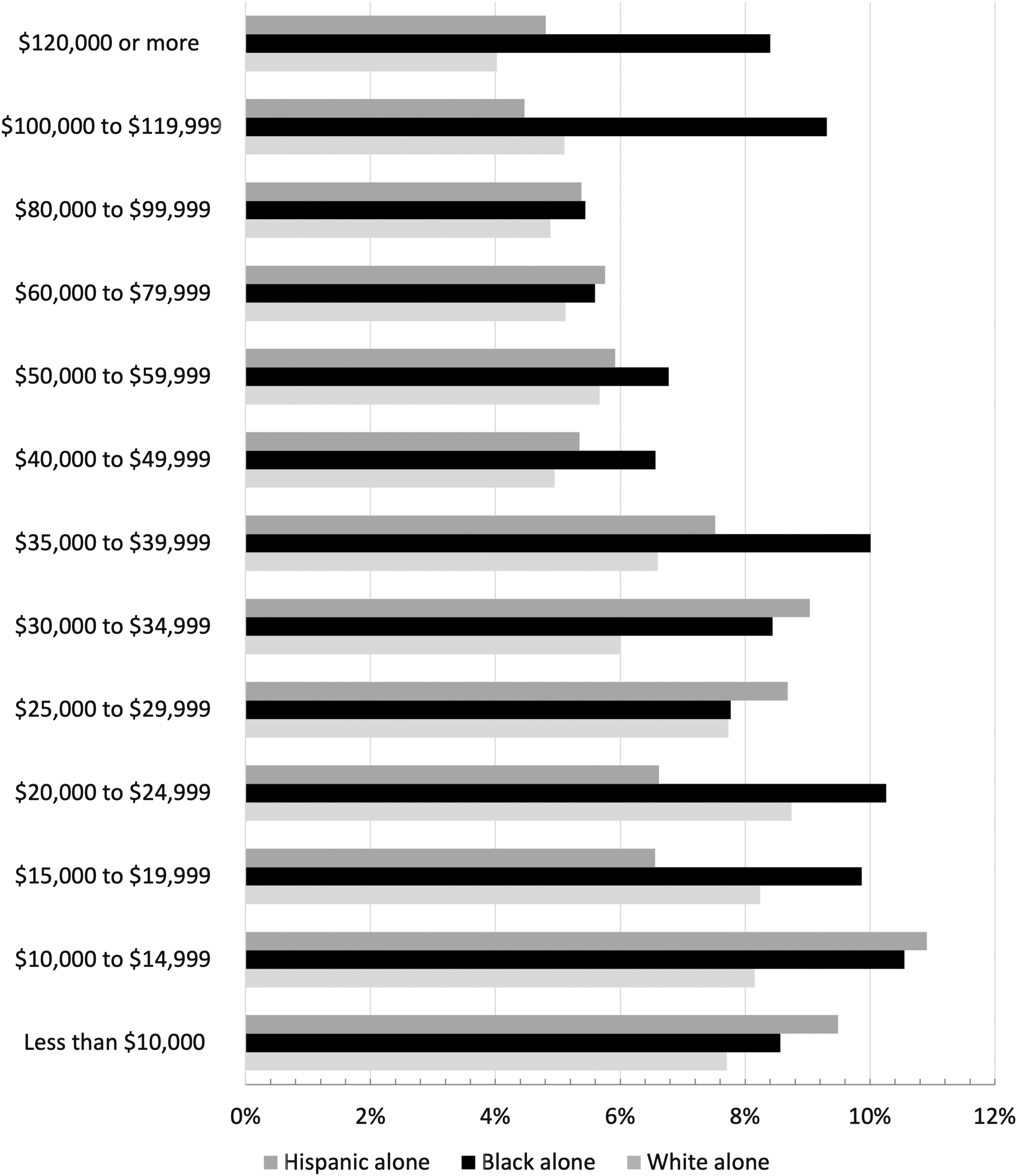
% Heating Problems: Uncomfortably cold for 24 hours or more (American Housing Survey, 2019).
Physical failures include subpar housing location and conditions that result in inequitable access to basic utilities and necessities. 46 Disproportionate infrastructural inadequacy manifests in two primary ways: location and condition, which results in an increase in susceptibility to damages from various environmental hazards and changes in extreme temperatures and precipitation regimes. Substandard housing manifests in the location where structurally marginalized communities live, which causes these groups to be more exposed, 47 living largely in areas more prone to flooding, 48 wildfires, 49 and extreme temperatures. 50 Furthermore, the condition of housing that is occupied by these groups is more likely to be inadequate, for example, when it is made from subpar materials, is older and insufficiently maintained, is energy inefficient, or has structural deficiencies and/or appliances that are outdated or faulty. 51
Moreover, the inequality in income, wealth, and access to resources and opportunities that Black, Latinx, and other marginalized ethnic communities experience means that some important determinants of adaptive capacity are likely less available to these communities than to nonmarginalized (often wealthier and whiter) communities that are more able to rely on both personal investment and societal investment in their neighborhoods. 52 Lower wealth results in being uninsured or poorly insured against disasters, inability to accumulate wealth in assets (e.g., housing) and in savings, and inability to rely on personal wealth to prepare themselves and their homes for disasters. 53
As climate change progresses, it has become clear that without active intervention emphasizing equity and aiming to reverse historical patterns of structural exclusion, low income, low wealth, Black, Latinx, and other marginalized ethnic communities are vulnerable populations and are likely to continue to be disproportionately affected, as environmental hazards will only exacerbate energy insecurity. 54 Recognition of such disparities has contributed to development of the environmental justice movement, with the goal of ensuring that all people, regardless of ethnicity, nationality, origin, or income, have access to safe environments and protection from environmental hazards. 55
As such, principles of environmental justice have increasingly been incorporated to concepts of climate justice that recognize that climate change disproportionately affects certain vulnerable communities. 56 Recognizing that infrastructural investment can mitigate risk and enhance resilience to hazards, understanding current deficiencies in housing, inequitable investment patterns, and expected future infrastructural needs is crucial for planning a just transition that mitigates historical harms and adapts to uncertain futures.
Compounding the reality that vulnerable communities often have lower quality housing, we might expect systemic disparities in who gets to stay in place under hazard conditions (e.g., due to reactive and wealth-oriented spending). Low income, wealth, or racially segregated people might have higher incentives to move (e.g., due to lower opportunity to stay in place under acceptable conditions) or be forced to move (e.g., due to destruction of their home).
As we describe in the next section, with the progression of climate change, where proactive investment is needed is expected to change due in part to both preemptive (e.g., managed retreat 57 ) and reactive (e.g., hurricane resettlement 58 ) climate migration. In particular, climate migration could create new housing demand by low-income and low-wealth newcomers, potentially in different places than have previously been migration targets. In addition, consideration must be made to address how these regional population shifts will impact energy demand throughout the continental United States (e.g., increased demand for heating due to population growth in colder places), particularly as the energy system is electrifying and decarbonizing.
What is Coming: Regional Population Shifts and Changes in Energy Infrastructure
Regional climate change impacts are expected to result in climate migration across the United States, as increasing climate hazards influence where people can and/or wish to live. The resulting population shift has major implications for how the location of adequate housing infrastructure might equitably promote resilience to climate change.
Climate change models suggest there will be certain regions in the United States that will be more exposed and/or more vulnerable to climate risks in the future. For example, the Gulf Coast will experience more, and more severe, storm events, the Northeast will experience increase flooding, coastal towns will experience the impacts of sea level rise, and the West will be at an increased risk from wildfire events. 59 That is, regions across the United States are expected to experience varying climate change impacts with equally varying results, with increased chance that vulnerable populations will experience multiple hazards (e.g., drought, hurricanes, flooding, and sea level rise) that place them at greater risk. 60
Who gets to stay in place in the face of disruption? Previous disasters (e.g., Hurricane Katrina) suggest that the decision to return home after evacuation is dependent on household income level, where middle-income households are more likely to return and rebuild. 61 It is also dependent on race: after Katrina, Black households delayed their return to New Orleans due to experiencing more severe damages to their homes, making returning a more lengthy process. 62 Vulnerability is also magnified by where low-income households are able to relocate, often moving into areas that are equally or more exposed as their previous residence due to affordability, perpetuating a vicious cycle. 63
This observation raises the mirror question of: who is able to choose to move proactively to safer locations, given that moving is expensive and often highly disruptive to community ties? And, who is at risk of being forced to move proactively, with agency limited by access to options? Wealthier communities, and those with existing high-quality housing infrastructure, are more likely to be able to rebuild or remain in place, suggesting that climate migrants might disproportionately be members of vulnerable and marginalized ethnic groups. 64 Disruption to community ties, loss of local assets, and the cost of moving are likely to further exacerbate disparities in adaptive capacity and resilience without explicit attention to equity.
Receiving cities could experience a steep growth rate as a result of climate migration. Retreat away from the coast 65 is anticipated to shift populations from coastal communities to cities that are not coastal, but are near the coasts, with model projections suggesting such cities could experience a net amount of migrants of >100,000 by the year 2100 under the representative concentration pathway (RCP) 8.5 scenario, with a 1.8-m sea level rise (e.g., Austin, Texas; Atlanta, Georgia; Houston, Texas receiving 250,000 migrants). 66 The RCP 8.5 scenario is an unlikely extreme case. 67 Nevertheless, it is not yet possible to rule out a 2-m sea level rise by 2100. 68
Climate-driven population redistribution is also expected to result from changes in temperature. 69 Electricity demand will likely increase in regions that are projected to experience higher temperatures, with small towns and rural populations experiencing more stress to their service areas than larger cities. 70 The increase in exposure to extreme heat will also cause more people to become vulnerable, so it is crucial to investigate future extreme heat events with population distribution dynamics. 71
It is also important to consider that migrants may be relocating from customarily warmer climates to colder climates (e.g., a family moves from New Orleans to Minneapolis, or Puerto Rico to Massachusetts 72 ). As a result, this population may be in an increased vulnerable state due to overall higher energy needs and less intuition about safety thresholds when making decisions mediated by energy costs. Moreover, effective interventions vary by region: for example, heat pumps might require natural gas or resistance heating backups in the coldest areas of the United States. 73 Ensuring that available appropriate housing does not lock in long-term energy burdens or dangerous conditions is a priority for housing investment.
This shift in population will increase burden on infrastructure systems, in particular the housing stock.
As the climate continues to change and challenge current living standards, it is likely that migration will increase, and it may be possible to (somewhat) predict where people might migrate to or out of, 74 although further research in this area is necessary. Planners should consider the redistributive potential of climate impacts when designing justice-centering, proactive housing infrastructure programs, in particular with a focus on zoning regulations, building codes and policies that center equity and energy efficient building designs. Lessons in preparing for rapid population growth and degrowth alike can be drawn from experience with boomtowns, 75 which demonstrate the importance of flexible design and infrastructural rightsizing. So far, possible population growth from climate migration is largely not incorporated in decision making. 76
In thinking about all these issues in tandem there is an evident tension between the receiving community (locals) and the incoming community (migrants). Although available, green-energy-efficient, and effective housing stock is desirable for migrants and receiving communities alike, it is crucial to avoid eco-gentrification that results from improvement projects causing displacement of lower income, often nonwhite residents. 77
Similarly, managed retreat from risky areas (e.g., those at risk of sea level rise, extreme temperatures, and storms) is potentially a valuable adaptive strategy but one that could easily result in increased segregation based on access to resources. Climate change will cause harm, but explicit planning and updating building codes, zoning regulations, and policies could help to minimize felt harms and provides a major opportunity for infrastructural interventions, such as abundant, accessible, and energy-efficient housing, which could address historical structural injustices.
Where we Could be: Anticipate Population Shifts and Energy Changes for Housing Energy Justice
Under climate change, communities that have not recently seen major population growth might attract migrants (e.g., the Midwest) 78 with an attendant need for housing stock that is energy-efficient, affordable, and safe. To avoid long-term energy burden lock-ins while simultaneously protecting occupants from extreme temperatures, new housing stock will need to prioritize passive energy and new strategies for energy efficiency. Major federal investments in housing should consider these dynamics, ensuring policies, zoning regulations, and building codes are in place that support a more equitable and energy-efficient housing stock, when needed.
Residential energy efficiency is an urgent concern, since impending challenges that come with the changing climate, migration, and changes to energy infrastructure that impact residential energy demand in ways that could exacerbate historical inequities and structural injustice without careful attention. We must correct course, and design with intentionality to ensure equity. Not doing so risks ongoing displacement and disparity in housing equity, risking that historically marginalized communities are also future marginalized communities. 79
Fortunately, strategies exist that can dramatically improve the resilience of housing to temperature extremes and costs in particular. With effort, a large portion of newly constructed buildings could be net zero energy buildings (NZEBs), with major advantages for utility bills and passive safety in the face of extreme temperatures. As climate change will impact the energy sector in various ways (e.g., increase temperature loads, outages with natural hazard damages), NZEBs could be major contributors to climate resilience, due to being essentially self-sufficient from an energy perspective. 80 NZEBs are not necessarily more expensive up-front versus conventional buildings. 81
NZEBs have the potential to be cost-effective, 82 but care must be taken to choose building components carefully based on region, climate, and efficiency goals alongside cost. 83 Moreover, policy has been a major obstacle in their implementation, 84 with opportunities to remove such barriers. Such new buildings could also be designed with climate adaptation in mind, incorporating and anticipating climate change projections during the design phase of building construction. 85 For proactive infrastructure investments, such as in cities that are expected to grow in response to climate migration, ensuring new build homes are highly energy efficient (e.g., through local building codes) and designed for future climates is a key resilience strategy. Ensuring that proactive policy also emphasizes equitable distribution of high-quality infrastructure is also a resilience priority.
A just transition that prioritizes material well-being for all as society simultaneously mitigates and adapts to climate change must include explicit recognition of and action to correct major infrastructural inequities that lead to severe and disproportionate burden in specific communities. Although burdened communities can and often do display resilience even in the absence of adequate infrastructure, where “resilience” is defined as “the ability to prepare and plan for, absorb, recover from, and more successfully adapt to adverse events,” 86 the fact that communities might be able to compensate for underinvestment with other resources 87 is not a substitute for equitable societal investment in infrastructure that can enhance safety and facilitate thriving. Such compensatory possibilities, however, do not excuse societal-scale infrastructural investments from a focus on equitable distribution of resources.
Conclusion
Infrastructural disparities in the United States have contributed to injustices and structural marginalization in specific communities, including low income, low wealth, and Black, Latinx and other marginalized ethnic communities, which are likely to experience additional excess risk due to the threat multiplication of climate change. Moreover, migration associated with climate change will unduly impact these communities, because they are more likely to need to move, less likely to be able to overcome challenges by paying for personal resilience, and more dependent on nonfinancial determinants of adaptive capacity that might be lost during moves. Thus, it is crucial to anticipate that potential for historical injustices could become even worse future injustices without intervention by explicitly considering distributional effects of future infrastructural decisions.
Buildings are one specific target for equitable infrastructure investments to enhance resilience, given existing high energy burdens for vulnerable groups and anticipated growth in electricity demand and energy costs resulting from climate change adaptation and mitigation. When combined with information that already exists about likely climate migration and known strategies for improving infrastructure, such as building energy efficiency, infrastructure planning that emphasizes equity can improve resilience to climate change for vulnerable people.
Footnotes
Acknowledgments
We thank the reviewers for their thoughtful comments and efforts toward improving our article.
Authors' Contributions
A.M. and E.G. conceived of the present idea and contributed to the writing of the article.
Disclaimer
The opinions expressed in this study are the authors' own and do not represent the opinions of the program or the Robert Wood Johnson Foundation.
Author Disclosure Statement
No competing financial interests exist.
Funding Information
A.M. is a scholar in Health Policy Research Scholars, a national leadership program supported by the Robert Wood Johnson Foundation. It supports scholars from diverse disciplines and backgrounds in applying and advocating for policy changes that improve health and equity (