






Abstract
Introduction:
Automated skills assessment can provide surgical trainees with objective, personalized feedback during training. Here, we measure the efficacy of artificial intelligence (AI)-based feedback on a robotic suturing task.
Materials and Methods:
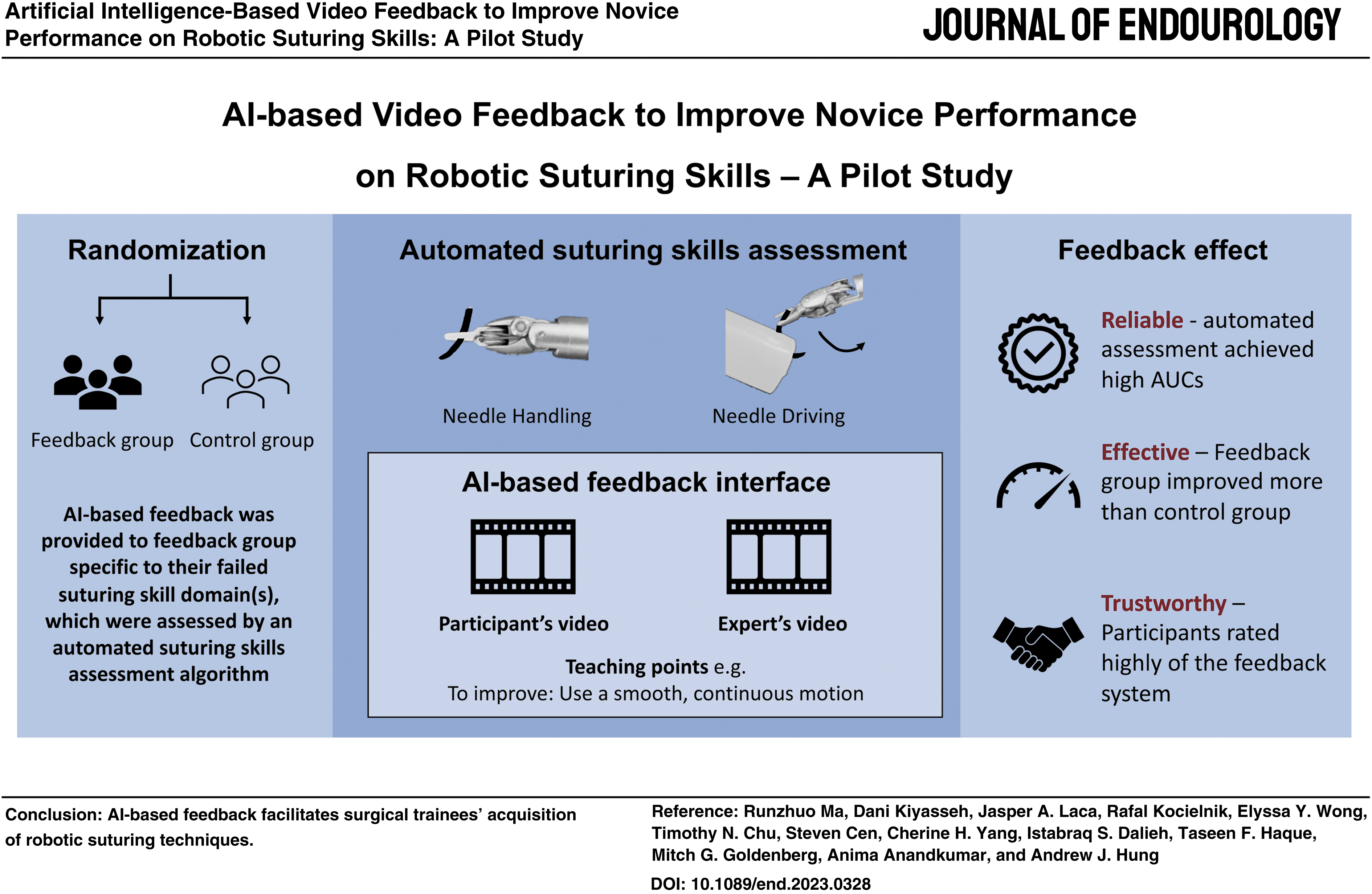
Forty-two participants with no robotic surgical experience were randomized to a control or feedback group and video-recorded while completing two rounds (R1 and R2) of suturing tasks on a da Vinci surgical robot. Participants were assessed on needle handling and needle driving, and feedback was provided via a visual interface after R1. For feedback group, participants were informed of their AI-based skill assessment and presented with specific video clips from R1. For control group, participants were presented with randomly selected video clips from R1 as a placebo. Participants from each group were further labeled as underperformers or innate-performers based on a median split of their technical skill scores from R1.
Results:
Demographic features were similar between the control (n = 20) and feedback group (n = 22) (p > 0.05). Observing the improvement from R1 to R2, the feedback group had a significantly larger improvement in needle handling score (0.30 vs −0.02, p = 0.018) when compared with the control group, although the improvement of needle driving score was not significant when compared with the control group (0.17 vs −0.40, p = 0.074). All innate-performers exhibited similar improvements across rounds, regardless of feedback (p > 0.05). In contrast, underperformers in the feedback group improved more than the control group in needle handling (p = 0.02).
Conclusion:
AI-based feedback facilitates surgical trainees' acquisition of robotic technical skills, especially underperformers. Future research will extend AI-based feedback to additional suturing skills, surgical tasks, and experience groups.
Get full access to this article
View all access options for this article.
References
Supplementary Material
Please find the following supplemental material available below.
For Open Access articles published under a Creative Commons License, all supplemental material carries the same license as the article it is associated with.
For non-Open Access articles published, all supplemental material carries a non-exclusive license, and permission requests for re-use of supplemental material or any part of supplemental material shall be sent directly to the copyright owner as specified in the copyright notice associated with the article.
