






Abstract
Some previous attempts to foster societal reconciliation through electoral reform have failed to deliver expected outcomes or introduced unforeseen challenges. In this article, we analyze the D21 electoral system, which belongs to the family of electoral systems intended to moderate election campaigns and reduce societal polarization by allowing for the use of multiple votes. Recognizing the fundamental premise that no electoral system is flawless and can excel in all possible performance criteria, we argue that D21, as a specific representative of vote-for-k methods, offers a balanced set of expectations. We support this claim through comparisons with other voting methods based on criteria related to social utility, strategic behavior, and expected administrative costs and complexity. In the case of social utility and strategic behavior, we conduct comparisons based on well-established criteria. As for administrative costs and complexity, given its unique nature, we rely on the only available concept that we have adapted for the purpose of comparing majoritarian electoral systems. D21, when employing only plus votes, performs reasonably well in all three areas with no significant expected deviations compared to other voting systems. Conversely, the optional minus vote in the D21 method makes strategic behavior easier and causes some administrative challenges.
INTRODUCTION
Debates over the ideal electoral system are perennial, with various systems proving suitable for specific contexts. In discussions concerning divided societies, scholars have debated the merits of proportional representation (Lijphart, 1977) and the soft-power of electoral systems to encourage cooperation and mutual support among social groups (Horowitz, 1991, Horowitz, 2004; Reilly, 2002; Emerson, 2007). Recent societal polarization in formerly moderate countries (Carothers & O’Donohue, 2019) raises questions about electoral systems that can moderate competition and whether they are administratively feasible and resilient against strategic behavior.
For instance, the alternative vote (AV), advocated by Horowitz (2004) and Reilly (2002) for divided societies, requires a literate electorate, complex winner selection, and a long interim until final results. Its limitations were evident in Fiji’s 1999 Parliamentary elections, where the invalid vote rate surged to 9.2% from around 1% in previous plurality elections (see Hartmann, 2001, 644–672). Since each electoral system has pros and cons, a balanced system is crucial, rather than one that excels in some aspects but fails in others.
In this article, we present the D21 method (D21), an electoral system designed by Karel Janeček, a Czech mathematician and entrepreneur. The method acquired its name by shortening Janeček’s vision of Democracy 2.1, as he introduced this voting system aiming to aid democracy through its presumed effects of reducing political polarization, boosting voter turnout, and enhancing political engagement (Janeček, 2021). The method has already found application in numerous instances of participatory budgeting (Kukučková & Poláchová, 2021; Sedmihradská et al., 2022) and has been subjected to testing against various scenarios, where its outcomes were compared with the plurality rule (e.g., & ., Gibbs & Chappell, 2021) and the two-round electoral system (Oreský & Čech, 2020; Gibbs & Cheerakathil, 2022). Analyses have so far validated the moderation effect of this method, even within a limited number of observations. However, its broader comparative qualities remain rather unknown.
D21 is a voting method characterized by a systematically limited number of multiple plus (positive) votes, allowing voters to cast more votes than there are winners but fewer than there are candidates. It seeks to preserve the key benefits of multi-vote methods—such as reducing vote splitting, minimizing incentives for strategic voting (SV), and encouraging positive campaigning (Brams & Fishburn, 2010; Emerson, 2012; Weber, 1995)—while emphasizing strong voter preferences.
D21 shares traits with other Approval voting (ApV) derivates like Restricted Approval Voting (RAV) (Baharad & Nitzan, 2005) and “vote-for-k” methods (e.g., Saari, 2023) designed to address ApV’s drawbacks. Unlike these methods, D21 systematically limits the number of votes, allowing for voting for a single candidate with set maximums, making it a specific case of RAV. As a subvariant of the vote-for-k category, D21 offers insights into a broader group of voting systems that allow voting for a fixed set of candidates.
Even minor changes to ApV can have significant impacts. Baharad and Nitzan (2005) suggest that lowering the vote limit, as in D21 and RAV, may more effectively produce a majority winner than ApV. However, this adjustment could also affect election outcomes, strategic behavior, and electoral management, areas that are often underexplored, even more so for these modified variants. While ApV has been studied extensively (see e.g., Brams & Fishburn, 1978, 2010; Felsenthal & Nurmi, 2018; Hamlin & Hua, 2023; Niemi, 1984), evaluations are often fragmented, focusing on a narrow set of criteria. Administrative expectations (see Reynolds, Reilly, and Ellis, 2005) for alternative electoral systems also remain underdeveloped compared to those used in global parliamentary elections.
In addition, one variant of D21 incorporates minus (negative) votes, akin to Combined ApV (Felsenthal, 1989) or disapproval voting (Alcantud and Laruelle, 2014). However, in D21, the number of minus votes is both limited and conditional (as detailed below). Testing this variant offers a deeper insight into this specific approach within alternative voting methods.
Our goal is not only to present and analyze the D21 method but to situate it within the broader context of studies evaluating voting methods across various criteria. Although D21 shares similarities with ApV, it warrants separate analysis because other ApV-derived systems lack such extensive comparative evaluation and their performance on many of the criteria examined here is largely unknown. By adopting this comparative approach, we can better assess the true strengths and weaknesses of D21. We thus provide a comprehensive comparison with other voting systems, consolidating existing knowledge on well-known methods into a single source.
D21 can be applied to both single and multi-mandate elections. However, this study focuses on its majoritarian version, as multi-member elections require different comparative criteria. D21 can also be modified to allow a minus (negative) vote to counter polarizing candidates. Throughout the following sections, we differentiate between two D21 variations, as they exhibit significant differences across comparative criteria. We will refer to the version of D21 with only plus votes as “D21+” and the version including minus votes as “D21−”.
The question at hand is how both variations of the D21 method compare to other prevalent majoritarian electoral systems across various criteria, including social utility, administrative demands, and resilience against strategic behavior. We essentially adhere to Felsenthal and Nurmi (2018) recommendations to consider not only the social utility criteria but also administrative-technical criteria. These include the requirements of the voters, ease of understanding how the winner is selected, ease of executing the elections, minimizing the temptation to vote insincerely, and discriminability—the system’s ability to select a unique winner (Felsenthal & Nurmi, 2018, 127–128). Therefore, we provide an evaluation of the expected electoral administration requirements, focusing on voter education, counting results, and the count (detailed below). We also address strategic behaviors, all of which align with Felsenthal and Nurmi’s criteria, respectively. We omit the discriminability criterion, agreeing with Smith (2000) that it does not play a significant role in actual political elections.
In addition to D21, we examine commonly used electoral methods such as plurality voting/first-past-the-post (FPTP), the two-round system (TRS), and instant runoff/ranked choice voting/AV. We also explore widely-debated alternatives such as the Borda count (BC), ApV, and majority judgment (MJ). These systems aim to mitigate societal tensions by encouraging moderate campaigns through broader voter appeal and multiple voting options. Previous studies on these methods provide common criteria and results for comparison, both of which we utilize in our analysis.
Following our exposition of the D21 electoral system, we conduct a comprehensive comparative analysis against other voting methods. We consolidate dispersed knowledge from various studies, structuring our analysis into three sections: social choice theory, strategic behavior, and administrative demands. Given the scope of this article and our reliance on established indicators used in similar studies when evaluating D21, the precise definitions and operationalization of individual criteria are detailed in Supplementary Appendix SA1 and Supplementary Appendix SA2.
D21 METHOD
D21 is a voting method used in both single-winner and multi-winner elections, allowing voters to support multiple candidates similar to ApV. However, unlike ApV, D21 systematically limits the number of votes each voter can cast. The core idea of the method is to allow more positive votes than there are winners, promoting campaign moderation (see Brams & Fishburn, 2010), yet fewer votes than candidates, ensuring that voters focus on strong preferences. This approach helps mitigate the erosion of the majority principle seen in ApV (Baharad & Nitzan, 2005). D21 comes in two variants: D21+, allowing only positive votes, and D21−, which includes also negative votes. Formulas for the recommended number of votes in different scenarios are provided in Supplementary Appendix SA3.
As this article discusses single-winner elections, the formulas in Supplementary Appendix SA3 determine that D21+ and D21− allow up to two plus votes when a race has three to eight candidates. 1 For more than eight candidates, up to three plus votes are permitted. In addition, in D21−, voters can cast one minus vote if there are more than three candidates, provided they cast at least two plus votes. In elections with three candidates, ApV and both D21 variants are essentially the same method. Therefore, later in the article, we omit simulations with three candidates to better illustrate the differences between these methods.
As mentioned above, the utilization of multiple plus votes under D21 is expected to produce effects similar to ApV. Unlike plurality voting, the allowance of multiple votes mitigates the problem of vote splitting (Dellis & Oak, 2007) since voters can lend support to up to three (or two) candidates if they so choose. In addition, this method encourages sincere voting behavior, as is also expected under ApV (see Brams & Fishburn, 1978), allowing voters to support their favorite candidate(s) while also indicating support for their preferred frontrunner. This reduces the number of wasted votes significantly. Moreover, the provision for multiple votes motivates candidates to engage in more positive campaigning (Kabre et al., 2017), as they enhance their odds of victory by garnering support not only from their core electorate but also from their rivals’ plurality voters.
Notably, polarising candidates encounter challenges in gaining supplementary backing, thus D21+ presents hurdles (Oreský & Čech, 2020), as do other multi-vote methods such as approval or disapproval voting (Baujard et al., 2014). The inclusion of the minus vote in D21− amplifies this effect. This mechanism also augments information about candidates, helping identify candidate profiles and thus more precisely reflecting voters’ preferences. Implementation of the minus vote option could potentially elevate voter turnout (Dolinski & Drogosz, 2011).
An important question may arise: Why adopt the D21 method when it yields effects similar to those of established voting systems like (dis)approval voting? The primary distinction lies in the constraints imposed on the number of votes. D21, by focusing exclusively on strong preferences, reduces the risk of elevating bland candidates as winners, a criticism commonly directed at ApV, though likely overstated (see Alós-Ferrer & Granić, 2012; Brams & Fishburn, 1988, Brams & Fishburn, 2010).
Assume voters rank candidates from 1 (most preferred) to n (least preferred). A strong candidate, ‘s’, has polarising support, often being the first choice for a specific group of voters but lacking broader backing. A bland candidate, ‘b’, has broader but less intense support, often being the second or third choice for most voters. Let Ps(E) represent the probability of electing a strong candidate in electoral system E, and Pb(E) for a bland candidate.
In FPTP, where voters select only one candidate, strong candidates have a high chance of winning: Ps(FPTP) = max (c/v), where c is the number of votes for the candidate and v is the total voters. Bland candidates have a low chance: Pb(FPTP) ≈ 0. In ApV, voters can approve any number of candidates, lowering the chance for strong candidates and increasing it for bland ones.
In D21, where voters choose two or three candidates, strong candidates have higher chances than in ApV but lower than in FPTP. The probability of a strong candidate winning is higher than in ApV, as voters must be more selective, favoring strong candidates. However, the probability of a bland candidate winning is lower than in ApV but higher than in FPTP, because voters can still support bland candidates, though with greater selectivity. Thus, we can conclude:


It is also expected that the limited number of votes will enhance the likelihood of identifying a majority winner (Baharad & Nitzan, Baharad & Nitzan, 2005), thereby addressing a key shortcoming of ApV. The forthcoming analysis aims to confirm these expectations and uncover additional advantages or potential drawbacks of the method. In addition, the minus vote in D21− adds a unique dimension; enabling voters to disadvantage a candidate they vehemently oppose.
Empirical examinations of evaluative voting (e.g., Baujard et al., 2014), where voters grade each candidate on a given scale, demonstrate that voters readily employ minus votes when given the option. Consequently, an abundance of minus votes could conceivably result in a scenario where all viable candidates receive negative votes, primarily due to their higher visibility. It could be argued that such a situation is unlikely to materialize in actual elections.
The idea of limited variable votes (where voters may but need not use a specific number of votes) is not entirely novel. In the first four U.S. presidential elections, eligible voters could vote for up to two candidates (Nagel, 2007). However, the runner-up assumed the role of vice president, rendering these elections distinct from conventional single-winner contests. Fishburn and Gehrlein (1977) referred to this method as ‘vote for no more than x candidates’ and categorized it as a variable voting rule. While they explored its Condorcet efficiency (CE), in this article, we delve much deeper into scrutinizing the voting approach represented by the D21 method.
SOCIAL CHOICE THEORY CRITERIA
Different voting procedures can produce varying outcomes (e.g., McCune & McCune, 2024; Song, 2023) even with fixed voters’ preferences. Therefore, it is imperative to identify desirable attributes of voting rules to compare their feasibility. Social choice theory offers numerous criteria to assess the effectiveness of voting methods. Felsenthal and Nurmi (2018) propose multiple for evaluating single-winner voting methods, framing them as paradoxes—undesirable election outcomes to avoid. In this context, we investigate the susceptibility of the D21 method to these 13 paradoxes. 2 In addition, we incorporate three additional criteria-later-no-harm, local independence of irrelevant alternatives, and independence of clones-as they are often discussed within the literature of social choice theory.
Condorcet winner paradox
D21 is vulnerable to this paradox, demonstrated by the example:
Suppose there are 10 voters with the following preferences (brackets are used for the candidate(s) who receive a vote from voter(s)):
6 voters (A>B)>C>D 4 voters (B>C)>D>A
Here, A is the Condorcet winner as it is preferred over each alternative. However, under D21, B emerges as the winner with 10 votes while A only garners 6. 3
Absolute majority winner paradox
The example from the first paradox can also be applied here, as A was the absolute majority winner (ranked first by 60% of voters). Therefore, D21 is vulnerable to this paradox.
Condorcet loser paradox
D21 is vulnerable to this paradox, demonstrated by the example:
Consider the scenario:
6 voters (A)>B>D>C 4 voters (B)>C>D>A 1 voter (C>A)>D>B 4 voters (C)>B>D>A
A is the Condorcet loser, ranked last by an absolute majority of voters. However, under this scenario, A would be elected under D21.
Absolute majority loser paradox
D21 is vulnerable to this paradox, as demonstrated in the example of paradox 3 where Candidate A is not just the Condorcet loser but also the absolute majority loser.
The pareto paradox
D21 is vulnerable to this paradox. Consider the scenario:
2 voters (A>B)>D>C 1 voter (C)>A>B>D
Here, A is the Condorcet winner, and there is a tie between A and B. If ties are resolved randomly, there is a 50% probability that B is elected. If B were elected, it would demonstrate that a Pareto-dominated candidate can be elected under D21 as all voters prefer A to B.
Additional support paradox (lack of monotonicity)
D21 is not susceptible to the lack of monotonicity, as increasing candidate X’s support will either maintain the number of X’s votes or increase it.
Reinforcement paradox
D21 is not vulnerable to this paradox because it consistently elects the alternative that attains the plurality of votes from any given electorate. Consequently, if two separate electorates, each awarding candidate X the plurality of votes, are combined into a single electorate, candidate X will still secure the highest number of votes. Therefore, candidate X will be elected by D21, provided that improving a candidate’s position does not alter its approvability status (the ability to receive plus votes under D21). In other words, candidates initially receiving “plus” votes will retain their status after improvement, and likewise will disapprove candidates.
Truncation paradox
D21 is vulnerable to this paradox. Consider the scenario:
50 voters (A>B)>C 5 voters (B)>C>A
In this D21 scenario, B emerges as the winner. However, if 50 voters were to truncate their votes, their most favored option, A, would prevail.
No-show paradox
The D21 is not vulnerable to the No-Show Paradox. The selected alternative, X, is defined as being ranked first (or second or third) by the (simple) majority of voters. It can be only replaced by another winner, say Y, if some voters who originally ranked X as their first (or second or third) choice abstain from voting. The abstention of any other voters would only increase X’s majority margin. Moreover, those who originally ranked X as their first (or second or third) choice cannot gain an advantage by abstaining, as doing so would decrease X’s majority count, possibly even leading to X not winning. Therefore, under D21, no voters can benefit from abstaining. This holds true under the assumption that improving a candidate’s position does not alter their approvability status. In other words, candidates initially approved will remain approved after the improvement of their position, and likewise will disapproved candidates.
Twin paradox
D21 is immune to the Twin Paradox. On the contrary, the more voters with the same preferences vote for the same alternative(s), the more likely that alternative will be selected by D21.
Violation of subset choice condition (SCC)
Given that D21 requires strong preferences, it is highly likely that if we were to remove a second-ranked option, voters would probably give a plus vote to those who had been third in their preference order. This could alter the winner, as demonstrated in the example:
6 voters (A>B)>C>D 4 voters (D>C)>B>A 1 voter (C>A)>B>D
Under D21, A is the unique winner. However, if we were to remove the loser B, then C wins because it moves into the second position for 6 voters (thus gaining 6 additional votes).
D21 satisfies the SCC if we assume that voters provide plus vote(s) for precisely the same available candidates in all subsets of candidates. As a result, winners remain winners in all subsets they are members of.
Preference inversion paradox
D21 is vulnerable to this paradox. We can utilize the scenario from the 3rd paradox.
If we invert preferences from this scenario:
6 voters (A)>B>D>C 4 voters (B)>C>D>A 1 voter (C>A)>D>B 4 voters (C)>B>D>A
We would get the following preferences:
6 voters (C)>D>B>A 4 voters (A)>D>C>B 1 voter (B>D)>A>C 4 voters (A)>D>B>C
In this case, A is not only the Condorcet winner but also the absolute majority winner and the winner under D21—thus demonstrating D21’s vulnerability to the preference inversion paradox.
Dependence on the order of the voting paradox
D21 is impervious to this paradox, as it operates concurrently rather than sequentially.
Later-no-harm criterion
Since D21 does not allow voters to rank candidates, and the later-no-harm criterion explicitly requires that a voter’s later preferences should not harm their earlier ones, this criterion, by this definition, does not apply to D21. However, if we consider the internal preferences of the voter in what constitutes a ‘later’ preference, D21 would not satisfy this criterion. In some cases, D21 might even encourage tactical voting strategies, such as bullet voting or truncation.
Consider the scenario:
100 voters (A)>B>C 5 voters (B>C)>A
If 100 voters were to additionally use their second plus vote, B would win.
Local independence of irrelevant alternatives
For similar reasons as the vulnerability of D21 to the SCC criterion (not susceptible under the aforementioned assumption in the SCC paradox), we can observe that if we were to remove the highest-ranked candidate(s) who originally received plus vote(s), it would be possible for the candidate(s) originally in the 3rd (or 4th) position(s) to receive a plus vote instead. This has the potential to significantly impact the results.
Considering the scenario from the SCC example, if we were to remove the original winner A, the results would be as follows:
6 voters (B>C)>D 4 voters (D>C)>B 1 voter (C>B)>D
While the original results had A in 1st place (7 plus votes), B in 2nd place (6 plus votes), C in 3rd place (5 plus votes), and D in 4th place (4 plus votes), the new results show that C is in 1st place (11 plus votes), B in 2nd place (7 plus votes), and D in 3rd place (4 plus votes). This illustrates D21’s vulnerability to this paradox.
Independence of clones criterion
D21 is vulnerable to this criterion, as demonstrated by the scenario:
6 voters (A>B)>C>D 5 voters (B>C)>A>D 2 voters (D>A)>C>B
Candidate B wins the election under D21. However, if we introduce a candidate A2, a very similar candidate to A, the preferences would be:
6 voters (A>A2)>B>C>D 5 voters (B>C)>A>A2>D 2 voters (D>A)>A2>C>B
Now, candidate A wins. Introducing a clone candidate changes the outcome, despite A receiving the same number of votes. If the winner were to present their clone, they would garner the same support while potentially securing a higher lead over the candidate in the 2nd place.
Table 1 summarizes the vulnerability of the D21 method 4 to the examined paradoxes and compares it to other frequently discussed voting rules. We observe that D21’s susceptibility is very similar to ApV—with both methods exhibiting certain vulnerabilities—as these methods operate on a similar logic, with D21+ essentially a modified version of limited ApV. However, when interpreting the table, two important factors must be considered. First, as Felsenthal and Nurmi (2018) argue, certain paradoxes—marked in Table 1—are generally regarded as more important than others. These paradoxes can arise without any modification to the relevant data (such as the number of voters, candidates, and elected candidates), leading to unexpected and undesirable outcomes (for more, see Felsenthal & Nurmi, 2018). Second, a voting method’s potential to encounter a paradox does not imply that it consistently fails. The frequency of such failures is of greater significance. Thus, we will analyze the frequency of occurrences for the Condorcet winner paradox and three other pivotal paradoxes, in the upcoming section, utilizing simulations. Furthermore, our focus will extend to utility criteria, enabling comparisons of voting methods from a cardinal perspective, not solely an ordinal one. Although Felsenthal and Nurmi (2018) consider the Pareto paradox to be important, we do not examine it. Mathematical simulations have confirmed that its occurrence is extremely rare in elections with a large number of voters (see e.g., Mbih, Moyouwou, & Picot, 2008; Nurmi & Uusi-Heikkilä, 1986). Nor do we examine monotonicity, as D21 is immune to this paradox. However, mathematical simulations (Miller, 2017; Ornstein & Norman, 2014) show that monotonicity failures could arise relatively often in runoff (TRS and AV) elections, especially in competitive races. Empirical studies have not confirmed this expectation in single-winner elections (Graham-Squire & Zayatz, 2021; McCune & Graham-Squire, 2023).
Comparison of D21 and Other Voting Methods’ Resistance to Various Paradoxes
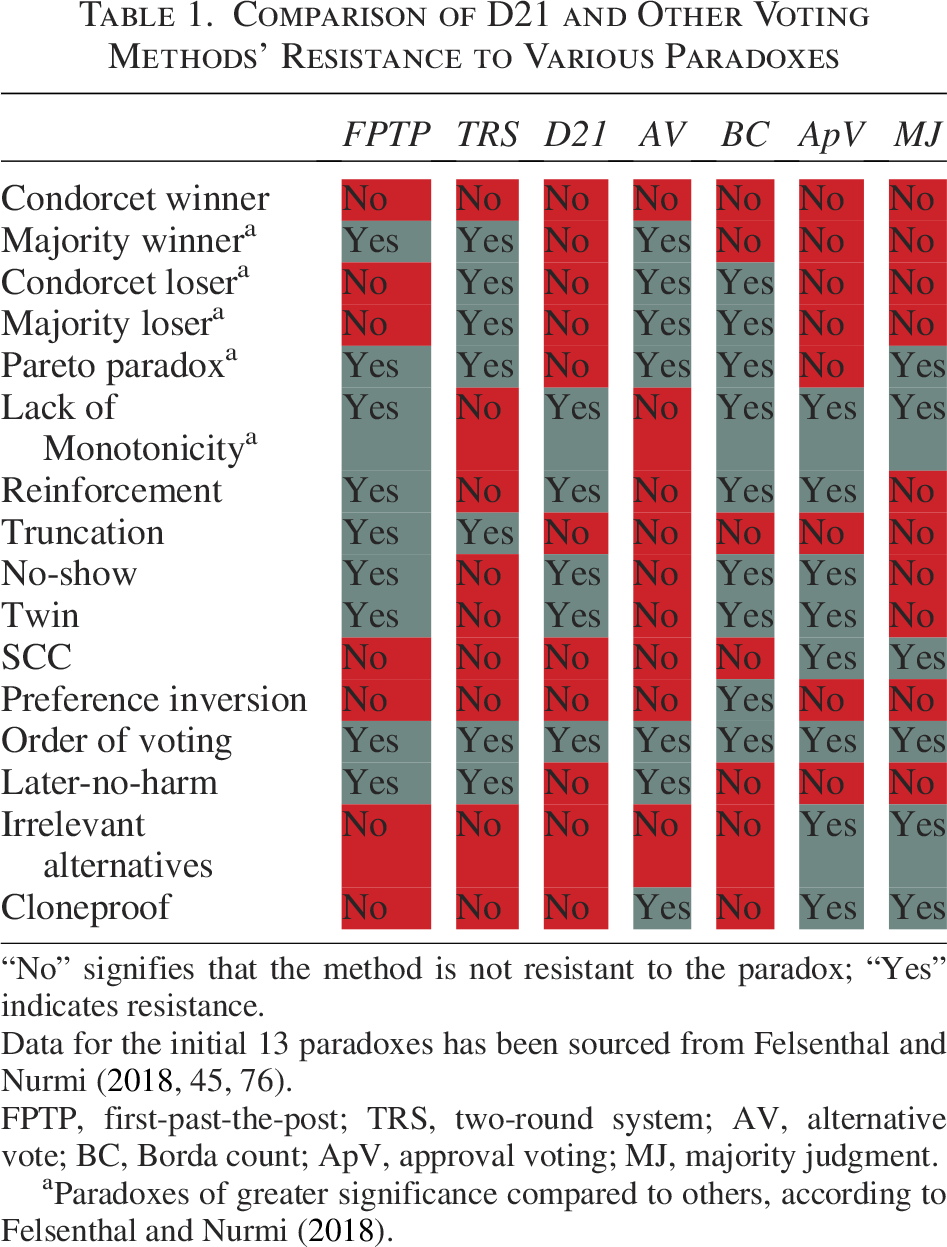
“No” signifies that the method is not resistant to the paradox; “Yes” indicates resistance.
Data for the initial 13 paradoxes has been sourced from Felsenthal and Nurmi (2018, 45, 76).
FPTP, first-past-the-post; TRS, two-round system; AV, alternative vote; BC, Borda count; ApV, approval voting; MJ, majority judgment.
Paradoxes of greater significance compared to others, according to Felsenthal and Nurmi (2018).
Computer simulations of the occurrence of selected paradoxes
In this section, we examine the frequencies of the most discussed and important paradoxes through computer simulations. We compare the CE 5 of various voting methods, which many scholars (e.g., Laslier, 2011) consider a crucial criterion when examining voting systems. However, CE considers only the relative rankings of voters’ preferences, not their intensities. Therefore, we also investigate utility efficiency (UE) as advocated by others (e.g., Harsanyi, 1953, Harsanyi, 1955; Hillinger, 2005) who argue that social utility better reflects voters’ will. Harsanyi (1977) and Merrill (1984) define the social utility of a candidate as the sum of all utilities for that candidate. The candidate with the highest utility is referred to as the utility winner. We define the UE of a method as the frequency with which it selects a utility winner, using the same definition employed by Green-Armytage, Tideman, and Cosman (2016). Similarly, we analyze how often methods choose the candidate with the lowest sum of utilities. In addition, we investigate the frequency with which methods select the majority winner, majority loser, and Condorcet loser. 6 Except for UE, this set consists of what Felsenthal and Nurmi (2018) refer to as simple paradoxes, most of which are of utmost importance.
Simulation methodology
To assess the frequency of paradoxes for each voting method, we employ stochastic computer simulations of repeated draws using the impartial culture (IC) distribution to determine the preferences voters base their decisions on across various electoral systems. The whole simulation model can be downloaded from https://github.com/alotbsol/IH21_D21_comparison. The readme file includes a manual for replication of the study. For each simulation run, we assign random utilities between 0 and 1 to each candidate for every voter. This is achieved using a random number generator with precision to eight decimal points. These numbers are then utilized to establish comprehensive strong preferences for each voter. Since the full set of preferences is available for each voter, it is assumed that for ordinal ranking methods, all voters provide a complete ranking. In cases where two identical values are generated, the candidates are ranked in reverse order, i.e., candidate two is ranked above candidate one. This approach aligns with a similar process employed by Merrill (1984) and Smaoui and Lepelley (2014). The simulations assume sincere voting, which impacts their comparability to real elections. When voters can select multiple candidates, we assume they use the optimal strategy: voting for candidates with utilities above the average candidate utility to that voter (e.g., Fishburn, 1970; Green-Armytage et al., 2016; Merrill, 1984; Weber, 1978).
Numerous researchers (e.g., Fishburn & Gehrlein, 1977; Gehrlein, 1997; Nurmi, 1992) have already proved that the measured values exhibit significant variability based on the distribution employed for generating results. The IC distribution we employ, while limited, provides a fundamental baseline, assuming complete randomness in voter preferences, allowing for the exploration of pure, unbiased outcomes. Previous simulations (compare Gehrlein & Lepelley, 2017; Green-Armytage et al., 2016; Merrill, 1984; Merlin, Tataru, & Valognes, 2002; Nurmi, 1992) indicate that IC tends to underestimate CE and UE compared to spatial models, which introduce greater homogeneity and therefore more closely align with actual voting behavior. However, researchers have yet to identify input conditions that replicate the distributions observed in real elections with more than three candidates (Plassmann & Tideman, 2014). Furthermore, while spatial models can provide valuable insights into precisely defined conditions, using fewer dimensions assumes certain underlying societal conditions, complicating comparability. IC advantageously considers all possible scenarios without assuming any specific voter preference distributions of correlations.
Since voting method stability is crucial and requires performance testing across various plausible scenarios, we designed most of our IC scenarios with 500 and 5017 voters and 4 and 9 candidates. This enables us to compare frequencies with both low and high numbers of candidates simultaneously. Each scenario was iterated 2,424,242 times.
Simulation results
We must note that not all elections have a Condorcet winner, Condorcet loser, majority winner, or majority loser. Table 2 shows how often these occur under IC. To test the intrinsic features of voting methods, we reduced the number of voters when assessing majority winners and majority losers, as these are rare with large voter counts under IC. Even when modeling with just 10 and 11 voters, they occurred in only 0.36% of iterations with 9 candidates. Tables 2 and 3 average the results, accounting for differences between odd and even voter counts.
Occurrence Frequencies of Selected Paradoxes under IC Distribution

Own data.
IC, impartial culture; UE, utility efficiency.
Comparison of Efficiencies in Selected Paradoxes
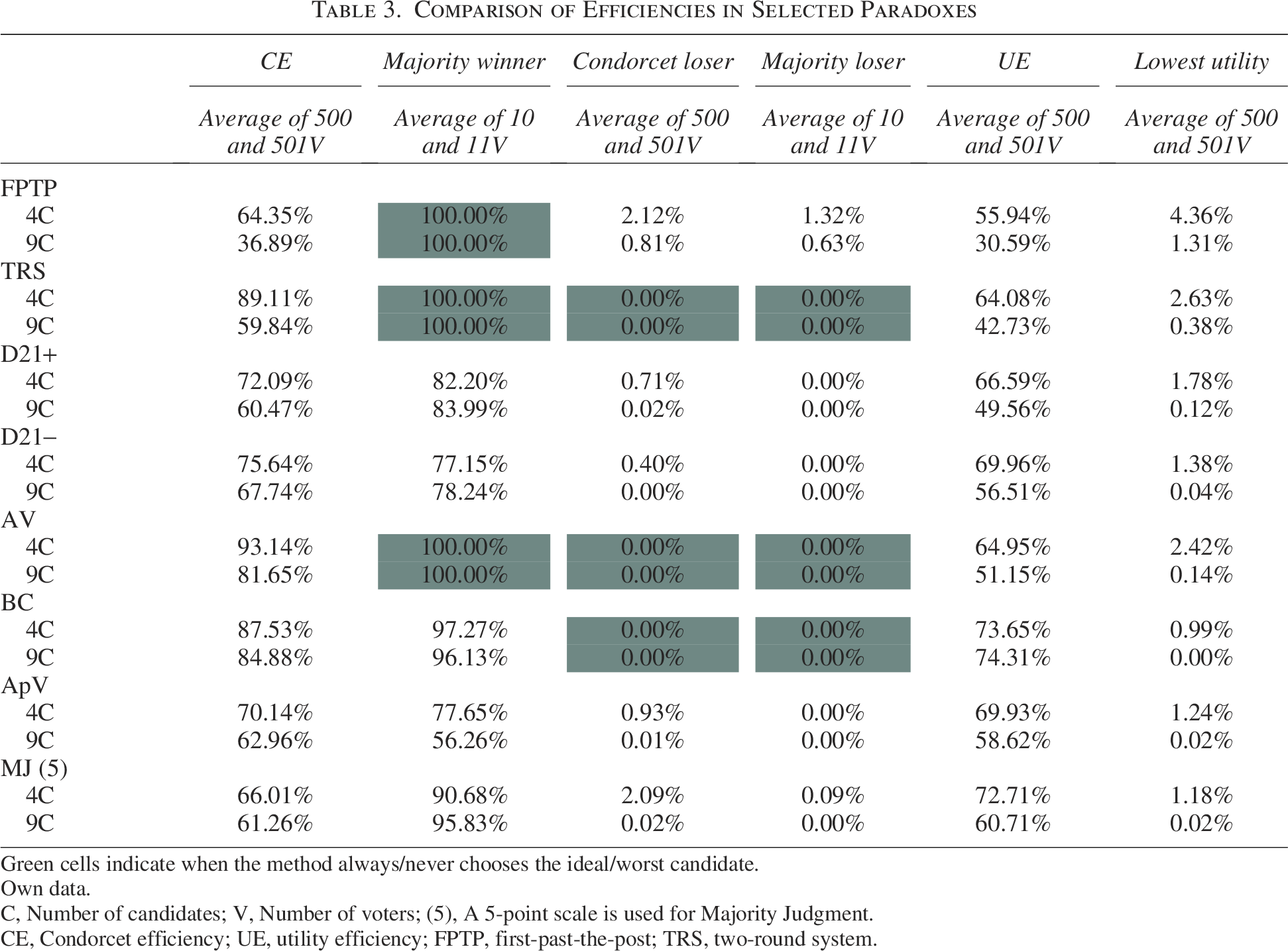
Green cells indicate when the method always/never chooses the ideal/worst candidate.
Own data.
C, Number of candidates; V, Number of voters; (5), A 5-point scale is used for Majority Judgment.
CE, Condorcet efficiency; UE, utility efficiency; FPTP, first-past-the-post; TRS, two-round system.
Table 3 presents how effectively different voting methods identify (un)desirable candidates. While results can vary across models and databases, whether theoretical or empirical, they generally convey a consistent message about the relative positions of voting methods (Gehrlein & Lepelley, 2017). Accordingly, our model aligns with findings from other studies (e.g. Gehrlein & Lepelley, 2017; Merrill, 1984; Nurmi, 1992).
D21 outperforms well-established FPTP in terms of CE, particularly in elections with more candidates, and is comparable to ApV and MJ. TRS, also commonly used in official elections, is more effective with fewer candidates but falls behind D21− in scenarios with 9 candidates. This difference is even more pronounced when considering UE, where both versions of D21 outperform these traditional voting systems across all candidate numbers.
On the other hand, both FPTP and TRS are immune to the majority winner paradox, whereas the D21 methods display reasonable performance in this aspect, a significant improvement over ApV with 9 candidates, thereby proving Baharad and Nitzan’s (2005) theorem. D21 is designed to increase the likelihood over ApV of identifying a majority winner. However, as demonstrated in surveys and practice, voters tend to vote similarly under both methods, suggesting that the theory may underestimate the likelihood of identifying a majority winner in ApV. Paradoxes centered on the selection of undesirable candidates (such as Condorcet and Majority loser and Lowest utility candidate) hold limited relevance for comparing voting methods, as all methods tend to avoid selecting such candidates, especially in elections with a significant number of candidates.
BC generally provides the most consistent results, with high CE and UE across all scenarios. However, our model assumes sincere voting and complete knowledge of preferences. This bias favors voting methods that are highly susceptible to SV, such as BC (Green-Armytage et al., 2016), or whose effectiveness necessitates extensive voter information, such as AV, with CE that declines significantly when voters do not rank every candidate (Kilgour et al., 2020). AV shows strong CE performance, but its UE is comparable to D21+ and D21−.
It can be concluded that both D21 variants offer reasonable alternatives to established voting methods, performing similarly to ApV and MJ when addressing serious paradoxes. Notably, D21 also significantly improves the likelihood of finding a majority winner compared to ApV, leaving it with no major flaws. While ApV and FPTP are most resistant to the remaining paradoxes arising from modifications to the relevant data (as noted above), D21 shows average performance. However, these paradoxes may incentivize strategic behavior, which we will examine further.
STRATEGIC BEHAVIOUR (SB)
Following Green-Armytage (2014), we categorize strategic behavior into two categories: SV, where voters cast ballots differing from their sincere preferences, and strategic nomination (SN), where candidates enter or exit races to change election outcomes. Ideally, a voting system should not motivate SB, as it skews the will of the people (Dasgupta & Maskin, 2020). However, nearly 50 years ago, the Gibbard-Satterthwaite theorem demonstrated that all ordinal voting methods are vulnerable to strategic manipulation (Gibbard, 1973; Satterthwaite, 1975). The same applies to voting systems based on grading. This section evaluates the frequency of strategic behavior in D21+ and D21− and compares it with available secondary data and academic estimates of various electoral systems, using Nagel’s (2012) criteria: (1) vulnerability to SV, (2) scale of information required for SV, (3) psychological demands of SV, (4) the later-no-harm criterion, (5) campaigns and retaliation strategies, and f) strategic entry and exit.
Vulnerability to SV
Green-Armytage et al. (2016) define resistance to SV as “the likelihood that sincere voting will result in an outcome that no group of voters will be able to change to their mutual advantage by changing their votes” (Green-Armytage et al., 2016, 185). We can assume that the more likely SV is to alter results, the more likely voters will engage in it. Table 4 presents the combined findings from four studies (Balinski & Laraki, 2010; Favardin & Lepelley, 2006; Green-Armytage, 2014; Green-Armytage et al., 2016), which yield only minor discrepancies in their results. The most significant variance is observed in ApV, where the level of resistance depends on assumptions about voting behavior. Hence, we report two values for ApV. We include D21 in this secondary data comparative summary because we can infer its propensity for SV from the available knowledge about ApV.
Resistance of Electoral Methods to Strategic Voting a
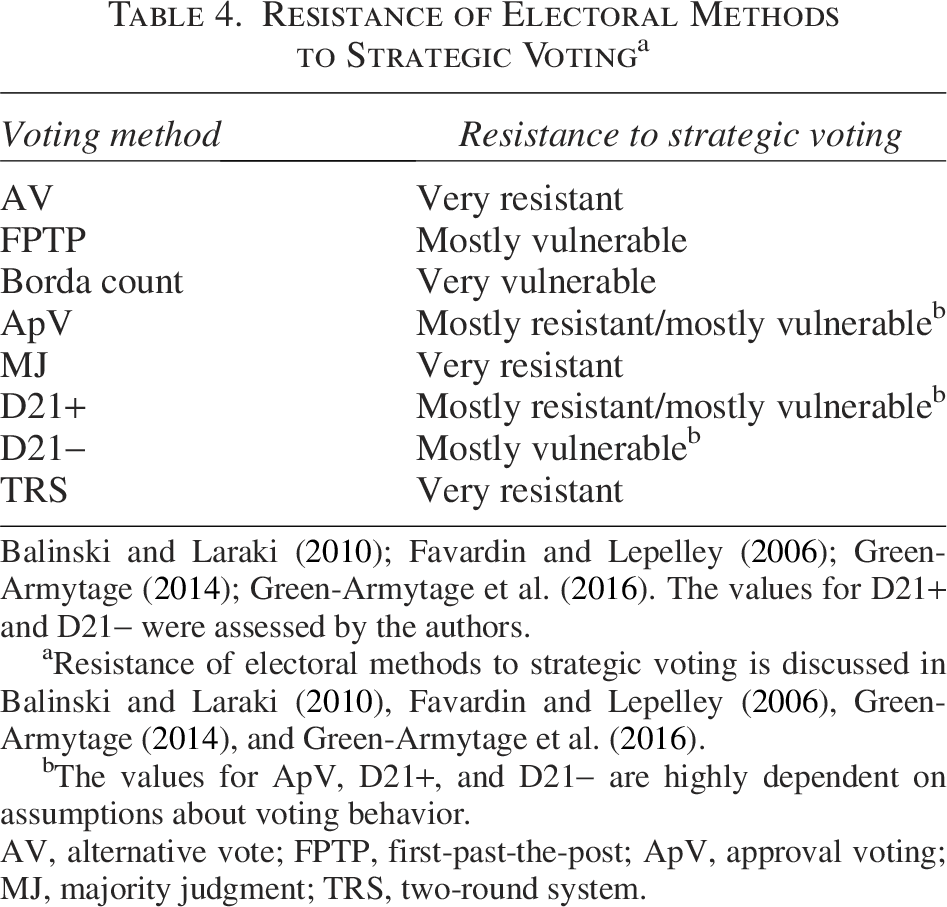
Balinski and Laraki (2010); Favardin and Lepelley (2006); Green-Armytage (2014); Green-Armytage et al. (2016). The values for D21+ and D21− were assessed by the authors.
Resistance of electoral methods to strategic voting is discussed in Balinski and Laraki (2010), Favardin and Lepelley (2006), Green-Armytage (2014), and Green-Armytage et al. (2016).
The values for ApV, D21+, and D21− are highly dependent on assumptions about voting behavior.
AV, alternative vote; FPTP, first-past-the-post; ApV, approval voting; MJ, majority judgment; TRS, two-round system.
D21+’s resistance should resemble that of ApV, given that empirical studies indicate voting behavior under D21+ closely mirrors that of ApV (compare the average of cast votes from Gibbs & Cheerakathil, 2022; Oreský & Čech, 2020; with Baujard & Lebon, 2022a; Baujard, Igersheim, & Senné, 2011; Kabre et al., 2017; Roescu, 2014). Although ApV is generally seen as vulnerable to SV (see Green-Armytage, 2014; Green-Armytage et al., 2016), Balinski and Laraki (2010) note that ApV becomes more resistant when voters have a broader range of acceptable candidates. Based on the sources cited, it is reasonable to assume that voters in both ApV and D21+ tend to approve more than just their top candidates. Therefore, it makes sense to lean toward evaluating these methods as mostly resistant to SV in practice.
Conversely, D21− is more vulnerable to SV due to the potential strategic utilization of minus votes that can more frequently alter outcomes. However, we do not consider D21− to be as vulnerable as BC, in which the more candidates participate in an election, the more voters can influence the results through SV. If a voter strategically moves their sincere second preference into last place in a 10-candidate election, that candidate loses 8 points they would have sincerely received. A minus vote in D21− would only cost one point.
The scale of information needed for SV
The likelihood of voters employing a type of SV is closely tied to the extent of available information, such as insights from election polls. As the information required for successful SV increases, its likelihood tends to decrease (Nagel, 2012). This section provides an overview of each type of SV and assesses its information demands.
The first type of SV involves reordering candidates, which can take the form of compromise, burying, or push-over strategies. Compromise occurs when a voter supports a less-preferred candidate with a higher rank because their more-preferred candidate is unlikely to win. Effective use of compromise requires voters’ awareness of the frontrunners in an election. In D21+, as in ApV, compromise is expected only when none of the viable candidates (frontrunners) are among those the voter sincerely approves, which is relatively rare. This might happen slightly more often in D21+ than in ApV, given the limit on votes in D21+. Decapitation, a stronger form of compromise wherein a voter demotes their favorite to a lower rank, reduces their grade, or refrains from approval, is relatively common under FPTP as voters opt to vote for frontrunners to avoid wasting on non-viable candidates.
Burying occurs when a voter seeks to boost their preferred candidate’s prospects by downranking, lowering the grade, or withholding approval from their strongest opponent, even if they find that opponent acceptable. Its effective employment requires a voter to know the chances of the top two candidates and their favored candidate. The push-over strategy is specific to multi-step voting systems like AV or TRS. If a voter is confident of their preferred candidate’s advancement to the second round in TRS, they can vote for another candidate who they know will subsequently lose to the preferred candidate. Push-over necessitates the most information, as voters require precise knowledge of viable candidates’ prospects to ensure their preferred candidate advances to the next round.
The second type of SV is called truncation. In voting methods that allow ranking or approving multiple candidates (AV, ApV, and D21), voters can enhance the chances of their favorite candidate by refraining from approving/ranking all the candidates they sincerely support. A truncation strategy necessitates that voters know the prospects of many candidates. The extreme version of truncation is “bullet voting”, where a voter approves/ranks only a single candidate. Given that D21+ generally allows fewer votes than ApV, if a voter employs bullet voting, they would truncate fewer votes than in ApV.
The final form of SV entails the spreading of preferences, feasible only under methods where voters grade candidates (e.g., range voting, majority judgment). A voter who genuinely assigns candidate A 8 points out of 10, and candidate B 2 points, can be motivated to elevate candidate A’s prospects by awarding them 10 points and candidate B 0 points. Spreading preferences distinctly require no specific information for implementation. Table 5 presents the informational prerequisites for each type of SV.
Informational Requirements of Different Types of Strategic Voting
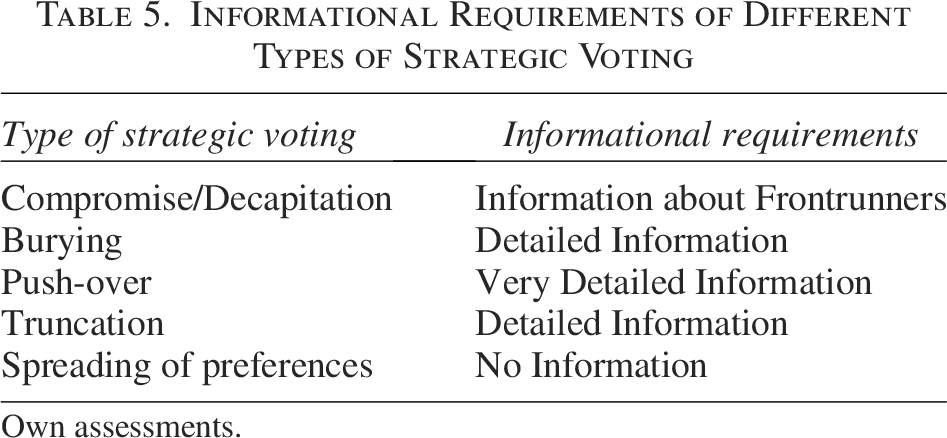
Own assessments.
Psychological demands of SV
Laboratory voting experiments (e.g., Meir et al., 2020) and empirical studies (e.g., Baujard & Lebon, 2022b) demonstrate that some voters value honest voting even if SV could be effective. If this assumption holds for real elections, we can expect that as a certain type of SV departs from sincere preferences, it becomes more psychologically demanding for voters. From this perspective, decapitation under FPTP and TRS is the most demanding, as voters cannot express any level of support for their favorite candidate. The results of real elections indicate that this hypothesis is likely valid to at least some extent, as many voters still vote for non-viable candidates even when election polls motivate them to compromise. The psychological demand of compromise without decapitation, burying, and truncation would strongly depend on the intensity of the voter’s relationship with the candidate they would raise or lower in preference rankings or not vote for. However, as this intensity would be lower than for their favorite candidate, we can expect these three types of SV to be less demanding than decapitation. Push-over should be easier, as its only goal is to help a favorite candidate win. Spreading of preferences would be easiest, as it does not require a change of preference order. Table 6 summarises the psychological demands of different types of SV.
Psychological Demands of Different Types of Strategic Voting
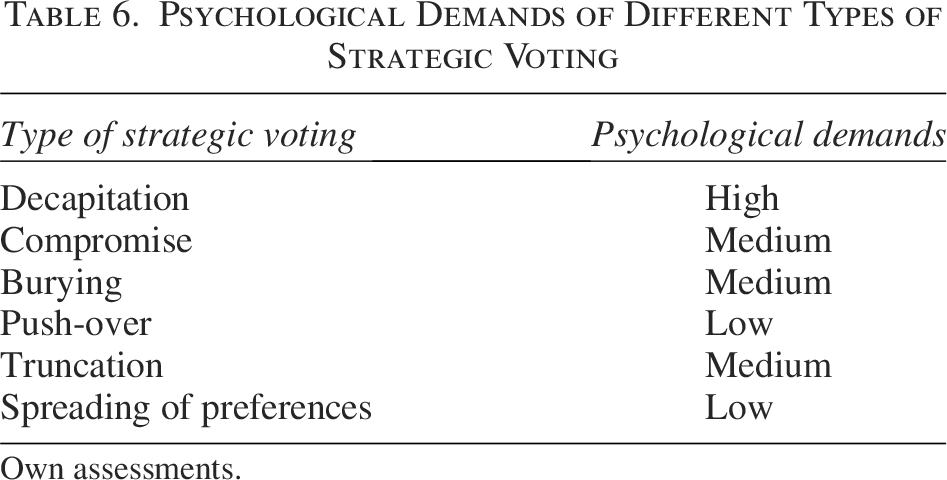
Own assessments.
Later-no-harm
Voting methods that fail this criterion (see above) inherently encourage voters to truncate their sincere preferences and resort to bullet voting. This is because using more votes, preferences or approvals could potentially harm the chances of their preferred candidate. However, a limitation of this criterion lies in its exclusive focus on the prospects of the favorite candidate, without considering the strength of other preferences and the voting behavior of other voters.
Consider a scenario with three-candidate elections where the first group of voters genuinely votes for candidates A and B under D21+ or ApV, while the second group with fewer voters solely votes for candidate C. If half of the first group bullet votes for their most preferred candidate A, and the other half does the same for B, it could easily result in candidate C winning. The first group of voters stands to lose significantly if the bullet voting strategy fails or gain only minimally if it succeeds. Consequently, the effectiveness of this voting behavior would require voters to possess highly detailed information about the preferences of other voters; however, such information is typically not accessible. In practice, bullet voting does not appear to be a widespread strategy under ApV or D21+ and may not be effective in ensuring the election of an intended winner (see Hamlin & Hua, 2023, 341–342; Oreský & Čech, 2020).
Moreover, as Hamlin and Hua (2023) note in the context of ApV, voting for two acceptable candidates “means that, at worst, a candidate who is acceptable to the voter still wins” (Hamlin & Hua, 2023, 341), and the violation of the later-no-harm criterion “refers to the individual voter or subset of voters and not to the electorate as a whole” (Hamlin & Hua, 2023, 341).
Campaigns and retaliation strategies
In theory, candidates could gain an advantage by encouraging supporters to engage in various forms of SV. For instance, candidates might motivate voters to bury their main opponents by ranking them low or giving them a minus vote under D21−. However, initiating such a campaign would likely provoke retaliation, as opponents would prompt their supporters to do the same, thereby diminishing the potential benefits of this strategy. This could lead to the candidate who started the burying strategy ultimately facing setbacks.
Likewise, if a candidate openly encourages supporters to truncate their votes and withhold support from others, it is reasonable to expect that they will not gain many votes from their backers. Such strategies might work better in smaller electorates, where concealing this type of campaigning is feasible. However, in large-scale elections, such as national ones, covert campaigning is not practical. Push-over, another form of SV, involves asking voters to support another candidate for the reasons described above. Yet, due to its demanding informational prerequisites, the push-over strategy remains largely theoretical and is rarely, if ever, implemented in actual elections.
Spreading preferences is truly unique, as candidates would ideally encourage their supporters to adopt this approach, as it maintains the genuine order of preferences and maximizes the influence of voters. Moreover, it is advantageous for candidates regardless of whether election polls favor them. In theory, the campaign for spreading preferences would be particularly effective and advantageous for candidates with conservative supporters, implying that they do not assign their favorite candidates the highest marks. Given that spreading preferences is not targeted toward specific candidates, there would be no grounds for retaliatory strategies. With the compromise/decapitation strategy, there is no motivation for strategic campaigning, as candidates would have to support other candidates more than themselves, thereby eliminating any chance of victory.
Strategic entry and exit
In addition to campaigns, voting rules also determine whether it is advantageous for candidates to participate in the elections. Among these, FPTP is the most restrictive, as voters can only support a single candidate, discouraging candidates with similar views from participating. If they still choose to run, they could suffer from vote-splitting and fail to win even with majority support. On the other hand, there are no barriers to participation under the approval and range voting methods, as voters can express maximal support for all the candidates they prefer. An extreme case is BC, which slightly encourages non-viable candidates to run, as they could widen the point gap between similar candidates and their main opponents. Consequently, their participation might boost the chances of another candidate. Table 7 provides an overview of the incentives for strategic entry and exit of candidates across all the examined voting methods.
Incentives for Strategic Entry and Exit
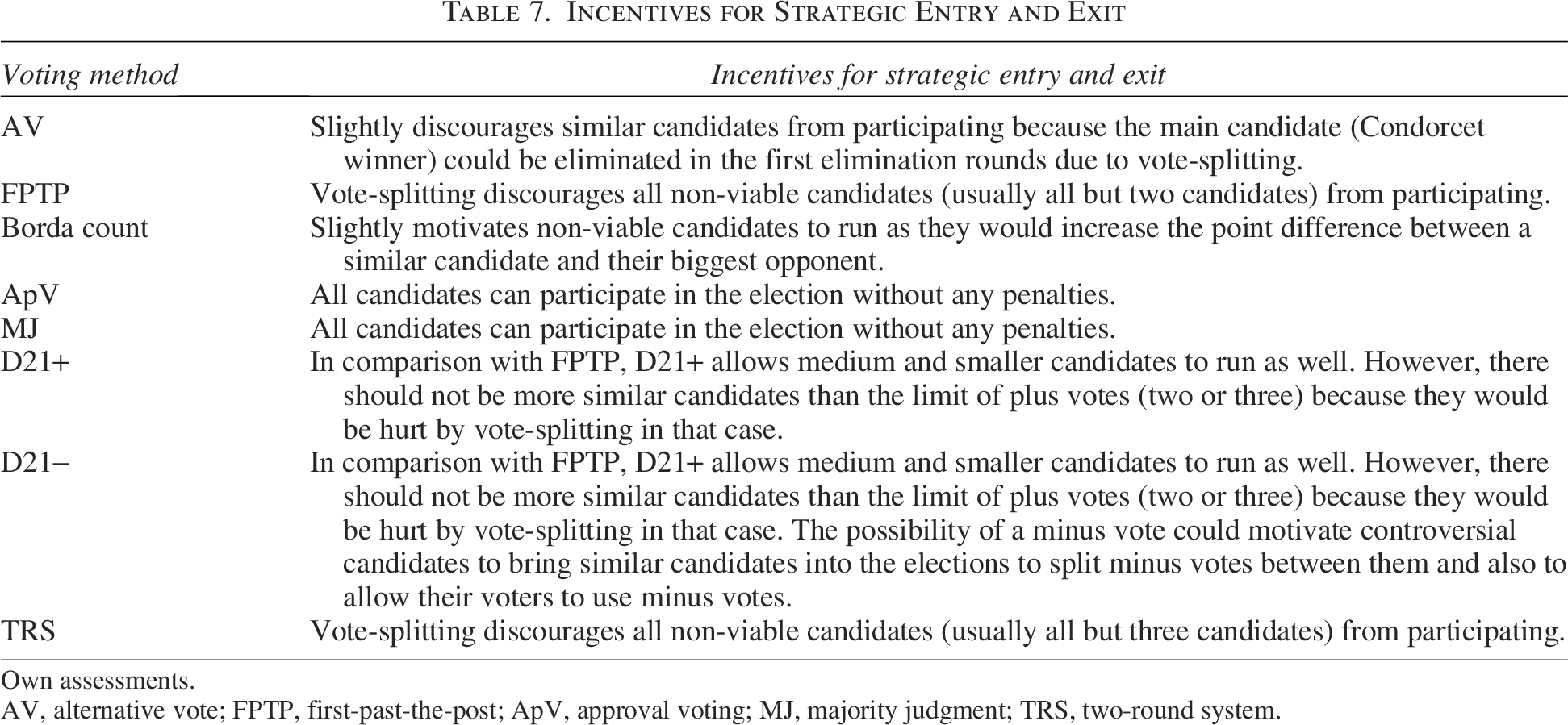
Own assessments.
AV, alternative vote; FPTP, first-past-the-post; ApV, approval voting; MJ, majority judgment; TRS, two-round system.
Estimation of strategic behavior frequency under examined voting methods
AV
AV is vulnerable to compromise and push-over. Although compromise requires less information, it is only occasionally effective. Push-over is mostly theoretical and AV has very limited impact on strategic entry and exit. Consequently, SB is expected to be very rare under AV.
FPTP
FPTP is vulnerable only to decapitation. This type of SV has low information requirements and is often effective, yet it is psychologically demanding. Furthermore, FPTP restricts the number of candidates. Overall, SB is likely to occur frequently under FPTP.
BC
Considered highly vulnerable to SB, BC is susceptible to compromise, burying, and truncation. It also incentivizes many candidates to participate in elections strategically, making SB very frequent.
ApV
Burying and truncation in ApV require substantial information, limiting their occurrence. Compromise is more likely due to its lower psychological demands. Moreover, ApV has minimal influence on strategic entry and exit so we can expect SB rarely under ApV.
Majority judgment
While MJ is susceptible to compromise, burying, truncation, and spreading of preferences, these forms of SB are not very effective. Spreading preferences is psychologically easy for voters and may be used frequently, but it would deviate less from sincere preferences compared to SB under FPTP.
D21 method
SB frequency under D21+ should resemble ApV, with slightly more compromise and less truncation. D21+ also discourages some candidates from participating compared to ApV. Overall, SB is expected to be rare under D21.
D21 method with minus vote
The inclusion of minus vote in D21− would encourage voters to use burying more often compared to D21+. Minus votes might also motivate strategic candidate entry. As a result, SB is anticipated to be frequent under D21−.
Two round system
In contrast to FPTP, TRS reduces the motivation for decapitation as voters can support a front-runner in the second round. With more viable candidates in TRS, the incentive for strategic exit is weaker, allowing more candidates to participate. Thus, SB is projected to be rare under TRS.
ELECTORAL ADMINISTRATION
We evaluate the potential administrative implications of the D21 method with the same approach as research, specifically drawing on the framework by Reynolds, Reilly, and Ellis (2005). This framework, which justifies criteria for assessing mainstream electoral systems, is particularly useful for comparing D21 with other less standard methods mentioned in this article.
Reynolds, Reilly, and Ellis’s (2005) analysis, which links electoral systems to their administrative requirements, focuses on cost and complexity, including aspects like drawing electoral boundaries, voter registration, ballot paper design and production, voter education, number of polling days, by-elections, and the count. Their study remains a unique and relevant reference in the growing literature on electoral administration.
Unlike Reynolds and his collaborators, we do not include the criterion of by-elections in our analysis, as we believe it is mostly unaffected by the electoral system in use. Additionally, we have split the original count criterion into two distinct categories. The first retains the original definition, assessing the complexity for election commissioners in counting the votes on the ballots. The second, which we refer to as counting results, evaluates the anticipated complexity of determining mandates from the votes, specifically the complexity of the computing process.
Assessment methodology
To assess the theoretical administrative costs and complexity of electoral systems, we follow the reasoning presented by Reynolds, Reilly, and Ellis (2005). The details of the operationalization can be found in Supplementary Appendix SA2, where we define assessment categories based on the arguments presented in their study. Our aim is to formulate administrative variables that are broadly applicable, enabling us to assess expected administrative costs and complexities resulting from electoral system features.
However, there are intentional inconsistencies in our assessments compared to Reynolds, Reilly, and Ellis’s (2005) work. Firstly, due to the utilization of the considered electoral systems in single-member districts (SMDs), all the systems are assessed as having high costs and complexity in drawing electoral boundaries and voter registration. 7 Secondly, there are inconsistencies in the count indicator due to its division into two and the correction of an identified inconsistency in the original handbook by Reynolds and his collaborators.
Reynolds, Reilly, and Ellis (2005, 156) argue that “AV, BC, and STV [(Single Transferable Vote)—a proportional ranked-choice method used in multi-winner elections, where voters rank candidates and surplus votes are transferred, authors’ note], as preferential systems requiring numbers to be marked on the ballot, are more complex to count”. However, they assess AV and BC as having medium cost and complexity, while STV is considered highly demanding in their comparative table. This inconsistency led us to create an explicit operationalization table (Supplementary Appendix SA2). We assess electoral systems based on their basic characteristics, which may influence aspects of electoral administration similarly to other systems evaluated by Reynolds and colleagues.
Another inconsistency arises in the assessment of ballot paper design and production for AV. Reynolds, Reilly, and Ellis (2005, 154) suggest that “FPTP and AV ballot papers are often easiest to print and, in most cases, have a relatively small number of names”, but their assessment is based on a limited context of AV usage. However, considering theoretical expectations, SN is minimal under AV (see above). Therefore, we evaluate AV in line with other methods that incentivize candidacy, placing it in the middle in terms of costs and complexity.
To facilitate overall comparisons, we assigned values of 1–3 (in the respective order) to the low-medium-high scale, enabling us to calculate average values of administrative demands for each electoral system, while recognizing that each specific administrative variable retains its individual significance.
Results of how electoral systems might influence electoral administration
As shown in Table 8, majoritarian electoral systems in SMDs are expected to perform poorly in administration-related areas, particularly in drawing electoral boundaries and voter registration. These systems require frequent boundary adjustments to maintain equal vote weight, and voter registration scores are lowest due to its empirical operationalization by Reynolds, Reilly, and Ellis (2005), making it less relevant in theoretical comparison.
Anticipated Administrative Costs and Complexities across Different Electoral Systems
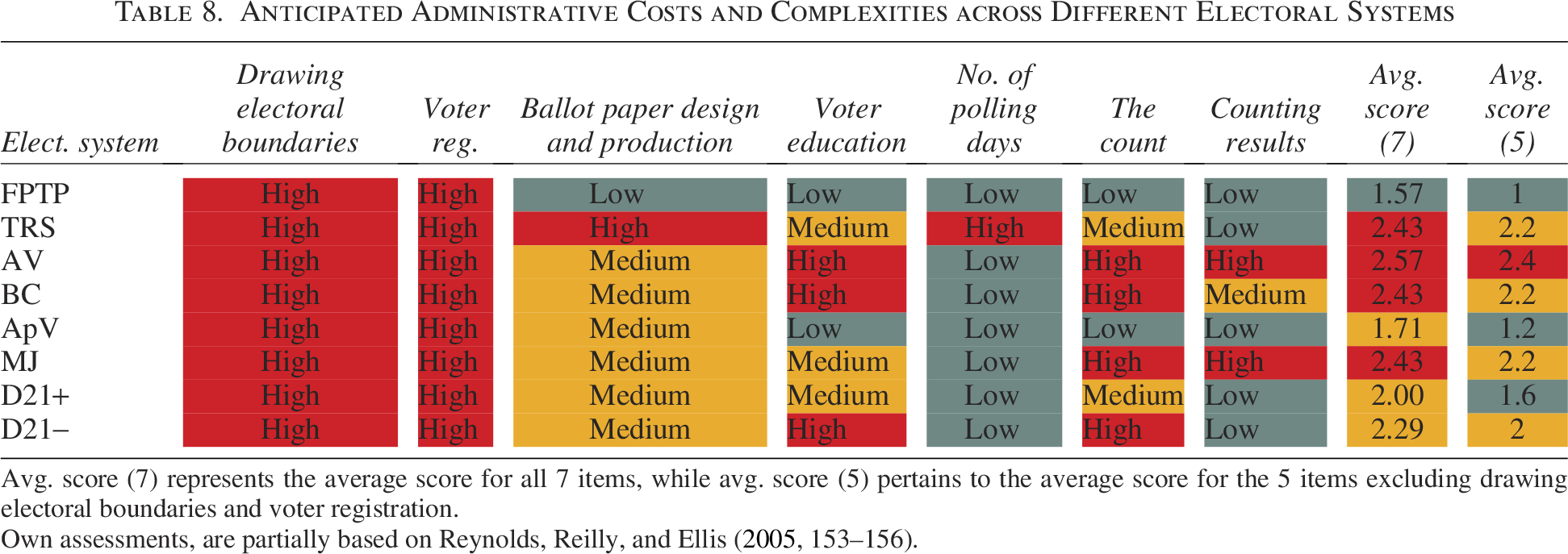
Avg. score (7) represents the average score for all 7 items, while avg. score (5) pertains to the average score for the 5 items excluding drawing electoral boundaries and voter registration.
Own assessments, are partially based on Reynolds, Reilly, and Ellis (2005, 153–156).
Plurality voting, however, excels administratively, with unproblematic impacts across most criteria, earning a perfect average score for the five criteria with varying values (see Table 8). ApV and D21+ also perform well, with straightforward voting procedures that minimize voter education needs and simplify the vote-counting process carried out by electoral commissions, which involves both tallying the votes and determining the winner, similar to FPTP. Although their ballot design may be slightly more complex, this difference is minor, and both systems maintain strong overall administrative efficiency. The D21− ballot, used in the 2023 Czech presidential elections, exemplifies this simplicity (see Figure 1), with the D21+ differing only in its shorter instructions at the top and the absence of the minus vote column. However, slightly higher numbers of candidates are expected, resulting in uniformly ‘medium’ assessments.
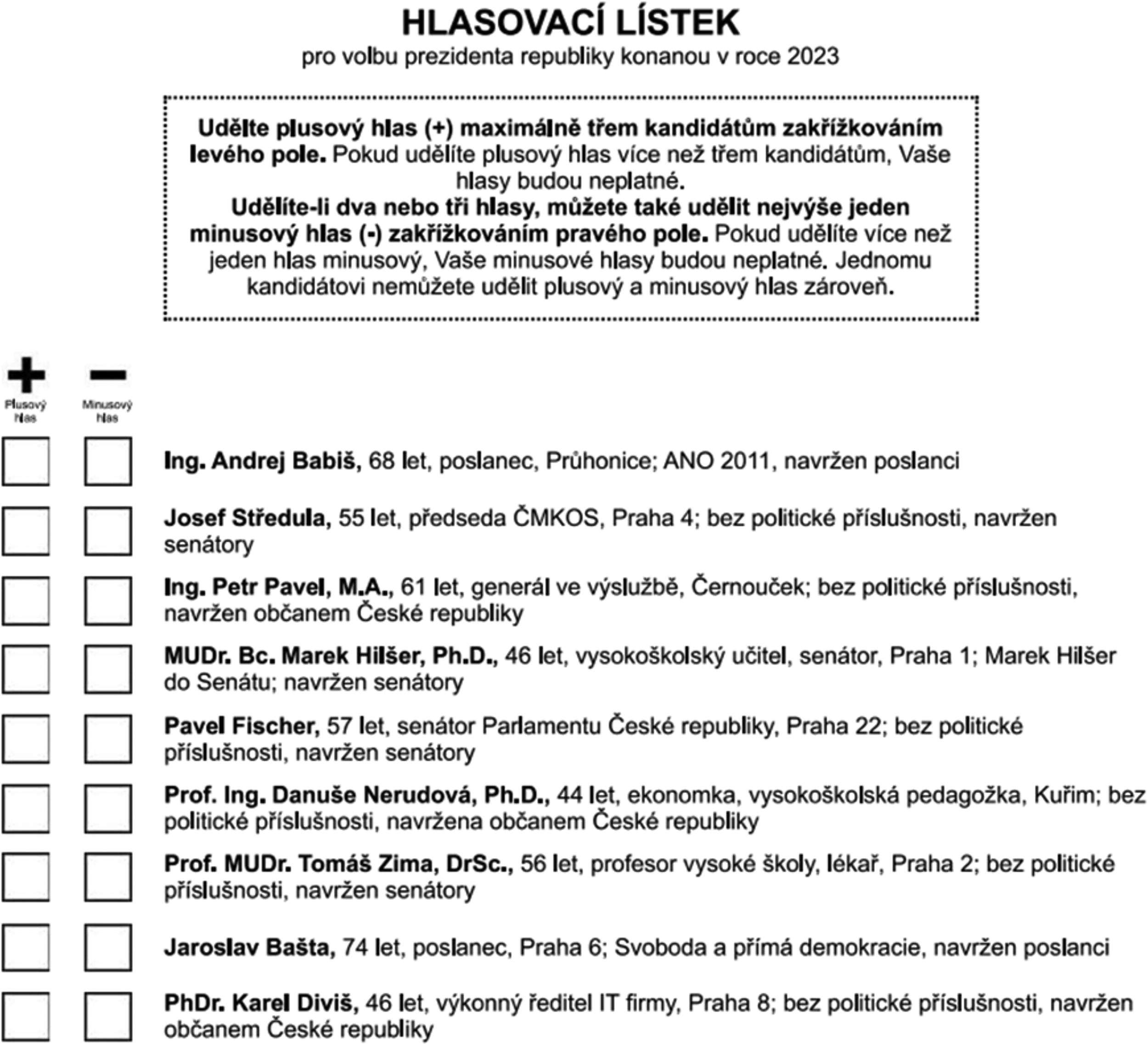
A D21− ballot used in the survey for the 2023 Czech presidential elections.
Somewhere between the expectedly less demanding and highly demanding voting systems lies D21−. Its conditional negative vote affects both voters in their potential inability to cast a fully valid vote and election commissioners who may find it quite demanding to verify whether the conditions for casting are met.
The final category includes the most demanding electoral systems: AV, TRS, BC, and MJ. These systems significantly strain electoral administration, with each scoring poorly on multiple administrative criteria. For instance, BC poses considerable challenges due to its complex voting process and the difficulty of counting points from preferential votes, which can cause delays. Similarly, AV and MJ require election commissioners to count numbers rather than votes, often leading to delays as complete voting results are needed before mandate allocation can begin.
This does not necessarily mean that more demanding electoral systems lead to poor administration in practice. Even demanding electoral systems can be efficiently managed if a country is well-prepared. With adequate resources and well-prepared electoral management body, smooth administration is possible under demanding electoral rules. The non-applied systems we assessed share basic features with existing methods, allowing for theoretical evaluation.
CONCLUSION
We analyzed a viable alternative to both mainstream and alternative electoral systems aimed at moderating social polarization. We argue that D21 can fulfill this role by offering distinct qualities. As a system designed to reduce campaign extremism and societal polarization by allowing voters to cast more votes (see Cox, 1990; Crosson & Tsebelis, 2022), D21 fits well within this approach. Given the fundamental premise that no electoral system is perfect or excels in all performance criteria, we assert that D21+ performs reasonably well without significant expected deviations compared to other voting systems.
While some voting systems inherently avoid a large number of paradoxes (FPTP, BC), others are more effective at addressing the most critical ones (TRS, AV, and BC). In this regard, D21 does not guarantee the avoidance of as many paradoxes, nor most of the important ones, as some other electoral alternatives, making its performance on social choice criteria the weakest among the three comparative sections in this article. However, as our simulations revealed, this does not mean that D21 consistently fails in this regard; on the contrary, it performs reasonably well in selecting utility winners, especially in elections with more candidates. The same holds true for revealing a Condorcet winner if one is present.
While D21−, in elections with more candidates, appears to perform slightly better in terms of CE and UE than D21+, it does so at the cost of less frequently selecting the majority winner. However, the minus vote in D21− can be more problematic, as it may serve as a tool for SV, making D21− more susceptible to it. This makes D21− similarly problematic as FPTP, BC, and MJ, where we can expect the most frequent use of SV. On the contrary, falling short on some social choice criteria is not expected to increase the inclination for strategic behavior, as D21+ aligns with other relatively resistant methods like AV, ApV, or TRS. Finally, D21+’s expected administrative requirements align closely with FPTP and APV, suggesting smooth implementation.
Compared to the most similar ApV, D21+ offers a different balance of pros and cons. The design of D21+ ensures a significant improvement in finding a majority winner, which in ApV is highly dependent on voters’ behavior. This improvement comes at the cost of slightly lower UE and a lack of resistance to some minor paradoxes, though D21+ does not increase the tendency for strategic behavior. Both ApV and D21+ have similar inclinations to strategic behavior, but D21+ slightly reduces truncation while slightly increasing the incentives for compromise and discouraging some candidates from running. Although D21+ may require slightly more administrative effort than ApV, it remains one of the least demanding systems.
These findings provide insight into “vote-for-k” methods and the debate on ApV restrictions. D21+ introduces a different trade-off, where certain advantages might be desirable enough to offset potential drawbacks. Overall, D21+ presents a well-balanced set of characteristics, with no major flaws or extreme unforeseen impacts.
In discussions on electoral reforms for SMDs, often governed by FPTP, the AV is noted for its social choice advantages and resistance to strategic behavior, though it requires significant administrative adjustments. The BC prevents voting paradoxes (e.g., Saari, 2023), but its susceptibility to strategic behavior and administrative complexity is often overlooked. In contrast, D21+ achieves reasonable social choice outcomes, with its vulnerability to certain paradoxes not expected to lead to frequent strategic behavior, and it is easy to administer. Moreover, D21+’s limited voting options alleviate theoretical concerns about bland candidates, making it a compromise between FPTP and ApV.
Paradoxically, alternative electoral systems, including D21+, offer more reasonable pathways for reform to mitigate potential undesirable side-effects. D21+ offers a balanced set of expectations, essential for addressing polarization, which can stem from paradoxical election results, perceived administrative bias, or strategic behavior that undermines the voter’s will. With global polarization on the rise, many observers (e.g., Bernabel, 2015; see also Slaughter et al., 2019) and NGOs (e.g., Electoral Reform Society) have identified FPTP as a contributor to this issue. We should, therefore, invest more effort into understanding these AV methods.
CODE AVAILABILITY
The model is a custom code based on Python 3.8.3 and available libraries. The model can be downloaded from https://github.com/alotbsol/IH21_D21_comparison. The readme file includes a manual for replication of the study.
Footnotes
ACKNOWLEDGMENT
This article and the research behind it would not have been possible without the support of Karel Janeček, the founder of the Institute H21.
AUTHOR DISCLOSURE STATEMENT
Karel Janeček, the founder of Institute H21, is also the author of the D21 Method.
FUNDING INFORMATION
No funding was received for this article.
