






Abstract
An opportunity exists for circular resource use, decreasing environmental impact and economic risk and at the same time enhancing biodiversity and global standards of living. When viewed from the perspective of an engineering student, technology is the solution. When viewed from the perspective of a policy student, policy is the way to solve these problems. The public, culture, and the social side of circularity? This is typically not considered in the education of our future science, technology, engineering, and math (STEM) and policy professionals. To truly create circular systems, however, we need a different approach. We need the combined effort of scientists, engineers, cultural leaders, policy makers, industry, communities, and artists. We need circularity professionals, regardless of discipline, to have observation, teamwork, creative thinking, perspective-taking, and critical analysis skills. As part of a University of Minnesota National Science Foundation-funded Research Traineeship (NRT) program, we have developed a three-credit course to fill these needs: A Circularity Revolution: Working to Close the Loop on Global Issues. The course is cotaught by a consulting artist and an environmental engineering professor and brings critical analysis tools to bear on technological and policy topics. Focusing on biases, varied perspectives, case-based learning, and shared mental models, this approach encourages cross-disciplinary dialogue. Here we present the learning objectives, approach, course structure, and outcomes of this course with the goal of providing information to facilitate the teaching of similar courses at peer institutions.
Introduction
As population increases along with the standard of living, pressure on energy and elemental resources will increase (Agricultural Development Economics Division Economic and Social Development Department, 2009; He et al., 2021; National Research Council, 1999; Richardson et al., 2023; United Nations Educational, Scientific and Cultural Organization and Earthscan, 2009; World Economic Forum and Platform for Accelerating the Circular Economy, 2019). A tremendous opportunity exists to re-envision resource use as circular, decreasing risk and enhancing global standards of living and environmental quality (Atanasova et al., 2021; National Research Council, 1999). Nevertheless, current trends in resource extraction, water use, and emissions are making the world even less circular (Circle Economy, 2018; He et al., 2021; Hoellein and Rochman, 2021). Valuable resources contained in electronics worth up to $62.5 billion dollars are discarded annually (World Economic Forum and Platform for Accelerating the Circular Economy, 2019). Water is viewed and used as a disposable commodity, rather than a critical resource, with two-thirds of the global population expected to live under conditions of water stress by 2050 (He et al., 2021; United Nations Educational, Scientific and Cultural Organization and Earthscan, 2009; United Nations World Water Assessment Programme, 2015). Some of this stress could be partially ameliorated by more thoughtful reuse of wastewater. In fact, wastewater treatment accounts for ∼3% of total annual U.S. electricity use and ultimately results in the conversion of waste to CO2 instead of generating energy or products of value (Circle Economy, 2018). Finally, it is estimated that in 15 years, plastic production will consume 20% of world oil supplies and the total mass of plastic waste in landfills and natural environments will double (World Economic Forum, 2016).
Circularity is not a new idea. For years research and development have been focused on creating new circular technologies and redefining “waste” (Atanasova et al., 2021; Dantas et al., 2022; Demarteau et al., 2020; Mulchandani and Westerhoff, 2016; Winkler and Straka, 2019). When viewed from the perspective of an engineering student, it is clear that technology can provide answers, if only the public would purchase the “right” products and policy makers would pass the “right” laws. When viewed from the perspective of a policy maker, it is clear that the passage of laws requires finesse and compromise, but the end goal will be supported if engineers would simply upscale technologies with no collateral waste production and energy use. The public, culture, and the social side of circularity? This is typically not considered in the education of our future STEM and policy professionals.
To truly create circular systems, we need a different approach. We need the combined effort of scientists, engineers, cultural leaders, policy makers, industry, and communities (Hysa et al., 2020; Lahti et al., 2018; O’Byrne et al., 2015; Velenturf et al., 2018; Whitmer et al., 2010). There is a global need for STEM-based graduates trained in circularity to have additional knowledge in economics, policy, and business (Choudhury et al., 2019; Council of Graduate Schools and Educational Testing Service, 2010; Hysa et al., 2020; King and Nibbelink, 2019; Lahti et al., 2018; O’Byrne et al., 2015; Stahel, 2001; Stahel, 2016). In addition, the ability to work cooperatively with communities has recently been embraced as one of the most successful ways to create impact and incorporate the needs of and knowledge inherent in communities into that impact (Bolger et al., 2018; Borden and Wiseman, 2016; Irwin et al., 2018; Velenturf et al., 2018; Vogel et al., 2016; Whitmer et al., 2010). In fact, in a study spanning educational systems in seven countries, Filho et al. (2018) found that to advance education in sustainability, academics needed to collaborate and embrace different ways of knowing and varied perspectives (Denecke et al., 2017; Ferrini-Mundi, 2013; National Academies of Sciences, Engineering, and Medicine, 2018; Saxena, 2014). Finally, we need circularity professionals, whether trained as scientists/engineers or policy makers/economists, to have observation, teamwork, collaboration, critical and creative thinking, and analysis skills (Beddoes, 2020; Choudhury et al., 2019; Haroutounian, 2017; Haroutounian, 2019; Jasani and Saks, 2013; Lavi and Marti, 2023; Oerther, 2022; Tyler and Likova, 2012). These skills can be improved via project-based learning, design thinking, shared mental models, and thinking-based learning (Beddoes, 2020; Boelt et al., 2022; Caeiro-Rodriguez et al., 2021; Filho et al., 2016), yet these approaches are not often incorporated in a way that brings in broad perspectives and different ways of knowing.
As part of a University of Minnesota
Methods
The course has been offered three times: Spring 2023 (25 students), Fall 2023 (13 students), and Fall 2024 (19 students) (Table 1). Environmental engineer William Arnold and consulting artist Gudrun Lock cotaught the first and third iterations, while the second iteration was cotaught by environmental engineer Paige Novak and Gudrun Lock. The artist coinstructor is a community-based social practice artist researching ecosystems, community health, brownfields, and revitalization. This work is performed via historical and physical (place-based) research (e.g., assessments of bird and tree diversity, experiments on soil health), community relationships, and industry and political relationships. She creates art objects, citizen science projects, and actual material interventions, sharing what she has learned, including its layered human and ecological dynamics. All three contributed to the development of the course, along with NRT Program Coordinator M.B.W., Mechanical Engineering professor N.W., and evaluator E.L.G. Evaluation was conducted across all three years using a developmental evaluation framework, with data collection tools refined based on findings from each iteration. While formative data were gathered in all years, Year 3 included the most complete and methodologically rigorous dataset and is therefore the primary focus of the results presented in this article. The initial offering in Spring 2023 served as a pilot, providing an opportunity to explore various qualitative and quantitative assessments to evaluate the course’s effectiveness and guide future improvements, with subsequent iterations refining data collection and analysis methods.
Students Enrolled in Circularity Courses Years 1–3
Course Learning Objectives and Approach
Below we present the overall learning objectives and approach for the course. By the end of the course, students in A Circularity Revolution were expected to have achieved the following learning objectives, written to align with the highest levels of Bloom’s Taxonomy (Anderson and Krathwohl, 2001), namely, analysis, evaluation, and creation. This reflects the complexity of interdisciplinary, real-world problem-solving needed in circularity.
Evaluate technical, economic, and policy dimensions of circularity challenges and propose integrated solutions. Compare and interpret diverse ways of knowing including cultural, institutional, and community-based perspectives, and explain how these shape approaches to circularity. Analyze case studies involving circular use of water and materials and assess their feasibility and sustainability. Assess renewable energy resources in terms of their environmental, economic, and social implications for circular systems. Reflect on and articulate how personal, disciplinary, and societal histories shape perspectives on environmental problems and proposed solutions. Demonstrate interdisciplinary thinking through critical reflection, stakeholder analysis, and synthesis of technical and nontechnical data. Collaborate effectively in interdisciplinary teams to define circularity challenges, integrate diverse disciplinary inputs, and codevelop solutions.
The class was designed as a survey course, to provide students with the fundamental knowledge and perspectives to develop and critique sustainable solutions for water, energy, and materials use, reuse, and upcycling from technological, policy, and social viewpoints. It is from these three viewpoints that topics were selected and presented throughout the course. Key foci included frameworks and basic tools to achieve and interrogate circularity, such as systems thinking, life cycle assessment, mass balances, solution cocreation, basic policy tools, and tools from the postgrowth literature. Guest speakers brought circularity examples to class, four of which formed the basis of case studies that students analyzed each semester. Nitrogen use and water reuse were included as case studies in all three years. Aspects of energy were also covered, but they varied between the years to include policy, carbon capture, carbon recovery, or renewable energy. Plastic, and specifically “renewables based” plastic, was a topic in Year 2. Additional grades were based on individual reflections on course readings, responses to others’ reflections, and a scaffolded interdisciplinary group project (report and presentation) used to demonstrate how science and technology, policy, and community/stakeholder knowledge are all critical for developing and reconceptualizing sustainable solutions to problems in water, material, and energy use.
The class leans into the concept of perspective heavily, encouraging students to identify their own perspectives, based not only on their area of study but also on their personal history, while also identifying the perspectives of their instructors, authors of their course readings, and guest speakers. In the class, we bring the idea of perspective to the forefront. This challenges students to question their own biases, and importantly, acknowledge that although science and engineering work to be objective, as a human enterprise, they are also biased. This perspective taking is useful for understanding the scope and limitations of quantitative environmental impact frameworks (e.g., life cycle assessment) and for expanding students’ conceptions of systems and the importance of solution cocreation. This also prepares students to work with an interdisciplinary group for their project.
Course Structure
Course content was presented from three primary viewpoints: technology (science/engineering), policy, and society to provide tools for analyzing circularity challenges. The course schedule of the third iteration of the course is shown in Table 2.
Schedule of Class Activities and Assignments
The class has two 75-min meetings per week. The position/title/job of the guest speaker are shown in italics.
Assignments
With respect to course assignments and grading, for each of the course offerings, students were required to (i) analyze four different case studies presented in class (case-based learning, e.g., Lavi and Marti, 2023), (ii) assess and critically reflect on their individual and disciplinary identity (shared mental models, e.g., Beddoes, 2020), as well as (iii) complete a large project in an interdisciplinary team with scaffolded assignments, a 10–15-page final paper, and a final presentation (project-based learning, shared mental models) (Table 2). The second and third offering added critical reflections on the reading material, with the third offering also including student responses to each other’s reflections, again, to help build shared mental models. The instructions for the case study analyses, the two types of reflection assignments, and the project are provided in the Supplementary Data.
The basis of the case studies was a lecture in class by either one of the instructors or a guest speaker. These examples were then independently analyzed by the students, identifying the circularity issue involved, major technological issues and potential solutions, major policy issues and potential solutions, community and environmental stake(s) in the issue, and how different perspectives, including their own, informed their view and frame. The inclusion of three additional outside references was also required to facilitate more independent case-based learning (Lavi and Marti, 2023).
As mentioned above, students were also required to reflect critically on their individual and disciplinary identities, allowing them to explore conceptions of knowledge, confirmation bias, societal needs, and equity in new ways (Supplementary Data). This type of critical reflection was introduced by the consulting artist, first on an individual level, then as an aspect of class discussions, and finally, as a tool to examine each speaker’s perspective. In the third iteration of the course, the artist wrote five prompts developed from perspectives brought up through class readings and speakers for the students to respond to (Supplementary Data); they also responded to each other’s writings. This exercise was expected to encourage a sense of shared experience and a shared mental model (Beddoes, 2020), expose students to the thoughts of the entire student body, encourage an individual exploration of the topics and themes in the class, allow the students to relate the class content to their own experience and knowledge systems, and create a place for processing the layers of complex course information in a way that was new to many students.
With respect to the interdisciplinary projects, students were assigned groups based on the class make-up to ensure that each group had a balance of graduate students and undergraduate students along with a mix of students with a policy, humanities, social science, science, and engineering focus. The project was scaffolded with intermediate assignments of (1) a project title, a one paragraph description of circularity topic, and a brief description of the approach, goals, and tasks to be completed, (2) an outline of the written report, identifying the specific topics that will be covered, where information will be obtained, specific goals and tasks that need to be completed, and a list of references, and finally, (3) a three-page summary covering the motivation (e.g., environmental issue(s) at stake), the science and policy issues, proposed solutions for the circularity issue, and a brief description of how different perspectives influence the potential for success, implementation, and the approach for the proposed solutions. The written report, due at the end of the course, included these same topics but in a longer and more detailed 10–15-page format. The groups also presented their projects to the class, covering similar information. Project topics evolved over the three course offerings, with initial topics that were too large to be thoughtfully addressed (e.g., “plastic”) to “right sized” projects, such as restaurant food waste in Minneapolis and improved packaging options for groceries, as the instructors gained the experience to steer and narrow student-selected project topics during in-class work times.
Assessment of Pilot Course Year 1
In the pilot year (Spring 2023), the Tolerance of Ambiguity scale (TAS) (Budner, 1962) was used as a pre- and postassessment tool to measure changes in students’ ability to cope with uncertain, ambiguous, and complex situations. This construct was chosen due to its relevance for interdisciplinary work, where varied perspectives and approaches are essential (Spelt et al., 2009). The TAS assessment was analyzed across three subgroups: undergraduate engineering students (n = 9), graduate students in engineering programs (n = 7), and graduate students in other programs, ranging from chemistry to public policy (n = 10). The assessment showed small increases in tolerance of ambiguity for undergraduate engineering students but no statistically significant changes overall. The limitations of this approach included the small sample size and the instrument’s inability to capture nuanced changes in interdisciplinary competencies.
Assessment of Course Year 2
In Year 2 (Fall 2023), the evaluation methodology evolved based on lessons learned from the pilot. A modified subset of questions from the Interprofessional Socialization and Valuing Scale (ISVS-21) (King et al., 2016) was used for pre- and postassessments (Supplementary Data). All answers were provided on a Likert scale (7 = to a great extent, 1 = not at all) reflecting agreement with five statements. The ISVS-21 was developed and validated in interprofessional health education settings to assess growth in attitudes, values, and behaviors related to team-based collaboration. Despite its origins in health education, it was selected for this course due to its strong alignment with interdisciplinary learning goals and the concept of shared mental models, particularly role articulation, comfort in collaboration, and appreciation for other perspectives. These constructs are essential to the Circularity course’s emphasis on systems thinking, communication across fields, and team problem-solving (Course Objectives 1, 2, 5, 6, and 7). A subset of questions from the assessment was selected to reflect these domains (Supplementary Data).
Assessment of Course Year 3
In Year 3 (Fall 2024), the pre- and postassessment framework was further refined to enhance methodological rigor. Institutional Review Board (IRB) exemption was obtained to allow the collection of student identifiers with pre- and post-test data obtained with the ISVS-21 instrument. Paired t-tests were used to determine statistical significance in individual score changes.
Qualitative Feedback Across the Three Course Offerings
Qualitative data were collected from students across all three course offerings in the form of the zero-point quizzes and reflections, in-class discussions, end-of-semester feedback, and interviews conducted by the external evaluator. Thematic synthesis was performed on this qualitative feedback to identify patterns of student growth. Themes were not derived from formal software-aided coding but represent structured, repeated analytic reflection and consensus-building with program leadership and instructors across years. They were intended to inform real-time improvements to course design and complement the ISVS findings by contextualizing the mechanisms of student growth. In addition, lessons learned by the instructors were identified through facilitated conversations with the external evaluator and written prompts.
Results and Discussion
Course Outcomes, Evaluation, and the Student Experience
Collected data highlight recurring themes, linked to the learning objectives that suggested that there was substantial value in this interdisciplinary, case-based and project-based approach in enhancing students’ learning and professional development. Both qualitative and quantitative evaluations revealed key patterns that emphasize the course’s role in fostering knowledge and skills related to circularity, shared mental models (e.g., Beddoes, 2020), teamwork, and the ability to tackle complex problems from multiple perspectives. The projects were extremely successful, with the students producing work that was thoughtful, drew from a large number of references or primary data collection (for example, interviews about or data collected on food waste in UMN cafeterias), and clearly covered a range of policy, community, and technology alternatives to solving circularity problems (Learning Objectives 1, 2, 6, 7). In Year 2, a requirement was added to the project to include a systems diagram, which showed growth in the students’ ability to see the larger boundaries of their project topic and the varied social, policy, and technology influences.
Qualitative evaluation supported the value of the artist-led reflections with respect to stimulating critical thinking. Indeed, because the consulting artist coinstructor was a community based, social practice artist, the topics on which she lectured or encouraged reflection were complex, including textile manufacturing and labor, ecosystem and community health, brownfields and revitalization, and mining. She also approached those topics from that of a historian, community spokesperson, naturalist, and artist, bringing a wealth of perspective to the group that was enhanced by the coinstructors’ perspective as an environmental engineer and various guest speakers in policy and business.
In both Years 2 and 3, students reported increased confidence and competence in engaging with interdisciplinary teams and problems. This was evident in Year 2 results (Table 3), from the growth observed in students’ ability to articulate their expertise and engage in interdisciplinary collaboration as measured using the ISVS-21 instrument. Here growth was seen across all five domains measured by the modified version of the instrument used to assess the course (Table 3). This was also clear from the ISVS-21 results from Year 3 where statistically significant improvements were also observed across all five measured domains (Table 3). The strongest improvements in mean scores (> +0.8) were in students’ ability to share and exchange ideas in team discussions, describe their expertise to team members, and clarify misconceptions about disciplinary roles. These findings suggest that the course was particularly effective in enhancing interdisciplinary communication, the construction of shared mental models, and knowledge-sharing skills (Learning Objectives 6 and 7). This has been seen by a multitude of others in courses focused on using problem-based learning and in courses focused on creating shared mental models (Beddoes, 2020; Boelt et al., 2022). Our course had one substantive open-ended team project and was structured in such a way to create strong shared mental models, from content selection to in-class discussions focused on perspective and “role” (Beddoes, 2020; Boelt et al., 2022), resulting in the observed measured gains in the ability to work effectively in teams.
Pre- and Post-Test Result Using the Interprofessional Socialization and Valuing Scale (ISVS-21) (King et al., 2016)
In Year 2, pre- and post-test data were collected anonymously for evaluation purposes and could not be matched at the individual level. As a result, inferential statistics (e.g., t-tests, p-values) were not conducted.
In Year 3 for each outcome, a difference score was calculated per individual (post–pre), and the t-test was conducted on this distribution of within-subject differences (df = n − 1).
Student identifiers were allowed to be collected in Year 3, allowing more statistical rigor.
Qualitative feedback also supported these findings, clearly demonstrating the improvement in teamwork and understanding material from other disciplines, with excerpts given below.
Technology exposure made me feel more confident. I feel that I now have the skills to understand the technology and science. I have a more well-rounded background. I gained/practiced the skill to dissect science and the ability to talk about this more with family and friends. (Policy graduate student)
The class broadened my scope. I saw how important policy is to technology and the need for context to best apply technologies. (Engineering graduate student)
Hearing about different groups with different perspectives was really great. It was surprising to me to find that we really can work together! I am in an interdisciplinary department but this class actually allows you to work with different disciplines. My college claims to be an interdisciplinary school, but we don’t really interact with other programs. With the NRT, it’s good to have a wide range of students and in the [The Circularity Revolution] course in particular. I am meeting people who are doing work that’s totally different than what I am doing. (Policy graduate student)
Students in each cohort identified the interdisciplinary group projects as a highlight of the course. Working with peers from diverse academic backgrounds challenged assumptions, expanded problem-solving toolkits, and fostered creativity, as observed in the final project—the topics, the solutions generated, and the information obtained to support their project outcomes. Engineering students, for example, described a new appreciation for cultural and policy perspectives, while policy students highlighted increased technical understanding. This shift is documented in external evaluation reports from all three years, which include both pre/postassessment data and student reflections highlighting increased comfort with interdisciplinary collaboration, expanded use of systems thinking, and a broader understanding of stakeholder perspectives. For example, students noted that group discussions allowed them to “see a problem from different perspectives” and “call on more sources of information to analyze the problem.” Challenges, such as navigating differing levels of disciplinary expertise and tools, were opportunities for growth in teamwork and communication skills.
Thematic synthesis of qualitative feedback collected across all three course offerings revealed consistent patterns of student growth in circularity knowledge, but also in areas of critical thinking, teamwork, and assessment of bias. These themes emerged through zero-point reflections, in-class discussions, end-of-semester feedback, and interviews conducted by the external evaluator. Across Years 2 and 3, students described a shift in how they framed complex problems, reporting greater capacity for systems thinking and interdisciplinary integration. Across all three years, many articulated an increased awareness of their own disciplinary assumptions and described learning to communicate more effectively with peers from different academic and professional backgrounds. Particularly in Years 2 and 3, students emphasized the value of exposure to alternative ways of knowing, including community- and artist-informed perspectives, and noted that these experiences challenged their notions of objectivity in science and broadened their approach to sustainability solutions. Growth in the ability to explain technical content to nonexperts was also a frequently cited takeaway, especially in relation to interdisciplinary group work and final project presentations. These emergent themes complement and contextualize the quantitative findings, underscoring the course’s impact on both cognitive and interpersonal dimensions of interdisciplinary learning.
Indeed, the value of the artist-driven reflections and the varied perspectives offered by the guest speakers were also clear from the qualitative feedback and the following illustrative student quotations.
This class is bigger than just the curriculum. I’ve found myself applying it to my other classes, internships, and job opportunities and just daily life. I’m realizing that the world is incredibly more complicated than I thought. I’m reading that solutions aren’t as straightforward as I once believed. I’m learning I’ve approached almost everything with a fairly deep bias that I didn’t know. I’m relearning my place in the world and where I can fit in and feel like I’m going through another growth spurt and feeling all these big things and like I’m on the border of an existential crisis and then… get home to do my organic chemistry homework, or heat transfer, or thermodynamics - courses that are filled to the brim with content and theory. The professors do their best to give real world examples but the content still feels abstract. (Engineering undergraduate student)
Having my thoughts and ideas challenged is when I have had the most personal growth in my own understanding and perspective. Having time for discussions in class is really helpful for this purpose. (Chemistry undergraduate student)
Now I am really trying to figure out what I’m thinking and why I’m thinking it, and I am asking what’s the goal of the speaker and why are they telling me these things, and what does it mean? “Truth” and being “right” now live in some gray area and I didn’t know that could happen in science. I thought that only happened in the arts, humanities and policy. (Mechanical Engineering undergraduate student)
Dealing with conflicting thoughts of economic growth versus planetary health and sustainability have been a constant source of confusion for me this year, this course has helped me process some of this thinking more fully. (International development graduate student)
Thank you for continually pushing me to think critically through these moments of cognitive dissonance and giving the space to voice our opinions freely. This has been an excellent experience, and I sincerely appreciate the feedback I’ve been given and the chance to learn from such a wide variety of experts. (Chemical engineering grad student)
Through online reflections and student responses, as well as in-class exercises and targeted discussion, the students learned not only how their individual background, family, and schooling informed the way they see problems, but they also learned to critically examine the frame through which a variety of class speakers presented information. Beddoes (2020) highlighted the importance of shared mental models, including understanding the knowledge and skills, roles and responsibilities, and sources of information of others on their team, in addition to an appreciation for team member interdependence, to the success of teamwork. The dialogue-based framework in our course allowed students to hone their thinking over the course of the semester and create a shared mental model, which was reflected in their increased teamwork-related scores (Table 3). In addition, the reflections, and specifically the prompts given by the consulting artist that challenged students to consider how societal norms dictate what questions are allowed to be asked, how value is understood across areas of knowledge, and who has the power to frame the issues, opened students up to think together, identify different “roles” on a team, and share thoughts across disciplines. This also expanded how they understood the social determinants of success or failure in energy, water, and materials circularity. By the end, students appeared to have strong shared models regarding course content (Beddoes, 2020) and spoke about feeling more confident and connected to each other as a group because of the reflection responses and in-class discussions (see comments above).
Lessons Learned by Instructors
As instructors we learned that the artist must be fully integrated into the course, ideally, during the early phases of course development, so they are exposed to the STEM and policy content and can create useful prompts as well as guide the direction of the class as a whole. In addition, the artist should be involved in presenting course material in the first week of the class. During Year 1, the artist was present to stimulate discussion and introspection but was not involved in presenting course material until several weeks into the course. This resulted in students being confused as to what her role was in the class. In Years 2 and 3, the artist coinstructor was exactly that: a coinstructor from the initial class period on. This allowed her to be incorporated fully into the class and approached as a true coinstructor where it was clear to students that the artist was able to provide useful contributions in contextualizing problems within social, political, economic, and community contexts.
Because the class is a survey of ideas rather than oriented toward specific circularity solutions, it is useful to break up the technology, policy, and arts and community content to create a flow that keeps all students engaged without overwhelming them with a large block of new content outside of their background area. Clearly presenting the course as a survey of ideas let the students know they would gain facility with new approaches without necessarily having to be an expert in any of them. This helped the students understand expectations and encouraged them to dig deeper into material outside of class, which was particularly helpful for the project. With respect to the projects, as mentioned earlier, the project topics selected in Year 1 were too large to be thoughtfully addressed (e.g., “plastic”). The coinstructors quickly learned how to help the students “right size” their project topics in Years 2 and 3 to allow them to gather specific data and provide a much more thoughtful analysis of policy, community, and technology alternatives to address the topic. Although a room that enables easier group work and discussion is helpful, we taught in a more traditional classroom in Years 2 and 3. We found that the real secret to achieving the learning objectives for this course was having the instructors focused on facilitating conversation and reflection through in-class and assignment prompts.
Knowing that the class content can be emotional is also important. The problems discussed are complex and “high stakes.” Giving students the time to reflect and share their thoughts within small groups or with the whole class was critical for allowing students to process the information, learn from one another, and maintain a solution-oriented mindset. These opportunities for structured reflection were not only pedagogical tools but were also integrated into the course evaluation process. In each year of the course, the external evaluator facilitated structured debriefs with instructors, collected student reflections, and incorporated those data into annual evaluation reports. These methods provided a consistent mechanism for capturing and analyzing learning for both instructors and students and supported real-time course improvements. The students seemed to learn as much about themselves as the issues of circularity, with a range of disciplinary backgrounds and life experiences creating a beneficial class dynamic.
Instructor learning was an important dimension of course development and evaluation. Engineering faculty noted that the interdisciplinary nature of the class challenged them to rethink the primacy of technical solutions and engage more deeply with policy and social dimensions. Similarly, the consulting artist highlighted the transformative potential of integrating creative practices into STEM and policy education, noting that this approach seemed to foster more expansive thinking about environmental impact, solution options, and circularity in general. These insights were documented through facilitated conversations and written prompts conducted as part of the evaluation process.
Finally, it is important to note that institutionally unaffiliated speakers, such as artists, may need more class context prior to visiting and sharing their work. Initial video calls with these external speakers to prepare them and consider how to support their perspectives was useful and is recommended. Because their knowledge and perspectives may be new to the students, the artist coinstructor should act as a support and make connections to other ideas and class content to validate external perspectives. In addition, this group must be paid appropriately for their time, as they are less likely to be in a salaried position that encourages and compensates for guest lectures.
Conclusions
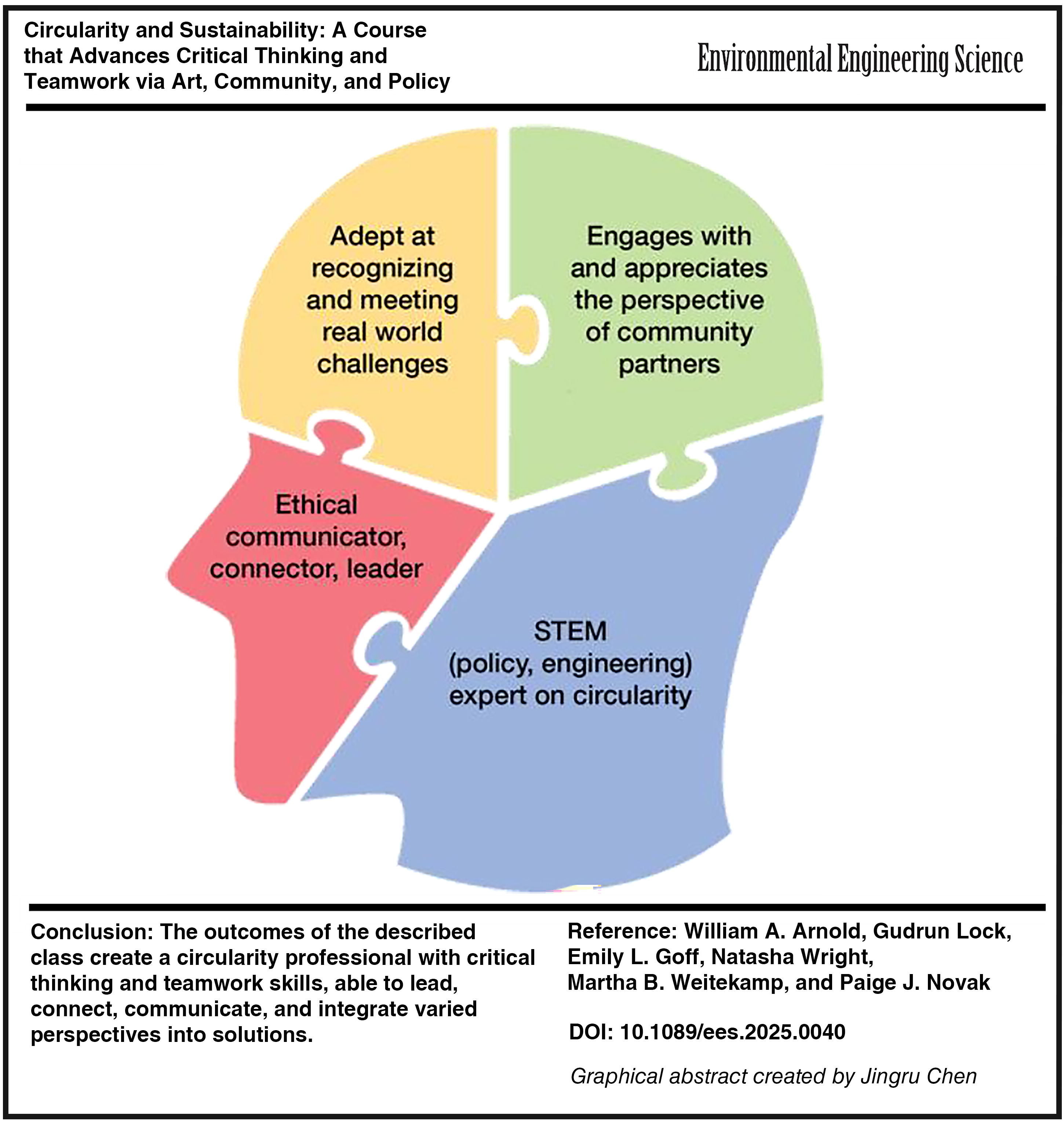
The enormous problems that our students will face during their career—plastic pollution, “forever chemicals,” a need for critical minerals while restricting environmental damage and worker exploitation, climate change, and nitrogen fluxes that exceed planetary boundaries (e.g., Richardson et al., 2023)—require circular solutions and a different set of skills. We argue that the skills that students will need include the ability to communicate, think creatively, work in teams, recognize perspective and bias, and look outside of their own field for solutions (Choudhury et al., 2019; Haroutounian, 2017; Haroutounian, 2019; Jasani and Saks, 2013; Oerther, 2022; Tyler and Likova, 2012). They will need to recognize that technology or policy alone cannot solve problems of this magnitude, but that rather, they need to be integrated with one another and with a social and behavioral perspective to move towards lasting change. The approach taken in the class that we describe herein, A Circularity Revolution: Working to Close the Loop on Global Issues, pushes students to rapidly acknowledge their own and others’ perspectives and biases. It helps them to quickly understand the tools from a variety of fields that can be used to advance circular solutions and also highlights the impact of society on solution adoption and problem prevention. We recommend that other institutions adopt similar cotaught courses to increase the number of circularity professionals working effectively in the broad area of sustainability.
Footnotes
Acknowledgments
The authors gratefully acknowledge the guest speakers and students that made this course possible.
Authors’ Contributions
All authors confirm their contribution to the article. W.A.A.: Conceptualization, investigation, writing—reviewing and editing. G.L.: Conceptualization, investigation, writing—reviewing and editing. E.L.G.: Conceptualization, methodology, formal analysis, investigation, writing—reviewing and editing. N.W.: Conceptualization, writing—reviewing and editing. M.B.W.: Conceptualization, writing—reviewing and editing. P.J.N.: Conceptualization, investigation, writing—original draft preparation, funding acquisition.
The authors welcome inquiries related to course content and resources.
Author Disclosure Statement
The authors do not have a conflict of interest.
Funding Information
This material is based upon work supported by the National Science Foundation under Grant Number 2152119. Any opinions, findings, and conclusions or recommendations expressed in this material are those of the author(s) and do not necessarily reflect the views of the National Science Foundation.

References
Supplementary Material
Please find the following supplemental material available below.
For Open Access articles published under a Creative Commons License, all supplemental material carries the same license as the article it is associated with.
For non-Open Access articles published, all supplemental material carries a non-exclusive license, and permission requests for re-use of supplemental material or any part of supplemental material shall be sent directly to the copyright owner as specified in the copyright notice associated with the article.
