






Abstract
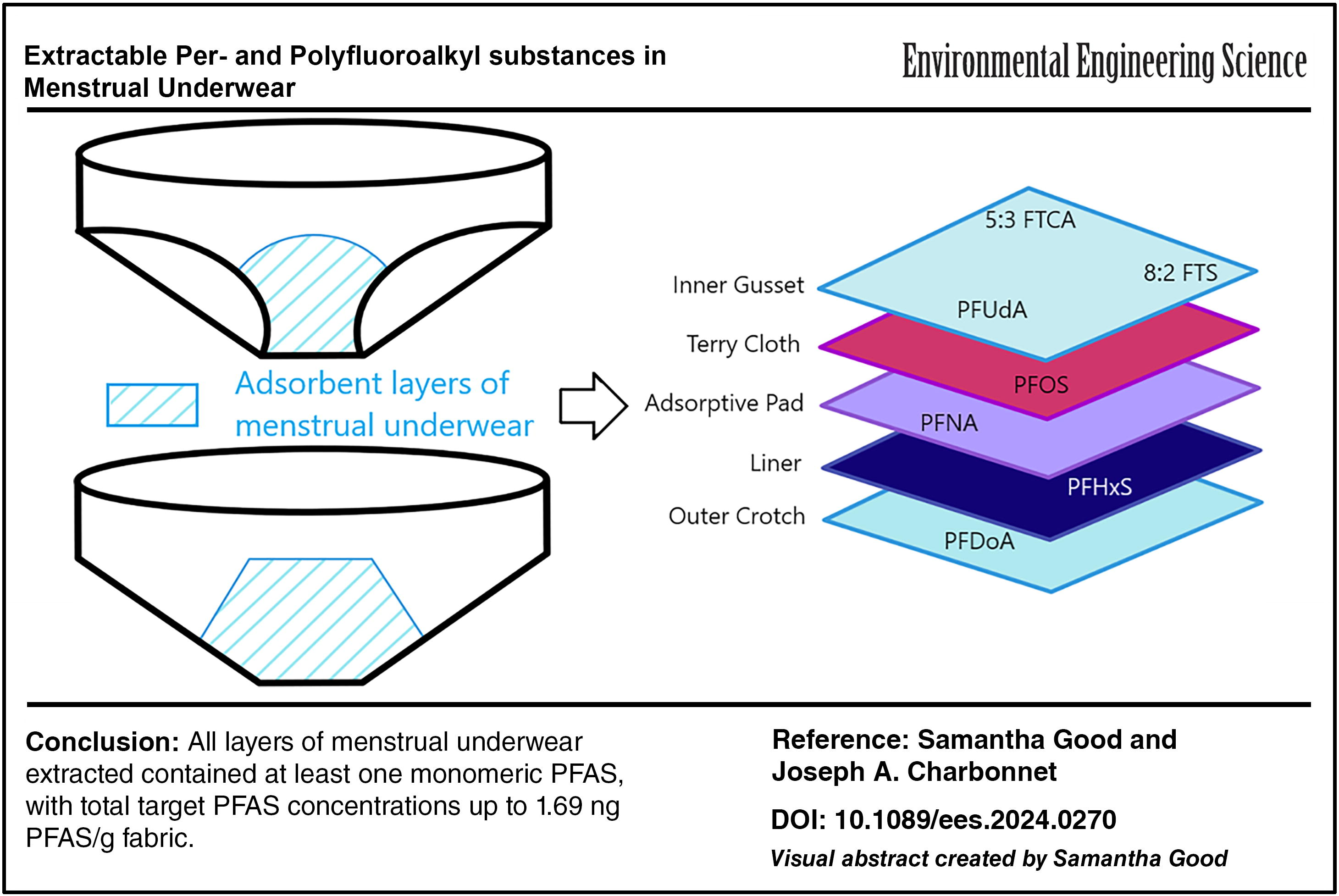
Menstrual underwear are reusable, leak-resistant menstrual hygiene products. Per- and polyfluoroalkyl substances (PFAS) are persistent anthropogenic chemicals that present health risks. We performed targeted liquid chromatography–mass spectrometry analysis on PFAS in methanol extracts of three menstrual underwear garments and one nonmenstrual organic cotton underwear as a control. Twenty PFAS were detected above the limits of quantitation in at least one layer of a garment. All layers of menstrual and nonmenstrual garments contained at least one target PFAS, with total target PFAS concentrations up to 1.69 ng PFAS/g fabric. Outer crotch layers, which contacts the epidermis, exhibited the highest total PFAS concentrations. The inner gusset, worn in contact with the genitals, also contained PFAS, suggesting a potential exposure route. Both short- and long-chain PFAS of various subclasses were among the layers, with fluorotelomers detected most frequently. These findings indicate that monomeric PFAS may be present in both menstrual and nonmenstrual underwear, a potential source of PFAS exposure for users, and contribute PFAS to domestic wastewater via laundering.
Introduction
Menstrual underwear are reusable, leak-resistant menstrual hygiene products (Hogue, 2022), which may be perceived as more comfortable, convenient, accessible, environmentally-friendly, and affordable than pads or tampons (VanLeeuwen and Torondel, 2018). The intentional addition of per- and polyfluoroalkyl substances (PFAS) to menstrual underwear could help to achieve uniform liquid distribution (Gaines, 2023), enhancing absorbency and comfort while preventing fabrics from becoming saturated and maintaining breathability (Schellenberger et al., 2019). Water- and oil-repellent side-chain fluorinated polymers can extend garment lifetime, but degrade under environmental conditions, releasing monomeric PFAS into the environment (Schellenberger et al., 2019).
PFAS exposure is associated with negative impacts to female reproductive health (Rickard et al., 2022). The external genital area, exposed to menstrual underwear during use, is more permeable than the epidermis (Ishii et al., 2014). This physiological vulnerability could increase PFAS uptake and expose wearers to endocrine-disrupting compounds.
Some menstrual underwear brands have faced lawsuits alleging their products contain PFAS despite their statements to the contrary (Hogue, 2022). Prior studies have indicated that some menstrual underwear contain fluorine levels indicative of the intentional addition of fluorinated compounds (Anonymous, 2023; Rodgers et al., 2022). However, previous research analyzing target PFAS in five menstrual underwear garments suggested extractable target PFAS were relatively uncommon in menstrual underwear, as they were quantified in just one of the garments tested (Rodgers et al., 2022).
The objective of this investigation was to quantitatively assess the presence of extractable monomeric PFAS in menstrual underwear. We used chemical extraction and liquid chromatography–tandem mass spectrometry to measure 41 target PFAS in 14 individual layers of menstrual underwear from three brands and one organic cotton underwear.
Methods
Samples were acquired in February 2023, and product formulations may have since changed. Garments A (menstrual) and D (organic cotton control) were from the same brand and purchased simultaneously from a brick-and-mortar retailer. Garments B and C (menstrual) were purchased online.
The methanolic textile extraction was adapted from Ritter et al. with each garment layer extracted in triplicate (Ritter et al., 2017). Target analyte limits of quantitation (LOQs) can be found in Supplementary Table S5. All detections below the LOQ were treated as zero values for statistical and graphing purposes, includingwhere a target PFAS was detected in some but not all triplicates. Results are presented as the mean and standard error for individual fabric layers from each garment (Fig. 1, Supplementary Table S7). Sample preparation and analysis information are available in Supplementary Data S1.
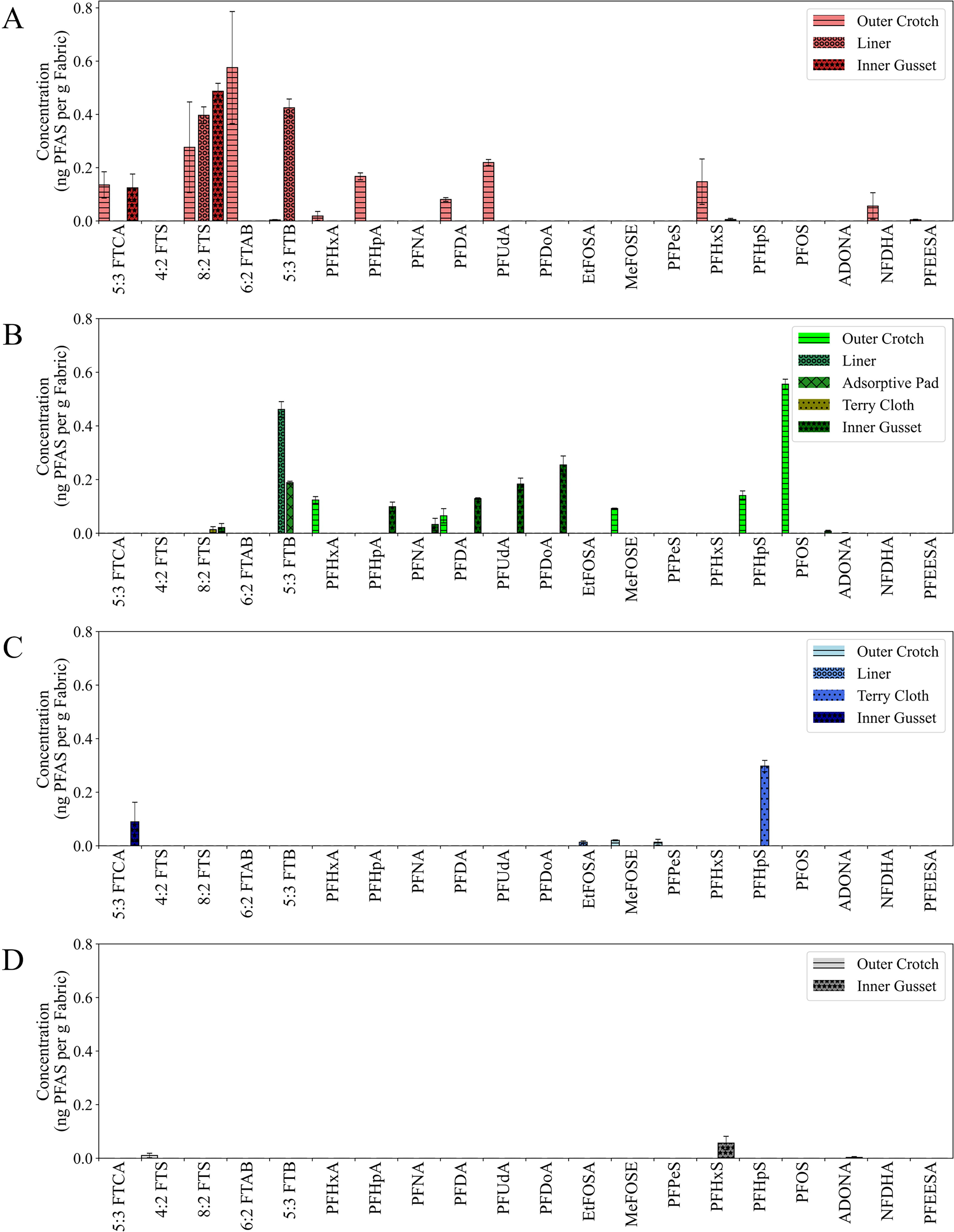
Average PFAS concentrations (ng/g fabric) quantified in each layer of garment. Error bars show standard error among triplicate samples of garment layer. Panels
Results and Discussion
Twenty PFAS were detected above the LOQ in at least one layer of a garment, and every layer of all garments contained extractable monomeric PFAS, with summed concentrations ranging from 0.01 to 1.69 ng PFAS/g fabric (Table 1, Fig. 1). No single PFAS was dominant or detected in the majority of garments. The highest PFAS concentrations were in the outer crotch fabric of Garments A and B, the terry cloth of Garment C, and the inner gusset of Garment D. The outer crotch fabric constitutes most of the garment, placing elevated PFAS concentrations in contact with the wearer’s epidermis. The inner gusset is in contact with the external genital area, which could lead to greater PFAS absorption (Ishii et al., 2014). Even the inner gusset of the nonmenstrual control contained PFAS, implying nonmenstrual underwear is a potential source of exposure. However, a layer-by-layer comparison revealed the nonmenstrual organic cotton control consistently had the lowest summed PFAS concentration among the four garments (Table 1), suggesting that the concentrations of PFAS monomers in the menstrual garments may be consistent with intentional PFAS addition.
∑41PFAS (ng/g) Extracted Using Methanol in Garment Layers
“—” = layer not present in garment. (n) = Number of quantified PFAS.
The PFAS distribution among layers indicated variability in PFAS distributions among materials and garment designs, with detections of both short- and long-chain PFAS despite the phase-out of long-chain PFAS production in the United States [EPA (Environmental Protection Agency), 2021]. Fluorotelomers were the most frequently detected subclass, with 14 detections across all garments (Supplementary Table S8). Fluorinated side-chain polymers are commonly used in fabric products and degrade into fluorotelomer monomers (Schellenberger et al., 2019).
Our results aligned with previously documented PFAS concentrations in menstrual hygiene products (Zhou et al., 2023). Previous research quantified only one target PFAS above the LOQ in one of five menstrual undergarments, yet it detected multiple PFAS above the limit of detection but below the LOQ, ranging from 0.079 to 2.28 ng/g (Rodgers et al., 2022). Our research, with lower LOQs, quantified 19 additional PFAS, suggesting that PFAS may have been present below the LOQ of previous studies. Further, previous studies only quantified target monomeric PFAS in the top layer of hygiene products (Rodgers et al., 2022; Zhou et al., 2023); our research suggests that different layers of menstrual products contain different target PFAS at different concentrations. Study limitations are discussed in Supplementary Data S1.
Conclusion
We quantified extractable monomeric PFAS in every layer of fabric across all underwear tested, both menstrual and nonmenstrual. These findings align with previous research in this field while extending the scope of results through lower experimental LOQs (Rodgers et al., 2022). A layer-by-layer comparison consistently revealed lower total PFAS concentrations in nonmenstrual underwear, indicating the possible intentional addition of PFAS in menstrual underwear. Findings underscore the need for clinical studies to explore the risks of genital PFAS exposure from menstrual hygiene products, given that PFAS are associated with negative impacts to female reproductive health. These results could further guide consumer decisions regarding risk associated with genital PFAS exposure and inform regulation of fluorinated side-chain polymers in fabrics. Furthermore, our data suggest that laundering menstrual underwear may contribute to PFAS release into domestic wastewater, although further research is needed to quantify this environmental impact.
Footnotes
Acknowledgment
The authors thank lab manager Bongi Hlabano-Moyo and lab member Juhe Liu.
Authors’ Contributions
S.G.: Investigation, Writing—original draft, Data curation. J.A.C.: Investigation, Conceptualization, Writing—review and editing, Supervision.
Author Disclosure Statement
The authors declare no competing financial interests.
Funding Information
Funding came from the Iowa State University Faculty Startup Fund and the Cleo Cowell Engineering Scholarship Fund.

References
Supplementary Material
Please find the following supplemental material available below.
For Open Access articles published under a Creative Commons License, all supplemental material carries the same license as the article it is associated with.
For non-Open Access articles published, all supplemental material carries a non-exclusive license, and permission requests for re-use of supplemental material or any part of supplemental material shall be sent directly to the copyright owner as specified in the copyright notice associated with the article.
