






Abstract
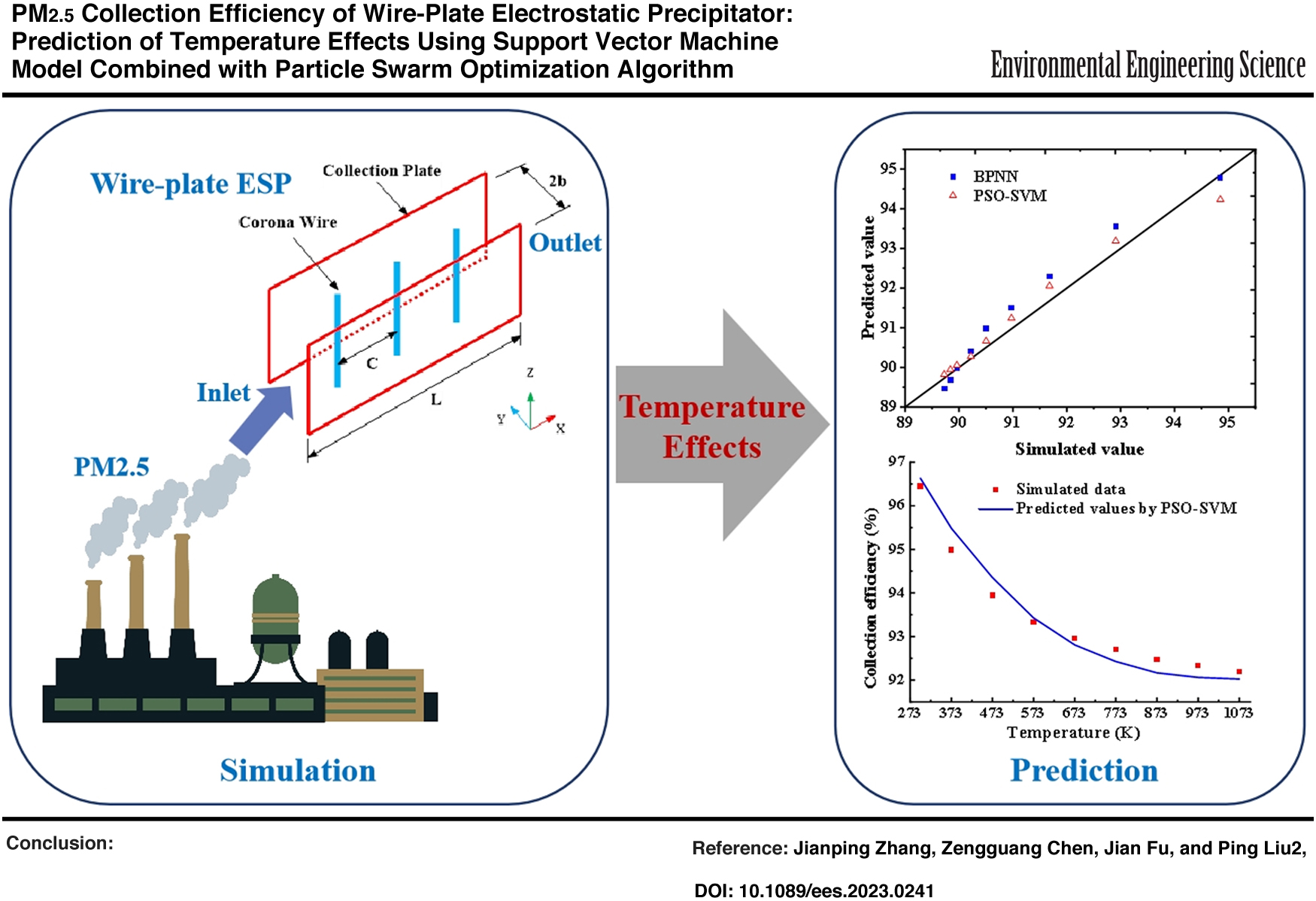
With the rapid development of industry, coal-fired power generation accounts for a large proportion of the total power generation, emitting a large amount of harmful substances, such as PM2.5, seriously affecting human health. To investigate the PM2.5 collection efficiency of wire-plate electrostatic precipitator (ESP) at different temperatures, numerical simulations based on the multi-field coupling model of ESP were conducted. Support vector machine (SVM) model combined with particle swarm optimization (PSO) algorithm gives the PSO-SVM prediction model, and the simulated data are used as training data, PSO-SVM and back propagation neural network (BPNN) models are used to predict the temperature effect under different operating conditions. The results show that PM2.5 collection efficiency in the wire-plate ESP gradually decreases with increasing temperature, and the decreased rate becomes small constantly. Both PSO-SVM and BPNN models accurately describe the relationship between collection efficiency and temperature, the average relative errors of the two models for predicting the collection efficiency of 1.0 μm particles at different temperatures are 0.247% and 0.363%, respectively. Compared with BPNN, the overall error of PSO-SVM is 0.928% lower, suggesting that PSO-SVM model yields smaller relative error and higher prediction accuracy. The related findings can provide references for studying the collection performance and rapidly determining the operating parameters of ESP.
Get full access to this article
View all access options for this article.