






Abstract
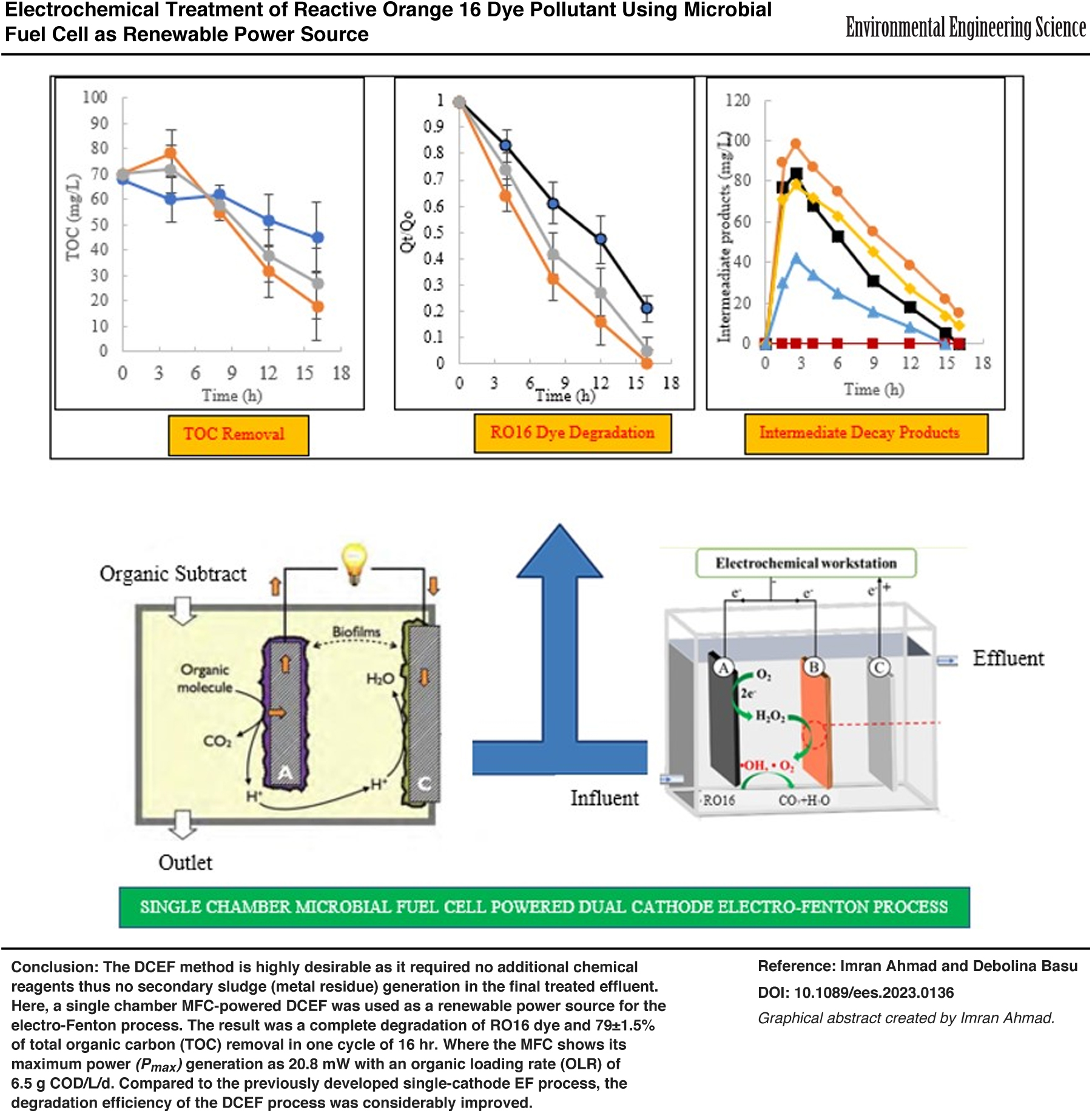
Electro-Fenton (EF) process plays an effective role for organic pollutant degradation, although it required nonsustainable electrical power source to produce hydrogen peroxide (H2O2). Two-chamber microbial fuel cells (MFCs) have been proposed for pollutant treatment using Fenton-based reactions, but these MFCs generate low-power densities and required expensive membranes. Here, we proposed a more efficient dual-reactor system with single-chamber MFC as renewable power source for dual cathodes electro-Fenton (DCEF) process treatment of reactive orange 16 (RO16) dye as model pollutant. The MFC was fabricated with a low-cost earthen pot (volume = 750 mL) using a carbon felt anode and carbon cloth air cathode, respectively. For the DCEF chamber, two cathodes: graphite plate (C1) and stainless steel (C2) were used for simultaneous H2O2 production and activation. The MFC produced the maximum power (Pmax) of 20.8 mW at an organic loading rate (OLR) of 6.5 g COD/L/day. For any higher OLR ≥6.5 g COD/L/day, the MFC shows an overloaded organic substrate condition which resulted in a reduction in system efficiency. It was found that complete degradation of RO16 dye and 79 ± 1.5% of total organic carbon removal was achieved in one cycle (16 h) of the dual reactor system. Compared to the previously developed single-cathode EF process, the degradation efficiency of the DCEF process was considerably improved. The results of the developed dual-reactor system show efficient removal of RO16 persistent organic pollutants that would advance the practical application of the EF treatment process.
Get full access to this article
View all access options for this article.
References
Supplementary Material
Please find the following supplemental material available below.
For Open Access articles published under a Creative Commons License, all supplemental material carries the same license as the article it is associated with.
For non-Open Access articles published, all supplemental material carries a non-exclusive license, and permission requests for re-use of supplemental material or any part of supplemental material shall be sent directly to the copyright owner as specified in the copyright notice associated with the article.
