






Abstract
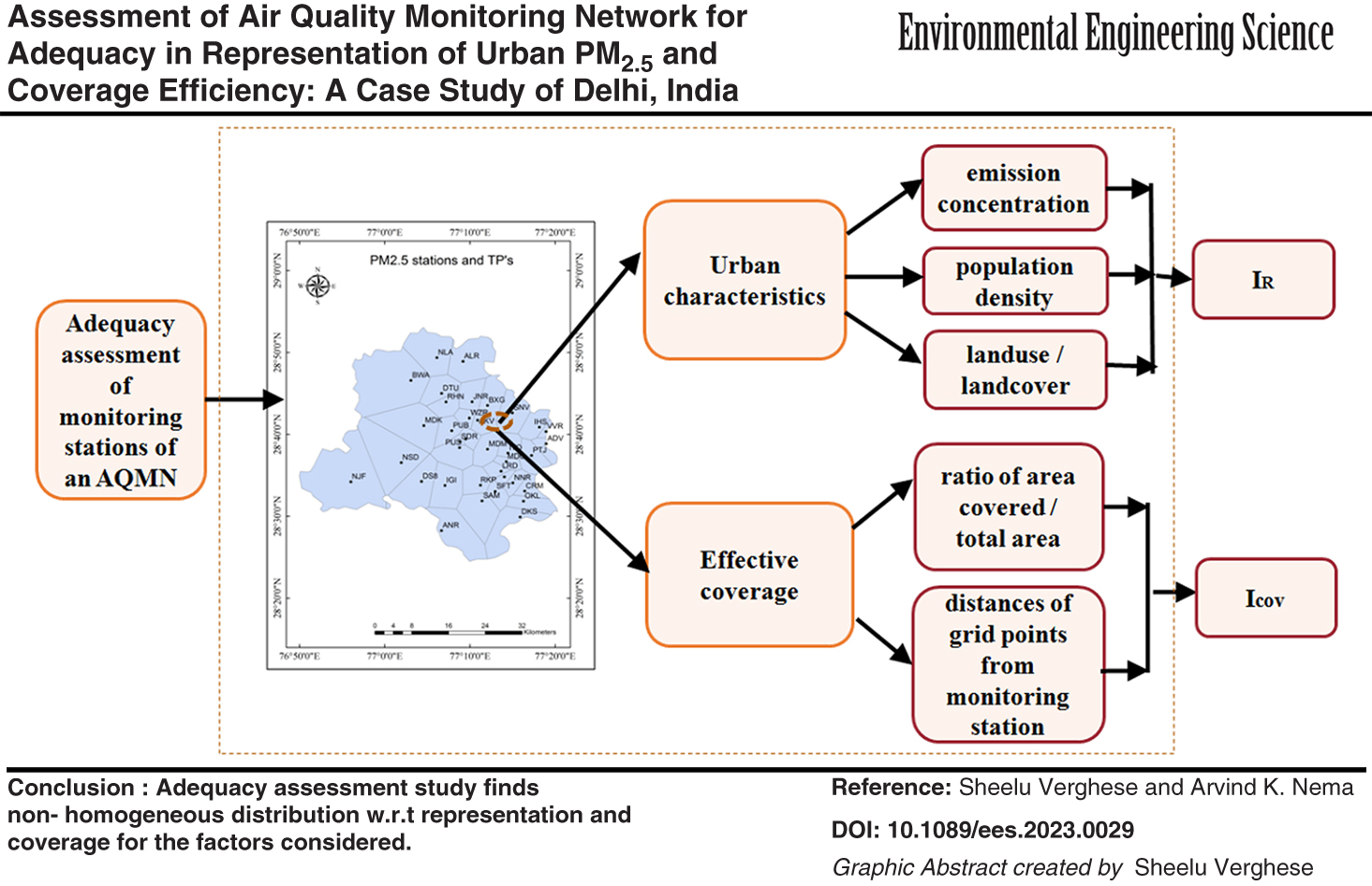
Air quality monitoring stations are sited to effectively characterize the circumambient pollution concentration. Population, landuse, and emissions are dominant urban aspects that guide siting of a station. Adequacy assessment of stations for coverage and representation thus assumes significance as a prerequisite to network modifications, especially for urban clusters. Airshed approach for management of air quality-related issues is drawing rapid attention, especially in developing nations. The conceptual methodology proposed in this study for assessment assumes that a Thiessen polygon area represents an airshed and the enclosed monitoring station records pollution concentrations of this area. This hypothesis is applied as a case study for adequacy assessment of PM2.5 monitoring network of Delhi, India. Two indices, namely index of representation and coverage index, are evaluated to quantify the adequacy. Index of representation is estimated for influencing attributes: emissions, population density, and land use type denoting the urban-specific characteristics. Coverage effectiveness index is calculated based on proportional area of polygons and Euclidean distances. An alternate approach of estimation by analysis of spatial correlation coefficients of pollution concentrations is also discussed by this work. The results draw attention to the nonhomogeneity in the representativeness and coverage for network considered. The approaches demonstrated can be applied to airshed regions, for management of air pollution, by identifying stations with inadequate coverage and representation of spatial attributes.
Get full access to this article
View all access options for this article.