






Abstract
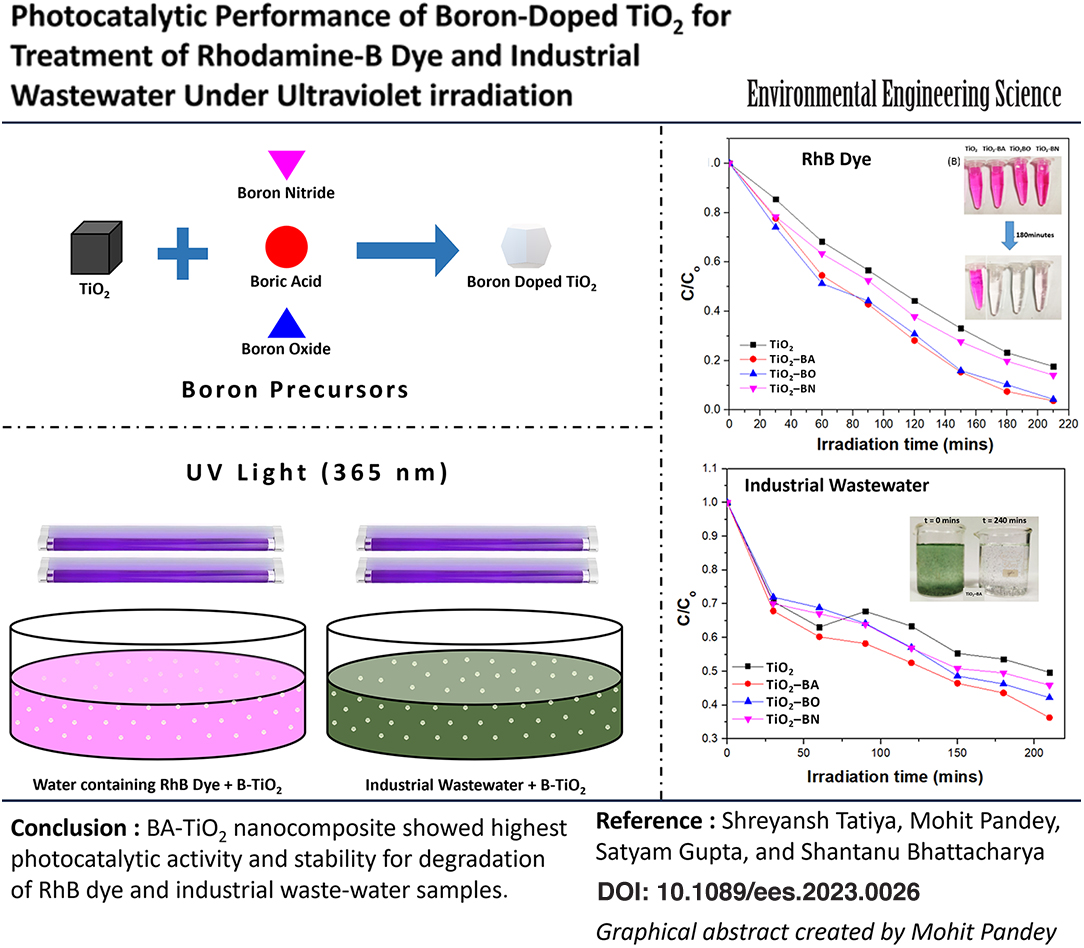
The organic dyes that have been added to water by various industrial effluents possess a serious threat to the environment due to their mutagenic character. TiO2 has been widely employed as a photocatalysis for the degradation of these dyes. However, a non-metal doped TiO2 can be a promising candidate for the advanced treatment of industrial wastewater containing organic dyes. In this work, we have prepared and tested different boron-doped TiO2 photocatalysts to examine the effect of boron addition on the photocatalytic activity of TiO2. The various boron precursors used are boric acid (BA), boron oxide (BO), and boron nitride (BN), through which Boron is formulated and is doped through a single-step sol-gel method. The prepared nanocomposites are characterized using various characterization techniques, such as Field Emission Scanning Electron Microscopy (FESEM), Transmission electron microscopy (TEM), ultraviolet-visible (UV-Vis) and Raman spectroscopy, X-ray diffraction (XRD), Fourier Transform Infrared (FTIR) spectroscopy, photoluminescence, and X-ray Photoelectron Spectroscopy (XPS) analysis. UV light of wavelength 365 nm has been used for studying the photocatalyst behavior. Both rhodamine-B (RhB) and industrial wastewater samples have been studied for degradation kinetics. The boron-doped TiO2 nanocomposites show a high level of dye degradation (>95%) with RhB dye and (>63%) with industrial wastewater samples. Further, TiO2-BA composites in both the cases showed maximum dye degradation compared with other boron nanocomposites with an enhancement in the efficiency of (>13%) over a pure phase of TiO2.
Get full access to this article
View all access options for this article.
References
Supplementary Material
Please find the following supplemental material available below.
For Open Access articles published under a Creative Commons License, all supplemental material carries the same license as the article it is associated with.
For non-Open Access articles published, all supplemental material carries a non-exclusive license, and permission requests for re-use of supplemental material or any part of supplemental material shall be sent directly to the copyright owner as specified in the copyright notice associated with the article.
