






Abstract
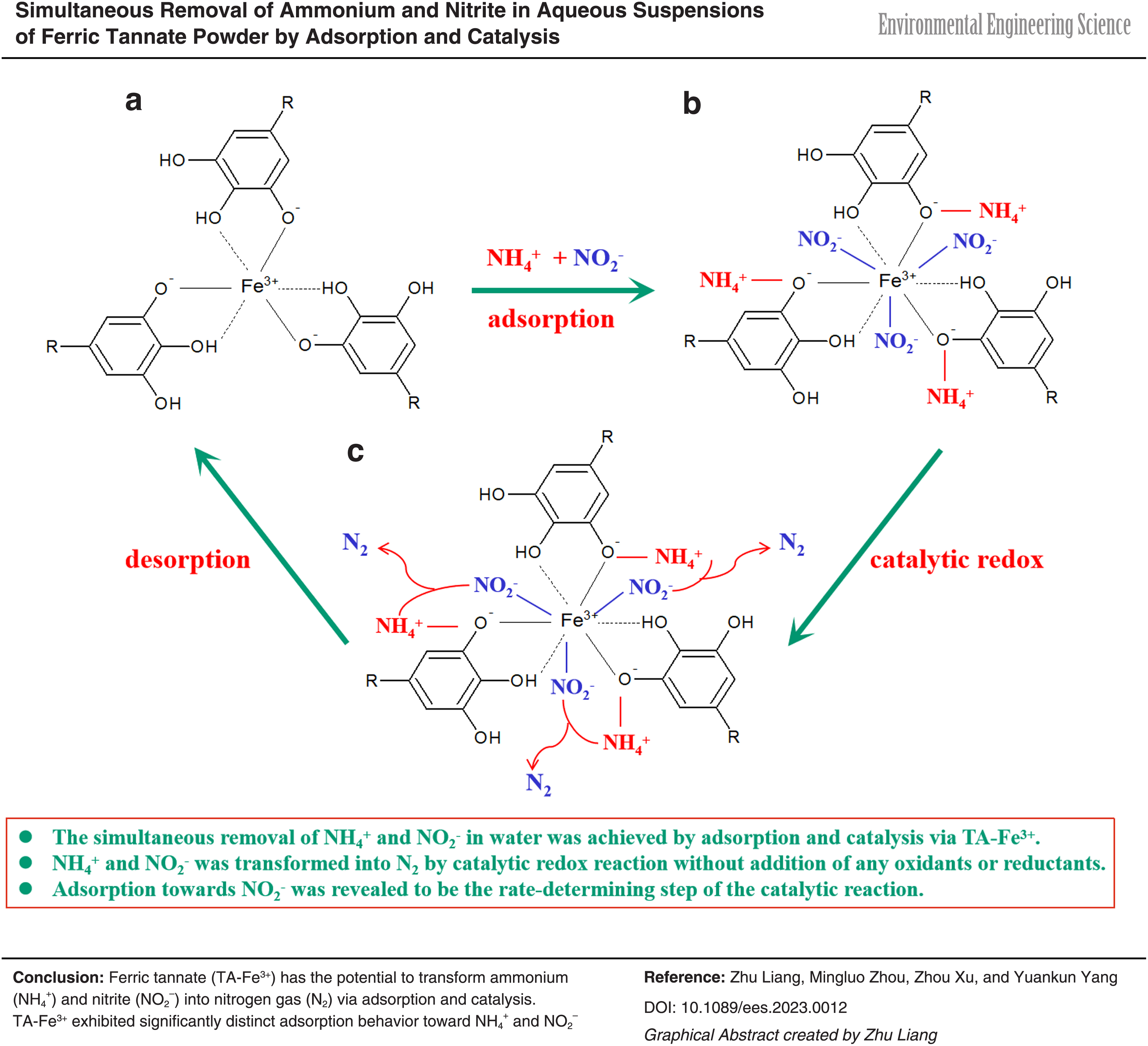
Ferric tannate (TA-Fe3+) has the potential to transform ammonium (NH4+) and nitrite (NO2−) into nitrogen gas (N2) through adsorption and catalysis. Few reports have given detailed account of different adsorption behavior for NH4+ and NO2−, which is important to develop the potential of the material. TA-Fe3+ was synthesized here and its performance as an adsorbent/catalyst for the simultaneous removal of NH4+ and NO2− from water was investigated. Results confirmed the adsorption and catalysis capability of TA-Fe3+ toward NH4+ and NO2−: (1) Following a 24 h adsorption and redox, the concentrations of NH4+ and NO2− in the mixed solution decreased from initial values of 10.71 and 7.14 to 4.28 and 1.64 mmol/L, respectively, and 0.41 mmol/g of N2 was produced with a maximal N2 yield rate of 0.072 mmol/[g·h]. The N2 yield was about 144 times that in the absence of TA-Fe3+; (2) intermediate products such as nitrous oxide (N2O) and nitrate (NO3−) were not detected; and (3) Raman spectrum analysis identified the site of Fe–O bond to be the center of adsorption and catalysis. Moreover, there were interesting findings: (1) TA-Fe3+ exhibited significantly distinct adsorption behavior toward NH4+ and NO2−. External diffusion and internal diffusion exerted a key influence on the adsorption toward NH4+ and NO2−, respectively; NH4+ was adsorbed on TA-Fe3+ in the form of monolayer, and NO2− in the forms of both monolayer and multilayer; (2) TA-Fe3+ was easily regenerated with water; and (3) adsorption toward NO2− was the rate-determining step of the catalytic reaction. These findings will provide valuable enlightenment for the further work to reveal the adsorption and catalysis mechanisms of TA-Fe3+.
Get full access to this article
View all access options for this article.
References
Supplementary Material
Please find the following supplemental material available below.
For Open Access articles published under a Creative Commons License, all supplemental material carries the same license as the article it is associated with.
For non-Open Access articles published, all supplemental material carries a non-exclusive license, and permission requests for re-use of supplemental material or any part of supplemental material shall be sent directly to the copyright owner as specified in the copyright notice associated with the article.
