






Abstract
A growing world population with increasing levels of food consumption will lead to more dairy and swine production and increasing amount of manure that requires treatment. Discharge of excessive nutrients and carbon in untreated animal manure can lead to greenhouse gas emissions and eutrophication concerns, and treatment efforts can be expensive for small scale farmers in marginalized communities. The overall goal of this study was to determine the environmental and economic sustainability of four animal manure management scenarios in Costa Rica: (1) no treatment, (2) biodigesters, (3) biodigesters and struvite precipitation, and (4) biodigesters, struvite precipitation, and lagoons. Life cycle assessment was used to assess the carbon footprint and eutrophication potential, whereas life cycle cost analysis was used to evaluate the equivalent uniform annual worth over the construction and operation and maintenance life stages. Recovery of biogas as a cooking fuel and recovery of nutrients from the struvite reactor reduced the carbon footprint, leading to carbon offsets of up to 2,500 kg CO2 eq/year. Offsets were primarily due to avoiding methane emissions during energy recovery. Eutrophication potential decreased as resource recovery processes were integrated, primarily due to improved removal of phosphorus in effluent waters. Resource recovery efforts led to equivalent uniform annual benefits of $825 to $1,056/year, which could provide a helpful revenue source for lower-income farmers. This research can provide clarity on how small-scale farmers in marginalized settings can utilize resource recovery technologies to better manage animal manure, while improving economic and environmental sustainability outcomes.
Introduction
An estimated 60%
The recovery of valuable resources from animal manure could be particularly beneficial to protect waterways and improve food security for marginalized farmers living in poverty. The majority of those living in poverty tend to live in rural areas and work in agriculture (World Bank, 2014). Small farms (<2 ha) make up 84% of all global agricultural land (Lowder
Opportunities exist at small-scale farms to reduce environmental impacts and recover beneficial resources by implementing and/or improving treatment of animal manure. Appropriate technologies for treatment of animal manure from smaller farms in developing communities should utilize locally available resources, be economically affordable, and safely provide resources back to the farmer (Mihelcic
Limited life cycle assessment (LCA) studies focus on resource recovery for wastewater treatment systems and animal manure management in developing regions (Corominas
Other studies have investigated the benefits of resource recovery from community-scale wastewater treatment and resource recovery in Bolivia, highlighting the benefits of energy recovery, water reuse, and nutrient recycling (Cornejo
In Latin America, two LCAs have been conducted on swine and dairy wastewater manure management (Pérez
While LCA is useful for understanding the environmental impacts, life cycle cost analysis (LCCA) can be used to assess the economic implications of wastewater management and resource recovery strategies, especially in marginalized communities. Two U.S. based studies have investigated life cycle cost implications of resource recovery strategies that included struvite precipitation (Ishii and Boyer, 2015; Amini
Therefore, the overall goal of this study was to determine the life cycle environmental and economic sustainability of four animal manure management and resource recovery scenarios in rural Costa Rica using LCA and LCCA: (1) no treatment, (2) biodigesters (energy recovery), (3) biodigesters and struvite precipitation (energy and nutrient recovery), and (4) biodigesters, struvite precipitation, and lagoons (energy, nutrient, and water recovery). The specific objectives were (1) to identify potential resource recovery and emission reduction strategies that can address multiple UN SDGs and (2) to assess the economic feasibility of water, energy, and nutrient recovery strategies to highlight potential costs and benefits for small-scale farmers. This study is unique in its combination of life cycle economic and environmental sustainability for small-scale animal manure management and resource recovery to achieve global goals and inform policy in a developing region.
Case Study Background
The site location of this study took place at the University of Georgia-Costa Rica (UGA-CR) in San Luis, Costa Rica. UGA-CR implemented biodigesters on their campus to treat dairy and swine manure to reduce propane use and model sustainable agriculture (Kinyua
A combination of appropriate technologies was investigated that included two biodigesters, a struvite precipitation reactor, lagoons, and an aquaculture pond (Supplementary Figs. S1 and S2) (Orner
The biodigester effluent, rich in ammonium and phosphate, was used to precipitate struvite (magnesium ammonium phosphate), a slow-release bio-based fertilizer. A 200-L struvite precipitation reactor was built in 2018 based on the design of Etter
After the struvite precipitation reactor, the liquid effluent was discharged to a series of four lagoons. The last lagoon was used to test the aquaculture efforts of growing tilapia, which can be harvested for food production. The liquid passes from one lagoon to the next by gravity. The liquid effluent from the fourth lagoon drains by gravity to fertilize protein banks of Mulberry and King Grass downstream of the lagoon, closing the food and nutrient loop.
As up to three unit processes were in operation, four scenarios were analyzed, with each scenario adding a resource recovery unit process (further scenario details provided in Supplementary Information). In scenario 1 (no treatment), manure is directly applied without treatment. In scenario 2 (biodigester with energy recovery only), two biodigesters were added to treat animal manure. The biodigesters produce biogas that is recovered for energy use, and the liquid and solid digester effluent is directly applied to the land. A struvite reactor is added to the two biodigesters in scenario 3 (biodigesters and struvite with energy and nutrient recovery) to recover nutrients from the liquid digestate. In scenario 4 (biodigesters, struvite, and lagoons with energy, nutrient, and water recovery), a series of lagoons are added to treat the liquid struvite reactor effluent. The reclaimed water is used for aquaculture to produce tilapia, and the remaining lagoon effluent can be used for further nutrient recovery (Fig. 1). These scenarios were investigated to establish what combination of energy, nutrient, and water recovery could lead to the most beneficial economic and environmental outcomes.
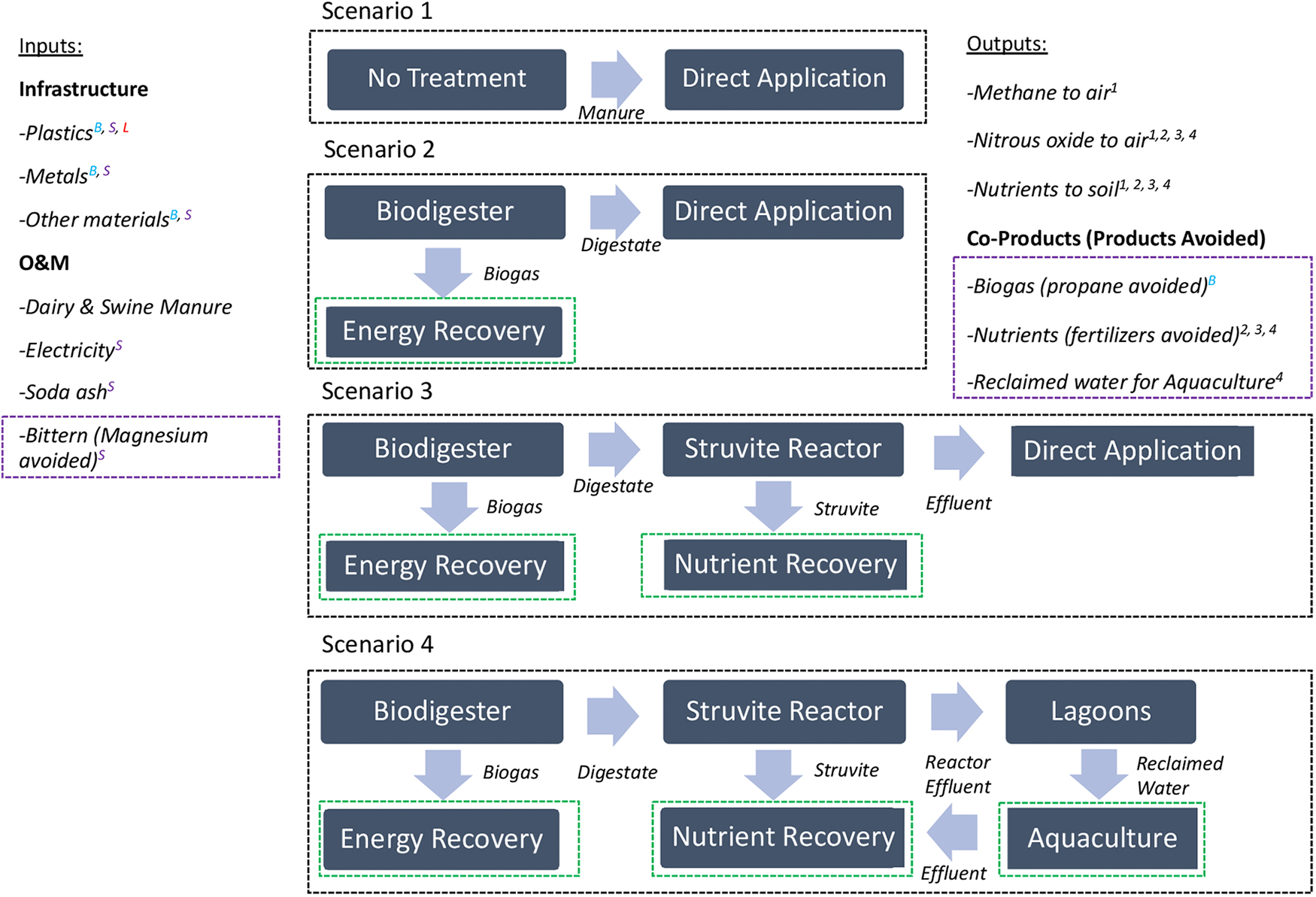
System boundaries of the scenarios analyzed are shown (
Materials and Methods
LCA goal and scope definition
A LCA was conducted on this animal manure management system. In accordance with International Organization for Standardization guidelines of LCA (ISO, 2006), (1) a goal and scope were defined, (2) a life cycle inventory was compiled, (3) a LCA was conducted, and (4) results were interpreted. The goal of this LCA was to assess the environmental impacts of the animal manure management system in four treatment scenarios. The functional unit of this system was to treat 1,500 L/day of animal manure and recover resources over the course of 1 year of operation. The system boundary included construction, as well as the operation and maintenance (O&M) phases of the life cycle, where end-of-life impacts are assumed to be negligible. This includes infrastructure and O&M phases of (1) no treatment, (2) biodigester (energy recovery), (3) biodigester and struvite precipitation (energy and nutrient recovery), and (4) biodigester, struvite precipitation, and lagoons (energy, nutrient, and water recovery) (Fig. 1). Remaining scope items, including the life cycle inventory analysis, life cycle impact assessment (LCIA), and interpretation are discussed in the following Life cycle inventory, Avoided products, and Life cycle impact assessment sections.
Life cycle inventory
Life cycle inventory data were collected through communication with O&M personnel at UGA-CR, effluent measurements from a previous study on this system (Orner
Summary of Life Cycle Inventory Items
Scenarios include: scenario 1—No treatment; scenario 2—Biodigester (energy recovery); scenario 3—Biodigester and struvite precipitation (energy and nutrient recovery); scenario 4—Biodigester, struvite precipitation, and lagoons (energy, nutrient, and water recovery). Life cycle inventory values per functional unit are shown in Supplementary Tables S1–S4.
No infrastructure used for land application of animal manure.
Plastic infrastructure includes polyvinyl chloride, polypropylene, and polyethylene.
Metals include primarily steel and some aluminum for the struvite reactor.
Includes bricks and diesel for scenario 2 and a canvas cloth filter for scenario 3.
UGA-CR, University of Georgia-Costa Rica.
The no-treatment scenario consisted of no infrastructure. We assumed 12 head of swine and dairy cows and that land application of swine and dairy manure caused GHG emissions (e.g., CH4 and N2O) and nutrient emissions (N and P) to soil (Supplementary Table S1). An emission factor of 1 kg CH4/head/year was used to estimate methane emissions from land application based on IPCC methods (Jun
The second scenario, biodigester (energy recovery), consisted of infrastructure, including plastics, metals, bricks, and diesel usage during construction (Supplementary Table S2). Plastics (e.g., polyvinyl chloride, polypropylene, and polyethylene), diesel, steel, and bricks were necessary for the biodigester infrastructure (Botero and Preston, 1987). Biodigester infrastructure included piping to transport the biogas to cook stoves, where it would be directly used as a cooking fuel without cleaning, similar to current practices. Biogas storage is not considered. Data on methane captured from the biodigester were collected from a previous study (Kinyua
The third scenario, biodigester and struvite precipitation (energy and nutrient recovery) considered the infrastructure from the biodigester in addition to the metals and plastic infrastructure from the struvite reactor built on-site during the time of data collection (Supplementary Table S3). Emissions during operation included nitrous oxide emissions, chemical usage, chemicals avoided, energy usage, nutrient emissions to soil, and fertilizers avoided due to nutrient recovery were considered (details in Supplementary Information). Chemical quantities used for struvite precipitation (e.g., soda ash used for pH adjustment and magnesium used to form the solid precipitate) were measured on-site and energy usage was estimated based on heat requirements to dry out struvite (Orner
The fourth scenario includes the biodigester, struvite precipitation, and lagoons for energy, nutrient, and water recovery (Supplementary Table S4). As such, this scenario includes infrastructure from the biodigester and struvite reactor (scenario 2 and 3) in addition to infrastructure from the lagoons (e.g., geomembrane). Negligible environmental impacts are associated with fish production since no additional chemicals, energy, or infrastructure added, and farmers will conduct activities manually. During the operation phase, nitrous oxide emissions are considered in addition to nutrient emissions to the soil from the lagoon effluent. Given the reuse potential of the lagoon effluent, nitrogen and phosphorus fertilizers avoided as a result of water reuse were considered.
Avoided products
Products avoided through resource recovery scenarios were also considered using a system expansion allocation method (Table 1). For example, biogas recovered through biodigestion can be used as a cooking fuel, which can replace propane that would otherwise be used. Propane avoided through biogas recovery was estimated based on calculations relating the volumes and calorific values of propane and biomethane. In addition, nutrients recovered through struvite recovery and water reuse lead to the replacement of synthetic fertilizer used for these efforts. The N and P fertilizer replacement values were based on the N and P (kg/year) from struvite and water reuse. A limitation to this approach is that plants may not assimilate nutrients in struvite or reclaimed water at the same rate as synthetic fertilizer. Refer to the Supplementary Information to see the detailed life cycle inventory of avoided products.
Life cycle impact assessment
SimaPro 9 was used to conduct the LCIA using ReCiPe methods (Pré, 2016). ReCiPe (Goedkoop
Life cycle cost analysis
In conjunction with the life cycle inventory, unit costs of infrastructure materials and chemicals used during operations were gathered through manufacturer websites and personal communication with UGA-CR O&M personnel. Based on unit costs, infrastructure and O&M costs were estimated for each unit process to identify dominant cost contributors. Decommissioning and dismantling costs at the end of life were considered negligible due to the small scale of the system. Life cycle costs of the infrastructure and O&M were calculated and expressed as an equivalent uniform annual cost.
Revenue streams associated with resources recovered and associated products were also calculated. The three main products that have the potential to generate revenue streams or cost savings due to on-site production of products include energy production, nutrient production, and fish production. Benefits associated with energy production come from the cost savings associated with biogas production replacing use of propane. On-site nutrient production of struvite leads to avoided purchase of fertilizers. Because opportunity exists to use the fourth lagoon for production of tilapia as a food source, benefits associated with localized fish production were quantified. The equivalent uniform annual worth (EUAW) accounts for system costs as negative values and revenues as positive values. Costs and revenues are expressed in 2018 U.S. Dollars (2018 USD/year) using a 9.21% interest rate (World Bank, 2018) and a 20-year analysis period. Engineering economics equations (Newnan
Sensitivity analysis
A sensitivity analysis was conducted to assess the system's sensitivity to changes in input inventory data using methods similar to Mo
Results and Discussion
Life cycle assessment
Life cycle carbon footprint
The annual carbon footprints for the four treatment scenarios are shown in Fig. 2. Under the no-treatment (scenario 1), the total annual carbon footprint is 1,263 kg CO2 eq/year. Under this alternative, dairy and swine manure is collected and subsequently land applied. The dominant contributors to GHG emissions in scenario 1 included nitrous oxide (73%) and methane (27%). In a large-scale study of untreated swine manure, methane contributed 73–84% and nitrous oxide contributed 12–26% of overall GHG emissions (Hamelin
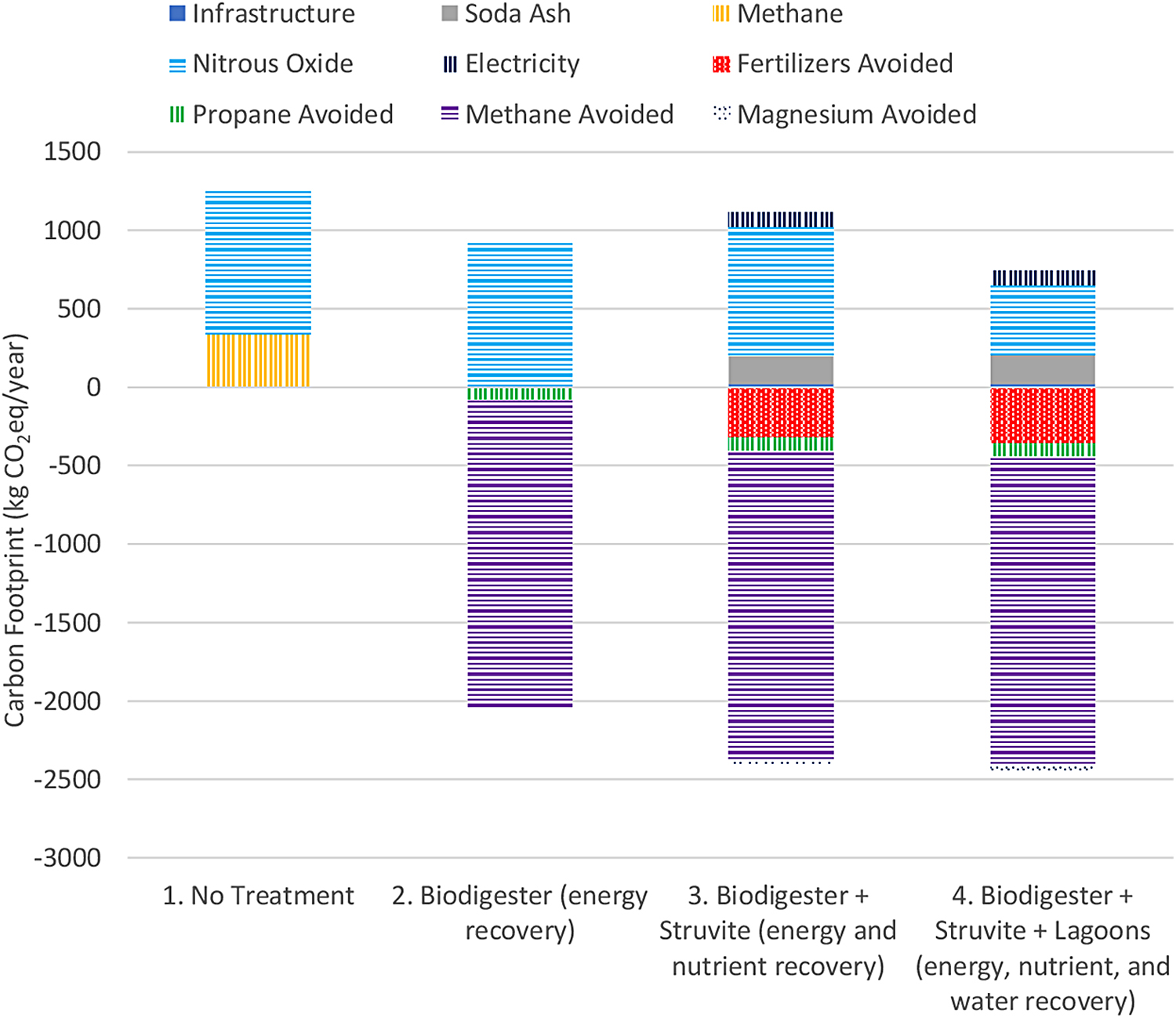
Annual carbon footprint (kilograms of CO2 equivalents/year) of four animal manure management scenarios analyzed using life cycle assessment.
Adding a biodigester with energy recovery (scenario 2) reduces methane emissions, and the recovery of biogas as a cooking fuel leads to the avoidance of methane release, offsetting 1,969 kg CO2 eq/year (Fig. 2). Nitrous oxide from the land application of digestate emits 912 kg CO2 eq/year, and thus remains the dominant contributor (99% of the total without offsets) to the carbon footprint. Meanwhile, infrastructure from the biodigesters has a minimal impact (5 kg CO2 eq/year) on the carbon footprint, and accounts for only 1% of the total without offsets. In addition, replacing propane with biogas leads to an offset of 85 kg CO2 eq/year. Collectively, these carbon sinks lead to a carbon-positive system that reduces the total annual carbon footprint to −1,137 kg CO2 eq/year. Previous studies have also shown that the carbon footprint decreases when untreated or land applied manure scenarios are compared to biogas recapture scenarios (Hamelin
When struvite precipitation was added to energy recovery efforts in scenario 3, additional benefits emerge due to the carbon offsets associated with nutrient recovery in the form of struvite (Fig. 2). Environmental and economic impacts of magnesium have been investigated previously (Sakthivel
The results of combined energy, nutrient, and water recovery from scenario 4 were largely the same as scenario 3, except that less nitrous oxide was emitted due to reduced nitrogen concentrations in the liquid effluent leaving the system (Fig. 2). This improved nutrient removal due to the addition of the lagoons led to a decrease in carbon footprint associated with nitrous oxide emissions (447 kg CO2 eq/year). Additional infrastructure requirements for small-scale lagoons have a minimal impact on the carbon footprint (3% of the total without offsets). Overall, recovery of biogas as a cooking fuel and recovery of nutrients from the struvite reactor improved the environmental performance of the treatment process. Avoiding methane emissions provided the largest offsets. Although existing studies have assessed biogas recovery from biodigesters (Pérez
Life cycle eutrophication potential
The annual eutrophication potential for each treatment scenario is shown in Fig. 3. The contribution of each unit process can be seen in the difference in eutrophication potential between each scenario. The dominant contributor to eutrophication potential in each management scenario was nutrient discharges, particularly from phosphorus. Eutrophication potential decreased as resource recovery unit processes were added to the treatment train due to an increase of nutrient recovery and removal. If no treatment occurred (scenario 1), the eutrophication potential was 25.6 kg P eq/year. The eutrophication potential remained high (19.7 kg P eq/year) in scenario 2 due to poor removal of nutrients during anaerobic digestion. The biodigester was not designed to remove high levels of nitrogen and phosphorus; therefore, the nutrient-rich biodigester effluent can impair water quality if directly discharged to a nearby water body (Orner
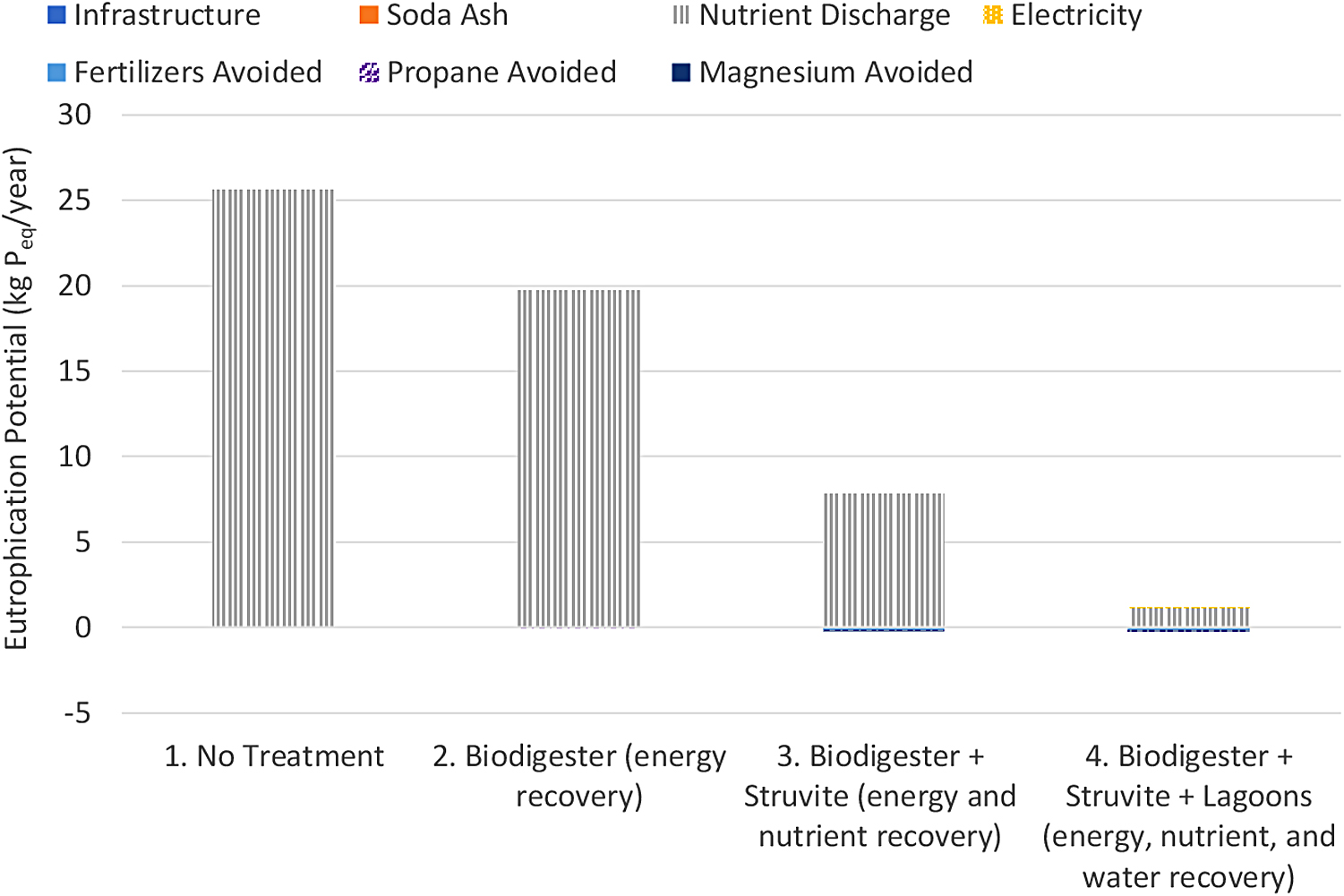
Annual eutrophication potential (kilograms of P equivalents/year) of four scenarios analyzed using life cycle assessment.
Products such as propane, fertilizers, and magnesium that were avoided due to resource recovery had a minimal impact on eutrophication potential reduction. Offsets associated with propane avoided from the biodigester (scenario 2) were negligible. Offsets associated with fertilizers avoided due to struvite recovery were only 2% of the total eutrophication potential. In contrast, the relative contribution of fertilizers avoided was 14% of the total when combining biodigesters, struvite recovery, and lagoons for treatment and nutrient recovery. The relative contribution of fertilizers avoided was higher because improved nutrient recovery caused the overall eutrophication potential to decrease. The total eutrophication potential that was offset from the use of magnesium from the salt manufacturing facility was minimal as well for scenarios 3 and 4.
Life cycle cost analysis
The EUAW for scenarios 2–4 was evaluated to assess costs and benefits of multiple resource recovery strategies (Fig. 4).
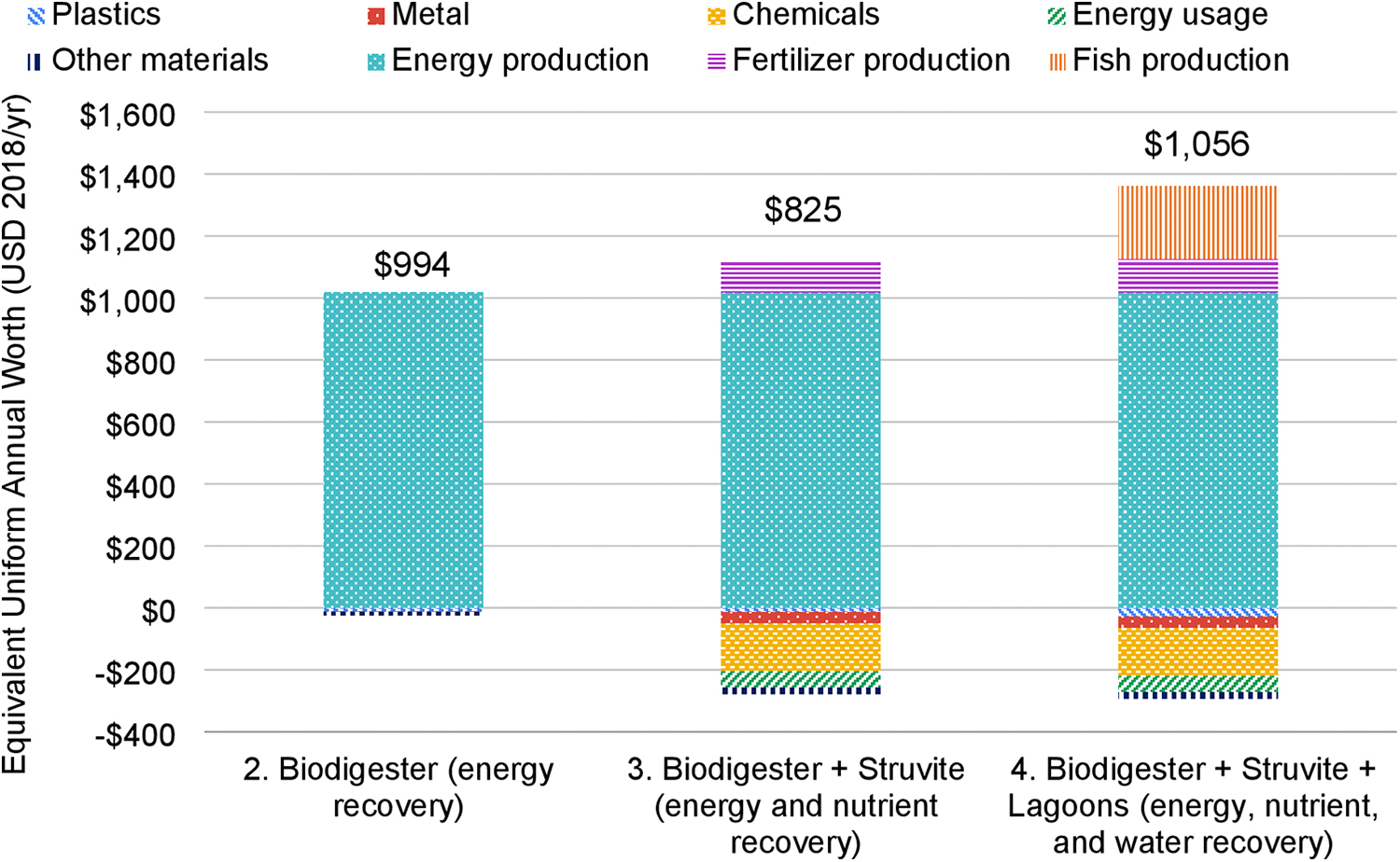
Life cycle cost of treatment and resource recovery strategies, expressed as EUAW in USD 2018 per year.
Scenario 1 was excluded from the analysis due to the low costs associated with the no treatment scenario for small-scale farmers. Energy production from biogas was the greatest single contributor to revenue streams for scenarios 2–4. All three scenarios led to net benefits, in which the net EUAW was $994/year, $825/year, and $1,056/year for scenarios 2, 3, and 4, respectively. The net annual benefit of $825 to 1,056 can provide a helpful revenue source for entry-level farmers who earn approximately $8,000/year (ERI, 2020). Globally, many small-scale farms live in extreme poverty, earning less than $1.25/day (UN, 2020b). This net annual benefit associated with globally transferable resource recovery technologies could significantly reduce the number of small-scale family farmers living in poverty given the appropriate market demand for water, energy, and nutrients.
Scenario 2 provided benefits from energy production only, whereas scenario 3 provided the benefits of both energy and struvite fertilizer production. In scenario 2, infrastructure costs for the biodigester were minimal compared to the net revenue gains from biogas production. When struvite precipitation was added in scenario 3, the EUAW slightly decreased to $825/year due to the additional costs of infrastructure, chemicals, and energy needed for struvite recovery. The dominant contributor to the cost was chemicals needed for struvite precipitation, accounting for 21% of the net EUAW. Chemical costs could be reduced by seeking out low-cost and locally available alternatives to soda ash, such as wood ash (Sakthivel
Scenario 4 combined energy, nutrient, and water recovery strategies to provide coproducts such as biogas, struvite fertilizer, and fish. This scenario had the greatest net EUAW ($1,056/year) out of all four scenarios. The additional cost of lagoon infrastructure was minimal compared to the benefits gained from fish production ($235/year). Energy production, fertilizer production, and fish production in scenario 4 represented 97%, 10%, and 22% of the net EUAW. In addition to having the largest EUAW, scenario 4 could reduce the risk of eutrophication through a carbon-neutral combination of appropriate resource recovery technologies while providing beneficial coproducts to improve the management of water-energy-food nexus systems.
Sensitivity analysis
Generally, carbon footprint, eutrophication potential, and EUAW results were not highly sensitive to changes in dominant life cycle inventory items for all scenarios evaluated (please refer to Supplementary Fig. S3 in Supplementary Information); when changing input values at ±20%, a percent change of approximately ±20% was seen in most cases. For example, changes in nitrous oxide at ±20% resulted in a percent change of ±20% for carbon footprint results in all scenarios evaluated. However, methane avoided in scenario 2 had the highest sensitivity on carbon footprint results, leading to a percent change of ±34.3% due to its large contribution to biodigester offsets when recovering biogas. Shifts in methane or methane avoided for all other scenarios had a lower sensitivity to carbon footprint results, leading to a percent change range between −5.3% and +5.5% for all scenarios analyzed. These findings highlight that carbon footprint results were more sensitive to changes in nitrous oxide in all scenarios, whereas methane avoided had the highest sensitivity in scenario 2. This calls attention to the importance of proper digester maintenance and soil management practices to reduce GHG emissions.
For eutrophication potential, phosphorus discharges were the dominant contributor for all scenarios analyzed. Shifts in total phosphorus discharges at ±20% resulted in a eutrophication potential percent change range between −20.4% and +20.1% for scenarios 1–4. This highlights the relative sensitivity of total phosphorus discharges and the importance of struvite recovery to encourage slow release of nutrients from a bio-based fertilizer to reduce the risk of eutrophication.
Key contributors to EUAW were energy production in the form of biogas, chemical costs for struvite precipitation, and the benefits of fish production. When assessing the sensitivity of these three input parameters, energy production was found to have the largest sensitivity on EUAW results (±18.2%). In contrast, shifts in chemicals and fish production had a lower sensitivity on EUAW results, leading to a percent change of ±2.9% and ±4.2% on cost results, respectively. This underscores the importance of training farmers in O&M best practices and monitoring existing systems to maximize the cost savings associated with biogas recovery.
Conclusions
This study determined the environmental and economic sustainability of recovering resources from animal manure in four management scenarios. Results from a LCA revealed that carbon neutrality was primarily achieved via energy recovery. Eutrophication potential decreased as resource recovery unit processes were integrated. The primary contributor to the revenue streams was biogas production, whereas the dominant contributor to cost was the soda ash needed for pH adjustment during struvite precipitation. Wood ash could be a more economical alternative for pH adjustment. Combining three resource recovery technologies was the most economically positive scenario that could address multiple UN SDGs related to food security, sanitation, energy, and GHG emissions. However, all four scenarios provided financial benefits that outweighed costs, thereby presenting promising economic feasibility for small-scale farmers.
This research can provide clarity on how small-scale farmers in low-resource settings can utilize resource recovery technologies such as biodigesters, struvite precipitation reactors, and aquaculture lagoons while improving economic and environmental performance of manure management. Future work is needed to assess the social sustainability of the resource recovery technologies (e.g., struvite reactor, biodigesters, aquaculture lagoons) when scaled up to larger systems. Future work could also consider assessing various resource recovery technologies for a small network of farmers to establish best practices for the health and safety of food production, while monitoring the long-term sustainability of these systems in practice.
Footnotes
Acknowledgments
This material was made possible by a Fulbright Study/Research Grant to Dr. Orner. The authors thank the University of Georgia-Costa Rica for hosting Dr. Orner for 10 months and responding to information requests. The authors also thank Xochitl Ramirez from California State University-Chico for her contributions to preliminary data analysis.
Author Disclosure Statement
No competing financial interests exist.
Funding Information
This work was supported by a US Fulbright Study/Research Grant. Additionally, this material is based in part upon work supported by the National Science Foundation under Grant Number 1856009.*

*
References
Supplementary Material
Please find the following supplemental material available below.
For Open Access articles published under a Creative Commons License, all supplemental material carries the same license as the article it is associated with.
For non-Open Access articles published, all supplemental material carries a non-exclusive license, and permission requests for re-use of supplemental material or any part of supplemental material shall be sent directly to the copyright owner as specified in the copyright notice associated with the article.
