






Abstract
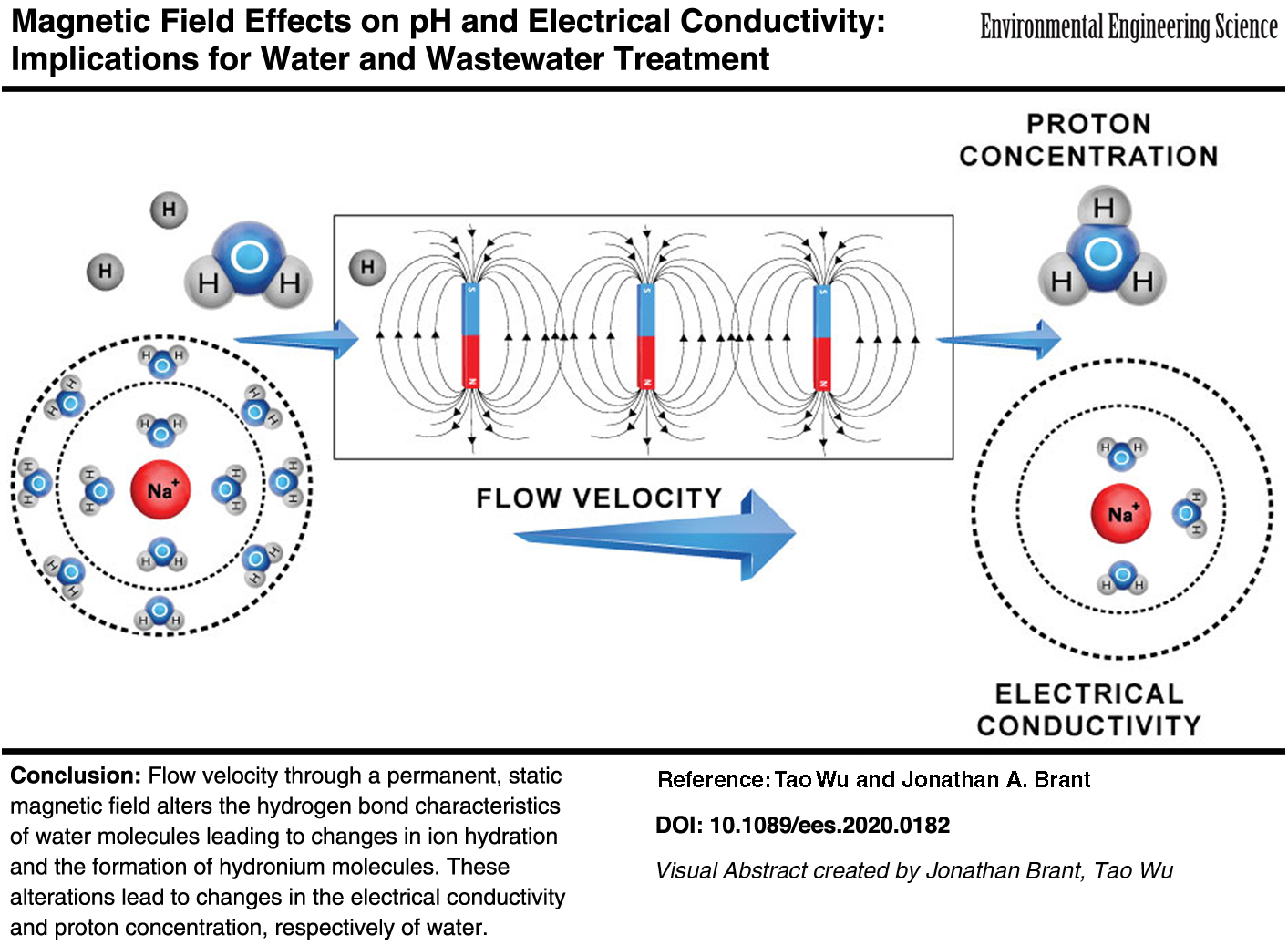
Manipulation of water chemistry plays an important role in water and wastewater treatment. Much effort has been directed at accomplishing such changes in ways that require less energy and material consumption to reduce treatment costs and improve process sustainability. Magnetic fields have been shown to affect the properties of water and its constituents. In this study, theoretical assessments of changes in electrical conductivity and proton concentration, as a function of flow velocity through a magnetic field, were developed and experimentally verified. Experiments were done using a flow-through system consisting of permanent neodymium magnets arranged in a helical pattern in a pipe to generate a constant multidirectional magnetic field (1.350 T). In accordance with increasing flow velocity (8–6 cm/s), the proton concentration decreased from 10−7 to
Graphical abstract
Get full access to this article
View all access options for this article.
References
Supplementary Material
Please find the following supplemental material available below.
For Open Access articles published under a Creative Commons License, all supplemental material carries the same license as the article it is associated with.
For non-Open Access articles published, all supplemental material carries a non-exclusive license, and permission requests for re-use of supplemental material or any part of supplemental material shall be sent directly to the copyright owner as specified in the copyright notice associated with the article.
