






Abstract
Extensive research demonstrates that parks are important for human health and well-being across the human life span. Research also reveals disparities in park distribution both across and within cities of the United States, with under-resourced communities often having fewer green spaces, and ones that are smaller and of lower quality. Outdoor spaces at public schools can be reimagined as community parks to welcome public use after-hours and on weekends. The Community Schoolyards initiative of The Trust for Public Land promotes engagement with school districts and park systems to expand park access in urban underserved communities. Our engaged team science approach used a natural experiment situation to evaluate multiple aspects of a schoolyard-to-park transformation program in Tacoma, Washington (USA), with a focus on civic intelligence. We combined community engagement with evaluation to understand how elementary school students responded to participatory design when generating ideas for their local schools’ schoolyard renovations. A pre–post, mixed-methods study (two intervention schools and one control school) was conducted despite COVID closures and remote teaching, requiring multiple study adaptations. Combined quantitative (student surveys) and qualitative (teacher interviews) methods were implemented to understand the impacts of a participatory design process for children. Quantitative results indicated little change from baseline, while qualitative results suggest substantial positive developmental outcomes. While additional research is needed, particularly in less extraordinary times than those presented by the COVID-19 pandemic, we found that an early design experience can introduce children to new ways of thinking about their school, their community, themselves, and the importance of parks.
Introduction
Extensive research indicates that parks are important for human health and well-being across the human life span (Wolf, Measells, Grado, & Robbins, 2015). Health benefits for children having access to parks include physical activity, socioemotional health, academic achievement, and cognitive health (Hazlehurst et al., 2022; Bikomeye, Balza, & Beyer, 2021; Mason, Ronconi, Scrimin, & Pazzaglia, 2021). Also, reviews focusing on adults indicate that the presence of readily accessible local parks is associated with better physical activity (Bancroft et al., 2015; Kaczynski & Henderson, 2007), improved mental health (Alcock et al., 2017; Stigsdotter et al., 2010), and social cohesion outcomes that contribute to health promotion (Jennings & Bamkole, 2019; Peters, Elands, & Buijs, 2010).
Local schools and parks have historically been sited based on separate policy and finance dynamics in the United States. Public schools are on dedicated public lands based on population trends and service needs (McDonald, 2010). While there are historic inequities in resource allocation for schools, within and across cities (Lee, Shores, & Williams, 2022), policies have evolved to provide education opportunities to all children (Irby, Torres, & Abdelrahman, 2018). In contrast, parks are distributed less intentionally with disparities in distribution observed across many cities (Regas et al., 2022; Rowland-Shea, Doshi, Edberg, & Fanger, 2020). Communities having larger proportions of Black, Indigenous, and other people of color and lower income families often have parks of smaller size (Rigolon, 2016; Rigolon, Browning, & Jennings, 2018), of lesser quality (Rigolon, 2017), or have fewer user features and amenities (Smiley et al., 2016; Suminski et al., 2012), including on-site programming (Cohen et al., 2016).
Community schoolyards are a strategy to increase availability of parks in communities and promote time outdoors for children (The Trust for Public Land, 2021). Community schoolyards can also address inequities in urban park access and quality. Parks infill, meaning the rededication of existing land uses to park creation, can be difficult as land may not be available for acquisition, or the purchase price is not affordable (Harnik, 2012; Sefair, Molano, Medaglia, & Sarmiento, 2012). Conversion of public schoolyards to community parks (Fernández, Pérez-Silva, & Villalobos-Araya, 2022; Uteuova, 2022) transforms spaces that are primarily intended for recess use and after-school programming into park spaces that also serve nearby residents after-hours and on weekends. Expanded use entails more than allowing increased access. Effective transitions to community schoolyards require redesign and enhanced functionality of the schoolyard to accommodate broader cohorts of users and programs (Rigolon, Derr, & Chawla, 2015).
Children are beneficiaries of quality parks and schools, but rarely have influence on either, with decisions of policy, design, or programs directed primarily by adult-based institutions (Derr & Kovács, 2015; Derr & Tarantini, 2016). If adult leaders and facilitators listen authentically to child and youth participants, treating them as valued guides, more child-friendly places can be created (Derr, Chawla, & Mintzer, 2018). Nonetheless, few studies have evaluated the inclusion of children as site users in participatory design. Derr et al. (2018) presented eight case studies as exemplars of placemaking with children and youth. A 2019 systematic review of studies about children’s participation in urban planning and design found only 30 publications since 1990 (Ataol, Krishnamurthy, & Van Wesemael, 2019). A limited number of studies have focused on children’s input on play spaces, noting social and physical activity dimensions. One review reported themes of children’s playground preferences and participatory experiences, as well as adult perceptions of youth involvement (Schoeppich, Koller, & McLaren, 2021). One study found that children (ages 6–12) chose playgrounds for the interaction with other children (39%), while fewer mentioned the equipment (14%), and parents observed that playgrounds enhanced their children’s social development (Diamantouli & Fousteri, 2020). Lastly, a case study of participatory park design (Özdemir, 2019) noted that when children participate in decisions about their play spaces and nearby places, they help create and transform their environment, gain a sense of ownership and partnership, and see possibilities in the process of making choices. Although limited, research highlights that planning and designing with (instead of for) children are essential (Francis & Lorenzo, 2006; Derr & Tarantini, 2016; Ataol et al., 2019).
The Trust for Public Land (TPL) conducts a national initiative to convert schoolyards to community parks (The Trust for Public Land, 2021). In these projects, students partner in design and decision-making to transform underutilized public spaces. TPL schoolyard project managers have anecdotally observed positive developmental behaviors in students when participating in processes of schoolyard-to-park conversions. Reports suggest that children express pride, a sense of achievement, even a level of disbelief about what was possible at the outset of the participatory process. Students embrace planning and design processes enthusiastically, take note of the role of professionals, and see practical applications of their classroom learning (C. Simmons, personal communication, May 2, 2019).
Such observations and anecdotes align with the important role of civic intelligence in child development (Minkler, 2024). Civic intelligence, broadly considered, describes personal understandings of the positive change that happens when people work collectively to address problems efficiently and equitably, with an emphasis on responsibilities of citizenship. It refers to the collective capability of individuals, communities, and institutions to reach change through engagement (Schuler, 2014; Schuler, 2016). Educators can promote civic intelligence in students by teaching democratic principles, systems thinking, and civic value (Minkler, 2024). Participating in community problem-solving is a practical pathway to civic learning at an early age, helping students to develop a community-based outlook and problem-solving toolkit (White, Dong, Campbell, & Lee, 2023) and can include extracurricular projects (Masrukhi, 2018). Place-based civic engagement that is youth-focused can address shared goals that address education, urban environment, and health needs in ways that are formative and equitable (Cohen & Schuchter, 2012; Reese & Ardalan, 2023).
As part of the national Community Schoolyard initiative, TPL is partnering on a program of multiple schoolyard transformations in Tacoma, WA (USA). This article reports the results of a natural experiment situation (Hazlehurst et al., 2023). We conducted pre–post mixed-methods studies, with two intervention schools and a control school. Other evaluations focused on physical activity attributes, participation (Hazlehurst et al., 2023), and academic performance. The purpose of this particular study was to understand the impacts of a participatory design experience on young children. Our research goals were to understand if participating third-graders indicated civic intelligence responses as a consequence of contributing to change of place through design processes.
There were three important influences on this research program. First, an engaged team science approach was implemented, reinforced by project funding from the Interdisciplinary Research Leaders program of the
Methods
Place and context
It is estimated that in the United States, 100 million people, including 28 million children, do not have a park within a 10-min walk (∼½ mile) of home (Chapman et al., 2021). Decades of systemic racism and redlining have led to chronic disinvestments in parks and recreational facilities in many marginalized communities (Wen, Zhang, Harris, Holt, & Croft, 2013; Rigolon, 2016). In 2021, the 100 most populated U.S. cities, neighborhoods where most residents identify as Black, Hispanic and Latinx, American Indian/Alaska Native, or Asian American and Pacific Islander, have access to an average of 44% less park acreage than predominantly White neighborhoods, and similar park space inequities exist in low-income neighborhoods (Chapman et al., 2021).
TPL has committed to expand park access for nearly 6 million people across the United States by partnering to create open schoolyards in 20 underserved school districts by 2025 (The Trust for Public Land, 2020a). This pledge builds on schoolyard renovation achievements, formalized as the Community Schoolyards™ program (The Trust for Public Land, 2021). With support from partners and funders, TPL has converted more than 300 schoolyards over the past 50 years, transforming them to assets that serve all community members (Metro Parks Tacoma, 2023).
Tacoma, Washington, a diverse city of 240,000 residents, has the largest park access gap of any major city in the state of Washington. Thirty-one percent of Tacoma residents cannot access parks and open spaces within a 10-min walk of their homes (Metro Parks Tacoma, 2023). Planned community schoolyard conversions in Tacoma will serve more than 40,000 people who currently do not have a park near their home.
Map analysis concluded that Tacoma’s Eastside neighborhoods have some of the largest park access gaps (The Trust for Public Land, 2020b). In addition, the neighborhoods have little land available for purchase, are identified as having low or very low levels of opportunity based on a compilation of 32 indicators in the Tacoma Equity Index Map (City of Tacoma, 2024), and have the poorest public health metrics across Tacoma (Tacoma-Pierce County Health Department, 2022). In partnership with the Tacoma Public Schools (TPS) district and Metro Parks Tacoma (MPT), TPL launched “Tacoma Community Schoolyards” to expand access to school properties after-hours and on weekends (The Trust for Public Land, 2020c). Six pilot schools in Eastside Tacoma were selected to initiate the program.
Phased schoolyard expansions started in 2020 and continue to 2025 in collaboration with the local public health department and MPT to assure ongoing after-hours programming and sites’ maintenance. An Interlocal Master Agreement was drafted in late 2023 to affirm joint use and is now in the process of being executed (A. McConnico, personal communication, July 11, 2024).
Team science and mixed methods
Team science conceptually invokes processes of interdisciplinary theory and interrelated research approaches as critical contributions to scientific discovery and translational research (Bennett & Gadlin, 2012). Beyond laboratory and field science, the principle of broadly engaged team science emphasizes collaboration with community to better understand public health and local knowledge (Selker & Wilkins, 2017). Key insights and expertise of local individuals and organizations are pursued through authentic “science with” community partners rather than “research of” places (Clayton et al., 2016). Rich dialogue about the conceptual premises and practical implementation of a study can generate evaluations that are particularly relevant to both research goals and social context (Little et al., 2017; Turner & Baker, 2020). This study is a rare example of broadly engaged team science (Selker & Wilkins, 2017). The core research was initiated by investigators in pediatric medicine, landscape architecture, and environmental psychology. As collaborations with schools and communities deepened, additional partners added disciplinary expertise in medical anthropology, public health, statistics, and community organizing.
We used mixed methods in our community engaged research to assure greater relevance through codesign of research questions and methods by investigators and partners. Qualitative and quantitative research methods were combined to achieve greater breadth and depth of understanding, and corroboration of findings (Johnson et al., 2007). Triangulation of theory, investigator input, and data strategies can inform better explanations of any study situation and lead to greater confidence in results (Denzin, 2017; Webb, Campbell, Schwartz, & Sechrest, 1999). Mixed methods premised on triangulation—to expand inquiry, compare findings, or potentially reveal contradictions (Greene, Caracelli, & Graham, 2016)—were highly relevant for our broadly engaged team science research (Baker, 2015; Selker & Wilkins, 2017).
Research intervention
We used a quasi-experimental design taking advantage of a natural experiment (TPL schoolyard renovation program) using two intervention schools and one wait-listed comparison school (as control). Table 1 provides enrollment data, indicating that the Eastside schools exhibited greater ethnic diversity and lower household incomes when compared with the entire school district.
Demographic and Household Income Data for Study Schools, 2020–2021
Notes: Free and reduced price meal (FRPM) eligibility is used as a proxy for income. FRPM and student race/ethnicity data are reported by school districts to Washington Office of Superintendent of Public Instruction, 2024.
Third-grade students in the intervention schools participated in a 12-week curriculum, developed across TPL schoolyard projects in the United States. The standard in-school design workshops engage children in imagining and learning processes, including schoolyard greening options, the importance of nature in cities, stormwater management, outdoor activity facilities, and field trips to nearby parks or natural areas.
The COVID pandemic was a major external influence on this project (Turner-McGrievy, Halliday, & Moore, 2021). Stringent public health guidelines for social distancing and school closures were implemented across all TPS in early 2020. Ongoing design workshop challenges and a one-year start-up delay forced multiple research modifications. Table 2 is an overview of the workshop curriculum, including adaptations for COVID. Consequent research modifications addressed the inability to conduct on-campus observations of students, student nonparticipation in virtual class sessions, and limited access to students’ design products to evaluate levels of engagement. Students did return to in-person instruction for the last two workshops, but the brief time with students was used to backfill content that was not fully delivered during prior workshops.
Participatory Design Curriculum by Week, Activities, Goals, and COVID Adaptations
Student ideas were generated and shared as visioning exercises and sketches during virtual on-screen sessions, and were supplemented by project workbooks, customized for each school. Students’ collected design ideas were provided to a professional design firm to prepare formal design alternatives. Feedback on design alternatives was elicited from the entire school and nearby community members (Fig. 1) after completion of the participatory design curriculum. Control school students did not receive the workshop program, but their schoolyard is scheduled for later redesign.
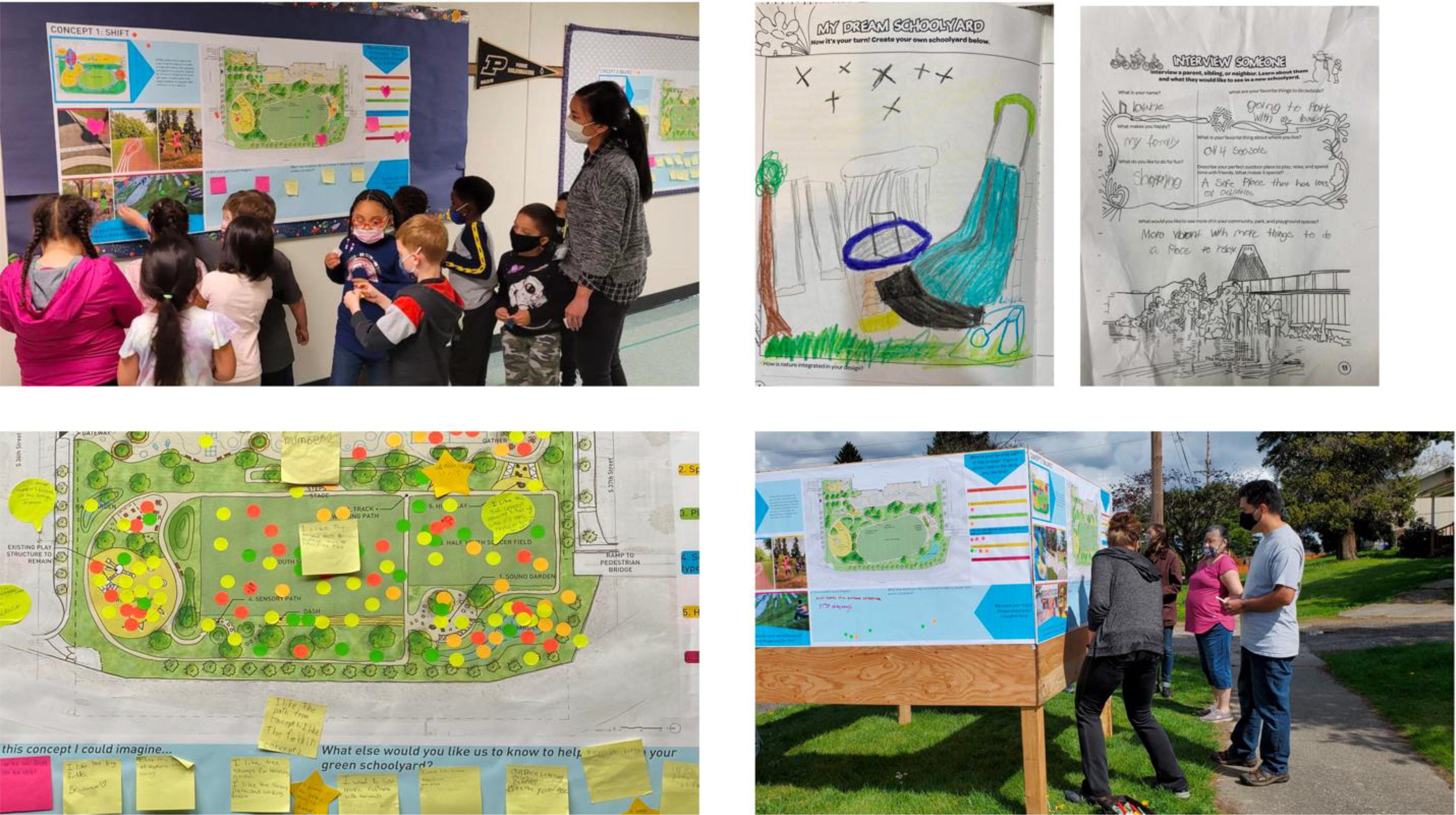
Students and community park design—early sketches, park design voting by students, and community voting.
Data collection
Student surveys and teacher interviews were used to collect primary data about student responses to the design engagement. This study was reviewed by the Seattle Children’s Hospital and University of Washington Institutional Review Boards and deemed exempt under 45 CFR 46.104(d)(1), referring to established or commonly accepted educational settings, by both institutions. In addition, procedures involving student interactions were approved by the TPS Data and Assessment Research Team (TPS-DART).
Validated self-report instruments that have been designed or adapted for use with children (i.e., acknowledging the reading and cognitive skills of third-grade students) were assembled into a survey. Table 3 summarizes the survey elements, each being a dimension of civic intelligence. The constructs of Covitality and School Membership assess the degree to which project engagement heightens personal perceptions of school-based satisfactions that extend beyond academic achievement. The Teamwork and Collective Efficacy constructs assess self-perceptions of competence and capacity potentially applicable beyond the school setting. The collective efficacy instrument was implemented in the post-test survey specifically to evaluate the potential generalizability of participatory design to other situations in a child’s life.
Survey Constructs for Student Assessment Regarding Participatory Design Workshops
The survey was pretested for age appropriateness and potential response fatigue. Age and gender were collected as student self-reports. Gender was included in the analysis as there is variability in social skills expressed by boys and girls across elementary school grades (Hajovsky, Caemmerer, & Mason, 2021). The survey took about 20 min to complete.
Surveys were administered to all eligible third-grade students in two intervention schools (86) and the control school (38) before the design curriculum launch (October) and 1–2 weeks after completing the participatory activities (January). The survey was read to students to encourage completion via an online format and to accommodate reduced reading skills (see qualitative results concerning COVID). An information sheet was translated into multiple languages (English, Spanish, Somali, and Vietnamese) and distributed to parents two weeks in advance. An assent document was distributed to students before each survey. Parents could choose to opt their children out of the study by signing and returning the form to the school or contacting the study team.
All teachers of intervention classes were recruited for individual qualitative interviews. Interview guides aligned with broader study goals (Bernard, 2017; Patton, 2014), addressing domains of student and teacher experience with participatory design, and teachers’ observations about student learning and development (Table 4). Interviews were conducted within 3 weeks postintervention over Zoom. Teachers provided verbal consent after reviewing an information sheet with the interviewer. Consent is not required in exempt research, but we felt it was important to explain all research procedures to teacher participants. Each received 50 U.S. dollars as compensation.
Teacher Interview Domains and Questions
Data analysis
Online (pretest) and pencil-and-paper (posttest) response data were entered into REDCap. Responses and demographics were summarized for intervention versus control at baseline (pretest) and follow-up (posttests). Survey scores were compared using Wilcoxon-rank sum test for intervention versus control at pretest and to compare with the posttest.
Responses for each of the scales were heavily skewed to the positive. Data were transformed to address assumptions of normality by taking the quadratic of the total scores. The transformed scores for each survey construct (e.g., Covitality Total, Teamwork, and School Membership) were regressed on time (pre- or posttest surveys), intervention/control status, age, and gender using a linear mixed-effect model (LMEM). The interaction between time and intervention status was not found to be significant in any models so was removed from the models. Within-subject correlations were accounted for by including random-effect terms in the models. All analyses were performed using R version 3.4.1.
Qualitative data were analyzed using methods of interview transcription, codebook development, coding, and synthesis that conform to qualitative research standards (Braun & Clarke, 2006; Hennink, Hutter, & Bailey, 2020; O’Brien, Harris, Beckman, Reed, & Cook, 2014; Pope, Ziebland, & Mays, 2000). Dedoose Version 7.0.23 (Sociocultural Research Consultants, Los Angeles, California) was used for coding and thematic analysis of the transcribed interview recordings. A hierarchically organized codebook was developed and adapted for open coding by two investigators, and differences were resolved by discussion. Final analysis code reports were summarized by themes and subthemes with associated quotes (attributed by participant number).
Results
Demographics
A total of 124 students participated in the study: 86 in the two intervention schools (44 and 42, respectively) and 38 in the control school. Survey completion ranged from 76% to 95% across schools and pre–post phases of data collection. Most students were 8 or 9 years of age, with mixed representation of gender (Table 5).
Demographic Characteristics of Intervention and Control Students
Pretest Data, presented as: n (%)
Student surveys
All 37 survey items were scored by students on a low-to-high scale of 1 to 4. Mean scores on all constructs were positively skewed, possibly indicating ceiling effects. When analyzing pretest responses, control school students registered higher means than the intervention students on multiple constructs with significant outcomes for Gratitude, Optimism, and School Membership (Table 6). On the posttest, control school students indicated higher scores, with Covitality Total and Optimism being statistically significant. Scores for Collective Efficacy in the posttest were lower than other constructs, but with no significant differences.
Comparison of Survey Scores Within Pre- and Posttests for Intervention and Control (Scale 1–4, Wilcoxon Rank Sum Test, p Value Significance ≤0.05)
Differences in scores for posttest minus pretest were then calculated for the intervention and control schools for all constructs and compared (Table 7). All changes were neutral to negative with teamwork displaying a significant negative change in the control school. No other comparisons were statistically significant.
Comparison of Survey Score Differences (Posttest–Pretest: Scale 1–4, Median [q1–q3], Wilcoxon Rank Sum Test)
LMEM analysis using quadratic-transformed scores were consistent with other results, each showing a significant negative change in response across time for all constructs. After adjusting for change in score over time, there was a significant difference in Covitality Total and School Membership scores between the intervention and control groups, with lower scores in the intervention group.
Teacher interviews
The four third-grade teachers from the two intervention schools had 5–42 years of teaching experience. Four themes emerged in the analysis as follows: engagement and emotional connection, collaboration and belonging, change agency, and COVID classroom challenges.
Theme—engagement and emotional connection
Teachers observed that students were engaged during the participatory design lessons, even while in online mode. Students discussed the schoolyard design, showing excitement and sharing ideas for the renovated schoolyard. One teacher said, They were pretty well engaged. They were excited about it, they kind of took it all to heart. I think some of them, a little bit more than others, were able to process through some of the parts of it, like thinking about it from other peoples’ perspectives. [01]
Teachers shared stories of students displaying increased self-esteem after the participatory design process. Some students showed increased confidence in class, posing questions they would not normally feel comfortable asking, wanting to present in front of the class, and advocating for things they wanted. One teacher shared, [One student] especially comes to mind. Because she came to me from another school, and she was very quiet. But she has been so excited to share and present ideas. And since we especially work in groups with [the participatory design], I think the biggest thing is—I’ve had 3 or 4 people now that are like, “Can I share in front of the class?” And that was a fear before. [04]
Teachers mentioned that they also enjoyed the design process and appreciated seeing their students emotionally invested in the schoolyard: I thought it was just kind of a unique thing for the kids to get to do. It’ll be really exciting when it’s actually being [rebuilt]. And I think kids will be like, “Oh, that’s what I wanted there, and I planned that.” [03]
Theme—collaboration and belonging
Teachers observed that students felt a stronger sense of belonging, pride, and connection to the school after the participatory design process. Students felt they were leaving a lasting impression on their school, they were able to make key decisions about their own schoolyard, and that they would be welcome to use their schoolyard after hours and on weekends. One teacher described, It made them feel super important. Because they are doing something for the school. And I keep telling them, “You know, 10 years from now when you come back, you can tell your friends or your buddies or whoever that you helped make this playground.” That was very huge for them. [02]
Teachers reported that the participatory design lessons helped students show more empathy by way of thinking about what others might want in their schoolyard; They all came into it really thinking about themselves and what they wanted. And by the time they were done, it was like, “Oh, wait, but we might also need this.” [01] The participatory design process also challenged students to work together in groups, providing opportunities to learn about collaboration; There definitely was that learning experience for kids to figure out how to work together, and some of them struggled with it a little bit more than others. But I wouldn’t call it a negative. It was just—a chance for them to be able to get those skills that they didn’t have before. [01]
Theme—change agency
Teachers noticed that students discussed other school issues after the participatory design process. Students seemed empowered to enact change in their school. One teacher reported in response to a prompt about efficacy, Oh, yeah. Because nobody would have thought of it before… Because they wouldn’t think they’d have the power to do it…and people are listening to them. They saw that someone’s listening to them. [02]
Another teacher shared an example of students noticing a problem and offering a solution: And I know just like when I go out every day and do recess with them, and it rains, and so there’s all these puddles. You can’t really go on the field because it’s kind of just a mess. And so kids are like all of a sudden, like, “Oh, if we had something that could do this, we could still go out on these days.” [03]
Students began to understand some of the practical aspects of design and building as they interacted with the professional design team, including projects such as a schoolyard renovation take time and money; professionals such as architects work on schoolyards; schoolyard design is a process with multiple elements that go into eventual construction beyond structures and equipment. For instance, a student observed a site survey team and engaged with a surveyor; the teacher observed, … he was one [student] that was very excited about the school [design] thing, and … started asking [the surveyor] questions, and the guy started talking about it [03]. Another teacher described, I thought it was a great process for kids to kind of get the opportunity to think of a playground beyond just what is their favorite toy, but to kind of really get into the other things that go into it and thinking about other people. [01]
Theme—COVID and classroom challenges
Despite observations of student benefit, larger issues were noted once returning to in-person instruction during the pandemic. One teacher mentioned that this year is so different [04] in terms of student and classroom dynamics. Another teacher stated that her third-grade classes, struggle with engagement, and especially after COVID and everything else. So, it’s kind of an issue on everything we do, is just keeping them going throughout the day. [03]
Some students may have had difficulty understanding lessons during the participatory design due to disrupted learning development. As a teacher reported: I think …. other kids I’ve had in the past…. I’m teaching third grade, and I’ve got almost—I have 20 kids, and 15 of them are kindergarten, first-grade level. [04]. Teachers described a higher rate of students reading below third-grade levels compared with prior years, which may have impacted students’ ability to complete surveys. One teacher observed: These kids basically—you’re not supposed to say this, but it’s just reality—they lost 2 years of school. And so, a lot of it was difficult. The first day, … we knew right off the bat there was no way they could read the survey questions. Because a lot of our 3rd graders are functioning at kindergarten, maybe first grade level. … That’s just where they’re at. … so, what we ended up doing was just reading the [survey] questions to them. [02]
TPS has implemented an all-grade Whole Child programming that emphasizes social emotional learning in alignment with the Washington State policy (Washington Office of Superintendent of Public Instruction, 2020). Teachers brought up issues of decreased emotional intelligence that might have influenced social self-perceptions. As one teacher described, I think that the lack of engagement this year is just lack of understanding. And it’s understanding of concepts, of social cues, and just social interactions. Because that’s what I’m finding, is just a really low comprehension of most things. [04]
Discussion
Our engaged team study sought to understand the potential civic intelligence implications for elementary school students who participated in creating collective visions for schoolyard-to-park transformations. A complicated project from the outset, the complexities of implementation during COVID forced multiple adaptations and extended the research activity. Mixed quantitative and qualitative results offer layered insights.
Survey patterns
Reviewing all survey results (Fig. 2), response trends on all constructs across time are negative, including the control group. Interestingly, scores on survey constructs for the children in the control school were consistently more positive in the pre- and posttest phases. The intervention students also expressed negative trending for each of the constructs with less change for School Membership and more for Covitality compared with the control students. It is unclear why intervention school students reported lower ratings for the constructs even at the outset of the study as student traits, school administration, and community context were intentionally comparable.
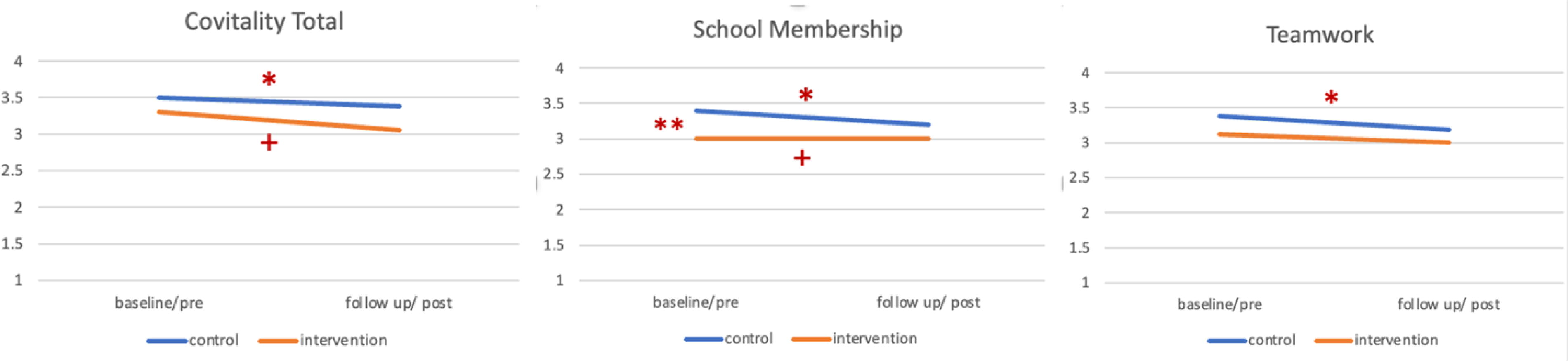
Significant survey results by construct, pre–post across control and intervention schools. *significant decrease over time (LMEM), **significant pretest difference (Wilcoxon rank sum),
What are explanations for the negative trending? There are several possible influences. The workshop series started in October, then resumed in the new year with evaluation shortly after. Changed moods over the holidays and/or winter incidence of SAD (Seasonal Affective Disorder) in the region (Dennett, 2021) may have had impacts. Perhaps being familiar with the survey, children were more reflective about their answers in the posttest. COVID was a probable influence as all schools were dynamically adjusting best practices for in-school safety (Kwakye & Kibort-Crocker, 2021), and anecdotes of ongoing trauma reported by school administrators likely affected children’s general moods (Scott, Jaber, & Rinaldi, 2021; Watson, Capp, Astor, Kelly, & Benbenishty, 2022). Despite negative response trends, the students rated all survey constructs highly (means of 3.0 or higher on a four-point scale). A possible ceiling effect and associated skewed data may indicate a limitation in sensitivity of the survey measures, compromising the accuracy of measures and limiting variance in the data (Taylor, 2012). The high ratings are also a testament to the efforts by teachers and staff to not only sustain academic activity but also to encourage positive conditions for the children. This was likely reinforced by the district-wide Whole Child program that promotes social emotional learning in addition to academic achievement (Tacoma Public Schools, 2024). The workshop activity could potentially generate greater benefit in schools where such programming is not as well developed, thus starting with lower baseline scores.
Interview patterns
Design is a complex activity, dependent on a blending of multiple analysis, knowledge, and cognitive inputs (Cross, 2023). The participatory workshops augmented the schools’ standard curricula, in that the TPL program offered students a unique experience of change-making incorporating team-based and individual ideas. Teachers noted students’ recognition of the consequences of their design inputs, such as Oh, that’s what I wanted there, and I planned that [04]. This postexperience perception suggests important extracurricular educational outcomes and learning processes. Extracurricular activities are a way to enable children to become contributors to their community and develop socioemotional assets such as self-esteem and resilience (Roopesh, 2018). Yet existing research on the specific benefits of extracurricular activities for children is fragmented (European Commission, Directorate-General for Employment, & Social Affairs & Inclusion, 2021). Community schoolyard projects offer opportunities to study not only health response from being outdoors but also social process.
Teachers observed participatory workshop effects on the interpersonal relationships of the students. Some students came to recognize that other people may bring different perspectives to a shared project or task, a realization that is invaluable for successful teamwork for people of all ages (Kozlowski & Bell, 2013; Leinonen & Bluemink, 2008). Other students were more willing to advocate for their ideas, and willing to share those ideas in a public way in their classes. Teachers noted that learning to work in a group was novel but became a valuable extracurricular project experience.
Our survey constructs evaluated perceptions of personal satisfactions and efficacy. While limited significant changes were found in pre–post comparisons, the students scored in the upper positive ranges of the instruments. Teachers observed that students exhibited both personal and interpersonal positive behavioral outcomes during the workshop series. Yet, there were inconsistencies across the research approaches. Teachers observed differences in the degree to which individual students responded to the design process. For example, many of their recollections focused on a single child or a subgroup of the entire class, providing less insight on trends across all students.
A connection to the school in terms of a sense of belonging and pride was expressed by students. One teacher observed that the design process made them [the students] feel super important [02] in that they were leaving a legacy, a sense of contribution that was very huge for them [02]. Students also felt they gained the power to enact change, in part, because others were listening to them. The qualitative Change Agency theme describes how students started to notice additional challenges in the schoolyard, think about other people, and realize that they could generate solutions.
Personal efficacy measures were added to the survey in the posttest, prompted by observations during the workshops. Development of personal efficacy is promoted by several factors, including mastery of experiences, observing others (particularly in situations of success), positive emotions associated with an activity, and reinforcing messages from others (Maddux, 2002). There has been little research about efficacy development in young children (Korfiatis & Petrou, 2021). While no significant difference was noted between the intervention and control school students on survey measures, the teachers’ observations, particularly in the qualitative Change Agency theme, suggest that efficacy, a valuable developmental trait, could be intentionally nurtured in workshop planning and implementation.
Our team encountered COVID-related challenges and delays in conducting the research. Yet this was inconsequential compared with disturbances within the educational settings of our school partners. Broader research efforts are only now yielding insights into the social and personal traumas experienced by children due to the extreme interruptions of COVID (Delvecchio et al., 2022; Fitzgerald, Nunn, & Isaacs, 2021). We heard firsthand of the difficulties experienced by students as all social and logistical conditions were upended, with administrators and teachers doing their best to engage students within remote formats and continue the education process.
The pandemic was a major upset, yet carrying on education in the face of emergencies or disasters is highly important. Trauma may be introduced in students’ lives by personal or household circumstances, by natural disasters (increasingly common with climate change), or by episodes of violence (such as school shootings or conflict) (Burde, Guven, Kelcey, Lahmann, & Al-Abbadi, 2015; Kwakye & Kibort-Crocker, 2021). When provided with structured, meaningful, and creative activities in a school setting or in informal learning spaces, children living in emergency and postemergency situations experience improved emotional and behavioral well-being (Burde, Kapit, Wahl, Guven, & Skarpeteig, 2017). While our study did not directly address children and other situational trauma, we have begun to explore how engaging children in design might become a practice of “greening in the red zone” for young people (Tidball & Krasny, 2014; Touloumakos & Barrable, 2020; Wells, 2014).
Limitations and future research
Limitations are inherent in all studies, but do not diminish important intellectual and community contributions. The program of design workshops and the associated research were each highly adaptive due to COVID, thus replication could be difficult. Nonetheless, much was learned as our team resolved multiple challenges associated with team science, school engagement, and design process. As the Tacoma schools’ projects are similar to other school-to-community park transformations being implemented around the United States, this report offers important insights about child development through design-based extracurricular programs.
Expanding the study sampling is recommended, as our interview group was quite small, and surveys were limited to third-graders. Despite potential differences in social responses of boys and girls in the participatory design, our study sample was not large enough to examine differences by gender and other demographics. Statistical power to detect significant differences between respondents, and the intervention and control groups could be improved with equal and larger population sizes.
Our longitudinal research goal is to evaluate student response after the schoolyards are constructed, including a second posttest survey, personal efficacy follow-up, and review of academic achievement. Evaluations may include comparisons of the students’ anticipations of the transformed space versus actual construction. COVID mandates limited the planned outreach for full-school student input and community engagement. Would scores on the survey have been different if the full program of design outreach had happened, and the students had been able to observe extended response to their design ideas? A postconstruction follow-up would yield insights about outcomes premised on more extensive community connection, observed tangible outcomes, and extended time for student self-reflection.
The teachers generally described positive developmental outcomes for the students. The survey also indicated high marks for civic intelligence constructs but with slightly diminished postworkshop scores. Using mixed-methods approaches to explore diverse perspectives of a situation does not necessarily result in the corroboration of findings (Hands, 2022). Using qualitative and quantitative approaches may generate results that are mixed, convergent, or even divergent. Mixed findings can reveal gradations or nuances of the study situation, with each type of data yielding different insights (Farmer, Robinson, Elliott, & Eyles, 2006). Mixed methods can inform future evaluation in this ongoing research program in several ways. First, the qualitative results may inform revision or greater specification of the quantitative outcome measures. Also, the design workshops could include more intentional content about civic intelligence constructs and social emotional learning, then use mixed methods to iteratively refine workshop presentations. For example, allotting routine time for personal reflections within a youth-focused program in conservation field work boosted mental health benefits (Wolf & Housley, 2017).
Conclusions
This research program is novel and important for several reasons. Historic legacies of urban and transportation planning, community disinvestment, and racism have contributed to a dearth of parks and green space in many communities, including our study area. Schoolyard transformations to community parks are a solution, and the qualitative findings of this study indicate that involving children in the design and development process could have positive impacts on their self-perceptions of school membership, teamwork, and self-efficacy (Terjesen, Jacofsky, Froh, & DiGiuseppe, 2004). Nature elements (such as gardens, tree groves, and outdoor classrooms) have been incorporated into final designs; thus, an associated potential is that young people come to experience nature and its benefits through a process of engagement (Chawla, 2021; Bates, Bohnert, & Gerstein, 2018). Greening schoolyards can be a collaborative approach to reconnect children with nature and provide meaningful experiences that foster well-being (van Dijk-Wesselius, Maas, Hovinga, van Vugt, & van den Berg, 2018). While additional research is needed, particularly in less extraordinary times than those presented by the COVID-19 pandemic, an early design experience can build civic intelligence, introducing children to new ways of thinking about their school, their community, themselves, and the importance of parks.
Footnotes
Author Note
This study was reviewed by the Institutional Review Board (IRB) of Seattle Children’s Hospital (protocol number STUDY00002677, September 4, 2020), and the IRB of the University of Washington (protocol number STUDY00011253, December 19, 2020). School leadership and administrators agreed to have data collectors from the research team on campus for data collection. The data presented in this study are available on reasonable request from the corresponding author; the data are not publicly available due to consent and privacy restrictions according to IRB determination.
Acknowledgments
We extend our appreciation to Sarneshea Evans and Levon Williams of the Trust for Public Land, and Quena Batres of the Nature Conservancy, for their school engagement work. Gratitude is extended to the principals and 3rd grade teachers of Jennie Reed, Mann, Stafford and Whitman Elementary Schools of Tacoma Public Schools. We thank Reviewers of an earlier version of the article as their comments and suggestions helped us to greatly improve the quality of the manuscript.
Authors’ Contributions
Conceptualization: P.S.T., C.S., K.L.W., K.S.; Methodology: P.S.T., C.S., K.L.W., K.S.; Validation: P.S.T., C.S., K.L.W., K.S.; Formal Analysis: A.V.F., K.H., K.S.; Investigation: K.S., K.H., K.A.G, C.S.; Resources: K.A.G., P.S.T., C.S.; Data Curation: A.V.F., K.S., K.H.; Writing—Original Draft: K.L.W, K.S., C.S., K.H., A.V.F., P.S.T.; Writing—Review & Editing: K.L.W, K.S., P.S.T, A.V.F.; Visualization: A.V.F, K.L.W.; Supervision: C.S., K.A.G., P.S.T., K.L.W.; Project Administration: C.S., K.A.G., P.S.T.; Funding Acquisition: C.S., P.S.T., K.L.W.
Author Disclosure Statement
No competing financial interests exist.
Funding Information
The authors gratefully acknowledge funding from the Robert Wood Johnson Foundation, Interdisciplinary Research Leaders program (K.L.W., K.S., C.S., K.H., A.V.F., K.A.G., and P.S.T.). Funders were not involved in the design of the study; collection, analysis, and interpretation of data; or in writing the article.

References
Supplementary Material
Please find the following supplemental material available below.
For Open Access articles published under a Creative Commons License, all supplemental material carries the same license as the article it is associated with.
For non-Open Access articles published, all supplemental material carries a non-exclusive license, and permission requests for re-use of supplemental material or any part of supplemental material shall be sent directly to the copyright owner as specified in the copyright notice associated with the article.
