






Abstract
The experience of matrescence, the developmental transition to motherhood, has not explicitly included the ecological domain, whereby mothers awaken to ecological concerns and question their ethical relationship to nature. Therefore, in this paper, we argue the need for a new framework known as maternal ecopsychology and its related ecotherapies to accelerate a mother's movement toward an enlarged ecoconsciousness as part and parcel of an already unfolding matrescence. We will also explore the ecopsychological underpinnings of maternal mental health disorders, such as Perinatal Mood and Anxiety Disorders, which have not previously been viewed from a nature-based perspective. First, we define ecoconsciousness and the ecological self to demonstrate how their development is necessary for humanity's ecological sustainability, especially for maternal health. We then outline how mothers have a unique opportunity to move from an anthropocentric to an ecocentric worldview through their matrescence and, in doing so, later reinterpret maternal psychopathology. We propose nature-based interventions such as those available to adolescents as alternative treatments for established maternal mental health symptoms, including but not limited to climate and environment-related concerns. Finally, we share general guidelines for ecotherapeutic practices with mothers to address the three primary conflicts that often arise in matrescence and to help mothers transition away from the limitations of anthropocentrism and toward a profound new interrelationship with nature instead.
Introduction
In 1973, Dana Raphael, the medical anthropologist who studied breastfeeding and birth, coined the term matrescence and described this life stage as fundamental to the physical and social, or biosocial, standing of a woman. Matrescence was later applied to the field of maternal mental health by Athan and Reel (2015) and expanded to emphasize its psychosocial aspects and to give primacy to mothers' subjectivity—their felt-level experience—particularly changes in their personal identity and worldview or ego development. Yet another way to describe matrescence is to understand it as a holistic change across the many interrelated domains, or the bio-psycho-social-spiritual realities of an individual, to name a few (A. Athan, unpublished data; Athan & Reel, 2015). 1
In this respect, matrescence shares much with adolescence, or “matrescence like adolescence,” including the disorientation and reorientation experienced by those undergoing any transition process or rite of passage. The experience of matrescence, however, has not explicitly included the psychoecological domain, whereby mothers psychologically awaken to ecological concerns and question their ethical relationship to nature. By comparison, adolescence is a well-recognized time of emerging eco-awareness that has become a fruitful area of study within the field of ecopsychology. For example, outdoor learning has been found to have positive impacts on brain function (e.g., attention), emotions (e.g., calm mood), self-esteem (e.g., confidence), friendships (e.g., belonging), and existential questioning (e.g., meaning making) (Gray & Piggott, 2018). Young adults are also increasingly verbalizing anxiety over climate change and the perceived lack of care for the environment, locally and globally (Thompson et al., 2002).
Similar to adolescence, matrescence may place mothers at risk for ecodistress or elicit their eco-resilience. To date, ecopsychologists have not examined these mental health implications in-depth nor offered innovative practices to help mothers transform their burgeoning ecological awareness into a lifelong outlook. This paper will therefore argue the need for a new framework known as maternal ecopsychological development, and its related ecotherapies, to accelerate a mother's movement toward an enlarged ecoconsciousness as part and parcel of an already unfolding matrescence. It will also explore the ecopsychological underpinnings of maternal mental health disorders such as Perinatal Mood and Anxiety Disorders (PMADs), which have not previously been viewed from a nature-based perspective.
When the field of ecopsychology has discussed mothers, it has mostly focused on their increased environmental activism (see, for instance, Logsdon-Conradsen & Allred, 2010) without inquiring into the deeper underlying changes in their ego identifications. This lack of curiosity is notable given that developing an ecoconsciousness, or awakening to the interconnected rather than fragmented nature of life on Earth (Uhl, 2013, p. 50), is growth-producing and recognized as vital to human maturation (Barrow, 1995; Hage & Rauckienė-Michaelsson, 2004; Hung, 2017; Machnev et al., 2018; Molina-Motos, 2019; Morris, 2002; Plotkin, 2008; Spitzform, 2000).
A more mother-centered ecopsychological interpretation—or a matricentric one, to use the term put forward by O'Reilly (2019)—would recognize mothers as attempting this same transformation from egocentricity to ecocentricity but without the same visibility given in adolescence. It might also illuminate whether the suffering at the heart of this process is a normative response given mothers “failure to launch” into a higher order ecoconsciousness because they lack either the personal competence or social support to do so successfully. Some mothers may demonstrate resilience in the face of these challenges, whereas others may experience a range of symptoms like PMADs such as excessive sadness, anger or guilt, lack of interest and motivation, ruminative worry and hypervigilance, and self-doubt and pessimism.
Clinically, therapists would do well to attend to the ecopsychological content of maternal distress and to use it in a purposeful manner. Negative affective responses that include environmental-related concerns or even climate-induced trauma may be important communications of a deeper developmental conflict. Mothers may be suffering needlessly by labeling these symptoms as maladaptive rather than adaptive to the ecological crisis at hand. When unrecognized as an attempt toward greater ecopsychological maturation, mothers may at best experience an arrested development, or at worst meet criteria for a range of diagnoses.
Lastly, an ecopsychological developmental perspective provides a novel and more expansive way to understand matrescence, in turn, since it is not rooted in traditional psychosocial models that are inherently anthropocentric. In conventional models of identity development, individuals are asked to adapt to the demands of social expectations to be recognized as mature members of society. Yet, in the context of human-driven climate change and the growing problem of sustainable life on earth, mothers appear to be rejecting social norms that require them to conform to egocentric values they deem harmful to the planet (e.g., consumerism). Unable to conform, yet unable to fully realize their ecocentricity, mothers may be stuck in a suspended state of liminality for longer than necessary (Barr, 2008).
Drawing on the stages of van Gennep's (1960) influential rite of passage model (severance, liminality, and incorporation) that has been used to describe many common life transitions, liminality is defined as a change that has begun but is not yet adapted to. It is an opportunity to find new solutions even in the face of disturbing overwhelm and confusion (Barr, 2008). As primary caregivers of the next generation, the successful outgrowth of ecoconsciousness in mothers has implications for their children as well—both personal and planetary wellness at stake. When supporting the process of matrescence, it then must be reinterpreted not merely as a personal crisis of social adaptation, but also as a collective one of social evolution.
This paper will first define ecoconsciousness and the ecological self in the field of ecopsychology to demonstrate how its development is necessary for both humanity's ecological sustainability and especially for maternal health. It will then outline how mothers have a unique opportunity to move from an anthropocentric to an ecocentric worldview through their matrescence, and in doing so, later reinterpret maternal psychopathology. Nature-based interventions such as those available to adolescents will be proposed as alternative treatments for established maternal mental health symptoms including but not limited to climate and environment-related concerns. Finally, general guidelines for ecotherapeutic practices with mothers will be shared to address the three primary conflicts that often arise in matrescence and to help mothers transition away from the limitations of anthropocentrism and toward a profound new interrelationship with nature instead.
Developing an Ecoconsciousness
The concept of developing a mature ecoconsciousness is linked with deep ecology (Naess, 1973), the philosophy and social movement originating in the 1970s, which views a disconnected human-centered consciousness as the cause of the ecologically destructive values, knowledge, and actions (Beck, 1995; Bragg, 1996; Devall, 1988; Devall & Sessions, 1985; Drengson, 1989; Leff, 1978; Morris, 2002; O'Sullivan & Taylor, 2004; Uhl, 2013). Deep ecologists see the climate crisis as a direct outcome of the 17th- and 18th-century Cartesian worldview where the mind is superior to matter, humans are seen as “outside and above” the rest of nature, and consciousness is denied to more-than-humans. This results in an “alienated self” that splits relationships into mutually exclusive win-or-lose categories in ways that are both self-serving and isolating (Warren & Cheney, 1991).
Ecoconsciousness must then develop away from humanity's egocentricity and instead toward earth-centeredness, or from anthropocentrism to ecocentrism (Molina-Motos, 2019, p. 581). This more mature self-other relationship is unbroken and whole and “perceives reality not as a collection of discrete and isolated entities but as a dynamic web,” (Hage et al., 2004, p. 63) that is “immersed in the world, rather than separate from it” (Freyne, 2018; Morris, 2002, p. 579). This is also reflected in Gaia theory that proposes Earth as a self-regulated system of which humans are an integral part. The ecological self experientially knows itself as an aspect of the earth's living system, and (inter)personal development includes maturing this in ever deeper and warmer ways (Plotkin, 2008; Spitzform, 2000).
As environmental educator Molina-Motos (2019) explains, “Ecocentric thinking is a more integrative way to think about ourselves as creatures living in an ecosphere” (p. 3), ever more complex and interrelational. Through their embodied relational practice, it may naturally occur for mothers to find it harder to stay disinterested as they can no longer ignore the “sound of a dying planet” (Morris, 2002, p. 581). This increased sensitivity may also be driven by the natural world itself as Gaia theory suggests that the planet is speaking its distress directly through human and more-than-human mothers through the collective ecoconscious (Harding, 2006; Roszak, Gomes, & Kanner, 1995).
Many ecophilosophers and ecopsychologists agree that the development of a more respectful and relational ecoconsciousness is key to healing earthly damage and to creating a more harmonious future on our planet (Barrow, 1995; Fisher & Abrams, 2002; Hage et al., 2004; Hung, 2017; Machnev et al., 2018; Molina-Motos, 2019; Morris, 2002; Plotkin, 2008, 2021; Naess, 1993; O'Sullivan & Taylor, 2004; Roszak et al., 1995; Spitzform, 2000; Uhl, 2013). The developmental process often begins with an ecoawakening—a lived, phenomenological experience that spurs a person's awareness of their embeddedness in an animate natural world. While it may organically occur across the lifespan and accelerate during major life transitions (e.g., adolescence, matrescence), it is arguably in need of greater educational and therapeutic support.
Ecopsychologist Spitzform (2000) draws on Fast's (1989) concept of “selving” as an unfolding interactional process by which humans form and reform the ecological self only through “ongoing engagement with the more-than- human world” (p. 284). This requires sustained interactions with nature rather than repeated dissociations from it. Ecofeminist approaches, in turn, center a relational self in psychotherapy interventions with all genders that matures in connection to, rather than separation from, others (Gilligan, 1993; Ulrich, 1996). An ecofeminist “deep and warm” approach thus equates personal growth with affective connection, caring action, and mutual flourishing not only in human relationships but also with the more-than-human community.
In terms of matrescence, this ecological “selving” likely continues well past the early stages of motherhood since it requires a lifetime to establish a fully realized self-in-relation not only to the microsystem of the family but also to the larger ecosystem by extension (Fast, 1998). The same could be said of adolescence, which occurs even earlier in age. Across the lifespan, the self is already and always relational and ready to “affirm the radical interdependence of all beings” (Gaard, 2017; Molina-Motos, 2019, p. 3).
Maternal Environmentalism
To date, ecopsychology has primarily engaged with matrescence from the perspective of mothers' environmental activism, or the political or social justice domain-level. As a result, it has missed the opportunity to support mothers to go “deeper and warmer” and accelerate ecoconscious development during the transition to motherhood. A literature review demonstrates that mothers have long drawn on their role as mothers to challenge practices and policies that threaten their homes, families, and communities (Logsdon-Conradsen, 2011; Peeples & DeLuca, 2006; Seager, 1993).
In some cases, women were inspired by the symbolic power of the “angry mother” archetype to legitimize their activism, garner public support, and motivate others to join their causes (Logsdon-Conradsen & Allred, 2010, p. 141–142; Peeples et al., 2006, p. 59). Mothers have led grassroots organizing around highly localized issues overlooked by more prominent environmental organizations, such as the inequitable distribution of hazardous industry and waste in poor and minority communities (Peeples et al., 2006), polyvinyl chloride in baby products (Anstey, 2009), and polychlorinated biphenyls pollution showing up in breastmilk because of polluted Akwesasne rivers (LaDuke, 1999).
Motherhood sparks the emergence of environmental concerns, labeled an “inheritance factor,” whereby parents are sensitized to ethical issues due to birth or adoption of their child(ren), report feeling “awakened” to the problems of the industrial modern world, and experience a newfound ethical responsibility to the natural world (Carey, Shaw, & Shiu, 2008, p. 559). A key developmental task of ecological matrescence is to move beyond narrow lifestyle changes and into a more enlarged self-awareness of their embeddedness in nature.
Mothers may be well prepared to grow into this higher-order level of ecoconsciousness and realize longer-lasting changes beyond the horizon of a more limited environmental agenda. Maternal developmental theories have already demonstrated that becoming a mother entails a parallel process of decentering the ego through connection to their children and disillusionment with sexist systems (e.g., unpaid family leave) (Anderson & Grace, 2015). Affiliating their self-worth to the more-than-human web of relations may be but a small leap.
Aspects of maternal environmental activism have been critiqued by the fields of environmental ethics and advertising sciences as a form of “greenwashing motherhood,” an ideology that emphasizes ecologically shallow values and a consumer-centric lifestyle (AbiGhannam & Atkinson, 2016; Afflerback, Carter, Anthony, & Grauerholz, 2013; Ray, 2011).
This might look like eating organic produce, wearing natural fibers, recycling plastics, composting at home, and reducing energy consumption. This type of green motherhood, however, may create more harm than it alleviates, burdening mothers with more carework and guilt—this time with an environmental “third shift” (Ray, 2011)—a set of resource-intensive prescriptions of how to save the planet for the sake of the next generation (Hays, 1998).
While on the surface green mothering ideology seems beneficial, this activism depletes mothers and removes responsibility from the corporations and governments driving climate change. As Sturgeon (2009) says, green motherhood continues a long line of placing eschewed environmental state responsibility on mothers, “to do the (house)work of cleaning up environmental damage” (cited in Ray, 2011, p. 82). In performing environmental activism, mothers face a “double bind” (Atkinson, 2014, p. 554).
On the one hand, mothers are sold by advertisers an illusion of “scientific” and “ecologically appropriate” products or services to make better, safer parenting choices and buy into a morally empowered mothering identity in places they turn to for advice such as pregnancy magazines (Atkinson, 2014). On the other hand, mothers are erased as agentic decision makers and replaced with branded experts who endorse green products and services that further intensify unsustainable practices (Atkinson 2014; Knibb & Taylor, 2017; Ray, 2011).
Green motherhood, then, risks both maternal psychological health and ecological sustainability (Sandilands, 1993; Smith, 2010). Although heightened political or consumer awareness is desirable, a deeper ecological attitude that instead focuses on the quality of human relationship to natural living systems may be the rescue from green motherhood's contradictions.
Becoming a mother is a unique occasion to discern the differences between these two states, as a woman is already undergoing a major identity shift that is challenging old life structures and revealing deeper feminist truths such as the gendered inequities in caring responsibilities (Anderson & Grace, 2015; Green, 2005).
Recently, Davis (2023) reconceptualized green motherhood through an ecofeminist developmental lens. Differentiating between environmental and ecological carework, she argues that maternal ecological growth happens, “by living reflexively within the web of relations, by exploring transformative results of communication-centered interactions and the aliveness they are increasingly experiencing in nonhumans, and by challenging themselves to develop a more critical understanding of how difference exists and functions within their web of relations” (p. 7).
This interpretation casts green motherhood as a developmental distortion—a misappropriation of the deeper, more authentic, warm, and embodied growth toward ecocentricity that is possible for mothers who undergo this process. Awareness of this difference is critical to avoid a mother's attention being directed into stereotypical anthropocentric activism that reinforces disconnection and harm to the environment (Davis, 2023).
While seemingly nuanced, freedom from such distortion may result in a true environmental radicalization with profound consequences, such as a reenlivened, nature-related society for both mothers and others alike. For instance, rather than participating in recycling as shame-based self-erasure where a mother is trying to fix environmental problems defensively, a mother can take on an altogether different intrapsychic attitude of caring for herself and her human and more-than-human family.
As Naess (1995) explains, “[T]hrough broader identification, [mothers] may come to see their own interest served by environmental protection” (cited in Diehm, 2002, p. 29). An authentic earth-centered identification is the opposite of self-interest or self-abnegation and can repair this false egoconsciousness. Only then, as ecophilosopher Diehm (2002) states, “will [we] learn that actions for the environment, or any other, do not exclude the flourishing of the self, that such actions can in fact be highly consonant with it” (p. 29). The resulting relational ethics posits mutual flourishing as a counter-narrative that affirms the interdependence of all beings, rather than the success of one over the other.
While ecological growth could intersect with environmental activism to good effect, it would only be one aspect of a fuller ecological awakening in motherhood. As discussed, considerable discernment would be required to ensure that such activism is not human-centered and unconsciously recapitulates the root causes of climate change and ecological destruction. Education and supportive therapeutic practices are, therefore, needed to buffer a mother's risk of being misappropriated and coopted by the dominant egocentric culture during their important developmental push toward ecocentricity.
Maternal Ecopsychology
Maternal ecopsychology is the current emerging term that hopes to integrate ecopsychological and maternal psychological theories. The authors' primary aim is to reintroduce the missing ecological domain into the bio-psycho-social-spiritual model of the transition to motherhood, or for shorthand, matrescence (Fig. 1). Maternal ecopsychology builds on matrescence's original conceptual framework with the aim of inspiring yet another way to understand the experiences of mothers in general and more specifically the unique developmental tasks necessary for their social evolution into ecocentricity.
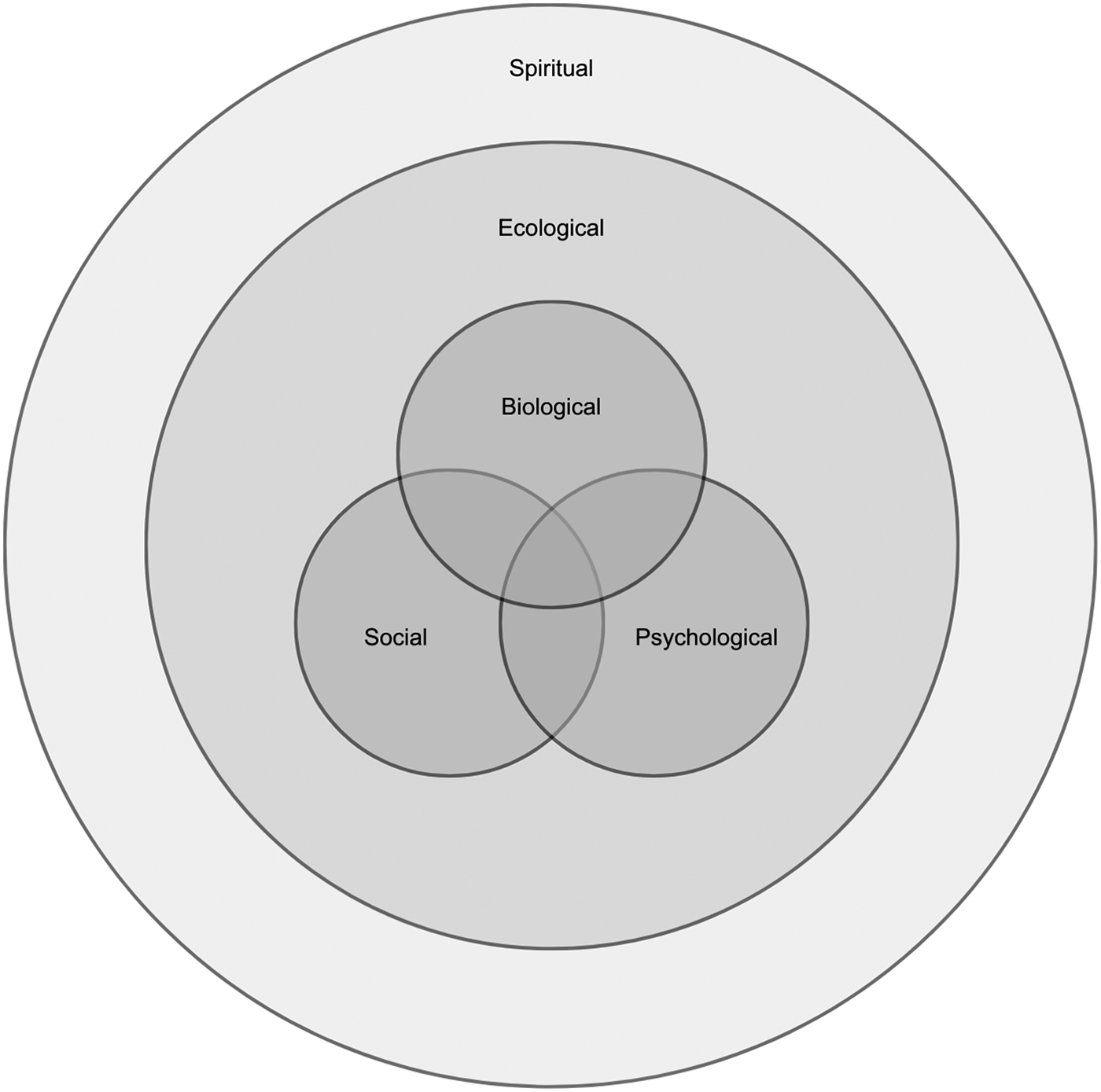
A bio-psycho-social-ecological-spiritual model for maternal mental health.
A main difference from existing models is that maternal ecopsychology is inherently matricentric, providing a mother-centered perspective (O'Reilly, 2019) while also inclusively understanding mothering as a socially and historically constructed practice available to all people (Ruddick, 1980). Matrescence already represents a significant departure from clinical approaches to perinatal distress, as it focuses on how people develop as they take on the caring for dependents while also challenging the child-centeredness that has problematically defined many motherhood theories (Athan & Reel, 2015). The integration of an ecological perspective only widens the psychological story of maternal mental health and acknowledges the increasing rise in maternal ecodistress in the fullness of its meaning.
To further understand an ecocentric matrescence, turning to adolescence once more may be a helpful parallel to a similar life stage marked by holistic growth, emotional turbulence, and behavioral confusion (Arnett, 2006; Kimmel, 2008). The more well-studied rite-of-passage model attributes the declining social, emotional, and physical health in adolescents to the lack of facilitation by Western culture needed to transform immature consciousness into mature adulthood (Claussen, 2017). Arrested development in adolescents is a result of being left without an appreciation for the past and lacking a “map” for the future (Arnett et al., 2011). As a result of their cultural abandonment, they may become stuck in a protracted liminality, unable to self-initiate and ever more vulnerable to the social pressure to remain egocentric (Crawford & Novak, 2006; Kang, 2014; Kessler, 1999).
As Naess describes it, the dominating Western worldview, “stresses the ultimate and extensive incompatibility of the interests of different individuals” (1989, p. 85). The contemporary adolescent ego is often shaped in opposition rather than in connection to others, thus denying life-supporting resources from the community and relying instead on an atomistic self. As many ecopsychologists note, individual arrested development is intertwined with collective arrested development (Plotkin, 2008). A “pathoadolescent” worldview results when young people are raised by a society that is “materialistic, greed-based, hostilely competitive, violent, racist, sexist, ageist, and ultimately self-destructive” (Plotkin, 2008, p. 7). Viewed from this lens, mental health is an ecopsychological problem in the making, and an ecotherapeutic problem to be solved.
In the parallel case of the mothers' own ego maturation and worldview reorientation, they may be similarly at risk for arrested development and poor mental health. The daily maternal practice of caretaking may potentially serve to first awaken ecological awareness. In some cases, the earliest acts of trying to conceive, birthing, or feeding connect mothers to similar relational labor visible across other animal species. For others, it is the largely dyadic work of mother-child bonding that connects them to “allomothers” or “other mothers” in the natural world and resituates them as not alone (Hrdy, 2009). Through this restored eco-relational insight, the original severance from nature is revealed to be a false and dangerous split (Spitzform, 2000).
For example, many verbalize becoming disillusioned with the competitive zero-sum aspects that pit a mother's survival against that of the child's early in the reproductive journey (e.g., abortion). New mothers may at first struggle to reconcile their direct lived experience with any societal norm that celebrates domination, “fragments instead of unifies, overemphasizes success and careers, separates the feeling from intellect and the practical from theoretical” (Hage et al., 2004, p. 6). Cartesian binaries such as mind/matter, human/nature, and nature/society are eventually transformed into tolerable states of healthy paradox without the need for splitting or compartmentalization (Freyne, 2018; Gaard, 2017; Molina-Motos, 2019). Unfortunately, few educational and evidence-based resources are available to them.
This initial separation from an anthropocentric worldview built on detachment and abuse of power moves mothers into their own liminality as they set out in search for alternative ways of knowing. In one unique study, Athan and Miller (2013) explored the ways a commitment to fostering a child through adoption, marriage, or conception leads mothers to a broadened psychospiritual perspective that in many ways mirrors Earth-centered maturation. Their study demonstrated profound shifts in six overlapping and interrelated themes, including unconditional love and interdependence, transcending ego or self-centeredness, compassion and empathy, mindfulness and heightened awareness, meaning and purpose in life, and faith in a higher power. One mother from the study describes her initiation into a more relational ecoconsciousness: Well, I imagined that I would love them, but … it's so much more, they are a part of me, they are me, they are more than me, they have made me more than me … you know, it's really like I'm connected to the earth … they have made me realize that I am part of the earth … from the earth … having children for me actually brought me down to a more daily experience of it (Athan & Miller, 2013, pp. 230–231).
This quote demonstrates how the love for children may catalyze a greater awareness of nature's web of relations on a spiritual level. Spirituality has been intertwined in the history of ecopsychological thought from accounts of sacred experiences in nature to Earth-based religion, and going as far as to state that spirituality is inherently ecological and vice versa (Deal & Bukowski, 2021; Snell, Simmonds, & Webster, 2011). On the material side, biological research on maternal brain plasticity has shown growth in prosocial regions that control empathy, vigilance, and social connection (Barba-Müller et al., 2019). A study conducted by Silvers and Haidt (2008) was even able to induce nursing in mothers by exposing them to “morally elevated” media that showed people engaging in kind behaviors. More research across the many interdisciplinary domains of matrescence is required to build a body of evidence that this life stage is primed for ecological awakening and in need of supportive services to fulfill its maturation.
In conclusion, the integration of ecopsychological theory into the model of matrescence may complete its picture and refresh how the mental health of mothers and the treatment of their distress is viewed. As Arne Naess, the father of deep ecology, expresses, “A widening and deepening of the self” is “a widening and deepening of the web of relational entities” (cited in Diehm, 2002, p. 28)—an experiential and embodied maturing of ecosystemic relationship. Ecopsychological development is therefore implicitly posthumanist and the ultimate realization of the animacy of all “Earth others,” respecting the linkages and differences among diverse lifeforms and their necessary function within a relational web (Plumwood, 1993; Spitzform, 2000).
Maternal Ecodistress
While maternal distress needs further conceptual development (Emmanuel & St. John, 2010), it has been defined in the literature as existing along a continuum from low to high when it comes to how a, “…mother responds to stress, adapting, function, and control, and connecting” (Copeland & Harbaugh, 2019, p. 29). This nonpathological term might best capture the “silent majority” of mothers who do not show clinical levels of disturbance but are still challenged by their new role and identity. It has also been criticized as a nonspecific “catch-all,” but so has the same been argued for depression. Copeland and Harbaugh (2019) note that depression is too often used to diagnose any type of distress new mothers may experience and that more holistic approaches are welcome. Postpartum depression and often co-occurring disorders such as anxiety are present in 11–20% of the U.S. population (Centers for Disease Control and Prevention, 2017), whereas general emotional stress in motherhood may swell to 40% or more (Missler et al., 2021).
A wider explanatory framework is necessary to encompass mothers' full range of experiences given that stress-related symptoms are now recognized as the most common complication of pregnancy and parenting, even in those who are “healthy and wealthy” (Wu et al., 2022). Biomedical approaches offer too “narrow and shallow” a view and leave out the deeper psychosocial underpinnings of early parenting, such as the dramatic lifestyle changes mothers face or the shifts in values (Athan & Reel, 2015; Barclay & Lloyd, 1996; Copeland et al., 2019; Davis, 2023; Emmanuel et al., 2010). If some mothers on the one end of the spectrum meet criteria for PMADs, and those in the middle experience average and manageable stress, then what of the mothers on the opposite end (Athan, 2011; A. Athan, unpublished data)?
Unfortunately, maternal flourishing has not been sufficiently explored despite equal numbers of women reflecting the prevalence rates of those with psychopathology (Athan, 2011). Nascent research in this area shows promise. For example, a high level of stress may be a prerequisite for post-traumatic growth and has been demonstrated in mothers whose foundational assumptions were being challenged and reworked (Taubman-Ben-Ari, Chasson, Horowitz, Azuri, & Davidi, 2021). Taubman-Ben-Ari (2022) states that a certain combination of personal resources and vulnerability is necessary, “in order to be able to go through hardship, change, and emerge a somewhat different person” (p. 3).
We offer the term maternal ecodistress to represent the diverse presentations and possibilities of mothers' environment-related concerns. Despite the near absence of academic work measuring the prevalence of ecodistress during matrescence, public awareness is showing up in real time, as demonstrated by growing media recognition of depression, grief, and post-traumatic stress related to themes of environmental degradation (Barry, 2022; Pattee, 2021; Piastrelli, 2021). A recent BBC (2019) article described ecoanxiety, a form of maternal ecodistress, as the overwhelming powerlessness some mothers experience when thinking about their future in a changing climate. One mother described her experience as, “…terrifying—for days, I couldn't sleep. My appetite went. I cried loads. I felt really, really anxious and upset. I remember being really frantic and asking my husband, ‘did you know about this?’” (BBC, 2021).
The academic literature on ecodistress in youth is also growing quickly and deemed an important factor in healthy adolescent development. A study by Hickman et al. (2021) measured the presence of ecoanxiety, in 10,000 young adults across 10 countries. Participants ages 16–25 reported feeling overwhelmed with emotions such as confusion, betrayal, and abandonment by adults and as though they “have no future, that humanity is doomed” (p. 1). Such chronic stress may have significant, long-lasting implications on the mental health of children, adolescents, and emerging adults. As previously discussed, a major developmental risk is the arrest of a maturing ecoconsciousness that stalls leaving behind a disconnected, pathoadolescent, alienated self.
Research on maternal ecodistress should be similarly conducted to examine the personal strengths and vulnerabilities that shape the ecological self of women across social and geographical locations. However, it is important to not only overpathologize maternal ecodistress or focus exclusively on reducing symptomatology but also consider its presence as potentially normative and even adaptive—helping mothers realize a more mature, Earth-centered consciousness. From the viewpoint of ecopsychology, if mothers experience an awakened awareness as documented by their newfound environmental ethics—then they may offer a unique way forward for society (Cairns, Johnston, & MacKendrick, 2013; Carey et al., 2008; Knibb et al., 2017). Building on ecofeminist concepts, this newfound attunement may be the affective heat of the ecological self's reemergence into the consciousness of mothers.
Maternal ecodistress may be the energetic signature of a warming up ecoconsciousness that is experiencing an “affective transformation” (Verlie, 2021) and no longer able to ignore its relational interconnection with an animate Earth (Molina-Motos, 2019). For example, one mother in a recent Marie Claire article shared her distress over the animals on her child's pajamas, bedsheets, toys, and books. She, “…would cry just thinking about how the savannas and forests where elephants and giraffes live are becoming completely drought burdened” and as a result, “They don't have a place to raise their babies” (Pattee, 2021, first paragraph). Another mother shared her anxiety with disposable plastic toys, feeling as though she had “developed a phobia to my way of life” (Barry, 2022).
The affective heat of ecodistress may be an invitation—a purposeful vulnerability preparing mothers for the psychological growth necessary to survive and reform humanity's crisis. As Plotkin (2008) reminds us, symptoms of ecodistress may naturally manifest during the movement from anthropocentrism to an ecocentrism, and like any developmental task, self-initiates may experience a quickening or regression depending on the supports they have. The degree and frequency of this ecodistress, and how best to facilitate it is an area of inquiry to be researched further as to how much is optimal—what constitutes normative or pathological levels.
Mothers expend tremendous resources managing their child(ren)'s environmental risk, their own panic about their child(ren)'s future, and their guilt for bringing life into an unpredictable climate-changing world to begin with (BBC, 2021). While a movement toward ecocentricity is desirable, it is not gained without a sense of grief or rootlessness. Detaching from the old ego-consciousness is a painful process since it requires abandoning a previous life structure even if “it is making me sick” with its own rewards and affiliations. Perhaps depression is related to the mourning of the previous lifestyle or despair over complicity with an ecocidal way of being, whereas anxiety is fear and a lack of safety as the enormity of the problem becomes increasingly realized.
Mothers need competent and consistent support to heal their anthropocentric split from nature while nurturing a new self-concept that can intimately engage with the animacy and intelligence of the earth (Clayton, 2003). Unfortunately, in Western matrescence, mothers are often left to face these conflicts alone and to self-initiate into ecocentricity within a dominant egocentric society that funnels maternal transformation into harmful self-sacrificing or consumer-centered practices (Abrams, 2005; Davis, 2023). Maternal ecopsychology and its connected therapeutic practices may be the best intervention available for mothers at this critical junction for both themselves and the planet.
Matrescence Ecotherapy
As discussed, the presence of a maternal ecodistress crisis has the potential to transform into an internal ecoawakening if appropriately supported. Numerous scholars theorize that some level of ecological distress is a healthy, normative response to the environmental problems humans are conditioned to ignore (Hage et al., 2004; Kuhn, 2001; Machnev et al., 2018). Its development may be optimally facilitated in natural environments where information arising from sustained contact with more-than-human beings, landscapes, and the elements guide individuals toward greater relational attachment to the web of life (Plotkin, 2021).
For example, Machnev et al. (2018) introduced an ecotherapeutic intervention to preschool children. After exposure to other animals and plants, the researchers discovered an increase in ecological knowledge, attitudes, and focus. Several articles examine the nascent presence of the ecological self in relation to child development as a signal of what may be possible later in the lifespan (Barrow, 1995; Hage et al., 2004; Hung, 2017; Machnev et al., 2018; Summers, Vivian, & Summers, 2019). Ecotherapeutic interventions with adolescents have proven especially beneficial by guiding young people with nature-connected journeys that mirror transition states (Andrews, 1999; Beck & Wong, 2022; Gass, 1993; Kingsman, 2021). Describing one such rite of passage program, Andrews (1999) draws on Turner's (1979) states of liminality to describe how nature immersion is like the “journey from the conventional structures of society through the transitional phase of liminality and back into society again” (p. 35).
With mothers there is the same potential for success but since matrescence has its own unique developmental tasks, it is important to have interventions tailored to meet mothers' unique conflicts. Echoing established literature on maternal mental health interventions, the following three primary conflicts may arise when therapeutically working with mothers: (1) isolation; (2) perfectionism; (3) self-sacrifice. While these occur in general maternal distress, it is important to listen keenly for ecological themes even if mothers themselves lack the language or insight to recognize them as such.
First, the common feelings of isolation in motherhood (Knafo, 2021) may be intensified because some may not know where to turn to for their climate concerns (BBC, 2021). In a recent mothers' circle conducted by one of the authors, a mother reported frustration over an upcoming child's birthday but did not disclose her feelings to close family or friends. Only after her emotions were validated by the group did she realize how alone she felt that the birthday was being threatened by elaborate over-consumption she felt powerless to stop.
The second area of conflict is the sociocultural pressure to be a “perfect” environmentalist. This may manifest as hypervigilance or controlling tendencies to reduce one's ecological footprint with calculated household and childcare decisions (Kleiman, 2008; Ray, 2011). There may also exist stress from either social comparison, where mothers attempt to keep up with more eco-minded peers, or gender inequities, where keeping up with eco-chores may overwhelmingly fall on the mother (Knibb et al., 2017). Another woman from the mothers' circle shared that she once avoided attending a new mothers' support group because she was ashamed of changing her baby's disposable diaper during the session.
This may similarly play out with the third primary conflict of meeting the “good mother” ideal. Mothers strive to become the “good green mother” (Knibb et al., 2017), sacrificing their authentic selves and the opportunity to deepen their place-based relationship with nature by buying into a prescriptive green behavior. They may also feel blamed as “breeders” for becoming parents in the first place, thus complicating the “good mother” ideal with a Malthusian population trap of the “ideal woman”—preferably a childless one (Sasser, 2018). These interrelated conflicts can leave mothers understandably ambivalent, overwhelmed, and depleted. Mothers may end up prioritizing environmental practices over their own well-being to signal their ecological morality, especially in social settings (Atkinson, 2014; Carey et al., 2008; Knibb et al., 2017).
Mothers benefit from ecotherapy whether their primary area of risk is within the ecological domain or not. As discussed, the three primary conflicts in maternal ecodistress are evident in generalized maternal distress as well. Ecotherapy supports maternal mental health by deepening the psychological connection to nature's animate intelligence and therefore shifts the experience of living in the world toward the better overall. Whether isolation is caused by climate concern, lack of familial support, or the multiple shifts of working motherhood, widening the web of relations through a regular ecotherapy practice can help mothers feel less alone by becoming intimate with their local plants, animals, and landscapes (Adams & Morgan, 2018).
Similarly, striving for perfection and control can be alleviated by allying with nature and its emergent solutions (Kleiman, 2008). For example, one mother learned to wait for aphid predators like ladybugs to arrive in her vegetable garden rather than using pesticides, surrendering to ecosystemic intelligence. By increasingly trusting nature, mothers may relax their vigilance in their motherwork by opening to the possibility of cocreation with more-than-humans to co-parent their children. This connects to the last conflict of loss of identity through self-abnegation with ongoing self-monitoring. Over time by learning one's niche in the ecosystem, mothers may more regularly include themselves as vitally important parts of the collective that deserve nurturing care too (Plotkin as referenced in Graves, 2021).
A helpful understanding of care articulated by ecological philosopher Puig de la Bellacasa (2017) is, “a practice that maintains webs of relations that [are] always happening in between… [and] spreads the meaning of the ethical to the whole of a situation” (p. 166). Ecotherapeutic interventions can help mothers overcome the sacrificial expectations of intensive mothering as they extend mothering back to themselves with nature in mutuality. One mother described this lesson as not wanting to be the ecosystem's “weak link” by trying to be something she was not. Instead, she resisted self-erasure, reenlivened, and recast herself as a purposeful presence in her ecosystem with a unique contribution to offer.
This integrative framing of the psychoecology of matrescence is foundational for generating innovative and sound ecotherapeutic interventions for mothers who experience ecodistress. Ecotherapy that uses a deep and warm lens may offer the best support for mothers across the spectrum of distress from explicit ecological matters (e.g., hypervigilance of the air quality's effects on an infant) to more generalized material (e.g., hypervigilance crossing the street with their infant). It is important to not concretize ecopsychological recommendations, however, as they should be used more as a map than a prescription for mothers. While many adolescent nature programs are of the “wilderness” style that remove youth from their home into a remote landscape, in matrescence, a similar one-size-fits-most approach cannot be adopted.
As discussed, maternal authority is always at risk of being decentered and coerced for potentially nefarious ends. Matrescence ecotherapy is instead a set of guiding principles rather than a list of strategies or dictums and therefore must be conducted in consensual collaboration with mothers. Ecopsychology similarly honors nature as “knowing best” (Plotkin, 2008, p. 2) and gives primacy to the wisdom it provides as the main healing agent. How nature is defined must also be reexamined when working with mothers. Rather than remove themselves from home life, therapists can encourage mothers to connect with accessible “hyper-local” nature nearby (Nisbet, Zelenski, & Murphy, 2009) (e.g., with themselves, their child, their pets, their backyard, water from their faucets, etc.) to model a nondualistic ecoconsciousness.
There are many ways to practice ecotherapy that are meaningfully connected to lineage and land, so clinicians are encouraged to use site-specific, place-based, culturally-literate, and person-centered practices (e.g., gardening, creating nature art, bonding with an animal in close by surroundings). This empowers mothers in their own “healing and wholing” capacities even while feeling the tension of ambiguity and paradox of existing between two diametrically opposing worldviews. Drawing on mothers' limitations realistically can help establish a plan for regular, sustainable contact with the more-than-human world, which can also help mothers incorporate the ecocentric worldview in their lives long-term.
Conclusion
This paper has focused on why maternal ecopsychology and how its application is important for the psychoecological well-being of mothers. Maternal ecodistress may be the nascent beginnings of an ecological developmental process with the potential to deepen mothers' relationship to nature and nonhumans, shift harmful ideologies of motherhood and environmental advocacy, and provide the foundation for more ethical ecological care practices (Davis, 2023).
Holding mothers' ecodistress as belonging to a developmental process validates mothers' environmental concerns while also midwifing their ego maturation toward an enlarged ecoconsciousness. Transforming the experience of motherhood through ecotherapy may also be supportive for PMADs and have far-reaching implications beyond reducing the burden of maternal mental health. As McMahon (1995) states, “[M]otherhood has the potential to challenge not only the political order but the deeper cultural images of human nature and the links between society and nature on which the social and political order rests” (p. 27).
As discussed, the dominant Western worldview teaches that the environment is separate and nothing more than a resource for human progress. Ecofeminists have long argued the similarities between mothers and nature, as both are exploited by the modern economic system to be used to the point of depletion (Sturgeon, 1997). Paris and Pye (2012) call the extractive way we treat mothers and label them as either “good” or “bad” based on their performance as the “mother complex” (p. 173). They note that many environmentalists project anthropocentric, androcentric, and immature projections of their own mother onto the earth, creating an idealized image of nature as an all-loving and all-giving “mother.”
This results in objectifying views of nature and self-hating views of humans that prevents the human species from evolving. A maturation of the collective mother complex is necessary to accomplish a large-scale shift into a more respectful relationship in which both parties can mutually survive and thrive. Mothers must also disencumber themselves from their own primary conflicts and if successful may be the very ones to lead the way out of this problematic dynamic. This attempt will not be successful if the material conditions of mothers are not improved, and the devaluing of caregiving not questioned.
As with adolescence, there is no returning to a previous life stage with matrescence. Going back to a pre-climate changing world is similarly impossible. Although there is always risk for regression, and the nostalgic return to the past, the transition to motherhood and the new ecocentric world order needed for humanity must be welcomed as a difficult but life-affirming and rewarding process. The way forward in both matrescence and climate change is to become more adaptive in the cocreation of a hopeful future.
How this may be accomplished only spurs more questions. How might mothers, who are reenvisioning their worldview and way of life, benefit from experiencing the ecosystem's warm animate intelligence? How might the human species benefit from mothers' bypassing the developmental distortions of egocentric social adaptation to an ecocentric social evolution? What might shift when mothers bring their lived experiences of ongoing relational development with their children into their ecological contexts?
Future research can draw on a maternal ecopsychological lens to investigate these deeper questions about maternal mental health by centering mothers' subjective experiences of both maternal ecodistress and psychoecological development through ecotherapeutic praxis. This lens allows mothers and mother-supporting professionals to “name then tame” overwhelming maternal ecodistress by viewing their growing pains as the inevitable psychoecological outgrowth of motherhood.
In conclusion, assisting mothers, as we do children and adolescents, to accelerate their shift into a more fully realized maternal ecoconconsciousess should become a pressing issue for both the psychological and environmental community. A developmental leap into ecocentricity, at any age or stage, may be the only thing that will save us and the more-than-humans from us.
Footnotes
Authors' Contributions
A.D.: Conceptualization, Writing-Original Draft, Writing-Review and Editing, and Visualization. A.A.: Conceptualization, Writing-Review and Editing, and Supervision.
Author Disclosure Statement
No competing financial interests exist.
Funding Information
No funding was received for this article.