






Abstract
Nature connectedness is an important factor underlying proenvironmental behavior. Only little is known on the aspects that influence nature connectedness in younger children. The study participants included 150 children at mean age of 6.5 years. Eighty-five of them attended nature-preschool that offers on average 13.1 h/week, and 65 of them typical preschool that offers on average 1.7 h/week, of their education in nature. Nature connectedness was measured with the connection to nature index. The regular visits to nature during preschool were associated with a higher sense of responsibility for nature (p = 0.013). The regular visits to nature during preschool, sex, parent's nature connectedness, or socioeconomic status (SES) were, however, not associated with overall nature connectedness. Children with lower SES scored higher in the enjoyment of nature than the children with higher SES (p = 0.029). Offering the children regular nature experiences in preschool may be beneficial for developing responsibility toward nature. Incongruent with previous studies, overall nature connectedness was high in all the children, regardless of the time they spent in nature during preschool.
Introduction
Human behavior is involved in the current environmental crises, including global warming and biodiversity loss. A better understanding of the variables that influence an individual's proenvironmental behaviors may be useful when trying to increase proenvironmental actions in communities.
Nature connectedness
Nature connectedness refers to an individual's subjective view of their relationship with the natural world (Martin & Czellar, 2016; Nisbet, Zelenski, & Murphy, 2009). Even though the concept can be operationalized in different ways, it typically includes the following aspect: affective, cognitive, and physical relationship individuals have with the natural world (Martin & Czellar, 2016; Martin et al., 2020; Nisbet et al., 2009). Connectedness to nature is shown to be a significant predictor of proenvironmental behaviors in adults (Mackay & Schmitt, 2019; Martin et al., 2020; Mayer & Frantz, 2004) as well as in children (Barrera-Hernández, Sotelo-Castillo, Echeverría-Castro, & Tapia-Fonllem, 2020; Collado, Staats, & Corraliza, 2013; Otto & Pensini, 2017).
In a study including (n = 255) fourth- to sixth-grade children taking part in nature-based environmental education, connectedness to nature explained 69% of the variance in ecological behavior (Otto & Pensini, 2017). Hence, it seems that nature connectedness may be one important factor underlying proenvironmental behavior. Regardless of the importance of the concept, only little is known on aspects that influence the level of nature connectedness in children, especially at younger age.
Nature connectedness in children
There is a strong current understanding that the bond with nature starts to develop already in early childhood (Green, Kalvaitis, & Worster, 2016; Wells & Lekies, 2006; Wilson, 1996) and that the bond with nature is strongly influenced by the personal experiences in nature (Green et al., 2016; Rosa, Profice, & Collado, 2018; Wells & Lekies, 2006). However, the more multidimensional concept, nature connectedness, is less studied in children. The few existing studies on green environments and nature connectedness in children suggest that children who have green environments around their home score higher in nature connectedness scales (Bakir-Demir, Berument, & Sahin-Acar, 2019; Cheng & Monroe, 2012; Collado et al., 2013).
These few studies, however, have a limitation that makes it hard to draw strong conclusions from the findings. They have not collected the data on the actual frequency or the hours that the children typically spent in the green environments but rather measured the existence of the green places around their homes (Bakir-Demir et al., 2019; Cheng & Monroe, 2012; Collado et al., 2013).
In the study of Cheng and Monroe (2012), including children aged between 8 and 10 years, the nature near home was measured by asking the children in the web survey whether they had nature nearby their homes. In the study by Bakir-Demir et al. (2019), including children aged between 8 and 11 years, the greenery was measured by Normalized Differential Vegetation Index, and by mother's and children's perceptions of the levels of greenery around their homes, that both reflect the amount of vegetation around the children's home addresses (Bakir-Demir et al., 2019).
Taking the actual hours spent in the close-by nature into account is, however, essential as children spend more and more time indoors, organized hobbies and institutions (Skår & Krogh, 2009), and the existence of the green places is thereby not reliably reflecting the actual time spent in greenery (Skår & Krogh, 2009). In the study of Collado et al. (2013), which showed that the time spent in nature might increase the nature connectedness in children, the actual time spent in nature was reported. The exposure, however, was short and seldom, as they compared children attending 1–2 weeks long summer camps in nature with children who were taking part in similar summer camp in urban setting (Collado et al., 2013).
Thus, for these reasons, the first aim of this study was to study if the actual objectively reported time spent in unbuilt nature during the preschool year is associated with nature connectedness.
Background characteristics and nature connectedness in children
Previous evidence suggests that time spent in nature may not be the only aspect affecting children's nature connectedness level. Previous research on the intergenerational transmission of values has shown clearly that the values of children are associated with those of their parents (Katz-Gerro, Greenspan, Handy, & Vered, 2020; Min, Silverstein, & Lendon, 2012; Ranieri & Barni, 2012).
There is growing evidence showing that teenager's proenvironmental values, attitudes, and behaviors are correlated with their parent's proenvironmental values and behaviors (Grønhøj & Thøgersen, 2017; Katz-Gerro et al., 2020; Leppänen, Haahla, Lensu, & Kuitunen, 2012; Li & Liu, 2016). There is also one recent study showing that at the age of 12–16 years, children's empathy for nature and connectedness with nature are positively associated with their parents' reports of empathy and connectedness to nature (Musitu-Ferrer, León-Moreno, Callejas-Jerónimo, Esteban-Ibáñez, & Musitu-Ochoa, 2019). However, it has not been studied whether parent's level of nature connectedness is associated with nature connectedness already in younger children.
In addition to values, there is some evidence that also sex may affect the level of nature connectedness. A study by Musitu-Feret et al. (2019) showed that within 12- to 16-year-old children, girls demonstrate overall greater cognitive and emotional empathy with the natural environment than boys. Also, socioeconomic status (SES) has been shown to influence the level of proenvironmental actions in adults (Chen et al., 2011; Giusti, Svane, Raymond, & Beery, 2018). However, it has not been studied if sex or family SES associates with nature connectedness in children.
Thus, the second aim of this study was to explore whether parent's nature connectedness, sex, or SES associate with nature connectedness in 6-year-old children, or if they moderate the impacts that the regular nature visits in preschool may have on children's nature connectedness.
Study hypothesis
In conclusion, it was set out to study (1) if the regular visits to nature during the preschool year or child's background characteristics, including sex, parent's nature connectedness, or family's SES associate with nature connectedness. In addition, (2) if these background characteristics moderate the association between regular nature visits and nature connectedness in 6-year-old children.
Materials and Methods
Data collection procedure
In Finland, the municipalities have the responsibility of organizing free preschool education of 4 h per working day (20 h/week) for all children living in the area. The curriculum of education is fixed, but municipalities have the right and freedom to organize education in different ways. Most commonly, the preschools organize their activities inside the daycare center or school, and the daily outdoor activities are carried out in a built playground area around the center. These typical types of preschools make field trips to unbuilt nature every now and then. Where in comparison, some preschool groups, called the nature-preschools, organize significant amount or all (up to a full 20 h/week) preschool activities regularly in unbuilt nature.
Unbuilt nature in this study refers to a nature area that has not been built or modified for humans. Unbuilt nature, thus, does not include parks, playgrounds, or other similar types of greeneries. As from the total land area in Finland, 73.1% is forest (Keenan et al., 2015), most of the unbuilt nature is forest. The density of forests all around Finland allow almost all preschools to organize some of their weekly activities in the forest if wanted.
In this study, 14 nature-preschool groups around Finland, and 13 typical preschool groups in the same municipality areas, were recruited to the study. All of the 27 preschool groups were willing to attend. A total of 380 families were invited to the study, and of them 150 (39.5%) participated. Data collection was performed after the children had been in the preschool on average 4.5 (range 2.3–8.4, standard deviation [SD] 1.8) months to ensure that the children had experienced long enough systematic nature visits at the time of the participation. The time of the data collection was not associated with connection to nature index (CNI) or its subscales (p > 0.321).
The study included three questionnaires: questionnaire 1 for the parent, questionnaire 2 for the child, and questionnaire 3 for the preschool managers. Preschool teachers delivered questionnaires 1 and 2 to the parents, and the parents sent the filled questionnaires to the university.
Ethics statement
Before starting the research project, it was ensured that the study protocol fulfills the ethical rules of Ethics Committee of the University of Jyväskylä (Finland), which follows the Finnish nationwide ethical guidelines of the Finnish Advisory Board on Research Integrity (TENK). According to TENK's guidelines, the study protocol did not require ethical review by an institutional ethics committee. Written research permissions for the study were obtained from all the attending municipalities. All guardians of the study participants gave their written informed consent before participating in the study.
Variables
Nature-preschool
Of the 150 children in this study, 85 (56.7%) were attending nature-preschool, and 65 (43.3%) typical preschool. Of the children attending nature-preschools, 39 (45.9%), and of the children attending typical preschools, 34 (52.3%) were girls (p = 0.435).
Time spent in nature during the preschool
The number of hours that the preschool education was organized on average in unbuilt nature in each preschool group during the preschool year was obtained by the questionnaire 3 sent to the preschool managers. From the preschool week that lasted for 20 h/week, nature-preschools offered on average 13.1 (SD 3.6, range 5.0–16 h), and typical preschool on average 1.7 (SD 0.9, range 0.5–5.0) hours, in unbuilt nature during an average week.
Nature connectedness
There are not currently any self-report questionnaires developed to evaluate nature connectedness in 6- to 7-year-old children (Barrable & Booth, 2020). However, The CNI questionnaire (Cheng & Monroe, 2012), which was originally developed for 8- to 10-year-old children, have demonstrated to be the most comprehendible and suitable also for 7- to 13-year-old children (Bragg, Wood, Barton, & Pretty, 2013).
It has also been successfully used for 7-year-olds in several previous studies (Bragg et al., 2013; Hughes, Rogerson, Barton, & Bragg, 2019). Study of Varni, Limbers, and Burwinkle (2007) has shown that already 5-, 6-, and 7-year-old children, when assisted, can reliably and validly self-report health-related quality of life (HRQL) questionnaire, which includes, for example, questions on their emotional functioning, comparable with older children and adolescents. There are 16 questions in the CNI, and most of them are very concrete, and all of them are relatively concrete. Seven out of 16 questions are asking how much child likes/enjoys something, 4 out of 16 are asking how much the child experiences basic and easily recognized emotions related to nature, and the last 5 out of 16 questions are asking how right or wrong the nature-related concrete statements are in child's opinion. As the difficulty level in the structures of the questions is rather similar between HRQL and CNI, the findings from the study of Varni et al. (2007) give further support to the view, that 6- to 7-year-old children are able to answer the questions reliably in CNI questionnaire.
Taken all this together, CNI seems to be a suitable tool to evaluate nature connectedness also in 6- to 7-year-old children, and thus, was used to measure nature connectedness in this study.
The CNI has been developed to assess the affective attitudes of children toward the natural environment. The scale consists of 16 items rated on a 5-point Likert scale, from 1 (strongly disagree) to 5 (strongly agree), and is scored by creating a sum of the 16 items, where higher scores indicating a stronger connectedness to nature. In addition to the overall sum scale, CNI includes four subscales: (1) enjoyment of nature, (2) empathy for creatures, (3) sense of oneness, and (4) sense of responsibility (Cheng & Monroe, 2012). The answers for CNI were collected by questionnaire 2 for the children.
Followed by the example of Varni et al. (2007), there was an attempt to simplify the cognitive demand of CNI as much as possible. Therefore, the parents were instructed to read the questions of CNI one by one to the child, and the child to point out from the questionnaire the colored circle that best reflects his/her opinion of each question. The colors were 1 = red = strongly disagree, 2 = orange, 3 = yellow = not disagree or agree, 4 = light green, 5 = dark green = strongly agree. Before starting to fill in the questionnaire, parents were also instructed to practice the answering protocol with the child with practicing question: “How much you like winter?”
Cronbach's α for the CNI was 0.78.
Childs frequency of visiting nature in free time
The children's frequency of visiting nature in free time was collected by questionnaire 1 for the parent. The parents were asked: “When your child is outdoors, how often he/she spends time in the forest or other unbuilt nature (after the daycare or during a day off)?,” using six categories (rarely, less frequently than weekly, once a week, twice a week, three to four times a week, and five to seven times a week). In the analyses, the variable was used both as a continuous variable and recoded into a dummy variable where value 0 (n = 55, 36.9%) represents spending time in nature less frequently than weekly and value 1 (n = 94, 63.1%) spending time in nature at least once a week.
Parent's nature connectedness
Parent's nature connectedness was collected by questionnaire 1 for the parent using a short-form version of the Nature relatedness scale (NR-6) (Nisbet & Zelenski, 2013). NR-6 includes six questions rated on a 5-point Likert scale, from 1 (strongly disagree) to 5 (strongly agree), and is scored by creating a mean of the six items, where higher scores indicating a stronger connectedness to nature. Cronbach's α for the NR-6 was 0.85.
Socioeconomic status
Family's SES was collected by questionnaire 1 for the parent. SES was operationalized from a question on the parent's highest attained education. Parents were asked to report their highest attained education using four categories: basic education, vocational school, bachelor's degree, and higher university degree. Owing to the small number of participants in some of the categories, the variables were recoded into dummy variable where value 0 (N = 56, 37.3%) represents two of the lowest groups, basic education and vocational school, and value 1 (N = 94, 62.7%) represents two of the highest groups: bachelor level degrees and higher university educations.
Parent's frequency of visiting nature in free time
Parent's frequency of visiting nature in their free time was collected by questionnaire 1 for the parent. Parents were asked the question: “How often do you spend time in nature by yourself?” using six categories (rarely, less frequently than weekly, once a week, twice a week, three to four times a week, and five to seven times a week). In the analyses, the variable was used as a dummy variable where value 0 (n = 83, 55.3%) represents spending time in nature less frequently than weekly, and value 1 (n = 67, 44.7%) spending time in nature at least once a week.
Reason for enrolling the child in a nature-preschool
The parents were asked in questionnaire 1 to choose from seven categories the most important reason for enrolling the child into the nature-preschool. The alternatives were (1) nature is important to our family, (2) we wanted to familiarize our child with nature, (3) some of the child's friends were applying to the same group, (4) health care or daycare professional recommended, (5) our child enjoys spending time in nature, (6) no special reason, and (7) some other reason. As there were <5 participants choosing the categories 3 and 4, and thus being too small for the statistical analyses, the participants from those categories were included into group 7.
Statistical analyses
G*Power analysis (Chow, Wang, & Shao, 2007; Faul, Erdfelder, Buchner, & Lang, 2009) was used to test the difference between two independent group means using a two-tailed test, and an α of 0.05. The result showed that a total sample of 126 participants with two equal-sized groups of n = 63 was required to achieve a power of 0.80.
Linear regression analyses were used to examine the associations between independent variables and nature connectedness as the dependent variable. The distributions of CNI subscales sense of empathy, and sense of openness, were skewed to the left, so they were natural log(ln) transformed to attain normality before running the analyses. Moderating effects of SES, sex, and parent's nature connectedness were analyzed by linear regression interaction analyses. The calculated interaction terms were added to the regression model, together with the main effects. Significant results were rerun in Model 2 with the following covariates: SES, sex, child's frequency of visiting nature in free time, and time of the measurement. The analyses were carried out using SPPS 26 for windows.
Results
The characteristics of the study population are summarized in Table 1.
Descriptives of the Study Population (N = 150)
CNI, connection to nature index; n, number of cases; SD, standard deviation; SES, socioeconomic status.
Nature-preschool, visits in nature during preschool and free time
The overall attendance of nature-preschool versus typical preschool was not associated with the CNI sum score (Table 2). The children attending nature-preschool scored higher in the CNI subscale sense of responsibility than the children in typical preschool (p = 0.013, unstandardized β = 0.323; Model 2 p = 0.012) (Table 2; Fig. 1). The groups did not differ in other CNI subscale scores (Table 2).
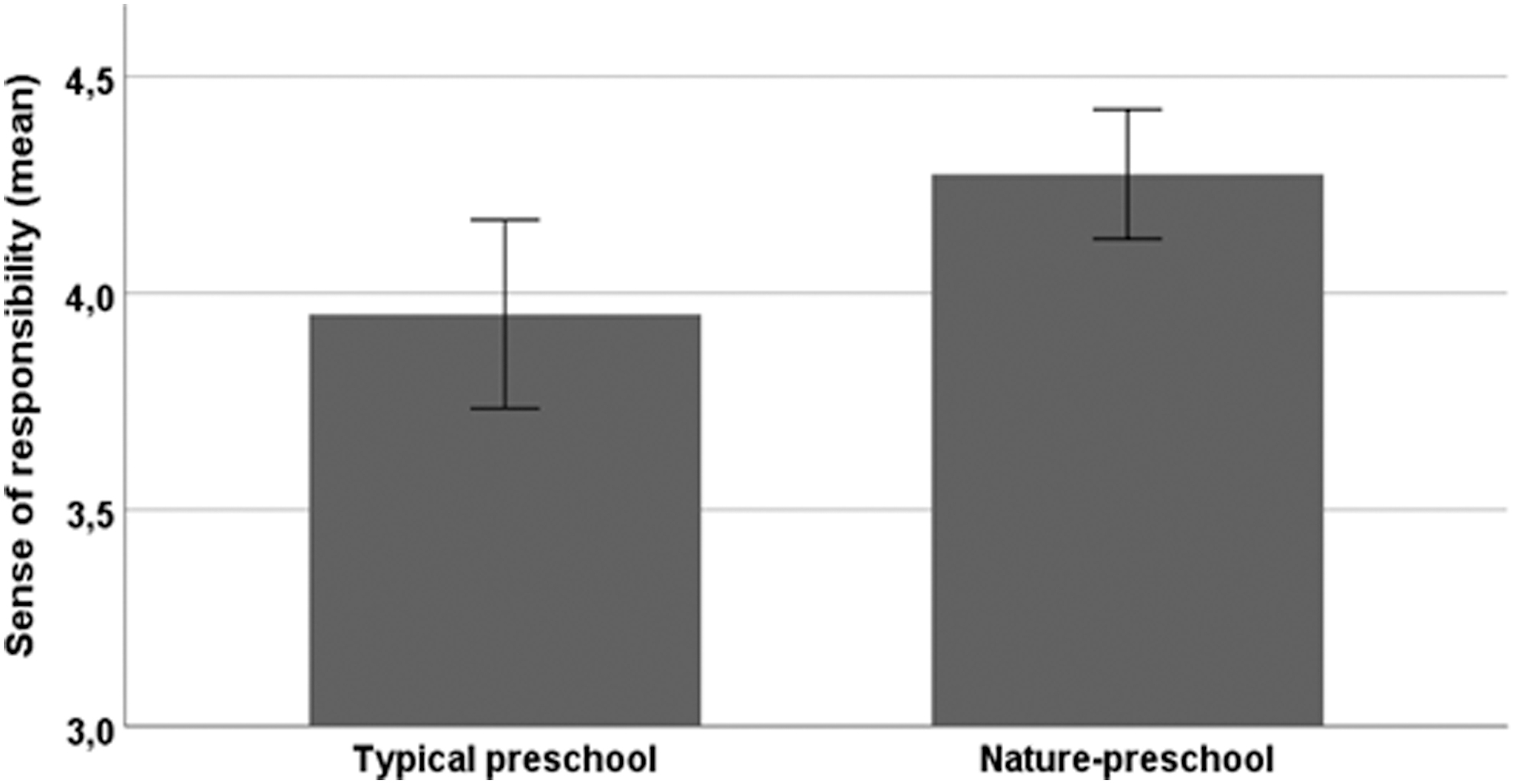
Association between the attendance of nature-preschool (regular visits in nature on average 13.1 h/week) versus typical preschool (regular visits in nature on average 1.7 h/week) and child's sense of responsibility mean score (subscale from CNI). Error bars represent 95% CI. CI, confidence interval; CNI, connection to nature index.
Associations Between Nature-Preschool and Time Spent in Nature and Connection to Nature Index Sum Score and Subscales
p < 0.05.
Low/high = split by median (8.0 h).
95% CI, 95% confidence interval.
When all the children were analyzed together, the hours that the children spent weekly in nature in the preschool were not associated with the overall CNI sum score (Table 2). The subscale analyses revealed, however, that the more hours that the children spent in nature during preschool, the higher their sense of responsibility was (p = 0.046, β = 0.021; Model 2 p = 0.044). None of the other subscales was associated with the hours spent in nature during preschool (Table 2).
Next, children were divided into two groups, cut from the median (8.0) by the time they spent in nature on average week during preschool. A similar association was found between the groups, as the children who spent >8 h/week in nature scored higher in the sense of responsibility than the children who spent <8 h/week in nature (p = 0.025, β = 0.289; Model 2 p = 0.023) (Table 2). Within the children who attended nature-preschool, the reason for enrolling a child to nature-preschool was not associated with their sense of responsibility, as none of the groups differed from each other in the sense of responsibility (p > 0.568).
The frequency children visited nature during the free time was not associated with the CNI sum score, nor any of its subscales, when analyzed as a continuous variable (Table 2). When the frequency of visiting nature during the free time was categorized into two groups (visiting nature less than weekly vs. weekly), the more frequent visit in nature during free time was associated with a lower sense of oneness (p = 0.046, β = −0.137; Model 2 p = 0.049). The more frequent visits in nature during the free time using categorical variable was not associated with the overall CNI sum score nor any of the other subscales (Table 2).
Cumulative nature visits (preschool and free time)
The cumulative effect of visiting nature both during preschool and free time was analyzed by dividing the children into four groups depending on whether they spent time in nature rarely or often (split from the median 8.0) during preschool and rarely or often during free time (less than weekly vs. at least weekly). The groups were (1) rarely in preschool and rarely in free time, (2) rarely in preschool and often in free time, (3) often in preschool and rarely in free time, and (4) often in preschool and often in free time.
CNI sum score did not differ between the four groups (p > 0.066), and thus not even children who spent <8 h in nature in preschool and less than weekly in free time, differed in CNI sum score from the children who spent >8 h in nature in preschool and at least weekly in free time. The subscale analyses revealed that the sense of oneness was lower in group 1 than in group 4 (p = 0.048, β = 0.193; Model 2 p = 0.046). The sense of responsibility was lower in group 1 than in group 2 (p = 0.009, β = 0.554; Model 2 p = 0.009), group 3 (p = 0.023, β = 0.444; Model 2 p = 0.029) and group 4 (p = 0.002, β = 0.577; Model 2 p = 0.002). None of the other groups differed from each other in CNI subscale scores (p > 0.081).
SES, sex, parent's nature connectedness, and parent's visits in nature
SES was not associated with the CNI sum score (p = 0.113). Subscale analyses revealed that children with lower SES scored higher in the enjoyment of nature than the children with higher SES (p = 0.029, β = −0.273; Model 2 p = 0.030) (Table 3; Fig. 2). SES was not associated with any of the other subscales (Table 3). Sex, parent's nature connectedness, or parent's visits in nature in free time were not associated with the child's CNI sum score or any of its subscales (Table 3).
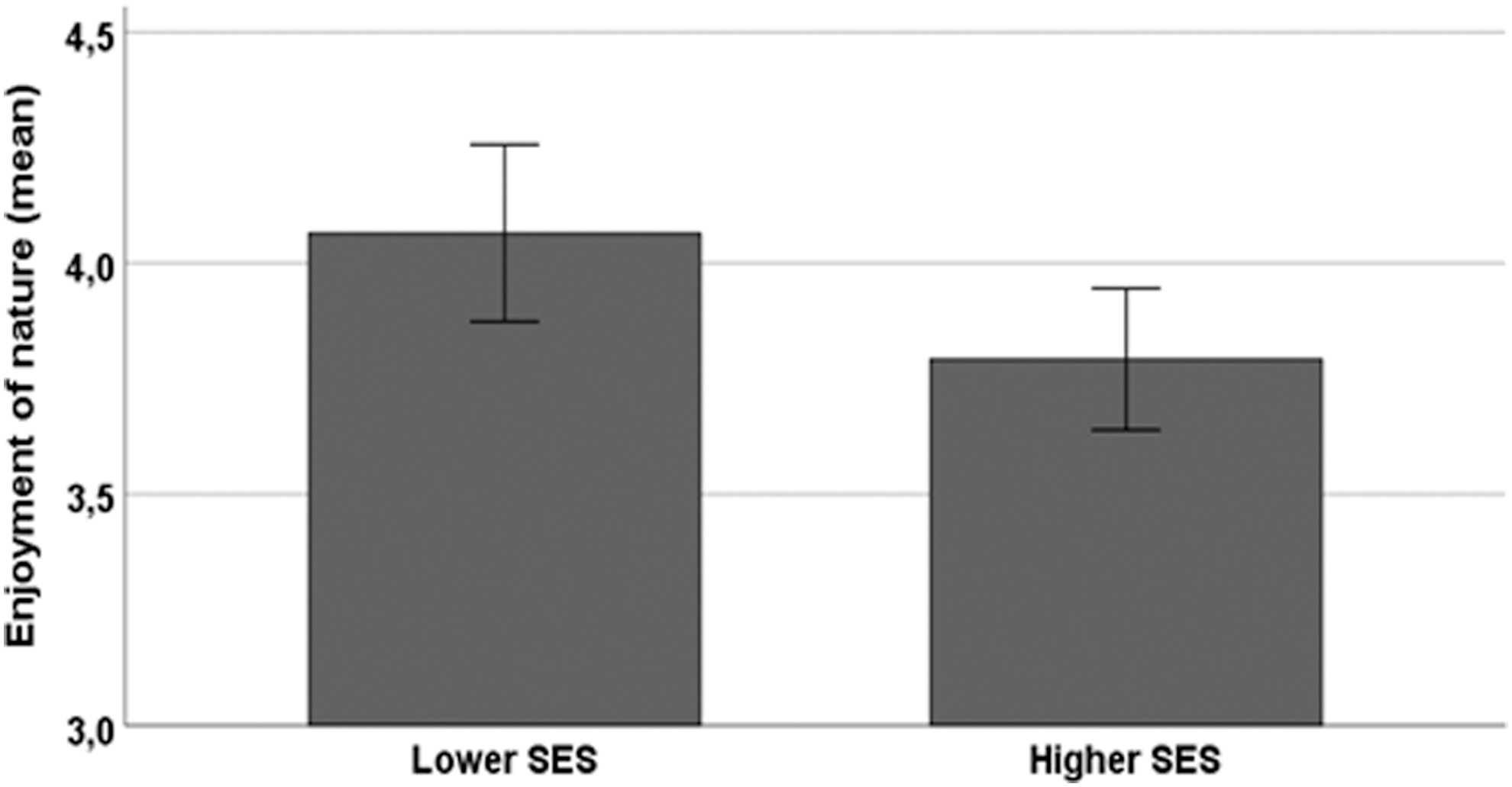
Association between family's SES and child's enjoyment of nature mean score (from CNI). Error bars represent 95% CI. SES, socioeconomic status.
Associations Between Sex, Socioeconomic Status, Parent's Nature Connectedness, and Parent's Visits in Nature in Free Time, and Connection to Nature Index Sum Score and Its Subscales
p < 0.05.
NR-6, short-form version of the nature relatedness scale.
Interaction effects of SES, sex, and parent's nature connectedness
SES, sex, or parent's nature connectedness did not moderate the associations between child's nature visits in preschool and CNI sum score, or none of the CNI subscales (p > 0.071) (Table 4).
Interaction Effects of (1) Sex, (2) Socioeconomic Status, and (3) Parent's Nature Connectedness (NR-6) and the (a) Attendance of Nature-Preschool, (b) Nature Time in Preschool and (c) Visits in Nature Free Time, on the Dependent Variables: Connection to Nature Index Sum Score and Its Subscales
Discussion
The main result showed that 6.5-year-old children who attended nature-preschool, and thus spent more time in unbuilt nature during the preschool year, had a higher sense of responsibility toward nature than typical preschoolers with fewer nature visits did. They, however, did not differ in their overall nature connectedness from children attending typical preschool. The mean CNI sum score for all the children was 4.1, and as the scores of 4–5 in CNI indicate a higher level of connection (Cheng & Monroe, 2012), all the children were highly connected to nature, regardless of the time spent in nature during the preschool year. The children who were in nature-preschool did not differ from typical preschoolers in any of the other CNI subscale scores: in empathy for creatures, in enjoyment of nature, or in sense of oneness.
Sense of responsibility for nature
The strong association between regular nature visits and a sense of responsibility toward nature is in line with the previous studies on adults. It has been proposed already 40 years ago that spending time outdoors may be one of the most influential factors in developing concern for the environment (Tanner, 1980), and more recent studies on adults have supported the hypotheses (Chawla, 1999; Ewert, Place, & Sibthorp, 2005; Palmer, 1993; Tanner, 1980; Wells & Lekies, 2006).
Studies on adults have also shown that spending time in nature, especially in appreciative activities, such as wildlife watching and nature photography, is associated with higher levels of environmental concern (Teisl & O'Brien, 2003). Thus, this study adds to the literature suggesting that spending time in nature may affect the sense of responsibility for nature already at the age of six.
This finding is important as it deepens the understanding between nature exposure and the development of the sense of responsibility for nature. The result can help determine more meaningful and effective ways to support younger generations in connecting and engaging with the natural world. This is vital, as the global environmental crises are accelerating and the effects are predicted to be drastic (Hoegh-Guldberg et al., 2018), and new ways to activate proenvironmental behaviors in communities are actively searched. Further studies, with longitudinal, as well as qualitative, and mixed-method study settings, are recommended to explore the importance of nature exposure, especially in preschool settings in more detail, as well as to determine how long-lasting the found effect is.
This result also raises a question of whether the sense of environmental responsibility should be considered as a part of nature connection, as it is in the CNI, or if should it be considered as more separate concept. As the significant results were found only at this subcategory, this study underlines the importance to also look these subcategories separately in further studies.
Previous studies have shown that visiting green environments in childhood also has a wide range of positive effects on children's physical and mental health. It has been associated with boosted microbial diversity and immune regulation (Roslund et al., 2020), fewer attention deficit hyperactivity disorder symptoms (Donovan, Michael, Gatziolis, t Mannetje, & Douwes, 2019), better emotional well-being (Ward, Duncan, Jarden, & Stewart, 2016), less behavioral problems (Flouri, Midouhas, & Joshi, 2014). Together with the novel finding on children's higher sense of responsibility toward nature in this study, municipalities can confidently be encouraged to offer children regular nature exposures as part of their daycare and preschool activities.
Overall nature connectedness
The null finding with regular nature visits and overall nature connectedness, in contrast, is incongruent with previous studies that have reported that children who have green environments around their homes, or who take part in summer camps in nature, have higher overall nature connectedness (Bakir-Demir et al., 2019; Cheng & Monroe, 2012; Collado et al., 2013). There is also previous qualitative evidence showing that nature experiences may increase an empathetic relationship with nature (Palmberg & Kuru, 2000).
There are several possible reasons that can explain the differences between this and the previous studies. First, there are differences in the study populations. The participants in this study are younger than in the previous studies. Children in this study are, on average, 6.5 years old, where the children in the previous studies were older, from 8 to 11 years old (Bakir-Demir et al., 2019; Cheng & Monroe, 2012; Collado et al., 2013). As the age of the children has shown to play a role in both the overall level and stability of nature connectedness (Liefländer, Fröhlich, Bogner, & Schultz, 2013), it may be that nature visits have different effects on nature connectedness in different age groups. Younger children have shown to have a stronger nature connectedness than older children (Liefländer et al., 2013), and thus, it could be that the effect that nature visits have on nature connectedness may not be that strong in younger ages.
Second and more importantly, this study was comparing the objectively reported time spent in the unbuilt nature during the preschool year, where the previous studies have compared the association between the existence of greenery around the homes with nature connectedness (Bakir-Demir et al., 2019; Cheng & Monroe, 2012). As the existence of the green places is not reliably reflecting the actual time spent in greenery (Skår & Krogh, 2009), it may be that these results are reflecting more accurately the association between the actual visits to nature and nature connectedness. This could mean that spending progressive time in nature might not affect the overall nature connectedness, especially the experienced empathy, sense of oneness, or enjoyment of nature, in children. As the nature connectedness level was high in all children, it could mean that strong nature connectedness can also develop when the visits to nature are more occasional.
Third, it is very important to point out that it is possible that there may have been positive publication bias favoring the results that would support the hypothetical beneficial effects of green places. Thus, this publication bias may be one reason why the nonsignificant results reported in this study do not support the positive findings made in the previous studies.
Background characteristics and nature connectedness
Against the hypotheses, none of the children's background characteristics, including sex, family's SES, parent's nature connectedness, or parent's visits in nature in free time, associated with a child's overall nature connectedness. In many of the previous studies teenager's proenvironmental values, attitudes, and behaviors have shown a correlation with their parent's proenvironmental values and behaviors (Barrable & Booth, 2020; Grønhøj & Thøgersen, 2017; Katz-Gerro et al., 2020; Leppänen et al., 2012; Li & Liu, 2016; Musitu-Ferrer et al., 2019). Thus, most surprisingly, not even the parent's nature connectedness associated with child's nature connectedness level in this study.
Our null finding could mean that parent's environmental values are more likely to influence a child's nature connectedness later than in preschool age. This view is reinforced by the conclusion by Ranieri and Barni (2012), who have pointed out that value transmission is a complex, bidirectional, and selective process, in which both parents and children influence each other, and that the social context in which parents and children live plays a significant role as well. Thus, this complex process may be more likely to occur with older children or teens.
The only significant finding on background characteristics was with the CNI subscale enjoyment of nature. It was found that children from lower socioeconomic backgrounds scored higher on the enjoyment of nature scale than the children from higher socioeconomic backgrounds. As none of the covariates, sex, time spent in nature during free time, parent's visits in nature in free time, or parent's nature connectedness explained the difference between the groups, we can only speculate the causes behind this finding. They may be related to some of the key perspectives that lower SES have shown to have on children's lives; the family and environmental stress perspective, the resource and investment perspective, or cultural perspectives (Duncan, Magnuson, & Votruba-Drzal, 2015). A more detailed study would be needed to explore this hypothesis.
Strengths and weaknesses
There are strengths and weaknesses in this study. It is important to point out that this was a cross-sectional correlation study. Thus, we cannot rule out that there may have been some differences in nature connectedness before the preschool education started. Second, CNI questionnaire was originally developed for children from 8 years onward (Cheng & Monroe, 2012). As there does not exist standardized nature connectedness questionnaires for 6- to 7-year-old children, and CNI have been shown to be a useful tool to evaluate children's nature connectedness before the age of 8 years (Bragg et al., 2013; Hughes et al., 2019) it was estimated that CNI is a valid alternative for capturing nature connectedness in 6.5-year-old children. For more details, see the methods section.
The most significant strength of this study was that the nature visits were continuous, long lasting, and objectively reported by the preschool managers. In addition, this study allowed analyzing range of background characteristics' moderating and covariate effects.
Conclusion
Regular nature visits during preschool were associated with a higher sense of responsibility for nature, suggesting that offering children regular nature experiences in preschool age could be beneficial for the development of responsibility toward nature. Incongruent with previous studies, overall nature connectedness was high in all the children at the age of six, regardless of the time they spent in nature during preschool.
Footnotes
Author's Contribution
K.S. is responsible for the study design, data collection, data analysis, and writing of this article.
Acknowledgments
I want to thank all the children and parents attending the study and the preschool teachers and managers for helping to organize the data collection. I am grateful to Pasi Hautala for his effort in data collection.
Disclaimer
This article has been submitted solely to this journal and is not published, in press, or submitted elsewhere.
Author Disclosure Statement
No competing financial interests exist.
Funding Information
This study is funded by Child and Nature Foundation, The Finnish Society of Forest Science, and The Ella and Georg Ehrnrooth Foundation. The funders have not had any role in the choice of the research project; design of the study; in the collection, analyses, or interpretation of data; in the writing of the article; or in the decision to publish the results.