






Abstract
We live in a time of accelerated environmental change. Links between ecosystem health and human health and well-being are increasingly recognized with ever more awareness of impending environmental catastrophe. There is a need for reciprocal healing on multiple scales. Transdisciplinary teams have the potential to address complex socioecological problems, yet they also have inherent challenges. There is a need for new ways of working. This paper details a collaborative and emergent process undertaken to address these challenges. The methods—a combination of established and novel techniques—are important for facilitating transdisciplinary team development and eliciting commitment to shared work. As an example, we share a case study of team building including exploration of literature about environment and health that will inform future work within a multiphase project, Women's Dreams. Grounded in an emergent strategy approach that values addressing complex changes through relatively small interactions, our process incorporated six methods: individual mind mapping, bibliomancy, group processing using sticky notes and paper, group mind mapping, free writing, and synthetic reflection. Emergent themes included healing, story-culture, encountering nature, place, invitation, re-membering, and gathering together. Recurring concepts running through these themes focused on dis-ease, relationship, ways of being, wild wisdom, and reimagining the future. Along with a generative method of team building, we offer invitations to action, both personal and collective, for cultivating reciprocal healing and a future that is more directly sustainable for all, human and more-than-human.
Introduction
Our time is one of accelerated environmental change and impending environmental catastrophe (Kolbert, 2015). As Debra Roberts of the Intergovernmental Panel on Climate Change (IPCC, 2018) noted, “The decisions we make today are critical in ensuring a safe and sustainable world for everyone… The next few years are probably the most important in our history.” Ecosystem health is increasingly linked to human health and well-being (Watts et al., 2018). The United States National Climate Assessment (USGCRP, 2018) now emphasizes health consequences including the lethality and trauma of ecological disasters, heat-induced illness, spread of infectious diseases, increased respiratory disease, food insecurity, and population displacement.
How do we respond to such predictions? We need a recognition of our interdependence with nature and a course charted toward reciprocal healing of humans and sentient nature on multiple scales. Reciprocal healing between humans, such as healers and clients (Rhatz, Bonell, Goldingay, Warber, & Dieppe, 2017) or physicians and patients (De Conciliis, 2014), may occur when the well-being of both parties is deeply and positively affected during transcendent moments of mutual acknowledgement and intense connection (Dieppe, Goldingay, & Warber, 2020). Such moments may be possible face-to-face with more-than-human nature (Abram, 1996) when sentience is acknowledged and deep interconnection is felt. Collective action can contribute to widening the circle of humans who are sensitized to and prepared to act in light of such experiences. In other words, “As we heal ourselves, we heal the earth—and vice versa” (Fleischner, quoted in Kahn, 2020). In a synthesis of cultural historian and environmental thinker Thomas Berry's work (e.g., Berry, 1999), Schenck (2015, p. 23) argues that to reshape our relationship with nature there is a need for
new means of cultivating ourselves … to live differently on the earth. Developing and telling the new story is one component … [This new story is found in] myth, ritual, and dream; in liturgy, poetry, and music; in wisdom literature and renewed philosophies and theologies; in … painting, sculpture, architecture.
One path toward developing the stories for new ways of living is to bring together people who have different ways of knowing, that is, different epistemological frames. Indeed, given the complexity of the socioecological challenges we face, the need for working across academic disciplines to find solutions is a recurrent theme (e.g., Lubchenco, 1998; van Kerkhoff, 2005). Increasingly, there is recognition for the need to incorporate knowledge not only from within the academy but also from policy and practice (Pohl, 2008). Haraway (2016) also calls for artists to join with scientists/academicians, further expanding possible processes of knowledge generation and effective action. How to bring these differing theoretical frameworks, ways of viewing problems, methods, and time horizons (to name a few) together for synergistic effort is a recognized challenge (Eigenbrode et al., 2007; Tress, Tress, and Fry, 2007). In their reflections on the importance of such transdisciplinary teams, Norris, O'Rourke, Mayer, and Halvorsen (2016) characterize the formation of a transdisciplinary team as a central barrier, framing it as a “wicked” problem (Rittel & Webber, 1973) in and of itself. Constituting the team and enabling the team to function are key components of team formation. To harvest the benefit of transdisciplinary teams, Norris et al. (2016) stress the need for facilitating processes that equip the collaborators to go beyond established disciplinary and practice ways of doing.
The inherent methodologic tension within transdisciplinary teams is similar to problems in mixed-methods research where quantitative and qualitative data are merged to produce new knowledge. Fetters and Molina-Azorin (2017) identify team integration of multiple content experts as an important dimension of successful mixed-methods research. Curry et al. (2012) suggest that developing a minimum shared commitment to the project, creating a safe space for voicing views, and developing a common language are essential to project group functioning. Still there is little study of procedures such as exploring essential readings and establishing mutual understanding of fundamental concepts that are critical to effective team action (Fetters & Molina-Azorin, 2017).
This article discusses a transdisciplinary team building approach developed in the context of a mixed-methods research project, Women's Dreams: Nature, Health and a Balanced Life. * The project examines women's visions, stories, and experiences of human and planetary healing with an overall goal of reimagining human ways of living in the context of environmental catastrophe. Products of the project include an interactive website, evaluation of forest therapy for deep relationship and reciprocal healing with nature, and curation/production of a participatory art exhibit that will inspire action toward reciprocal healing.
The project team includes women researchers and practitioners, scientists and artists. Central to moving forward with the multiphase, transdisciplinary project was a need to develop a shared understanding of a body of knowledge drawn from outside and across our respective experiences. Additionally, we needed to effectively and fully engage with the issues identified above as inherently germane to transdisciplinary work. The developed team-building approach is an example of an emergent strategy, an “intentional, adaptive, relational way of being” that seeks to build “complex patterns and systems of change through relatively small interactions” (Brown, 2017, p. 2). Key elements include standing in wonder of life's systems; mindful listening; learning through inspiration, conversation, personal revelations, experience, and reflection; aligning our behavior and our structures with our visions; and embodying dignity, collective power, love, generative conflict, and community.
The purpose of this paper, therefore, is to articulate a collaborative and emergent process of transdisciplinary team building which adds to the growing recognition of the advantages and challenges of transdisciplinarity and working across epistemological and methodological differences (Curry et al., 2012; Eigenbrode et al., 2007; Fetters & Molina-Azorin, 2017; Tress et al., 2007; Norris et al., 2016). As a real-world example of this process, we provide a case study detailing our multimethod approach. We share an exploration of the cross-cutting concepts identified through our process. Additionally, we offer emerging invitations to action that may contribute to reciprocal healing on multiple levels between humans and the more-than-human world.
Case Study
We participated in a multiday project retreat in a natural setting to solidify our interconnections as a team, to co-develop a shared understanding of existing literature in relation to human-nature healing, to identify central concepts, and to establish a shared vision and language. While we share a Western worldview (United States, United Kingdom), we bring diverse perspectives. These include different ways of knowing—academic research (S.L.W. & K.N.I.); arts-based practice (A.L.H., C.H., B.F.Q., & E.S.); disciplinary training in integrative family medicine (S.L.W.), environmental psychology (K.N.I.), arts (A.L.H., B.F.Q., & E.S.), and education (C.H.); professional experience in accredited land conservation practices (A.L.H.); environmental activism (B.F.Q.)—and diverse life experiences based our spread of ages (35–75). Underlying these surface identities, we found layers of lived experience that instilled a reverence for the earth and linked us to each other with a hope for healing.
Methods
Our process incorporated six methods: individual mind mapping, bibliomancy, group processing using sticky notes and paper, group mind mapping, free writing, and synthetic reflection. The individual mind mapping occurred before our retreat, while the free writing and synthetic reflection took place after. The other activities were facilitated during the face-to-face retreat. In keeping with the emergent strategy approach, we include not only a description of the methods but also brief reflections on their use and the ways in which the individual methods informed one another and our results.
Step 1. Mind mapping
This offers a quick, intuitive way of assessing a situation or knowledge base (Buzan & Abbott, 2006). It visually conveys how things are linked or sequenced. While conducting an informal scoping review of literature about climate change and environmental crisis as well as women's writing on nature and health, two authors (S.L.W. & B.F.Q.) each created individual mind maps. The full team posed the question: Could we make a group mind map? At the retreat, we had available 65 books that were contributed by team members as relevant for considering the intersection of nature, health, and expressive arts. We wondered: How could a group of diversely trained individuals rapidly gain a collective understanding of this body of written material? Such a question lies at the heart of many transdisciplinary projects.
Step 2. Bibliomancy
Divination by the book, dates back to at least the Romans, when the Sibylline books were consulted about anomalous events, like flooding (Moss, 2015). The process involves selecting a book, setting a question, then opening the book at random. With eyes closed, the fingers find the place within the text that conveys the answer or advice. The practice of bibliomancy can be used with spiritual tomes, for example, the Bible or Koran, dependent upon cultural context, or with any other book (e.g., the Iliad). The process may entail prayer or may be secular. Moss (2015, p. 114) asserts, “You'll not only get messages; it's a grand way to become more familiar with a text and to view it from different angles.” We used bibliomancy from this secular perspective as a sensitizing exercise. We each thought of a question based on what we wanted to learn related to our project. The technique was rapid and intuitive, molded by the question but with the element of chance inviting synchronicity into the process.
Step 3. Group processing using sticky notes and paper
As each woman spoke her question about the project and related her answer from the bibliomancy practice, the others quickly wrote down resonant words, phrases, or brief reactions on sticky notes. Each individual randomly placed her notes on a table-sized sheet of paper. Following this process, each individual shared what had emerged as meaningful to her about the other's question and answer. We were awed by the synchronicities that emerged and the quality of our sharing. We were ready to take a second dive into the literature.
Step 4. Group mind mapping
Each woman selected one to several books to identify the topics covered and the books' structure (e.g., by author, by topic). Observations were written on sticky notes, which were placed on a second table-sized piece of paper. We collectively grouped words and phrases with similar meanings, labeling each cluster and identifying linkages. The process was a conceptually dynamic exercise in meaning-making as we talked through ideas from selected books. Seven themes were identified: healing, story-culture, encountering nature, place, invitation, re-membering, gathering together. One of the facilitators observed that during the development of the group mind map “Everyone who participated was absolutely focused, riffing off of each other's ideas without being hampered by notions of intellectual ‘ownership,’ or individual ‘positioning’ in the conversation.”
A computer-based version of the collectively developed mind map (Fig. 1) was created using Scapple (version 1.2.3.; Scrivener, 2019). This software was selected because it supports multiple paths for connecting themes rather than being limited to hierarchical relationships.
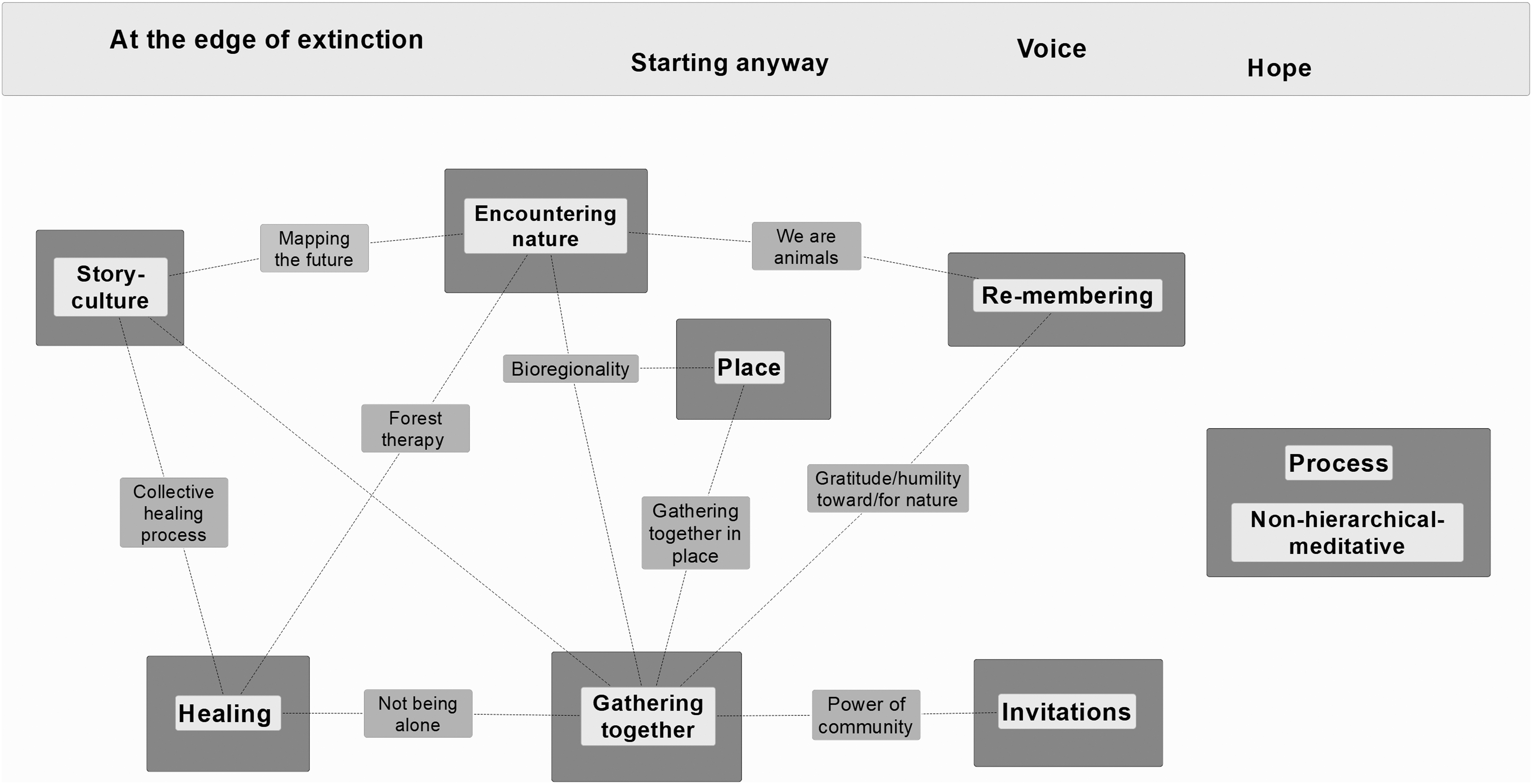
Collectively developed mind map of selected literature content as presented using Scapple, a mind mapping program.
Step 5. Free writing
This was used to more deeply explore each of the seven themes that emerged from the mind mapping exercise. The technique involves continuously writing whatever comes to mind on a topic or prompt. It is considered a form of prewriting but can also be used to explore feelings, thoughts, imagery, or related content (Elbow, 1973). We each volunteered to write about a theme.
We explored our chosen theme with a meditative, dreamlike mind. We used our “backwoods mind,” of the lone person living in the woods. We let the words/phrases associated with each theme sit together and form new meanings, like the transformation of a compost pile. We asked ourselves: What is triggered in me by this theme? We gave ourselves permission to speak, to write poetry, to draw, to find out what would emerge.
Step 6. Synthetic reflection
The individually developed pieces of writing—informed by the co-development of the shared mind map—were reviewed and summarized using a content analysis qualitative methods perspective (Elo & Kyngas, 2008; Morgan, 1993). Cross-cutting concepts were drawn out and compared back to existing topical literature. Invitations to action were identified and collated.
Cross-cutting concepts
Dis-ease
This concept weaves together ideas of disease, dissonance, disconnection, and disruption. The dis- prefix alerts us to the dissonant problems around us, stories that alienate us from nature. Disconnection calls out the dis-ease within us that needs healing: dis-stress, nature-deficit disorder (Louv, 2005). Halifax (1993) described this parallelism between inner and outer experiences as “the world wound,” a complex interrelationship between personal trauma and environmental degradation.
Disruption can provide the turmoil that catapults us into healing, creativity, and action. Bragg (2015) suggests that climate change could be an ally that moves us into the “Great Turning” (Macy & Chris, 2012) toward a more sustainable and healthful way of life. The earth needs us to face the darkness, feel the dissonance, acknowledge the disconnections, and disrupt our habitual patterns. Nature needs us to become whole. The places we love offer us respite and resilience; in return, we offer our reimagined and renewed action. We step into relationship and reciprocity.
Relationship
Our themes speak of the importance of finding ways to (re)create, tend, and fully engage in healthy relationships between our human and more-than-human world. Gatherings of families, of children, of all peoples; true comings together that reach across differences and generations (ancestral and future). We speak of interconnectedness with Mother Earth. We write of “joining forces with,” of “emergent co-created wisdom” and bringing all of our human-body/mind sensing capacities into collaboration. We imagine natural places as both home and love. This way of relationship can be characterized as friendly or kincentric rather than objectifying and dominant (Haraway, 2016; Kimmerer, 2013; Le Guin, 2017). Litfin (2012) notes that these relationships can contribute to “a deep sense of belonging—to the planet and each other” (p. 131).
Ways of being
We observe a need for cultivating a new way of being in the world that enables wellness, the creation of strong relationships, and reciprocal healing. Our themes draw attention to the relevance of slowness, humility, creativity, embodied and direct engagement, dreaming, dancing, attentiveness, open-heartedness, open-mindedness, gratitude, partnership working, staying flexible, and listening as part of this new way of being. These ways of being echo Brown's (2017) emergent strategy and are naturally suited to developing “the way of nonduality,” a perceptual dissolution of the barriers between self and others (Halifax, 1993, p. 137).
Wild wisdom
Where can we seek insight and guidance? Our themes invite us to turn to the more-than-human world. Soil teaches us about ways to steward the land. The varying traits of animals, such as multicolored bird species, and communities of plants remind us of the necessity of diversity for resilience. Natural places allow our inner and outer worlds to (re)connect. The visual and behavioral unity of a flock of birds gives imagery to how we might work together for a different future. There is an acknowledgement of sentience of the more-than-human world, a sense that there is an inherent wisdom. Kimmerer (2013) offers a clear argument for the value of listening to the wisdom of plants. We come into a living relationship; we receive the gift of ancient wisdom.
Reimagining the future
Humans and the sentient life around them need new visions of the future. Old and new stories help us experience new worlds, testing potential outcomes. Our dreams speak messages of possibility. Our bodies and the landscapes we feel connected to help us remember the past, experience the present, and seek the future in relationship. Macy and Chris (2012) call us to cultivate active hope, arguing that “knowing what we hope for and what we'd like or love, to take place” is not enough; “It is what we do with this hope that really makes the difference” (p. 4, emphasis ours). We are called to gather, despite our differences, and to contribute our novel ways of knowing. Those who never lost their connection to the earth emerge as guides toward the new resilient future that embodies health for all-that-is and the possibility of survival, flourishing, and healing.
Invitations to action
As an example of active hope, we share invitations to action, both personal and collective, that emerged from the original evocative writing generated in the free writing step (Table 1). We invite others to consider these actions that might lead to reciprocal healing and a future that is more directly sustainable for all, human and more-than-human.
Invitations to Action Emerging from the Collaborative Mind Map and Free Writing Exercise
Challenges and Opportunities for Transdisciplinary Teamwork
We need ways to make a difference in the enormously complex, global and political environmental crisis. Despair, anxiety, and helplessness are reasonable reactions as are retreating into knowledge that is known and familiar. It is of utmost urgency, however, to find ways to fruitfully integrate across boundaries (e.g., academic disciplines, policy, practice) to develop insight—and action—toward reciprocal healing of humans and the planet across multiple scales.
To address this challenge, we merged both novel and more commonly used team-building methods with an overall emergent strategy (Brown, 2017). Exploring essential literature is a common yet often unaddressed problem (Fetters & Molina-Azorin, 2017). We began with individual mind maps but quickly found that these were not satisfactory for transferring understanding to the whole team. Bibliomancy along with group processing and group mind mapping brought the textual material alive and rapidly generated a basic common level of knowledge. Establishing mutual understanding of fundamental concepts (Fetters & Molina-Azorin, 2017) began during group processing and mind mapping but was manifested more fully in the synthetic reflection step. Developing a common language (Curry et al., 2012) was supported by the group processing and mind mapping as well as the free writing and synthetic reflection. Creating a safe space for various views (Curry et al., 2012) was also facilitated by the group processing and mind mapping. The free writing step helped team members trust their own voice and the reception from other team members. The synthetic reflection step helped team members see the inherent value of their ideas.
Our methods reflected the elements of emergent strategies as described by Brown (2017). Group processing and mind mapping require mindful listening. Learning through inspiration can occur with bibliomancy, group processing, and free writing. Conversation drives the bibliomancy and two group processes. Personal revelation happens fluidly during bibliomancy, group processing, and mind mapping and is strongly at work in free writing. Individual experience figures in the group processing as each person identified resonant ideas; personal experience informed each person's free writing. Reflection carried across group processes and free writing and featured prominently in the synthetic reflection tasks. Aligning behavior and structure with vision was active across all the methods and is embodied in the invitations to action.
The approach, in toto, is intentional, relational, and adaptive; it builds the complex through small steps and embodies dignity, collective power, and generative community (Brown, 2017). Bibliomancy, group mind mapping, and free writing served as key disruptors, luring individuals with their lively novelty to go beyond their disciplinary or practice ways of knowing and doing (Curry et al., 2012). In experiencing this approach, utilizing these methods to address major issues of transdisciplinary work, individuals began to embrace an essential shared commitment to the team and to the project vision (Curry et al., 2012).
It is our hope that other transdisciplinary groups attempting to work at the complex intersection of environment and health, nature and healing, will embrace useful elements of a values-based emergent strategy and focus attention on team building to optimize their impact. The novel and established methods described here can be imported as is or modified to suit the situation and stage of team formation. The shared commitment, language, concepts, understanding, and vision garnered will more than make up for the time expended and may chart the way toward a future that is more directly healing for all—individuals, communities, and the more-than-human world.
Footnotes
Acknowledgments
All authors contributed free writing, reviewed, and edited the final manuscript. Conceptualization was undertaken by S.L.W. and K.N.I.; S.L.W., K.N.I., and B.F.Q. prepared the initial full draft of the manuscript. We thank two anonymous reviewers and the guest editors for their critique. We thank Emmylou Rahtz, Exeter Medical School, Truro, UK, for reviewing an earlier draft.
Author Disclosure Statement
No competing financial interests exist.
Funding Information
The project was supported by an award from the Institute for Integrative Health, (S.L.W., K.N.I., B.F.Q., A.L.H., & C.H.), with additional support from the Scottish Government's Rural and Environment Sciences and Analytical Services Division (K.N.I.) and Michigan Medicine Gifts of Art (E.S.).