




Abstract
Capsule Summary
Despite some hair dyes being advertised as all natural or allergen-free, patients still present with contact allergy following their use; these products likely contain cross-reactive ingredients not tested on standard series or undisclosed ingredients such as trace amounts of the allergens.
After utilizing high-performance liquid chromatography and mass spectrometry to analyze best-selling hair dyes marketed as “PPD-free,” we found that 7 of 51 hair dye products contained a compound of interest not present on the ingredient list.
Our findings reinforce the importance of considering allergy alert testing before the use of a new hair dye product in patients with a history of contact allergy, regardless of how it is commercially advertised or labeled.
INTRODUCTION
Hair dyes are among the most commonly used cosmetic products. 1 Reports suggest that more than 50% of women in the industrial world use permanent or temporary hair dyes during their lifetimes. 2 Even among men, hair coloring is not uncommon. 2 As the popularity of hair coloring has increased, so too has the worldwide prevalence of allergic contact dermatitis (ACD) to dyes. 1 The mainstay treatment of ACD is avoidance. Therefore, understanding hair dye labeling and its accuracy is imperative to how we counsel our patients on managing hair dye contact allergy.
For years, paraphenylenediamine (PPD) and other coal tar compounds in the aromatic amine family have been the primary agents used in hair dyes due to their ability to create long-lasting color in the hair shaft. Over two-thirds of hair dyes contain PPD, and it is the most frequent permanent hair dye component in North America, Europe, and East Asia.3,4 PPD is a potent contact sensitizer in hair products and a key patch test screening agent for hair dye contact allergy.5,6 In a large study examining ingredient labels of 107 different hair dyes from 10 major brands, researchers found that 99% of dyes contained at least 1 known hair dye contact allergen, and 78% contained PPD. 7
Targeting individuals with contact sensitivity, some hair dyes are advertised as allergen-free. These products often utilize plant-based colorizing ingredients such as henna, cassia, beetroot, coffee, indigo, and others. 8 Some manufacturing companies have replaced PPD with para-toluenediamine sulfate (PTDS) in permanent hair dyes in an effort to appeal to customers allergic to PPD. 9 However, many PPD-allergic patients may also react to PTDS. 9 In fact, the American Contact Dermatitis Society identified PTDS as the 2025 Allergen of the Year. 10 In our own anecdotal experience in the clinic, we have observed patients react to hair dyes despite careful avoidance of known allergenic ingredients after hair dye series testing. These observations led us to hypothesize that products marketed as “PPD-free,” “natural,” “chemical-free,” or “hypoallergenic” may still trigger contact dermatitis, suggesting that they may contain cross-reactive ingredients not tested on the hair dyes series or undisclosed ingredients such as trace amounts of the allergens in question. To address this gap, we tested best-selling hair dyes advertised as “PPD-free” for common allergens through high-performance liquid chromatography coupled to high-resolution tandem mass spectrometry (HPLC-HRMS) analysis. Of our 51 tested dyes, 5 contained PPD despite no mention of PPD on the ingredient list and 4 being labeled “PPD-free.” One of these contained PPD levels higher than 2% by weight, while the rest contained trace levels.
OBJECTIVE
We aimed to test hair dyes marketed and sold in the United States (US) as “PPD-free” for the presence of common hair dye allergens and ingredients, including p-phenylenediamine, m-aminophenol, p-aminophenol, toluene-2,5-diamine sulfate, 2-nitro-p-phenylenediamine, and 2-hydroxy-1,4-naphthoquinone (also known as henna). Given our own clinical observations and patch testing results, we suspected that several of these hair dyes may contain 1 or more of these ingredients and contribute to ACD. Through analytical chemistry, our study sought to assess for the presence of and quantify these phenolics in commonly used hair dyes. The results of this study aimed to help guide dermatologists in counseling patients with ACD about the importance of performing allergy alert testing. This counseling may include the deployment of the patient-administered tests before the use of hair dye products regardless of how they are commercially advertised or labeled.
METHODS
Hair Dye Selection
The term “PPD-free hair dye” was used to search Amazon, Target, and Walmart, in that order. The list of search results was then sorted by “Best Sellers” (top number sold). The online ingredient list for each of these “PPD-free hair dyes” was reviewed to ensure that PPD was not listed.
Selection of hair dyes involved a multi-factor authentication that included the following criteria: the online advertisement indicated the absence of PPD or other phenolics; the packaging matched the online description upon receipt of the product; the box containing the ingredients corroborated the ingredients listed online; the box ingredients corroborated the box label and online claim; the product was not expired; the product was intended for distribution in the US; the product label described the need for performing an allergy alert test; and the instructions for the allergy alert test were recorded. Hair dyes were excluded if they were not for brown or black coloring, if they were listed as “semi-permanent” or “temporary,” or if the label was written in a non-English language.
Duplicate products that showed up as a best seller at more than 1 retailer were recorded. We switched to the next site (i.e., from Amazon to Target, or from Target to Walmart) once we started to encounter repeat hair dyes of brands we already included or once there were 3 or more hair dyes in a row with PPD in the ingredient list. We also selected a small group of dyes labeled as including at least 1 of the 6 chemicals of interest for validation purposes.
High-Performance Liquid Chromatography and Mass Spectrometry
We performed HPLC coupled to mass spectrometry (MS) to determine whether p-phenylenediamine, m-aminophenol, p-aminophenol, toluene-2,5-diamine sulfate, 2-nitro-p-phenylenediamine, and 2-hydroxy-1,4-naphthoquinone were present in each sample. Samples were analyzed with a custom liquid chromatography-MS (LC-MS) assay to detect hair dye component targets (see Supplementary Data). Samples were run in 2 batches. Standard curve interpolation calculations were performed using Prism GraphPad Version 9.5.0. The percent target per starting material number was then calculated using the interpolated values.
To verify our results, we retested all 7 products for which we detected a compound that was not present on the ingredient list. For each of these products, we tested both the old, previously opened package (open for approximately 190 days) as well as a newly purchased, unopened package (14 total samples). These samples were analyzed using the same custom LC-MS assay, dilutions, and standard curve interpolation calculations.
RESULTS
A total of 51 unique hair dye products were selected for this study; 12 of these dyes were specifically selected to contain the tested substances for validation. Packages contained multiple products: colorant, color developer, shampoo, conditioner, barrier cream, and color-protecting mask. We limited our analysis to only the colorants and color developers. For hair dye use, the colorant is mixed with the developer before head application, leading to dilution of the on-head dye. However, the target compound concentrations detected in our study reflect the concentrations in the individual colorants and color developers (not the mixture). Of note, we identified minor discrepancies between the ingredient lists on the packaging and website for 2 of the 51 hair dye products. In these 2 cases (sample #30 and #48), we deferred to the product label.
Overall, we detected at least 1 of our targets in 27 of 51 products after background threshold correction (Table 1). For 7 products, we detected a compound of interest that was not present on the product’s ingredient list (Table 1). Specifically, for PPD, we identified 5 products for which PPD was detected but not reported on the packaging. Of these 5 products, 1 was actually above the upper limit of quantification (ULOQ), defined as 10 μM or 2% PPD by weight, and 3 products showed PPD detection that was below the lower limit of quantification (LLOQ), defined as 30 nM or 0.01% by weight for Samples 1–35 (Batch 1) and 100 nM or 0.02% by weight for Samples 36–67 (Batch 2). One product contained PPD at 31.72 nM or 0.01% by weight. Of note, we detected PPD at a concentration above the ULOQ, defined as 10 μM or 2% by weight, for 1 additional hair dye, but PPD was listed on the label for this product. For p-aminophenol, we identified 2 products for which the compound was detected but not reported on the ingredient list. Both of these were below the LLOQ, defined as 1 μM or 0.2% by weight for that batch. For 2-nitro-1,4-paraphenylenediamine, there was only 1 product for which the compound was detected but not listed on the packaging, and this was at 2021.77 nM or 0.57% by weight. Finally, for 2-hydroxy-1,4-naphthoquinone, there was also only 1 product for which the compound was present in the sample but not included on the ingredient list, and this was at 303.11 nM or 0.1% by weight. There were 5 products for which compounds were not detected despite being listed on the label. In 2 of these cases, PPD was included on the ingredient label but not present in the sample based on HPLC and MS.
Detection of Target Compounds in 51 Unique Hair Dye Products (39 Products Advertised as “PPD-Free”)
PPD, paraphenylenediamine; m-A-phenol, m-aminophenol; p-A-phenol, p-aminophenol; 2,5-DTS, toluene-2,5-diamine sulfate; 2-N-1,4-PPD, 2-nitro-p-phenylenediamine; Henna, 2-hydroxy-1,4-naphthoquinone.
Given these results, we performed an independent validation analysis in which we retested all products with target compounds detected but not listed on the label (n = 7) (Table 2). Upon retest of the newly purchased, unopened versions of the dyes, we redetected the ingredients in 4 of 7 products (57%). However, upon retesting the original, previously opened versions of the dyes, we redetected the ingredients in only 3 of 7 products (43%), suggesting that the material may have been degraded by oxidation into other molecular species that were not targeted in these assays due to the lack of available standards. For PPD specifically, we redetected this target in 4 of 5 newly purchased versions of the previously identified products.
Detection of Target Compounds in 7 Retested Hair Dye Products (Red Indicates Present in Sample but Not on Product’s Ingredient List; Green Indicates Present in Sample and on Product’s Ingredient List)
Run 1: initial HPLC-MS analysis on freshly opened hair dye. Run 2 (Old): subsequent HPLC-MS analysis on previously opened hair dye (open for ∼190 days). Run 2 (New): subsequent HPLC-MS analysis on second, newly purchased, freshly opened hair dye.
PPD, paraphenylenediamine; m-A-phenol, m-aminophenol; p-A-phenol, p-aminophenol; 2,5-DTS, toluene-2,5-diamine sulfate; 2-N-1,4-PPD, 2-nitro-p-phenylenediamine; Henna, 2-hydroxy-1,4-naphthoquinone.
DISCUSSION
Hair dyes represent a significant source of consumer exposure to allergens. A retrospective analysis conducted by the North American Contact Dermatitis Group found that hair dyes are the most frequently identified source of PPD contact dermatitis reactions. 11 In another survey of cosmetic formulations, PPD was most commonly found in hair coloring products. 12 PPD is the most common cause of hair dye contact dermatitis and can elicit severe reactions in many patients. 6 Therefore, understanding cryptic sources of PPD in hair products is critical to how we counsel patients and help them identify potential allergen sources. In our study, we detected PPD in several dyes that did not report this ingredient on the packaging—at least 1 at a concentration possibly able to trigger a reaction in a PPD-sensitive patient and 4 others at levels of unknown clinical significance. We redetected PPD in newly purchased versions of 4 of 5 of these products, indicating the sensitivity and rigor of our detection methods. These findings may explain, in part, why patients who use “PPD-free” products may still experience reactions despite attempts at PPD avoidance.
We detected a range of PPD concentrations across different hair dyes. Prior work has attempted to determine the upper and lower PPD concentration limits that carry clinical significance for the consumer. Marzulli and Maibach performed a human repeat insult patch test on PPD concentrations of 0.01%, 0.1%, and 1% and found that 7%, 11%, and 53%, respectively, of participants were sensitized to PPD following the induction period. 13 Ezendam et al. extrapolated on this data and animal data to conclude that concentrations lower than 0.00034% to 0.34% of PPD by weight in hair dyes are expected to be “safe,” or, in other words, a level at which no skin sensitization (newly emergent allergy) is expected to occur. 14 Another study found that hair dyes with PPD concentrations of 0.67% or less were not expected to cause skin sensitization induction. 4 According to the Cosmetic Ingredient Review (CIR) guidelines, the recommended maximum concentration of PPD range is 0.98–3% in hair dyes, with a maximum on-head concentration after dilution of 1% by weight. 12 Dyes are mixed with oxidizer and, therefore, diluted prior to head application. In our study, a total of 4 hair dyes contained PPD concentrations well above 0.67%, two of which were greater than 2%, indicating that some products advertised as “PPD-free” contain potentially “unsafe” and likely sensitizing PPD levels. Depending on the volume of oxidizer mixed with these dyes, the final on-head concentration may or may not exceed the 1% PPD limit. The other dyes contained PPD at or below 0.01%. These levels are unlikely to be sensitizing and are well below the CIR limit, although it remains unclear whether such low levels can elicit dermatitis in a sensitized individual. The threshold of sensitization may be much higher than the threshold of elicitation once an individual is already sensitized.
Detection of PPD by HPLC can be limited by loss of the original compound from the tested mixture due to oxidation of PPD upon exposure to air. PPD oxidizes on and in the skin, changing from white to the desired brown or darker dye color. 15 These oxidation products are thought to be required for the induction of ACD. 6 In fact, PPD oxidation products have been found to more potently stimulate an inflammatory response than PPD itself. 16 In our repeat HPLC run of the old, previously opened dyes, we did not redetect PPD in over half of the products, likely because PPD was consumed through oxidation following 190 days of exposure to air. The lack of PPD detection was not likely due to inaccuracies of our methodology in these previously opened dyes, as we redetected PPD in newly opened versions of 4 of the 5 dyes. This finding is important for future studies on PPD in hair dyes, as it indicates that dyes exposed to air for prolonged periods of time may yield inaccurate results.
Although there have been several prior studies investigating PPD and other allergenic hair dye ingredients causing ACD, the literature is limited when considering the presence of these common allergens in hair dyes advertised as “PPD-free.” One such study from 2016 evaluated the safety of 15 commercial hair dye products in 23 patients with ACD to PPD. 17 The authors performed patch tests using these 15 hair dyes, which were advertised as “hypoallergenic,” “no para-phenylenediamine,” and “non-allergenic.” They found that 87% of patients had a positive patch test reaction to at least 1 product. Through inference of patch testing results and/or reviewing ingredients with manufacturers, the authors found that despite the product labels, 26.7% of the hair dyes likely contained PPD after accounting for the cross-reactivity of PPD to other substituted phenolics. Our study corroborates these findings that despite products being labeled as “PPD-free,” 10.3% (4/39) of these dyes contained PPD. These collective results undermine the accuracy of product marketing/labeling and reinforce the need for more comprehensive chemical testing of such products before they are recommended to patients. Of note, the presence of PPD in these hair dyes does not necessarily suggest deliberate clandestine use by product manufacturers. The source of unreported PPD in these products is unknown, and this study cannot be used to determine the source or intention behind the presence of these dye molecules in the products. Trace levels of PPD and other contaminants could arise from incompletely cleaned manufacturing equipment used for different product lines, or they could be intentional additives to boost the performance of primarily natural dyes.
Beyond PPD, other aromatic dyes are known to elicit contact dermatitis and/or cross-react with PPD. A study on contact allergy to common ingredients in hair dyes found that 4.5% of patients reacted to PPD, 2.8% reacted to toluene-2,5-diamine sulfate, 1.8% reacted to p-aminophenol, and 1% reacted to m-aminophenol, indicating that other phenolics, in addition to PPD, can be strong contact sensitizers. 18 Another study specifically examined PPD cross-reactivity and found that toluene-2,5-diamine sulfate, 5-(4-nitrophenyl)-2,4-pentadienal, m-aminophenol, and p-aminophenol are hair dye allergens with significant cross-reactivity to PPD. 19 In fact, Vogel et al. showed that 85.7% of PPD-sensitized individuals also reacted to toluene-2,5-diamine sulfate, which is widely used by companies as a substitute for PPD in hair dyes. 20 Due to the similar molecular structure, PPD-sensitized patients can produce an allergic reaction to these other aromatic amines without prior exposure. In our experiment, we detected p-aminophenol and 2-nitro-p-phenylenediamine in several hair dyes despite the absence of these ingredients on the product label, which may elicit dermatitis in PPD-sensitized individuals. Given the considerable risk of ACD due to cross-reactions, it is important for patients to be aware of the presence of these related chemicals. Even if PPD-positive patients ultimately patch test negative to the available testing allergens for other aromatic amines, continued reactions to hair dye may necessitate empirical avoidance of these cross-reactors. It is also important to note the potential for “compound” contact allergens, whereby a chemical reaction between 2 separate ingredients can yield a new sensitizing ingredient not listed on the label.
Limitations
Limitations include the relatively small number of hair dye products tested (51 products). Additionally, for 2 of the hair dyes, there were minor discrepancies between the ingredient list on the product packaging and the online information. We also acknowledge that the original samples were run in 2 separate batches, leading to slightly different sensitivities and quantification limits. Finally, the dyes were exposed to room air for under 2 minutes and then stored in sterile capped tubes for about 1 hour between aliquoting and testing. This likely allowed for oxidation of chemical components, leading to potentially lower levels of the target product detected.
CONCLUSIONS
Hair dye use is a prevalent and rising cause of ACD. Despite product labeling and marketing, hair dyes may still contain common contact allergens and potent sensitizers such as PPD and other phenolics. Our study found that of 51 tested hair dye products, 5 contained PPD even though this compound was not included on the ingredient list, and 4 were marketed as “PPD-free.” The results of this study will assist dermatologists in counseling patients with ACD about the value of the allergy alert test (Figure 1) before introducing new hair dye products, regardless of the claims or ingredients on the label.
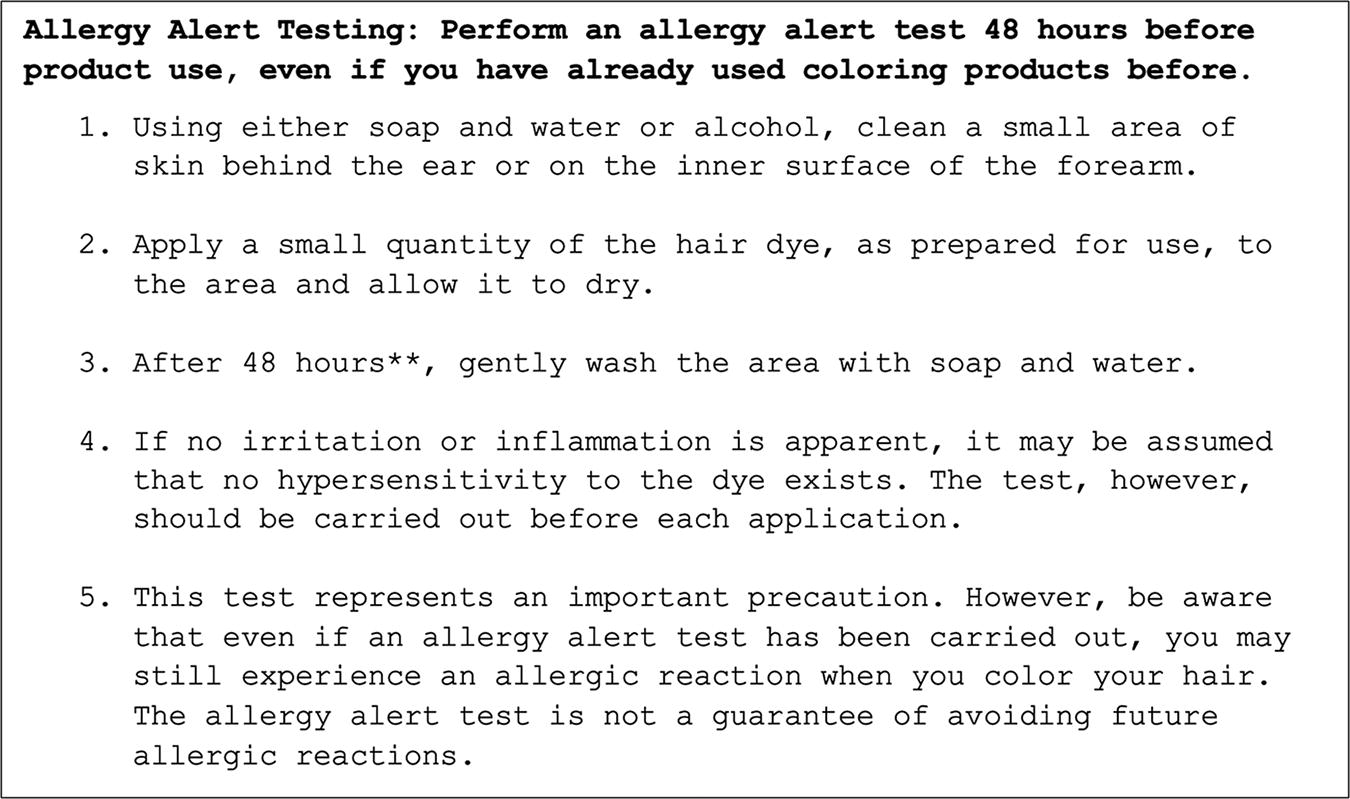
Allergy alert testing protocol 21 *. *While the allergy alert testing protocols included on the product packaging were generally consistent across the different hair dyes, variability does exist. The 2 main protocol components that varied were the exact time to leave on the product prior to rinsing (24 hours versus 48 hours) and the specific anatomical location to perform the test (behind the ear, inner surface of forearm, or bend of elbow). **In the cited protocol, the hair-coloring products were washed off after 45 minutes due to concerns about an increased risk of sensitization with a longer application period. However, most protocols for consumer self-testing (as listed on hair dye product packaging and inserts) recommend a 24–48-hour application period, as described in Figure 1.

References
Supplementary Material
Please find the following supplemental material available below.
For Open Access articles published under a Creative Commons License, all supplemental material carries the same license as the article it is associated with.
For non-Open Access articles published, all supplemental material carries a non-exclusive license, and permission requests for re-use of supplemental material or any part of supplemental material shall be sent directly to the copyright owner as specified in the copyright notice associated with the article.
