






Abstract
PRECIS
This report details a case of ACD resulting from exposure to chromium in the clasp of an Apple Watch band.
DISCUSSION
A 21-year-old female came to our clinic for a metal allergy test recommended by her orthodontist before undergoing further orthodontic treatment. She had previously undergone orthodontic treatment during her primary school years, which led to the development of eczema throughout her body. Subsequently, a patch test at a dermatology clinic confirmed a metal allergy. She managed her symptoms with Fexofenadine, an antihistamine medication, during the remainder of her orthodontic treatment. After completing the treatment, her eczema resolved, eliminating the need for further medication. Aware of her metal allergy, she became cautious about wearing metal accessories. In addition, she did not have atopic dermatitis at the time. Her orthodontist recommended a comprehensive metal allergy test at our clinic prior to any additional orthodontic procedures to prevent similar allergic reactions.
The patch test was executed (Patch Test ReagentsTM, Torii Pharmaceutical Corporation, Tokyo, Japan, allergEAZE
The patient was aware of her metal allergy and had been wearing the watch over her clothes, so she had not experienced any skin problems from it. After purchasing an Apple Watch SE and wearing it directly on her skin (Fig. 1A), she developed vesicular dermatitis beneath the watch clasp within a few days (Fig. 1B), prompting her to cease using the watch immediately. The band was the original Apple Watch band, not an add-on component or replacement band. The watch case was made of aluminum, and the back was made of ceramic. Although she had a positive reaction to aluminum in the patch test, no skin changes were observed in the case contact area (Fig. 1C). The band was made of fluor elastomer and included a metal clasp. However, the presence of any metal parts in the band was not mentioned by the manufacturers in the manual. Analysis of the metal parts using an Energy Dispersive X-ray Fluorescence Spectrometer (EDX7000, Shimadzu, Kyoto, Japan) revealed a composition of 62.9% iron, 17.2% chromium, 14.0% nickel, and 2.5% molybdenum, suggesting 18–12-Mo stainless steel (Fig. 1D). This analysis was pivotal in pinpointing chromium as the likely allergen responsible for the patient’s ACD.
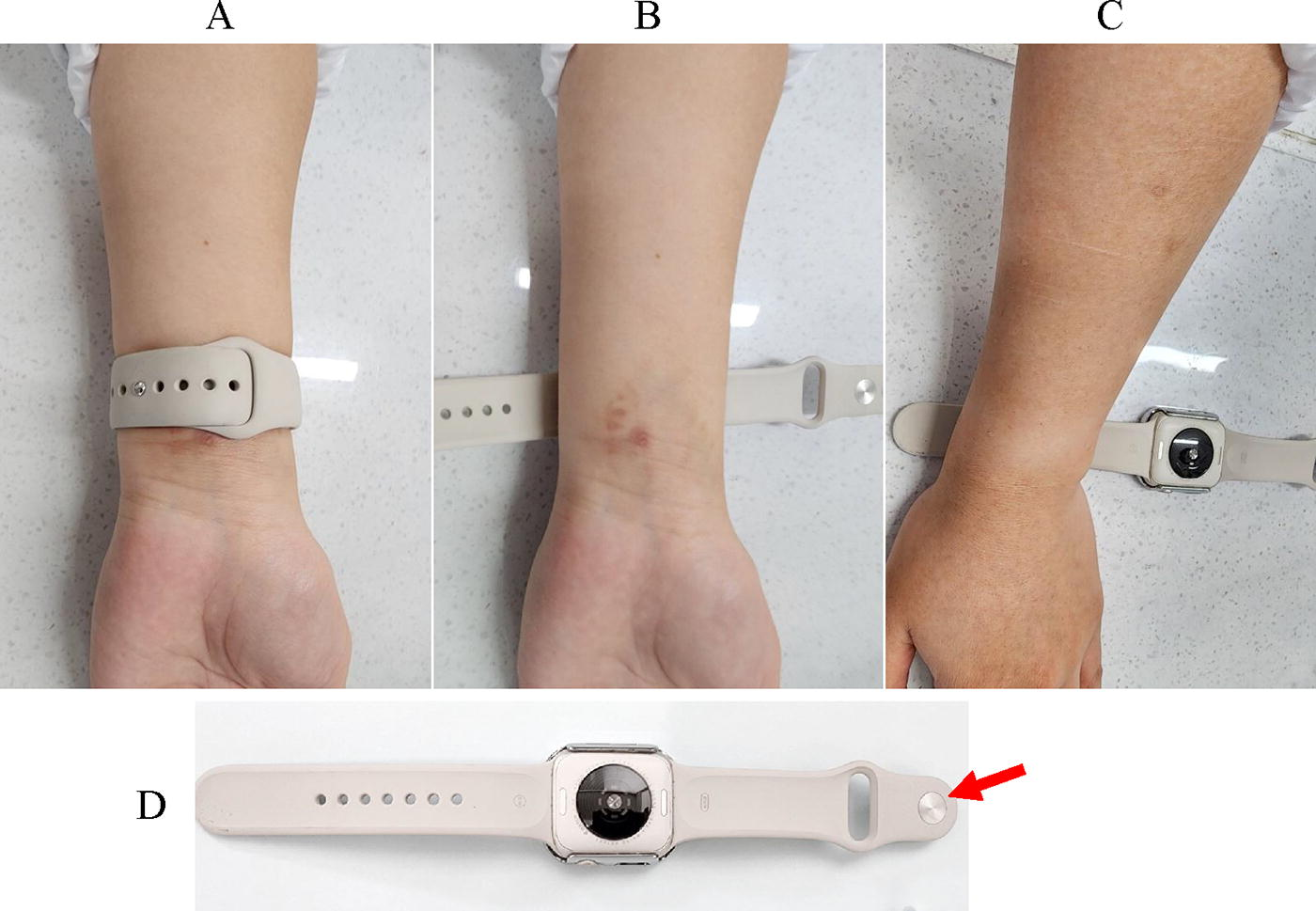
Clinical images. (A). Apple watch on the wrist. (B). Vesicular dermatitis on the area under the watch clasp (patient has already stopped using the watch and is on a healing trend). (C). No allergic symptoms in the area in contact with the watch itself. (D). Apple Watch. The arrow indicates the affected clasp area.
Only two cases of ACD related to Apple Watches2,3 have been reported, with both incidents linked to the nickel content of the device’s case. This case posits that chromium exposure was the catalyst for the ACD episode. The patient had previously used a cobalt–chromium alloy orthodontic appliance and may have been pre-sensitized to chromium. She was aware of her metal sensitivity and was careful about wearing jewelry. However, she occasionally experienced skin problems when wearing piercings. Therefore, we analyzed these earrings using energy-dispersive X-ray spectrometry and found that most of the posts were titanium alloy, and some of the clasps that came into contact with the skin contained chromium and palladium. These elements were positive elements. It is possible that exposure to these metals through the earrings might have contributed to her sensitization.
It is important to note that smartwatches, including the Apple Watch, are designed to be worn in direct contact with the skin, even during activities that involve sweating. This is significant because sweat contains not only water but also salt and organic acids, which can accelerate the corrosion and oxidation of metals. When these components come into contact with metal, especially in an environment where metals are prone to oxidation, they accelerate the corrosion and oxidation of the metal and make it easier for metal ions to be released. While manufacturers provide allergy warnings in their manuals, 4 they do not specify the materials used in band clasps. Therefore, it is crucial to not only mention the materials of the watch body but also those of the band. This case underscores the importance for individuals with metal allergies to be vigilant not only about nickel but also with other metals like chromium, 5 which may pose additional risks.
Pearl OR ZEBRA
This case demonstrates that ACD can arise from various metals, necessitating comprehensive allergen labeling on all device components.
