






Abstract
The present study aims to bridge the gap regarding the potential influence of problem gaming on problem gambling (PG) by examining the potential indirect effect of risky loot box use in this relationship. We also aim to examine these relationships in an understudied cultural context, that is, Eastern European, thus enlarging the current geographical scope of the research on problematic gaming and gambling. The research was conducted on a sample of 703 Romanians (56.5 percent male, 43.5 percent female), aged between 18 and 46 (M = 23.07; SD = 5.24), who play video games frequently. They completed instruments measuring problem gaming, online PG, and purchasing loot boxes risk. Our findings also indicate that risky engagement with loot box mechanism had a significant indirect effect on the association between the two types of problematic behavior (i.e., gaming and gambling). This suggests that excessive involvement in online gaming is linked with an increased propensity for problematic use of loot boxes, and further with a higher risk of PG. Our results indicate that higher involvement in video gaming may be associated with higher levels of risky engagement, which could plausibly lead to a greater likelihood of purchasing them and this more problematic relationship with loot boxes further increases the risk of PG. Our study contributes to advancing knowledge about these constructs while suggesting the negative impact of loot boxes in that their acquisition is related to higher involvement in online gambling.
Introduction
Problem gambling (PG) represents one of the primary concerns in contemporary society due to the negative consequences it can entail across various domains, 1 including negative outcomes for individuals, families, and broader societal well-being.2–4 Involvement in gambling, defined as the number of different formats in which an individual participates in gambling, 5 is linked with PG or gambling disorder.2,6–9 Several significant risk factors for the development of PG have been identified in the literature, such as being male, 10 lower socioeconomic status, 11 early gambling onset, 12 extraversion, 13 impulsivity, 14 or sensation seeking. 15
Recent literature suggests that video gaming may also be a risk factor for the development of PG. Excessive involvement in video gaming is a symptom of problem gaming or “Internet Gaming Disorder (IGD),” which was officially recognized as a condition warranting further study in the “Diagnostic and Statistical Manual of Mental Disorders, 5th edition” 16 and included in the International Classification of Diseases, 11th edition. 17 Associations between gaming and gambling have been found by past research,18,19 and there is also longitudinal evidence that problem video gaming is a risk factor for later PG.20,21 This may be due to games with financial stakes and outcomes being often enticed by advertisements and game-related incentives, and to the significant growth of gambling, both official and informal, in e-sports.22,23 Besides this increased exposure of potentially enticing gambling opportunities within video games, there are several similarities between the two types of behaviors. 24 The most evident are specific features highly resembling those found in gambling that have been incorporated into video games, such as increased financial expenditures required to remain competitive.25,26 These include loot boxes, which typically encompass a range of digital items, purchasable either with in-game virtual currency or actual currency.27,28
Digital items purchased through loot boxes have randomized incentives, including a significant element of chance.29–31 Furthermore, purchasing or opening a loot box is often paired with audio-visual effects that enhance anticipation and reception of rewards 32 in ways highly similar to various aspects of gambling games, such as slot machines. 33 Therefore, loot boxes have been described as a gambling-like feature.29,31,34,35 Furthermore, past research suggests that they may serve as an introduction to conventional gambling33,36 and a gateway to PG,24,29 as various studies found a correlation between engagement in loot boxes, viewed as spending, and symptoms of PG.37–41 However, at present, studies on loot boxes and PG are limited and predominantly conducted in Western European countries or in the United States. Therefore, further research into these phenomena in other cultural contexts is warranted.
The present study, based on previous findings and theories of problem gaming, PG, and loot boxes,24,30,31,40–43 aims to bridge the gap regarding the potential influence of problem gaming on PG by examining the potential indirect effect of risky loot box use in this relationship. This indirect effect can be explained and supported by several psychological and behavioral mechanisms, such as (a) loot boxes incorporating features similar to gambling, like randomized rewards,29,31 which create an environment that mimics gambling behavior and introduces gamers to the concept of uncertain outcomes, a key aspect of gambling; or (b) loot boxes activating reinforcement mechanisms, where unpredictable rewards heighten arousal and encourage repeated behavior, similar to slot machines. 35 Also, as past findings suggest, higher involvement in video gaming may increase the odds of purchasing loot boxes to profit from the in-game advantages that they offer.41,42 Furthermore, purchasing loot boxes may facilitate the transition from this in-game behavior to engaging in gambling activities.44,45 These findings substantiate our hypothesis that risky engagement with loot boxes has an indirect effect on the association between problem gaming and PG. We also aim to examine these relationships in an understudied cultural context, that is, Eastern European, thus enlarging the current geographical scope of the research on problematic gaming and gambling.
Method
Participants and procedure
This research involved 703 Romanian participants aged between 18 and 46 (M = 23.07; SD = 5.24; 56.6 percent males) who play video games regularly. Most participants reported participation in gambling activities (57.3 percent). The majority of participants were male (56.6 percent), urban residents (65.1 percent), and currently pursuing a bachelor’s degree (49.5). Detailed participant characteristics can be observed in Table 1.
The Characteristics of the Participants
An online survey was distributed in various groups dedicated exclusively to individuals passionate about video games on social media platforms (Facebook and Reddit). Before providing responses to our survey, participants were instructed to read the informed consent, which included information about data confidentiality and the ability to withdraw from the study at any time without any consequences. Participation was entirely voluntary. The inclusion criteria for the study were age (above 18 years) and involvement in video gaming. The research design and materials were approved by the Ethics Committee of the Faculty to which the authors are affiliated (No. 1735/November 2023).
Measures
Problem gaming was measured using the Internet Gaming Disorder Scale. 46 This scale assesses the severity of IGD and its negative effects, considering both online and/or offline gaming activities occurring over a period of 12 months (e.g., “Do you systematically fail when trying to control or cease your gaming activity?”). Participants responded to the nine items using a 5-point response scale from 1 (never) to 5 (very often). Scores were obtained by summing the participants’ responses. The primary aim of the questionnaire is not to diagnose but to assess the severity and associated negative effects. Thus, higher scores obtained on this instrument indicate greater levels of gaming-related disturbance. In our study, Cronbach’s alpha = 0.90, indicating excellent reliability. 47
Online PG was measured using the “Online Problem Gambling Behavior Index” (OPGBI). 48 The 12 items of the OPGBI target specific behavioral indicators of involvement in gambling activities, such as setting limits on betting accounts, player communication with betting operators, and gambling-related behavior, on a 4-point response scale from 0 (never) to 3 (almost every time) (e.g., “Do you increase your stakes the following day after you have lost in an online gambling session?”). Total scores can range from 0 to 36, with higher scores indicating a high level of online PG. The advantage of this instrument lies in its ability to provide an objective assessment of problematic involvement in gambling activities. In our study, Cronbach’s alpha = 0.93, indicating excellent reliability. 47
Purchasing loot boxes’ risk was measured with the 5-item “Risky Loot Boxes Index” (RLI). 33 RLI evaluates an individual’s propensity for risky use of loot boxes on a 5-point Likert Scale from 1 (strongly disagree) to 5 (strongly agree) (e.g., “The thrill of opening Loot Boxes has encouraged me to buy more.”). A higher score indicates a higher risk of purchasing loot boxes. In our study, Cronbach’s alpha = 0.91, indicating excellent reliability. 47
Socio-demographic data. Participants also reported their age, gender, current residence (urban or rural), education level, marital status, and involvement in gambling activities.
Overview of the Statistical Analysis
After the preliminary analysis, we examined the associations between the main variables of the study using Pearson correlations. Then, we tested the indirect effect of purchasing loot boxes’ risk on the relationship between problem gaming and online PG, by performing bootstrapping with 5,000 bootstrapped samples and a 95% bias-corrected confidence interval (CI) using the PROCESS macro for SPSS.
Results
Preliminary data analyses
We computed the Skewness and Kurtosis values to assess the normality of the distributions (see Table 2). All the Skewness values were within the 2/−2 limit and Kurtosis values were within 7/−7, indicating normality. 49
Descriptive Statistics and Associations Among the Main Variables
p < 0.001.
The results of the independent samples t test showed that there are significant gender differences in online PG (t[684.75] = 5.15; p < 0.001), with males (M = 4.38) presenting higher scores than female participants (M = 2.05).
The association between main variables
The results of Pearson correlation analysis (see Table 2) suggested that there are significant positive associations between the main variables—problem gaming, purchasing loot boxes’ risk, and online PG.
Testing the indirect effect
We used the PROCESS macro in SPSS 26—Model 4, with a 95%CI and 5,000 bootstrapped samples 50 to investigate the potential indirect effect of purchasing loot boxes’ risk on the relationship between problem gaming and online PG, controlling for age and gender (see Figure 1). The results suggest that the total effect of problem gaming on online PG was significant, b = 0.40; SE = 0.02; p < 0.001; 95% CI [0.35; 0.45]. The direct effect was significant, b = 0.27; SE = 0.03; p < 0.001; 95% CI [0.21; 0.33]. Moreover, purchasing loot boxes’ risk had a significant indirect effect on the relationship between problem gaming and online PG, b = 0.12; SE = 0.02; 95% CI [0.07; 0.18].
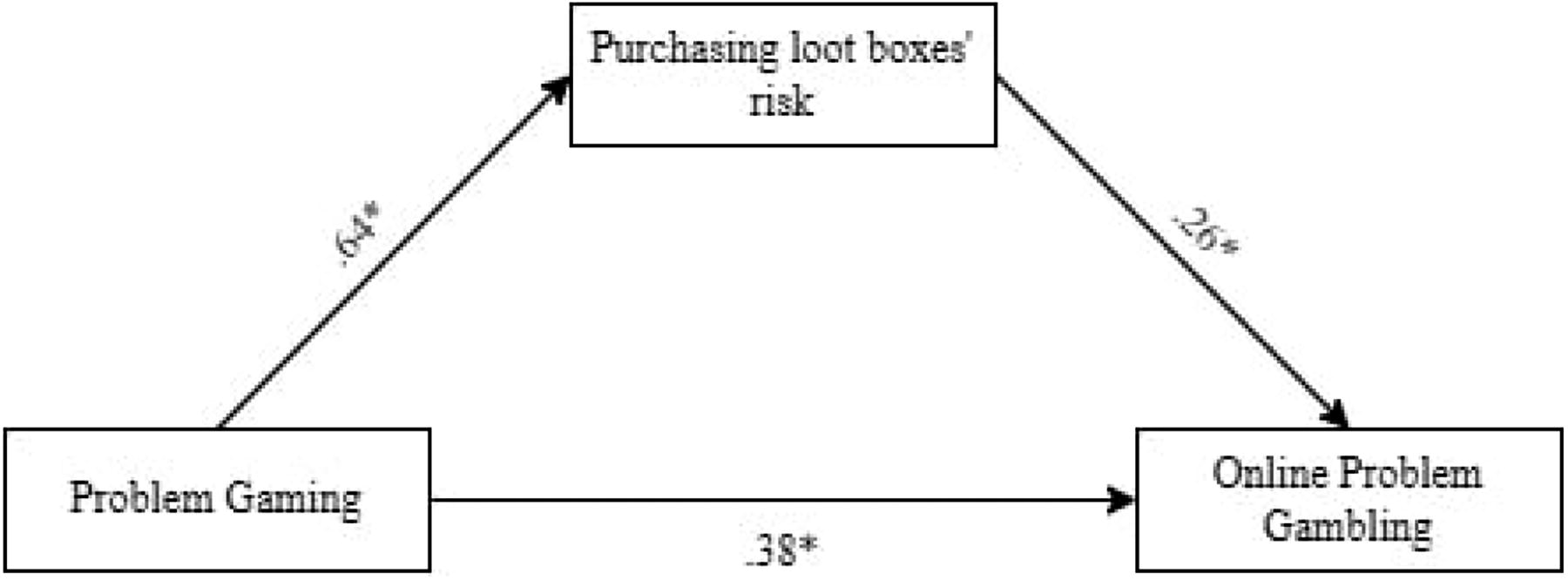
The mediating role of purchasing loot boxes’ risk on the relationship between problem gaming and online problem gambling. Note: *p < 0.001. The coefficients represented are standardized coefficients.
Discussions
The present study found a positive association between problem gaming and online PG, consistent with previous results.18,19 As previously suggested, this association may stem from the fact that both behaviors share several risk factors, such as male gender, 10 maladaptive coping strategies, 51 or life stress. 52 Moreover, problem gaming and online PG have important similarities, especially since game developers have started to introduce gambling-like mechanism within their games. 35
Our findings also indicate that risky engagement with loot box mechanism had a significant indirect association with the two types of problematic behavior. This suggests that excessive involvement in online gaming is linked with an increased propensity for problematic use of loot boxes, and further with a higher risk of PG. First, past results highlighted that individuals who are more involved in gaming are more likely to purchase loot boxes.41,42 Our results suggest that higher involvement in video gaming may increase susceptibility to risky engagement with loot boxes, potentially leading to a greater likelihood of purchasing them while gaming.
Secondly, this more problematic relationship with loot boxes is associated with increased risk of PG. This may be due to the fact that loot boxes entail a system of virtual or actual currency,27,28 which can mimic reality and, in certain cases, may normalize this gambling-like experience. As loot boxes offer random rewards, purchasing them entails taking the risk of receiving an item far below its price. Consequently, the individual may develop a greater tolerance for risks in general (e.g., for those involved in gambling) with each subsequent purchase. Moreover, loot boxes can generate associations between the risk that the player takes and the potential rewards received from that item, similar to the risk-rewards association created in the case of slot machine gambling, for example.53,54
These findings add to the past research on the relationships between gaming, loot box use, and gambling by providing evidence from an understudied cultural context (i.e., the Eastern European one) for the risk of gambling problems associated with purchasing loot boxes within video games.24,45,55 Our study indicates that problematic use of loot boxes may have an indirect association with the relationship between problem gaming and PG, in addition to this potential situation and the connection between gaming involvement and loot box purchases, which have both been the subject of previous investigations. This suggests that individuals who spend time and money on video games may be more susceptible to developing gambling problems, particularly when exposed to loot boxes. However, given that the present work did not test excessive spending, we can only hypothesize this for now. This aspect could be considered in future studies.
There are several limitations to our research, such as its correlational design, which prevents concluding on causal effects, and the exclusive use of self-report measurements. Thus, it is necessary to acknowledge the cross-sectional nature of the data, which limits the ability to draw causal conclusions. In this regard, longitudinal studies are needed to clarify the directionality and causality of these relationships and to better understand how problem gaming and gambling may interact over time. Additionally, our study focused exclusively on online PG. Future studies may investigate participation in gambling activities both online and offline, as well as a more fine-grained differentiation of the specific gambling activities in which people engage (e.g., sports betting, electronic slot machine games, and lottery) in relation to the specific type of video games individuals engage with (e.g., shooter games, and adventure games). Furthermore, considering that the RLI does not account for the monetary amounts spent on loot boxes, future studies may include a measurement of this aspect as well.
In sum, this study found that the problematic use of loot boxes has an indirect effect on the relationship between excessive involvement in online gaming and PG. This pattern of associations highlights the danger that problem gaming poses in terms of the development of PG symptoms, as well as the role of risky engagement with loot boxes in this relation, which emphasizes the need for further research and regulation to address the potential harm associated with these gaming practices. Additionally, another strength of this article is the novel utilization of the RLI 33 as a mediator, because the optimal use of this measure has not been fully established since its introduction. On another note, professionals in gambling prevention should emphasize that excessive online gaming and loot box purchases may have a negative impact in terms of increasing the likelihood of experiencing gambling problems.
Footnotes
Authors’ Contributions
A.H., A.C.H., and T.-D.H. contributed equally to conceptualization, methodology, formal analysis, supervision, writing—original draft, and writing—review, editing, and data curation.
Ethics Statement
This study’s protocol was designed in concordance with ethical requirements specific to the Faculty of Psychology and Educational Sciences, Alexandru Ioan Cuza University (Iași, Romania), before beginning the study and supervised by A.H. All participants voluntarily participated in the study and gave written informed consent following the Declaration of Helsinki and the national laws from Romania regarding ethical conduct in scientific research, technological development, and innovation. No animal studies are presented in this article.
Ethical Approval
The study was approved by the Ethics Committee of the Faculty of Psychology and Educational Sciences, “Alexandru Ioan Cuza” University, Iași, Romania, Approval No. 1735/November 2023, before beginning the study and supervised by A.H.
Data Availability
Data will be made available on request.
Author Disclosure Statement
The authors declare that they have no known competing financial interests or personal relationships that could have influenced the work reported in this article. The authors declare no financial interests/personal relationships, which may be considered as potential competing interests.
Funding Information
No funding was received for this article.