






Abstract
Immersive virtual reality (IVR) technology provides several educational affordances that make it a valuable tool for learning, especially from a constructivist learning perspective. Combined with the increasing availability of Metaverse social platforms, such as ENGAGE and AltSpace VR, where students and teachers can meet and work together, IVR may transform how students learn and interact with educational content. However, little is known about students' attitudes toward IVR in education. To address this gap, we surveyed 329 undergraduate students from different universities in Italy. We used the Unified Theory of Acceptance and Use of Technology (UTAUT) to predict students' intention to adopt IVR for learning. We further explored the role that different individual factors, including students' learning styles, affordances perceptions, and personal innovativeness, have on their attitudes toward IVR. A hierarchical multiple regression analysis revealed that the four constructs of the UTAUT, namely performance expectancy, effort expectancy, social influence, and facilitating conditions were the strongest predictors of students' intention to use IVR in education and that individual factors only had little impact on it. Based on these results, this study provides helpful indications for researchers and educators who wish to introduce IVR effectively in educational contexts. Given the new possibilities provided by Metaverse applications based on IVR technology for learning, it is indeed crucial to fully understand the attitudes different stakeholders in education have toward adopting this technology in educational contexts.
Introduction
Since Mark Zuckerberg,
The Metaverse is considered a virtual environment that overlaps or replaces the surrounding physical world, and that different people can share. Today, several technologies, including virtual reality (VR), augmented reality, and mixed reality, can be used to enable users to experience such a virtual environment. 1 These technologies offer different virtual experiences depending on whether they augment or simulate reality and focus on users' inner or external worlds. 2 Recognizing that learning in the Metaverse extends beyond mere immersion in a digital environment, as it encourages social interactions and the exploration of diverse environments engaging different cognitive and affective dimensions, VR has shown to be a pillar of the Metaverse's educational applications. 3
Long before the term “Metaverse” became a buzzword, researchers were already investigating the educational implications of VR learning environments. In 2010, Dalgarno and Lee 4 specifically identified five VR educational affordances: spatial representation, experiential learning, intrinsic motivation, situational learning, and collaborative learning (Table 1). These opportunities are highly valuable, especially from a constructivist learning perspective. 5 According to constructivists, learning is an active, rather than passive, process in which people construct their knowledge by extracting meanings from interactions with the world around them. Since childhood, we “learn by doing” 6 : we observe, manipulate, and experience the world with our senses, creating mental models that we update across life based on our experiences.
Virtual Reality Affordances
VLE, virtual learning environment; VR, virtual reality.
Dalgarno and Lee's 4 affordances referred to nonimmersive VR simulations delivered through desktop applications. The emergence of immersive virtual reality (IVR) technologies has further increased the appeal for Metaverse applications in education. In IVR simulations, users are isolated from the external environment, transported into the simulated reality, and wholly absorbed in it, thanks to technologies such as 3D head-mounted displays (HMDs) that allow a 360° realistic view. A recent review 7 revealed that thanks to its immersive and interactive features, IVR promotes users' sense of presence, embodiment, and attentional and emotional engagement, reinforcing some of the opportunities already identified by Dalgarno and Lee. 4 IVR indeed allows students to learn about different topics in an immersive, playful, and experiential setting, 8 and has shown to strengthen students' motivation and improve academic performance. 7
Most studies analyzing IVR applications in education have been conducted with university students. 9 This is likely related to the fact that navigating and interacting within IVR environments is highly demanding, as users must simultaneously perform and monitor many tasks (e.g., exploration, body movements, verbal and nonverbal interactions). These tasks may be more complex for young children and adolescents 10 because of their cognitive, physical, and psychosocial development. 11 Consequently, the first attempts to deliver Metaverse courses have been conducted by universities around the world, including, for example, Standford, the University of Tokyo, the University College London, and many others. 12
Many universities are recreating their campus in the Metaverse where students can virtually meet and attend classes. 13 On the wave of this increasingly use of educational applications in the Metaverse, researchers have started to develop and empirically test learning experiences using different VR social platforms, such as ENGAGE 14 and AltSpaceVR.15–17
Given the opportunities offered by this technology, researchers have begun to analyze the factors influencing its successful integration into educational contexts. In particular, the attitudes that different stakeholders in the academic world have toward IVR technology are crucial factors affecting the intention to adopt it.18–20 Since students are end-users of the technology, their positive attitude is essential for its inclusion in education.
One of the most comprehensive models used to investigate the factors determining users' behavioral intention (BI) to adopt technology is the Unified Theory of Acceptance and Use of Technology (UTAUT). 21 The UTAUT identifies four main factors. Performance expectancy (PE) defines the degree to which users perceive technology as improving their performance. Effort expectancy (EE) defines the degree to which a person believes the technology will be easy to use. Social influence (SI) is the extent to which users believe individuals, who are important to them, think they should use the technology. Facilitating conditions (FC) refer to the degree to which a person feels there is a technological infrastructure to facilitate the usage of the technology. The model also identifies some moderator variables, including gender, age, voluntary adoption, and technology experience.
Shen et al. 22 have recently used this model to investigate university students' intention to use HMD-based IVR for education. The authors examined the role of students' learning styles on their intention to use HMDs for learning, using Kolb's Experiential Learning Theory 23 as a theoretical framework to define learning styles. Kolb 23 identifies four phases of learning: concrete experiences (CEs), where learning is the result of perceptions and reactions to experiences; reflective observation (RO), where learning results mainly from listening and observation; abstract conceptualization (AC), in which learning is realized through the systematic analysis and organization of information; and active experimentation (AE), where learning is based on actions, experiments, and feedbacks.
Effective learning involves all four stages of the process, but learners may show a greater or lesser predisposition for each phase, resulting in different learning styles. 24 Kolb describes learning styles based on two axes defining how students take in experience (TE; i.e., how they grasp it) and how they deal with experience (DE; i.e., how they transform it) (Fig. 1).
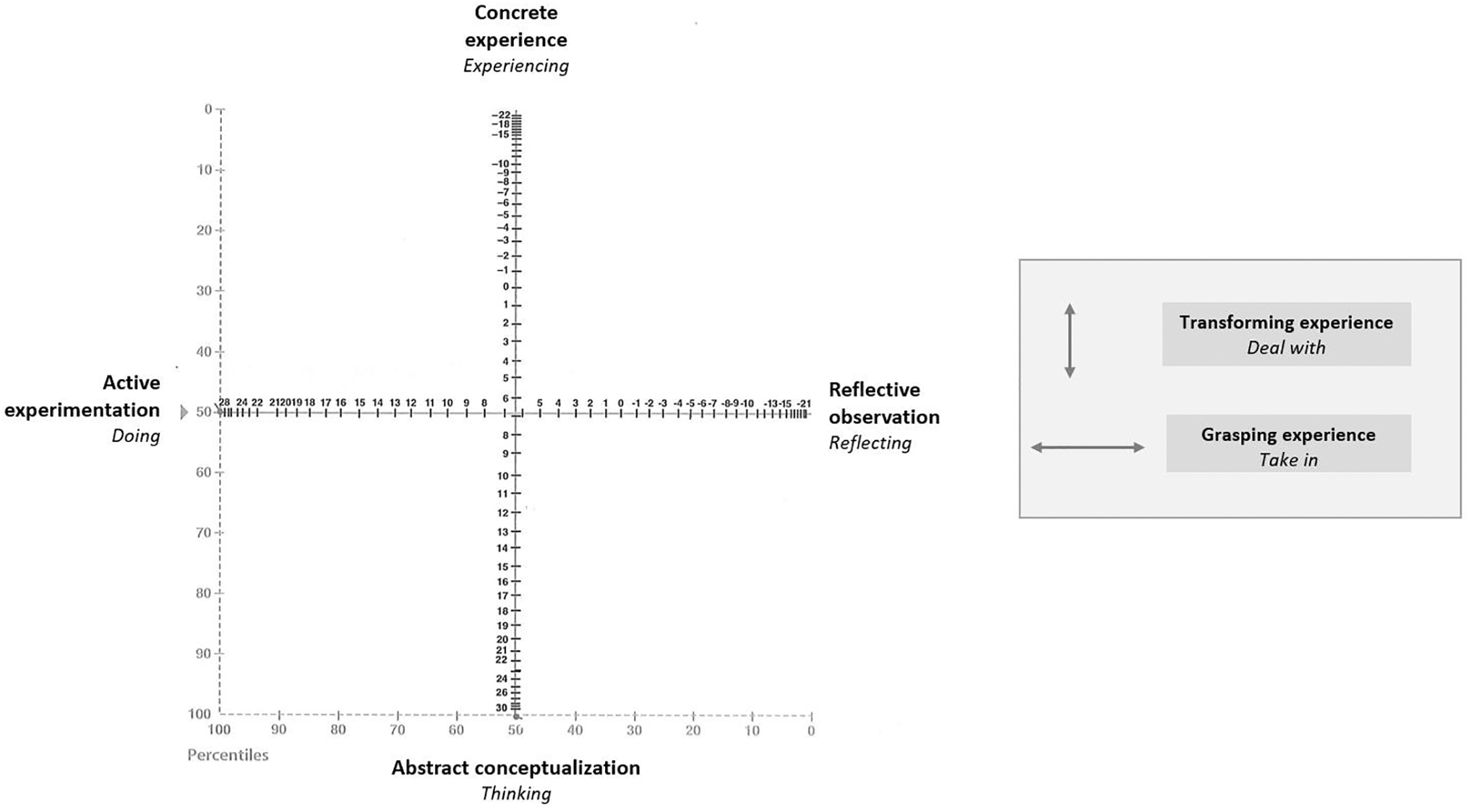
Learning styles dimensions. The vertical axis represents how students take in experience (i.e., how they grasp it), whereas the horizontal axis represents how students deal with experience (i.e., how they transform it).
Shen et al.'s results 22 indicated that, in addition to the UTAUT determinants, students' intention to use IVR in education was significantly influenced by their orientation toward CEs. The authors suggested that, by watching a short introductory video showing application examples of IVR, students could recognize the educational potential of IVR in providing interactive and tangible experiences. As a result, students' inclination toward this learning mode had a significant impact on their intention to utilize IVR.
Our study aimed to confirm Shen et al.'s findings 22 on the role of the UTAUT determinants and of students' learning styles on their intention to use IVR. Furthermore, building upon their results, showing the significant influence of students' orientation toward CEs on their intention to use IVR, our study aimed to delve into the potential of IVR as a tool for knowledge construction by further considering the role of students' perceptions of the learning affordances offered by IVR. These affordances are indeed expected to resonate with students' desire for active and engaging forms of learning, supporting their constructivist approach to knowledge acquisition. Finally, recognizing the novelty of the technology, we investigated the potential influence of a personal inclination toward embracing new technologies and seeking innovative experiences, defined as personal innovativeness (PI). 25 PI has repeatedly emerged as a significant determinant in technology adoption studies especially in the context of IVR and Metaverse applications.23,24
First, we hypothesize that PE, EE, SI, and FC would positively affect students' intention to use IVR. Furthermore, considering that a unique feature of IVR technology is to provide opportunities for students to engage in immersive and experiential contexts, 22 we predicted that students with a preference for CEs and AE, along with those valuing IVR affordances, would have a higher intention to use IVR. Finally, drawing upon previous literature 19 indicating that PI influences the intention to adopt new technologies, we posited that students with a higher level of PI would be more inclined to embrace IVR.
Methods
Participants
Students' invitations to participate in the study were published on online platforms and social media of some universities in Lombardy (Italy). A total of 395 Italian university students participated in the study, but only 359 completed the survey and were considered for analysis. Participants were screened for the frequency of use of IVR systems. They had to indicate how often they used IVR for entertainment or education, using two items rated on a five-point Likert scale ranging from 1 “Never” to 5 “Daily.” Mean scores of participants' use of IVR for entertainment and education were computed. Participants who reported a score higher than two were excluded. Indeed, although IVR usage is growing, it is still not widely prevalent. Recent reports revealed that the top use case of VR headsets is gaming and, in Italy, only 4.2 percent of video gamers above the age of 16 use them.26,27
This statistic highlights that IVR adoption is not mainstream, and only a minority have used this technology. By targeting individuals with limited exposure to IVR, our study aimed to capture a more representative segment of the population. A total of 324 university students (gender: 256 female, 68 male; age: 21.8 ± 2.18 years) were included in the analyses. In contrast to Shen et al.'s study, 22 which primarily included participants from the management, engineering, and science fields, our sample primarily consisted of students from the social science field (81.48 percent from the psychology faculty). The Local Ethics Committee of the Psychology Department of the University of Milano-Bicocca approved the study. All participants provided informed consent. Ethical Approval Number: RM 2020-247.
Measures
Students' attitudes toward IVR for learning were measured using an Italian-adapted version of the UTAUT items used by Shen et al. 22 The scale measures PE, EE, SI, FC and BI.
Learning styles were measured using an Italian-adapted version of Kolb's Learning Style Inventory. 28 Participants were presented with 12 incomplete statements presenting different learning situations. Four options could complete each statement, and participants had to rank-order them according to their learning preferences. Each option corresponds to one of the four learning modes indicated by Kolb 28 : CE, RO, AC, and AE. Following the scoring procedure, these results were used to determine how participants usually take in experience and how they deal with experience. Lower values in the TE axis indicate that a person prefers to engage in first-person hands-on activities and CEs, whereas higher values indicate that a person privileges an intellectual understanding of the experience and AC. On the contrary, lower values in the DE axis suggest that a person prefers to focus on RO of the sensations and behaviors emerged from experience, whereas higher values reveal that a person prefers to test knowledge and skills acquired in new situations through AE. The axis and values are given in Figure 1.
Affordances Perceptions (AP) were measured using four ad hoc questions designed to assess students' beliefs about the importance of each learning opportunity offered by IVR. 7 A principal component analysis (varimax rotation) revealed one significant component explaining 49.5 percent of the variance. The values of each item on the single component are given in Table 2. The mean scores of the four items were used as a continuous variable in the analyses.
PI was measured using a four-item Italian-adapted scale from Agarwal and Prasad, 25 previously used to measure the propensity to use new technologies. 19
Component Loadings of the Affordances Perceptions Items
Table 3 reports the items and reliability values of the continuous variables included in the questionnaire (all except the learning styles), examined using Cronbach's alpha.
Continuous Variables' Reliability Analysis
IVR, immersive virtual reality; VRH, Virtual Reality Head-Mounted Display.
Procedure
All participants were asked to complete an online survey in Qualtrics investigating their attitude toward IVR as an educational tool. Given that we were interested in investigating nonexperts' attitudes but their limited knowledge of the technology could prevent them from answering knowingly, following Shen et al.'s approach, 22 participants were presented with a slide-based video with a pre-recorded voice describing IVR and its possibility to deliver interactive and immersive hands-on experiences on a variety of topics. Our video was designed to demonstrate major IVR capabilities and academic applications in a concise manner, providing students with the same type of basic theoretical knowledge. The script of the video is given in Table 4. The estimated time to complete the survey was 30 minutes.
Video Script on the Use of Virtual Reality Presented to Participants
Results
Associations among learning styles, PI, affordances, and acceptance
Table 5 provides descriptive data and correlations among variables. All the variables correlated with students' BI to use IVR. The strongest positive correlations were found with the other factors of the UTAUT model, including PE, EE, SI, and FC. Therefore, the more students perceive IVR as useful and effortless, and the more they believe that significant others support its use and that they can find help with its application, the more they are open to use IVR for learning.
Pearson Correlation Analysis
p < 0.05; **p < 0.01; ***p < 0.001.
Both dimensions of learning styles, TE and DE, correlated with BI, negatively and positively, respectively, meaning that students who prefer to learn by CEs and AE are more committed to learning with IVR than students who are more oriented to AC and RO. AP positively correlated with BI, meaning that the more the students valorize an active construction of knowledge in their learning process, the more they intend to use IVR for learning. Finally, PI showed a positive correlation with BI meaning that students who are more open to try out new technologies are more willing to use IVR for learning.
Predictors of students' intention to use IVR
To identify the predictors of students' intention to use IVR for learning (BI), we run a hierarchical multiple regression model in which the UTAUT dimensions (PE, EE, SI, and FC) (Step 1), learning styles (TE and DE) (Step 2), AP (Step 3), and PI (Step 4) were sequentially entered as predictors of BI. The results of the hierarchical multiple regressions are reported in Table 6. Step 1 showed that UTAUT's factors explained 35 percent of the variation of BI. Specifically, BI was mostly predicted by PE (β = 0.381), followed, respectively, by FC (β = 0.287), EE (β = 0.251), and SI (β = 0.174). In Step 2, adding LS to the model allowed explaining an additional 1 percent of the variation of BI.
Hierarchical Multiple Regression Analysis
p < 0.05; **p < 0.01; ***p < 0.001.
Among the two axes of learning styles, only TE (β = −0.012) significantly predicted BI. In Step 3, adding AP (β = 0.167) explained an additional 1 percent of the variation. Step 4 revealed that adding PI (β = 0.095) again allowed explaining an extra 1 percent of the variation in BI.
Discussion
Our study aimed to confirm and extend the findings of Shen et al. 22 by adopting a different approach to explore the unique contributions of the UTAUT dimensions, students' learning styles, and additional individual factors (affordances perceptions [AP] and PI) on students' intention to adopt IVR.
Results confirmed past evidence 29 about the robustness of the UTAUT model with PE, EE, SI, and FC, explaining a large proportion of BI variance (35 percent). In addition, our findings showed that learning styles explained BI, however little (1 percent) but that only TE significantly predicted BI. These findings are in line with previous research. 22 Given that IVR's main potential is to engage users in interactive and multisensory environments, students more oriented toward learning through CEs are more intentioned to adopt IVR in their learning programs. This idea is further supported by the result showing that students' perceptions of IVR affordances explain an extra 1 percent of the BI variance. This means that valuing IVR learning affordances in one's educational process has a significant, although small, role in students' intention to use IVR for learning.
We reasoned that those students who usually prefer experiential and active forms of learning may have grasped from the brief video the potential of this technology to promote learning activities more akin to their learning mode. Finally, in line with previous works,30–33 results confirmed that PI predicts BI, meaning that being more open to try new technologies positively impacts the intention to use IVR as an educational tool, even if it adds only a little contribution (1 percent) to the model.
Limitations and future research
This study has some limitations, and it is important to acknowledge that other factors may influence students' attitudes toward IVR.
First, our gender-unbalanced and limited age range sample may limit the results' generalizability. Future studies should explore the role of these factors as well as socioeconomic status, which can impact technology accessibility, and affordability, in shaping attitudes toward technology.
Second, although our study differed from Shen et al.'s research 22 as it primarily involved psychology students, future studies should aim to include participants from various faculties allowing for a more diverse sample that can capture a wider range of perspectives and experiences.
Furthermore, our study focused on students who were new to IVR technology, providing insights into the early stages of acceptance. Therefore, future research could make use of expectation confirmation models34,35 to explore the impact of real immersive experiences on pre- and postadoption beliefs.
In addition, researchers should be aware that other dispositional factors, such as personality trait 36 and cognitive styles, 37 and other social and contextual factors, 38 may influence technology adoption and should therefore be considered.
Practical implications
Our findings suggest that the UTAUT factors alone explain much of the variance of students' intention to use IVR in education, whereas individual factors explain it only marginally. This result is encouraging as it suggests that IVR could be introduced to a wide range of learners if proper support is offered and the educational potentialities are adequately illustrated. Therefore, educators should focus on promoting the value of IVR technology while providing adequate support to address students' concerns. Indeed, given the technology's novelty, students are likely to have little or no experience with IVR (as in our sample) and may not be fully aware of its possible applications in education. Instructional designers can tailor educational materials and experiences to align with students' learning styles and preferences, leveraging IVR's potential for interactive and hands-on learning.
Technology developers can design user-friendly IVR systems and interfaces, considering students' ease of use and incorporating features that enhance the educational value of the technology. These practical implications can guide stakeholders in effectively integrating IVR into educational settings and maximizing its benefits for student learning. Moreover, integrating IVR effectively into specific educational contexts requires tailored infrastructure, educator training, and context-specific contents. Indeed, tailoring IVR to specific subjects requires collaboration between educators and developers, ensuring that content and design align with the curriculum. Different subjects, like history versus physics, demand varied IVR designs. Continuous feedback from all stakeholders will be key to ensure systems are both pedagogically sound and user-friendly.
Conclusions
The new educational landscape offered by the Metaverse, and the technologies involved in its creation, such as IVR, have been under discussion. Although IVR should not be considered a synonym of Metaverse, 39 many educational applications conceived from a Metaverse perspective are designed to be experienced with immersive technologies. For this reason, it is crucial to conduct research on IVR applications to assess their effectiveness and applicability in educational contexts.
The wide range of possibilities offered by “Eduverse” 40 immersive technologies (virtual lectures, collaborative projects, simulations, virtual tours, etc.) is leading to the development of new IVR affordances, 41 such as embodiment, interactivity, navigability, sense-ability and create-ability, which should be investigated further.
Footnotes
Author Disclosure Statement
The authors declare no conflict of interest in the work reported here.
Funding Information
No funds, grants, or other support were received for this article.